
OMR BNY Mellon Continental European Opportunities (Responsisble) Pn
SRI Style:
Sustainability Tilt
SDR Labelling:
-
Product:
Pension
Fund Region:
Europe ex UK
Fund Asset Type:
Equity
Launch Date:
02/06/2003
Last Amended:
Aug 2026
Dialshifter ( ):
Fund/Portfolio Size:
£m
ISIN:
GB0033147421, GB0033187559
Objectives:
The Fund aims to achieve capital growth over the long term (5 years or more)
Sustainable, Responsible
&/or ESG Overview:
The Fund aims to achieve capital growth over the long term (5 years or more). It does so by investing mainly in a concentrated portfolio of shares issued by continental European companies. While pursuing its investment objective, the Fund invests a minimum of 70% of its portfolio in company shares with sustainability (i.e. positive environmental and/or social) characteristics.)
Primary fund last amended:
Aug 2026
Information directly from fund manager.
Fund Filters
Sustainability - General
Has policies that consider (environmental and social) sustainability issues. Strategies vary but are likely to consider environmental issues like climate change, carbon emissions, biodiversity loss, resource management, environmental impacts; and social issues like equal opportunities, human rights, labour standards, diversity and adherence to internationally recognised codes. See individual entry information.
Aim to encourage higher sustainability standards through responsible ownership / stewardship / engagement / voting activity
Use the UN Global Compact to inform or help direct where they can or cannot invest. Will typically not invest in companies with significant breaches (low standards) - strategies vary. (The UNGC covers a wide range of issues - search 'UNGC'). See https://unglobalcompact.org/
Aim to support the shift to a sustainable future. See eg https://www.transitionpathwayinitiative.org/
Environmental - General
Options that limit or 'reduce' their exposure to carbon intensive industries (ie sectors which are major contributors to climate change). Strategies vary.
Climate Change & Energy
Avoid companies involved in fracking and tar sands - which are widely regarded as controversial methods of oil and gas extraction. Strategies vary.
Avoid companies that are involved in extracting oil from the Arctic regions.
Avoid investing in companies / assets with coal, oil and gas reserves. See individual entry information for further details.
Encourage the transition to lower carbon activities through asset selection and / or responsible ownership activity.
Will only invest in companies that report greenhouse gas emissions in line with this international reporting framework. See https://www.fsb-tcfd.org/ https ://www.ifrs.org/sustainability/tcfd/
Social / Employment
All mining companies excluded
Ethical Values Led Exclusions
Companies are excluded if they are involved in any aspect of the production chain for tobacco products, including cigarettes, vaping, e-cigarettes, chewing tobacco and cigars.
Excludes companies which make controversial weapons such as landmines, cluster munitions and chemical weapons.
Does Not exclude companies with military contracts - this may include medical supplies, food, safety equipment, housing, technology etc.
Avoids companies that produce alcohol. Strategies vary; some may allow a small proportion of revenue to come from this area.
Avoids companies with significant involvement in the gambling industry. Some may allow a small proportion of revenues to come from this area.
Avoids companies that derive significant income from pornography and related areas. Strategies vary.
Gilts & Sovereigns
Does not invest in / excludes 'sovereigns' - debt issued by governments. See eg https://www.investopedia.com/terms/s/sovereign-debt.asp
Banking & Financials
Can include banks as part of their holdings / portfolio.
Invests in financial instruments (cash, derivatives and / or foreign exchange) issued by banks. Strategies vary.
May invest in insurance companies.
Governance & Management
Avoids investing in companies with poor governance practices.(e.g. board structure, management practices etc.) Views may however vary on what counts as 'poor' practices - and funds may not immediately divest as they may prefer to work to encourage higher standards.
Exclude companies that are subject to United Nations sanctions. See eg https://main.un.org/securitycouncil/en/content/un-sc-consolidated-list
Aim to encourage higher ESG standards through responsible ownership / stewardship / engagement /voting activity
Asset Size
Invests in a combination of small, medium and larger (potentially multinational) companies / assets.
How The Fund/Portfolio Works
Has principle 'ethical approach' to avoid companies by using negative screening criteria. Strategies vary.
Makes stock selection (and ongoing management) decisions based on ESG data or company ratings (normally supplied by third parties) rather than focusing on what individual companies do, how they operate or their plans for the future
Investment selection process uses internationally agreed 'norms' (e.g. United Nations Global Compact - UNGC - or the UN Sustainable Development Goals - SDGs) alongside additional SRI criteria such as positive or negative stock selection policies and/or stewardship strategies.
Considers both the 'positive' and 'negative' aspects of company behaviour and makes balanced, considered decisions as part of their investment approach. May apply to a range of different issues and policy areas.
Uses internationally agreed standards, conventions and 'norms' to help direct investment decisions (e.g. the UN Global Compact, UN Sustainable Development Goals).
Publish explanations of their ethical, social and/or environmental policies online (i.e. investment decision making strategies/ buy/sell &/or asset management strategies).
Does not use stock lending for performance or risk purposes.
Unscreened Assets & Cash
May invest in assets that have not passed its usual sustainability criteria or screening standards in order to help manage investment risk. This may be limited or significant. Strategies vary.
Fund Management Company Information
About The Business
Find fund / asset management companies that are smaller or specialise in particular areas - notably, ideally ESG related. Strategies vary.
Finds fund / asset management companies that have a published company wide stewardship, engagement and / or responsible ownership policy or strategy that covers all investments. Stewardship typically involves encouraging higher ESG standards through voting and dialogue.
Find fund / asset management companies that actively encourage higher 'environmental, social and governance' and / or 'sustainable and responsible investment' practices across investee companies - typically where the aim is to encourage positive change that is aligned with the best interests of investors. Strategies vary. See additional information and options.
Find fund / asset managers that vote all* the shares they own at Annual General Meetings and Extraordinary General Meetings. A commitment to voting shares is a key indicator of 'responsible share ownership' demonstrating their support for or disagreement with management policy. (*situations can legitimately, occasionally occur where voting proves impossible, but in principle all shares should be voted.)
Find options run by managers that apply Responsible ownership or 'Stewardship' policies to all or most of their investment assets. This means active involvement (e.g. voting, dialogue) with the companies across all or most funds, products and services.
Find fund / asset management companies that consider environmental, social and governance (ESG) issues when deciding whether or not to invest in a company for all / almost all of their funds and other assets. This is increasingly seen as part of sound risk management.
Finds organisations / fund managers that have an in-house (company wide) diversity improvement programme - meaning that they are working to ensure that within their own businesses they employ people from diverse backgrounds - often typically focused on ethnicity and/or sex.
Fund / asset manager has information on their website that explains how they treat 'vulnerable clients' (as set out in FCA regulation)
Collaborations & Affiliations
Find fund / asset management companies that have signed up to the UN backed 'Principles of Responsible Investment'.
Find fund / asset management companies that are members of UKSIF - the UK Sustainable Investment and Finance association
Fund management entity is a member of the Investment Association https://www.theia.org/
Resources
Find fund / asset management companies that employ people to steer and support fund managers in voting shares at company AGM's and EGMs in ways that are consistent with encouraging higher ESG/sustainability standards.
Find a fund / asset management company that directly employs specialist ESG/SRI/sustainability researchers or analysts. This allows asset managers to discuss environmental, social and governance risks and opportunities directly with companies.
Find fund / asset management companies that makes use of expert external research companies. This can help deliver specialist expertise and means resources are pooled with other investors.
Accreditations
Find fund / asset managers that are signatories to the FRC UK Stewardship Code, which sets out a framework for constructive investor / investee relations where managers are encouraged to behave like responsible, typically longer term 'company owners'.
Engagement Approach
Find fund / asset management companies that regularly initiate or run industry wide (collaborative) investor projects aimed at raising environmental, social and governance standards amongst investee companies.
Fund / asset manager has stewardship /responsible ownership strategy that is focused on addressing climate change with investee assets.
Fund / asset manager has a stewardship /responsible ownership strategy that involves working with fossil fuel companies on climate change related issues. See fund manager website for details.
The fund / asset manager has a responsible ownership / stewardship strategy that focuses on biodiversity and nature issues relating to the assets they invest the aim of which will be to reduce harm and or deliver improvement. Strategies vary. https://tnfd.global
Fund / asset manager has a responsible ownership / stewardship strategy which means they are working to encourage the shift to more sustainable business practices in ways that respect and are sensitive to social issues and the impact change has on people effected by the changes that are taking place. https://www.transitionpathwayinitiative.org/ https://transitiontaskforce.net/
Fund / asset manager has responsible ownership / stewardship strategy in place which aims to address human rights issues in investee companies (and potentially their suppliers) with the aim of raising standards
Fund / asset manager has responsible ownership / stewardship strategy in place that aims to improve labour standards for the benefit of employees in investee companies (and potentially their suppliers)
Fund / asset management company has a stewardship strategy in place which involves working to raise diversity, equality and inclusion standards across investee assets
Fund / asset manager is working with the assets they hold to help stamp out modern slavery - where direct or indirect company employees are exploited for business benefits.
Fund / asset managers have stewardship strategies in place that focus on improving governance standards across investee assets
Fund / asset manager has stewardship strategy in place which involves discussing mental health issues with investee companies - with the aim of raising standards
Has a stewardship / responsible ownership strategy that encourages responsible supply chain - ie the managers will discuss environmental, social and governance issues with investee companies with the aim of raising standards
Escalation policies describe how a manager will proceed if stewardship / engagement activity is not successful in the short term.
Climate & Net Zero Transition
Fund / asset management organisations that have pledged to reduce their greenhouse gas emissions to ‘net zero’. Strategies vary - this area is changing rapidly.
This fund / asset management company has set a date by which they plan to achieve net zero greenhouse gas / CO2e emissions.
Find fund / asset management companies that are working with the companies they invest in to encourage reductions in carbon dioxide and other greenhouse gas emissions.
Finds organisations / fund managers that have a company wide carbon transition plan - meaning that they have plotted a path to how they will move away from activities that produce or use carbon based energy sources (that emit greenhouse gases) towards clean, alternative, renewable energy sources.
Finds organisations / fund management companies that are in the process of working out how to make a ‘net zero commitment’ - meaning that when that is finalised they will have started the process of reducing their total greenhouse gas emissions to 'zero'.
See https://sciencebasedtargets.org/
Transparency
Find fund / asset management companies that publish a report detailing their responsible investment ownership - also known as 'Stewardship' - activity.
Find fund / asset management companies that publish information about their sustainable and responsible investment strategies on their company website.
Find fund / asset management companies that will supply information about their sustainable and responsible investment activity on request.
Fund / asset management companies that publish a full record of how they vote their shares at AGMs (annual general meetings) and EGMs (extraordinary general meetings). Voting strategies have an important role to play encouraging higher environmental, social and governance standards.
This fund / asset management company has published a plan that explains how they are going to achieve net zero greenhouse gas / CO2e emissions.
Comments
Please note:
- Controversial weapons avoidance policy (AFM company wide): Our policy is to exclude manufacturers of the following weapons: anti-personnel mines, cluster munitions, chemical weapons, biological weapons, nuclear weapons, Incendiary weapon, non-detectable fragment, blinding laser weapons, white phosphorus weapons, depleted uranium weapons.
- Net Zero Asset Managers (NZAM) signatory - Our UK legal entity, Newton Investment Management (NIM), is a signatory to the Net Zero Asset managers (NZAM) initiative.
Sustainable, Responsible &/or ESG Policy:
Sustainable investment philosophy
We consider sustainable investment to be about investing with a clear intent to deliver environmental and/or social outcomes alongside generating a financial return. The strategies that follow the Newton sustainable investment framework seek to balance financial, social and environmental outcomes to support long-term shareholder returns.
Sustainable investment framework
This framework is focused on two main components: defining what is incompatible with a sustainable universe --‘sustainable investment restrictions’ and defining what constitutes a sustainable investment. The latter rests on an approach that focuses on key sustainable investment themes with underlying sustainable activities and how an investment is connected with this – through alignment or contribution measures.
Sustainable investment universe
The portfolio manager is responsible for applying the Newton sustainable investment framework and ensuring that the security is eligible following a review which is documented. The review determines whether the investment contributes towards one or more of the Newton sustainable investment themes (sustainable contributors) or demonstrates strong environmental and/or social practices that align with one or more of the Newton sustainable investment themes (sustainable aligners).
Sustainable contributors: These are companies that provide solutions (products and services) that address the most pressing environmental or social challenges. Our sustainable investment framework is applied through a series of measures, such as revenues from products relating to Renewable and low-carbon energy sources, resource efficiency, affordable housing, medical technology and healthy eating. As a measure of their contribution, each sustainable contributor must have at least 30% revenue exposure (in aggregate) from one of more of the sustainable activities, as defined in the sustainable investment framework, or have at least 30% capital expenditure (CAPEX) or operational expenditure (OPEX) aligned to the EU Taxonomy.
Sustainable aligners: These are companies that manage to a high standard the social and environmental issues relating from their direct operations and supply chains as well as integrate sustainability priorities into their business strategy. This is primarily about the internal management of a company’s operations and supply chain where we seek to invest in leaders or best-in-class industry players. Companies that integrate sustainability into their business strategy have committed explicitly to improving their environmental and social impacts by reducing negative externalities that is expected to lead to a transformation of their business models. The outcome of this mitigation and transformation of the negative externality results in a meaningful positive outcome for society and/or the environment.
These two classifications are guided by frameworks, developed, and maintained by the Newton RI team, ensuring robustness and consistency in order to identify the suitable sustainable investment propositions. The overall framework is reviewed regularly and may evolve over time with Newton’s own thinking as well as with regulatory development.
Sustainable investment restrictions*
The sustainable investment restrictions mainly seek to avoid investments in areas of significant social or environmental harm. These restrictions cannot be overridden.
Here we seek to avoid investments involved in areas of high negative externalities, those that cause significant long-term societal harm, investments that have been identified as having severe controversies and/or violating one or more of the ten UN Global Compact Principles covering areas including human rights, labour practices, corruption and the environment. We do not believe that exposure to such activities is aligned with our sustainable investment framework.
To identify these companies, we use a combination of external service providers including Bloomberg, ISS, RepRisk, CDP and Factset to inform our decisions. The sustainable investment restrictions are hard coded into the Newton trade process and any potential violations are caught in the pre-trade compliance checks. Revenue threshold parameters applied through these restrictions reflect just one part of our sustainable investment framework – a key part of this process is the additional research
and analysis conducted by the investment team.
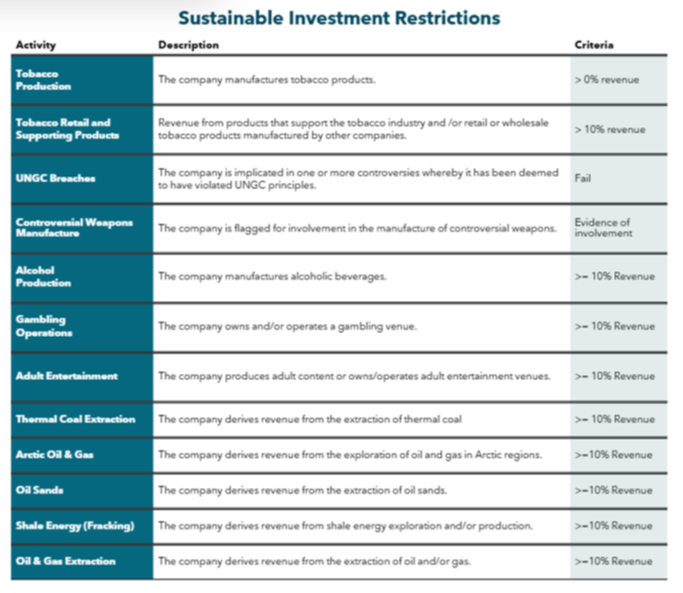
Note: 1 Some strategies following the Newton Sustainable Investment process may choose to add to these exclusions – but may never subtract.
Source: Newton, 30 January 2025.
However, please note: revenue threshold parameters reflect just one part of our sustainable investment process – a key part of this process is the additional research and analysis conducted by the investment team.
Our process seeks to clearly distinguish between activities that are subject to hard exclusions versus those activities that sustainability portfolio managers may be able to invest in in certain circumstances (precautionary pool).
Precautionary pool
For areas that have been identified as having controversies or the potential to cause harm (such as fossil fuels other than thermal coal, animal welfare, conventional defence and nuclear power) but are not covered by the sustainable investment restrictions, portfolio managers are alerted, when considering such investments, to review the controversial activity through what is referred to as the 'precautionary pool'. The precautionary pool includes companies that have been flagged in relation to their involvement in heavy-emitting industries, hold exposures to activities that are restricted, but at lower revenue thresholds, and areas such as nuclear power and animal welfare, where there may be nuances in the investment case that are deemed important to be highlighted.
The full list of activities caught currently under the precautionary pool is included below:
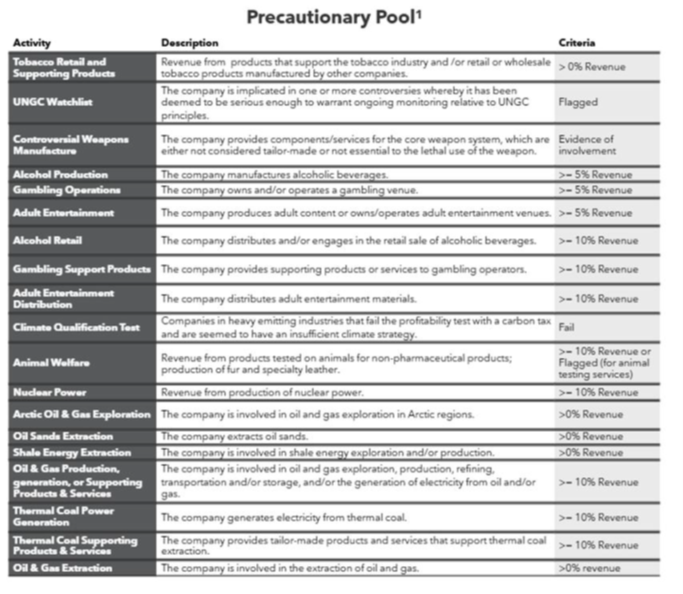
Note: 1 The RI team maintains a list of companies that are tagged under the ‘precautionary pool. Portfolio managers are alerted to this pool in the sustainable investment documentation portal (the Newton ‘RI App’). The portfolio managers are encouraged to work with the RI adviser assigned to the portfolio, to ensure that the managers are comfortable that the investment is not in conflict with the objectives of their strategy.
Source: Newton, 30 January 2025.
Governance
Issuers with exposure to areas captured under the precautionary pool are considered to be part of the investment universe, but portfolio managers considering such investments are alerted and encouraged to review the activity in consultation with the Newton responsible investment (RI) team (specifically an RI adviser), to ensure that the portfolio managers are comfortable that this investment is not in conflict with the objective of their strategy. Holdings of strategies that follow the Sustainable investment
process are regularly reviewed at the sustainable investment forum (SIF).
The SIF has been established as an oversight group to monitor our strategies with sustainability characteristics. The role of the SIF is to:
- Conduct a review of existing and new holdings against portfolio objectives (where those objectives specifically reference sustainability), our investment framework for the sustainable strategy range and any regulatory standards.
- Foster debate by bringing together a wider set of sustainability experts within the business.
- Provide support by educating, training and sharing knowledge and insights among the investment team.
Resources, Affiliations & Corporate Strategies:
The Newton responsible investment team is headed by Rebecca White. This team is the centre of excellence for all matters related to responsible investment, and with its deep functional knowledge of the responsible investment space and how it is evolving, it provides guidance, support and subject-matter expertise to our wider investment team. Individuals within the team possess crucial understanding of and related skills in, corporate governance, sustainability, stewardship and analytical investment research. The team is focused on the delivery of investment, client and sustainability outcomes. This is achieved through our work across research and integration, engagement, partnering with sustainability and charity managers on the frameworks for and delivery of client mandates, and with BNY Investments in voting execution.

In many ways, we have a decentralised RI set up, whereby we have focused dedicated RI team, though individuals have a deep understanding of investments, and are enabled to focus on this, and held accountable to being high impact in this regard. We are supported by several teams across Newton and BNY Investments, who have a strong understanding of, or background in, Responsible Investment, and who advocate for the team and enable it to be successful.
The RI team is a fully integrated unit within the investment management function, reporting to the Head of Investment Research. The team operates closely with investment analysts and portfolio managers as part of Newton’s multidimensional research approach, contributing daily to investment discussions and thematic research. This deeply integrates RI into Newtons investment approach, whilst enabling focused specialist research, company dialogue and engagement on material environmental, social, and governance matters.
Structured training and development are key components of Newton’s ESG integration. The RI team facilitates ongoing training sessions covering internal practices, product ranges, emerging regulations, and topical ESG issues such as climate transition commitments and biodiversity. These sessions target investment teams and broader groups, combining formal group training, informal updates, external expert insights, and hands-on learning through research trips and knowledge series. This continuous education ensures that investment professionals are equipped to assess and integrate ESG factors effectively, supporting the firm’s commitment to responsible investment and stewardship.
The Newton RI team is supported by teams at Newton’s parent company, BNY Investments. It has two dedicated teams at the group level: one focused on proxy voting and governance, and another on sustainability. Former Newton RI colleagues are now a key part of these central teams and continue to provide support to Newton. This ensures a consistent understanding of Newton’s approach. These central teams support the delivery of operational components of RI and allow Newton to focus on investment outcomes. We also work closely with the BNY Investments Data and Analytics team, which includes RI-focused resource, who support Newton via maintaining and evolving quantitative processes, oversight, and the development of tools.
Finally, Newton’s sustainable, responsible and charity portfolio managers can be viewed as an extension of the RI team. These portfolio managers have a depth of expertise in sustainability topics, client expectations, and embrace the spirit of integration and debate that we strive for, within RI and across our investment platform more broadly.
The team continually enhances its own understanding of existing and emerging areas of responsible investment interest. This enables the team to provide continuing expertise internally as well as to contribute to the ongoing development of thinking within the industry.
Newton is a PRI signatory. Our 2024 PRI ratings (for the 2023 calendar year) can be accessed through the PRI transparency and assessment reports available on the Newton website (https://www.newtonim.com/uk-institutional/responsible-investment/)


ESG Governance
Issuers with exposure to areas captured under the precautionary pool are considered to be part of the investment universe, but portfolio managers considering such investments are alerted and encouraged to review the activity in consultation with the Newton responsible investment (RI) team (specifically an RI adviser), to ensure that the portfolio managers are comfortable that this investment is not in conflict with the objective of their strategy. Holdings of strategies that follow the Sustainable investment process are regularly reviewed at the sustainable investment forum (SIF).
The SIF has been established as an oversight group to monitor our strategies with sustainability characteristics. The role of the SIF is to:
- Conduct a review of existing and new holdings against portfolio objectives (where those objectives specifically reference sustainability), our investment framework for the sustainable strategy range and any regulatory standards.
- Foster debate by bringing together a wider set of sustainability experts within the business.
- Provide support by educating, training and sharing knowledge and insights among the investment team.
Literature
Voting Record
Disclaimer
IMPORTANT INFORMATION
Past performance is not a guide to future performance.
The value of investments can fall. Investors may not get back the amount invested.
Income from investments may vary and is not guaranteed.
For Professional Clients only.
Provided solely for use by Fund Ecomarket.
BNY, BNY Mellon and Bank of New York Mellon are the corporate brands of The Bank of New York Mellon Corporation and may be used to reference the corporation as a whole and/or its various subsidiaries generally.
Issued in the United Kingdom by BNY Mellon Investment Management EMEA Limited, BNY Mellon Centre, 160 Queen Victoria Street, London EC4V 4LA. Registered in England No. 1118580. Authorised and regulated by the Financial Conduct Authority.
Newton global assets under management (AUM) is the combined total assets under management of Newton Investment Management Limited (‘NIM’), Newton Investment Management North America LLC (‘NIMNA’) and Newton Investment Management Japan Limited (‘NIMJ’).
Returns may increase or decrease as a result of currency fluctuations.
Costs incurred when purchasing, holding, converting or selling any investment, will impact returns.
Costs may increase or decrease as a result of currency and exchange rate fluctuations.
Newton manages a variety of investment strategies. How ESG analysis is integrated into Newton’s strategies depends on the asset classes and/or the particular strategy involved. ESG can be one of many inputs into the fundamental analysis. Newton will make investment decisions that are not based solely on ESG analysis. Other attributes of an investment may outweigh ESG analysis when making investment decisions.
*Newton’ and/or ‘Newton Investment Management’ is a corporate brand which refers to the following group of affiliated companies: Newton Investment Management Limited (“NIM”), Newton Investment Management North America LLC (“NIMNA”) and Newton Investment Management Japan Limited ("NIMJ").
Newton’s assets under management include assets collectively managed by NIM, NIMNA and NIMJ. In addition, AUM for Newton includes assets of bank-maintained collective investment funds for which Newton has been appointed sub-advisor, where Newton personnel act as dual officers of affiliated companies and assets of wrap fee account(s) for which Newton provides sub-advisory services to the primary manager of the wrap program.
| Fund Name | SRI Style | SDR Labelling | Product | Region | Asset Type | Launch Date | Last Amended |
|
|---|---|---|---|---|---|---|---|---|
OMR BNY Mellon Continental European Opportunities (Responsisble) Pn |
Sustainability Tilt | - | Pension | Europe ex UK | Equity | 02/06/2003 | Aug 2026 | |
ObjectivesThe Fund aims to achieve capital growth over the long term (5 years or more) |
ISIN: GB0033147421, GB0033187559 |
|||||||
Sustainable, Responsible &/or ESG OverviewThis product is linked to the "BNY Mellon European Opportunities Fund (Responsible)" fund. The following information refers to the primary fund.
The Fund aims to achieve capital growth over the long term (5 years or more). It does so by investing mainly in a concentrated portfolio of shares issued by continental European companies. While pursuing its investment objective, the Fund invests a minimum of 70% of its portfolio in company shares with sustainability (i.e. positive environmental and/or social) characteristics.) |
||||||||
|
Primary fund last amended: Aug 2026 |
||||||||
|
Information received directly from Fund Manager |
||||||||
|
Please select what you would like to read:
Fund FiltersSustainability - General
Sustainability policy
Has policies that consider (environmental and social) sustainability issues. Strategies vary but are likely to consider environmental issues like climate change, carbon emissions, biodiversity loss, resource management, environmental impacts; and social issues like equal opportunities, human rights, labour standards, diversity and adherence to internationally recognised codes. See individual entry information.
Encourage more sustainable practices through stewardship
Aim to encourage higher sustainability standards through responsible ownership / stewardship / engagement / voting activity
UN Global Compact linked exclusion policy
Use the UN Global Compact to inform or help direct where they can or cannot invest. Will typically not invest in companies with significant breaches (low standards) - strategies vary. (The UNGC covers a wide range of issues - search 'UNGC'). See https://unglobalcompact.org/
Transition focus
Aim to support the shift to a sustainable future. See eg https://www.transitionpathwayinitiative.org/ Environmental - General
Limits exposure to carbon intensive industries
Options that limit or 'reduce' their exposure to carbon intensive industries (ie sectors which are major contributors to climate change). Strategies vary. Climate Change & Energy
Fracking & tar sands excluded
Avoid companies involved in fracking and tar sands - which are widely regarded as controversial methods of oil and gas extraction. Strategies vary.
Arctic drilling exclusion
Avoid companies that are involved in extracting oil from the Arctic regions.
Fossil fuel reserves exclusion
Avoid investing in companies / assets with coal, oil and gas reserves. See individual entry information for further details.
Encourage transition to low carbon through stewardship activity
Encourage the transition to lower carbon activities through asset selection and / or responsible ownership activity.
TCFD / IFRS reporting requirement
Will only invest in companies that report greenhouse gas emissions in line with this international reporting framework. See https://www.fsb-tcfd.org/ https ://www.ifrs.org/sustainability/tcfd/ Social / Employment
Mining exclusion
All mining companies excluded Ethical Values Led Exclusions
Tobacco & related product manufacturers excluded
Companies are excluded if they are involved in any aspect of the production chain for tobacco products, including cigarettes, vaping, e-cigarettes, chewing tobacco and cigars.
Controversial weapons exclusion
Excludes companies which make controversial weapons such as landmines, cluster munitions and chemical weapons.
Military involvement not excluded
Does Not exclude companies with military contracts - this may include medical supplies, food, safety equipment, housing, technology etc.
Alcohol production excluded
Avoids companies that produce alcohol. Strategies vary; some may allow a small proportion of revenue to come from this area.
Gambling avoidance policy
Avoids companies with significant involvement in the gambling industry. Some may allow a small proportion of revenues to come from this area.
Pornography avoidance policy
Avoids companies that derive significant income from pornography and related areas. Strategies vary. Gilts & Sovereigns
Does not invest in sovereigns
Does not invest in / excludes 'sovereigns' - debt issued by governments. See eg https://www.investopedia.com/terms/s/sovereign-debt.asp Banking & Financials
Invests in banks
Can include banks as part of their holdings / portfolio.
Invests in financial instruments issued by banks
Invests in financial instruments (cash, derivatives and / or foreign exchange) issued by banks. Strategies vary.
Invests in insurers
May invest in insurance companies. Governance & Management
Avoids companies with poor governance
Avoids investing in companies with poor governance practices.(e.g. board structure, management practices etc.) Views may however vary on what counts as 'poor' practices - and funds may not immediately divest as they may prefer to work to encourage higher standards.
UN sanctions exclusion
Exclude companies that are subject to United Nations sanctions. See eg https://main.un.org/securitycouncil/en/content/un-sc-consolidated-list
Encourage higher ESG standards through stewardship activity
Aim to encourage higher ESG standards through responsible ownership / stewardship / engagement /voting activity Asset Size
Invests in small, mid & large cap companies / assets
Invests in a combination of small, medium and larger (potentially multinational) companies / assets. How The Fund/Portfolio Works
Negative selection bias
Has principle 'ethical approach' to avoid companies by using negative screening criteria. Strategies vary.
Data led strategy
Makes stock selection (and ongoing management) decisions based on ESG data or company ratings (normally supplied by third parties) rather than focusing on what individual companies do, how they operate or their plans for the future
Combines norms based exclusions with other SRI criteria
Investment selection process uses internationally agreed 'norms' (e.g. United Nations Global Compact - UNGC - or the UN Sustainable Development Goals - SDGs) alongside additional SRI criteria such as positive or negative stock selection policies and/or stewardship strategies.
Balances company 'pros and cons' / best in sector
Considers both the 'positive' and 'negative' aspects of company behaviour and makes balanced, considered decisions as part of their investment approach. May apply to a range of different issues and policy areas.
Norms focus
Uses internationally agreed standards, conventions and 'norms' to help direct investment decisions (e.g. the UN Global Compact, UN Sustainable Development Goals).
SRI / ESG / Ethical policies explained on website
Publish explanations of their ethical, social and/or environmental policies online (i.e. investment decision making strategies/ buy/sell &/or asset management strategies).
Do not use stock / securities lending
Does not use stock lending for performance or risk purposes. Unscreened Assets & Cash
Uses unscreened 'diversifiers' to help manage risk
May invest in assets that have not passed its usual sustainability criteria or screening standards in order to help manage investment risk. This may be limited or significant. Strategies vary. Fund Management Company InformationAbout The Business
Boutique / specialist fund management company
Find fund / asset management companies that are smaller or specialise in particular areas - notably, ideally ESG related. Strategies vary.
Responsible ownership / stewardship policy or strategy (AFM companywide)
Finds fund / asset management companies that have a published company wide stewardship, engagement and / or responsible ownership policy or strategy that covers all investments. Stewardship typically involves encouraging higher ESG standards through voting and dialogue.
ESG / SRI engagement (AFM companywide)
Find fund / asset management companies that actively encourage higher 'environmental, social and governance' and / or 'sustainable and responsible investment' practices across investee companies - typically where the aim is to encourage positive change that is aligned with the best interests of investors. Strategies vary. See additional information and options.
Vote all* shares at AGMs / EGMs (AFM companywide)
Find fund / asset managers that vote all* the shares they own at Annual General Meetings and Extraordinary General Meetings. A commitment to voting shares is a key indicator of 'responsible share ownership' demonstrating their support for or disagreement with management policy. (*situations can legitimately, occasionally occur where voting proves impossible, but in principle all shares should be voted.)
Responsible ownership policy for non SRI / sustainable options (AFM companywide)
Find options run by managers that apply Responsible ownership or 'Stewardship' policies to all or most of their investment assets. This means active involvement (e.g. voting, dialogue) with the companies across all or most funds, products and services.
Integrates ESG factors into all / most research (AFM companywide)
Find fund / asset management companies that consider environmental, social and governance (ESG) issues when deciding whether or not to invest in a company for all / almost all of their funds and other assets. This is increasingly seen as part of sound risk management.
In-house diversity improvement programme (AFM companywide)
Finds organisations / fund managers that have an in-house (company wide) diversity improvement programme - meaning that they are working to ensure that within their own businesses they employ people from diverse backgrounds - often typically focused on ethnicity and/or sex.
Vulnerable client policy on website (AFM companywide)
Fund / asset manager has information on their website that explains how they treat 'vulnerable clients' (as set out in FCA regulation) Collaborations & Affiliations
PRI signatory
Find fund / asset management companies that have signed up to the UN backed 'Principles of Responsible Investment'.
UKSIF member
Find fund / asset management companies that are members of UKSIF - the UK Sustainable Investment and Finance association
Investment Association (IA) member
Fund management entity is a member of the Investment Association https://www.theia.org/
Net Zero Asset Managers (NZAM) signatory
Resources
In-house responsible ownership / voting expertise
Find fund / asset management companies that employ people to steer and support fund managers in voting shares at company AGM's and EGMs in ways that are consistent with encouraging higher ESG/sustainability standards.
Employ specialist ESG / SRI / sustainability researchers
Find a fund / asset management company that directly employs specialist ESG/SRI/sustainability researchers or analysts. This allows asset managers to discuss environmental, social and governance risks and opportunities directly with companies.
Use specialist ESG / SRI / sustainability research companies
Find fund / asset management companies that makes use of expert external research companies. This can help deliver specialist expertise and means resources are pooled with other investors. Accreditations
UK Stewardship Code signatory (AFM companywide)
Find fund / asset managers that are signatories to the FRC UK Stewardship Code, which sets out a framework for constructive investor / investee relations where managers are encouraged to behave like responsible, typically longer term 'company owners'. Engagement Approach
Regularly lead collaborative ESG initiatives (AFM companywide)
Find fund / asset management companies that regularly initiate or run industry wide (collaborative) investor projects aimed at raising environmental, social and governance standards amongst investee companies.
Engaging on climate change issues
Fund / asset manager has stewardship /responsible ownership strategy that is focused on addressing climate change with investee assets.
Engaging with fossil fuel companies on climate change
Fund / asset manager has a stewardship /responsible ownership strategy that involves working with fossil fuel companies on climate change related issues. See fund manager website for details.
Engaging on biodiversity / nature issues
The fund / asset manager has a responsible ownership / stewardship strategy that focuses on biodiversity and nature issues relating to the assets they invest the aim of which will be to reduce harm and or deliver improvement. Strategies vary. https://tnfd.global
Engaging to encourage a Just Transition
Fund / asset manager has a responsible ownership / stewardship strategy which means they are working to encourage the shift to more sustainable business practices in ways that respect and are sensitive to social issues and the impact change has on people effected by the changes that are taking place. https://www.transitionpathwayinitiative.org/ https://transitiontaskforce.net/
Engaging on human rights issues
Fund / asset manager has responsible ownership / stewardship strategy in place which aims to address human rights issues in investee companies (and potentially their suppliers) with the aim of raising standards
Engaging on labour / employment issues
Fund / asset manager has responsible ownership / stewardship strategy in place that aims to improve labour standards for the benefit of employees in investee companies (and potentially their suppliers)
Engaging on diversity, equality & / or inclusion issues
Fund / asset management company has a stewardship strategy in place which involves working to raise diversity, equality and inclusion standards across investee assets
Engaging to stop modern slavery
Fund / asset manager is working with the assets they hold to help stamp out modern slavery - where direct or indirect company employees are exploited for business benefits.
Engaging on governance issues
Fund / asset managers have stewardship strategies in place that focus on improving governance standards across investee assets
Engaging on mental health issues
Fund / asset manager has stewardship strategy in place which involves discussing mental health issues with investee companies - with the aim of raising standards
Engaging on responsible supply chain issues
Has a stewardship / responsible ownership strategy that encourages responsible supply chain - ie the managers will discuss environmental, social and governance issues with investee companies with the aim of raising standards
Stewardship escalation policy
Escalation policies describe how a manager will proceed if stewardship / engagement activity is not successful in the short term. Climate & Net Zero Transition
Net Zero commitment (AFM companywide)
Fund / asset management organisations that have pledged to reduce their greenhouse gas emissions to ‘net zero’. Strategies vary - this area is changing rapidly.
Net Zero - have set a Net Zero target date (AFM companywide)
This fund / asset management company has set a date by which they plan to achieve net zero greenhouse gas / CO2e emissions.
Encourage carbon / greenhouse gas reduction (AFM companywide)
Find fund / asset management companies that are working with the companies they invest in to encourage reductions in carbon dioxide and other greenhouse gas emissions.
Carbon transition plan published (AFM companywide)
Finds organisations / fund managers that have a company wide carbon transition plan - meaning that they have plotted a path to how they will move away from activities that produce or use carbon based energy sources (that emit greenhouse gases) towards clean, alternative, renewable energy sources.
Working towards a ‘Net Zero’ commitment (AFM companywide)
Finds organisations / fund management companies that are in the process of working out how to make a ‘net zero commitment’ - meaning that when that is finalised they will have started the process of reducing their total greenhouse gas emissions to 'zero'.
Committed to SBTi / Science Based Targets Initiative
See https://sciencebasedtargets.org/ Transparency
Publish responsible ownership / stewardship report (AFM companywide)
Find fund / asset management companies that publish a report detailing their responsible investment ownership - also known as 'Stewardship' - activity.
Full stewardship / responsible ownership policy information on company website
Find fund / asset management companies that publish information about their sustainable and responsible investment strategies on their company website.
Full stewardship / responsible ownership policy information available on request
Find fund / asset management companies that will supply information about their sustainable and responsible investment activity on request.
Publish full voting record (AFM companywide)
Fund / asset management companies that publish a full record of how they vote their shares at AGMs (annual general meetings) and EGMs (extraordinary general meetings). Voting strategies have an important role to play encouraging higher environmental, social and governance standards.
Net Zero transition plan publicly available (AFM companywide)
This fund / asset management company has published a plan that explains how they are going to achieve net zero greenhouse gas / CO2e emissions. CommentsPlease note:
Sustainable, Responsible &/or ESG Policy:Sustainable investment philosophy We consider sustainable investment to be about investing with a clear intent to deliver environmental and/or social outcomes alongside generating a financial return. The strategies that follow the Newton sustainable investment framework seek to balance financial, social and environmental outcomes to support long-term shareholder returns. Sustainable investment framework This framework is focused on two main components: defining what is incompatible with a sustainable universe --‘sustainable investment restrictions’ and defining what constitutes a sustainable investment. The latter rests on an approach that focuses on key sustainable investment themes with underlying sustainable activities and how an investment is connected with this – through alignment or contribution measures. Sustainable investment universe The portfolio manager is responsible for applying the Newton sustainable investment framework and ensuring that the security is eligible following a review which is documented. The review determines whether the investment contributes towards one or more of the Newton sustainable investment themes (sustainable contributors) or demonstrates strong environmental and/or social practices that align with one or more of the Newton sustainable investment themes (sustainable aligners). Sustainable contributors: These are companies that provide solutions (products and services) that address the most pressing environmental or social challenges. Our sustainable investment framework is applied through a series of measures, such as revenues from products relating to Renewable and low-carbon energy sources, resource efficiency, affordable housing, medical technology and healthy eating. As a measure of their contribution, each sustainable contributor must have at least 30% revenue exposure (in aggregate) from one of more of the sustainable activities, as defined in the sustainable investment framework, or have at least 30% capital expenditure (CAPEX) or operational expenditure (OPEX) aligned to the EU Taxonomy. Sustainable aligners: These are companies that manage to a high standard the social and environmental issues relating from their direct operations and supply chains as well as integrate sustainability priorities into their business strategy. This is primarily about the internal management of a company’s operations and supply chain where we seek to invest in leaders or best-in-class industry players. Companies that integrate sustainability into their business strategy have committed explicitly to improving their environmental and social impacts by reducing negative externalities that is expected to lead to a transformation of their business models. The outcome of this mitigation and transformation of the negative externality results in a meaningful positive outcome for society and/or the environment. These two classifications are guided by frameworks, developed, and maintained by the Newton RI team, ensuring robustness and consistency in order to identify the suitable sustainable investment propositions. The overall framework is reviewed regularly and may evolve over time with Newton’s own thinking as well as with regulatory development. Sustainable investment restrictions* The sustainable investment restrictions mainly seek to avoid investments in areas of significant social or environmental harm. These restrictions cannot be overridden. Here we seek to avoid investments involved in areas of high negative externalities, those that cause significant long-term societal harm, investments that have been identified as having severe controversies and/or violating one or more of the ten UN Global Compact Principles covering areas including human rights, labour practices, corruption and the environment. We do not believe that exposure to such activities is aligned with our sustainable investment framework. To identify these companies, we use a combination of external service providers including Bloomberg, ISS, RepRisk, CDP and Factset to inform our decisions. The sustainable investment restrictions are hard coded into the Newton trade process and any potential violations are caught in the pre-trade compliance checks. Revenue threshold parameters applied through these restrictions reflect just one part of our sustainable investment framework – a key part of this process is the additional research
Note: 1 Some strategies following the Newton Sustainable Investment process may choose to add to these exclusions – but may never subtract. However, please note: revenue threshold parameters reflect just one part of our sustainable investment process – a key part of this process is the additional research and analysis conducted by the investment team. Our process seeks to clearly distinguish between activities that are subject to hard exclusions versus those activities that sustainability portfolio managers may be able to invest in in certain circumstances (precautionary pool). Precautionary pool For areas that have been identified as having controversies or the potential to cause harm (such as fossil fuels other than thermal coal, animal welfare, conventional defence and nuclear power) but are not covered by the sustainable investment restrictions, portfolio managers are alerted, when considering such investments, to review the controversial activity through what is referred to as the 'precautionary pool'. The precautionary pool includes companies that have been flagged in relation to their involvement in heavy-emitting industries, hold exposures to activities that are restricted, but at lower revenue thresholds, and areas such as nuclear power and animal welfare, where there may be nuances in the investment case that are deemed important to be highlighted. The full list of activities caught currently under the precautionary pool is included below:
Note: 1 The RI team maintains a list of companies that are tagged under the ‘precautionary pool. Portfolio managers are alerted to this pool in the sustainable investment documentation portal (the Newton ‘RI App’). The portfolio managers are encouraged to work with the RI adviser assigned to the portfolio, to ensure that the managers are comfortable that the investment is not in conflict with the objectives of their strategy. Governance Issuers with exposure to areas captured under the precautionary pool are considered to be part of the investment universe, but portfolio managers considering such investments are alerted and encouraged to review the activity in consultation with the Newton responsible investment (RI) team (specifically an RI adviser), to ensure that the portfolio managers are comfortable that this investment is not in conflict with the objective of their strategy. Holdings of strategies that follow the Sustainable investment The SIF has been established as an oversight group to monitor our strategies with sustainability characteristics. The role of the SIF is to:
Resources, Affiliations & Corporate Strategies:The Newton responsible investment team is headed by Rebecca White. This team is the centre of excellence for all matters related to responsible investment, and with its deep functional knowledge of the responsible investment space and how it is evolving, it provides guidance, support and subject-matter expertise to our wider investment team. Individuals within the team possess crucial understanding of and related skills in, corporate governance, sustainability, stewardship and analytical investment research. The team is focused on the delivery of investment, client and sustainability outcomes. This is achieved through our work across research and integration, engagement, partnering with sustainability and charity managers on the frameworks for and delivery of client mandates, and with BNY Investments in voting execution.
In many ways, we have a decentralised RI set up, whereby we have focused dedicated RI team, though individuals have a deep understanding of investments, and are enabled to focus on this, and held accountable to being high impact in this regard. We are supported by several teams across Newton and BNY Investments, who have a strong understanding of, or background in, Responsible Investment, and who advocate for the team and enable it to be successful. The RI team is a fully integrated unit within the investment management function, reporting to the Head of Investment Research. The team operates closely with investment analysts and portfolio managers as part of Newton’s multidimensional research approach, contributing daily to investment discussions and thematic research. This deeply integrates RI into Newtons investment approach, whilst enabling focused specialist research, company dialogue and engagement on material environmental, social, and governance matters. Structured training and development are key components of Newton’s ESG integration. The RI team facilitates ongoing training sessions covering internal practices, product ranges, emerging regulations, and topical ESG issues such as climate transition commitments and biodiversity. These sessions target investment teams and broader groups, combining formal group training, informal updates, external expert insights, and hands-on learning through research trips and knowledge series. This continuous education ensures that investment professionals are equipped to assess and integrate ESG factors effectively, supporting the firm’s commitment to responsible investment and stewardship. The Newton RI team is supported by teams at Newton’s parent company, BNY Investments. It has two dedicated teams at the group level: one focused on proxy voting and governance, and another on sustainability. Former Newton RI colleagues are now a key part of these central teams and continue to provide support to Newton. This ensures a consistent understanding of Newton’s approach. These central teams support the delivery of operational components of RI and allow Newton to focus on investment outcomes. We also work closely with the BNY Investments Data and Analytics team, which includes RI-focused resource, who support Newton via maintaining and evolving quantitative processes, oversight, and the development of tools. Finally, Newton’s sustainable, responsible and charity portfolio managers can be viewed as an extension of the RI team. These portfolio managers have a depth of expertise in sustainability topics, client expectations, and embrace the spirit of integration and debate that we strive for, within RI and across our investment platform more broadly. The team continually enhances its own understanding of existing and emerging areas of responsible investment interest. This enables the team to provide continuing expertise internally as well as to contribute to the ongoing development of thinking within the industry. Newton is a PRI signatory. Our 2024 PRI ratings (for the 2023 calendar year) can be accessed through the PRI transparency and assessment reports available on the Newton website (https://www.newtonim.com/uk-institutional/responsible-investment/)
ESG Governance Issuers with exposure to areas captured under the precautionary pool are considered to be part of the investment universe, but portfolio managers considering such investments are alerted and encouraged to review the activity in consultation with the Newton responsible investment (RI) team (specifically an RI adviser), to ensure that the portfolio managers are comfortable that this investment is not in conflict with the objective of their strategy. Holdings of strategies that follow the Sustainable investment process are regularly reviewed at the sustainable investment forum (SIF). The SIF has been established as an oversight group to monitor our strategies with sustainability characteristics. The role of the SIF is to:
LiteratureVoting RecordDisclaimerIMPORTANT INFORMATION Newton manages a variety of investment strategies. How ESG analysis is integrated into Newton’s strategies depends on the asset classes and/or the particular strategy involved. ESG can be one of many inputs into the fundamental analysis. Newton will make investment decisions that are not based solely on ESG analysis. Other attributes of an investment may outweigh ESG analysis when making investment decisions. *Newton’ and/or ‘Newton Investment Management’ is a corporate brand which refers to the following group of affiliated companies: Newton Investment Management Limited (“NIM”), Newton Investment Management North America LLC (“NIMNA”) and Newton Investment Management Japan Limited ("NIMJ"). Newton’s assets under management include assets collectively managed by NIM, NIMNA and NIMJ. In addition, AUM for Newton includes assets of bank-maintained collective investment funds for which Newton has been appointed sub-advisor, where Newton personnel act as dual officers of affiliated companies and assets of wrap fee account(s) for which Newton provides sub-advisory services to the primary manager of the wrap program. |
||||||||