Please note: This section of the database is in beta and still under development
Information received directly from Fund Manager
Last amended date: May 2026
|
Please select what you would like to read:
Fund Management Company Information
About The Business
Collaborations & Affiliations
Resources
Accreditations
Engagement Approach
Company Wide Exclusions
Climate & Net Zero Transition
Transparency
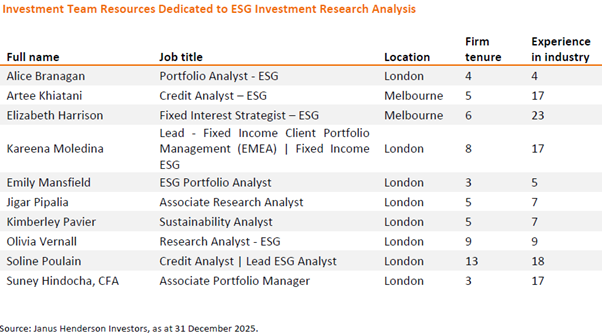
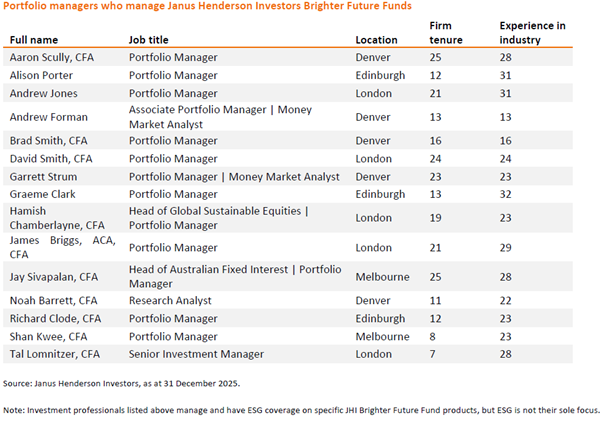
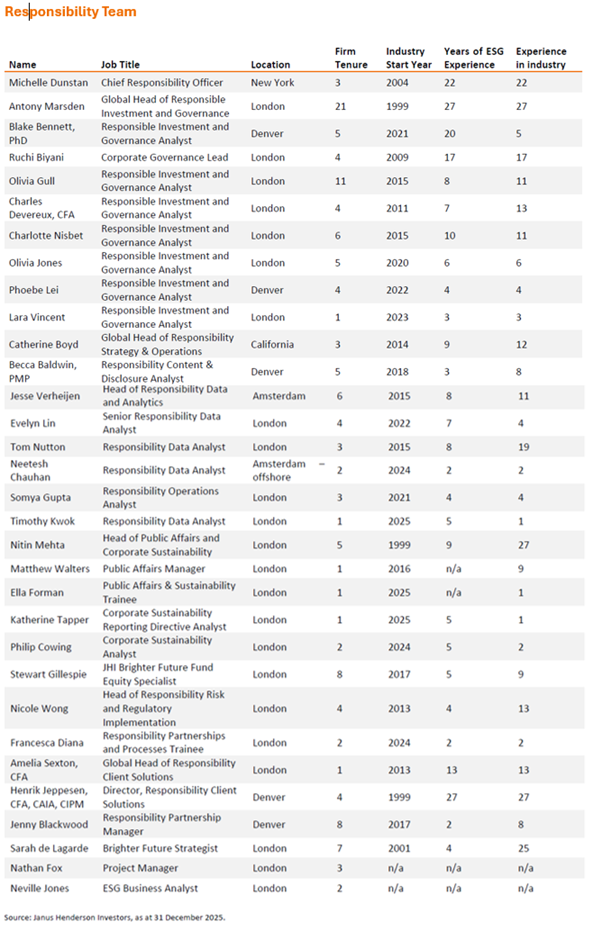
Resources, Affiliations & Corporate Strategies:As at 31 December 2025, Janus Henderson has 32 Responsibility Team resources. This centralised team are our ESG subject-matter experts who partner with our investment teams on ESG. On our investment teams, we have 10 dedicated ESG experts embedded within numerous investment teams. Additionally, we have 15 portfolio managers* on Janus Henderson’s Brighter Future (ESG-focused) Funds. Our portfolio managers are further supported by our central research functions and/or investment team analysts. Source: Janus Henderson Investors, as at 31 December 2025. *Portfolio managers manage multiple strategies, so may not be fully dedicated to ESG-focused products. Note: the methodology to calculate this data has changed and previously included portfolio managers who manage ESG-integrated funds rather than ESG-labelled products.
Janus Henderson has a three-pronged approach to Responsibility.
Janus Henderson’s has had a Responsible Investment Policy since approximately 2001, referring to the legal Henderson policy established at this time. In 2023, we implemented our revised Responsible Investment Policy, which sets out our approach to Responsible Investing and ESG Governance and Oversight. As an active manager, integrating financially material ESG factors into our investment decision-making and ownership practices is fundamental to delivering the results our clients seek from us. Financially material ESG considerations are a key component of the investment processes employed by our investment teams for most of our actively managed strategies. Our investment teams operate and are structured in ways most suited to their respective asset classes. Aside from expectations outlined within our Responsible Investment Policy, the precise approach to and depth of ESG integration is down to the discretion and judgement of our investment teams, who apply their differentiated perspectives, insight and experience to identify sustainable business practices that can generate long-term value for investors. While the evaluation of our implementation of ESG criteria is carried out at the strategy level, our central Responsibility Team supports each team in their ESG integration with data, tools, stewardship, and ESG research.
Engagement and stewardship are integral and natural parts of our long-term, active approach to investment management. We believe engagement is vital to understanding and promoting practices that position the companies and issuers we invest in for future financial success. Our investment teams often partner with our central Responsibility Team on engagements with company management teams. We prefer an engagement-focused approach to a firm-level exclusion or divestment policy for companies and issuers where we have identified financially material ESG risks. We believe this approach is best for maximising risk-adjusted returns for our clients. We have a wide range of engagement themes and topics chosen by individual investment teams or the Responsible Investment and Governance Team, which is part of the broader Responsibility Team. These range from longstanding engagement themes such as climate change and diversity, equity & inclusion, to biodiversity, human capital and culture, health and wellbeing, and sustainable corporate governance. Most products and services offered by a company or issuer play necessary roles for the global economy – including sectors with higher carbon emissions such as energy, industrials, materials, and utilities. Rather than ignoring companies or issuers in these sectors through automatic exclusion or divestment, engagement leads to two benefits:
Stewardship is an integral and natural part of Janus Henderson’s long-term, active approach to investment management. We believe that strong ownership practices such as management engagement can help protect and enhance long-term shareholder value. We continue to remain a signatory to the Financial Reporting Council’s UK Stewardship Code, regarded as a benchmark in investment stewardship, as well as supporting Japan’s Stewardship Code, and broader initiatives around the world including the UN-supported Principles for Responsible Investment (PRI).
Janus Henderson understands responsible investing continues to evolve and mature. We are committed to maintaining an open dialogue with our clients, shareholders, employees, industry groups, and regional regulators to ensure we continue to meet their expectations and hold true to our values as a steward of our clients’ capital. This includes listening to client needs and developing new products to meet changing requirements. It also means actively sharing the views of our managers on how they see financially material ESG issues reshaping the investment landscape and where the risks and opportunities lie. The Janus Henderson website provides access to manager insights as well as our Responsibility policies, voting records and annual reports.
Many of Janus Henderson’s clients want to achieve their risk and return objectives using ESG criteria. To meet the needs of these clients, we have and continue to build our suite of JHI Brighter Future Fund strategies that have an ESG focus, alongside the primary financial objective.. Companies that have leading ESG practices Companies that are improving or transitioning Companies that provide ESG solutions or enable others
Firm-wide exclusions policy Except as noted below, the firmwide exclusions generally apply to all Janus Henderson Funds and discretionary segregated mandates. They do not apply to index and certain other derivatives or passive portfolios (including ETFs) intended to track a benchmark. Weapons (or Controversial Weapons) Exclusions ▪ Cluster munitions Further to this, investments cannot be made in issuers which invest in/have minority shareholdings of 20% or more in manufacturers of the above. Cannabis related issuers ▪ Domicile of Janus Henderson Group Fund; Exceptions investing in CRI more broadly may be permitted following request to, and approval from, the ESGOC. All exceptions to this Policy requirement must be suitably documented with the accompanying rationale. Implementation Classification of issuers is primarily based on activity identification fields supplied by our third-party ESG data providers. This classification may be subject to an investment research override, following approval by the ESG Oversight Committee (ESGOC), in cases where sufficient evidence exists that the third-party field is not accurate or appropriate In any scenario where a portfolio position is identified as not meeting this exclusion criteria for any reason (legacy holding, transition holding, etc.) the portfolio manager shall generally be granted 90 days to review or challenge classification of the issuer if appropriate. After this period, in the event an investment research override is not granted, divestment is required under normal market trading circumstances. Responsibility Team History We have had employees focused on ESG research, stewardship, etc. since 1991; typically embedded within the investment teams. In 2012, we formally created a separate Responsibility team, independent from the investment teams. Responsibility Team Beyond investment support, the Responsibility Team drives strategic initiatives, develops new ESG products, provides bespoke client advisory, and leads corporate sustainability programs. They also represent the Firm externally through active participation in global responsibility initiatives and stewardship codes, reinforcing our commitment to transparency and long-term value creation. Michelle Dunstan, an experienced leader in Responsibility strategy and responsible investing, is our Chief Responsibility Officer (CRO), overseeing our Responsibility strategy. To emphasise the importance of our responsibility efforts and embed them across our entire Firm, the CRO reports directly to the CEO, provides quarterly reports to our Board of Directors on established metrics and targets, and sits on the Firm’s Strategic Leadership Team. Goals for Responsibility Team and Chief Responsibility Officer Our Chief Responsibility Officer oversees the areas of our three-pronged approach to Responsibility.
To accomplish this, the Responsibility Team and Chief Responsibility Officer have five goals, as agreed upon by the Janus Henderson Group Board of Directors:
The team’s three business lines are set up to accomplish these goals:
Beyond the three core pillars, in 2025, we introduced a new position designed to amplify the intersection of purpose and financial impact: the Brighter Future Strategist. The Team’s Brighter Future Strategist role helps connect Janus Henderson’s purpose, responsible investing priorities, and philanthropic initiatives in a way that is meaningful and accessible for clients. The Brighter Future Strategist works across investments, responsibility team pillars, brand, and client teams to strengthen Janus Henderson’s brand with clients and investors by championing the values that shape our business and define our future. Our Chief Responsibility Officer provides quarterly updates to the Governance and Nominations Committee on progress against a range of tangible metrics, including science-based targets on our corporate Scope 1 + 2 and Scope 3 upstream emissions, metrics around reporting, thought leadership, and investment strategy development.
Responsible Investment Policy Oversight and Governance Board of Directors Oversight of Responsibility, including climate considerations, is part of the formal remit of the Governance and Nominations Committee of the Janus Henderson Group Board of Directors. The Group Governance Committee has established tangible ESG and climate metrics and targets for our operational activities. These metrics include setting science-based targets on our corporate Scope 1 + 2 and Scope 3 upstream emissions, and tracking our CDP score, as well as metrics around reporting, thought leadership, and investment strategy development. At the investment level, the Board receive metrics on how we integrate material climate factors in our research and engagement, our thought leadership, and in our investment strategy development. Our Chief Responsibility Officer, Michelle Dunstan, presents a quarterly update to the Group Governance and Nominations Committee on the metrics, progress against targets, and advancements on strategic Responsibility initiatives. In addition, the Chief Responsibility Officer conducts a Director education session for the Group Governance and Nominations Committee each quarter; this is a “deep dive” into an important Responsibility topic - which could include our own corporate responsibility practices or our responsible investing practices.
Our ESG Oversight Committee (ESGOC), which reports to Janus Henderson’s ExCo, provides direct oversight of ESG investment-related matters. The ESGOC provides oversight over ESG investment processes including credibility and feasibility of ESG-related commitments in portfolio design, portfolio management, various ESG data and toolsets, as well as non-investments oversight over ESG processes including regulatory and client reporting standards, and ESG disclosure. The ESGOC is responsible for ensuring that the firm’s framework to manage ESG-related risks is adequate and effective. Specific duties include:
In 2024, our ESGOC successfully established our ESG Strategic Advisory Council, which sits under and supports the ESGOC, strategically by reviewing, challenging, and advising on firm-wide or investment-level ESG regulatory and non-regulatory developments, strategic priorities, pledges and partnerships, and other ESG matters requiring strategic input.
Janus Henderson has an independent internal audit function, which reports to the Janus Henderson Group Audit Committee. It is responsible for the internal audit of the firm’s worldwide activities. Internal audit operates a multi-year, risk-based audit plan that covers all aspects of the firm’s investment and stewardship activities, such as proxy voting. Internal Audit embeds ESG considerations in all relevant audits within its cyclical risk-based plan. In addition, Internal Audit includes thematic reviews, which in 2024 included a review of the ESG control framework with a focus on regulatory compliance. The findings of these internal audits are regularly shared with the Janus Henderson Group Audit Committee as well as other relevant boards.
Our Operational Risk function provides support and oversight to each business function to ensure all operational risks are managed in accordance with the risk appetite statement of the firm. Climate risks associated with each operational risk are identified and analysed as qualitative scenarios. Corporate physical and transition risks are reviewed at least annually and reported in a formal corporate Climate Risk Report to the Janus Henderson Group Risk Committee (including escalations of matters identified during the period, if any). Our Financial Risk team is an independent function reporting directly to the Chief Risk Officer. Its activities include market risk oversight, liquidity risk monitoring and counterparty credit risk management. Further, the team reviews and challenges investment management in light of ESG-related risks— including climate risks—alongside traditional market risk metrics and embeds sustainability risk into the risk profiles of our funds, as appropriate. Beginning in 2023, the Financial Risk team further supports the investment desks in providing portfolio-level oversight of sustainability, climate, and ESG risks. Risk oversight meetings are held with investment desks regularly, with an agenda item to ensure climate-related portfolio risks have been identified.
The Compliance team implements automated investment restriction controls within Janus Henderson’s order management system for ESG-related screening and supplements this approach with further controls for qualitative commitments. Additionally, the Compliance team reviews regulatory adherence to the investment policy via the execution of a risk-based monitoring plan. The Compliance team provides board and committee reporting on ESG regulatory matters and are members of the ESGOC.
The Front Office Controls & Governance team provide ongoing assurance that investment products are managed in line with documented sustainability commitments, where automated controls and/or third-party data are not available.
We believe there is a strong link between sustainability issues and the companies that will grow and succeed going forward. This applies to us as an organisation, as well as the companies our investment teams actively engage with in their pursuit of long-term risk-adjusted returns for our clients. Janus Henderson has been certified as a CarbonNeutral® company since 2007, and we continued to be certified as a CarbonNeutral® company throughout 2024, including for emissions across our corporate Scope 1, 2, and a subset of upstream Scope 3, including business travel, waste, and homeworking. To achieve this certification, Janus Henderson’s emissions inventory has been independently assessed, and we have provided financing to a range of emission reduction projects, supporting essential renewable energy, afforestation, and methane capture from landfill gas to offset our remaining emissions. These projects additionally deliver co-benefits for the environment and society in accordance with the United Nations Sustainable Development Goals (SDGs). Additionally, we have been an investor signatory of the Carbon Disclosure Project since 2000 and we are a registered supporter of the Task Force on Climate-related Financial Disclosures (TCFD). In 2024 we maintained high scores in our Principles for Responsible Investment (PRI) reporting covering the prior year through 30 June 2024. Due to changes in the reporting structure, we elected to disclose only the mandatory PRI signatory reporting through June 2025; therefore we will not receive an updated PRI score until approximately November 2026, covering 1 July 2025 – 30 June 2026. Janus Henderson actively participates in a variety of independent ESG/CSR benchmarking exercises including with firms such as MSCI, Sustainalytics, and CDP to evaluate the sustainability of our practices alongside our peers. Janus Henderson Group is rated at the parent company level and continues to maintain the following ESG Ratings. As at 31 December 2025, our Firm received a AAA rating from MSCI. This rating keeps us in the top 10% of asset management and custody bank industry peers.
The Responsible Investment Brand Index (RIBI™) is an index scale that evaluates more than 600 asset managers on their commitment to responsible investment and branding. In April 2025, RIBI™ rated Janus Henderson Investors "Avant-Gardist" for the second year in a row. This rating is their highest distinction, with only 20% of asset managers assessed achieving this category.
ESG Affiliations, Memberships, Initiatives and Certifications In addition to being a founding signatory of the United Nations-supported Principles for Responsible Investment (PRI), Janus Henderson is involved in a wide range of ESG-related initiatives and working groups as a member, supporter or in an advisory capacity. Our participation in industry working groups along with our sharing of insights and knowledge of ESG through our published materials reflects our status as an active proponent of sustainable investing. For the full list of our ESG Affiliations, Memberships and Certification details please refer to the Affiliations section in our website: Responsibility-Related Affiliations at Janus Henderson - Janus Henderson Investors In addition, we publicly support standard setters and industry groups who work with governments to implement stronger sustainability standards in the investment management industry. Where possible, we contribute to ESG policy and regulatory discussions through our response to consultations.
As part of our commitment to advancing the industry dialogue around ESG, we seek to make the thinking of our investment teams widely available to our clients, shareholders, and other stakeholders through a variety of content, including white papers, articles, podcasts, videos, and panel debates. As with our ESG research, we aim to publish content that contains thoughtful, practical, research-driven, and forward-looking insights. In 2025, we generated 28 thought leadership and educational pieces on responsibility topics. Our investment teams also produce papers on ESG investment approaches and relevant topics. The insights included relevant topics such as evaluating corporate transition plans, precision technology in agriculture, responsible mining, and human rights and supply chain management. For further information on Janus Henderson’s ESG capabilities, policies, engagement etc., please visit to the ESG Resource Library in our website: ESG Resource Library at Janus Henderson - Janus Henderson Investors.
Dialshifter:Our organisation is helping to support the Paris Climate Agreement and the Race to Net Zero by… We have embedded climate change, including many aspects of the NZAMI framework, within our firm as aligned with the following:
|
As at 31 December 2025, Janus Henderson has 32 Responsibility Team resources. This centralised team are our ESG subject-matter experts who partner with our investment teams on ESG. On our investment teams, we have 10 dedicated ESG experts embedded within numerous investment teams. Additionally, we have 15 portfolio managers* on Janus Henderson’s Brighter Future (ESG-focused) Funds. Our portfolio managers are further supported by our central research functions and/or investment team analysts.
Source: Janus Henderson Investors, as at 31 December 2025.
*Portfolio managers manage multiple strategies, so may not be fully dedicated to ESG-focused products. Note: the methodology to calculate this data has changed and previously included portfolio managers who manage ESG-integrated funds rather than ESG-labelled products.
Our approach to Responsibility
Janus Henderson has a three-pronged approach to Responsibility.
- The first is our own corporate responsibility. Our commitment to responsibility extends to our corporate practices, embodying the principle that ‘Responsibility starts at home.’ We need to ensure our own policies and practices reflect what our stakeholders demand. At a corporate level, behaving responsibly impacts our people, our culture, and our choices with the ultimate aim of investing in a brighter future for our clients. We leverage our influence to responsibly deliver value to our clients, employees, shareholders, and the wider community.
- The second is ESG integration. At an investment level, we integrate financially material ESG factors into our analysis and processes for most of our actively managed strategies, as appropriate, to help us identify opportunities and risks and to drive the long-term value of the companies in which we invest.
- The third is our JHI Brighter Future Funds. For those clients who want to achieve their risk and return objectives using ESG criteria, we have and continue to build our suite of JHI Brighter Future Fund strategies that have an ESG focus, alongside the primary financial objective.
Responsible Investment Policy overview and Integration
Janus Henderson’s has had a Responsible Investment Policy since approximately 2001, referring to the legal Henderson policy established at this time. In 2023, we implemented our revised Responsible Investment Policy, which sets out our approach to Responsible Investing and ESG Governance and Oversight.
As an active manager, integrating financially material ESG factors into our investment decision-making and ownership practices is fundamental to delivering the results our clients seek from us. Financially material ESG considerations are a key component of the investment processes employed by our investment teams for most of our actively managed strategies. Our investment teams operate and are structured in ways most suited to their respective asset classes. Aside from expectations outlined within our Responsible Investment Policy, the precise approach to and depth of ESG integration is down to the discretion and judgement of our investment teams, who apply their differentiated perspectives, insight and experience to identify sustainable business practices that can generate long-term value for investors. While the evaluation of our implementation of ESG criteria is carried out at the strategy level, our central Responsibility Team supports each team in their ESG integration with data, tools, stewardship, and ESG research.
Engagement and stewardship approach
Engagement and stewardship are integral and natural parts of our long-term, active approach to investment management. We believe engagement is vital to understanding and promoting practices that position the companies and issuers we invest in for future financial success.
Our investment teams often partner with our central Responsibility Team on engagements with company management teams. We prefer an engagement-focused approach to a firm-level exclusion or divestment policy for companies and issuers where we have identified financially material ESG risks. We believe this approach is best for maximising risk-adjusted returns for our clients.
We have a wide range of engagement themes and topics chosen by individual investment teams or the Responsible Investment and Governance Team, which is part of the broader Responsibility Team. These range from longstanding engagement themes such as climate change and diversity, equity & inclusion, to biodiversity, human capital and culture, health and wellbeing, and sustainable corporate governance.
Most products and services offered by a company or issuer play necessary roles for the global economy – including sectors with higher carbon emissions such as energy, industrials, materials, and utilities. Rather than ignoring companies or issuers in these sectors through automatic exclusion or divestment, engagement leads to two benefits:
- Insight: Knowledge gained through engagements with companies or issuers can be leveraged in the investment process to better inform our research, financial modeling, and investment decisions. Engaging for insight helps us assess the magnitude of any potential risk, how well a company or issuer is managing that risk, and the potential impact on that company or issuer’s financial outcomes.
- Outcomes: Where a company or issuer may be ignoring or not managing a financially material ESG risk, engaging for outcomes can encourage that company or issuer to adopt policies or practices that will address that risk and better position it for the future.
Engagement with the company or issuer’s management or board of directors directly link the ESG consideration to why we believe addressing it makes them a better company, leading to improved cash flows, valuations, cost of capital, or credit ratings. In 2024, we conducted a total of 716 engagement discussions – 666 for insight and 50 for outcomes.
Stewardship is an integral and natural part of Janus Henderson’s long-term, active approach to investment management. We believe that strong ownership practices such as management engagement can help protect and enhance long-term shareholder value.
We continue to remain a signatory to the Financial Reporting Council’s UK Stewardship Code, regarded as a benchmark in investment stewardship, as well as supporting Japan’s Stewardship Code, and broader initiatives around the world including the UN-supported Principles for Responsible Investment (PRI).
Our commitment to clients
Janus Henderson understands responsible investing continues to evolve and mature. We are committed to maintaining an open dialogue with our clients, shareholders, employees, industry groups, and regional regulators to ensure we continue to meet their expectations and hold true to our values as a steward of our clients’ capital. This includes listening to client needs and developing new products to meet changing requirements. It also means actively sharing the views of our managers on how they see financially material ESG issues reshaping the investment landscape and where the risks and opportunities lie. The Janus Henderson website provides access to manager insights as well as our Responsibility policies, voting records and annual reports.
Janus Henderson Investors Brighter Future Funds
Many of Janus Henderson’s clients want to achieve their risk and return objectives using ESG criteria. To meet the needs of these clients, we have and continue to build our suite of JHI Brighter Future Fund strategies that have an ESG focus, alongside the primary financial objective..
Companies that have leading ESG practices
Invest in companies that excel in managing ESG risks or take advantage of financially material ESG opportunities.
Companies that are improving or transitioning
Invest in companies that actively enact positive change in their own operations to address financially material ESG issues.
Companies that provide ESG solutions or enable others
Invest in companies that offer products and services that are essential to addressing financially-material ESG issues.
Firm-wide exclusions policy
Except as noted below, the firmwide exclusions generally apply to all Janus Henderson Funds and discretionary segregated mandates. They do not apply to index and certain other derivatives or passive portfolios (including ETFs) intended to track a benchmark.
Weapons (or Controversial Weapons) Exclusions
No investments in direct manufacturers of the below:
▪ Cluster munitions
▪ Anti-personnel mines
▪ Chemical weapons
▪ Biological weapons (‘non-conventional weapons’)
Further to this, investments cannot be made in issuers which invest in/have minority shareholdings of 20% or more in manufacturers of the above.
Cannabis related issuers
To ensure Janus Henderson complies with regional legal and regulatory obligations ‘Cannabis-Related Issuers’ (CRI) may be excluded where an issuer’s revenue from cannabis related activities is understood to constitute more than 5% of their total revenue. A permissibility assessment is undertaken that gives consideration to various factors, including, without limitation:
▪ Domicile of Janus Henderson Group Fund;
▪ Domicile of Janus Henderson Group Fund Manager, including any sub-delegations;
▪ Domicile of the CRI; and
▪ Type of cannabis business operation, product, or activity conducted by the CRI.
Exceptions investing in CRI more broadly may be permitted following request to, and approval from, the ESGOC. All exceptions to this Policy requirement must be suitably documented with the accompanying rationale.
Implementation
Classification of issuers is primarily based on activity identification fields supplied by our third-party ESG data providers. This classification may be subject to an investment research override, following approval by the ESG Oversight Committee (ESGOC), in cases where sufficient evidence exists that the third-party field is not accurate or appropriate
In any scenario where a portfolio position is identified as not meeting this exclusion criteria for any reason (legacy holding, transition holding, etc.) the portfolio manager shall generally be granted 90 days to review or challenge classification of the issuer if appropriate. After this period, in the event an investment research override is not granted, divestment is required under normal market trading circumstances.
Responsibility Team History
We have had employees focused on ESG research, stewardship, etc. since 1991; typically embedded within the investment teams. In 2012, we formally created a separate Responsibility team, independent from the investment teams.
Responsibility Team
The central Responsibility Team is a specialised in-house group that brings together expertise in responsible investment and governance, ESG data and analytics, thematic research, engagement advisory, proxy voting, and regulatory strategy, partnering with and serving as a resource for our investment desks. They play a leading role in working with investment desks to enhance their ESG integration processes and externally leading our active participation in numerous responsibility initiatives. Fundamental, bottom-up research has been at the core of our investment process for more than 45 years and this partnership leads to enhanced research and decision-making by marrying the sector and industry expertise of the investment teams with the responsibility skills of the Responsibility Team.
Beyond investment support, the Responsibility Team drives strategic initiatives, develops new ESG products, provides bespoke client advisory, and leads corporate sustainability programs. They also represent the Firm externally through active participation in global responsibility initiatives and stewardship codes, reinforcing our commitment to transparency and long-term value creation.
Michelle Dunstan, an experienced leader in Responsibility strategy and responsible investing, is our Chief Responsibility Officer (CRO), overseeing our Responsibility strategy. To emphasise the importance of our responsibility efforts and embed them across our entire Firm, the CRO reports directly to the CEO, provides quarterly reports to our Board of Directors on established metrics and targets, and sits on the Firm’s Strategic Leadership Team.
Goals for Responsibility Team and Chief Responsibility Officer
Our Chief Responsibility Officer oversees the areas of our three-pronged approach to Responsibility.
- The first is our own corporate responsibility. Our commitment to responsibility extends to our corporate practices, embodying the principle that ‘Responsibility starts at home’. We need to ensure our own policies and practices reflect what our stakeholders demand. At a corporate level, behaving responsibly impacts our people, our culture, and our choices with the ultimate aim of investing in a brighter future for our clients. We leverage our influence to responsibly deliver value to our clients, employees, shareholders, and the wider community.
- The second is ESG integration. At an investment level, we integrate financially material ESG factors into our analysis and processes for most of our actively managed strategies, as appropriate, to help us identify opportunities and risks and to drive the long-term value of the companies in which we invest.
- The third is our JHI Brighter Future Funds. For those clients who want to achieve their risk and return objectives using ESG criteria, we have and continue to build our suite of JHI Brighter Future Fund strategies that have an ESG focus, alongside the primary financial objective. This can be evidenced by, for example, thematic selection criteria, commitments to beat a benchmark on specific ESG metrics, or targeting a positive environmental or social impact.
To accomplish this, the Responsibility Team and Chief Responsibility Officer have five goals, as agreed upon by the Janus Henderson Group Board of Directors:
- Enhance Responsibility insight and integration within investment teams
- Embed a long-term strategic approach to addressing ESG regulations. Systematise Responsibility data for enhanced insights and reporting▪
- Integrate our corporate responsibility strategy in broader corporate strategy. Offer clients a comprehensive, customised Responsibility Solution.
The team’s three business lines are set up to accomplish these goals:
- Our Responsibility Strategy and Operations pillar oversees firmwide responsibility delivery by providing the data, infrastructure, regulatory coordination, and operational support that underpin investment decision-making, client outcomes, and corporate sustainability. They support our investment and non-investment teams in areas of ESG data and analytics, regulations and risk (collaborating with Regulatory, Risk, Compliance, and Legal on relevant regulatory requirements / disclosures), corporate sustainability (development and support of our corporate environmental strategy and execution), and public affairs.
- Our Responsible Investment and Governance pillar provides direct support to our investment teams. The focus of this partnership is on equipping and supporting our analysts and portfolio managers to do what they do best: research industries and securities to select the most attractive candidates for inclusion in our portfolios. Our team will partner with the investment teams to deliver ESG training, support on developing frameworks to identify financially material ESG risks and considerations, planning and conducting engagements, supporting research on issues that can impact cash flows or valuation, and advising proxy voting.
- Our Responsibility Client Solutions pillar focuses on partnering with our product distribution teams, and investment teams to enhance existing portfolios and deliver new portfolios to clients across varying levels of responsibility needs, from robust integration to ESG-focused strategies. They also partner with investment desks to continuously evolve our integration capabilities, including developing and refining integration frameworks that inform research, stewardship, and portfolio construction. The team also contributes to the development of training, reports, client responses, external communications, and Responsibility thought leadership topics.
Beyond the three core pillars, in 2025, we introduced a new position designed to amplify the intersection of purpose and financial impact: the Brighter Future Strategist. The Team’s Brighter Future Strategist role helps connect Janus Henderson’s purpose, responsible investing priorities, and philanthropic initiatives in a way that is meaningful and accessible for clients. The Brighter Future Strategist works across investments, responsibility team pillars, brand, and client teams to strengthen Janus Henderson’s brand with clients and investors by championing the values that shape our business and define our future.
Our Chief Responsibility Officer provides quarterly updates to the Governance and Nominations Committee on progress against a range of tangible metrics, including science-based targets on our corporate Scope 1 + 2 and Scope 3 upstream emissions, metrics around reporting, thought leadership, and investment strategy development.
Responsible Investment Policy Oversight and Governance
Board of Directors
Oversight of Responsibility, including climate considerations, is part of the formal remit of the Governance and Nominations Committee of the Janus Henderson Group Board of Directors. The Group Governance Committee has established tangible ESG and climate metrics and targets for our operational activities. These metrics include setting science-based targets on our corporate Scope 1 + 2 and Scope 3 upstream emissions, and tracking our CDP score, as well as metrics around reporting, thought leadership, and investment strategy development. At the investment level, the Board receive metrics on how we integrate material climate factors in our research and engagement, our thought leadership, and in our investment strategy development. Our Chief Responsibility Officer, Michelle Dunstan, presents a quarterly update to the Group Governance and Nominations Committee on the metrics, progress against targets, and advancements on strategic Responsibility initiatives. In addition, the Chief Responsibility Officer conducts a Director education session for the Group Governance and Nominations Committee each quarter; this is a “deep dive” into an important Responsibility topic - which could include our own corporate responsibility practices or our responsible investing practices.
ESG Oversight Committee
Our ESG Oversight Committee (ESGOC), which reports to Janus Henderson’s ExCo, provides direct oversight of ESG investment-related matters. The ESGOC provides oversight over ESG investment processes including credibility and feasibility of ESG-related commitments in portfolio design, portfolio management, various ESG data and toolsets, as well as non-investments oversight over ESG processes including regulatory and client reporting standards, and ESG disclosure. The ESGOC is responsible for ensuring that the firm’s framework to manage ESG-related risks is adequate and effective. Specific duties include:
- Review of ESG-related metrics and commitments for new funds and mandates and changes to ESG-related commitments to existing mandates
- Review of ESG-related processes, systems, and resources in place for funds and mandates
- Review of output from ongoing ESG oversight controls monitoring of key ESG-related metrics and exceptions, as well as escalations of matters identified during the course of the monitoring, if any.
The ESGOC is chaired by our Chief Responsibility Officer with additional membership from Responsibility, Product, Investment Controls & Governance, Compliance, Financial Risk, and Legal.
In 2024, our ESGOC successfully established our ESG Strategic Advisory Council, which sits under and supports the ESGOC, strategically by reviewing, challenging, and advising on firm-wide or investment-level ESG regulatory and non-regulatory developments, strategic priorities, pledges and partnerships, and other ESG matters requiring strategic input.
Internal Audit
Janus Henderson has an independent internal audit function, which reports to the Janus Henderson Group Audit Committee. It is responsible for the internal audit of the firm’s worldwide activities. Internal audit operates a multi-year, risk-based audit plan that covers all aspects of the firm’s investment and stewardship activities, such as proxy voting. Internal Audit embeds ESG considerations in all relevant audits within its cyclical risk-based plan. In addition, Internal Audit includes thematic reviews, which in 2024 included a review of the ESG control framework with a focus on regulatory compliance. The findings of these internal audits are regularly shared with the Janus Henderson Group Audit Committee as well as other relevant boards.
Risk management functions
Our Operational Risk function provides support and oversight to each business function to ensure all operational risks are managed in accordance with the risk appetite statement of the firm. Climate risks associated with each operational risk are identified and analysed as qualitative scenarios. Corporate physical and transition risks are reviewed at least annually and reported in a formal corporate Climate Risk Report to the Janus Henderson Group Risk Committee (including escalations of matters identified during the period, if any).
Our Financial Risk team is an independent function reporting directly to the Chief Risk Officer. Its activities include market risk oversight, liquidity risk monitoring and counterparty credit risk management. Further, the team reviews and challenges investment management in light of ESG-related risks— including climate risks—alongside traditional market risk metrics and embeds sustainability risk into the risk profiles of our funds, as appropriate. Beginning in 2023, the Financial Risk team further supports the investment desks in providing portfolio-level oversight of sustainability, climate, and ESG risks. Risk oversight meetings are held with investment desks regularly, with an agenda item to ensure climate-related portfolio risks have been identified.
Compliance
The Compliance team implements automated investment restriction controls within Janus Henderson’s order management system for ESG-related screening and supplements this approach with further controls for qualitative commitments. Additionally, the Compliance team reviews regulatory adherence to the investment policy via the execution of a risk-based monitoring plan. The Compliance team provides board and committee reporting on ESG regulatory matters and are members of the ESGOC.
Front Office Controls
The Front Office Controls & Governance team provide ongoing assurance that investment products are managed in line with documented sustainability commitments, where automated controls and/or third-party data are not available.
ESG Ratings and Recognition
We believe there is a strong link between sustainability issues and the companies that will grow and succeed going forward. This applies to us as an organisation, as well as the companies our investment teams actively engage with in their pursuit of long-term risk-adjusted returns for our clients.
Janus Henderson has been certified as a CarbonNeutral® company since 2007, and we continued to be certified as a CarbonNeutral® company throughout 2024, including for emissions across our corporate Scope 1, 2, and a subset of upstream Scope 3, including business travel, waste, and homeworking. To achieve this certification, Janus Henderson’s emissions inventory has been independently assessed, and we have provided financing to a range of emission reduction projects, supporting essential renewable energy, afforestation, and methane capture from landfill gas to offset our remaining emissions. These projects additionally deliver co-benefits for the environment and society in accordance with the United Nations Sustainable Development Goals (SDGs). Additionally, we have been an investor signatory of the Carbon Disclosure Project since 2000 and we are a registered supporter of the Task Force on Climate-related Financial Disclosures (TCFD). In 2024 we maintained high scores in our Principles for Responsible Investment (PRI) reporting covering the prior year through 30 June 2024. Due to changes in the reporting structure, we elected to disclose only the mandatory PRI signatory reporting through June 2025; therefore we will not receive an updated PRI score until approximately November 2026, covering 1 July 2025 – 30 June 2026.
Janus Henderson actively participates in a variety of independent ESG/CSR benchmarking exercises including with firms such as MSCI, Sustainalytics, and CDP to evaluate the sustainability of our practices alongside our peers.
Janus Henderson Group is rated at the parent company level and continues to maintain the following ESG Ratings.
As at 31 December 2025, our Firm received a AAA rating from MSCI. This rating keeps us in the top 10% of asset management and custody bank industry peers.
- MSCI: AAA as of December 2025
- Sustainalytics: 16.8 / low risk as of December 2024
- CDP: C as at December 2024
- FTSE Russell ESG Scores: 4.4/5 as of June 2025
- ISS: C- ESG Corporate Rating (E&S ratings updated as of September 2025, G updated as of May 2025)
The Responsible Investment Brand Index (RIBI™) is an index scale that evaluates more than 600 asset managers on their commitment to responsible investment and branding. In April 2025, RIBI™ rated Janus Henderson Investors "Avant-Gardist" for the second year in a row. This rating is their highest distinction, with only 20% of asset managers assessed achieving this category.
ESG Affiliations, Memberships, Initiatives and Certifications
In addition to being a founding signatory of the United Nations-supported Principles for Responsible Investment (PRI), Janus Henderson is involved in a wide range of ESG-related initiatives and working groups as a member, supporter or in an advisory capacity.
Our participation in industry working groups along with our sharing of insights and knowledge of ESG through our published materials reflects our status as an active proponent of sustainable investing.
For the full list of our ESG Affiliations, Memberships and Certification details please refer to the Affiliations section in our website: Responsibility-Related Affiliations at Janus Henderson - Janus Henderson Investors
In addition, we publicly support standard setters and industry groups who work with governments to implement stronger sustainability standards in the investment management industry. Where possible, we contribute to ESG policy and regulatory discussions through our response to consultations.
Thought Leadership
As part of our commitment to advancing the industry dialogue around ESG, we seek to make the thinking of our investment teams widely available to our clients, shareholders, and other stakeholders through a variety of content, including white papers, articles, podcasts, videos, and panel debates. As with our ESG research, we aim to publish content that contains thoughtful, practical, research-driven, and forward-looking insights.
In 2025, we generated 28 thought leadership and educational pieces on responsibility topics. Our investment teams also produce papers on ESG investment approaches and relevant topics. The insights included relevant topics such as evaluating corporate transition plans, precision technology in agriculture, responsible mining, and human rights and supply chain management.
In terms of specific themes and topics, we produced broader papers and debates on a variety of ESG issues, including methane emissions from the oil & gas industry, deforestation, the role of metals in decarbonisation, renewable energy, and electric and autonomous vehicles. We also published articles outlining our approach to ESG and natural capital investing.
For further information on Janus Henderson’s ESG capabilities, policies, engagement etc., please visit to the ESG Resource Library in our website: ESG Resource Library at Janus Henderson - Janus Henderson Investors.
Our organisation is helping to support the Paris Climate Agreement and the Race to Net Zero by…
We have embedded climate change, including many aspects of the NZAMI framework, within our firm as aligned with the following:
- Maintain net zero climate targets for our corporate operations
- Integrate financially material climate considerations into our research process for most actively managed strategies
- Focus active climate research and engagement on critical issues that impact revenues, cash flows, valuations, and cost of capital
- Equip our investment teams with tools and training to effectively evaluate the impact of material climate issues, including the development of our proprietary ESG Explore data solution and Climate Transition Assessment (CTA) framework.
Funds
Disclaimer
The Global Responsible Managed fund avoids companies engaged in fossil fuel power generation, however, the fund may invest in companies generating power from natural gas where the company’s strategy involves a transition to renewable energy. In the case of labelled bonds, the fund may consider bonds issued by companies engaged in fossil fuel power generation where there is no association with tar sands, oil shale, fracking, or a predominant reliance on thermal coal power generation, and where there is a credible plan for transition to net zero or renewable energy. Investment in such companies is permitted where carbon intensity is aligned with a below 2°C scenario (limiting global warning to 2°C from pre-industrial levels). Where carbon intensity cannot be determined, a 10% threshold for energy production from natural gas is used.
This document is intended solely for the use of professionals, defined as Eligible Counterparties or Professional Clients, and is not for general public distribution. Marketing Communication. Past performance does not predict future returns. The value of an investment and the income from it can fall as well as rise and you may not get back the amount originally invested. Tax assumptions and reliefs depend upon an investor’s particular circumstances and may change if those circumstances or the law change. If you invest through a third party provider you are advised to consult them directly as charges, performance and terms and conditions may differ materially. Nothing in this document is intended to or should be construed as advice. This document is not a recommendation to sell or purchase any investment. It does not form part of any contract for the sale or purchase of any investment. Any investment application will be made solely on the basis of the information contained in the Prospectus (including all relevant covering documents), which will contain investment restrictions. This document is intended as a summary only and potential investors must read the prospectus, and where relevant, the key investor information document before investing. We may record telephone calls for our mutual protection, to improve customer service and for regulatory record keeping purposes.
Issued by Janus Henderson Investors. Janus Henderson Investors is the name under which investment products and services are provided by Janus Henderson Investors International Limited (reg no. 3594615), Janus Henderson Investors UK Limited (reg. no. 906355), Janus Henderson Fund Management UK Limited (reg. no. 2678531), (each registered in England and Wales at 201 Bishopsgate, London EC2M 3AE and regulated by the Financial Conduct Authority), Tabula Investment Management Limited (reg. no. 11286661 at 10 Norwich Street, London, United Kingdom, EC4A 1BD and regulated by the Financial Conduct Authority) and Janus Henderson Investors Europe S.A. (reg no. B22848 at 78, Avenue de la Liberté, L-1930 Luxembourg, Luxembourg and regulated by the Commission de Surveillance du Secteur Financier).
Janus Henderson is a trademark of Janus Henderson Group plc or one of its subsidiaries. © Janus Henderson Group plc.