
BNY Mellon FutureLegacy 6 Fund
SRI Style:
Sustainability Tilt
SDR Labelling:
Unlabelled - promotes sustainable characteristics (has CFD)
Product:
OEIC
Fund Region:
Global
Fund Asset Type:
Multi Asset
Launch Date:
07/02/2023
Last Amended:
Aug 2026
Dialshifter ( ):
):
Fund/Portfolio Size:
£71.90m
(as at: 31/05/2026)
Total Assets Under Management:
£85208.98m
(as at: 31/03/2026)
ISIN:
GB00BQH89234, GB00BQH89127
Contact Us:
Objectives:
To achieve capital growth and potential for income over the long term (5 years or more) while being managed to a pre-defined level of risk. The Fund will aim to maintain a risk profile classification of 6 from a scale of 1 (lowest) to 10 (highest) which is assessed against the risk ratings scale provided by an external third party risk rating agency.
Sustainable, Responsible
&/or ESG Overview:
The Funds aims to achieve capital growth and potential for income over the long term (5 years or more) while being managed to a pre-defined level of risk. It does so by investing in a portfolio of UK and international securities across a broad range of asset classes. While pursuing its investment objective, the Fund invests a minimum of 70% of its portfolio in securities with sustainability (i.e. positive environmental and/or social) characteristics.
Primary fund last amended:
Aug 2026
Information directly from fund manager.
Fund Filters
Sustainability - General
Has policies that consider (environmental and social) sustainability issues. Strategies vary but are likely to consider environmental issues like climate change, carbon emissions, biodiversity loss, resource management, environmental impacts; and social issues like equal opportunities, human rights, labour standards, diversity and adherence to internationally recognised codes. See individual entry information.
Aim to encourage higher sustainability standards through responsible ownership / stewardship / engagement / voting activity
Use the UN Global Compact to inform or help direct where they can or cannot invest. Will typically not invest in companies with significant breaches (low standards) - strategies vary. (The UNGC covers a wide range of issues - search 'UNGC'). See https://unglobalcompact.org/
Aim to support the shift to a sustainable future. See eg https://www.transitionpathwayinitiative.org/
Environmental - General
Options that limit or 'reduce' their exposure to carbon intensive industries (ie sectors which are major contributors to climate change). Strategies vary.
Climate Change & Energy
Avoid companies involved in fracking and tar sands - which are widely regarded as controversial methods of oil and gas extraction. Strategies vary.
Avoid companies that are involved in extracting oil from the Arctic regions.
Avoid investing in companies / assets with coal, oil and gas reserves. See individual entry information for further details.
Encourage the transition to lower carbon activities through asset selection and / or responsible ownership activity.
Will only invest in companies that report greenhouse gas emissions in line with this international reporting framework. See https://www.fsb-tcfd.org/ https ://www.ifrs.org/sustainability/tcfd/
Social / Employment
All mining companies excluded
Ethical Values Led Exclusions
Companies are excluded if they are involved in any aspect of the production chain for tobacco products, including cigarettes, vaping, e-cigarettes, chewing tobacco and cigars.
Excludes companies which make controversial weapons such as landmines, cluster munitions and chemical weapons.
Does Not exclude companies with military contracts - this may include medical supplies, food, safety equipment, housing, technology etc.
Avoids companies that produce alcohol. Strategies vary; some may allow a small proportion of revenue to come from this area.
Avoids companies with significant involvement in the gambling industry. Some may allow a small proportion of revenues to come from this area.
Avoids companies that derive significant income from pornography and related areas. Strategies vary.
Gilts & Sovereigns
Invest in loans issued the government, commonly known as gilts or government bonds. These may or may not be ringfenced for specific projects (see additional options).
Avoids investing in 'some' gilts or government bonds. Strategies vary, but this may relate to avoiding specific countries or particular reasons for bond issuance. 'Green gilts' for example would be likely to be acceptable.
Invest in financial instruments issued by governments, but will only hold those that meet certain environmental and or social criteria. This may, for example mean certain assets are excluded in line with eg Freedom House research. Strategies vary.
Banking & Financials
Can include banks as part of their holdings / portfolio.
Invests in financial instruments (cash, derivatives and / or foreign exchange) issued by banks. Strategies vary.
May invest in insurance companies.
Governance & Management
Avoids investing in companies with poor governance practices.(e.g. board structure, management practices etc.) Views may however vary on what counts as 'poor' practices - and funds may not immediately divest as they may prefer to work to encourage higher standards.
Exclude companies that are subject to United Nations sanctions. See eg https://main.un.org/securitycouncil/en/content/un-sc-consolidated-list
Aim to encourage higher ESG standards through responsible ownership / stewardship / engagement /voting activity
Asset Size
Invests in a combination of small, medium and larger (potentially multinational) companies / assets.
How The Fund/Portfolio Works
Has principle 'ethical approach' to avoid companies by using negative screening criteria. Strategies vary.
Makes stock selection (and ongoing management) decisions based on ESG data or company ratings (normally supplied by third parties) rather than focusing on what individual companies do, how they operate or their plans for the future
Investment selection process uses internationally agreed 'norms' (e.g. United Nations Global Compact - UNGC - or the UN Sustainable Development Goals - SDGs) alongside additional SRI criteria such as positive or negative stock selection policies and/or stewardship strategies.
Invests in assets which have an ESG strategy (which is typically focused on avoiding companies that pose environmental, social or governance related risks) together with additional criteria such as positive and/or negative screens, themes and stewardship strategies.
Uses internationally agreed standards, conventions and 'norms' to help direct investment decisions (e.g. the UN Global Compact, UN Sustainable Development Goals).
Publish explanations of their ethical, social and/or environmental policies online (i.e. investment decision making strategies/ buy/sell &/or asset management strategies).
Has different risk options for the same investment strategy
Does not use stock lending for performance or risk purposes.
Unscreened Assets & Cash
Holds between 70-79% of assets which align to the sustainability objectives; which are not being held purely for risk management purposes, such as derivatives and cash equivalent assets.
May invest in assets that have not passed its usual sustainability criteria or screening standards in order to help manage investment risk. This may be limited or significant. Strategies vary.
Intended Clients & Product Options
Available via a tax efficient ISA product wrapper.
Fund Management Company Information
About The Business
Find fund / asset management companies that are smaller or specialise in particular areas - notably, ideally ESG related. Strategies vary.
Finds fund / asset management companies that have a published company wide stewardship, engagement and / or responsible ownership policy or strategy that covers all investments. Stewardship typically involves encouraging higher ESG standards through voting and dialogue.
Find fund / asset management companies that actively encourage higher 'environmental, social and governance' and / or 'sustainable and responsible investment' practices across investee companies - typically where the aim is to encourage positive change that is aligned with the best interests of investors. Strategies vary. See additional information and options.
Find fund / asset managers that vote all* the shares they own at Annual General Meetings and Extraordinary General Meetings. A commitment to voting shares is a key indicator of 'responsible share ownership' demonstrating their support for or disagreement with management policy. (*situations can legitimately, occasionally occur where voting proves impossible, but in principle all shares should be voted.)
Find options run by managers that apply Responsible ownership or 'Stewardship' policies to all or most of their investment assets. This means active involvement (e.g. voting, dialogue) with the companies across all or most funds, products and services.
Find fund / asset management companies that consider environmental, social and governance (ESG) issues when deciding whether or not to invest in a company for all / almost all of their funds and other assets. This is increasingly seen as part of sound risk management.
Finds organisations / fund managers that have an in-house (company wide) diversity improvement programme - meaning that they are working to ensure that within their own businesses they employ people from diverse backgrounds - often typically focused on ethnicity and/or sex.
Fund / asset manager has information on their website that explains how they treat 'vulnerable clients' (as set out in FCA regulation)
Collaborations & Affiliations
Find fund / asset management companies that have signed up to the UN backed 'Principles of Responsible Investment'.
Find fund / asset management companies that are members of UKSIF - the UK Sustainable Investment and Finance association
Find fund / asset management companies that have partnered with Fund EcoMarket - meaning that they are helping to improve access to information on sustainable and responsible investment by paying an annual fee to us which enables us to publish information for free. Partner funds are listed ahead of other funds and have their logos displayed.
Fund management entity is a member of the Investment Association https://www.theia.org/
Resources
Find fund / asset management companies that employ people to steer and support fund managers in voting shares at company AGM's and EGMs in ways that are consistent with encouraging higher ESG/sustainability standards.
Find a fund / asset management company that directly employs specialist ESG/SRI/sustainability researchers or analysts. This allows asset managers to discuss environmental, social and governance risks and opportunities directly with companies.
Find fund / asset management companies that makes use of expert external research companies. This can help deliver specialist expertise and means resources are pooled with other investors.
Accreditations
Find fund / asset managers that are signatories to the FRC UK Stewardship Code, which sets out a framework for constructive investor / investee relations where managers are encouraged to behave like responsible, typically longer term 'company owners'.
Engagement Approach
Find fund / asset management companies that regularly initiate or run industry wide (collaborative) investor projects aimed at raising environmental, social and governance standards amongst investee companies.
Fund / asset manager has stewardship /responsible ownership strategy that is focused on addressing climate change with investee assets.
Fund / asset manager has a stewardship /responsible ownership strategy that involves working with fossil fuel companies on climate change related issues. See fund manager website for details.
The fund / asset manager has a responsible ownership / stewardship strategy that focuses on biodiversity and nature issues relating to the assets they invest the aim of which will be to reduce harm and or deliver improvement. Strategies vary. https://tnfd.global
Fund / asset manager has a responsible ownership / stewardship strategy which means they are working to encourage the shift to more sustainable business practices in ways that respect and are sensitive to social issues and the impact change has on people effected by the changes that are taking place. https://www.transitionpathwayinitiative.org/ https://transitiontaskforce.net/
Fund / asset manager has responsible ownership / stewardship strategy in place which aims to address human rights issues in investee companies (and potentially their suppliers) with the aim of raising standards
Fund / asset manager has responsible ownership / stewardship strategy in place that aims to improve labour standards for the benefit of employees in investee companies (and potentially their suppliers)
Fund / asset management company has a stewardship strategy in place which involves working to raise diversity, equality and inclusion standards across investee assets
Fund / asset manager is working with the assets they hold to help stamp out modern slavery - where direct or indirect company employees are exploited for business benefits.
Fund / asset managers have stewardship strategies in place that focus on improving governance standards across investee assets
Fund / asset manager has stewardship strategy in place which involves discussing mental health issues with investee companies - with the aim of raising standards
Has a stewardship / responsible ownership strategy that encourages responsible supply chain - ie the managers will discuss environmental, social and governance issues with investee companies with the aim of raising standards
Escalation policies describe how a manager will proceed if stewardship / engagement activity is not successful in the short term.
Climate & Net Zero Transition
Fund / asset management organisations that have pledged to reduce their greenhouse gas emissions to ‘net zero’. Strategies vary - this area is changing rapidly.
This fund / asset management company has set a date by which they plan to achieve net zero greenhouse gas / CO2e emissions.
Find fund / asset management companies that are working with the companies they invest in to encourage reductions in carbon dioxide and other greenhouse gas emissions.
Finds organisations / fund managers that have a company wide carbon transition plan - meaning that they have plotted a path to how they will move away from activities that produce or use carbon based energy sources (that emit greenhouse gases) towards clean, alternative, renewable energy sources.
Finds organisations / fund management companies that are in the process of working out how to make a ‘net zero commitment’ - meaning that when that is finalised they will have started the process of reducing their total greenhouse gas emissions to 'zero'.
See https://sciencebasedtargets.org/
Transparency
Find fund / asset management companies that publish a report detailing their responsible investment ownership - also known as 'Stewardship' - activity.
Find fund / asset management companies that publish information about their sustainable and responsible investment strategies on their company website.
Find fund / asset management companies that will supply information about their sustainable and responsible investment activity on request.
Fund / asset management companies that publish a full record of how they vote their shares at AGMs (annual general meetings) and EGMs (extraordinary general meetings). Voting strategies have an important role to play encouraging higher environmental, social and governance standards.
This fund / asset management company has published a plan that explains how they are going to achieve net zero greenhouse gas / CO2e emissions.
Comments
Please Note:
- Controversial weapons avoidance policy (AFM company wide) - Our policy is to exclude manufacturers of the following weapons: anti-personnel mines, cluster munitions, chemical weapons, biological weapons, nuclear weapons, Incendiary weapon, non-detectable fragment, blinding laser weapons, white phosphorus weapons, depleted uranium weapons.
Sustainable, Responsible &/or ESG Policy:
Sustainable investment philosophy
We consider sustainable investment to be about investing with a clear intent to deliver environmental and/or social outcomes alongside generating a financial return. The strategies that follow the Newton sustainable investment framework seek to balance financial, social and environmental outcomes to support long-term shareholder returns.
Sustainable investment framework
This framework is focused on two main components: defining what is incompatible with a sustainable universe --‘sustainable investment restrictions’ and defining what constitutes a sustainable investment. The latter rests on an approach that focuses on key sustainable investment themes with underlying sustainable activities and how an investment is connected with this – through alignment or contribution measures.
Sustainable investment universe
The portfolio manager is responsible for applying the Newton sustainable investment framework and ensuring that the security is eligible following a review which is documented. The review determines whether the investment contributes towards one or more of the Newton sustainable investment themes (sustainable contributors) or demonstrates strong environmental and/or social practices that align with one or more of the Newton sustainable investment themes (sustainable aligners).
Sustainable contributors: These are companies that provide solutions (products and services) that address the most pressing environmental or social challenges. Our sustainable investment framework is applied through a series of measures, such as revenues from products relating to Renewable and low-carbon energy sources, resource efficiency, affordable housing, medical technology and healthy eating. As a measure of their contribution, each sustainable contributor must have at least 30% revenue exposure (in aggregate) from one of more of the sustainable activities, as defined in the sustainable investment framework, or have at least 30% capital expenditure (CAPEX) or operational expenditure (OPEX) aligned to the EU Taxonomy.
Sustainable aligners: These are companies that manage to a high standard the social and environmental issues relating from their direct operations and supply chains as well as integrate sustainability priorities into their business strategy. This is primarily about the internal management of a company’s operations and supply chain where we seek to invest in leaders or best-in-class industry players. Companies that integrate sustainability into their business strategy have committed explicitly to improving their environmental and social impacts by reducing negative externalities that is expected to lead to a transformation of their business models. The outcome of this mitigation and transformation of the negative externality results in a meaningful positive outcome for society and/or the environment.
These two classifications are guided by frameworks, developed, and maintained by the Newton RI team, ensuring robustness and consistency in order to identify the suitable sustainable investment propositions. The overall framework is reviewed regularly and may evolve over time with Newton’s own thinking as well as with regulatory development.
Sustainable investment restrictions*
The sustainable investment restrictions mainly seek to avoid investments in areas of significant social or environmental harm.
These restrictions cannot be overridden.
Here we seek to avoid investments involved in areas of high negative externalities, those that cause significant long-term societal harm, investments that have been identified as having severe controversies and/or violating one or more of the ten UN Global Compact Principles covering areas including human rights, labour practices, corruption and the environment. We do not believe that exposure to such activities is aligned with our sustainable investment framework.
To identify these companies, we use a combination of external service providers including Bloomberg, ISS, RepRisk, CDP and Factset to inform our decisions. The sustainable investment restrictions are hard coded into the Newton trade process and any potential violations are caught in the pre-trade compliance checks. Revenue threshold parameters applied through these restrictions reflect just one part of our sustainable investment framework – a key part of this process is the additional research and analysis conducted by the investment team.
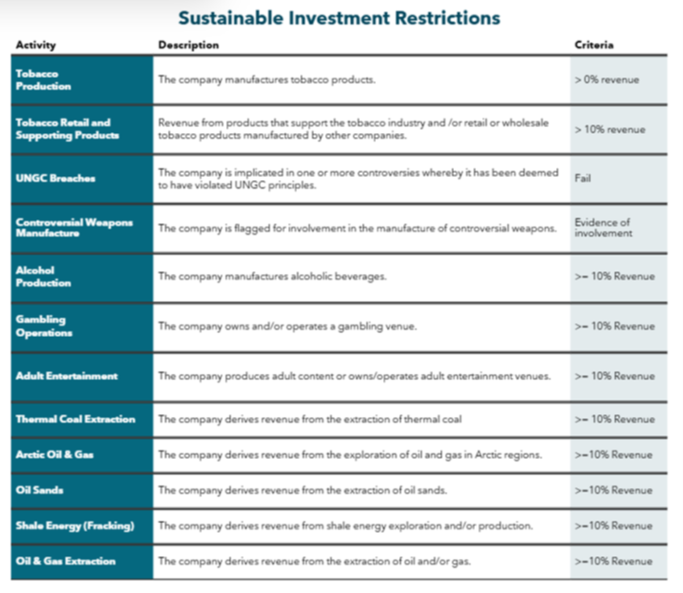
Note: 1 Some strategies following the Newton Sustainable Investment process may choose to add to these exclusions – but may never subtract.
Source: Newton, 30 January 2025.
However, please note: revenue threshold parameters reflect just one part of our sustainable investment process – a key part of this process is the additional research and analysis conducted by the investment team.
Our process seeks to clearly distinguish between activities that are subject to hard exclusions versus those activities that sustainability portfolio managers may be able to invest in in certain circumstances (precautionary pool).
Precautionary pool
For areas that have been identified as having controversies or the potential to cause harm (such as fossil fuels other than thermal coal, animal welfare, conventional defence and nuclear power) but are not covered by the sustainable investment restrictions, portfolio managers are alerted, when considering such investments, to review the controversial activity through what is referred to as the 'precautionary pool'. The precautionary pool includes companies that have been flagged in relation to their involvement in heavy-emitting industries, hold exposures to activities that are restricted, but at lower revenue thresholds, and areas such as nuclear power and animal welfare, where there may be nuances in the investment case that are deemed important to be highlighted.
The full list of activities caught currently under the precautionary pool is included below:
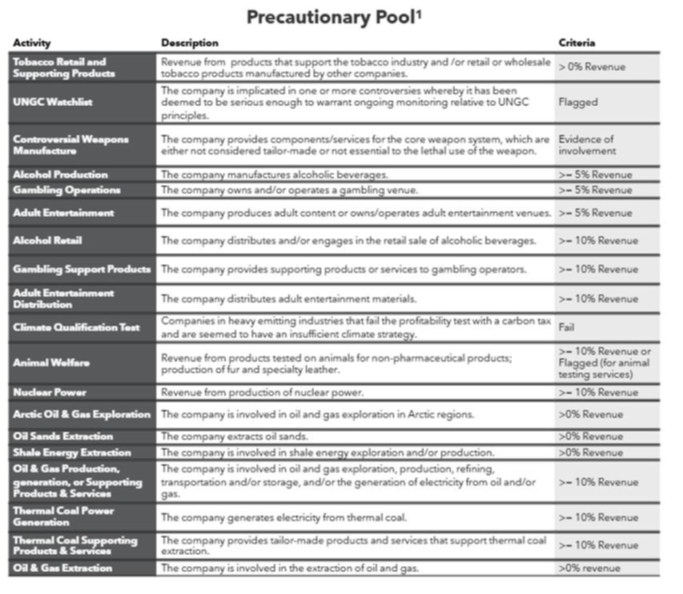
Note: 1 The RI team maintains a list of companies that are tagged under the ‘precautionary pool. Portfolio managers are alerted to this pool in the sustainable investment documentation portal (the Newton ‘RI App’). The portfolio managers are encouraged to work with the RI adviser assigned to the portfolio, to ensure that the managers are comfortable that the investment is not in conflict with the objectives of their strategy.
Source: Newton, 30 January 2025.
Governance
Issuers with exposure to areas captured under the precautionary pool are considered to be part of the investment universe, but portfolio managers considering such investments are alerted and encouraged to review the activity in consultation with the Newton responsible investment (RI) team (specifically an RI adviser), to ensure that the portfolio managers are comfortable that this investment is not in conflict with the objective of their strategy. Holdings of strategies that follow the Sustainable investment
process are regularly reviewed at the sustainable investment forum (SIF).
The SIF has been established as an oversight group to monitor our strategies with sustainability characteristics. The role of the SIF is to:
- Conduct a review of existing and new holdings against portfolio objectives (where those objectives specifically reference sustainability), our investment framework for the sustainable strategy range and any regulatory standards.
- Foster debate by bringing together a wider set of sustainability experts within the business.
- Provide support by educating, training and sharing knowledge and insights among the investment team.
Resources, Affiliations & Corporate Strategies:
Newton has a centralised responsible investment team. This team is the centre of excellence for all matters related to responsible investment, and with its deep functional knowledge of the responsible investment space and how it is evolving, it provides guidance, support and subject-matter expertise to our wider investment team. The responsible investment team, as you can see below, is global in its footprint and diverse in its employee base. The team is organised into three pillars of expertise – stewardship, research and analytics: these specialisations under the responsible investment umbrella allow us to bring further depth and expertise to each of these activities. The team’s compact size enables it to work cohesively and operate as one team.
Stewardship: Oversees the firm’s engagement framework and advocacy initiatives, focusing its efforts on meaningful outcomes for clients, and also undertakes the firm’s proxy voting activities. Provides subject-matter expertise to the investment team on governance risks and evolving expectations.
Sustainability research: Subject-matter experts consulting the investment and research teams, driving deep insights on sustainability-related subjects. The team manages Newton’s sustainability standards, definitions and frameworks.
Responsible investment analytics: Has strong quantitative and RI data expertise and owns the data ecosystem, creating and managing responsible investment data models, frameworks and tools that support ESG integration and sustainable investing. The team has built an innovative suite of building blocks that can be leveraged to develop scalable solutions to meet specific client requirements.
The role of the responsible investment team is to be a support function to the investment teams, to set standards around sustainable investment, and to coordinate and ensure effectiveness around our stewardship efforts. It guides the business around policies and direction of travel for sustainability and stewardship more broadly. The responsible investment team also owns and manages the overall governance systems to ensure we deliver against key codes and commitments including stewardship codes, industry principles such as the UN Principles for Responsible Investment, and industry pledges such as the Net Zero Asset Managers Initiative (NZAMi).
Supporting the team, and the wider business, are various external organisations and vendors including ESG service providers, memberships, and internal systems for monitoring and reporting.
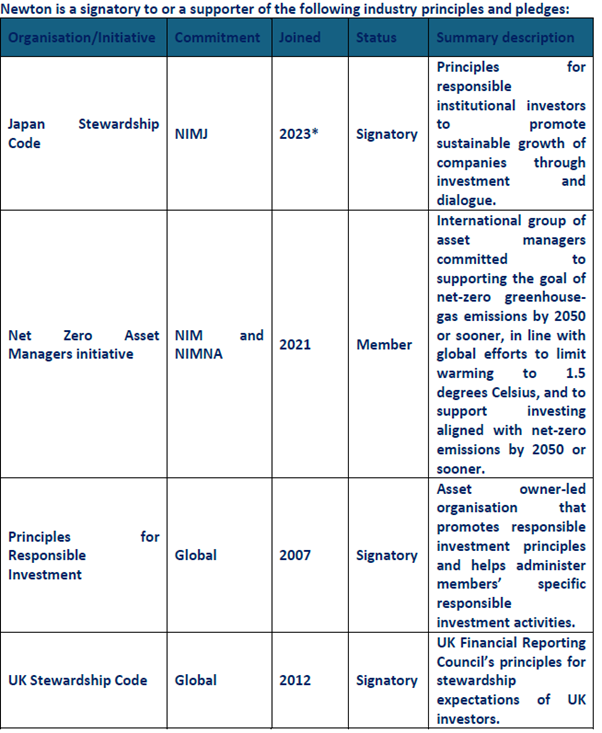
Affiliations
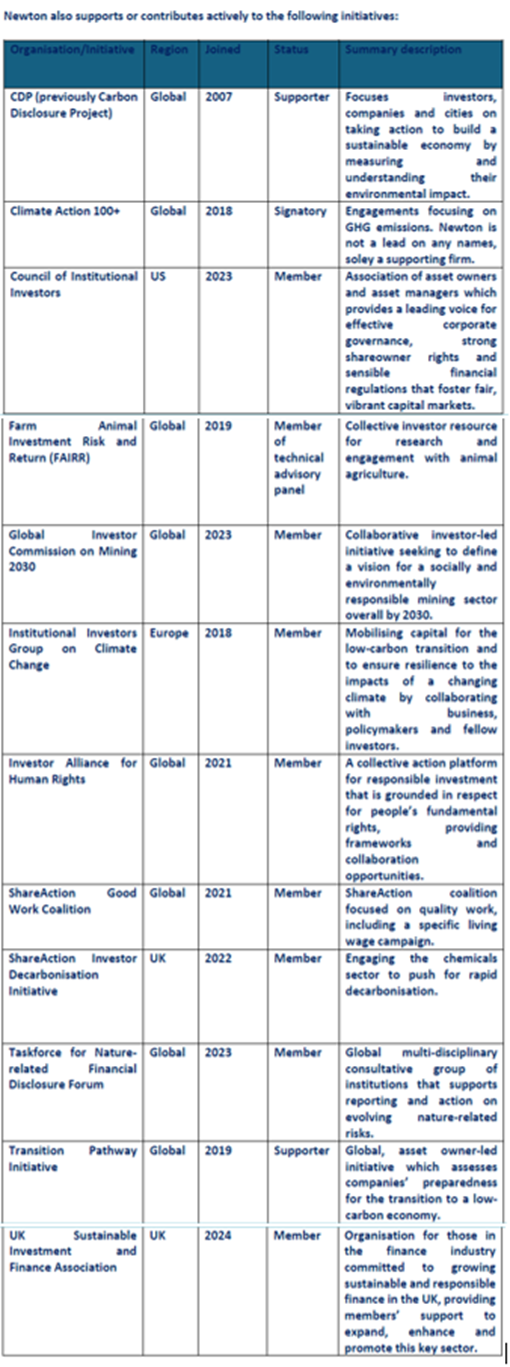
As investors and an intermediary in the financial system we play an important role in providing investors with access to investment solutions, and that with this comes an inherent responsibility to do what is right on behalf of our clients, as well as wider asset owners and stakeholders in the financial system. Our advocacy focus involves supporting or seeking to influence various issues and areas for the long-term interest of our clients and Newton.
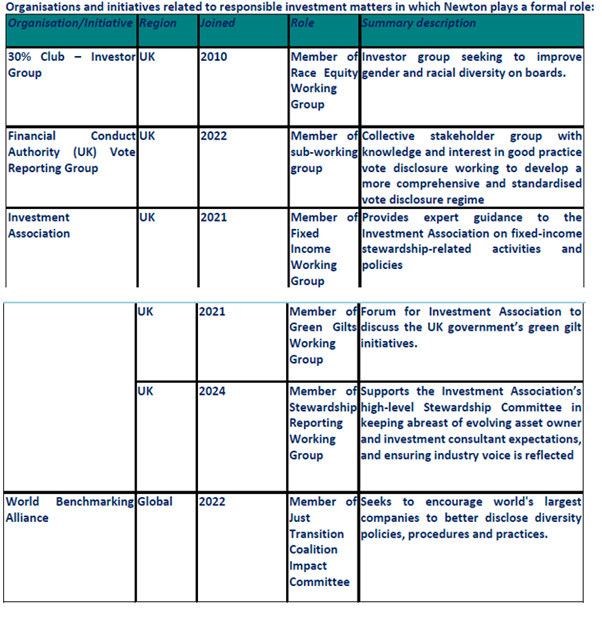
Organisations and initiatives related to responsible investment matters in which Newton plays a formal role:
*Newton Japan was established as a legal entity in March 2023. Its prior commitment to the Japan Stewardship Code was under its previous structure.
ESG Governance
Having an effective management and governance framework is an important part of our overall business strategy. As investors, we understand the value of effective leadership and accountability. This is closely linked to the culture of our business, as leadership and accountability have equal importance in Newton’s governance. We have therefore established appropriate governance systems and controls to support our stewardship and RI policy. This policy is reviewed and approved by the Newton Sustainability Committee (NIM and NIMNA), which reports to the Newton Executive Management Committee (NEMC) (to note, the NEMC reports into NIM and NIMNA boards). The policy is also reviewed and approved by the NIMJ Investment Oversight Committee, which reports into the NIMJ Executive Management Committee. The NEMC has overall responsibility for defining Newton’s approach, values and actions across all Newton entities.
Two of our operating committees play important roles in relation to our stewardship and RI efforts:
- Newton Sustainability Committee – oversees all aspects relating to stewardship and RI at NIM and NIMNA, including our investments, direct impacts and engagement with communities, and engagement with the wider market (advocacy) regarding RI and stewardship matters.
- Newton Risk and Compliance Committee – supported by the Newton Conflicts of Interest Committee and the Emerging Risks Working Group.
These committees deal with various stewardship and RI aspects on an ad-hoc basis, including any relevant internal audit findings and actions as well as climate-related risk updates from internal groups.
Our Board Risk Committee also plays a role in the governance of our RI and stewardship efforts; it acts as an escalation point for any material issues identified through our governance systems and controls. For example, it has previously considered materials related to climate risk. We have also established the Newton Sustainable Investment Forum (SIF) as an oversight group to monitor our strategies with sustainability characteristics.
The role of the SIF is to:
- Foster debate by bringing together a wider set of Newton investment team members focusing on sustainability, including sustainability portfolio managers and RI team members
- Provide support by educating, training and sharing knowledge and insights among the investment team.
SDR Labelling:
Unlabelled - promotes sustainable characteristics (has CFD)
- Consumer Facing Disclosure
SDR Literature:
Literature
Fund Holdings
Voting Record
Disclaimer
IMPORTANT INFORMATION
Past performance is not a guide to future performance.
The value of investments can fall. Investors may not get back the amount invested.
Income from investments may vary and is not guaranteed.
For Professional Clients only.
Provided solely for use by Fund Ecomarket.
BNY, BNY Mellon and Bank of New York Mellon are the corporate brands of The Bank of New York Mellon Corporation and may be used to reference the corporation as a whole and/or its various subsidiaries generally.
Issued in the United Kingdom by BNY Mellon Investment Management EMEA Limited, BNY Mellon Centre, 160 Queen Victoria Street, London EC4V 4LA. Registered in England No. 1118580. Authorised and regulated by the Financial Conduct Authority.
Newton global assets under management (AUM) is the combined total assets under management of Newton Investment Management Limited (‘NIM’), Newton Investment Management North America LLC (‘NIMNA’) and Newton Investment Management Japan Limited (‘NIMJ’).
Returns may increase or decrease as a result of currency fluctuations.
Costs incurred when purchasing, holding, converting or selling any investment, will impact returns.
Costs may increase or decrease as a result of currency and exchange rate fluctuations.
Newton manages a variety of investment strategies. How ESG analysis is integrated into Newton’s strategies depends on the asset classes and/or the particular strategy involved. ESG can be one of many inputs into the fundamental analysis. Newton will make investment decisions that are not based solely on ESG analysis. Other attributes of an investment may outweigh ESG analysis when making investment decisions.
*Newton’ and/or ‘Newton Investment Management’ is a corporate brand which refers to the following group of affiliated companies: Newton Investment Management Limited (“NIM”), Newton Investment Management North America LLC (“NIMNA”) and Newton Investment Management Japan Limited ("NIMJ").
Newton’s assets under management include assets collectively managed by NIM, NIMNA and NIMJ. In addition, AUM for Newton includes assets of bank-maintained collective investment funds for which Newton has been appointed sub-advisor, where Newton personnel act as dual officers of affiliated companies and assets of wrap fee account(s) for which Newton provides sub-advisory services to the primary manager of the wrap program.
For Professional Clients only.
Please refer to the prospectus, KID/KIID or KFS where applicable and other fund documents for a full list of risks and before making any investment decisions. Documents are available in English and in selected local languages where the fund is registered. Go to bny.com/investments.
The value of investments and the income received can fall as well as rise and investors may not get back the original amount invested.
The Fund can invest more than 35% of net assets in different transferable securities and money market instruments issued or guaranteed by the UK or an EEA State, its local authorities, a third country or public international bodies of which the UK or one or more EEA States are members.
BNY is the corporate brand of The Bank of New York Mellon Corporation and may be used to reference the corporation as a whole and/or its various subsidiaries generally.
Provided solely for use by Fund Ecomarket.
BNY Mellon Investment Funds is an open-ended investment company with variable capital (ICVC) with limited liability between sub-funds. Incorporated in England and Wales: registered number IC27. The Authorised Corporate Director (ACD) is BNY Mellon Fund Managers Limited (BNY MFM), incorporated in England and Wales: No. 1998251. Registered address: BNY Mellon Centre, 160 Queen Victoria Street, London EC4V 4LA. Authorised and regulated by the Financial Conduct Authority.
Issued in United Kingdom by BNY Mellon Investment Management EMEA Limited, BNY Mellon Centre, 160 Queen Victoria Street, London EC4V 4LA. Registered in England No. 1118580. Authorised and regulated by the Financial Conduct Authority.
BNY Mellon FutureLegacy 6 Fund: The Fund is actively managed without benchmark-related constraints. The Fund will measure its performance against the Investment Association's Mixed Investment 40-85% Shares NR Sector Average as a comparator benchmark (the "Benchmark"). The Fund will use the Benchmark as an appropriate comparator because it includes a broad representation of funds with levels of equity and bond exposure similar to those of the Fund.
Effective 1 August 2025, the Fund’s benchmark changed from 25% ICE BofA Global Broad Index GBP Hedged and 75% MSCI ACWI GBP NR to the Investment Association's Mixed Investment 40-85% Shares NR sector average. Benchmark performance shown for all time periods is that of the Investment Association's Mixed Investment 40-85% Shares NR sector average.
The BNY Mellon FutureLegacy funds are actively managed typically by using forward-looking expectations of volatility. In doing so, the Investment Manager uses its own internal risk model, whilst also considering external independent risk profiling methodologies. Based on a risk profile scale of 1 (lowest) to 10 (highest), the funds target a risk profile of 3, 4, 5, 6 or 7 but this is not guaranteed. The risk profile targeted by each of these funds can be identified through the number included in the respective fund name. This risk profile is not the same as the risk and reward category shown in the KIID. The risk profiles are assessed against the risk rating scale provided by Dynamic Planner, but are subject to change.
Dynamic Planner Risk Ratings should not be used for making an investment decision and it does not constitute a recommendation or advice in the selection of a specific investment or class of investments.
KEY INVESTMENT RISKS
Objective/Performance Risk: There is no guarantee that the Fund will achieve its objectives.
Currency Risk: This Fund invests in international markets which means it is exposed to changes in currency rates which could affect the value of the Fund.
Derivatives Risk: Derivatives are highly sensitive to changes in the value of the asset from which their value is derived. A small movement in the value of the underlying asset can cause a large movement in the value of the derivative. This can increase the sizes of losses and gains, causing the value of your investment to fluctuate. When using derivatives, the Fund can lose significantly more than the amount it has invested in derivatives.
Changes in Interest Rates & Inflation Risk: Investments in bonds/money market securities are affected by interest rates and inflation trends which may negatively affect the value of the Fund.
Credit Ratings and Unrated Securities Risk: Bonds with a low credit rating or unrated bonds have a greater risk of default. These investments may negatively affect the value of the Fund.
Credit Risk: The issuer of a security held by the Fund may not pay income or repay capital to the Fund when due.
Emerging Markets Risk: Emerging Markets have additional risks due to less-developed market practices.
Share Class Currency Risk: Where a share class is denominated in a different currency from the base currency of the Fund, changes in the exchange rate between the share class currency and the base currency may affect the value of your investment.
China Interbank Bond Market and Bond Connect Risk: The Fund may invest in China interbank bond market through connection between the related Mainland and Hong Kong financial infrastructure institutions. These may be subject to regulatory changes, settlement risk and quota limitations. An operational constraint such as a suspension in trading could negatively affect the Fund's ability to achieve its investment objective.
Volcker Rule Risk: The Bank of New York Mellon Corporation or one of its affiliates ("BNYM") has invested in the Fund. As a result of restrictions under the "Volcker Rule," which has been adopted by U.S. Regulators, BNYM must reduce its shareholding percentage so that it constitutes less than 25% of the Fund within, generally, three years of the Fund's establishment (which starts when the Fund's manager begins making investments for the Fund). Risks may include: BNYM may initially own a proportionately larger percentage of the Fund, and any mandatory reductions may increase Fund portfolio turnover rates, resulting in increased costs, expenses and taxes. Details of BNYM's investment in the Fund are available upon request.
CoCo's Risk: Contingent Convertible Securities (CoCo's) convert from debt to equity when the issuer's capital drops below a pre-defined level. This may result in the security converting into equities at a discounted share price, the value of the security being written down, temporarily or permanently, and/or coupon payments ceasing or being deferred.
Responsible Investing Risk: The investment policy for this Fund places restrictions on its exposure to certain sectors or types of investments to reflect its responsible investing approach. The Fund's performance may be negatively impacted due to these restrictions in comparison to funds which do not have these restrictions. The Fund will not engage in securities lending activities and, therefore, may forego any additional returns that may be produced through such activities.
Counterparty Risk: The insolvency of any institutions providing services such as custody of assets or acting as a counterparty to derivatives or other contractual arrangements, may expose the Fund to financial loss.
A complete description of risk factors is set out in the Prospectus in the section entitled "Risk Factors".
| Fund Name | SRI Style | SDR Labelling | Product | Region | Asset Type | Launch Date | Last Amended |
|
|---|---|---|---|---|---|---|---|---|
BNY Mellon FutureLegacy 6 Fund |
Sustainability Tilt | Unlabelled - promotes sustainable characteristics (has CFD) | OEIC | Global | Multi Asset | 07/02/2023 | Aug 2026 | |
ObjectivesTo achieve capital growth and potential for income over the long term (5 years or more) while being managed to a pre-defined level of risk. The Fund will aim to maintain a risk profile classification of 6 from a scale of 1 (lowest) to 10 (highest) which is assessed against the risk ratings scale provided by an external third party risk rating agency. |
Fund/Portfolio Size: £71.90m (as at: 31/05/2026) Total Assets Under Management: £85208.98m (as at: 31/03/2026) ISIN: GB00BQH89234, GB00BQH89127 Contact Us: salessupport@bny.com |
|||||||
Sustainable, Responsible &/or ESG OverviewThe Funds aims to achieve capital growth and potential for income over the long term (5 years or more) while being managed to a pre-defined level of risk. It does so by investing in a portfolio of UK and international securities across a broad range of asset classes. While pursuing its investment objective, the Fund invests a minimum of 70% of its portfolio in securities with sustainability (i.e. positive environmental and/or social) characteristics. |
||||||||
|
Primary fund last amended: Aug 2026 |
||||||||
|
Information received directly from Fund Manager |
||||||||
|
Please select what you would like to read:
Fund FiltersSustainability - General
Sustainability policy
Has policies that consider (environmental and social) sustainability issues. Strategies vary but are likely to consider environmental issues like climate change, carbon emissions, biodiversity loss, resource management, environmental impacts; and social issues like equal opportunities, human rights, labour standards, diversity and adherence to internationally recognised codes. See individual entry information.
Encourage more sustainable practices through stewardship
Aim to encourage higher sustainability standards through responsible ownership / stewardship / engagement / voting activity
UN Global Compact linked exclusion policy
Use the UN Global Compact to inform or help direct where they can or cannot invest. Will typically not invest in companies with significant breaches (low standards) - strategies vary. (The UNGC covers a wide range of issues - search 'UNGC'). See https://unglobalcompact.org/
Transition focus
Aim to support the shift to a sustainable future. See eg https://www.transitionpathwayinitiative.org/ Environmental - General
Limits exposure to carbon intensive industries
Options that limit or 'reduce' their exposure to carbon intensive industries (ie sectors which are major contributors to climate change). Strategies vary. Climate Change & Energy
Fracking & tar sands excluded
Avoid companies involved in fracking and tar sands - which are widely regarded as controversial methods of oil and gas extraction. Strategies vary.
Arctic drilling exclusion
Avoid companies that are involved in extracting oil from the Arctic regions.
Fossil fuel reserves exclusion
Avoid investing in companies / assets with coal, oil and gas reserves. See individual entry information for further details.
Encourage transition to low carbon through stewardship activity
Encourage the transition to lower carbon activities through asset selection and / or responsible ownership activity.
TCFD / IFRS reporting requirement
Will only invest in companies that report greenhouse gas emissions in line with this international reporting framework. See https://www.fsb-tcfd.org/ https ://www.ifrs.org/sustainability/tcfd/ Social / Employment
Mining exclusion
All mining companies excluded Ethical Values Led Exclusions
Tobacco & related product manufacturers excluded
Companies are excluded if they are involved in any aspect of the production chain for tobacco products, including cigarettes, vaping, e-cigarettes, chewing tobacco and cigars.
Controversial weapons exclusion
Excludes companies which make controversial weapons such as landmines, cluster munitions and chemical weapons.
Military involvement not excluded
Does Not exclude companies with military contracts - this may include medical supplies, food, safety equipment, housing, technology etc.
Alcohol production excluded
Avoids companies that produce alcohol. Strategies vary; some may allow a small proportion of revenue to come from this area.
Gambling avoidance policy
Avoids companies with significant involvement in the gambling industry. Some may allow a small proportion of revenues to come from this area.
Pornography avoidance policy
Avoids companies that derive significant income from pornography and related areas. Strategies vary. Gilts & Sovereigns
Invests in gilts / government bonds
Invest in loans issued the government, commonly known as gilts or government bonds. These may or may not be ringfenced for specific projects (see additional options).
Gilts / government bonds - exclude some
Avoids investing in 'some' gilts or government bonds. Strategies vary, but this may relate to avoiding specific countries or particular reasons for bond issuance. 'Green gilts' for example would be likely to be acceptable.
Invests in sovereigns subject to screening criteria
Invest in financial instruments issued by governments, but will only hold those that meet certain environmental and or social criteria. This may, for example mean certain assets are excluded in line with eg Freedom House research. Strategies vary. Banking & Financials
Invests in banks
Can include banks as part of their holdings / portfolio.
Invests in financial instruments issued by banks
Invests in financial instruments (cash, derivatives and / or foreign exchange) issued by banks. Strategies vary.
Invests in insurers
May invest in insurance companies. Governance & Management
Avoids companies with poor governance
Avoids investing in companies with poor governance practices.(e.g. board structure, management practices etc.) Views may however vary on what counts as 'poor' practices - and funds may not immediately divest as they may prefer to work to encourage higher standards.
UN sanctions exclusion
Exclude companies that are subject to United Nations sanctions. See eg https://main.un.org/securitycouncil/en/content/un-sc-consolidated-list
Encourage higher ESG standards through stewardship activity
Aim to encourage higher ESG standards through responsible ownership / stewardship / engagement /voting activity Asset Size
Invests in small, mid & large cap companies / assets
Invests in a combination of small, medium and larger (potentially multinational) companies / assets. How The Fund/Portfolio Works
Negative selection bias
Has principle 'ethical approach' to avoid companies by using negative screening criteria. Strategies vary.
Data led strategy
Makes stock selection (and ongoing management) decisions based on ESG data or company ratings (normally supplied by third parties) rather than focusing on what individual companies do, how they operate or their plans for the future
Combines norms based exclusions with other SRI criteria
Investment selection process uses internationally agreed 'norms' (e.g. United Nations Global Compact - UNGC - or the UN Sustainable Development Goals - SDGs) alongside additional SRI criteria such as positive or negative stock selection policies and/or stewardship strategies.
Combines ESG strategy with other SRI criteria
Invests in assets which have an ESG strategy (which is typically focused on avoiding companies that pose environmental, social or governance related risks) together with additional criteria such as positive and/or negative screens, themes and stewardship strategies.
Norms focus
Uses internationally agreed standards, conventions and 'norms' to help direct investment decisions (e.g. the UN Global Compact, UN Sustainable Development Goals).
SRI / ESG / Ethical policies explained on website
Publish explanations of their ethical, social and/or environmental policies online (i.e. investment decision making strategies/ buy/sell &/or asset management strategies).
Different risk options of this strategy are available
Has different risk options for the same investment strategy
Do not use stock / securities lending
Does not use stock lending for performance or risk purposes. Unscreened Assets & Cash
Assets typically aligned to sustainability objectives 70 - 79%
Holds between 70-79% of assets which align to the sustainability objectives; which are not being held purely for risk management purposes, such as derivatives and cash equivalent assets.
Uses unscreened 'diversifiers' to help manage risk
May invest in assets that have not passed its usual sustainability criteria or screening standards in order to help manage investment risk. This may be limited or significant. Strategies vary. Intended Clients & Product Options
Available via an ISA (OEIC only)
Available via a tax efficient ISA product wrapper. Fund Management Company InformationAbout The Business
Boutique / specialist fund management company
Find fund / asset management companies that are smaller or specialise in particular areas - notably, ideally ESG related. Strategies vary.
Responsible ownership / stewardship policy or strategy (AFM companywide)
Finds fund / asset management companies that have a published company wide stewardship, engagement and / or responsible ownership policy or strategy that covers all investments. Stewardship typically involves encouraging higher ESG standards through voting and dialogue.
ESG / SRI engagement (AFM companywide)
Find fund / asset management companies that actively encourage higher 'environmental, social and governance' and / or 'sustainable and responsible investment' practices across investee companies - typically where the aim is to encourage positive change that is aligned with the best interests of investors. Strategies vary. See additional information and options.
Vote all* shares at AGMs / EGMs (AFM companywide)
Find fund / asset managers that vote all* the shares they own at Annual General Meetings and Extraordinary General Meetings. A commitment to voting shares is a key indicator of 'responsible share ownership' demonstrating their support for or disagreement with management policy. (*situations can legitimately, occasionally occur where voting proves impossible, but in principle all shares should be voted.)
Responsible ownership policy for non SRI / sustainable options (AFM companywide)
Find options run by managers that apply Responsible ownership or 'Stewardship' policies to all or most of their investment assets. This means active involvement (e.g. voting, dialogue) with the companies across all or most funds, products and services.
Integrates ESG factors into all / most research (AFM companywide)
Find fund / asset management companies that consider environmental, social and governance (ESG) issues when deciding whether or not to invest in a company for all / almost all of their funds and other assets. This is increasingly seen as part of sound risk management.
In-house diversity improvement programme (AFM companywide)
Finds organisations / fund managers that have an in-house (company wide) diversity improvement programme - meaning that they are working to ensure that within their own businesses they employ people from diverse backgrounds - often typically focused on ethnicity and/or sex.
Vulnerable client policy on website (AFM companywide)
Fund / asset manager has information on their website that explains how they treat 'vulnerable clients' (as set out in FCA regulation) Collaborations & Affiliations
PRI signatory
Find fund / asset management companies that have signed up to the UN backed 'Principles of Responsible Investment'.
UKSIF member
Find fund / asset management companies that are members of UKSIF - the UK Sustainable Investment and Finance association
Fund EcoMarket partner
Find fund / asset management companies that have partnered with Fund EcoMarket - meaning that they are helping to improve access to information on sustainable and responsible investment by paying an annual fee to us which enables us to publish information for free. Partner funds are listed ahead of other funds and have their logos displayed.
Investment Association (IA) member
Fund management entity is a member of the Investment Association https://www.theia.org/ Resources
In-house responsible ownership / voting expertise
Find fund / asset management companies that employ people to steer and support fund managers in voting shares at company AGM's and EGMs in ways that are consistent with encouraging higher ESG/sustainability standards.
Employ specialist ESG / SRI / sustainability researchers
Find a fund / asset management company that directly employs specialist ESG/SRI/sustainability researchers or analysts. This allows asset managers to discuss environmental, social and governance risks and opportunities directly with companies.
Use specialist ESG / SRI / sustainability research companies
Find fund / asset management companies that makes use of expert external research companies. This can help deliver specialist expertise and means resources are pooled with other investors. Accreditations
UK Stewardship Code signatory (AFM companywide)
Find fund / asset managers that are signatories to the FRC UK Stewardship Code, which sets out a framework for constructive investor / investee relations where managers are encouraged to behave like responsible, typically longer term 'company owners'. Engagement Approach
Regularly lead collaborative ESG initiatives (AFM companywide)
Find fund / asset management companies that regularly initiate or run industry wide (collaborative) investor projects aimed at raising environmental, social and governance standards amongst investee companies.
Engaging on climate change issues
Fund / asset manager has stewardship /responsible ownership strategy that is focused on addressing climate change with investee assets.
Engaging with fossil fuel companies on climate change
Fund / asset manager has a stewardship /responsible ownership strategy that involves working with fossil fuel companies on climate change related issues. See fund manager website for details.
Engaging on biodiversity / nature issues
The fund / asset manager has a responsible ownership / stewardship strategy that focuses on biodiversity and nature issues relating to the assets they invest the aim of which will be to reduce harm and or deliver improvement. Strategies vary. https://tnfd.global
Engaging to encourage a Just Transition
Fund / asset manager has a responsible ownership / stewardship strategy which means they are working to encourage the shift to more sustainable business practices in ways that respect and are sensitive to social issues and the impact change has on people effected by the changes that are taking place. https://www.transitionpathwayinitiative.org/ https://transitiontaskforce.net/
Engaging on human rights issues
Fund / asset manager has responsible ownership / stewardship strategy in place which aims to address human rights issues in investee companies (and potentially their suppliers) with the aim of raising standards
Engaging on labour / employment issues
Fund / asset manager has responsible ownership / stewardship strategy in place that aims to improve labour standards for the benefit of employees in investee companies (and potentially their suppliers)
Engaging on diversity, equality & / or inclusion issues
Fund / asset management company has a stewardship strategy in place which involves working to raise diversity, equality and inclusion standards across investee assets
Engaging to stop modern slavery
Fund / asset manager is working with the assets they hold to help stamp out modern slavery - where direct or indirect company employees are exploited for business benefits.
Engaging on governance issues
Fund / asset managers have stewardship strategies in place that focus on improving governance standards across investee assets
Engaging on mental health issues
Fund / asset manager has stewardship strategy in place which involves discussing mental health issues with investee companies - with the aim of raising standards
Engaging on responsible supply chain issues
Has a stewardship / responsible ownership strategy that encourages responsible supply chain - ie the managers will discuss environmental, social and governance issues with investee companies with the aim of raising standards
Stewardship escalation policy
Escalation policies describe how a manager will proceed if stewardship / engagement activity is not successful in the short term. Climate & Net Zero Transition
Net Zero commitment (AFM companywide)
Fund / asset management organisations that have pledged to reduce their greenhouse gas emissions to ‘net zero’. Strategies vary - this area is changing rapidly.
Net Zero - have set a Net Zero target date (AFM companywide)
This fund / asset management company has set a date by which they plan to achieve net zero greenhouse gas / CO2e emissions.
Encourage carbon / greenhouse gas reduction (AFM companywide)
Find fund / asset management companies that are working with the companies they invest in to encourage reductions in carbon dioxide and other greenhouse gas emissions.
Carbon transition plan published (AFM companywide)
Finds organisations / fund managers that have a company wide carbon transition plan - meaning that they have plotted a path to how they will move away from activities that produce or use carbon based energy sources (that emit greenhouse gases) towards clean, alternative, renewable energy sources.
Working towards a ‘Net Zero’ commitment (AFM companywide)
Finds organisations / fund management companies that are in the process of working out how to make a ‘net zero commitment’ - meaning that when that is finalised they will have started the process of reducing their total greenhouse gas emissions to 'zero'.
Committed to SBTi / Science Based Targets Initiative
See https://sciencebasedtargets.org/ Transparency
Publish responsible ownership / stewardship report (AFM companywide)
Find fund / asset management companies that publish a report detailing their responsible investment ownership - also known as 'Stewardship' - activity.
Full stewardship / responsible ownership policy information on company website
Find fund / asset management companies that publish information about their sustainable and responsible investment strategies on their company website.
Full stewardship / responsible ownership policy information available on request
Find fund / asset management companies that will supply information about their sustainable and responsible investment activity on request.
Publish full voting record (AFM companywide)
Fund / asset management companies that publish a full record of how they vote their shares at AGMs (annual general meetings) and EGMs (extraordinary general meetings). Voting strategies have an important role to play encouraging higher environmental, social and governance standards.
Net Zero transition plan publicly available (AFM companywide)
This fund / asset management company has published a plan that explains how they are going to achieve net zero greenhouse gas / CO2e emissions. CommentsPlease Note:
Sustainable, Responsible &/or ESG Policy:Sustainable investment philosophy We consider sustainable investment to be about investing with a clear intent to deliver environmental and/or social outcomes alongside generating a financial return. The strategies that follow the Newton sustainable investment framework seek to balance financial, social and environmental outcomes to support long-term shareholder returns. Sustainable investment framework This framework is focused on two main components: defining what is incompatible with a sustainable universe --‘sustainable investment restrictions’ and defining what constitutes a sustainable investment. The latter rests on an approach that focuses on key sustainable investment themes with underlying sustainable activities and how an investment is connected with this – through alignment or contribution measures. Sustainable investment universe The portfolio manager is responsible for applying the Newton sustainable investment framework and ensuring that the security is eligible following a review which is documented. The review determines whether the investment contributes towards one or more of the Newton sustainable investment themes (sustainable contributors) or demonstrates strong environmental and/or social practices that align with one or more of the Newton sustainable investment themes (sustainable aligners). Sustainable contributors: These are companies that provide solutions (products and services) that address the most pressing environmental or social challenges. Our sustainable investment framework is applied through a series of measures, such as revenues from products relating to Renewable and low-carbon energy sources, resource efficiency, affordable housing, medical technology and healthy eating. As a measure of their contribution, each sustainable contributor must have at least 30% revenue exposure (in aggregate) from one of more of the sustainable activities, as defined in the sustainable investment framework, or have at least 30% capital expenditure (CAPEX) or operational expenditure (OPEX) aligned to the EU Taxonomy. Sustainable aligners: These are companies that manage to a high standard the social and environmental issues relating from their direct operations and supply chains as well as integrate sustainability priorities into their business strategy. This is primarily about the internal management of a company’s operations and supply chain where we seek to invest in leaders or best-in-class industry players. Companies that integrate sustainability into their business strategy have committed explicitly to improving their environmental and social impacts by reducing negative externalities that is expected to lead to a transformation of their business models. The outcome of this mitigation and transformation of the negative externality results in a meaningful positive outcome for society and/or the environment. These two classifications are guided by frameworks, developed, and maintained by the Newton RI team, ensuring robustness and consistency in order to identify the suitable sustainable investment propositions. The overall framework is reviewed regularly and may evolve over time with Newton’s own thinking as well as with regulatory development. Sustainable investment restrictions* The sustainable investment restrictions mainly seek to avoid investments in areas of significant social or environmental harm. To identify these companies, we use a combination of external service providers including Bloomberg, ISS, RepRisk, CDP and Factset to inform our decisions. The sustainable investment restrictions are hard coded into the Newton trade process and any potential violations are caught in the pre-trade compliance checks. Revenue threshold parameters applied through these restrictions reflect just one part of our sustainable investment framework – a key part of this process is the additional research and analysis conducted by the investment team.
Note: 1 Some strategies following the Newton Sustainable Investment process may choose to add to these exclusions – but may never subtract. However, please note: revenue threshold parameters reflect just one part of our sustainable investment process – a key part of this process is the additional research and analysis conducted by the investment team. Our process seeks to clearly distinguish between activities that are subject to hard exclusions versus those activities that sustainability portfolio managers may be able to invest in in certain circumstances (precautionary pool). Precautionary pool For areas that have been identified as having controversies or the potential to cause harm (such as fossil fuels other than thermal coal, animal welfare, conventional defence and nuclear power) but are not covered by the sustainable investment restrictions, portfolio managers are alerted, when considering such investments, to review the controversial activity through what is referred to as the 'precautionary pool'. The precautionary pool includes companies that have been flagged in relation to their involvement in heavy-emitting industries, hold exposures to activities that are restricted, but at lower revenue thresholds, and areas such as nuclear power and animal welfare, where there may be nuances in the investment case that are deemed important to be highlighted. The full list of activities caught currently under the precautionary pool is included below:
Note: 1 The RI team maintains a list of companies that are tagged under the ‘precautionary pool. Portfolio managers are alerted to this pool in the sustainable investment documentation portal (the Newton ‘RI App’). The portfolio managers are encouraged to work with the RI adviser assigned to the portfolio, to ensure that the managers are comfortable that the investment is not in conflict with the objectives of their strategy. Governance Issuers with exposure to areas captured under the precautionary pool are considered to be part of the investment universe, but portfolio managers considering such investments are alerted and encouraged to review the activity in consultation with the Newton responsible investment (RI) team (specifically an RI adviser), to ensure that the portfolio managers are comfortable that this investment is not in conflict with the objective of their strategy. Holdings of strategies that follow the Sustainable investment The SIF has been established as an oversight group to monitor our strategies with sustainability characteristics. The role of the SIF is to:
Resources, Affiliations & Corporate Strategies:Newton has a centralised responsible investment team. This team is the centre of excellence for all matters related to responsible investment, and with its deep functional knowledge of the responsible investment space and how it is evolving, it provides guidance, support and subject-matter expertise to our wider investment team. The responsible investment team, as you can see below, is global in its footprint and diverse in its employee base. The team is organised into three pillars of expertise – stewardship, research and analytics: these specialisations under the responsible investment umbrella allow us to bring further depth and expertise to each of these activities. The team’s compact size enables it to work cohesively and operate as one team. Sustainability research: Subject-matter experts consulting the investment and research teams, driving deep insights on sustainability-related subjects. The team manages Newton’s sustainability standards, definitions and frameworks. Responsible investment analytics: Has strong quantitative and RI data expertise and owns the data ecosystem, creating and managing responsible investment data models, frameworks and tools that support ESG integration and sustainable investing. The team has built an innovative suite of building blocks that can be leveraged to develop scalable solutions to meet specific client requirements. The role of the responsible investment team is to be a support function to the investment teams, to set standards around sustainable investment, and to coordinate and ensure effectiveness around our stewardship efforts. It guides the business around policies and direction of travel for sustainability and stewardship more broadly. The responsible investment team also owns and manages the overall governance systems to ensure we deliver against key codes and commitments including stewardship codes, industry principles such as the UN Principles for Responsible Investment, and industry pledges such as the Net Zero Asset Managers Initiative (NZAMi). Supporting the team, and the wider business, are various external organisations and vendors including ESG service providers, memberships, and internal systems for monitoring and reporting.
Affiliations Organisations and initiatives related to responsible investment matters in which Newton plays a formal role: *Newton Japan was established as a legal entity in March 2023. Its prior commitment to the Japan Stewardship Code was under its previous structure. ESG Governance Having an effective management and governance framework is an important part of our overall business strategy. As investors, we understand the value of effective leadership and accountability. This is closely linked to the culture of our business, as leadership and accountability have equal importance in Newton’s governance. We have therefore established appropriate governance systems and controls to support our stewardship and RI policy. This policy is reviewed and approved by the Newton Sustainability Committee (NIM and NIMNA), which reports to the Newton Executive Management Committee (NEMC) (to note, the NEMC reports into NIM and NIMNA boards). The policy is also reviewed and approved by the NIMJ Investment Oversight Committee, which reports into the NIMJ Executive Management Committee. The NEMC has overall responsibility for defining Newton’s approach, values and actions across all Newton entities. Two of our operating committees play important roles in relation to our stewardship and RI efforts:
These committees deal with various stewardship and RI aspects on an ad-hoc basis, including any relevant internal audit findings and actions as well as climate-related risk updates from internal groups. Our Board Risk Committee also plays a role in the governance of our RI and stewardship efforts; it acts as an escalation point for any material issues identified through our governance systems and controls. For example, it has previously considered materials related to climate risk. We have also established the Newton Sustainable Investment Forum (SIF) as an oversight group to monitor our strategies with sustainability characteristics. The role of the SIF is to:
SDR Labelling:Unlabelled - promotes sustainable characteristics (has CFD)
SDR Literature:LiteratureFund HoldingsVoting RecordDisclaimerIMPORTANT INFORMATION Newton manages a variety of investment strategies. How ESG analysis is integrated into Newton’s strategies depends on the asset classes and/or the particular strategy involved. ESG can be one of many inputs into the fundamental analysis. Newton will make investment decisions that are not based solely on ESG analysis. Other attributes of an investment may outweigh ESG analysis when making investment decisions. *Newton’ and/or ‘Newton Investment Management’ is a corporate brand which refers to the following group of affiliated companies: Newton Investment Management Limited (“NIM”), Newton Investment Management North America LLC (“NIMNA”) and Newton Investment Management Japan Limited ("NIMJ"). Newton’s assets under management include assets collectively managed by NIM, NIMNA and NIMJ. In addition, AUM for Newton includes assets of bank-maintained collective investment funds for which Newton has been appointed sub-advisor, where Newton personnel act as dual officers of affiliated companies and assets of wrap fee account(s) for which Newton provides sub-advisory services to the primary manager of the wrap program. For Professional Clients only. Please refer to the prospectus, KID/KIID or KFS where applicable and other fund documents for a full list of risks and before making any investment decisions. Documents are available in English and in selected local languages where the fund is registered. Go to bny.com/investments. The value of investments and the income received can fall as well as rise and investors may not get back the original amount invested. The Fund can invest more than 35% of net assets in different transferable securities and money market instruments issued or guaranteed by the UK or an EEA State, its local authorities, a third country or public international bodies of which the UK or one or more EEA States are members. BNY is the corporate brand of The Bank of New York Mellon Corporation and may be used to reference the corporation as a whole and/or its various subsidiaries generally. Provided solely for use by Fund Ecomarket. BNY Mellon Investment Funds is an open-ended investment company with variable capital (ICVC) with limited liability between sub-funds. Incorporated in England and Wales: registered number IC27. The Authorised Corporate Director (ACD) is BNY Mellon Fund Managers Limited (BNY MFM), incorporated in England and Wales: No. 1998251. Registered address: BNY Mellon Centre, 160 Queen Victoria Street, London EC4V 4LA. Authorised and regulated by the Financial Conduct Authority. Issued in United Kingdom by BNY Mellon Investment Management EMEA Limited, BNY Mellon Centre, 160 Queen Victoria Street, London EC4V 4LA. Registered in England No. 1118580. Authorised and regulated by the Financial Conduct Authority. BNY Mellon FutureLegacy 6 Fund: The Fund is actively managed without benchmark-related constraints. The Fund will measure its performance against the Investment Association's Mixed Investment 40-85% Shares NR Sector Average as a comparator benchmark (the "Benchmark"). The Fund will use the Benchmark as an appropriate comparator because it includes a broad representation of funds with levels of equity and bond exposure similar to those of the Fund. Effective 1 August 2025, the Fund’s benchmark changed from 25% ICE BofA Global Broad Index GBP Hedged and 75% MSCI ACWI GBP NR to the Investment Association's Mixed Investment 40-85% Shares NR sector average. Benchmark performance shown for all time periods is that of the Investment Association's Mixed Investment 40-85% Shares NR sector average. The BNY Mellon FutureLegacy funds are actively managed typically by using forward-looking expectations of volatility. In doing so, the Investment Manager uses its own internal risk model, whilst also considering external independent risk profiling methodologies. Based on a risk profile scale of 1 (lowest) to 10 (highest), the funds target a risk profile of 3, 4, 5, 6 or 7 but this is not guaranteed. The risk profile targeted by each of these funds can be identified through the number included in the respective fund name. This risk profile is not the same as the risk and reward category shown in the KIID. The risk profiles are assessed against the risk rating scale provided by Dynamic Planner, but are subject to change. Dynamic Planner Risk Ratings should not be used for making an investment decision and it does not constitute a recommendation or advice in the selection of a specific investment or class of investments. KEY INVESTMENT RISKS Objective/Performance Risk: There is no guarantee that the Fund will achieve its objectives. Currency Risk: This Fund invests in international markets which means it is exposed to changes in currency rates which could affect the value of the Fund. Derivatives Risk: Derivatives are highly sensitive to changes in the value of the asset from which their value is derived. A small movement in the value of the underlying asset can cause a large movement in the value of the derivative. This can increase the sizes of losses and gains, causing the value of your investment to fluctuate. When using derivatives, the Fund can lose significantly more than the amount it has invested in derivatives. Changes in Interest Rates & Inflation Risk: Investments in bonds/money market securities are affected by interest rates and inflation trends which may negatively affect the value of the Fund. Credit Ratings and Unrated Securities Risk: Bonds with a low credit rating or unrated bonds have a greater risk of default. These investments may negatively affect the value of the Fund. Credit Risk: The issuer of a security held by the Fund may not pay income or repay capital to the Fund when due. Emerging Markets Risk: Emerging Markets have additional risks due to less-developed market practices. Share Class Currency Risk: Where a share class is denominated in a different currency from the base currency of the Fund, changes in the exchange rate between the share class currency and the base currency may affect the value of your investment. China Interbank Bond Market and Bond Connect Risk: The Fund may invest in China interbank bond market through connection between the related Mainland and Hong Kong financial infrastructure institutions. These may be subject to regulatory changes, settlement risk and quota limitations. An operational constraint such as a suspension in trading could negatively affect the Fund's ability to achieve its investment objective. Volcker Rule Risk: The Bank of New York Mellon Corporation or one of its affiliates ("BNYM") has invested in the Fund. As a result of restrictions under the "Volcker Rule," which has been adopted by U.S. Regulators, BNYM must reduce its shareholding percentage so that it constitutes less than 25% of the Fund within, generally, three years of the Fund's establishment (which starts when the Fund's manager begins making investments for the Fund). Risks may include: BNYM may initially own a proportionately larger percentage of the Fund, and any mandatory reductions may increase Fund portfolio turnover rates, resulting in increased costs, expenses and taxes. Details of BNYM's investment in the Fund are available upon request. CoCo's Risk: Contingent Convertible Securities (CoCo's) convert from debt to equity when the issuer's capital drops below a pre-defined level. This may result in the security converting into equities at a discounted share price, the value of the security being written down, temporarily or permanently, and/or coupon payments ceasing or being deferred. Responsible Investing Risk: The investment policy for this Fund places restrictions on its exposure to certain sectors or types of investments to reflect its responsible investing approach. The Fund's performance may be negatively impacted due to these restrictions in comparison to funds which do not have these restrictions. The Fund will not engage in securities lending activities and, therefore, may forego any additional returns that may be produced through such activities. Counterparty Risk: The insolvency of any institutions providing services such as custody of assets or acting as a counterparty to derivatives or other contractual arrangements, may expose the Fund to financial loss. A complete description of risk factors is set out in the Prospectus in the section entitled "Risk Factors". |
||||||||