ILPM Bridging the sustainable investment advice gap
Posted on: July 16th, 2026
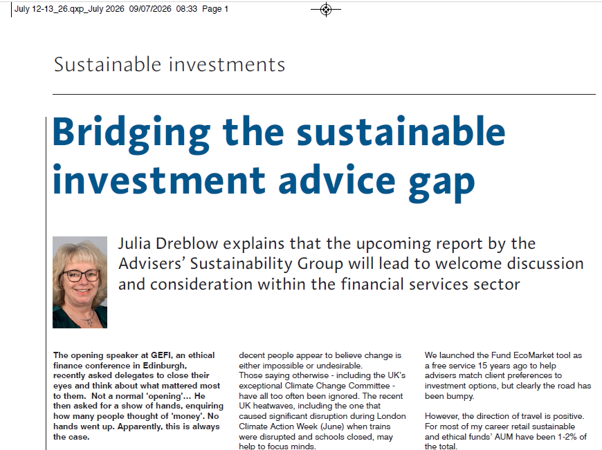
Investment Life and Pension Moneyfacts article – July 2026
In my latest ILP Moneyfacts article I explore ‘bridging the sustainable investment advice gap’ and share some thoughts on the upcoming Adviser Sustainability Group report.
Download printed version here: ILP Moneyfacts july 2026 p12-13
The full text of the article is here:
Bridging the sustainable investment advice gap
Julia Dreblow explains that the upcoming report by the Advisers’ Sustainability Group will lead to welcome discussion and consideration within the financial services sector
The opening speaker at GEFI, an ethical finance conference in Edinburgh, recently asked delegates to close their eyes and think about what mattered most to them. Not a normal ‘opening’… He then asked for a show of hands, enquiring how many people thought of ‘money’. No hands went up. Apparently, this is always the case.
This was not, however, the first time I had been asked to think more deeply about what we do as a sector. A London conference organised by Triodos and the New Economics Foundation think tank made a similar point – asking whether or not the financial system ‘serves’ people as they would wish.
A complex system
I don’t believe there is much chance we will all ever agree exactly what a system as complex as finance should do, but that’s not the point. If what we most care about is people and/or places, I’d suggest it is well worth thinking about how well the financial system, and our actions, reflects, supports or indeed undermines this.
I have worked in financial services for over three decades and firmly believe we
provide many useful services. We facilitate financial transactions, help business to grow, enable people to save for retirement – and much more.
However, I also believe there is a deeply damaging underbelly. A deeply entrenched culture of short-termism – and putting profit above all else – irrespective of medium or longer-term implications or outcomes. And while this might have been understandable 30 years ago, it is no longer acceptable now, given what we know about the damage we are causing to the planet, and its implications for people.
Listening to experts
And, as many are aware, this culture is so deeply embedded in operations that many decent people appear to believe change is either impossible or undesirable.
Those saying otherwise – including the UK’s exceptional Climate Change Committee – have all too often been ignored. The recent UK heatwaves, including the one that caused significant disruption during London Climate Action Week (June) when trains were disrupted and schools closed, may help to focus minds.
Perhaps the biggest irony, however, is that change is not only possible, and desirable – but also happening apace. Indeed, the current net zero backlash may in part be in response to the growing success of renewables, as well as the desirability of locally sourced, low cost, low carbon and readily available energy.
So, although global emissions continue to rise, and the replacement of fossil fuels is insufficiently rapid, the transition to clean energy is moving far faster than many believed possible. Likewise, electrification.
To illustrate – renewable energy accounted for over 60% of China’s total installed power generation capacity in 2025 (gov.cn) – and Chinese emissions have started to fall, Texas exceeded California’s solar power capacity in 2025 (Reuters), and renewables generated a record 52.5% of the UK’s electricity in 2025 (RenewablesUK / gov.uk).
Retail demand
So, what does this mean for retail investment, and in particular the financial advice sector?
The FCA’s last Financial Lives Survey (in 2024) reported that 72% of people wanted their investments to ‘make money and do some good’. The IA reports c7% of assets being in sustainable (and similar) funds. So while these may not map perfectly, the difference is huge.
Readers of my articles will know that addressing this massive mismatch has been my life’s work.
We launched the Fund EcoMarket tool as a free service 15 years ago to help advisers match client preferences to investment options, but clearly the road has been bumpy.
However, the direction of travel is positive. For most of my career retail sustainable and ethical funds’ AUM have been 1-2% of the total.
Advising clients requires more than identifying good transition stories, however, and some will have felt unsettled since the ESG boom around the time of COVID. That period has led many to feel somewhat bruised and resulted in the FCA taking action with SDR, new regulation that included the anti-greenwash rule. And since then markets have conspired against longer term thinkers – with AI, the mag 7, defence and fossil fuel assets often generating strong returns.
The extent to which such assets match the needs of clients who want to ‘do good’, however, is a matter of opinion. Views vary – often starkly – which is why the best way for an adviser or wealth manager to identify appropriate solutions is to ask clients’ open questions.
Supporting advisers and wealth managers
One of the challenges for advisers and wealth managers has been understanding what good practice looks like. Business practices vary significantly, so firm rules would be a risk in my view, however, in general there has, to date, been far too little reliable support for intermediaries in this area. (Noting that SDR was primarily focused on fund management and needed to be live before further actions could be considered).
This may however change shortly. The Advisers’ Sustainability Group, set up by the FCA shortly after SDR, is due to report and make some recommendations shortly. The ASG terms of reference can be found on the PIMFA (ASG secretariat) website. And although not finalised yet, the following will give you a flavour of the report’s content:
Our remit focused on two main areas: adviser practices and training.
Our report has, however, stretched this to three sections. We added an ‘Essential knowledge’ chapter – as the committee felt there was little point outlining good advice practice if relevant and reliable foundational information was not available. This chapter includes, for example, information on public attitudes to sustainability, strategy information – introducing different approaches – an introduction to relevant regulation, key concepts – and – why this area matters. Further support, including a glossary, is in the appendix.
Chapters two and three are as per our remit, although we split the adviser section in two – separating business management and client facing support and suggestions.
We have also been mindful that businesses vary greatly both in investment management and advisory practices. Care has been taken to ensure readers do not get the impression the committee thinks ‘one size fits all’. It does not. We have sought to offer suggestions that will help advice and wealth management firms large and small. The ‘business framework’ section therefore comprises a range of suggestions and options. The ‘advice proposition framework’ is similar – with step-by-step suggestions supporting advisers from the initial client meeting to monitoring client plans, with example questions, FAQs and a good practice checklist.
Chapter three is a framework for training and CPD provision, being mindful that this may be an inhouse or external function. Most of the information needed to support our suggestions is covered or referenced in Chapter one. The ASG report outlines eight modules, although some advisers may not need, or wish, to do all of them.
Hopes for the future of sustainability advice
Our hope is that, once live, the report will help bridge the gap between client interest and support for sustainable, responsible and ethical investment options. By talking about issues and approaches, as well as introducing readers to systemic risk, we hope to help intermediaries have better conversations about financial plans – which are typically medium or longer term and therefore highly relevant to sustainability concerns.
Our focus is largely around the benefits of identifying and responding to client’s own preferences, rather than leaning more heavily into regulatory areas or the imperfections of modern portfolio theory in a world where many planetary boundaries have already been breached. Carrot not stick.
While much has changed over the time we have been writing this report, and I remain unable to offer a definitive publication date, our hope is that this will stimulate discussion and consideration across retail financial services – from the regulator through to advisers, wealth managers and service providers.
After all, if what we most care about is the people and places we love, why would we not favour companies that are working towards a safer, fairer and more sustainable future? As individuals we may all be tiny cogs in the machine, but for advisers and wealth managers in particular – it is those tiny cogs that matter most. And if those tiny cogs drive EVs – noting that the RAC said in April 2026 that there are now over two million on UK roads, or oppose wars, this may well shape their opinions on what constitutes a good, or appropriate, investment.
This may be simply to do with personal preferences, or it may mean that they understand systemic risk. There is only one way to find out.
Our aim, and expectation, is that the Advisers’ Sustainability Group report will be published early in Q3.
Julia Dreblow, Founder SRI Services and Fund EcoMarket Vice chair of the FCA established Advisers’ Sustainability Group and DLAG member