Our ‘SRI Styles’ help you navigate sustainable, responsible and ethical investment options by highlighting key similarities and differences
‘SRI Styles’ are our in house classification system.
The styles group broadly similar fund (and product) options together, based on the environmental, social and or governance issue(s) they consider and the approach(es) managers employ.
They are based on publicly available information and aim to compliment, not replace strategy information supplied by fund and portfolio managers.
- Our SRI Styles should not be confused with the FCA’s sustainable fund (SDR) labels that became available for use by UK funds (only) in July 2024.
- SDR labelled funds are required to meet certain regulatory requirement as described in the FCA’s Sustainability Disclosure Requirements (PS23/16). (We introduce these rules here.)
- SRI Styles are our opinion of a strategy – based on information published by the fund or portfolio manager.
The Fund EcoMarket SRI Styles are described below.
Please be aware: strategies within each style vary, there is cross-over between the styles, and the styles should be regarded as a ‘starting point’…
People often have specific interests, concerns and views on how things should work. In most instances we recommend the styles are used in conjunction with the additional filter options on the Fund EcoMarket tool – whcih we collect directly from product managers.
- Our SDR Support page also talks about how the SRI Styles may map to the SDR labelling regime.
‘SRI Styles’ directory and links to individual ‘Styles’ pages
Funds which focus on a specific issue or theme – often alongside screening criteria and engagement:
- Sustainable Style options focus significantly on (environmental and social) sustainability issues, opportunities and themes when selecting investments. These funds tend to have forward looking strategies, favouring companies and other assets that show ‘sustainability leadership’, are ‘solutions companies’ , or are helping to facilitate the ‘transition’ to more sustainable lifestyles. They may also have ‘ethical’ exclusion criteria and encourage positive change through stewardship activity.
- Environmental Style options significantly integrate environmental issues into investment strategies. Their focus is often around longer term environmental and resource related issues, risks and opportunities. Some funds are very broad, others focus on a single issue, industry or resource. They may have ‘ethical’ exclusion criteria and also encourage positive change through stewardship activity.
- Social Style options focus on ‘people issues’, investing in assets that help to address social challenges such as employment, education, housing and other basic necessities of life. Strategies vary, some invest in an individual sector others invest more broadly.
Funds which focus on ‘ethical’ or ‘values based’ issues – normally by employing negative and/or positive screening criteria – typically alongside ESG considerations and engagement activity:
- Ethically Focused options focus on ‘values based’ issues almost always alongside considering ESG (environmental, social and governance) and sustainability related issues. These funds set out where they aim to invest and avoid in their published criteria. Some have extensive exclusions others may make more balanced decisions – balancing pros and cons. The most common exclusions are armaments and tobacco. Negative screens often operate alongside positive criteria. Strategies vary. These strategies are often complemented by responsible ownership (stewardship) activity.
- Faith Based options invest in line with specific religious principles (e.g. Shariah Law)
Strategies that significantly integrate ‘issues’ – but may invest widely across most sectors and/or rely substantially on stewardship activity:
- Sustainability Tilted options integrate (environmental and social) sustainability considerations into their investment processes, favouring – being ‘overweight’ in – companies the managers believe have higher standards and being ‘underweight’ (invested less in) companies with lower sustainability standards. This means they are likely to invest in almost all types of companies – potentially including assets some clients will view as controversial. They may also have ‘ethical’ exclusion criteria that remove certain companies or asset types. They may also encourage positive change through stewardship activity – to a greater or lesser extent.
- ESG Plus options have environmental, social and governance risk mitigation strategies, often alongside other strategies which demonstrate the fund is intended for clients with an interest in ESG issues. They may have responsible ownership strategies that encourage higher standards and/or exclusion criteria. These funds may hold assets some clients review as controversial. Strategies vary. See fund entries for further information.
Limited avoidance
- Limited Tilt or Exclusions options that exclude or have underweight positions in certain areas of an index or allowable universe as a result of ethical or sustainable screens, or policies. Areas of interest may include tobacco, armaments or fossil fuel companies, companies with high carbon footprints or low ESG scores. These strategies tend to have a small impact on asset selection, meaning their tracking error is low (relative to conventionally managed alternatives). These strategies should not be confused with higher ethical or sustainable options which have more extensive policies and therefore invest differently and are likely to be better suited to clients with clear sustainability or ethical preferences.
Responsible ownership and stewardship activity
- Responsible Ownership information on Fund EcoMarket refers to company wide ‘stewardship’ strategies.
- Responsible ownership characteristics and activities can be searched within the ‘Fund Management Company Information’ filter area.
Additional SRI Styles classifications listed on our tool
The following are used for a small number of options with the aim of reducing the risk of misleading users. These are not reflected in our StyleFinder fact find tool – which is intended to support adviser’s conversations with clietns.
- ‘Other’ is used to flag funds that have a policy or strategy that is aligned to the issues covered by sustainable and/or ethical funds but is substantially different from other funds (e.g. single/niche issue).
- ‘Unclassified’ funds that we have considered but are not confident are intended for clients with a keen interest in ESG, sustainability or ethical issues.
- ‘Pending’ indicates funds that are not yet classified.
- ‘Multiple Options’ are for products and services (typically portfolios) where solutions are available that have different sustainability characteristics, or where bespoke solutions may be provided.
Strategies vary, often significantly. Please see individual product entries for policy information.
About Fund EcoMarket listings
Fund EcoMarket aims to list all regulated, retail, onshore funds (plus many related options) that have a significant emphasis on sustainability and ethical issues, and as such are designed for clients with an interest in these areas.
NOTE:
- A listing on this database tool does not represent any form of endorsement, recommendation on our part – or an indication of quality or appropriateness.
- We are happy to include additional options on request, if relevant to this area.
- We do not charge for listing options on the tool. The site is paid for by our partners who’s funds are listed first.
- We do not list more specialist options such as unlisted funds or individual share or bonds.
- Fund EcoMarket is intended for use by financial services professionals. Please contact an authorised financial adviser or wealth manager for investment and financial planning advice.
- Please contact us if you have found any omissions or would like to request we alter any of the information we publish.
Sustainable and ethical investment strategy variations
One of the most important aspects of this area, is the need to recognise that both investment manager and clients’ aims and opinions vary.
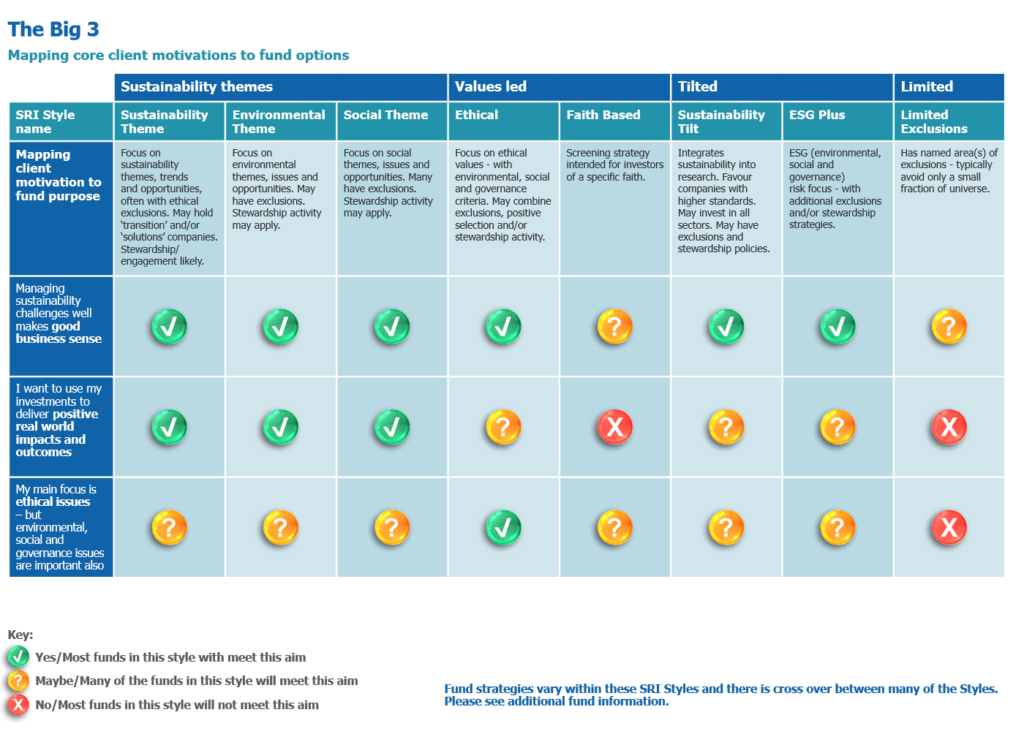
The table below maps our SRI Styles to three common client ‘motivations’ for investing in this area, these are intended to help you get started:
Please be aware that some of the style names shown below have been updated.
This service is for information only. Please speak with a qualified financial adviser for further information.
We are not regulated, do not offer advice and can not deal directly with individual investors.