Invesco Summit Responsible 3 (UK) Fund
SRI Style:
ESG Plus
SDR Labelling:
Unlabelled - promotes sustainable characteristics (has CFD)
Product:
OEIC
Fund Region:
UK
Fund Asset Type:
Multi Asset
Launch Date:
14/01/2021
Last Amended:
Sep 2025
Dialshifter ( ):
):
Fund/Portfolio Size:
£36.07m
(as at: 31/08/2025)
Total Screened Themed SRI Assets:
£99303.10m
(as at: 30/06/2025)
Total Responsible Ownership Assets:
£99303.10m
(as at: 30/06/2025)
Total Assets Under Management:
£2001384.50m
(as at: 30/06/2025)
ISIN:
GB00BMFKGZ59, GB00BMFKH079
Contact Us:
Objectives:
Invesco's Summit Responsible funds intend to invest 100% of its assets (excluding cash and cash equivalents) in investments meeting certain ESG criteria, as well as grow the amount invested over the long term (five years plus).
The Invesco Summit Responsible 3 Fund (UK) The fund will typically have a balanced exposure to debt securities, such as investment grade debt, and equity securities, and aims to have a risk profile of 45% to 75% (level of volatility compared to the MSCI AC World index).
There is no guarantee that the funds will achieve these aims and an investor may not get back the amount invested.
Sustainable, Responsible
&/or ESG Overview:
It is the investment team’s belief that non-financial considerations such as ESG are a third dimension of investing, alongside return and risk. The team acknowledges that consideration of ESG-related factors in investment analysis can help to mitigate risk and/or identify opportunities that may benefit from the ESG-related trends.
For its funds, the team sees ESG considerations as part of an investment toolkit that can help in its macro analysis, fund research and also in underlying fund managers' stock analysis.
It is important to note that no decisions are taken because of ESG scores or ESG analysis alone. Rather, these observations are used to complement other aspects of the team’s own independent research.
ESG is embedded throughout the investment process, both from a top-down and bottom-up perspective
Primary fund last amended:
Sep 2025
Information directly from fund manager.
Fund Filters
Climate Change & Energy
Has a policy which describes the avoidance or limited investment in the nuclear industry. Strategies vary.
Will only invest in companies that report greenhouse gas emissions in line with this international reporting framework. See https://www.fsb-tcfd.org/ https ://www.ifrs.org/sustainability/tcfd/
Ethical Values Led Exclusions
Companies are excluded if they are involved in any aspect of the production chain for tobacco products, including cigarettes, vaping, e-cigarettes, chewing tobacco and cigars.
Companies are excluded if they make more than 5% of their revenue from the manufacture, sale or distribution of tobacco products including cigarettes, vaping, e-cigarettes, chewing tobacco and cigars.
Excludes companies which make controversial weapons such as landmines, cluster munitions and chemical weapons.
Does Not exclude companies with military contracts - this may include medical supplies, food, safety equipment, housing, technology etc.
Has a written civilian firearms exclusion policy - meaning that they will not invest in companies that make (or perhaps also sell) handguns made for non-military users.
Gilts & Sovereigns
Invest in loans issued the government, commonly known as gilts or government bonds. These may or may not be ringfenced for specific projects (see additional options).
Invest in financial instruments issued by governments, but will only hold those that meet certain environmental and or social criteria. This may, for example mean certain assets are excluded in line with eg Freedom House research. Strategies vary.
Banking & Financials
Can include banks as part of their holdings / portfolio.
May invest in insurance companies.
Governance & Management
Has policies that relate to corporate governance issues such as board structure, executive remuneration, bribery and/or corporate corruption. These funds will typically avoid companies with poor practices. Strategies vary.
Exclude companies that are subject to United Nations sanctions. See eg https://main.un.org/securitycouncil/en/content/un-sc-consolidated-list
Product / Service Governance
Find fund / asset managers that factor in 'environmental, social and governance' issues as part of their investment decision making process. A focus on 'ESG' typically means a fund is carrying out additional research to help reduce ESG related risks. It does not necessarily mean a focus on sustainability. Strategies vary. See fund literature.
Asset Size
Invests in a combination of small, medium and larger (potentially multinational) companies / assets.
How The Fund/Portfolio Works
Focuses on finding and investing in companies with positive / beneficial attributes. This strategy can be applied in addition to exclusion criteria and engagement/stewardship activity.
Has principle 'ethical approach' to avoid companies by using negative screening criteria. Strategies vary.
Invest more heavily in assets which have higher ESG ratings/standards or scores and less heavily in companies with lower ESG ratings. Where this is central to the strategy you should expect assets in most sectors. Strategies vary.
Does not use stock lending for performance or risk purposes.
Intended Clients & Product Options
Designed to meet the needs of individual investors with an interest in sustainability issues.
Comments
*Please note - We have partial exclusions to civilian armaments and conventional weapons I.e. based on revenue thresholds for conventional weapons and armaments manufacturers.
This applies to the Invesco Summit Responsible 1 Fund (UK), Invesco Summit Responsible 2 Fund (UK), Invesco Summit Responsible 3 Fund (UK), Invesco Summit Responsible 4 Fund (UK), Invesco Summit Responsible 5 Fund (UK),
Sustainable, Responsible &/or ESG Policy:
It is the investment team’s belief that non-financial considerations such as ESG are a third dimension of investing, alongside return and risk. The team acknowledges that consideration of ESG-related factors in investment analysis can help to mitigate risk and/or identify opportunities that may benefit from the ESG-related trends.
For its funds, the team sees ESG considerations as part of an investment toolkit that can help in its macro analysis, fund research and also in underlying fund managers' stock analysis.
It is important to note that no decisions are taken because of ESG scores or ESG analysis alone. Rather, these observations are used to complement other aspects of the team’s own independent research.
ESG is embedded throughout the investment process, both from a top-down and bottom-up perspective.
Asset allocation
As macro thinkers, ESG considerations naturally form part of the team’s top-down macro research efforts. The VOTE framework drives the team’s tactical asset allocation views. The VOTE framework encompasses a comprehensive set of inputs to facilitate the team's qualitative assessment of markets and asset classes. Here, the team fundamentally grades each asset class and market on the basis of the following factors: Valuations (V), Other factors (O), Technicals (T) and Earnings/Economics (E). Where appropriate, ESG is considered within each of these elements; however, it is within ‘Other’ where ESG is most pertinent. Considerations within this area include politics and policy.
Major political changes, such as a shift from one party to another, for instance, impact the perceived country risk of a particular economy, while social factors such as income inequality play an important role in determining a country’s growth potential. While the team finds that ESG issues, per se, may or may not be determining factors of our economic analysis, they do nonetheless form part of our overall evaluation.
The ESG assessment of developed sovereign exposures harnesses the Fundamental Fixed Income team’s sovereign proprietary ESG ratings, with a minimum issuer score of B.
Fund selection
While the asset allocation stage of the process determines which markets (and how much of those markets) should be owned, responsible fund selection is concerned with determining how these markets are accessed and in ensuring the underlying funds selected deliver on the intended ESG outcomes.
The Summit Responsible portfolios allocate to Invesco’s proprietary ESG ETFs which are selected for their expected ability to yield similar risk/return profiles (through high correlation and low tracking errors) to traditional regional equity and corporate bond indices, but with improved ESG characteristics compared to such traditional indices.
In practice, Invesco’s ESG ETFs maintain exposure to all equity GICS sectors (which helps achieve a low level of active risk and therefore a ‘market-like’ experience) though combine exclusionary and positive tilting approaches within sectors to improve the range’s overall ESG characteristics.
Engagement
The team’s engagement is typically top-down, carried out at a national, industry and regulatory level. Lead manager for the fund range, David Aujla, is engaged with several organisations on responsible investment matters, particularly around the ‘S’ in ESG and on topics such as how financial services can drive social mobility. He founded and co-leads the Diversity Project’s Social Mobility workstream, which seeks to improve socio-economic diversity within the investment and savings industry.
Top-down engagement is complemented with bottom-up efforts where, as a firm, we exercise our rights as active owners to encourage continual improvement in the companies that we invest in. Together with our Sustainable Investing Services team, we may escalate concerns along a broad escalation hierarchy, such as engaging directly with the company’s board and/or senior management, collaborating with fellow shareholders or sponsoring service provider engagement.
Process:
The investment process comprises asset allocation, fund selection, and portfolio construction:
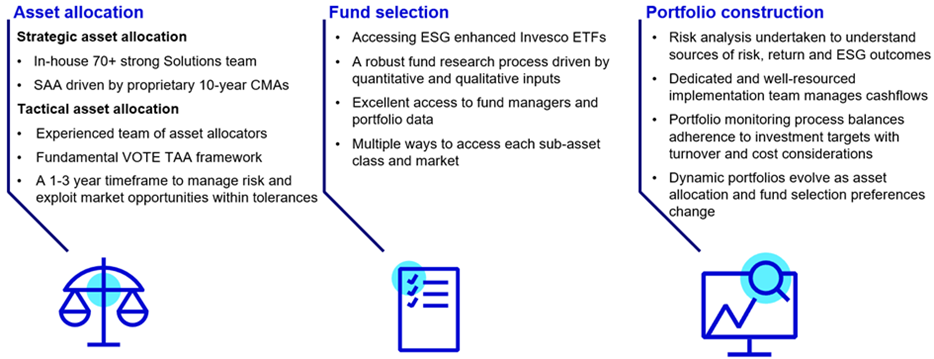
For illustrative purposes only.
Stage 1: Asset allocation
The asset allocation stage determines the asset classes owned and the proportions in which they are owned. There are two key steps in this stage:
- Strategic asset allocation (SAA): The starting point is SAA, which ensures that each portfolio is aligned to its intended risk profile, while seeking to maximise return potential. The team is fortunate to be able to access this expertise via the firm’s in-house global Invesco Solutions team. It is this team’s proprietary 10-year capital market assumptions (CMAs) - risk and return estimates for each asset class - that drives these long-term allocations.
- Tactical asset allocation: Each portfolio’s final positioning is determined by the team’s TAA views, which seek to exploit relative value opportunities between asset classes and markets on a one-to-three-year time horizon. This stage of the process is driven by the team’s fundamental VOTE framework, which combines the team’s deep macro experience and Invesco’s extensive investment capabilities.
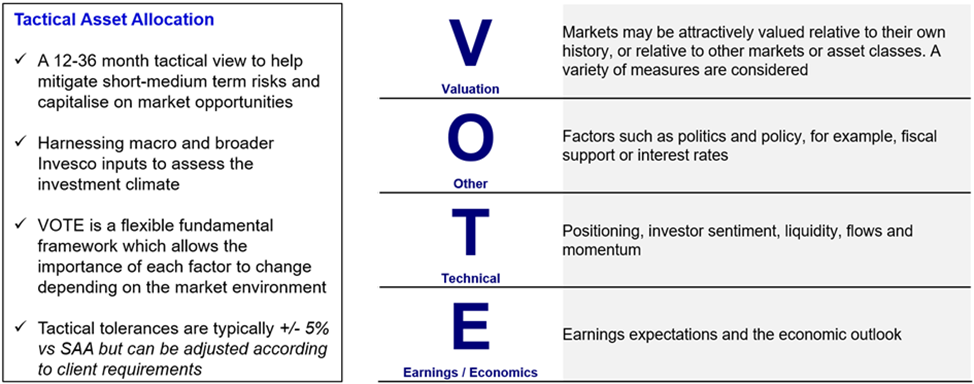
For illustrative purposes only.
The VOTE framework encompasses a comprehensive set of inputs to facilitate the team's qualitative assessment of markets and asset classes. Here, the team fundamentally grades each asset class and market on the basis of the following factors; valuation, other, technicals and earnings/economics. Each market is graded on an A to E scale determining those markets the team believes should be tactically overweight, underweight, or neutral.
Example of the TAA framework:
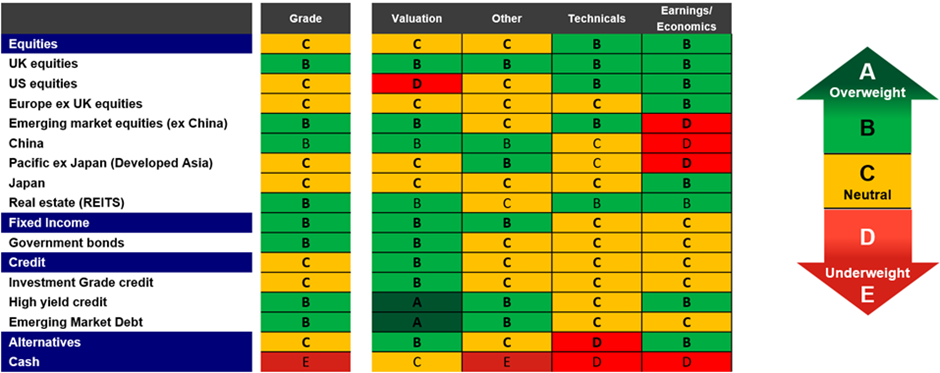
For illustrative purposes only. Red letters denote a score downgrade, green letters denote a score upgrade. Scores range from A to E with A being the strongest rank.
Stage 2: Fund selection
While the asset allocation stage of the process determines which markets (and how much of those markets) should be owned, responsible fund selection is concerned with determining how these markets are accessed and in ensuring the underlying funds selected deliver on the intended ESG outcomes.
Summit Responsible takes relatively little active risk (i.e. typically has low tracking error) as it is designed to deliver a market-like experience with ESG improvements vs a non ESG-comparator.
To achieve this, the Summit Responsible portfolios allocate to Invesco’s proprietary ESG ETFs which are selected for their expected ability to yield similar risk/return profiles (through high correlation and low tracking errors) to traditional regional equity and corporate bond indices, but with improved ESG characteristics compared to such traditional indices.
As a responsible range, Summit Responsible targets a more broad-church approach to ESG, not necessarily a sustainable or impact approach. Therefore, while certain exclusion criteria are applied, a tilting approach within the underlying ETFs is favoured which means overweights towards higher scoring or positive ESG momentum companies.
Importantly, the methodology used is industry neutral so that we don’t end up with significant over-weights to certain sectors or regions as some other ESG funds do. This ensures that this range of funds is more balanced and less skewed to style factors like growth and value or to sectors like technology and oil & gas.
Ultimately this also means that the range has exposure to all the 11 equity GICS sectors (which helps achieve a ‘market-like’ experience) though applies exclusions and positive tilting within sectors to improve its ESG characteristics.
The adopted methodology therefore tends to provide a more balanced outcome for investors in relation to the customary trade-off between tracking error and ESG improvement potential.
With the aim of achieving 100% responsible investments, the underlying ETFs selected by the team typically follow four key index methodologies to deliver responsible outcomes.
The four index methodologies used are:
- MSCI ESG Universal Select Business Screens index
- FTSE All Share ex Investment Trusts ESG Climate Select index
- S&P 500 ESG index
- Bloomberg MSCI Liquid ESG Weighted Bond index.
To varying degrees, each methodology adopts a combination of:
- Negative ESG screening by which certain sectors may be excluded, including but not limited to weapons, oil sands, tobacco or companies that have not been rated due to poor ESG credentials.
- Positive ESG screening or tilting increasing overall exposure to those companies demonstrating a robust ESG profile and/or a positive trend in improving that profile.
Where the range has exposure to government bonds, this will be accessed via Invesco ETFs which meet certain ESG internal criteria but are not inherently ‘ESG’ funds (i.e. such funds do not meet Article 8 or 9 of Sustainable Finance Disclosure Regulation (SFDR) or equivalent local regulation). The ESG assessment of these exposures harnesses the Invesco Fixed Income (IFI) team’s sovereign proprietary ESG rating which rates over 160 sovereign issuers. The Summit Responsible range will invest in issuers whose rating in our proprietary tool is an A or B.
When identifying and selecting the underlying ETFs, the investment team considers the following ESG factors:
- Underlying index ESG methodology: Construction decisions such as exclusions (e.g. business involvement exclusions), revenue thresholds, positive screening or tilting and sustainable selection are considered to ensure they are in line with the requirements of the investment objective and policy, and to maximise consistency of approach where relevant/possible.
- ESG rating/score: The overall ESG score, and the improvement achieved versus an equivalent non-ESG index is considered. In particular, the team is interested in the ESG improvement relative to the active risk (tracking error) taken against a non-ESG index.
- Relative performance: The team seeks to understand how the underlying index can be expected to behave versus its non-ESG equivalent. Performance history is considered where available, and for new (or custom) indices a back-test may be considered.
- Asset class representation: The team seeks to ensure that each fund (and by extension the index it tracks) is representative of the sub-asset class it is intended to reflect. While a low tracking error versus the non-ESG equivalent index can mitigate the risk of poor sub-asset class representation, the team also considers other metrics such as overlap/coverage, relative sector and geographic tilts, and market capitalisation.
- Replication methodology: Whether physical or synthetic, the team seeks transparency over the way in which a fund replicates its underlying index, and where the key risks may lie.
The ‘buy’ decision is qualitative in nature with the investment team making a fundamental assessment of the factors above in the context of the Summit Responsible range investment objectives.
Once selected and part of the portfolio, due diligence on each ETFs is performed at least on a quarterly basis and will undergo a comprehensive due diligence review at least once a year. This is intended to:
- Ensure that at least 80% of each of the five fund’s assets (excluding cash and cash equivalents) are invested responsibly.
- Review any methodological changes of the underlying ETFs. This is supported by regular interaction with the Invesco ETF team.
- Review that the methodologies in use by the underlying ETFs remain relevant to the changing requirements of responsible investing. This is supported by regular interaction with Invesco’s Sustainable Investing Services team.
- Monitor whether the underlying ETFs are behaving in line with expectations.
- Review if alternative funds exist that would improve the risk, return or ESG criteria of the Summit Responsible range.
The investment team benefits from excellent access to information on underlying ETFs as well as regular engagement with their fund managers.
Where an underlying ETF has ceased to be suitable (for example, due to a change or deterioration in its ESG characteristics in the opinion of the investment team), funds part of the Summit Responsible range may continue to hold such investment until such time that it is possible and practicable, in the team’s view, to liquidate the position.
The team also monitors and measures each fund’s performance with metrics and indicators such as the fund’s ESG score, ESG rating and carbon intensity. This is done by aggregating data from the underlying ETFs and third-party data providers. The team compares this against the same indicators for a relevant comparable broad market index to measure the attainment of the environmental and/or social characteristics promoted by the Range.
Each fund’s ESG characteristics is outlined in monthly factsheets which have an ESG addendum, as well as in a detailed half yearly report. The half yearly reports are produced by an independent third party on Invesco’s behalf and utilise MSCI data. Both the factsheets and the half yearly reports can be found on the funds’ product pages on our website.
Stage 3: Portfolio construction
Before final portfolios are determined they are analysed by the on-desk dedicated risk manager who provides detailed risk analysis to the fund managers. This is to ensure that the funds are aligned with intended risk profiles and that the risk exposures are consistent across the portfolios and aligned with the views of the investment team.
The contributors to portfolio risk, both absolute and relative, are decomposed to ensure that risk is well balanced, in-line with expectations and that no unintended biases or skews exist. Scenario analysis is also undertaken to understand how the portfolios may have behaved in given historical environments, and ‘what-if’ analysis to understand what may happen in forward-looking, or hypothetical, scenarios.
Resources, Affiliations & Corporate Strategies:
Created in 2013, Invesco’s dedicated Sustainable Investing Services (SIS) team and the Proxy Voting team are responsible for leveraging best practices globally in sustainable investing capabilities across Invesco including ESG integration, voting and engagement, supporting distribution teams with client engagement, and advising product teams on sustainability innovation.
Our Global SIS and Proxy Voting teams act as a centralised resource to guide, support and inform Invesco's investment teams on all work in this area. The teams are organized across five pillars:
- Client: Guides messaging and training for distribution teams, engages clients on ESG issues, and supports product strategy.
- Research: Conducts proprietary ESG research and collaborates with investment teams on engagements.
- Analytics: Manages ESG analytics, data vendor selection, portfolio screening and reviews.
- Operations: Project manages sustainability-focused initiatives and manages the scheduling and organization for the SIS team.
- Proxy: Provides guidance on governance issues and supports development of our PROXYintel voting platform and Global Proxy Voting Policy.
The combined SIS and proxy Voting teams includes 36 ESG professionals (as at 30 June 2025) located in North America, Asia Pacific, and EMEA who provide localized support and analysis to our investment teams across the globe.
Our sustainable investing services professionals collaborate closely with these investment teams, providing support, insights and analysis while investment teams maintain discretion on portfolio decisions. Our governance structure enables oversight and accountability through the ESG Steering Committee, while allowing our investment teams to integrate sustainable investing approaches tailored to their asset classes and styles.
As shown in the following organizational chart, the combined team comprises five pillars to support sustainable investing efforts across specific functions firm-wide. The team's geographic structure also ensures that most Invesco teams have an appropriate local contact. The ESG Steering Committee, asset class-specific investment teams, and firm-wide functional units also collaborate with SIS team members from each of the five pillars.
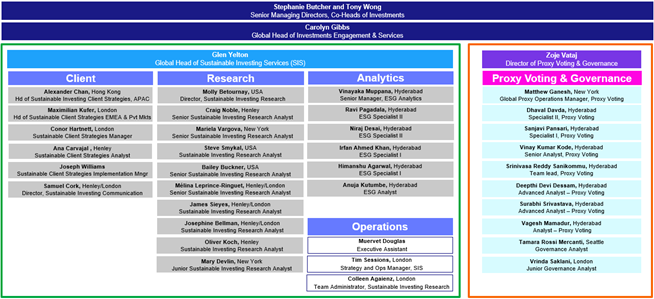
Source: Invesco as of 30 June 2025. For illustrative purposes only.
Each investment team has a unique approach to incorporating sustainable investing considerations, as defined in its investment process and appropriate for the respective asset class. To support this effort, Invesco has dedicated specialists and champions within individual investment teams across the globe. These individuals are closely connected with the SIS team and formally collaborate via the ESG Steering Committee.
Governance oversight structure
Managing risk is an integral part of our investment culture at Invesco, and it starts with the recognition that everyone plays a role in risk management. Built with multiple lines of defense, our risk management approach seeks to ensure that our managers adhere to best practices. The goal is for portfolios to perform as expected and for clients to feel confident in their investment.
Investment teams
We believe the best outcomes are achieved through distinct investment teams across the globe, with discrete investment perspectives, operating under a disciplined philosophy and process. To support the unique needs of each investment team, each one deploys a robust risk management framework that is tailored to its investment process and is owned by its CIO. Each of our teams uses its framework to thoroughly assess the risk and return characteristics of each individual security and carefully calibrates the overall risk level of the portfolio when these investments are combined. Teams incorporate environmental, social, or governance related considerations where relevant or required to achieve portfolio objectives. Investment team leaders have responsibility for overseeing the implementation of investment strategies including those with ESG related objectives or incorporating ESG factors.
Multiple groups within Invesco
At each step in the process, the investment teams are provided with global expertise and support that enhances their risk management efforts. The following groups provide oversight of the investment teams to make sure they are operating within best practices as well as their stated objectives:
- Investment Risk Management is responsible for identifying, measuring, and monitoring appropriate portfolio risks to ensure that each portfolio is managed as intended
- Global Performance delivers customized portfolio performance analysis and attribution reporting that facilitates the Investment Risk evaluation of whether ex-post performance results are aligned with ex-ante risk expectations
- Global Compliance monitors pre- and post-trade compliance and performs other fiduciary assurance functions
- Other governance structures that assure best practices include the Global Trade Operations Committee, the New Instrument Committee, the Pricing Committee and the Proxy Committee
Senior leaders, independent boards and audit teams
Oversight is critical. The following groups provide a high-level review of the entire process:
- The Invesco Performance and Risk Committeeis composed of senior leaders who review risk and performance issues and monitor progress against the firm-wide strategic priority of achieving strong investment performance.
- Internal Audit provides end-to-end process review to identify any control gaps and execution challenges.
Given the importance that Invesco places on ESG at an investment level, Invesco has a governance structure across multiple dimensions, which enables oversight and accountability for effective stewardship.
Invesco’s Sustainable Investing Services Team acts as a global resource, responsible for investment team support and analysis related to ESG risks and opportunities, voting and engagement, supporting the distribution teams with client engagement, and advising product teams on ESG innovation, while investment teams maintain discretion on portfolio decisions. The team comprises professionals located across three regions: North America, Asia Pacific and EMEA. The team is organized across four pillars that define their major responsibilities: Client, Research, Proxy and Analytics.
The ESG Executive Steering Committee (ESG Executive Steerco) establishes strategic direction for and implementation of ESG related investment management initiatives at Invesco. The Committee is composed of representatives from Investments, Distribution, and many functional areas. It provides direction for resource allocation and operational implementation while facilitating communication across the firm. The Committee aids in fostering global collaboration on ESG issues, enabling us to benefit from diverse perspectives and maintain consistent standards. Alongside various cross-functional working groups, it encapsulates our inclusive approach to ESG, ensuring a purposeful, holistic strategy that aligns with client objectives.
We have created a variety of working groups across the organization in support of delivering ESG related investment capabilities. Some groups are tasked with delivering on a specific initiative or facilitating collaboration across an asset class or region. Others are designed for providing broad communication about current themes or regulation, tools or resources such as data, or they focus on evergreen priorities including proxy voting.
Invesco's Global Invesco Proxy Advisory Committee is guided by our philosophy that investment teams should manage proxy voting. It is a global investments-driven committee comprised of representatives from various investment management teams and chaired by the Director of Proxy Voting and Governance. The committee provides a forum for investment teams to monitor, understand and discuss key proxy issues and voting trends within the Invesco complex, to assist us in meeting regulatory obligations, and to consider conflicts of interest in the proxy voting process.
Assurance
Internal Audit prepares a risk-based audit plan at least semi-annually based on its assessment of the risks presented by various activities within the firm. The Department begins by determining and closely examining the universe of Invesco’s functional areas and entities, engaging in discussions with responsible parties and various assurance functions, reviewing market and industry developments, reviewing discussion topics raised by risk management committees, and considering regulatory expectations.
Each item in the universe is given a ranking of Critical, Major, Moderate or Minor risk that accounts for both the likelihood a particular risk event could occur and the associated impact to the organization. Determination of the appropriate risk ratings involves an evaluation of many factors including but not limited to: Financial, Legal/Regulatory, Reputational, Operational, Customer or Client, and Market Detriment impacts.
During this process, other assurance reviews are also considered. Internal Audit uses the overall risk assessment scores noted above, along with the regulatory requirements, guidance and feedback from the Audit Committee and senior management, to preliminarily assess whether a process should be considered for inclusion in the audit plan. Based on the result of risk assessment, ESG related matters may be identified for audit coverage as part of the audit plan
Additionally, the Global Compliance department's annual testing plan seeks to assess compliance in key risk areas, avoiding duplication of testing and considering other control reviews, including internal audits. Our Compliance Monitoring team seeks to apply testing standards consistent with regulatory expectations in each region in which Invesco operates, and reports findings to senior management of Compliance and other impacted business functions. For example, in 2020 the Compliance Monitoring team conducted an advisory review of proxy voting in North America. The purpose of this review was to provide guidance and recommendations around the region's proxy voting process, to evaluate whether policies and procedures were reasonably designed and to determine how effectively the controls in place comply with regulations.
Membership of other ESG/RI associations
Invesco is an active member and supporter of several external organisations, largely via our global investment teams. Following is a representative list of current affiliations.
A member of:
- 30% Club Japan Investors Group
- Asian Corporate Governance Association (ACGA)
- Asia Investor Group on Climate Change (AIGCC)
- Better Building Partnership (BBP)
- Carbon Disclosure Project
- Climate Bonds Initiative
- Corporate Responsibility Interface Center (CRIC) (DACH countries)
- Council of Institutional Investors (CII) (US)
- Farm Animal Investment Risk & Return Initiative (FAIRR)
- Global Real Estate Sustainability Benchmark (GRESB)
- EFAMA Sustainable Finance Committee
- ESG Disclosure Study Group (Japan)
- Hong Kong Green Finance Association (HKGFA)
- IFRS Advisory Council (oversees ISSB – successor to SASB)
- Investment Company Institute (ICI) (ICI Fund Disclosure Working Group, ICI Global ESG Task Force, and ICI Proxy Issues Working Group)
- Investment Association (UK)
- Investor Forum (UK)
- Institutional Investors Group on Climate Change (IIGCC), including Net Zero Investment Framework working group
- Investment Management Education Alliance (IMEA)
- Ireland Central Bank group (Invesco Investment Management Limited)
- Irish Funds ESG Legal committee
- One Planet Asset Managers
- Quoted Companies Alliance (QCA)
- Responsible Investment Association (RIA) (Canada)
- Responsible Investment Association Australasia (RIAA)
- Task force on Climate-Related Financial Disclosures (TCFD) (Supporter and Discloser), TCFD Consortium
- Transition Pathway Initiative
- Task force on Nature-Related Financial Disclosures’ (TNFD) Forum
- UK Sustainable Investment and Finance Association (UKSIF)
A signatory to:
- Principles for Responsible Investment (PRI)
- EFAMA Stewardship Code
- Indian Stewardship Code
- Japan’s Stewardship Code
- UK Stewardship Code
- Net Zero Asset Managers Initiative
Additionally, GRESB provides the basis for the reporting, scoring and peer ranking of Invesco Real Estate's (IRE’s) ESG management and policies:
- IRE has submitted data to GRESB since 2012 and has been a GRESB member since 2014.
- In 2024, six IRE-managed strategies achieved five out of five Green Stars, placing them in the top 20% of all global submissions in 2024.
Source: Invesco as at 30 June 2025.
Invesco is committed to adopting and implementing responsible investment principles in a manner that is consistent with its fiduciary responsibilities to clients. We have a client-centric approach to responsible investing which focuses on customising solutions to client needs and objectives. Therefore, we do not apply a single, top-down, firm-wide responsible investing policy or process, instead, our investment teams implement policies or processes tailored to their asset classes, investment styles and client objectives. Where appropriate, sustainable and responsible investing policies are applied on a product-by-product basis in alignment with regional regulatory or client requirements.
We believe this approach is better than a one-size-fits-all methodology and allows us to provide a range of sustainable investing capabilities that support our clients in meeting their various objectives.
While we do not have a specific firm-wide responsible investing policy in the strictest definition, we do have a number of sustainability-related policies, statements and reports at the firm level which in aggregate lay out a high-level vision for responsible investing. These are listed below.
- Investment Stewardship Report outlines Invesco's accomplishments, reaffirming our commitment to global stewardship and detailing how our endeavours reinforce this core mission.
- Invesco’s Policy Statement on Global Corporate Governance and Proxy Voting describes Invesco's commitment to responsible investing and proxy voting, as well as the good governance principles that inform our approach to engagement and voting at shareholder meetings.
Invesco's Task Force on Climate Related Financial Disclosures (TCFD) Report seeks to build on our past experience and provide a comparable, investor-relevant disclosure on our activities and capabilities in climate-aware investing.
SDR Labelling:
Unlabelled - promotes sustainable characteristics (has CFD)
Key Performance Indicators:
While the fund does not pursue a specific sustainability objective or Sustainability goal(s), the fund does consider environmental, societal and governance factors as part of its Responsible investment approach. The fund is designed to deliver improved ESG outcomes vs a non-ESG comparator, and does so in a market-like way which limits structural skews to styles and sectors.
- Consumer Facing Disclosure
SDR Literature:
Literature
Voting Record
Disclaimer
Investment risks
The value of investments and any income will fluctuate (this may partly be the result of exchange rate fluctuations) and investors may not get back the full amount invested.
The use of ESG criteria may affect the Fund’s investment performance and therefore may perform differently compared to similar products that do not screen investment opportunities against ESG criteria.
The issuers of the debt securities to which the product is exposed may not always make interest and other payments due to financial difficulties or insolvency. The value of the debt securities may fall due to poor market conditions, such as a decrease in market liquidity, and/or variations in interest rates. These risks increase where the product invests in high yield, or lower credit quality, bonds.
The product may be exposed to securities of emerging and developing markets, where difficulties in relation to market liquidity, dealing, settlement and custody problems could arise which could result in losses.
The product's use of financial derivatives may result in the product being leveraged, that is, the economic exposure created by using a derivative may be greater than the amount invested. The product, therefore, has the potential to lose more than it paid. If a counterparty becomes insolvent this will also result in a loss. The use of certain derivatives may also impair the product’s liquidity which may mean the product has to close positions at an unfavourable price.
Important information
This marketing communication is for Professional Clients only.
Data as at 31 August 2025, unless otherwise stated.
This is marketing material and not financial advice. It is not intended as a recommendation to buy or sell any particular asset class, security or strategy. Regulatory requirements that require impartiality of investment/investment strategy recommendations are therefore not applicable nor are any prohibitions to trade before publication.
Views and opinions are based on current market conditions and are subject to change.
Telephone calls may be recorded.
For the most up to date information on our funds, please refer to the relevant fund and share class-specific [Key Investor Information Documents/Key Information Documents], the Supplementary Information Document, the ICVC ISA Terms and Conditions, the financial reports and the Prospectus, which are available using the contact details shown. For details of fund specific risks, please refer to the relevant [Key Investor Information Documents/Key Information Documents].
The Fund does not have a UK sustainability investment label because it does not meet the criteria set by the FCA’s Sustainability Disclosure Requirements. These labels are designed to help investors identify products with specific sustainability goals.
Issued by: Invesco Fund Managers Limited, Perpetual Park, Perpetual Park Drive, Henley-on-Thames, Oxfordshire RG9 1HH, UK. Authorised and regulated by the Financial Conduct Authority.
| Fund Name | SRI Style | SDR Labelling | Product | Region | Asset Type | Launch Date | Last Amended |
|
|---|---|---|---|---|---|---|---|---|
Invesco Summit Responsible 3 (UK) Fund |
ESG Plus | Unlabelled - promotes sustainable characteristics (has CFD) | OEIC | UK | Multi Asset | 14/01/2021 | Sep 2025 | |
ObjectivesInvesco's Summit Responsible funds intend to invest 100% of its assets (excluding cash and cash equivalents) in investments meeting certain ESG criteria, as well as grow the amount invested over the long term (five years plus). The Invesco Summit Responsible 3 Fund (UK) The fund will typically have a balanced exposure to debt securities, such as investment grade debt, and equity securities, and aims to have a risk profile of 45% to 75% (level of volatility compared to the MSCI AC World index). There is no guarantee that the funds will achieve these aims and an investor may not get back the amount invested.
|
Fund/Portfolio Size: £36.07m (as at: 31/08/2025) Total Screened Themed SRI Assets: £99303.10m (as at: 30/06/2025) Total Responsible Ownership Assets: £99303.10m (as at: 30/06/2025) Total Assets Under Management: £2001384.50m (as at: 30/06/2025) ISIN: GB00BMFKGZ59, GB00BMFKH079 Contact Us: InvescoEMEARFPteam@invesco.com |
|||||||
Sustainable, Responsible &/or ESG OverviewIt is the investment team’s belief that non-financial considerations such as ESG are a third dimension of investing, alongside return and risk. The team acknowledges that consideration of ESG-related factors in investment analysis can help to mitigate risk and/or identify opportunities that may benefit from the ESG-related trends. ESG is embedded throughout the investment process, both from a top-down and bottom-up perspective |
||||||||
|
Primary fund last amended: Sep 2025 |
||||||||
|
Information received directly from Fund Manager |
||||||||
|
Please select what you would like to read:
Fund FiltersClimate Change & Energy
Nuclear exclusion policy
Has a policy which describes the avoidance or limited investment in the nuclear industry. Strategies vary.
TCFD / IFRS reporting requirement
Will only invest in companies that report greenhouse gas emissions in line with this international reporting framework. See https://www.fsb-tcfd.org/ https ://www.ifrs.org/sustainability/tcfd/ Ethical Values Led Exclusions
Tobacco & related product manufacturers excluded
Companies are excluded if they are involved in any aspect of the production chain for tobacco products, including cigarettes, vaping, e-cigarettes, chewing tobacco and cigars.
Tobacco & related products - avoid where revenue > 5%
Companies are excluded if they make more than 5% of their revenue from the manufacture, sale or distribution of tobacco products including cigarettes, vaping, e-cigarettes, chewing tobacco and cigars.
Controversial weapons exclusion
Excludes companies which make controversial weapons such as landmines, cluster munitions and chemical weapons.
Military involvement not excluded
Does Not exclude companies with military contracts - this may include medical supplies, food, safety equipment, housing, technology etc.
Civilian firearms production exclusion
Has a written civilian firearms exclusion policy - meaning that they will not invest in companies that make (or perhaps also sell) handguns made for non-military users. Gilts & Sovereigns
Invests in gilts / government bonds
Invest in loans issued the government, commonly known as gilts or government bonds. These may or may not be ringfenced for specific projects (see additional options).
Invests in sovereigns subject to screening criteria
Invest in financial instruments issued by governments, but will only hold those that meet certain environmental and or social criteria. This may, for example mean certain assets are excluded in line with eg Freedom House research. Strategies vary. Banking & Financials
Invests in banks
Can include banks as part of their holdings / portfolio.
Invests in insurers
May invest in insurance companies. Governance & Management
Governance policy
Has policies that relate to corporate governance issues such as board structure, executive remuneration, bribery and/or corporate corruption. These funds will typically avoid companies with poor practices. Strategies vary.
UN sanctions exclusion
Exclude companies that are subject to United Nations sanctions. See eg https://main.un.org/securitycouncil/en/content/un-sc-consolidated-list Product / Service Governance
ESG integration strategy
Find fund / asset managers that factor in 'environmental, social and governance' issues as part of their investment decision making process. A focus on 'ESG' typically means a fund is carrying out additional research to help reduce ESG related risks. It does not necessarily mean a focus on sustainability. Strategies vary. See fund literature. Asset Size
Invests in small, mid & large cap companies / assets
Invests in a combination of small, medium and larger (potentially multinational) companies / assets. How The Fund/Portfolio Works
Positive selection bias
Focuses on finding and investing in companies with positive / beneficial attributes. This strategy can be applied in addition to exclusion criteria and engagement/stewardship activity.
Negative selection bias
Has principle 'ethical approach' to avoid companies by using negative screening criteria. Strategies vary.
ESG weighted / tilt
Invest more heavily in assets which have higher ESG ratings/standards or scores and less heavily in companies with lower ESG ratings. Where this is central to the strategy you should expect assets in most sectors. Strategies vary.
Do not use stock / securities lending
Does not use stock lending for performance or risk purposes. Intended Clients & Product Options
Intended for clients interested in sustainability
Designed to meet the needs of individual investors with an interest in sustainability issues. Comments*Please note - We have partial exclusions to civilian armaments and conventional weapons I.e. based on revenue thresholds for conventional weapons and armaments manufacturers. Sustainable, Responsible &/or ESG Policy:It is the investment team’s belief that non-financial considerations such as ESG are a third dimension of investing, alongside return and risk. The team acknowledges that consideration of ESG-related factors in investment analysis can help to mitigate risk and/or identify opportunities that may benefit from the ESG-related trends. For its funds, the team sees ESG considerations as part of an investment toolkit that can help in its macro analysis, fund research and also in underlying fund managers' stock analysis. ESG is embedded throughout the investment process, both from a top-down and bottom-up perspective. Asset allocation Process:The investment process comprises asset allocation, fund selection, and portfolio construction:
For illustrative purposes only.
For illustrative purposes only.
For illustrative purposes only. Red letters denote a score downgrade, green letters denote a score upgrade. Scores range from A to E with A being the strongest rank.
To varying degrees, each methodology adopts a combination of:
Where the range has exposure to government bonds, this will be accessed via Invesco ETFs which meet certain ESG internal criteria but are not inherently ‘ESG’ funds (i.e. such funds do not meet Article 8 or 9 of Sustainable Finance Disclosure Regulation (SFDR) or equivalent local regulation). The ESG assessment of these exposures harnesses the Invesco Fixed Income (IFI) team’s sovereign proprietary ESG rating which rates over 160 sovereign issuers. The Summit Responsible range will invest in issuers whose rating in our proprietary tool is an A or B.
Once selected and part of the portfolio, due diligence on each ETFs is performed at least on a quarterly basis and will undergo a comprehensive due diligence review at least once a year. This is intended to:
Where an underlying ETF has ceased to be suitable (for example, due to a change or deterioration in its ESG characteristics in the opinion of the investment team), funds part of the Summit Responsible range may continue to hold such investment until such time that it is possible and practicable, in the team’s view, to liquidate the position. The team also monitors and measures each fund’s performance with metrics and indicators such as the fund’s ESG score, ESG rating and carbon intensity. This is done by aggregating data from the underlying ETFs and third-party data providers. The team compares this against the same indicators for a relevant comparable broad market index to measure the attainment of the environmental and/or social characteristics promoted by the Range. Each fund’s ESG characteristics is outlined in monthly factsheets which have an ESG addendum, as well as in a detailed half yearly report. The half yearly reports are produced by an independent third party on Invesco’s behalf and utilise MSCI data. Both the factsheets and the half yearly reports can be found on the funds’ product pages on our website. Resources, Affiliations & Corporate Strategies:Created in 2013, Invesco’s dedicated Sustainable Investing Services (SIS) team and the Proxy Voting team are responsible for leveraging best practices globally in sustainable investing capabilities across Invesco including ESG integration, voting and engagement, supporting distribution teams with client engagement, and advising product teams on sustainability innovation. Our Global SIS and Proxy Voting teams act as a centralised resource to guide, support and inform Invesco's investment teams on all work in this area. The teams are organized across five pillars:
The combined SIS and proxy Voting teams includes 36 ESG professionals (as at 30 June 2025) located in North America, Asia Pacific, and EMEA who provide localized support and analysis to our investment teams across the globe. Our sustainable investing services professionals collaborate closely with these investment teams, providing support, insights and analysis while investment teams maintain discretion on portfolio decisions. Our governance structure enables oversight and accountability through the ESG Steering Committee, while allowing our investment teams to integrate sustainable investing approaches tailored to their asset classes and styles. As shown in the following organizational chart, the combined team comprises five pillars to support sustainable investing efforts across specific functions firm-wide. The team's geographic structure also ensures that most Invesco teams have an appropriate local contact. The ESG Steering Committee, asset class-specific investment teams, and firm-wide functional units also collaborate with SIS team members from each of the five pillars.
Source: Invesco as of 30 June 2025. For illustrative purposes only. Each investment team has a unique approach to incorporating sustainable investing considerations, as defined in its investment process and appropriate for the respective asset class. To support this effort, Invesco has dedicated specialists and champions within individual investment teams across the globe. These individuals are closely connected with the SIS team and formally collaborate via the ESG Steering Committee. Governance oversight structure Managing risk is an integral part of our investment culture at Invesco, and it starts with the recognition that everyone plays a role in risk management. Built with multiple lines of defense, our risk management approach seeks to ensure that our managers adhere to best practices. The goal is for portfolios to perform as expected and for clients to feel confident in their investment. Investment teams We believe the best outcomes are achieved through distinct investment teams across the globe, with discrete investment perspectives, operating under a disciplined philosophy and process. To support the unique needs of each investment team, each one deploys a robust risk management framework that is tailored to its investment process and is owned by its CIO. Each of our teams uses its framework to thoroughly assess the risk and return characteristics of each individual security and carefully calibrates the overall risk level of the portfolio when these investments are combined. Teams incorporate environmental, social, or governance related considerations where relevant or required to achieve portfolio objectives. Investment team leaders have responsibility for overseeing the implementation of investment strategies including those with ESG related objectives or incorporating ESG factors. Multiple groups within Invesco At each step in the process, the investment teams are provided with global expertise and support that enhances their risk management efforts. The following groups provide oversight of the investment teams to make sure they are operating within best practices as well as their stated objectives:
Senior leaders, independent boards and audit teams Oversight is critical. The following groups provide a high-level review of the entire process:
Given the importance that Invesco places on ESG at an investment level, Invesco has a governance structure across multiple dimensions, which enables oversight and accountability for effective stewardship. Invesco’s Sustainable Investing Services Team acts as a global resource, responsible for investment team support and analysis related to ESG risks and opportunities, voting and engagement, supporting the distribution teams with client engagement, and advising product teams on ESG innovation, while investment teams maintain discretion on portfolio decisions. The team comprises professionals located across three regions: North America, Asia Pacific and EMEA. The team is organized across four pillars that define their major responsibilities: Client, Research, Proxy and Analytics. The ESG Executive Steering Committee (ESG Executive Steerco) establishes strategic direction for and implementation of ESG related investment management initiatives at Invesco. The Committee is composed of representatives from Investments, Distribution, and many functional areas. It provides direction for resource allocation and operational implementation while facilitating communication across the firm. The Committee aids in fostering global collaboration on ESG issues, enabling us to benefit from diverse perspectives and maintain consistent standards. Alongside various cross-functional working groups, it encapsulates our inclusive approach to ESG, ensuring a purposeful, holistic strategy that aligns with client objectives. We have created a variety of working groups across the organization in support of delivering ESG related investment capabilities. Some groups are tasked with delivering on a specific initiative or facilitating collaboration across an asset class or region. Others are designed for providing broad communication about current themes or regulation, tools or resources such as data, or they focus on evergreen priorities including proxy voting. Invesco's Global Invesco Proxy Advisory Committee is guided by our philosophy that investment teams should manage proxy voting. It is a global investments-driven committee comprised of representatives from various investment management teams and chaired by the Director of Proxy Voting and Governance. The committee provides a forum for investment teams to monitor, understand and discuss key proxy issues and voting trends within the Invesco complex, to assist us in meeting regulatory obligations, and to consider conflicts of interest in the proxy voting process. Assurance Internal Audit prepares a risk-based audit plan at least semi-annually based on its assessment of the risks presented by various activities within the firm. The Department begins by determining and closely examining the universe of Invesco’s functional areas and entities, engaging in discussions with responsible parties and various assurance functions, reviewing market and industry developments, reviewing discussion topics raised by risk management committees, and considering regulatory expectations. Additionally, the Global Compliance department's annual testing plan seeks to assess compliance in key risk areas, avoiding duplication of testing and considering other control reviews, including internal audits. Our Compliance Monitoring team seeks to apply testing standards consistent with regulatory expectations in each region in which Invesco operates, and reports findings to senior management of Compliance and other impacted business functions. For example, in 2020 the Compliance Monitoring team conducted an advisory review of proxy voting in North America. The purpose of this review was to provide guidance and recommendations around the region's proxy voting process, to evaluate whether policies and procedures were reasonably designed and to determine how effectively the controls in place comply with regulations. Membership of other ESG/RI associations Invesco is an active member and supporter of several external organisations, largely via our global investment teams. Following is a representative list of current affiliations. A member of:
A signatory to:
Additionally, GRESB provides the basis for the reporting, scoring and peer ranking of Invesco Real Estate's (IRE’s) ESG management and policies:
Source: Invesco as at 30 June 2025. Invesco is committed to adopting and implementing responsible investment principles in a manner that is consistent with its fiduciary responsibilities to clients. We have a client-centric approach to responsible investing which focuses on customising solutions to client needs and objectives. Therefore, we do not apply a single, top-down, firm-wide responsible investing policy or process, instead, our investment teams implement policies or processes tailored to their asset classes, investment styles and client objectives. Where appropriate, sustainable and responsible investing policies are applied on a product-by-product basis in alignment with regional regulatory or client requirements.
Invesco's Task Force on Climate Related Financial Disclosures (TCFD) Report seeks to build on our past experience and provide a comparable, investor-relevant disclosure on our activities and capabilities in climate-aware investing. SDR Labelling:Unlabelled - promotes sustainable characteristics (has CFD) Key Performance Indicators:
While the fund does not pursue a specific sustainability objective or Sustainability goal(s), the fund does consider environmental, societal and governance factors as part of its Responsible investment approach. The fund is designed to deliver improved ESG outcomes vs a non-ESG comparator, and does so in a market-like way which limits structural skews to styles and sectors.
SDR Literature:LiteratureVoting RecordDisclaimerInvestment risks The value of investments and any income will fluctuate (this may partly be the result of exchange rate fluctuations) and investors may not get back the full amount invested. The use of ESG criteria may affect the Fund’s investment performance and therefore may perform differently compared to similar products that do not screen investment opportunities against ESG criteria. The issuers of the debt securities to which the product is exposed may not always make interest and other payments due to financial difficulties or insolvency. The value of the debt securities may fall due to poor market conditions, such as a decrease in market liquidity, and/or variations in interest rates. These risks increase where the product invests in high yield, or lower credit quality, bonds. The product may be exposed to securities of emerging and developing markets, where difficulties in relation to market liquidity, dealing, settlement and custody problems could arise which could result in losses. The product's use of financial derivatives may result in the product being leveraged, that is, the economic exposure created by using a derivative may be greater than the amount invested. The product, therefore, has the potential to lose more than it paid. If a counterparty becomes insolvent this will also result in a loss. The use of certain derivatives may also impair the product’s liquidity which may mean the product has to close positions at an unfavourable price. Important information This marketing communication is for Professional Clients only. Data as at 31 August 2025, unless otherwise stated. This is marketing material and not financial advice. It is not intended as a recommendation to buy or sell any particular asset class, security or strategy. Regulatory requirements that require impartiality of investment/investment strategy recommendations are therefore not applicable nor are any prohibitions to trade before publication. Views and opinions are based on current market conditions and are subject to change. Telephone calls may be recorded. For the most up to date information on our funds, please refer to the relevant fund and share class-specific [Key Investor Information Documents/Key Information Documents], the Supplementary Information Document, the ICVC ISA Terms and Conditions, the financial reports and the Prospectus, which are available using the contact details shown. For details of fund specific risks, please refer to the relevant [Key Investor Information Documents/Key Information Documents]. The Fund does not have a UK sustainability investment label because it does not meet the criteria set by the FCA’s Sustainability Disclosure Requirements. These labels are designed to help investors identify products with specific sustainability goals. Issued by: Invesco Fund Managers Limited, Perpetual Park, Perpetual Park Drive, Henley-on-Thames, Oxfordshire RG9 1HH, UK. Authorised and regulated by the Financial Conduct Authority. |
||||||||