
PIMCO GIS Global Bond ESG Fund
SRI Style:
ESG Plus
SDR Labelling:
Not eligible to use label (out of scope)
Product:
SICAV/Overseas
Fund Region:
Global
Fund Asset Type:
Fixed Interest
Launch Date:
12/01/2017
Last Amended:
Jul 2025
Dialshifter ( ):
):
Fund/Portfolio Size:
£3080.00m
(as at: 30/11/2025)
Total Screened Themed SRI Assets:
£450.00m
(as at: 31/03/2025)
Total Assets Under Management:
£1484221.00m
(as at: 31/03/2025)
ISIN:
IE00BYXVXY22, IE00BL58ST02, IE000LSJTG38, IE00BMFKKN11
Objectives:
The PIMCO GIS Global Bond ESG Fund emphasizes a diversified, multi-sector allocation with a high quality stance, while seeking to promote environmental and social characteristics via meaningful allocations to ESG labelled bonds, reducing its carbon footprint, and engagement activity on sustainability issues. By bringing together our time-tested investment process and ESG investing philosophy, PIMCO GIS Global Bond ESG Fund delivers an ESG-optimized global bond strategy with the flexibility to access a diversified opportunity set. The Fund promotes sustainability characteristics by leveraging PIMCO’s “3 Es”, our active ESG optimization process in global markets (Exclude, Evaluate, Engage). The fund seeks to exclude issuers that PIMCO deem to be fundamentally misaligned with sustainability practices.
Sustainable, Responsible
&/or ESG Overview:
Fund Description
The investment objective of the Fund is to seek to maximise total return, consistent with preservation of capital and prudent investment management. The Global Bond ESG Fund is a diverse, actively managed portfolio of global fixed-income securities, selected according to PIMCO’s internal ESG screening process alongside traditional investment characteristics and screening.
The Fund Advantage
The Fund benefits from PIMCO’s advanced sustainability capabilities, including proprietary ESG scoring frameworks for all major asset classes in the investment universe. Alongside corporate credit frameworks, PIMCO has tailored ESG frameworks for sovereigns, SSA, securitized credit and municipals. In addition, the Fund utilizes PIMCO’s bespoke ESG labelled bond framework which is incorporated in the Fund’s assessment of ESG labelled bonds – where the Fund seeks meaningful exposure to.
Primary fund last amended:
Jul 2025
Information directly from fund manager.
Fund Filters
Sustainability - General
Has policies that consider (environmental and social) sustainability issues. Strategies vary but are likely to consider environmental issues like climate change, carbon emissions, biodiversity loss, resource management, environmental impacts; and social issues like equal opportunities, human rights, labour standards, diversity and adherence to internationally recognised codes. See individual entry information.
Has a significant focus on sustainability issues
Aim to encourage higher sustainability standards through responsible ownership / stewardship / engagement / voting activity
Use the UN Global Compact to inform or help direct where they can or cannot invest. Will typically not invest in companies with significant breaches (low standards) - strategies vary. (The UNGC covers a wide range of issues - search 'UNGC'). See https://unglobalcompact.org/
Environmental - General
Has policies which relate to environmental issues. These will typically set out their stance on issues such as pollution, climate change, resource management, biodiversity loss, carbon emissions, plastics and/or additional environmental impacts. Strategies vary.
Options that limit or 'reduce' their exposure to carbon intensive industries (ie sectors which are major contributors to climate change). Strategies vary.
Aims to invest in companies with strong or market leading environmental policies and practices. Strategies vary. See individual entry information for more detail.
Climate Change & Energy
Avoid investment in major coal, oil and/or gas (extraction) companies. Strategies vary.
Avoid companies involved in fracking and tar sands - which are widely regarded as controversial methods of oil and gas extraction. Strategies vary.
Avoid companies that are involved in extracting oil from the Arctic regions.
Avoid investing in companies / assets with coal, oil and gas reserves. See individual entry information for further details.
Encourage the transition to lower carbon activities through asset selection and / or responsible ownership activity.
Invest in renewable energy companies and / or companies where renewable energy is a significant part of their business. Strategies vary.
Excludes companies and other assets with direct involvement in fossil fuel exploration (eg coal, oil and gas companies)
Social / Employment
Has policies which set out their approach to social issues (e.g. human rights, labour standards, equal opportunities, child labour and/or adherence to internationally recognised codes such as the UN Global Compact). Strategies with social policies typically avoid companies with low standards and/or work to encourage higher standards. See fund information for detail.
Has a labour standards policy - likely to mean they will invest in / favour companies that have higher employment related standards and avoid those with low standards. Strategies vary. See eg https://www.ilo.org/international-labour-standards
Aims to invest in assets with high social values - this may include strong human rights, labour standards and equal opportunities or safety related practices.
Ethical Values Led Exclusions
Companies are excluded if they are involved in any aspect of the production chain for tobacco products, including cigarettes, vaping, e-cigarettes, chewing tobacco and cigars.
Companies are excluded if they make more than 5% of their revenue from the manufacture, sale or distribution of tobacco products including cigarettes, vaping, e-cigarettes, chewing tobacco and cigars.
Excludes companies which make controversial weapons such as landmines, cluster munitions and chemical weapons.
Avoids companies that manufacture weapons intended specifically for military use. Strategies vary - may or may not include non-strategic military products.
Has a written civilian firearms exclusion policy - meaning that they will not invest in companies that make (or perhaps also sell) handguns made for non-military users.
Avoids companies that produce alcohol. Strategies vary; some may allow a small proportion of revenue to come from this area.
Avoids companies with significant involvement in the gambling industry. Some may allow a small proportion of revenues to come from this area.
Avoids companies that derive significant income from pornography and related areas. Strategies vary.
Human Rights
Has policies relating to human rights issues. Typically require companies to demonstrate higher standards, although some managers work to encourage improvements. Investee companies are often judged against internationally agreed norms or standards. Strategies vary.
Gilts & Sovereigns
Invest in loans issued the government, commonly known as gilts or government bonds. These may or may not be ringfenced for specific projects (see additional options).
Avoids investing in 'some' gilts or government bonds. Strategies vary, but this may relate to avoiding specific countries or particular reasons for bond issuance. 'Green gilts' for example would be likely to be acceptable.
Invest in financial instruments issued by governments, but will only hold those that meet certain environmental and or social criteria. This may, for example mean certain assets are excluded in line with eg Freedom House research. Strategies vary.
Banking & Financials
Can include banks as part of their holdings / portfolio.
Invests in financial instruments (cash, derivatives and / or foreign exchange) issued by banks. Strategies vary.
May invest in insurance companies.
Governance & Management
Has policies that relate to corporate governance issues such as board structure, executive remuneration, bribery and/or corporate corruption. These funds will typically avoid companies with poor practices. Strategies vary.
Avoids investing in companies with poor governance practices.(e.g. board structure, management practices etc.) Views may however vary on what counts as 'poor' practices - and funds may not immediately divest as they may prefer to work to encourage higher standards.
Exclude companies that are subject to United Nations sanctions. See eg https://main.un.org/securitycouncil/en/content/un-sc-consolidated-list
Has policies explaining how managers will respond to assets / companies that do not comply with relevant anti-bribery and anti-corruption standards or laws. Strategies vary; options include stewardship/ engagement and divestment - or a combination.
Encourage the banks and insurance companies they invest in to publish climate change related financial information - as set out by the Task Force on Climate Related Financial Disclosures (with the aim of helping investors measure and respond to climate risk).
Aim to encourage higher ESG standards through responsible ownership / stewardship / engagement /voting activity
Product / Service Governance
Find fund / asset managers that factor in 'environmental, social and governance' issues as part of their investment decision making process. A focus on 'ESG' typically means a fund is carrying out additional research to help reduce ESG related risks. It does not necessarily mean a focus on sustainability. Strategies vary. See fund literature.
Asset Size
Invests in international entities or bodies with agreed remits that are broadly similar to those that may otherwise be undertaken by individual governments eg the UN
Impact Methodologies
Has policies that aim to help or support the delivery of positive social or environmental impacts (or societal/real world outcomes) by investing in companies they regard as beneficial to people and / or the planet. Strategies vary.
Aims to measure the positive real world environmental and / or social benefits that are associated with their investment strategy. Investments that aim to deliver positive impacts and measure those impacts may be referred to as 'Impact' - although impact measurement is not restricted to Impact investments. Strategies vary.
Directs investment towards companies where a major part of their business is about solving environmental challenges. e.g. companies helping to address climate change.
Specifically sets out to invest in companies that are regarded as 'disrupting' existing business practices - typically through the development of innovative (sustainability aware) products and/or practices.
Aims to deliver positive environmental and or social impacts (real world benefits) through its engagement with investee assets
How The Fund/Portfolio Works
Focuses on finding and investing in companies with positive / beneficial attributes. This strategy can be applied in addition to exclusion criteria and engagement/stewardship activity.
Has principle 'ethical approach' to avoid companies by using negative screening criteria. Strategies vary.
Invest more heavily in assets which have higher ESG ratings/standards or scores and less heavily in companies with lower ESG ratings. Where this is central to the strategy you should expect assets in most sectors. Strategies vary.
Aims to avoid companies that do significant harm. This originates from the EU’s sustainable finance ‘DNSH’ (do no significant harm) work, which is not necessarily used by UK investors.
Investment selection process uses internationally agreed 'norms' (e.g. United Nations Global Compact - UNGC - or the UN Sustainable Development Goals - SDGs) alongside additional SRI criteria such as positive or negative stock selection policies and/or stewardship strategies.
Invests in assets which have an ESG strategy (which is typically focused on avoiding companies that pose environmental, social or governance related risks) together with additional criteria such as positive and/or negative screens, themes and stewardship strategies.
Considers both the 'positive' and 'negative' aspects of company behaviour and makes balanced, considered decisions as part of their investment approach. May apply to a range of different issues and policy areas.
Focuses on the careful management of environmental, social and governance (ESG) related risks - typically by avoiding or being underweight in companies seen as posing major risks in these areas (i.e. not necessarily by using themes, exclusions etc).
Invests in newly listed companies and other assets (eg bonds) which are significantly focused on the provision of products and/or services which are designed to solve environmental and/or social problems.
Does not use stock lending for performance or risk purposes.
Unscreened Assets & Cash
Holds between 70-79% of assets which align to the sustainability objectives; which are not being held purely for risk management purposes, such as derivatives and cash equivalent assets.
Holds between 80-89% of assets which align to the sustainability objectives; which are not being held purely for risk management purposes, such as derivatives and cash equivalent assets.
Holds at least 90% of assets which align to the sustainability objectives; which are not being held purely for risk management purposes, such as derivatives and cash equivalent assets.
Intended Clients & Product Options
Designed to meet the needs of individual investors with an interest in sustainability issues.
Only applicable for DFM’s & portfolio providers. Find service providers who offer bespoke ('personalised') SRI / ESG portfolio options
Labels & Accreditations
Find options classified under Article 8 of the EU’s SFDR (Sustainable Finance Disclosure Requirements). Article 8 of the SFDR is a set of requirements that apply to financial products that 'promote' environmental or social characteristics together with high governance. These rules do not currently apply to UK products so many managers may leave this field blank.
Fund Management Company Information
About The Business
Finds fund / asset management companies that have a published company wide stewardship, engagement and / or responsible ownership policy or strategy that covers all investments. Stewardship typically involves encouraging higher ESG standards through voting and dialogue.
Find fund / asset management companies that actively encourage higher 'environmental, social and governance' and / or 'sustainable and responsible investment' practices across investee companies - typically where the aim is to encourage positive change that is aligned with the best interests of investors. Strategies vary. See additional information and options.
Find fund / asset management companies that consider environmental, social and governance (ESG) issues when deciding whether or not to invest in a company for all / almost all of their funds and other assets. This is increasingly seen as part of sound risk management.
Finds organisations / fund managers that have an in-house (company wide) diversity improvement programme - meaning that they are working to ensure that within their own businesses they employ people from diverse backgrounds - often typically focused on ethnicity and/or sex.
Find fund / asset management companies that encourage the companies they invest in to have strong diversity, race, gender and other equality policies across all assets held, not simply screened or themed SRI/ESG funds. (ie Asset Management company wide).
Fund / asset management company has investments in bonds designed to meet sustainability requirements - however these assets may not be 'ringfenced' for this purpose. See website for details.
Collaborations & Affiliations
Find fund / asset management companies that have signed up to the UN backed 'Principles of Responsible Investment'.
Find fund / asset management companies that have partnered with Fund EcoMarket - meaning that they are helping to improve access to information on sustainable and responsible investment by paying an annual fee to us which enables us to publish information for free. Partner funds are listed ahead of other funds and have their logos displayed.
A member of the Taskforce for Nature Related Financial Disclosures group which aims to aid risk management and shift money towards nature-positive outcomes.
Fund management entity is a member of the Investment Association https://www.theia.org/
Resources
Find fund / asset management companies that employ people to steer and support fund managers in voting shares at company AGM's and EGMs in ways that are consistent with encouraging higher ESG/sustainability standards.
Find a fund / asset management company that directly employs specialist ESG/SRI/sustainability researchers or analysts. This allows asset managers to discuss environmental, social and governance risks and opportunities directly with companies.
Find fund / asset management companies that makes use of expert external research companies. This can help deliver specialist expertise and means resources are pooled with other investors.
Accreditations
Find fund / asset managers that are signatories to the FRC UK Stewardship Code, which sets out a framework for constructive investor / investee relations where managers are encouraged to behave like responsible, typically longer term 'company owners'.
Engagement Approach
Find fund / asset management companies that regularly initiate or run industry wide (collaborative) investor projects aimed at raising environmental, social and governance standards amongst investee companies.
Fund / asset manager has stewardship /responsible ownership strategy that is focused on addressing climate change with investee assets.
Fund / asset manager has a stewardship /responsible ownership strategy that involves working with fossil fuel companies on climate change related issues. See fund manager website for details.
Fund / asset manager has stewardship /responsible ownership strategy with involves encouraging investee asset to reduce plastic waste and pollution.
Fund / asset manager has a stewardship / responsible ownership policy that means they are working to encourage more responsible mining practices - where environmental and social issues are properly dealt with by the companies they invest in.
The fund / asset manager has a responsible ownership / stewardship strategy that focuses on biodiversity and nature issues relating to the assets they invest the aim of which will be to reduce harm and or deliver improvement. Strategies vary. https://tnfd.global
Fund / asset manager has a responsible ownership / stewardship strategy which means they are working to encourage the shift to more sustainable business practices in ways that respect and are sensitive to social issues and the impact change has on people effected by the changes that are taking place. https://www.transitionpathwayinitiative.org/ https://transitiontaskforce.net/
Fund / asset manager has responsible ownership / stewardship strategy in place which aims to address human rights issues in investee companies (and potentially their suppliers) with the aim of raising standards
Fund / asset manager has responsible ownership / stewardship strategy in place that aims to improve labour standards for the benefit of employees in investee companies (and potentially their suppliers)
Fund / asset management company has a stewardship strategy in place which involves working to raise diversity, equality and inclusion standards across investee assets
Fund / asset manager is working with the assets they hold to help stamp out modern slavery - where direct or indirect company employees are exploited for business benefits.
Fund / asset managers have stewardship strategies in place that focus on improving governance standards across investee assets
Has a stewardship / responsible ownership strategy that encourages responsible supply chain - ie the managers will discuss environmental, social and governance issues with investee companies with the aim of raising standards
Escalation policies describe how a manager will proceed if stewardship / engagement activity is not successful in the short term.
Climate & Net Zero Transition
Find fund / asset management companies that have published a Climate Risk policy or statement that is signed / owned by their Chief Executive.
Find fund / asset management companies that are working with the companies they invest in to encourage reductions in carbon dioxide and other greenhouse gas emissions.
Finds organisations / fund managers that have published ‘forward looking climate metrics’ e.g. 'implied temperature rise' data that are a total of the asset management company's share (% owned) of all the investee company emissions of the assets they manage, as well as their own direct and other indirect emissions.
Transparency
Find fund / asset management companies that publish a report detailing their responsible investment ownership - also known as 'Stewardship' - activity.
Find fund / asset management companies that publish information about their sustainable and responsible investment strategies on their company website.
Find fund / asset management companies that will supply information about their sustainable and responsible investment activity on request.
Find fund / asset management companies that have supplied Dialshifter information. See Dialshifter tab within record for more information.
Sustainable, Responsible &/or ESG Policy:
The proposed Fund is a clear expression of the firm’s top-down, bottom-up investment philosophy and commitment to sustainable investing. The Fund is a diverse, actively managed portfolio of global fixed-income securities, selected according to PIMCO’s internal ESG screening process. The Fund invests primarily in a diversified portfolio of investment grade bonds from around the world, on the basis of PIMCO’s ESG exclusions, evaluation and engagement decisions.
The primary investment objective of the Fund is to seek to maximise total return, consistent with preservation of capital and prudent investment management while seeking to provide positive social and environmental outcomes.
Additionally, in line with the rest of our solutions that follow sustainability strategies and guidelines, this portfolio also aims at:
- Avoiding issuers and sectors fundamentally at odds with ESG practices
- Achieving a meaningful exposure to ESG-labelled bonds (Green, Social, Sustainability and Sustainability-linked Bonds)
- Active monitoring of the Fund’s carbon profile
- Engagement activity on sustainability issues with portfolio companies
Sustainability Philosophy
At PIMCO, we define ESG Integration as the integration of material ESG factors into investment research. We believe incorporating ESG factors should be part of a robust investment process. We recognize that ESG factors are increasingly material inputs into our understanding of global economies, markets, industries and business models. Whether climate change, income inequality, shifting consumer preferences, regulatory risks, human capital management or unethical conduct, ESG factors are important considerations when evaluating long-term investment opportunities. These factors are evaluated across markets and asset classes, where applicable. Our commitment to ESG integration was one of the main drivers that led PIMCO to become a signatory to the Principles of Responsible Investment (PRI) in September 2011.
The integration of ESG factors into PIMCO’s investment process seeks to account for material ESG risks in both top-down macro positioning and bottom-up security evaluation. To the extent that ESG risks are material for particular sectors, issuers, etc., our fundamental credit views will reflect this. While ESG scores play a role in security selection for portfolios that follow sustainability strategies and guidelines, they are not a criterion for security selection in portfolios that do not follow sustainability strategies and guidelines. Additionally, integrating material ESG factors into the evaluation process does not mean that ESG information is the sole consideration for an investment decision; instead, PIMCO’s portfolio managers and analyst teams evaluate a variety of factors, which can include ESG considerations, to make investment decisions. By integrating material ESG factors into the evaluation process, PIMCO is increasing the total amount of information assessed to generate a more holistic view of an investment, in efforts to deliver the best performance outcomes for our clients.
In addition to the firm wide integration of material ESG risks, The PIMCO Global Bond ESG Fund seeks to promote environmental and social characteristics. As part of PIMCO’s ESG fund solutions, it follows our “3 E” implementation process:
- Exclude: We exclude issuers fundamentally misaligned with sustainability practices – both by their governing terms and in practice. Our exclusions process is overseen by the PIMCO ESG Exclusions Group.
- Evaluate: Using our proprietary and independent ESG scoring system, we seek to optimize portfolios that follow sustainability strategies and guidelines to emphasize companies in each industry with leading ESG practices or those who are progressing toward their ESG objectives, limited carbon footprint and high quality ESG labeled bond frameworks. Members of PIMCO’s global research team are responsible for assigning ESG scores to each of the issuers under their coverage in collaboration with our dedicated ESG analysts and ESG scores are augmented by insights from PIMCO’s engagement activities.
- Engage: Our final building block is constructive and collaborative engagement with issuers to influence ESG practices over time. We believe that allocating capital toward issuers willing to improve the sustainability of their business practices has the potential to benefit a strategy’s investment outcomes rather than simply excluding issuers with poor sustainability metrics and favouring those with strong metrics. As such, PIMCO portfolios that follow sustainability strategies and guidelines seek to overweight issuers that demonstrate a clear willingness to move toward better ESG-related practices, consistent with meeting the SDGs.
Ultimately, the Fund’s investments are governed by its prospectus, applicable laws and regulations.
Process:
ESG Integration: Firm-Wide Assets
At the firm level, PIMCO integrates material ESG factors into the investment research process where applicable to assess issuer risks. Our process emphasizes rigorous analysis of broad secular trends, which are at the core of both global ESG trends and long-term asset returns. Additionally, many ESG risks are idiosyncratic to the sector, and the specific issuer – sometimes the specific security. For this reason, our investment process evaluates relevant ESG risk factors from both the top-down (i.e. macro) and bottom-up (i.e. security specific) where applicable. In addition to the belief that ESG integration is essential to optimizing outcomes over the long-term, PIMCO has developed a robust platform specialized in supporting investment solutions with sustainability objectives.
From the top-down, the first and most important step in PIMCO’s process is to identify the major long-term themes that will impact the global economy and financial markets. PIMCO believes that such analysis is fundamental to making sound investment decisions. The firm’s annual Secular Forums are devoted to identifying and analyzing these longer-term trends and the analysis of ESG-related issues fits directly into that process. Similarly, periodic updates at the firm’s Cyclical Forums further address near-term sustainability related themes and potential investment implications.
Concurrently, the firm’s global research teams aim to evaluate material ESG-related issues as part of their bottom-up analysis of an issuer.
PIMCO aims to consider relevant risks and opportunities that could affect particular issuers or industries where appropriate. We consider how ESG factors may impact the issuer more broadly, and the potential effect on valuations. This can include an issuers’ impact on the environment and society, and how that impact may in turn affect the view of the issuer from relevant stakeholders including their investors, regulators, customers and labor force. To facilitate the integration of ESG risk factors in our analysis and help to monitor ESG related risks, we are continually enhancing our proprietary research with specific ESG related attributes and dedicated scoring. In addition to the ESG team working alongside analysts across asset classes, we also host training sessions on available ESG frameworks, scoring methodologies, ESG systems, data and tools.
ESG data and analysis, both internal and external, are readily available to all portfolio managers, traders and research analysts across the firm, which enables portfolio managers to make trading decisions that incorporate the material ESG characteristics of a given issuer.
ESG Investment Process: Portfolios that follow Sustainability Strategies and Guidelines
While material environmental, social, and governance considerations are incorporated into PIMCO’s broad investment processes, for those clients that want greater ESG orientation in their portfolio, our mandates that follow sustainability strategies and guidelines further utilize three building blocks of PIMCO’s ESG process – exclusions, evaluations, and engagement:
- Exclude: PIMCO’s separately managed portfolios that follow sustainability strategies and guidelines typically start with client-driven exclusions list. In the case of PIMCO sponsored funds that follow sustainability strategies and guidelines, we exclude issuers determined by PIMCO to be fundamentally misaligned with sustainability practices, including issuers focused on tobacco manufacturing, the production of controversial weapons, pornographic material and the production or distribution of coal. These core exclusions are supplemented by sovereign exclusions and a dynamic list of issuers excluded, for example, due to business practices determined in PIMCO’s judgment to be misaligned with relevant sustainable investment guidelines and restrictions and/or a failure to demonstrate a willingness to improve practices or unresponsiveness to PIMCO’s active engagement efforts. Issuers that do not meet relevant investment guidelines and restrictions are coded into our in-house compliance system, and portfolio managers, account managers, and our compliance teams closely monitor accounts to ensure compliance with applicable requirements.
- Evaluate: As well as seeking to exclude issuers lagging on ESG/sustainability progress, PIMCO portfolios that follow sustainability strategies and guidelines emphasize issuers with leading ESG practices or those who are progressing toward their ESG objectives in portfolio construction. These are identified through a proprietary ESG scoring system, which considers how an issuer currently fares relative to its peers in the industry, and the issuer’s ESG momentum. The result of this is that issuers already incorporating sound ESG practices are more likely to be candidates for our portfolios that follow sustainability strategies and guidelines.
- Engage: Our final building block is constructive and collaborative engagement with issuers to influence ESG practices over time. We believe that allocating capital toward issuers willing to improve the sustainability of their business practices has the potential to benefit a strategy’s investment outcomes rather than simply excluding issuers with poor sustainability metrics and favoring those with strong metrics. As such, PIMCO portfolios that follow sustainability strategies and guidelines seek to overweight issuers that demonstrate a clear willingness to move toward better ESG-related practices, consistent with meeting the SDGs.
The following graphic illustrates these three building blocks.
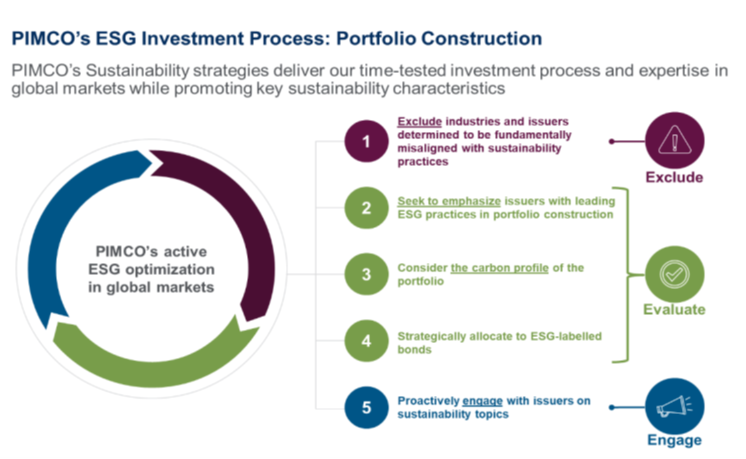
Source: PIMCO. For Illustrative Purposes only. ESG-labelled Bonds are defined as green, social, and sustainable bonds and sustainability-linked bonds. Green Bonds are those issues with proceeds specifically earmarked to be used for climate and environmental projects. Social Bonds are use-of-proceeds bonds earmarked to finance new and existing projects or activities with positive social impacts. Sustainability Bonds are use-of-proceeds bonds earmarked to finance new and existing projects or activities with positive environmental and social impacts. Sustainability-Linked Bonds (SLBs) are bonds that include sustainability-linked covenants, as explained by the issuer through use of a framework and/or legal documentation. The sustainability objectives and exclusions of any particular portfolio that follows sustainability strategies and guidelines will be set out in the respective governing documents. For detailed information related to our PIMCO sponsored funds that follow sustainability strategies and guidelines, please refer to the fund’s prospectus. Green/social/sustainability bonds of issuers involved in coal and fossil fuel-related sectors may be permitted.
ESG Evaluation
PIMCO has developed proprietary scoring frameworks across asset classes over the past decade. Our enhanced research process incorporates a detailed ESG asset assessment that complements the traditional ratings assigned by analysts. We have proprietary ESG scores for corporate issuers, sovereigns, securitized issuers and municipal issuers, in addition to PIMCO’s proprietary ESG labeled bond scoring framework to evaluate green, social and sustainability bond issuances.
Engagement
As one of the world’s leading bondholders, we engage with issuers on matters we believe are essential to risk and return considerations. Our goal is to uncover investment insights, mitigate risk, and capitalize on prospective opportunities that can influence investment outcomes.
We believe that collaborating with issuers to enhance their operational practices can significantly affect those with higher exposure to ESG-related risks. By engaging with companies at various stages of their sustainability journey, particularly in historically hard-to-abate sectors, we aim to create value and drive momentum forward. Our engagement practices, spanning diverse asset classes and types of issuers, are designed to promote efficiencies that may benefit additional stakeholders. Ultimately, our engagements are structured to help create investment value for our clients.
We engage to gain investment insights, mitigate risks, and potentially contribute to investment outcomes. We believe that working with issuers can enhance their operational practices.
Consistent issuer engagement is essential, in our view, for a thorough understanding of an investment’s risk-reward composition, which is critical to making informed buy or sell decisions. Thus, we believe consistent engagement enhances active investment management.
Our goal is to provide value for clients, and that goal informs how we structure engagement.
Portfolio Construction
Portfolio managers at PIMCO use the ESG assessments of our credit analysts and multiple proprietary ESG tools as additional inputs into their portfolio investment decisions. The combination of ESG considerations with financial valuations and credit fundamentals results in our decision to invest, add/reduce or even divest from a company.
External Research
At PIMCO we regularly evaluate ESG data providers which may add additional input into our in-house analysis conducted by our credit, sovereign and mortgage analyst teams. The firm relies primarily on internal research for decision-making; however, PIMCO also screens substantial amounts of external data sets. PIMCO currently utilizes MSCI as our primary external data provider but we also use Reprisk, TruCost, Bloomberg, CDP, SBTi, TPI, risQ, Maplecroft, Haver, and Freedom House, among other sources. ESG data generally flows directly into our proprietary IT systems, enabling portfolio managers and credit analysts to use this information efficiently. Further, data in our systems is not only limited to subscriptions to data providers. We also look at data and rankings available across different platforms including data sourced from the NGO sector. Examples of sources here include: Forest 500; Forest and Finance; Sustainability Policy Transparency Toolkit (SPOTT); the Ocean Health Index; and Exploring Natural Capital Opportunities, Risks and Exposure (ENCORE). We have also reviewed data sets from the Natural History Museum, Global Forest Watch, Yale and the World Bank.
Dialshifter
This fund is helping to ‘shift the dial from brown to green’ by…
… excluding industries and issuers misaligned with sustainability principles, including those involved in the fossil fuel industry; emphasizing issuers with “best-in-class” environmental, social, and governance (ESG) practices through a proprietary ESG scoring system; allocating meaningfully to green, social, and sustainability bonds; actively managing the portfolio’s carbon emissions and carbon intensity profile; and engaging proactively and collaboratively with corporate issuers to influence environmental, social, and governance (ESG) practices.
SDR Labelling:
Not eligible to use label (out of scope)
| Fund Name | SRI Style | SDR Labelling | Product | Region | Asset Type | Launch Date | Last Amended |
|
|---|---|---|---|---|---|---|---|---|
PIMCO GIS Global Bond ESG Fund |
ESG Plus | Not eligible to use label (out of scope) | SICAV/Overseas | Global | Fixed Interest | 12/01/2017 | Jul 2025 | |
ObjectivesThe PIMCO GIS Global Bond ESG Fund emphasizes a diversified, multi-sector allocation with a high quality stance, while seeking to promote environmental and social characteristics via meaningful allocations to ESG labelled bonds, reducing its carbon footprint, and engagement activity on sustainability issues. By bringing together our time-tested investment process and ESG investing philosophy, PIMCO GIS Global Bond ESG Fund delivers an ESG-optimized global bond strategy with the flexibility to access a diversified opportunity set. The Fund promotes sustainability characteristics by leveraging PIMCO’s “3 Es”, our active ESG optimization process in global markets (Exclude, Evaluate, Engage). The fund seeks to exclude issuers that PIMCO deem to be fundamentally misaligned with sustainability practices.
|
Fund/Portfolio Size: £3080.00m (as at: 30/11/2025) Total Screened Themed SRI Assets: £450.00m (as at: 31/03/2025) Total Assets Under Management: £1484221.00m (as at: 31/03/2025) ISIN: IE00BYXVXY22, IE00BL58ST02, IE000LSJTG38, IE00BMFKKN11 |
|||||||
Sustainable, Responsible &/or ESG OverviewFund Description The Fund Advantage The Fund benefits from PIMCO’s advanced sustainability capabilities, including proprietary ESG scoring frameworks for all major asset classes in the investment universe. Alongside corporate credit frameworks, PIMCO has tailored ESG frameworks for sovereigns, SSA, securitized credit and municipals. In addition, the Fund utilizes PIMCO’s bespoke ESG labelled bond framework which is incorporated in the Fund’s assessment of ESG labelled bonds – where the Fund seeks meaningful exposure to. |
||||||||
|
Primary fund last amended: Jul 2025 |
||||||||
|
Information received directly from Fund Manager |
||||||||
|
Please select what you would like to read:
Fund FiltersSustainability - General
Sustainability policy
Has policies that consider (environmental and social) sustainability issues. Strategies vary but are likely to consider environmental issues like climate change, carbon emissions, biodiversity loss, resource management, environmental impacts; and social issues like equal opportunities, human rights, labour standards, diversity and adherence to internationally recognised codes. See individual entry information.
Sustainability focus
Has a significant focus on sustainability issues
Encourage more sustainable practices through stewardship
Aim to encourage higher sustainability standards through responsible ownership / stewardship / engagement / voting activity
UN Global Compact linked exclusion policy
Use the UN Global Compact to inform or help direct where they can or cannot invest. Will typically not invest in companies with significant breaches (low standards) - strategies vary. (The UNGC covers a wide range of issues - search 'UNGC'). See https://unglobalcompact.org/ Environmental - General
Environmental policy
Has policies which relate to environmental issues. These will typically set out their stance on issues such as pollution, climate change, resource management, biodiversity loss, carbon emissions, plastics and/or additional environmental impacts. Strategies vary.
Limits exposure to carbon intensive industries
Options that limit or 'reduce' their exposure to carbon intensive industries (ie sectors which are major contributors to climate change). Strategies vary.
Favours cleaner, greener companies
Aims to invest in companies with strong or market leading environmental policies and practices. Strategies vary. See individual entry information for more detail. Climate Change & Energy
Coal, oil & / or gas majors excluded
Avoid investment in major coal, oil and/or gas (extraction) companies. Strategies vary.
Fracking & tar sands excluded
Avoid companies involved in fracking and tar sands - which are widely regarded as controversial methods of oil and gas extraction. Strategies vary.
Arctic drilling exclusion
Avoid companies that are involved in extracting oil from the Arctic regions.
Fossil fuel reserves exclusion
Avoid investing in companies / assets with coal, oil and gas reserves. See individual entry information for further details.
Encourage transition to low carbon through stewardship activity
Encourage the transition to lower carbon activities through asset selection and / or responsible ownership activity.
Invests in clean energy / renewables
Invest in renewable energy companies and / or companies where renewable energy is a significant part of their business. Strategies vary.
Fossil fuel exploration exclusion - direct involvement
Excludes companies and other assets with direct involvement in fossil fuel exploration (eg coal, oil and gas companies) Social / Employment
Social policy
Has policies which set out their approach to social issues (e.g. human rights, labour standards, equal opportunities, child labour and/or adherence to internationally recognised codes such as the UN Global Compact). Strategies with social policies typically avoid companies with low standards and/or work to encourage higher standards. See fund information for detail.
Labour standards policy
Has a labour standards policy - likely to mean they will invest in / favour companies that have higher employment related standards and avoid those with low standards. Strategies vary. See eg https://www.ilo.org/international-labour-standards
Favours companies with strong social policies
Aims to invest in assets with high social values - this may include strong human rights, labour standards and equal opportunities or safety related practices. Ethical Values Led Exclusions
Tobacco & related product manufacturers excluded
Companies are excluded if they are involved in any aspect of the production chain for tobacco products, including cigarettes, vaping, e-cigarettes, chewing tobacco and cigars.
Tobacco & related products - avoid where revenue > 5%
Companies are excluded if they make more than 5% of their revenue from the manufacture, sale or distribution of tobacco products including cigarettes, vaping, e-cigarettes, chewing tobacco and cigars.
Controversial weapons exclusion
Excludes companies which make controversial weapons such as landmines, cluster munitions and chemical weapons.
Armaments manufacturers avoided
Avoids companies that manufacture weapons intended specifically for military use. Strategies vary - may or may not include non-strategic military products.
Civilian firearms production exclusion
Has a written civilian firearms exclusion policy - meaning that they will not invest in companies that make (or perhaps also sell) handguns made for non-military users.
Alcohol production excluded
Avoids companies that produce alcohol. Strategies vary; some may allow a small proportion of revenue to come from this area.
Gambling avoidance policy
Avoids companies with significant involvement in the gambling industry. Some may allow a small proportion of revenues to come from this area.
Pornography avoidance policy
Avoids companies that derive significant income from pornography and related areas. Strategies vary. Human Rights
Human rights policy
Has policies relating to human rights issues. Typically require companies to demonstrate higher standards, although some managers work to encourage improvements. Investee companies are often judged against internationally agreed norms or standards. Strategies vary. Gilts & Sovereigns
Invests in gilts / government bonds
Invest in loans issued the government, commonly known as gilts or government bonds. These may or may not be ringfenced for specific projects (see additional options).
Gilts / government bonds - exclude some
Avoids investing in 'some' gilts or government bonds. Strategies vary, but this may relate to avoiding specific countries or particular reasons for bond issuance. 'Green gilts' for example would be likely to be acceptable.
Invests in sovereigns subject to screening criteria
Invest in financial instruments issued by governments, but will only hold those that meet certain environmental and or social criteria. This may, for example mean certain assets are excluded in line with eg Freedom House research. Strategies vary. Banking & Financials
Invests in banks
Can include banks as part of their holdings / portfolio.
Invests in financial instruments issued by banks
Invests in financial instruments (cash, derivatives and / or foreign exchange) issued by banks. Strategies vary.
Invests in insurers
May invest in insurance companies. Governance & Management
Governance policy
Has policies that relate to corporate governance issues such as board structure, executive remuneration, bribery and/or corporate corruption. These funds will typically avoid companies with poor practices. Strategies vary.
Avoids companies with poor governance
Avoids investing in companies with poor governance practices.(e.g. board structure, management practices etc.) Views may however vary on what counts as 'poor' practices - and funds may not immediately divest as they may prefer to work to encourage higher standards.
UN sanctions exclusion
Exclude companies that are subject to United Nations sanctions. See eg https://main.un.org/securitycouncil/en/content/un-sc-consolidated-list
Anti-bribery & corruption policy
Has policies explaining how managers will respond to assets / companies that do not comply with relevant anti-bribery and anti-corruption standards or laws. Strategies vary; options include stewardship/ engagement and divestment - or a combination.
Encourage TCFD alignment for banks & insurance companies
Encourage the banks and insurance companies they invest in to publish climate change related financial information - as set out by the Task Force on Climate Related Financial Disclosures (with the aim of helping investors measure and respond to climate risk).
Encourage higher ESG standards through stewardship activity
Aim to encourage higher ESG standards through responsible ownership / stewardship / engagement /voting activity Product / Service Governance
ESG integration strategy
Find fund / asset managers that factor in 'environmental, social and governance' issues as part of their investment decision making process. A focus on 'ESG' typically means a fund is carrying out additional research to help reduce ESG related risks. It does not necessarily mean a focus on sustainability. Strategies vary. See fund literature. Asset Size
Invest in supranationals
Invests in international entities or bodies with agreed remits that are broadly similar to those that may otherwise be undertaken by individual governments eg the UN Impact Methodologies
Aims to generate positive impacts (or 'outcomes')
Has policies that aim to help or support the delivery of positive social or environmental impacts (or societal/real world outcomes) by investing in companies they regard as beneficial to people and / or the planet. Strategies vary.
Measures positive impacts
Aims to measure the positive real world environmental and / or social benefits that are associated with their investment strategy. Investments that aim to deliver positive impacts and measure those impacts may be referred to as 'Impact' - although impact measurement is not restricted to Impact investments. Strategies vary.
Invests in environmental solutions companies
Directs investment towards companies where a major part of their business is about solving environmental challenges. e.g. companies helping to address climate change.
Invests in sustainability / ESG disruptors
Specifically sets out to invest in companies that are regarded as 'disrupting' existing business practices - typically through the development of innovative (sustainability aware) products and/or practices.
Aim to deliver positive impacts through engagement
Aims to deliver positive environmental and or social impacts (real world benefits) through its engagement with investee assets How The Fund/Portfolio Works
Positive selection bias
Focuses on finding and investing in companies with positive / beneficial attributes. This strategy can be applied in addition to exclusion criteria and engagement/stewardship activity.
Negative selection bias
Has principle 'ethical approach' to avoid companies by using negative screening criteria. Strategies vary.
ESG weighted / tilt
Invest more heavily in assets which have higher ESG ratings/standards or scores and less heavily in companies with lower ESG ratings. Where this is central to the strategy you should expect assets in most sectors. Strategies vary.
Significant harm exclusion
Aims to avoid companies that do significant harm. This originates from the EU’s sustainable finance ‘DNSH’ (do no significant harm) work, which is not necessarily used by UK investors.
Combines norms based exclusions with other SRI criteria
Investment selection process uses internationally agreed 'norms' (e.g. United Nations Global Compact - UNGC - or the UN Sustainable Development Goals - SDGs) alongside additional SRI criteria such as positive or negative stock selection policies and/or stewardship strategies.
Combines ESG strategy with other SRI criteria
Invests in assets which have an ESG strategy (which is typically focused on avoiding companies that pose environmental, social or governance related risks) together with additional criteria such as positive and/or negative screens, themes and stewardship strategies.
Balances company 'pros and cons' / best in sector
Considers both the 'positive' and 'negative' aspects of company behaviour and makes balanced, considered decisions as part of their investment approach. May apply to a range of different issues and policy areas.
ESG risk mitigation focus
Focuses on the careful management of environmental, social and governance (ESG) related risks - typically by avoiding or being underweight in companies seen as posing major risks in these areas (i.e. not necessarily by using themes, exclusions etc).
Participated in sustainability solutions IPOs or new issuances recently
Invests in newly listed companies and other assets (eg bonds) which are significantly focused on the provision of products and/or services which are designed to solve environmental and/or social problems.
Do not use stock / securities lending
Does not use stock lending for performance or risk purposes. Unscreened Assets & Cash
Assets typically aligned to sustainability objectives 70 - 79%
Holds between 70-79% of assets which align to the sustainability objectives; which are not being held purely for risk management purposes, such as derivatives and cash equivalent assets.
Assets typically aligned to sustainability objectives 80 – 89%
Holds between 80-89% of assets which align to the sustainability objectives; which are not being held purely for risk management purposes, such as derivatives and cash equivalent assets.
Assets typically aligned to sustainability objectives > 90%
Holds at least 90% of assets which align to the sustainability objectives; which are not being held purely for risk management purposes, such as derivatives and cash equivalent assets. Intended Clients & Product Options
Intended for clients interested in sustainability
Designed to meet the needs of individual investors with an interest in sustainability issues.
Bespoke SRI / ESG portfolios available
Only applicable for DFM’s & portfolio providers. Find service providers who offer bespoke ('personalised') SRI / ESG portfolio options Labels & Accreditations
SFDR Article 8 fund / product (EU)
Find options classified under Article 8 of the EU’s SFDR (Sustainable Finance Disclosure Requirements). Article 8 of the SFDR is a set of requirements that apply to financial products that 'promote' environmental or social characteristics together with high governance. These rules do not currently apply to UK products so many managers may leave this field blank. Fund Management Company InformationAbout The Business
Responsible ownership / stewardship policy or strategy (AFM companywide)
Finds fund / asset management companies that have a published company wide stewardship, engagement and / or responsible ownership policy or strategy that covers all investments. Stewardship typically involves encouraging higher ESG standards through voting and dialogue.
ESG / SRI engagement (AFM companywide)
Find fund / asset management companies that actively encourage higher 'environmental, social and governance' and / or 'sustainable and responsible investment' practices across investee companies - typically where the aim is to encourage positive change that is aligned with the best interests of investors. Strategies vary. See additional information and options.
Integrates ESG factors into all / most research (AFM companywide)
Find fund / asset management companies that consider environmental, social and governance (ESG) issues when deciding whether or not to invest in a company for all / almost all of their funds and other assets. This is increasingly seen as part of sound risk management.
In-house diversity improvement programme (AFM companywide)
Finds organisations / fund managers that have an in-house (company wide) diversity improvement programme - meaning that they are working to ensure that within their own businesses they employ people from diverse backgrounds - often typically focused on ethnicity and/or sex.
Diversity, equality & inclusion engagement policy (AFM companywide)
Find fund / asset management companies that encourage the companies they invest in to have strong diversity, race, gender and other equality policies across all assets held, not simply screened or themed SRI/ESG funds. (ie Asset Management company wide).
Invests in new sustainability linked bond issuances (AFM companywide)
Fund / asset management company has investments in bonds designed to meet sustainability requirements - however these assets may not be 'ringfenced' for this purpose. See website for details. Collaborations & Affiliations
PRI signatory
Find fund / asset management companies that have signed up to the UN backed 'Principles of Responsible Investment'.
Fund EcoMarket partner
Find fund / asset management companies that have partnered with Fund EcoMarket - meaning that they are helping to improve access to information on sustainable and responsible investment by paying an annual fee to us which enables us to publish information for free. Partner funds are listed ahead of other funds and have their logos displayed.
TNFD forum member (AFM companywide)
A member of the Taskforce for Nature Related Financial Disclosures group which aims to aid risk management and shift money towards nature-positive outcomes.
Investment Association (IA) member
Fund management entity is a member of the Investment Association https://www.theia.org/ Resources
In-house responsible ownership / voting expertise
Find fund / asset management companies that employ people to steer and support fund managers in voting shares at company AGM's and EGMs in ways that are consistent with encouraging higher ESG/sustainability standards.
Employ specialist ESG / SRI / sustainability researchers
Find a fund / asset management company that directly employs specialist ESG/SRI/sustainability researchers or analysts. This allows asset managers to discuss environmental, social and governance risks and opportunities directly with companies.
Use specialist ESG / SRI / sustainability research companies
Find fund / asset management companies that makes use of expert external research companies. This can help deliver specialist expertise and means resources are pooled with other investors. Accreditations
UK Stewardship Code signatory (AFM companywide)
Find fund / asset managers that are signatories to the FRC UK Stewardship Code, which sets out a framework for constructive investor / investee relations where managers are encouraged to behave like responsible, typically longer term 'company owners'. Engagement Approach
Regularly lead collaborative ESG initiatives (AFM companywide)
Find fund / asset management companies that regularly initiate or run industry wide (collaborative) investor projects aimed at raising environmental, social and governance standards amongst investee companies.
Engaging on climate change issues
Fund / asset manager has stewardship /responsible ownership strategy that is focused on addressing climate change with investee assets.
Engaging with fossil fuel companies on climate change
Fund / asset manager has a stewardship /responsible ownership strategy that involves working with fossil fuel companies on climate change related issues. See fund manager website for details.
Engaging to reduce plastics pollution / waste
Fund / asset manager has stewardship /responsible ownership strategy with involves encouraging investee asset to reduce plastic waste and pollution.
Engaging to encourage responsible mining practices
Fund / asset manager has a stewardship / responsible ownership policy that means they are working to encourage more responsible mining practices - where environmental and social issues are properly dealt with by the companies they invest in.
Engaging on biodiversity / nature issues
The fund / asset manager has a responsible ownership / stewardship strategy that focuses on biodiversity and nature issues relating to the assets they invest the aim of which will be to reduce harm and or deliver improvement. Strategies vary. https://tnfd.global
Engaging to encourage a Just Transition
Fund / asset manager has a responsible ownership / stewardship strategy which means they are working to encourage the shift to more sustainable business practices in ways that respect and are sensitive to social issues and the impact change has on people effected by the changes that are taking place. https://www.transitionpathwayinitiative.org/ https://transitiontaskforce.net/
Engaging on human rights issues
Fund / asset manager has responsible ownership / stewardship strategy in place which aims to address human rights issues in investee companies (and potentially their suppliers) with the aim of raising standards
Engaging on labour / employment issues
Fund / asset manager has responsible ownership / stewardship strategy in place that aims to improve labour standards for the benefit of employees in investee companies (and potentially their suppliers)
Engaging on diversity, equality & / or inclusion issues
Fund / asset management company has a stewardship strategy in place which involves working to raise diversity, equality and inclusion standards across investee assets
Engaging to stop modern slavery
Fund / asset manager is working with the assets they hold to help stamp out modern slavery - where direct or indirect company employees are exploited for business benefits.
Engaging on governance issues
Fund / asset managers have stewardship strategies in place that focus on improving governance standards across investee assets
Engaging on responsible supply chain issues
Has a stewardship / responsible ownership strategy that encourages responsible supply chain - ie the managers will discuss environmental, social and governance issues with investee companies with the aim of raising standards
Stewardship escalation policy
Escalation policies describe how a manager will proceed if stewardship / engagement activity is not successful in the short term. Climate & Net Zero Transition
Publish 'CEO owned' Climate Risk policy (AFM companywide)
Find fund / asset management companies that have published a Climate Risk policy or statement that is signed / owned by their Chief Executive.
Encourage carbon / greenhouse gas reduction (AFM companywide)
Find fund / asset management companies that are working with the companies they invest in to encourage reductions in carbon dioxide and other greenhouse gas emissions.
‘Forward Looking Climate Metrics’ published / ITR (AFM companywide)
Finds organisations / fund managers that have published ‘forward looking climate metrics’ e.g. 'implied temperature rise' data that are a total of the asset management company's share (% owned) of all the investee company emissions of the assets they manage, as well as their own direct and other indirect emissions. Transparency
Publish responsible ownership / stewardship report (AFM companywide)
Find fund / asset management companies that publish a report detailing their responsible investment ownership - also known as 'Stewardship' - activity.
Full stewardship / responsible ownership policy information on company website
Find fund / asset management companies that publish information about their sustainable and responsible investment strategies on their company website.
Full stewardship / responsible ownership policy information available on request
Find fund / asset management companies that will supply information about their sustainable and responsible investment activity on request.
Dialshifter statement
Find fund / asset management companies that have supplied Dialshifter information. See Dialshifter tab within record for more information. Sustainable, Responsible &/or ESG Policy:The proposed Fund is a clear expression of the firm’s top-down, bottom-up investment philosophy and commitment to sustainable investing. The Fund is a diverse, actively managed portfolio of global fixed-income securities, selected according to PIMCO’s internal ESG screening process. The Fund invests primarily in a diversified portfolio of investment grade bonds from around the world, on the basis of PIMCO’s ESG exclusions, evaluation and engagement decisions. The primary investment objective of the Fund is to seek to maximise total return, consistent with preservation of capital and prudent investment management while seeking to provide positive social and environmental outcomes. Additionally, in line with the rest of our solutions that follow sustainability strategies and guidelines, this portfolio also aims at:
The integration of ESG factors into PIMCO’s investment process seeks to account for material ESG risks in both top-down macro positioning and bottom-up security evaluation. To the extent that ESG risks are material for particular sectors, issuers, etc., our fundamental credit views will reflect this. While ESG scores play a role in security selection for portfolios that follow sustainability strategies and guidelines, they are not a criterion for security selection in portfolios that do not follow sustainability strategies and guidelines. Additionally, integrating material ESG factors into the evaluation process does not mean that ESG information is the sole consideration for an investment decision; instead, PIMCO’s portfolio managers and analyst teams evaluate a variety of factors, which can include ESG considerations, to make investment decisions. By integrating material ESG factors into the evaluation process, PIMCO is increasing the total amount of information assessed to generate a more holistic view of an investment, in efforts to deliver the best performance outcomes for our clients. In addition to the firm wide integration of material ESG risks, The PIMCO Global Bond ESG Fund seeks to promote environmental and social characteristics. As part of PIMCO’s ESG fund solutions, it follows our “3 E” implementation process:
Ultimately, the Fund’s investments are governed by its prospectus, applicable laws and regulations. Process:ESG Integration: Firm-Wide Assets At the firm level, PIMCO integrates material ESG factors into the investment research process where applicable to assess issuer risks. Our process emphasizes rigorous analysis of broad secular trends, which are at the core of both global ESG trends and long-term asset returns. Additionally, many ESG risks are idiosyncratic to the sector, and the specific issuer – sometimes the specific security. For this reason, our investment process evaluates relevant ESG risk factors from both the top-down (i.e. macro) and bottom-up (i.e. security specific) where applicable. In addition to the belief that ESG integration is essential to optimizing outcomes over the long-term, PIMCO has developed a robust platform specialized in supporting investment solutions with sustainability objectives. From the top-down, the first and most important step in PIMCO’s process is to identify the major long-term themes that will impact the global economy and financial markets. PIMCO believes that such analysis is fundamental to making sound investment decisions. The firm’s annual Secular Forums are devoted to identifying and analyzing these longer-term trends and the analysis of ESG-related issues fits directly into that process. Similarly, periodic updates at the firm’s Cyclical Forums further address near-term sustainability related themes and potential investment implications. Concurrently, the firm’s global research teams aim to evaluate material ESG-related issues as part of their bottom-up analysis of an issuer. PIMCO aims to consider relevant risks and opportunities that could affect particular issuers or industries where appropriate. We consider how ESG factors may impact the issuer more broadly, and the potential effect on valuations. This can include an issuers’ impact on the environment and society, and how that impact may in turn affect the view of the issuer from relevant stakeholders including their investors, regulators, customers and labor force. To facilitate the integration of ESG risk factors in our analysis and help to monitor ESG related risks, we are continually enhancing our proprietary research with specific ESG related attributes and dedicated scoring. In addition to the ESG team working alongside analysts across asset classes, we also host training sessions on available ESG frameworks, scoring methodologies, ESG systems, data and tools. ESG data and analysis, both internal and external, are readily available to all portfolio managers, traders and research analysts across the firm, which enables portfolio managers to make trading decisions that incorporate the material ESG characteristics of a given issuer. ESG Investment Process: Portfolios that follow Sustainability Strategies and Guidelines While material environmental, social, and governance considerations are incorporated into PIMCO’s broad investment processes, for those clients that want greater ESG orientation in their portfolio, our mandates that follow sustainability strategies and guidelines further utilize three building blocks of PIMCO’s ESG process – exclusions, evaluations, and engagement:
The following graphic illustrates these three building blocks.
Source: PIMCO. For Illustrative Purposes only. ESG-labelled Bonds are defined as green, social, and sustainable bonds and sustainability-linked bonds. Green Bonds are those issues with proceeds specifically earmarked to be used for climate and environmental projects. Social Bonds are use-of-proceeds bonds earmarked to finance new and existing projects or activities with positive social impacts. Sustainability Bonds are use-of-proceeds bonds earmarked to finance new and existing projects or activities with positive environmental and social impacts. Sustainability-Linked Bonds (SLBs) are bonds that include sustainability-linked covenants, as explained by the issuer through use of a framework and/or legal documentation. The sustainability objectives and exclusions of any particular portfolio that follows sustainability strategies and guidelines will be set out in the respective governing documents. For detailed information related to our PIMCO sponsored funds that follow sustainability strategies and guidelines, please refer to the fund’s prospectus. Green/social/sustainability bonds of issuers involved in coal and fossil fuel-related sectors may be permitted. ESG Evaluation PIMCO has developed proprietary scoring frameworks across asset classes over the past decade. Our enhanced research process incorporates a detailed ESG asset assessment that complements the traditional ratings assigned by analysts. We have proprietary ESG scores for corporate issuers, sovereigns, securitized issuers and municipal issuers, in addition to PIMCO’s proprietary ESG labeled bond scoring framework to evaluate green, social and sustainability bond issuances. Engagement As one of the world’s leading bondholders, we engage with issuers on matters we believe are essential to risk and return considerations. Our goal is to uncover investment insights, mitigate risk, and capitalize on prospective opportunities that can influence investment outcomes. We believe that collaborating with issuers to enhance their operational practices can significantly affect those with higher exposure to ESG-related risks. By engaging with companies at various stages of their sustainability journey, particularly in historically hard-to-abate sectors, we aim to create value and drive momentum forward. Our engagement practices, spanning diverse asset classes and types of issuers, are designed to promote efficiencies that may benefit additional stakeholders. Ultimately, our engagements are structured to help create investment value for our clients. We engage to gain investment insights, mitigate risks, and potentially contribute to investment outcomes. We believe that working with issuers can enhance their operational practices. Consistent issuer engagement is essential, in our view, for a thorough understanding of an investment’s risk-reward composition, which is critical to making informed buy or sell decisions. Thus, we believe consistent engagement enhances active investment management. Portfolio Construction Portfolio managers at PIMCO use the ESG assessments of our credit analysts and multiple proprietary ESG tools as additional inputs into their portfolio investment decisions. The combination of ESG considerations with financial valuations and credit fundamentals results in our decision to invest, add/reduce or even divest from a company. External Research At PIMCO we regularly evaluate ESG data providers which may add additional input into our in-house analysis conducted by our credit, sovereign and mortgage analyst teams. The firm relies primarily on internal research for decision-making; however, PIMCO also screens substantial amounts of external data sets. PIMCO currently utilizes MSCI as our primary external data provider but we also use Reprisk, TruCost, Bloomberg, CDP, SBTi, TPI, risQ, Maplecroft, Haver, and Freedom House, among other sources. ESG data generally flows directly into our proprietary IT systems, enabling portfolio managers and credit analysts to use this information efficiently. Further, data in our systems is not only limited to subscriptions to data providers. We also look at data and rankings available across different platforms including data sourced from the NGO sector. Examples of sources here include: Forest 500; Forest and Finance; Sustainability Policy Transparency Toolkit (SPOTT); the Ocean Health Index; and Exploring Natural Capital Opportunities, Risks and Exposure (ENCORE). We have also reviewed data sets from the Natural History Museum, Global Forest Watch, Yale and the World Bank. Dialshifter (Fund)This fund is helping to ‘shift the dial from brown to green’ by… … excluding industries and issuers misaligned with sustainability principles, including those involved in the fossil fuel industry; emphasizing issuers with “best-in-class” environmental, social, and governance (ESG) practices through a proprietary ESG scoring system; allocating meaningfully to green, social, and sustainability bonds; actively managing the portfolio’s carbon emissions and carbon intensity profile; and engaging proactively and collaboratively with corporate issuers to influence environmental, social, and governance (ESG) practices. Dialshifter (Corporate)Our organisation is helping to support the Paris Climate Agreement and the Race to Net Zero by… … offering solutions to support clients’ decarbonization goals. To provide clients a fixed income solution for the transition to a lower-carbon economy, PIMCO offers our Climate Bond Strategy, investing in issuers at the forefront of the climate transition. Additionally, for clients looking to implement decarbonization targets, PIMCO has developed a four-pillar decarbonization framework to help investors target long term objectives to reduce portfolio exposure to greenhouse gases. This framework provides a meaningful and realistic approach to decarbonizing fixed income portfolios over time, while engaging and investing in the climate solutions and leaders best positioned to contribute to real-economy emissions reductions. SDR Labelling:Not eligible to use label (out of scope) |
||||||||