Candriam Equities L Global Demography Fund
SRI Style:
Social Style
SDR Labelling:
Not eligible to use label (out of scope)
Product:
SICAV/Overseas
Fund Region:
Global
Fund Asset Type:
Equity
Launch Date:
02/01/2012
Last Amended:
Jun 2025
Dialshifter ( ):
):
Fund/Portfolio Size:
£2040.00m
(as at: 30/11/2025)
Total Screened Themed SRI Assets:
£38576.79m
(as at: 31/03/2025)
Total Responsible Ownership Assets:
£57540.75m
(as at: 31/03/2025)
Total Assets Under Management:
£128419.89m
(as at: 31/03/2025)
ISIN:
LU0654531341, LU1598288089, LU2346220564, LU2439121216
Contact Us:
Objectives:
The objective is to outperform the benchmark defined as the MSCI© World (Net Return) index by investing in global companies that are well positioned to profit from demographic changes.
Our approach to selecting environmental or social investments is referred to as Article 8 of the SFDR.
75% of the total net assets are invested in investments with environmental and social characteristics. A minimum percentage of 20% of these investments with environmental and social characteristics will consist of sustainable investments.
The fund’s investment strategy aims to promote environmental or social characteristics, or a combination of these characteristics, provided that the entities in which the investments are made apply good governance practices. To achieve this objective, the management team makes discretionary investment choices based on an economic/financial analysis process and an internal analysis of environmental, social and governance (ESG) criteria.
Sustainable, Responsible
&/or ESG Overview:
The sustainable investments which the sub-fund intends to make for part of the portfolio aim to contribute to a reduction in greenhouse gas emissions by means of exclusions and the use of climate indicators in the analysis of companies, and they aim to have a positive environmental and social impact in the long term.
Concerning sustainable investments with environmental objectives, the sub-fund, through its sustainable investments defined by Candriam’s proprietary ESG analysis, may over the long-term contribute to one or more of the following environmental objectives as set out in Article 9 of Regulation (EU) 2020/852:
- climate change mitigation,
- climate change adaptation,
- the sustainable use and protection of water and marine resources,
- the transition to a circular economy,
- pollution prevention and control.
Primary fund last amended:
Jun 2025
Information directly from fund manager.
Fund Filters
Sustainability - General
Has policies that consider (environmental and social) sustainability issues. Strategies vary but are likely to consider environmental issues like climate change, carbon emissions, biodiversity loss, resource management, environmental impacts; and social issues like equal opportunities, human rights, labour standards, diversity and adherence to internationally recognised codes. See individual entry information.
Aim to encourage higher sustainability standards through responsible ownership / stewardship / engagement / voting activity
Use the UN Global Compact to inform or help direct where they can or cannot invest. Will typically not invest in companies with significant breaches (low standards) - strategies vary. (The UNGC covers a wide range of issues - search 'UNGC'). See https://unglobalcompact.org/
Aim to invest (and manage assets) in ways that help to address all or some of the UN's Sustainable Development Goals (SDGs). See https://sdgs.un.org/goals).
Publicly report performance against named sustainability objectives
Environmental - General
Options that limit or 'reduce' their exposure to carbon intensive industries (ie sectors which are major contributors to climate change). Strategies vary.
Aims to invest in companies with strong or market leading environmental policies and practices. Strategies vary. See individual entry information for more detail.
Nature & Biodiversity
Has a written biodiversity policy or theme typically aimed at supporting, encouraging and improving environmental protection and safeguarding the natural world (sometimes referred to as 'natural capital'). See eg https://www.un.org/en/climatechange/science/climate-issues/biodiversity
Climate Change & Energy
Avoid investment in major coal, oil and/or gas (extraction) companies. Strategies vary.
Encourage the transition to lower carbon activities through asset selection and / or responsible ownership activity.
Has a supply chain decarbonisation policy which sets out their position on the need to reduce carbon emissions.
Social / Employment
Has a labour standards policy - likely to mean they will invest in / favour companies that have higher employment related standards and avoid those with low standards. Strategies vary. See eg https://www.ilo.org/international-labour-standards
Aims to invest in assets with high social values - this may include strong human rights, labour standards and equal opportunities or safety related practices.
Has a written diversity policy – where the manager will aim to select companies with a carefully considered, positive employment standards. This may cover a range of issues including gender, ethnicity, disability, beliefs and sexual orientation.
Has a policy that explains their position on which mining companies they may or may not invest in. Typically this may mean only investing in assets with high environmental and social standards. This is a growing concern given demand for rare earth metals eg lithium, cobalt.
Has a policy aimed at protecting vulnerable workers such as those on zero hour / informal contracts working in the gig economy
Ethical Values Led Exclusions
Companies are excluded if they are involved in any aspect of the production chain for tobacco products, including cigarettes, vaping, e-cigarettes, chewing tobacco and cigars.
Companies are excluded if they make more than 5% of their revenue from the manufacture, sale or distribution of tobacco products including cigarettes, vaping, e-cigarettes, chewing tobacco and cigars.
Excludes companies which make controversial weapons such as landmines, cluster munitions and chemical weapons.
Avoids companies that manufacture weapons intended specifically for military use. Strategies vary - may or may not include non-strategic military products.
Does Not exclude manufacturers of products intended for use in armaments and weapons. So may invest in them
Human Rights
Has policies relating to human rights issues. Typically require companies to demonstrate higher standards, although some managers work to encourage improvements. Investee companies are often judged against internationally agreed norms or standards. Strategies vary.
Has policies to avoid companies that employ children.
Has policies that exclude companies or other assets which operate in, or are owned by regimes which are not democratic, or where people may be oppressed. May use eg. Freedom House research. Strategies vary.
Has a policy which sets out the position on the treatment of indigenous people by investee assets/companies - typically meaning they won't invest in companies with low standards.
Has a policy which excludes assets with involvement in Modern Slavery
Has a policy which sets out its position on LGBTQ+ related social issues and their expectations of investee assets - typically meaning they won't invest in companies with poor standards.
Meeting Peoples' Basic Needs
Has a thematic investment approach focusing on the ‘silver economy’ - in particular (typically) the issues and opportunities presented by changing demographics. This could include finance, healthcare and medicines and/ or longevity science to extend lifespans. Strategies vary.
Gilts & Sovereigns
Does not invest in / excludes 'sovereigns' - debt issued by governments. See eg https://www.investopedia.com/terms/s/sovereign-debt.asp
Banking & Financials
Can include banks as part of their holdings / portfolio.
May invest in insurance companies.
Governance & Management
Avoids investing in companies with poor governance practices.(e.g. board structure, management practices etc.) Views may however vary on what counts as 'poor' practices - and funds may not immediately divest as they may prefer to work to encourage higher standards.
Has policies explaining how managers will respond to assets / companies that do not comply with relevant anti-bribery and anti-corruption standards or laws. Strategies vary; options include stewardship/ engagement and divestment - or a combination.
Encourage the companies they invest in to have more diverse board structures (e.g. more women on boards)
Aim to encourage higher ESG standards through responsible ownership / stewardship / engagement /voting activity
Product / Service Governance
Find fund / asset managers that factor in 'environmental, social and governance' issues as part of their investment decision making process. A focus on 'ESG' typically means a fund is carrying out additional research to help reduce ESG related risks. It does not necessarily mean a focus on sustainability. Strategies vary. See fund literature.
Asset Size
Invests more than half of their money into what are commonly regarded as 'large companies'. This will typically mean that the market capitalisation (or value) of the companies they hold is in excess of £5 to £10 billion.
Invests in a combination of small, medium and larger (potentially multinational) companies / assets.
Invests mainly in larger companies / assets. (e.g. over circa £5-£10bn)
Impact Methodologies
Aims to measure the positive real world environmental and / or social benefits that are associated with their investment strategy. Investments that aim to deliver positive impacts and measure those impacts may be referred to as 'Impact' - although impact measurement is not restricted to Impact investments. Strategies vary.
Specifically sets out to help deliver positive environmental impacts, benefits or 'real world' outcomes.
Specifically states that they aim to deliver positive social (i.e. people related) impacts and/or outcomes.
Aims to deliver positive environmental and or social impacts (real world benefits) through its engagement with investee assets
Invests more than 50% of capital in assets which are regarded as being significantly focused on providing solutions to environmental or social challenges. Strategies vary.
How The Fund/Portfolio Works
Focuses on finding and investing in companies with positive / beneficial attributes. This strategy can be applied in addition to exclusion criteria and engagement/stewardship activity.
Has principle 'ethical approach' to avoid companies by using negative screening criteria. Strategies vary.
Invest more heavily in assets which have higher ESG ratings/standards or scores and less heavily in companies with lower ESG ratings. Where this is central to the strategy you should expect assets in most sectors. Strategies vary.
Investment selection process uses internationally agreed 'norms' (e.g. United Nations Global Compact - UNGC - or the UN Sustainable Development Goals - SDGs) alongside additional SRI criteria such as positive or negative stock selection policies and/or stewardship strategies.
Considers both the 'positive' and 'negative' aspects of company behaviour and makes balanced, considered decisions as part of their investment approach. May apply to a range of different issues and policy areas.
Uses internationally agreed standards, conventions and 'norms' to help direct investment decisions (e.g. the UN Global Compact, UN Sustainable Development Goals).
Focuses on the careful management of environmental, social and governance (ESG) related risks - typically by avoiding or being underweight in companies seen as posing major risks in these areas (i.e. not necessarily by using themes, exclusions etc).
Publish explanations of their ethical, social and/or environmental policies online (i.e. investment decision making strategies/ buy/sell &/or asset management strategies).
Unscreened Assets & Cash
All assets - except cash - meet the sustainability criteria published in strategy documentation.
Intended Clients & Product Options
Available via a tax efficient ISA product wrapper.
Only applicable for DFM’s & portfolio providers. Finds those that offer an SRI / ESG portfolio option
Only applicable for DFM’s & portfolio providers. Find service providers who offer bespoke ('personalised') SRI / ESG portfolio options
Labels & Accreditations
Find options classified under Article 8 of the EU’s SFDR (Sustainable Finance Disclosure Requirements). Article 8 of the SFDR is a set of requirements that apply to financial products that 'promote' environmental or social characteristics together with high governance. These rules do not currently apply to UK products so many managers may leave this field blank.
Fund Management Company Information
About The Business
Find fund / asset management companies that are smaller or specialise in particular areas - notably, ideally ESG related. Strategies vary.
Find fund / asset management companies (or subsidiaries) that specialise in - or focus entirely on - investing in assets that are helping to deliver positive environmental and / or social impacts.
Finds fund / asset management companies that have a published company wide stewardship, engagement and / or responsible ownership policy or strategy that covers all investments. Stewardship typically involves encouraging higher ESG standards through voting and dialogue.
Find fund / asset management companies that actively encourage higher 'environmental, social and governance' and / or 'sustainable and responsible investment' practices across investee companies - typically where the aim is to encourage positive change that is aligned with the best interests of investors. Strategies vary. See additional information and options.
Find fund / asset managers that vote all* the shares they own at Annual General Meetings and Extraordinary General Meetings. A commitment to voting shares is a key indicator of 'responsible share ownership' demonstrating their support for or disagreement with management policy. (*situations can legitimately, occasionally occur where voting proves impossible, but in principle all shares should be voted.)
Find fund / asset managers that consider responsible ownership and ESG to be a key differentiator for their business.
Find fund / asset management companies that take sustainability criteria into account when selecting and/or managing all of their property / real estate investments.
Find fund / asset management companies that aim to align all their investments (across all funds) to help meet the aims of the UN Sustainable Development Goals.
Find options run by managers that apply Responsible ownership or 'Stewardship' policies to all or most of their investment assets. This means active involvement (e.g. voting, dialogue) with the companies across all or most funds, products and services.
Find fund / asset management companies that consider environmental, social and governance (ESG) issues when deciding whether or not to invest in a company for all / almost all of their funds and other assets. This is increasingly seen as part of sound risk management.
Finds organisations / fund managers that have an in-house (company wide) diversity improvement programme - meaning that they are working to ensure that within their own businesses they employ people from diverse backgrounds - often typically focused on ethnicity and/or sex.
Find fund / asset management companies that encourage the companies they invest in to have strong diversity, race, gender and other equality policies across all assets held, not simply screened or themed SRI/ESG funds. (ie Asset Management company wide).
Fund / asset management company has investments in bonds designed to meet sustainability requirements - however these assets may not be 'ringfenced' for this purpose. See website for details.
Fund management entity offers unstructured intermediary training on sustainable investment (ie for financial advisers and wealth managers)
Fund management entity offers unstructured intermediary training on sustainable investment (ie for financial advisers and wealth managers)
Collaborations & Affiliations
Find fund / asset management companies that have signed up to the UN backed 'Principles of Responsible Investment'.
Find fund / asset management companies that are members of UKSIF - the UK Sustainable Investment and Finance association
Fund management entity is a member of the Investment Association https://www.theia.org/
Resources
Find fund / asset management companies that employ people to steer and support fund managers in voting shares at company AGM's and EGMs in ways that are consistent with encouraging higher ESG/sustainability standards.
Find a fund / asset management company that directly employs specialist ESG/SRI/sustainability researchers or analysts. This allows asset managers to discuss environmental, social and governance risks and opportunities directly with companies.
Find fund / asset management companies that makes use of expert external research companies. This can help deliver specialist expertise and means resources are pooled with other investors.
Finds organisations / fund managers that have one or more ESG/sustainability experts on all investment teams or 'desks' (all asset types)
Accreditations
Finds organisations / fund managers that have an A+ PRI rating - meaning they are highly rated according to the 'Principles of Responsible Investment'
Find fund / asset managers that are signatories to the FRC UK Stewardship Code, which sets out a framework for constructive investor / investee relations where managers are encouraged to behave like responsible, typically longer term 'company owners'.
Engagement Approach
Find fund / asset management companies that regularly initiate or run industry wide (collaborative) investor projects aimed at raising environmental, social and governance standards amongst investee companies.
Find fund / asset management companies that are working with the companies they invest in to encourage more responsible corporate taxation.
Fund / asset manager has stewardship /responsible ownership strategy that is focused on addressing climate change with investee assets.
Fund / asset manager has a stewardship /responsible ownership strategy that involves working with fossil fuel companies on climate change related issues. See fund manager website for details.
Fund / asset manager has stewardship /responsible ownership strategy with involves encouraging investee asset to reduce plastic waste and pollution.
Fund / asset manager has responsible ownership / stewardship strategy in place which aims to address human rights issues in investee companies (and potentially their suppliers) with the aim of raising standards
Fund / asset manager is working with the assets they hold to help stamp out modern slavery - where direct or indirect company employees are exploited for business benefits.
Funds and other options may use assets that are not directly aligned with sustainability objectives in order to help manage investment risk. Requesting more sustainable options of this kind will aid alignment with fund objectives.
Working to address sustainability, ESG and related concerns around artificial intelligence.
This fund / asset manager may vote differently for different clients or regions. See fund manager stewardship policy for further information.
Escalation policies describe how a manager will proceed if stewardship / engagement activity is not successful in the short term.
Company Wide Exclusions
Find fund / asset management companies (not funds) that avoid investment in 'controversial weapons' across all of their funds and other investment vehicles.
Find fund / asset management companies that avoid investment in tobacco (manufacturing) companies across all their assets.
Find fund / asset management companies that avoid investment in fossil fuel companies (e.g. coal, oil and gas) across all of their funds. (and/ or other assets.)
Find funds / asset managers that are reviewing, or have reviewed, their exposure to carbon intensive industries including (but not only) mining, oil and gas companies. (Typically with reference to climate change.)
Climate & Net Zero Transition
Fund / asset management organisations that have pledged to reduce their greenhouse gas emissions to ‘net zero’. Strategies vary - this area is changing rapidly.
Find fund / asset management companies that have published a Climate Risk policy or statement that is signed / owned by their Chief Executive.
Find fund / asset management companies that are working with the companies they invest in to encourage reductions in carbon dioxide and other greenhouse gas emissions.
Finds organisations / fund managers that have a company wide carbon transition plan - meaning that they have plotted a path to how they will move away from activities that produce or use carbon based energy sources (that emit greenhouse gases) towards clean, alternative, renewable energy sources.
Finds organisations / fund managers that have published ‘forward looking climate metrics’ e.g. 'implied temperature rise' data that are a total of the asset management company's share (% owned) of all the investee company emissions of the assets they manage, as well as their own direct and other indirect emissions.
Find fund / asset management companies that are working to reduce their own (fund management company) carbon/greenhouse gas emissions.
Finds organisations / fund management companies that are in the process of working out how to make a ‘net zero commitment’ - meaning that when that is finalised they will have started the process of reducing their total greenhouse gas emissions to 'zero'.
Transparency
Find fund / asset management companies that publish a report detailing their responsible investment ownership - also known as 'Stewardship' - activity.
Find fund / asset management companies that publish information about their sustainable and responsible investment strategies on their company website.
Find fund / asset management companies that will supply information about their sustainable and responsible investment activity on request.
Fund / asset management companies that publish a full record of how they vote their shares at AGMs (annual general meetings) and EGMs (extraordinary general meetings). Voting strategies have an important role to play encouraging higher environmental, social and governance standards.
Find fund / asset management companies that have supplied Dialshifter information. See Dialshifter tab within record for more information.
Comments
- Armaments manufacturers not excluded: 3% revenue threshold
Sustainable, Responsible &/or ESG Policy:
In a first step, we reduce the investment universe by applying an ESG-filter based on controversial activities and the respect of the UN Global Compact principles.
Any companies exposed to the weapons industry are permanently excluded from the universe if they are involved in the production or sale of anti-personnel landmines, cluster bombs, depleted uranium, chemical, biological and nuclear weapons regardless of the sales/revenues derived from such products.
Candriam also excludes companies involved in white phosphorous weapons that derive more than 5% of their total sales/revenues from the production, manufacturing, trade, testing or maintenance of such weapons.
We also exclude all companies directly involved in the tobacco industry that derive more than 5% of their revenues from the manufacturing or retailing of tobacco products and all companies directly or indirectly involved in the thermal coal industry deriving more than 10% of their revenues from coal extraction or power generation from coal or developing new thermal coal projects. Gambling is also excluded as a controversial activity, applying a 5% revenue threshold.
Candriam also conducts a Norms-based Analysis to determine whether each company respects the ten principles of the United Nations Global Compact that cover four main categories: Human Rights, Labour, Environment, and Anti-Corruption. Based on this Norms-based review, we possibly exclude companies which have significantly and repeatedly breached any of the principles of the United Nation’s Global Compact.
As for Demographic screening, we aim to identify those companies that generate at least 30% of their revenues from one or more of the following demographic long-term sub-themes: Rising demand for food, water & natural resources, Urbanisation, Environment, Healthcare, Healthier lifestyle, Retirement & savings, Emerging markets consumer, Evolving consumption trends (including digital). Starting from a high-level market classification, it’s clear some industry groups fit squarely into one of the 8 sub-thematics. Examples would be Health Care Equipment, Pharma, Automation or Electrical Equipment players within Cap goods, Semiconductor companies, Wealth Managers, Luxury Apparel amongst others. For other sectors thematic relevancy is less clear and stocks will be screened and analysed on an ad hoc basis. Both eventually create the total universe of names for the strategy.
Process:
The strategy uses a fundamental bottom-up investment process, comprising four steps:
- As a first step, we apply ESG exclusion to the investment universe. We exclude companies that have significantly and repeatedly violated one of the principles of the United Nations Global Compact, covering four main categories: Human Rights, Labour Rights, Environment, and Corruption. We also exclude companies that are involved in controversial weapons, Tobacco, and Thermal Coal.
- As a second step, we screen all companies on their exposure to key demographic trends. We reduce the investment universe to companies having at least 30% of sales exposure to key demographic long-term trends in one or more of a set of related sub-themes.
- In a third step, each company is assessed through a financial analysis according to five fundamental criteria: 1) quality of management, 2) business growth, 3) competitive advantage, 4) value creation and 5) financial leverage. ESG factors are integrated in our financial analysis and thus have an impact on the fundamental companies’ assessment. This fundamental analysis is completed by a valuation exercise to determine the intrinsic value of each stock and its upside potential.
- The 4th and last step is the portfolio construction. We build a conviction portfolio that targets between 50 to 70 companies with a buy and hold mind-set. We close the construction process with a top- down sanity check on sectors.
Resources, Affiliations & Corporate Strategies:
ESG Investments & Research Team
Candriam has an independent and dedicated ESG Investments & Research Team, who has developed Candriam’s own ESG analysis methodology applied to three types of issuers: corporations, governments, and supranational institutions.
The team is organised around various pillars:
- ESG Corporate Research
- ESG Sovereign Research
- Impact
- Proxy Voting and Engagement
- ESG Development
- ESG Quant Analytics and Research.
The organigram below describes the organisation of the team:
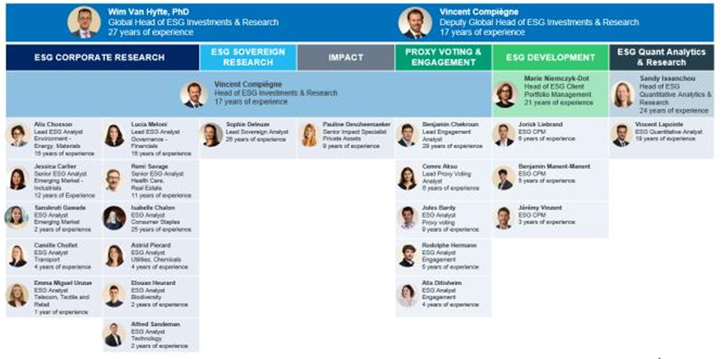
Date as of 31 January 2025
The ESG department is led by Wim Van Hyfte, PhD - Global Head of ESG Investments & Research and Vincent Compiègne, Deputy Global Head of ESG Investments & Research and Head of ESG Fundamental Research. Wim Van Hyfte, PhD has been portfolio manager for over a decade of one of Candriam’s flagship ESG funds and one of our largest ESG mandates. We believe we are one of the few investment managers to underscore the importance of integrating ESG factors in the investment process by naming an experienced ESG portfolio manager as global head of ESG research. Wim further enhances our research process with his academic research and doctorate in Financial Economics.
The ESG Investments & Research team is made up of 19 analysts dedicated to Corporate ESG Analysis, Sovereign ESG Analysis, Impact and Engagement & Voting. The corporate ESG analysts are specialised by sector. They integrate ESG risks and opportunities in both sector and company research.
The ESG analysts have designed an extensive database, which allows the management of all stages of our ESG investment process internally, from ESG analysis to portfolio construction and analysis. For the majority of our sustainable strategies, the ESG analysts determine the eligible ESG universe for the investment management team on the basis of the proprietary ESG analysis. The investment management teams then apply their respective investment processes and select issuers from the ESG Universe. For specific strategies, such as the Candriam Sustainable Equity Climate Action strategy, the eligibility of issuers is determined in conjunction with the investment teams.
The ESG Investments & Research Team also comprises dedicated ESG professionals for engagement activities and corporate responsible development. As a responsible investment manager, we are committed to engaging with issuers, and to exercising our shareholder voting and other rights in an educated and constructive fashion. We continuously expand our engagement with issuers, investors, and the public. In 2022, following a competitive submission, Candriam was named “Stewardship Team of the Year” at the Financial News Excellence in Institutional Fund Management Awards, in recognition of its constructive engagement and ESG proxy voting activities.
Our ESG Investments and Research Team is supported by an ESG Quant Analytics & Research team, specialised in ESG data analysis, and an ESG Development team, in charge of the commercial development and communication of Candriam’s ESG expertise.
Candriam governs its sustainability through several committees, each with specific roles and responsibilities:
- Strategic Sustainability Committee: Sets out strategic orientations for ESG investing and corporate sustainability, supported by ESG and CSR experts.
- Sustainability Risk Committee: Oversees and steers the management of extra-financial risks, including climate and human rights risks, and defines company-wide ESG investment restrictions.
- Proxy Voting Committee: Provides strategic guidance on proxy voting best practices and monitors Candriam’s voting policy.
- Candriam Institute for Sustainable Development: Oversees philanthropy and community impact programs, supporting initiatives in ESG research, education, social inclusion, environment, and cancer research.
- ESG Steering Committee: Coordinates the implementation of the strategic ESG roadmap, involving investment, operational, IT, and regulatory workstreams.
- CSR Steering Committee: Oversees and coordinates the implementation of the CSR roadmap across staff, clients, operational value chain, governance, and the community.
These committees ensure a comprehensive governance structure for sustainability at Candriam
Candriam’s sustainability approach across investment products and other dimensions of Candriam’s integration of sustainability considerations are described in detail through the following policies:
Sustainable Investment Policy, Exclusion Policy, Integration Policy, SRI Transparency Codes, Climate Policy, Biodiversity Policy, Sustainability Risk Policy, Principal Adverse Sustainability Impacts Statement, Human Rights Policy, Engagement Policy, Proxy Voting Policy, CSR Report.
Dialshifter
This fund is helping to ‘shift the dial from brown to green’ by...
...integrating ESG factors at every step of the investment process, from applying norms-based and controversial activities exclusions, to integrating ESG criteria in the fundamental stock analysis. Apart from its financial objectives, the fund has 2 ESG KPIs: achieving a carbon footprint that is lower than that of its benchmark, and obtaining an overall ESG score higher than the ESG score of its index.
SDR Labelling:
Not eligible to use label (out of scope)
Literature
Voting Record
Disclaimer
This document is provided by Candriam as an answer to a Request For Information issued by the recipient and is intended for the Recipient only. Please refer to the prospectus of the funds and to the key information document before making any investment decision. This communication does not constitute an offer to buy or sell financial instruments, nor does it represent an investment recommendation or confirm any kind of transaction, except where expressly agreed. Although Candriam selects carefully the data and sources within this document, errors or omissions cannot be excluded a priori. Candriam cannot be held liable for any direct or indirect losses as a result of the use of this document. The intellectual property rights of Candriam must be respected at all times, contents of this document may not be reproduced without prior written approval.
Warning: Past performance of a given financial instrument or index or an investment service or strategy, or simulations of past performance, or forecasts of future performance does not predict future returns. Gross performances may be impacted by commissions, fees and other expenses. Performances expressed in a currency other than that of the investor's country of residence are subject to exchange rate fluctuations, with a negative or positive impact on gains. If the present document refers to a specific tax treatment, such information depends on the individual situation of each investor and may change.
In respect to money market funds, please be aware that an investment in a fund is different from an investment in deposits and that the investment’s principal is capable of fluctuation. The fund does not rely on external support for guaranteeing its liquidity or stabilizing its NAV per unit or share. The risk of loss of the principal is borne by the investor.
Candriam consistently recommends investors to consult via our website https://www.candriam.com the key information document, prospectus, and all other relevant information prior to investing in one of our funds, including the net asset value (“NAV) of the funds. Investor rights and complaints procedure, are accessible on Candriam’s dedicated regulatory webpages https://www.candriam.com/en/professional/legal-information/regulatory-information/. This information is available either in English or in local languages for each country where the fund’s marketing is approved.
According to the applicable laws and regulations, Candriam may decide to terminate the arrangements made for the marketing of a relevant fund at any time.
Information on sustainability-related aspects: the information on sustainability-related aspects contained in this communication are available on Candriam webpage https://www.candriam.com/en/professional/sfdr/. The decision to invest in the promoted product should take into account all the characteristics or objectives of the promoted product as described in its prospectus, or in the information documents which are to be disclosed to investors in accordance with the applicable law.
Notice to investors in Switzerland: The information provided herein does not constitute an offer of financial instruments in Switzerland pursuant to the Swiss Financial Services Act ("FinSA") and its implementing ordinance. This is solely an advertisement pursuant to FinSA and its implementing ordinance for financial instruments.
Swiss representative: CACEIS (Switzerland) SA, Route de Signy 35, CH-1260 Nyon. The legal documents as well as the latest annual and semi-annual financial reports, if any, of the investment funds may be obtained free of charge from the Swiss representative.
Swiss paying agent: CACEIS Bank, Montrouge, succursale de Nyon/Suisse, Route de Signy, 35, CH-1260 Nyon.
Place of performance: Route de Signy 35, CH-1260 Nyon.
Place of jurisdiction: Route de Signy 35, CH-1260 Nyon.
Specific information for investors in France: the appointed representative and paying agent in France is CACEIS Bank, Luxembourg Branch, sis 1-3, place Valhubert, 75013 Paris, France. The prospectus, the key investor information, the articles of association or as applicable the management rules as well as the annual and semi-annual reports, each in paper form, are made available free of charge at the representative and paying agent in France.
Specific information for investors in Spain: Candriam Luxembourg Sucursal en España has its registered office at C/ Pedro Teixeira, 8, Edif. Iberia Mart I, planta 4, 28020 Madrid and is registered with the Comisión Nacional del Mercado de Valores (CNMV) as an European Economic Area management company with a branch.
Specific information for investors in Austria: The appointed Paying and Information Agent in Austria is Erste Bank der oesterreichischen Sparkassen AG, Am Belvedere 1, 1100 Vienna, Austria. The prospectus, the Key Investor Information Documents (KIIDs) relating to the portfolios of the Fund, the Articles, the audited annual accounts, the semi-annual accounts as well as the issuance and redemption prices are available in Austria free of charge (in the German language) at the Austrian Paying and Information Agent.”
| Fund Name | SRI Style | SDR Labelling | Product | Region | Asset Type | Launch Date | Last Amended |
|
|---|---|---|---|---|---|---|---|---|
Candriam Equities L Global Demography Fund |
Social Style | Not eligible to use label (out of scope) | SICAV/Overseas | Global | Equity | 02/01/2012 | Jun 2025 | |
ObjectivesThe objective is to outperform the benchmark defined as the MSCI© World (Net Return) index by investing in global companies that are well positioned to profit from demographic changes. Our approach to selecting environmental or social investments is referred to as Article 8 of the SFDR. 75% of the total net assets are invested in investments with environmental and social characteristics. A minimum percentage of 20% of these investments with environmental and social characteristics will consist of sustainable investments. The fund’s investment strategy aims to promote environmental or social characteristics, or a combination of these characteristics, provided that the entities in which the investments are made apply good governance practices. To achieve this objective, the management team makes discretionary investment choices based on an economic/financial analysis process and an internal analysis of environmental, social and governance (ESG) criteria. |
Fund/Portfolio Size: £2040.00m (as at: 30/11/2025) Total Screened Themed SRI Assets: £38576.79m (as at: 31/03/2025) Total Responsible Ownership Assets: £57540.75m (as at: 31/03/2025) Total Assets Under Management: £128419.89m (as at: 31/03/2025) ISIN: LU0654531341, LU1598288089, LU2346220564, LU2439121216 Contact Us: benjamin.rumary@candriam.com |
|||||||
Sustainable, Responsible &/or ESG OverviewThe sustainable investments which the sub-fund intends to make for part of the portfolio aim to contribute to a reduction in greenhouse gas emissions by means of exclusions and the use of climate indicators in the analysis of companies, and they aim to have a positive environmental and social impact in the long term. Concerning sustainable investments with environmental objectives, the sub-fund, through its sustainable investments defined by Candriam’s proprietary ESG analysis, may over the long-term contribute to one or more of the following environmental objectives as set out in Article 9 of Regulation (EU) 2020/852:
|
||||||||
|
Primary fund last amended: Jun 2025 |
||||||||
|
Information received directly from Fund Manager |
||||||||
|
Please select what you would like to read:
Fund FiltersSustainability - General
Sustainability policy
Has policies that consider (environmental and social) sustainability issues. Strategies vary but are likely to consider environmental issues like climate change, carbon emissions, biodiversity loss, resource management, environmental impacts; and social issues like equal opportunities, human rights, labour standards, diversity and adherence to internationally recognised codes. See individual entry information.
Encourage more sustainable practices through stewardship
Aim to encourage higher sustainability standards through responsible ownership / stewardship / engagement / voting activity
UN Global Compact linked exclusion policy
Use the UN Global Compact to inform or help direct where they can or cannot invest. Will typically not invest in companies with significant breaches (low standards) - strategies vary. (The UNGC covers a wide range of issues - search 'UNGC'). See https://unglobalcompact.org/
UN Sustainable Development Goals (SDG) focus
Aim to invest (and manage assets) in ways that help to address all or some of the UN's Sustainable Development Goals (SDGs). See https://sdgs.un.org/goals).
Report against sustainability objectives
Publicly report performance against named sustainability objectives Environmental - General
Limits exposure to carbon intensive industries
Options that limit or 'reduce' their exposure to carbon intensive industries (ie sectors which are major contributors to climate change). Strategies vary.
Favours cleaner, greener companies
Aims to invest in companies with strong or market leading environmental policies and practices. Strategies vary. See individual entry information for more detail. Nature & Biodiversity
Biodiversity / nature policy
Has a written biodiversity policy or theme typically aimed at supporting, encouraging and improving environmental protection and safeguarding the natural world (sometimes referred to as 'natural capital'). See eg https://www.un.org/en/climatechange/science/climate-issues/biodiversity Climate Change & Energy
Coal, oil & / or gas majors excluded
Avoid investment in major coal, oil and/or gas (extraction) companies. Strategies vary.
Encourage transition to low carbon through stewardship activity
Encourage the transition to lower carbon activities through asset selection and / or responsible ownership activity.
Supply chain decarbonisation policy
Has a supply chain decarbonisation policy which sets out their position on the need to reduce carbon emissions. Social / Employment
Labour standards policy
Has a labour standards policy - likely to mean they will invest in / favour companies that have higher employment related standards and avoid those with low standards. Strategies vary. See eg https://www.ilo.org/international-labour-standards
Favours companies with strong social policies
Aims to invest in assets with high social values - this may include strong human rights, labour standards and equal opportunities or safety related practices.
Diversity, equality & inclusion Policy (product level)
Has a written diversity policy – where the manager will aim to select companies with a carefully considered, positive employment standards. This may cover a range of issues including gender, ethnicity, disability, beliefs and sexual orientation.
Responsible mining policy
Has a policy that explains their position on which mining companies they may or may not invest in. Typically this may mean only investing in assets with high environmental and social standards. This is a growing concern given demand for rare earth metals eg lithium, cobalt.
Vulnerable / gig workers protection policy
Has a policy aimed at protecting vulnerable workers such as those on zero hour / informal contracts working in the gig economy Ethical Values Led Exclusions
Tobacco & related product manufacturers excluded
Companies are excluded if they are involved in any aspect of the production chain for tobacco products, including cigarettes, vaping, e-cigarettes, chewing tobacco and cigars.
Tobacco & related products - avoid where revenue > 5%
Companies are excluded if they make more than 5% of their revenue from the manufacture, sale or distribution of tobacco products including cigarettes, vaping, e-cigarettes, chewing tobacco and cigars.
Controversial weapons exclusion
Excludes companies which make controversial weapons such as landmines, cluster munitions and chemical weapons.
Armaments manufacturers avoided
Avoids companies that manufacture weapons intended specifically for military use. Strategies vary - may or may not include non-strategic military products.
Armaments manufacturers not excluded
Does Not exclude manufacturers of products intended for use in armaments and weapons. So may invest in them Human Rights
Human rights policy
Has policies relating to human rights issues. Typically require companies to demonstrate higher standards, although some managers work to encourage improvements. Investee companies are often judged against internationally agreed norms or standards. Strategies vary.
Child labour exclusion
Has policies to avoid companies that employ children.
Oppressive regimes (not free or democratic) exclusion policy
Has policies that exclude companies or other assets which operate in, or are owned by regimes which are not democratic, or where people may be oppressed. May use eg. Freedom House research. Strategies vary.
Indigenous peoples’ policy
Has a policy which sets out the position on the treatment of indigenous people by investee assets/companies - typically meaning they won't invest in companies with low standards.
Modern slavery exclusion policy
Has a policy which excludes assets with involvement in Modern Slavery
LGBTQ+ policy
Has a policy which sets out its position on LGBTQ+ related social issues and their expectations of investee assets - typically meaning they won't invest in companies with poor standards. Meeting Peoples' Basic Needs
Demographic / ageing population theme
Has a thematic investment approach focusing on the ‘silver economy’ - in particular (typically) the issues and opportunities presented by changing demographics. This could include finance, healthcare and medicines and/ or longevity science to extend lifespans. Strategies vary. Gilts & Sovereigns
Does not invest in sovereigns
Does not invest in / excludes 'sovereigns' - debt issued by governments. See eg https://www.investopedia.com/terms/s/sovereign-debt.asp Banking & Financials
Invests in banks
Can include banks as part of their holdings / portfolio.
Invests in insurers
May invest in insurance companies. Governance & Management
Avoids companies with poor governance
Avoids investing in companies with poor governance practices.(e.g. board structure, management practices etc.) Views may however vary on what counts as 'poor' practices - and funds may not immediately divest as they may prefer to work to encourage higher standards.
Anti-bribery & corruption policy
Has policies explaining how managers will respond to assets / companies that do not comply with relevant anti-bribery and anti-corruption standards or laws. Strategies vary; options include stewardship/ engagement and divestment - or a combination.
Encourage board diversity e.g. gender
Encourage the companies they invest in to have more diverse board structures (e.g. more women on boards)
Encourage higher ESG standards through stewardship activity
Aim to encourage higher ESG standards through responsible ownership / stewardship / engagement /voting activity Product / Service Governance
ESG integration strategy
Find fund / asset managers that factor in 'environmental, social and governance' issues as part of their investment decision making process. A focus on 'ESG' typically means a fund is carrying out additional research to help reduce ESG related risks. It does not necessarily mean a focus on sustainability. Strategies vary. See fund literature. Asset Size
Over 50% large cap companies
Invests more than half of their money into what are commonly regarded as 'large companies'. This will typically mean that the market capitalisation (or value) of the companies they hold is in excess of £5 to £10 billion.
Invests in small, mid & large cap companies / assets
Invests in a combination of small, medium and larger (potentially multinational) companies / assets.
Invests mostly in large cap companies / assets
Invests mainly in larger companies / assets. (e.g. over circa £5-£10bn) Impact Methodologies
Measures positive impacts
Aims to measure the positive real world environmental and / or social benefits that are associated with their investment strategy. Investments that aim to deliver positive impacts and measure those impacts may be referred to as 'Impact' - although impact measurement is not restricted to Impact investments. Strategies vary.
Positive environmental impact theme
Specifically sets out to help deliver positive environmental impacts, benefits or 'real world' outcomes.
Positive social impact theme
Specifically states that they aim to deliver positive social (i.e. people related) impacts and/or outcomes.
Aim to deliver positive impacts through engagement
Aims to deliver positive environmental and or social impacts (real world benefits) through its engagement with investee assets
Over 50% in assets providing environmental or social ‘solutions’
Invests more than 50% of capital in assets which are regarded as being significantly focused on providing solutions to environmental or social challenges. Strategies vary. How The Fund/Portfolio Works
Positive selection bias
Focuses on finding and investing in companies with positive / beneficial attributes. This strategy can be applied in addition to exclusion criteria and engagement/stewardship activity.
Negative selection bias
Has principle 'ethical approach' to avoid companies by using negative screening criteria. Strategies vary.
ESG weighted / tilt
Invest more heavily in assets which have higher ESG ratings/standards or scores and less heavily in companies with lower ESG ratings. Where this is central to the strategy you should expect assets in most sectors. Strategies vary.
Combines norms based exclusions with other SRI criteria
Investment selection process uses internationally agreed 'norms' (e.g. United Nations Global Compact - UNGC - or the UN Sustainable Development Goals - SDGs) alongside additional SRI criteria such as positive or negative stock selection policies and/or stewardship strategies.
Balances company 'pros and cons' / best in sector
Considers both the 'positive' and 'negative' aspects of company behaviour and makes balanced, considered decisions as part of their investment approach. May apply to a range of different issues and policy areas.
Norms focus
Uses internationally agreed standards, conventions and 'norms' to help direct investment decisions (e.g. the UN Global Compact, UN Sustainable Development Goals).
ESG risk mitigation focus
Focuses on the careful management of environmental, social and governance (ESG) related risks - typically by avoiding or being underweight in companies seen as posing major risks in these areas (i.e. not necessarily by using themes, exclusions etc).
SRI / ESG / Ethical policies explained on website
Publish explanations of their ethical, social and/or environmental policies online (i.e. investment decision making strategies/ buy/sell &/or asset management strategies). Unscreened Assets & Cash
All assets (except cash) meet published sustainability criteria
All assets - except cash - meet the sustainability criteria published in strategy documentation. Intended Clients & Product Options
Available via an ISA (OEIC only)
Available via a tax efficient ISA product wrapper.
Portfolio SRI / ESG options available
Only applicable for DFM’s & portfolio providers. Finds those that offer an SRI / ESG portfolio option
Bespoke SRI / ESG portfolios available
Only applicable for DFM’s & portfolio providers. Find service providers who offer bespoke ('personalised') SRI / ESG portfolio options Labels & Accreditations
SFDR Article 8 fund / product (EU)
Find options classified under Article 8 of the EU’s SFDR (Sustainable Finance Disclosure Requirements). Article 8 of the SFDR is a set of requirements that apply to financial products that 'promote' environmental or social characteristics together with high governance. These rules do not currently apply to UK products so many managers may leave this field blank. Fund Management Company InformationAbout The Business
Boutique / specialist fund management company
Find fund / asset management companies that are smaller or specialise in particular areas - notably, ideally ESG related. Strategies vary.
Specialist positive impact fund management company
Find fund / asset management companies (or subsidiaries) that specialise in - or focus entirely on - investing in assets that are helping to deliver positive environmental and / or social impacts.
Responsible ownership / stewardship policy or strategy (AFM companywide)
Finds fund / asset management companies that have a published company wide stewardship, engagement and / or responsible ownership policy or strategy that covers all investments. Stewardship typically involves encouraging higher ESG standards through voting and dialogue.
ESG / SRI engagement (AFM companywide)
Find fund / asset management companies that actively encourage higher 'environmental, social and governance' and / or 'sustainable and responsible investment' practices across investee companies - typically where the aim is to encourage positive change that is aligned with the best interests of investors. Strategies vary. See additional information and options.
Vote all* shares at AGMs / EGMs (AFM companywide)
Find fund / asset managers that vote all* the shares they own at Annual General Meetings and Extraordinary General Meetings. A commitment to voting shares is a key indicator of 'responsible share ownership' demonstrating their support for or disagreement with management policy. (*situations can legitimately, occasionally occur where voting proves impossible, but in principle all shares should be voted.)
Responsible ownership / ESG a key differentiator (AFM companywide)
Find fund / asset managers that consider responsible ownership and ESG to be a key differentiator for their business.
Sustainable property strategy (AFM companywide)
Find fund / asset management companies that take sustainability criteria into account when selecting and/or managing all of their property / real estate investments.
SDG aligned aims / objectives (AFM companywide)
Find fund / asset management companies that aim to align all their investments (across all funds) to help meet the aims of the UN Sustainable Development Goals.
Responsible ownership policy for non SRI / sustainable options (AFM companywide)
Find options run by managers that apply Responsible ownership or 'Stewardship' policies to all or most of their investment assets. This means active involvement (e.g. voting, dialogue) with the companies across all or most funds, products and services.
Integrates ESG factors into all / most research (AFM companywide)
Find fund / asset management companies that consider environmental, social and governance (ESG) issues when deciding whether or not to invest in a company for all / almost all of their funds and other assets. This is increasingly seen as part of sound risk management.
In-house diversity improvement programme (AFM companywide)
Finds organisations / fund managers that have an in-house (company wide) diversity improvement programme - meaning that they are working to ensure that within their own businesses they employ people from diverse backgrounds - often typically focused on ethnicity and/or sex.
Diversity, equality & inclusion engagement policy (AFM companywide)
Find fund / asset management companies that encourage the companies they invest in to have strong diversity, race, gender and other equality policies across all assets held, not simply screened or themed SRI/ESG funds. (ie Asset Management company wide).
Invests in new sustainability linked bond issuances (AFM companywide)
Fund / asset management company has investments in bonds designed to meet sustainability requirements - however these assets may not be 'ringfenced' for this purpose. See website for details.
Offer structured intermediary sustainable investment training
Fund management entity offers unstructured intermediary training on sustainable investment (ie for financial advisers and wealth managers)
Offer unstructured intermediary sustainable investment training
Fund management entity offers unstructured intermediary training on sustainable investment (ie for financial advisers and wealth managers) Collaborations & Affiliations
PRI signatory
Find fund / asset management companies that have signed up to the UN backed 'Principles of Responsible Investment'.
UKSIF member
Find fund / asset management companies that are members of UKSIF - the UK Sustainable Investment and Finance association
Investment Association (IA) member
Fund management entity is a member of the Investment Association https://www.theia.org/ Resources
In-house responsible ownership / voting expertise
Find fund / asset management companies that employ people to steer and support fund managers in voting shares at company AGM's and EGMs in ways that are consistent with encouraging higher ESG/sustainability standards.
Employ specialist ESG / SRI / sustainability researchers
Find a fund / asset management company that directly employs specialist ESG/SRI/sustainability researchers or analysts. This allows asset managers to discuss environmental, social and governance risks and opportunities directly with companies.
Use specialist ESG / SRI / sustainability research companies
Find fund / asset management companies that makes use of expert external research companies. This can help deliver specialist expertise and means resources are pooled with other investors.
ESG specialists on all investment desks (AFM companywide)
Finds organisations / fund managers that have one or more ESG/sustainability experts on all investment teams or 'desks' (all asset types) Accreditations
PRI A+ rated (AFM companywide)
Finds organisations / fund managers that have an A+ PRI rating - meaning they are highly rated according to the 'Principles of Responsible Investment'
UK Stewardship Code signatory (AFM companywide)
Find fund / asset managers that are signatories to the FRC UK Stewardship Code, which sets out a framework for constructive investor / investee relations where managers are encouraged to behave like responsible, typically longer term 'company owners'. Engagement Approach
Regularly lead collaborative ESG initiatives (AFM companywide)
Find fund / asset management companies that regularly initiate or run industry wide (collaborative) investor projects aimed at raising environmental, social and governance standards amongst investee companies.
Encourage responsible corporate taxation (AFM companywide)
Find fund / asset management companies that are working with the companies they invest in to encourage more responsible corporate taxation.
Engaging on climate change issues
Fund / asset manager has stewardship /responsible ownership strategy that is focused on addressing climate change with investee assets.
Engaging with fossil fuel companies on climate change
Fund / asset manager has a stewardship /responsible ownership strategy that involves working with fossil fuel companies on climate change related issues. See fund manager website for details.
Engaging to reduce plastics pollution / waste
Fund / asset manager has stewardship /responsible ownership strategy with involves encouraging investee asset to reduce plastic waste and pollution.
Engaging on human rights issues
Fund / asset manager has responsible ownership / stewardship strategy in place which aims to address human rights issues in investee companies (and potentially their suppliers) with the aim of raising standards
Engaging to stop modern slavery
Fund / asset manager is working with the assets they hold to help stamp out modern slavery - where direct or indirect company employees are exploited for business benefits.
Engaging to encourage more sustainable ‘diversifiers’ (e.g. derivatives)
Funds and other options may use assets that are not directly aligned with sustainability objectives in order to help manage investment risk. Requesting more sustainable options of this kind will aid alignment with fund objectives.
Engaging on the responsible use of AI
Working to address sustainability, ESG and related concerns around artificial intelligence.
Split voting policy
This fund / asset manager may vote differently for different clients or regions. See fund manager stewardship policy for further information.
Stewardship escalation policy
Escalation policies describe how a manager will proceed if stewardship / engagement activity is not successful in the short term. Company Wide Exclusions
Controversial weapons avoidance policy (AFM companywide)
Find fund / asset management companies (not funds) that avoid investment in 'controversial weapons' across all of their funds and other investment vehicles.
Tobacco avoidance policy (AFM companywide)
Find fund / asset management companies that avoid investment in tobacco (manufacturing) companies across all their assets.
Fossil fuel exclusion policy (AFM companywide)
Find fund / asset management companies that avoid investment in fossil fuel companies (e.g. coal, oil and gas) across all of their funds. (and/ or other assets.)
Review(ing) carbon / fossil fuel exposure for all funds (AFM companywide)
Find funds / asset managers that are reviewing, or have reviewed, their exposure to carbon intensive industries including (but not only) mining, oil and gas companies. (Typically with reference to climate change.) Climate & Net Zero Transition
Net Zero commitment (AFM companywide)
Fund / asset management organisations that have pledged to reduce their greenhouse gas emissions to ‘net zero’. Strategies vary - this area is changing rapidly.
Publish 'CEO owned' Climate Risk policy (AFM companywide)
Find fund / asset management companies that have published a Climate Risk policy or statement that is signed / owned by their Chief Executive.
Encourage carbon / greenhouse gas reduction (AFM companywide)
Find fund / asset management companies that are working with the companies they invest in to encourage reductions in carbon dioxide and other greenhouse gas emissions.
Carbon transition plan published (AFM companywide)
Finds organisations / fund managers that have a company wide carbon transition plan - meaning that they have plotted a path to how they will move away from activities that produce or use carbon based energy sources (that emit greenhouse gases) towards clean, alternative, renewable energy sources.
‘Forward Looking Climate Metrics’ published / ITR (AFM companywide)
Finds organisations / fund managers that have published ‘forward looking climate metrics’ e.g. 'implied temperature rise' data that are a total of the asset management company's share (% owned) of all the investee company emissions of the assets they manage, as well as their own direct and other indirect emissions.
In-house carbon / GHG reduction policy (AFM companywide)
Find fund / asset management companies that are working to reduce their own (fund management company) carbon/greenhouse gas emissions.
Working towards a ‘Net Zero’ commitment (AFM companywide)
Finds organisations / fund management companies that are in the process of working out how to make a ‘net zero commitment’ - meaning that when that is finalised they will have started the process of reducing their total greenhouse gas emissions to 'zero'. Transparency
Publish responsible ownership / stewardship report (AFM companywide)
Find fund / asset management companies that publish a report detailing their responsible investment ownership - also known as 'Stewardship' - activity.
Full stewardship / responsible ownership policy information on company website
Find fund / asset management companies that publish information about their sustainable and responsible investment strategies on their company website.
Full stewardship / responsible ownership policy information available on request
Find fund / asset management companies that will supply information about their sustainable and responsible investment activity on request.
Publish full voting record (AFM companywide)
Fund / asset management companies that publish a full record of how they vote their shares at AGMs (annual general meetings) and EGMs (extraordinary general meetings). Voting strategies have an important role to play encouraging higher environmental, social and governance standards.
Dialshifter statement
Find fund / asset management companies that have supplied Dialshifter information. See Dialshifter tab within record for more information. Comments
Sustainable, Responsible &/or ESG Policy:In a first step, we reduce the investment universe by applying an ESG-filter based on controversial activities and the respect of the UN Global Compact principles. Any companies exposed to the weapons industry are permanently excluded from the universe if they are involved in the production or sale of anti-personnel landmines, cluster bombs, depleted uranium, chemical, biological and nuclear weapons regardless of the sales/revenues derived from such products.
Candriam also excludes companies involved in white phosphorous weapons that derive more than 5% of their total sales/revenues from the production, manufacturing, trade, testing or maintenance of such weapons.
We also exclude all companies directly involved in the tobacco industry that derive more than 5% of their revenues from the manufacturing or retailing of tobacco products and all companies directly or indirectly involved in the thermal coal industry deriving more than 10% of their revenues from coal extraction or power generation from coal or developing new thermal coal projects. Gambling is also excluded as a controversial activity, applying a 5% revenue threshold.
Candriam also conducts a Norms-based Analysis to determine whether each company respects the ten principles of the United Nations Global Compact that cover four main categories: Human Rights, Labour, Environment, and Anti-Corruption. Based on this Norms-based review, we possibly exclude companies which have significantly and repeatedly breached any of the principles of the United Nation’s Global Compact.
As for Demographic screening, we aim to identify those companies that generate at least 30% of their revenues from one or more of the following demographic long-term sub-themes: Rising demand for food, water & natural resources, Urbanisation, Environment, Healthcare, Healthier lifestyle, Retirement & savings, Emerging markets consumer, Evolving consumption trends (including digital). Starting from a high-level market classification, it’s clear some industry groups fit squarely into one of the 8 sub-thematics. Examples would be Health Care Equipment, Pharma, Automation or Electrical Equipment players within Cap goods, Semiconductor companies, Wealth Managers, Luxury Apparel amongst others. For other sectors thematic relevancy is less clear and stocks will be screened and analysed on an ad hoc basis. Both eventually create the total universe of names for the strategy.
Process:The strategy uses a fundamental bottom-up investment process, comprising four steps:
Resources, Affiliations & Corporate Strategies:ESG Investments & Research Team Candriam has an independent and dedicated ESG Investments & Research Team, who has developed Candriam’s own ESG analysis methodology applied to three types of issuers: corporations, governments, and supranational institutions. The team is organised around various pillars:
The organigram below describes the organisation of the team:
Date as of 31 January 2025 The ESG department is led by Wim Van Hyfte, PhD - Global Head of ESG Investments & Research and Vincent Compiègne, Deputy Global Head of ESG Investments & Research and Head of ESG Fundamental Research. Wim Van Hyfte, PhD has been portfolio manager for over a decade of one of Candriam’s flagship ESG funds and one of our largest ESG mandates. We believe we are one of the few investment managers to underscore the importance of integrating ESG factors in the investment process by naming an experienced ESG portfolio manager as global head of ESG research. Wim further enhances our research process with his academic research and doctorate in Financial Economics. The ESG Investments & Research team is made up of 19 analysts dedicated to Corporate ESG Analysis, Sovereign ESG Analysis, Impact and Engagement & Voting. The corporate ESG analysts are specialised by sector. They integrate ESG risks and opportunities in both sector and company research. The ESG analysts have designed an extensive database, which allows the management of all stages of our ESG investment process internally, from ESG analysis to portfolio construction and analysis. For the majority of our sustainable strategies, the ESG analysts determine the eligible ESG universe for the investment management team on the basis of the proprietary ESG analysis. The investment management teams then apply their respective investment processes and select issuers from the ESG Universe. For specific strategies, such as the Candriam Sustainable Equity Climate Action strategy, the eligibility of issuers is determined in conjunction with the investment teams. The ESG Investments & Research Team also comprises dedicated ESG professionals for engagement activities and corporate responsible development. As a responsible investment manager, we are committed to engaging with issuers, and to exercising our shareholder voting and other rights in an educated and constructive fashion. We continuously expand our engagement with issuers, investors, and the public. In 2022, following a competitive submission, Candriam was named “Stewardship Team of the Year” at the Financial News Excellence in Institutional Fund Management Awards, in recognition of its constructive engagement and ESG proxy voting activities. Our ESG Investments and Research Team is supported by an ESG Quant Analytics & Research team, specialised in ESG data analysis, and an ESG Development team, in charge of the commercial development and communication of Candriam’s ESG expertise.
Candriam governs its sustainability through several committees, each with specific roles and responsibilities:
These committees ensure a comprehensive governance structure for sustainability at Candriam
Candriam’s sustainability approach across investment products and other dimensions of Candriam’s integration of sustainability considerations are described in detail through the following policies: Sustainable Investment Policy, Exclusion Policy, Integration Policy, SRI Transparency Codes, Climate Policy, Biodiversity Policy, Sustainability Risk Policy, Principal Adverse Sustainability Impacts Statement, Human Rights Policy, Engagement Policy, Proxy Voting Policy, CSR Report. Dialshifter (Fund)This fund is helping to ‘shift the dial from brown to green’ by... ...integrating ESG factors at every step of the investment process, from applying norms-based and controversial activities exclusions, to integrating ESG criteria in the fundamental stock analysis. Apart from its financial objectives, the fund has 2 ESG KPIs: achieving a carbon footprint that is lower than that of its benchmark, and obtaining an overall ESG score higher than the ESG score of its index.
Dialshifter (Corporate)Our organisation is helping to support the Paris Climate Agreement and the Race to Net Zero by...
We publish a certain number of metrics both at company level and fund level. SDR Labelling:Not eligible to use label (out of scope) LiteratureVoting RecordDisclaimerThis document is provided by Candriam as an answer to a Request For Information issued by the recipient and is intended for the Recipient only. Please refer to the prospectus of the funds and to the key information document before making any investment decision. This communication does not constitute an offer to buy or sell financial instruments, nor does it represent an investment recommendation or confirm any kind of transaction, except where expressly agreed. Although Candriam selects carefully the data and sources within this document, errors or omissions cannot be excluded a priori. Candriam cannot be held liable for any direct or indirect losses as a result of the use of this document. The intellectual property rights of Candriam must be respected at all times, contents of this document may not be reproduced without prior written approval. Warning: Past performance of a given financial instrument or index or an investment service or strategy, or simulations of past performance, or forecasts of future performance does not predict future returns. Gross performances may be impacted by commissions, fees and other expenses. Performances expressed in a currency other than that of the investor's country of residence are subject to exchange rate fluctuations, with a negative or positive impact on gains. If the present document refers to a specific tax treatment, such information depends on the individual situation of each investor and may change. In respect to money market funds, please be aware that an investment in a fund is different from an investment in deposits and that the investment’s principal is capable of fluctuation. The fund does not rely on external support for guaranteeing its liquidity or stabilizing its NAV per unit or share. The risk of loss of the principal is borne by the investor. Candriam consistently recommends investors to consult via our website https://www.candriam.com the key information document, prospectus, and all other relevant information prior to investing in one of our funds, including the net asset value (“NAV) of the funds. Investor rights and complaints procedure, are accessible on Candriam’s dedicated regulatory webpages https://www.candriam.com/en/professional/legal-information/regulatory-information/. This information is available either in English or in local languages for each country where the fund’s marketing is approved. According to the applicable laws and regulations, Candriam may decide to terminate the arrangements made for the marketing of a relevant fund at any time. Information on sustainability-related aspects: the information on sustainability-related aspects contained in this communication are available on Candriam webpage https://www.candriam.com/en/professional/sfdr/. The decision to invest in the promoted product should take into account all the characteristics or objectives of the promoted product as described in its prospectus, or in the information documents which are to be disclosed to investors in accordance with the applicable law. Notice to investors in Switzerland: The information provided herein does not constitute an offer of financial instruments in Switzerland pursuant to the Swiss Financial Services Act ("FinSA") and its implementing ordinance. This is solely an advertisement pursuant to FinSA and its implementing ordinance for financial instruments. Swiss representative: CACEIS (Switzerland) SA, Route de Signy 35, CH-1260 Nyon. The legal documents as well as the latest annual and semi-annual financial reports, if any, of the investment funds may be obtained free of charge from the Swiss representative. Swiss paying agent: CACEIS Bank, Montrouge, succursale de Nyon/Suisse, Route de Signy, 35, CH-1260 Nyon. Place of performance: Route de Signy 35, CH-1260 Nyon. Place of jurisdiction: Route de Signy 35, CH-1260 Nyon. Specific information for investors in France: the appointed representative and paying agent in France is CACEIS Bank, Luxembourg Branch, sis 1-3, place Valhubert, 75013 Paris, France. The prospectus, the key investor information, the articles of association or as applicable the management rules as well as the annual and semi-annual reports, each in paper form, are made available free of charge at the representative and paying agent in France. Specific information for investors in Spain: Candriam Luxembourg Sucursal en España has its registered office at C/ Pedro Teixeira, 8, Edif. Iberia Mart I, planta 4, 28020 Madrid and is registered with the Comisión Nacional del Mercado de Valores (CNMV) as an European Economic Area management company with a branch. Specific information for investors in Austria: The appointed Paying and Information Agent in Austria is Erste Bank der oesterreichischen Sparkassen AG, Am Belvedere 1, 1100 Vienna, Austria. The prospectus, the Key Investor Information Documents (KIIDs) relating to the portfolios of the Fund, the Articles, the audited annual accounts, the semi-annual accounts as well as the issuance and redemption prices are available in Austria free of charge (in the German language) at the Austrian Paying and Information Agent.” |
||||||||