
Schroder European Climate Transition Fund
SRI Style:
Sustainability Tilt
SDR Labelling:
Sustainability Improvers label
Product:
OEIC
Fund Region:
Europe ex UK
Fund Asset Type:
Equity
Launch Date:
02/05/2012
Last Amended:
Aug 2025
Dialshifter ( ):
):
Fund/Portfolio Size:
£19.17m
(as at: 31/03/2026)
Total Screened Themed SRI Assets:
£80299.00m
(as at: 31/03/2025)
Total Responsible Ownership Assets:
£653712.00m
(as at: 31/03/2025)
Total Assets Under Management:
£758460.00m
(as at: 31/03/2025)
ISIN:
GB00B7CM2R31, GB00B8VX2T67, GB00B9DLYT99, GB00B9GTQ502, GB00BJRSTV36, GB00B6S00Y77, GB00B7FHV230, 7, GB00BDRZNP45, GB00B79FC312, GB00BDRZNM14, GB00BF782S34, GB00B6QR3M93, GB00B94WQJ53, GB00B75ZTX45, GB00BJRSTW43,
Objectives:
The fund aims to provide capital growth in excess of the FTSE World Series Europe ex UK (Gross Total Return) Index (after fees have been deducted) over a three to five year period by investing in equities of European companies, excluding the UK, which have the potential to achieve net zero greenhouse gas (“GHG”) emissions by 2050. Such companies support decarbonisation and therefore contribute to the goal of limiting global warming to no more than 1.5˚C above pre-industrial levels.
By investing in companies that the investment manager determines to have the potential to achieve net zero GHG emissions by 2050, the fund aims to helps them continue to contribute to the positive sustainability outcome of reducing GHG emissions and therefore slowing global warming. Achieving net zero helps prevent the buildup of greenhouse gases, which in turn reduces the risk of both acute and chronic climate events such as extreme weather, sea-level rise, and disruptions to ecosystems.
Sustainable, Responsible
&/or ESG Overview:
The fund manager invests in companies that have the potential to achieve net zero GHG emissions by 2050 (“decarbonising investments”). Net zero GHG means that the amount of GHG emissions emitted into the atmosphere by a company is balanced by the amount removed. To qualify as a decarbonising investment, a company needs to have a temperature alignment of no more than 1.5˚C based on evidence of previous emissions reductions. This means that the company's expected emissions reductions are consistent with limiting global warming to 1.5 degrees C above pre-industrial levels. The manager has repeatable process for identifying these companies.
The fund may also invest up to 30% of its assets in companies that are not deemed to be decarbonising investments, but have a company-reported emissions reduction target aligned with a temperature of no more than 1.5˚C.
Primary fund last amended:
Aug 2025
Information directly from fund manager.
Fund Filters
Sustainability - General
Aim to encourage higher sustainability standards through responsible ownership / stewardship / engagement / voting activity
Use the UN Global Compact to inform or help direct where they can or cannot invest. Will typically not invest in companies with significant breaches (low standards) - strategies vary. (The UNGC covers a wide range of issues - search 'UNGC'). See https://unglobalcompact.org/
Publicly report performance against named sustainability objectives
Environmental - General
Has policies which relate to environmental issues. These will typically set out their stance on issues such as pollution, climate change, resource management, biodiversity loss, carbon emissions, plastics and/or additional environmental impacts. Strategies vary.
Options that limit or 'reduce' their exposure to carbon intensive industries (ie sectors which are major contributors to climate change). Strategies vary.
Has documented policies explaining the approach to environmental damage and pollution. Strategies vary.
Aims to invest in companies with strong or market leading environmental policies and practices. Strategies vary. See individual entry information for more detail.
Climate Change & Energy
Encourage the transition to lower carbon activities through asset selection and / or responsible ownership activity.
Aims to ensure holdings will reduce their greenhouse gas emissions in line with targets set at COP21 in Paris. The core aim is to help achieve ‘net zero emissions by 2050’ and a ‘maximum global temperature increase of +1.5 to +2 degrees above preindustrial levels’. Strategies and opinions vary.
Will only invest in companies that report greenhouse gas emissions in line with this international reporting framework. See https://www.fsb-tcfd.org/ https ://www.ifrs.org/sustainability/tcfd/
Requires all, or most of, the assets they invest in to have a ‘net zero action plan’ - describing how they will reduce their greenhouse gas emissions.
Ethical Values Led Exclusions
Companies are excluded if they are involved in any aspect of the production chain for tobacco products, including cigarettes, vaping, e-cigarettes, chewing tobacco and cigars.
Companies are excluded if they make more than 5% of their revenue from the manufacture, sale or distribution of tobacco products including cigarettes, vaping, e-cigarettes, chewing tobacco and cigars.
Excludes companies which make controversial weapons such as landmines, cluster munitions and chemical weapons.
Avoids companies that manufacture weapons intended specifically for military use. Strategies vary - may or may not include non-strategic military products.
Does Not exclude manufacturers of products intended for use in armaments and weapons. So may invest in them
Does Not exclude companies with military contracts - this may include medical supplies, food, safety equipment, housing, technology etc.
Has a written civilian firearms exclusion policy - meaning that they will not invest in companies that make (or perhaps also sell) handguns made for non-military users.
Avoids companies with significant involvement in the gambling industry. Some may allow a small proportion of revenues to come from this area.
Avoids companies that derive significant income from pornography and related areas. Strategies vary.
Gilts & Sovereigns
Does not invest in / excludes 'sovereigns' - debt issued by governments. See eg https://www.investopedia.com/terms/s/sovereign-debt.asp
Banking & Financials
Can include banks as part of their holdings / portfolio.
May invest in insurance companies.
Governance & Management
Avoids investing in companies with poor governance practices.(e.g. board structure, management practices etc.) Views may however vary on what counts as 'poor' practices - and funds may not immediately divest as they may prefer to work to encourage higher standards.
Encourage the companies they invest in to have more diverse board structures (e.g. more women on boards)
Encourage the banks and insurance companies they invest in to publish climate change related financial information - as set out by the Task Force on Climate Related Financial Disclosures (with the aim of helping investors measure and respond to climate risk).
Aim to encourage higher ESG standards through responsible ownership / stewardship / engagement /voting activity
Product / Service Governance
Find fund / asset managers that factor in 'environmental, social and governance' issues as part of their investment decision making process. A focus on 'ESG' typically means a fund is carrying out additional research to help reduce ESG related risks. It does not necessarily mean a focus on sustainability. Strategies vary. See fund literature.
Environmental, social and governance issues are part of this fund’s reporting of their ‘value’ to clients. AoV reporting is a statutory requirement. Including ESG factors in its calculation is not.
Impact Methodologies
Specifically sets out to help deliver positive environmental impacts, benefits or 'real world' outcomes.
Directs investment towards companies where a major part of their business is about solving environmental challenges. e.g. companies helping to address climate change.
Aims to deliver positive environmental and or social impacts (real world benefits) through its engagement with investee assets
How The Fund/Portfolio Works
Investment selection process uses internationally agreed 'norms' (e.g. United Nations Global Compact - UNGC - or the UN Sustainable Development Goals - SDGs) alongside additional SRI criteria such as positive or negative stock selection policies and/or stewardship strategies.
Does not use stock lending for performance or risk purposes.
Unscreened Assets & Cash
Only invests in cash to aid the practical management (buying and selling) of assets and so do not use additional financial instruments.
Intended Clients & Product Options
Designed to meet the needs of individual investors with an interest in sustainability issues.
Designed for clients who care about ethical and values-based issues, often alongside sustainability issues also.
Available via a tax efficient ISA product wrapper.
Labels & Accreditations
Find options that have chosen to adopt one of the Financial Conduct Authority (FCA) SDR labels. Please note: there are a range of reasons why potentially relevant options may not use an SDR label eg. adopting a label may be work in progress, the manager may not yet be allowed to do so because of the product type, a manager may feel they are insufficiently aligned to SDR requirements.
A voluntary corporate culture standard for investment managers, see https://www.investorsact.com/ - City Hive
Fund Management Company Information
About The Business
Finds fund / asset management companies that have a published company wide stewardship, engagement and / or responsible ownership policy or strategy that covers all investments. Stewardship typically involves encouraging higher ESG standards through voting and dialogue.
Find fund / asset management companies that actively encourage higher 'environmental, social and governance' and / or 'sustainable and responsible investment' practices across investee companies - typically where the aim is to encourage positive change that is aligned with the best interests of investors. Strategies vary. See additional information and options.
Find fund / asset managers that vote all* the shares they own at Annual General Meetings and Extraordinary General Meetings. A commitment to voting shares is a key indicator of 'responsible share ownership' demonstrating their support for or disagreement with management policy. (*situations can legitimately, occasionally occur where voting proves impossible, but in principle all shares should be voted.)
Find fund / asset managers that consider responsible ownership and ESG to be a key differentiator for their business.
Collaborations & Affiliations
Find fund / asset management companies that have signed up to the UN backed 'Principles of Responsible Investment'.
Find fund / asset management companies that are members of UKSIF - the UK Sustainable Investment and Finance association
Find fund / asset management companies that have partnered with Fund EcoMarket - meaning that they are helping to improve access to information on sustainable and responsible investment by paying an annual fee to us which enables us to publish information for free. Partner funds are listed ahead of other funds and have their logos displayed.
A member of the Taskforce for Nature Related Financial Disclosures group which aims to aid risk management and shift money towards nature-positive outcomes.
Fund management entity is a member of the Investment Association https://www.theia.org/
Engagement Approach
Fund / asset manager is working with the assets they hold to help stamp out modern slavery - where direct or indirect company employees are exploited for business benefits.
Transparency
Find fund / asset management companies that have supplied Dialshifter information. See Dialshifter tab within record for more information.
Sustainable, Responsible &/or ESG Policy:
To qualify as a decarbonising investment, a company needs to have a temperature alignment of no more than 1.5˚C based on evidence of previous emissions reductions. This means that the company's expected emissions reductions are consistent with limiting global warming to 1.5˚C above preindustrial levels. To calculate a company's temperature alignment, the investment manager uses emissions data from a third party provider and company reports to produce four data sets (using a reference year of 2019, or the first reported year thereafter), and calculate the trend in emissions reduction for each:
- Absolute emissions (based on Scope 1 and 2 emissions data)
- Absolute emissions (based on Scope 1, 2 and 3 emissions data)
- Emissions intensity (based on Scope 1 and 2 emissions data relative to annual revenue in USD)
- Emissions intensity (based on Scope 1, 2 and 3 emissions data relative to annual revenue in USD)
Absolute emissions measure the total amount of emissions of the company, while intensity measures emissions relative to a company's revenue. Scope 1 and 2 emissions come from a company's direct activities and indirect energy consumption, while Scope 3 emissions are indirect emissions from the company's value chain. The investment manager then uses an industry-standard methodology (the CDP-WWF Temperature Scoring Methodology) to calculate the company's temperature alignment based on the data set with the greatest emissions reduction trend. If a company's temperature alignment is 1.5˚C or less, the company is deemed to be a decarbonising investment.
Process:
The target sustainability outcome for the Fund is net zero GHG emissions by 2050. The standard of sustainability for the Fund (meaning the measure of whether a company has the potential to achieve the target outcome over time) is the CDP-WWF Temperature Scoring Methodology, which is used to assess whether a company has a long-term temperature alignment of no more than 1.5 ˚C by 2050, based on evidence of previous emissions reductions. This temperature alignment demonstrates that companies support net zero GHG emissions by 2050. The CDP-WWF Temperature Scoring Methodology is based on data issued by a third party data provider, or where data is missing, this can be sourced directly from company reports. Only data reported by companies is used to ensure accuracy and to support engagement.
Resources, Affiliations & Corporate Strategies:
Sustainability is fundamental to our investment principles at Schroders and we have an experienced and well-resourced Sustainable Investment team, who are embedded within our Investment function. We are a global team, spread across four regional hubs in London, Paris, Singapore and New York, aiming to ensure that sustainability is embedded through our global investment teams and client functions.
The team is led by Andrew Howard, Global Head of Sustainable Investment. As team head, he oversees our approach to ESG integration, active ownership, our sustainability research and tools, and our reporting and product strategy.
Our central Sustainable Investment team sits alongside investment teams rather than operating in a silo, which facilitates regular dialogue with our analysts and portfolio managers.
It is organised into four pillars:
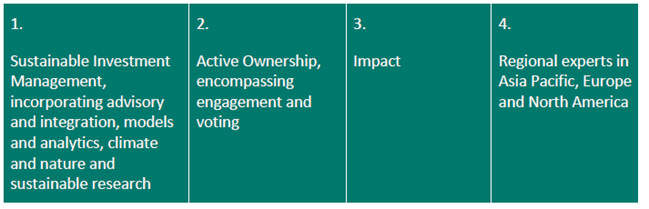
We outline their key responsibilities and areas of focus below.
1. Sustainable investment management
Our Advisory and Integration team acts as a central contact point and consultant for a range of stakeholders across the business. This includes advising investment teams on ESG integration best practice; compliance, risk and legal teams on ESG regulation; and working with our regional experts; across Asia Pacific, Europe and North America, as outlined under pillar four.
Our Models and Analytics team is responsible for the maintenance and evolution of our suite of proprietary tools. They are also responsible for ESG data, ensuring we harness sustainability data effectively from both conventional and unconventional sources.
Our Strategy and Research team is responsible for undertaking sustainability research to: inform firmwide strategy and commitments; provide insights for investment teams to analyse sustainability-related risks and opportunities; and provide research-related and technical support for other stakeholders across the firm.
2. Active ownership
Our Engagement team partners with investors to have dialogue with the companies in which we invest, seeking to understand how prepared they are for a changing world and pushing them towards more sustainable practices. The team track the progress of these engagements and hold companies to account.
Our Corporate Governance team is responsible for voting in line with our Voting Policy and Principles.
3. Impact
Our Impact team is responsible for scaling our impact product offering in line with best-practice impact principles. The team works closely with investment desks and is responsible for developing and implementing our impact management and measurement framework, including impact assessment and monitoring at transaction and portfolio level, product development, impact strategy and impact reporting.
4. Regional Expertise
Our Regional Experts based in Asia Pacific, Europe and North America have a deep understanding of local market characteristics and nuances, and are responsible for staying abreast of sustainability-related developments. Our experts work with clients and internal teams to navigate and support clients’ ESG aspirations and challenges, utilising Schroders’ proprietary tools and research to develop investment solutions that meet their needs. They also engage with regulators and industry bodies to shape and support the global sustainable finance agenda. Our regional experts are a critical extension of the central team in London as the firm continues to evolve its global ESG strategy.
We have a number of governance structures in place for decision-making and oversight of our approach to sustainable investment. The Board of Schroders plc (the Board) has collective responsibility for the management, direction and performance of the Group, and is accountable for our overall business strategy. The Group Chief Executive is responsible for proposing the strategy for the Group and for its implementation, supported by the Group’s senior management team and a number of Committees, some of which are noted below.
The Group Sustainability and Impact (GSI) Committee provides advice to the Group Chief Executive on sustainability and impact matters. The Committee considers, reviews and recommends the overall global sustainability and impact strategy, including key initiatives, new commitments and policies for approval. The Global Head of Sustainable Investment and Global Head of Corporate Sustainability are members of the Committee and report to the Board.
The Sustainability Executive Committee (ExCo) develops and oversees the delivery of our Group-level sustainable investment management strategy. The ExCo also advises on the development of our sustainability and impact investment and product frameworks. The ExCo has senior representation from across the business including Investment, Client Group, Wealth Management, Schroders Capital and Corporate Sustainability.
The Group Regulatory Oversight Committee (GROC) oversees the progress of sustainability regulatory change programmes, as well as facilitating the monitoring of emergent sustainability regulations and ensuring we have appropriately determined the impact on our Group sustainability strategy and supporting operations. The GROC receives input on planned or potential sustainability-related regulation from our Public Policy and Compliance teams, which actively engage with relevant regulators, industry trade associations and other bodies in our key markets of the UK and EU. Once the business implications of new legal and regulatory requirements are defined, the relevant sustainability regulations programme workstreams deliver the necessary change to our business operations. The GROC oversees the progress of the programme, including monitoring and mitigating associated risks and issues. Where necessary, risks and key issues from the GROC can be escalated to the Group Risk Committee for resolution.
Certain Schroders entities, businesses and Investment teams also have their own committees which consider their sustainable investment activities. For example, the Private Assets Sustainability and Impact Steering Committee (PA S&I SteerCo) develops and oversees the implementation of the Private Assets Sustainability and Impact strategy. In addition, the Wealth Management Sustainable Investment Committee (WMSIC), a sub-committee of the Wealth Management Investment Committee (WMIC), has delegated responsibility for recommending Wealth Management's Sustainability models, as well as providing investment strategy and direction for client portfolios that are linked to the sustainable models.
Alongside our central Sustainable Investment team, sustainable investing is also overseen and delivered by dedicated teams and expert individuals embedded throughout the firm (including across Investment teams and Client Group functions).
We have a long-standing commitment to support and collaborate with several industry groups, organisations and initiatives to promote well-functioning financial markets.
Our key stakeholders include exchanges, regulators and international and regional trade associations. For example, Schroders is a member of trade bodies such as the Investment Association in the UK, the European Fund and Asset Management Association (EFAMA), the Asia Securities Industry and Financial Markets Association (ASIFMA) in Hong Kong and the Securities Industry and Financial Markets Association (SIFMA) in the US. Through this participation we share our insights to support the development of policy recommendations, share best practice and build coalitions of like-minded market participants to advocate for better functioning markets.
Our activity with policymakers aims to help them ensure that the measures they take support businesses and provide clear direction. By monitoring and influencing regulatory initiatives at their inception, we aim to support the development of a business environment which is conducive to Schroders’ clients’ best interests.
We aim to engage with the regulatory environments in which we are operating and raise awareness on sustainability matters. We believe well-designed regulation is an important cornerstone to promoting healthy markets, and have asked publicly that policy makers support sustainable finance legislation and regulation and deliver on commitments, including around climate mitigation.
We consider this to be key in improving responsible investment standards across sectors, establishing a consistent dialogue with companies, and in promoting the ongoing development and recognition of sustainability and Environmental, Social and Governance (ESG) topics within the investment industry. A full list of organisations and initiatives of which Schroders is a member or signatory is available here (https://www.schroders.com/en/global/individual/corporate-transparency/working-with-policy-makers/memberships/)
SDR Labelling:
Sustainability Improvers label
Key Performance Indicators:
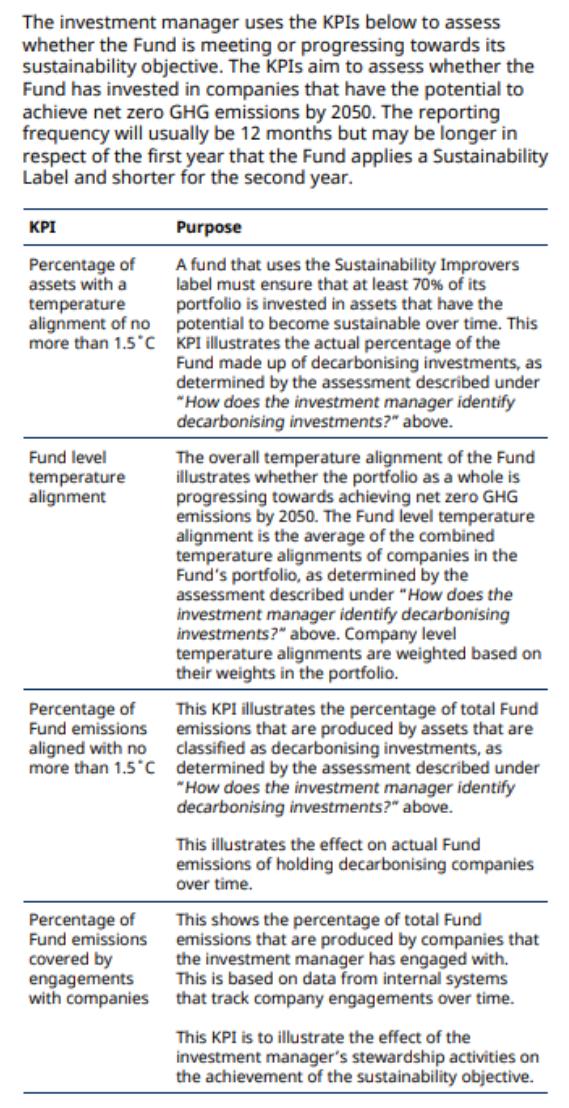
- Consumer Facing Disclosure
SDR Literature:
Literature
Fund Holdings
Voting Record
Disclaimer
Important Information
This document is addressed to existing client(s) only. Not for further distribution.
This document contains indicative terms for discussion purposes only and is not intended to provide the sole basis for evaluation of the investment solutions described.
Investment involves risk. Reliance should not be placed on any views or information in the material when taking individual investment and/or strategic decisions.
Any reference to regions/ countries/ sectors/ stocks/ securities is for illustrative purposes only and not a recommendation to buy or sell any financial instruments or adopt a specific investment strategy.
The material is not intended to provide, and should not be relied on for, accounting, legal or tax advice, or investment recommendations.
Past Performance is not a guide to future performance and may not be repeated.
The value of investments and the income from them may go down as well as up and investors may not get back the amounts originally invested. Exchange rate changes may cause the value of investments to fall as well as rise.
Schroders has expressed its own views and opinions in this document and these may change.
Information herein is believed to be reliable but Schroders does not warrant its completeness or accuracy.
The data contained in this document has been sourced by Schroders and should be independently verified. Third party data is owned or licenced by the data provider and may not be reproduced, extracted or used for any other purpose without the data provider’s consent. Neither Schroders, nor the data provider, will have any liability in connection with the third-party data.
Issued by Schroder Investment Management Limited, 1 London Wall Place, London EC2Y 5AU. Registered Number 1893220 England. Authorised and regulated by the Financial Conduct Authority.
For your security, communications may be recorded or monitored.
Issued in June 2025. 06340.
| Fund Name | SRI Style | SDR Labelling | Product | Region | Asset Type | Launch Date | Last Amended |
|
|---|---|---|---|---|---|---|---|---|
Schroder European Climate Transition Fund |
Sustainability Tilt | Sustainability Improvers label | OEIC | Europe ex UK | Equity | 02/05/2012 | Aug 2025 | |
ObjectivesThe fund aims to provide capital growth in excess of the FTSE World Series Europe ex UK (Gross Total Return) Index (after fees have been deducted) over a three to five year period by investing in equities of European companies, excluding the UK, which have the potential to achieve net zero greenhouse gas (“GHG”) emissions by 2050. Such companies support decarbonisation and therefore contribute to the goal of limiting global warming to no more than 1.5˚C above pre-industrial levels. By investing in companies that the investment manager determines to have the potential to achieve net zero GHG emissions by 2050, the fund aims to helps them continue to contribute to the positive sustainability outcome of reducing GHG emissions and therefore slowing global warming. Achieving net zero helps prevent the buildup of greenhouse gases, which in turn reduces the risk of both acute and chronic climate events such as extreme weather, sea-level rise, and disruptions to ecosystems. |
Fund/Portfolio Size: £19.17m (as at: 31/03/2026) Total Screened Themed SRI Assets: £80299.00m (as at: 31/03/2025) Total Responsible Ownership Assets: £653712.00m (as at: 31/03/2025) Total Assets Under Management: £758460.00m (as at: 31/03/2025) ISIN: GB00B7CM2R31, GB00B8VX2T67, GB00B9DLYT99, GB00B9GTQ502, GB00BJRSTV36, GB00B6S00Y77, GB00B7FHV230, 7, GB00BDRZNP45, GB00B79FC312, GB00BDRZNM14, GB00BF782S34, GB00B6QR3M93, GB00B94WQJ53, GB00B75ZTX45, GB00BJRSTW43, Contact Us: Arvin.Bains@Schroders.com / Meriel.Turner@schroders.com |
|||||||
Sustainable, Responsible &/or ESG OverviewThe fund manager invests in companies that have the potential to achieve net zero GHG emissions by 2050 (“decarbonising investments”). Net zero GHG means that the amount of GHG emissions emitted into the atmosphere by a company is balanced by the amount removed. To qualify as a decarbonising investment, a company needs to have a temperature alignment of no more than 1.5˚C based on evidence of previous emissions reductions. This means that the company's expected emissions reductions are consistent with limiting global warming to 1.5 degrees C above pre-industrial levels. The manager has repeatable process for identifying these companies. The fund may also invest up to 30% of its assets in companies that are not deemed to be decarbonising investments, but have a company-reported emissions reduction target aligned with a temperature of no more than 1.5˚C. |
||||||||
|
Primary fund last amended: Aug 2025 |
||||||||
|
Information received directly from Fund Manager |
||||||||
|
Please select what you would like to read:
Fund FiltersSustainability - General
Encourage more sustainable practices through stewardship
Aim to encourage higher sustainability standards through responsible ownership / stewardship / engagement / voting activity
UN Global Compact linked exclusion policy
Use the UN Global Compact to inform or help direct where they can or cannot invest. Will typically not invest in companies with significant breaches (low standards) - strategies vary. (The UNGC covers a wide range of issues - search 'UNGC'). See https://unglobalcompact.org/
Report against sustainability objectives
Publicly report performance against named sustainability objectives Environmental - General
Environmental policy
Has policies which relate to environmental issues. These will typically set out their stance on issues such as pollution, climate change, resource management, biodiversity loss, carbon emissions, plastics and/or additional environmental impacts. Strategies vary.
Limits exposure to carbon intensive industries
Options that limit or 'reduce' their exposure to carbon intensive industries (ie sectors which are major contributors to climate change). Strategies vary.
Environmental damage & pollution policy
Has documented policies explaining the approach to environmental damage and pollution. Strategies vary.
Favours cleaner, greener companies
Aims to invest in companies with strong or market leading environmental policies and practices. Strategies vary. See individual entry information for more detail. Climate Change & Energy
Encourage transition to low carbon through stewardship activity
Encourage the transition to lower carbon activities through asset selection and / or responsible ownership activity.
Paris aligned strategy
Aims to ensure holdings will reduce their greenhouse gas emissions in line with targets set at COP21 in Paris. The core aim is to help achieve ‘net zero emissions by 2050’ and a ‘maximum global temperature increase of +1.5 to +2 degrees above preindustrial levels’. Strategies and opinions vary.
TCFD / IFRS reporting requirement
Will only invest in companies that report greenhouse gas emissions in line with this international reporting framework. See https://www.fsb-tcfd.org/ https ://www.ifrs.org/sustainability/tcfd/
Require net zero action plan from all / most companies
Requires all, or most of, the assets they invest in to have a ‘net zero action plan’ - describing how they will reduce their greenhouse gas emissions. Ethical Values Led Exclusions
Tobacco & related product manufacturers excluded
Companies are excluded if they are involved in any aspect of the production chain for tobacco products, including cigarettes, vaping, e-cigarettes, chewing tobacco and cigars.
Tobacco & related products - avoid where revenue > 5%
Companies are excluded if they make more than 5% of their revenue from the manufacture, sale or distribution of tobacco products including cigarettes, vaping, e-cigarettes, chewing tobacco and cigars.
Controversial weapons exclusion
Excludes companies which make controversial weapons such as landmines, cluster munitions and chemical weapons.
Armaments manufacturers avoided
Avoids companies that manufacture weapons intended specifically for military use. Strategies vary - may or may not include non-strategic military products.
Armaments manufacturers not excluded
Does Not exclude manufacturers of products intended for use in armaments and weapons. So may invest in them
Military involvement not excluded
Does Not exclude companies with military contracts - this may include medical supplies, food, safety equipment, housing, technology etc.
Civilian firearms production exclusion
Has a written civilian firearms exclusion policy - meaning that they will not invest in companies that make (or perhaps also sell) handguns made for non-military users.
Gambling avoidance policy
Avoids companies with significant involvement in the gambling industry. Some may allow a small proportion of revenues to come from this area.
Pornography avoidance policy
Avoids companies that derive significant income from pornography and related areas. Strategies vary. Gilts & Sovereigns
Does not invest in sovereigns
Does not invest in / excludes 'sovereigns' - debt issued by governments. See eg https://www.investopedia.com/terms/s/sovereign-debt.asp Banking & Financials
Invests in banks
Can include banks as part of their holdings / portfolio.
Invests in insurers
May invest in insurance companies. Governance & Management
Avoids companies with poor governance
Avoids investing in companies with poor governance practices.(e.g. board structure, management practices etc.) Views may however vary on what counts as 'poor' practices - and funds may not immediately divest as they may prefer to work to encourage higher standards.
Encourage board diversity e.g. gender
Encourage the companies they invest in to have more diverse board structures (e.g. more women on boards)
Encourage TCFD alignment for banks & insurance companies
Encourage the banks and insurance companies they invest in to publish climate change related financial information - as set out by the Task Force on Climate Related Financial Disclosures (with the aim of helping investors measure and respond to climate risk).
Encourage higher ESG standards through stewardship activity
Aim to encourage higher ESG standards through responsible ownership / stewardship / engagement /voting activity Product / Service Governance
ESG integration strategy
Find fund / asset managers that factor in 'environmental, social and governance' issues as part of their investment decision making process. A focus on 'ESG' typically means a fund is carrying out additional research to help reduce ESG related risks. It does not necessarily mean a focus on sustainability. Strategies vary. See fund literature.
ESG factors included in Assessment of Value (AoV) report
Environmental, social and governance issues are part of this fund’s reporting of their ‘value’ to clients. AoV reporting is a statutory requirement. Including ESG factors in its calculation is not. Impact Methodologies
Positive environmental impact theme
Specifically sets out to help deliver positive environmental impacts, benefits or 'real world' outcomes.
Invests in environmental solutions companies
Directs investment towards companies where a major part of their business is about solving environmental challenges. e.g. companies helping to address climate change.
Aim to deliver positive impacts through engagement
Aims to deliver positive environmental and or social impacts (real world benefits) through its engagement with investee assets How The Fund/Portfolio Works
Combines norms based exclusions with other SRI criteria
Investment selection process uses internationally agreed 'norms' (e.g. United Nations Global Compact - UNGC - or the UN Sustainable Development Goals - SDGs) alongside additional SRI criteria such as positive or negative stock selection policies and/or stewardship strategies.
Do not use stock / securities lending
Does not use stock lending for performance or risk purposes. Unscreened Assets & Cash
No ‘diversifiers’ used other than cash
Only invests in cash to aid the practical management (buying and selling) of assets and so do not use additional financial instruments. Intended Clients & Product Options
Intended for clients interested in sustainability
Designed to meet the needs of individual investors with an interest in sustainability issues.
Intended for clients interested in ethical issues
Designed for clients who care about ethical and values-based issues, often alongside sustainability issues also.
Available via an ISA (OEIC only)
Available via a tax efficient ISA product wrapper. Labels & Accreditations
SDR Labelled
Find options that have chosen to adopt one of the Financial Conduct Authority (FCA) SDR labels. Please note: there are a range of reasons why potentially relevant options may not use an SDR label eg. adopting a label may be work in progress, the manager may not yet be allowed to do so because of the product type, a manager may feel they are insufficiently aligned to SDR requirements.
ACT signatory
A voluntary corporate culture standard for investment managers, see https://www.investorsact.com/ - City Hive Fund Management Company InformationAbout The Business
Responsible ownership / stewardship policy or strategy (AFM companywide)
Finds fund / asset management companies that have a published company wide stewardship, engagement and / or responsible ownership policy or strategy that covers all investments. Stewardship typically involves encouraging higher ESG standards through voting and dialogue.
ESG / SRI engagement (AFM companywide)
Find fund / asset management companies that actively encourage higher 'environmental, social and governance' and / or 'sustainable and responsible investment' practices across investee companies - typically where the aim is to encourage positive change that is aligned with the best interests of investors. Strategies vary. See additional information and options.
Vote all* shares at AGMs / EGMs (AFM companywide)
Find fund / asset managers that vote all* the shares they own at Annual General Meetings and Extraordinary General Meetings. A commitment to voting shares is a key indicator of 'responsible share ownership' demonstrating their support for or disagreement with management policy. (*situations can legitimately, occasionally occur where voting proves impossible, but in principle all shares should be voted.)
Responsible ownership / ESG a key differentiator (AFM companywide)
Find fund / asset managers that consider responsible ownership and ESG to be a key differentiator for their business. Collaborations & Affiliations
PRI signatory
Find fund / asset management companies that have signed up to the UN backed 'Principles of Responsible Investment'.
UKSIF member
Find fund / asset management companies that are members of UKSIF - the UK Sustainable Investment and Finance association
Fund EcoMarket partner
Find fund / asset management companies that have partnered with Fund EcoMarket - meaning that they are helping to improve access to information on sustainable and responsible investment by paying an annual fee to us which enables us to publish information for free. Partner funds are listed ahead of other funds and have their logos displayed.
TNFD forum member (AFM companywide)
A member of the Taskforce for Nature Related Financial Disclosures group which aims to aid risk management and shift money towards nature-positive outcomes.
Investment Association (IA) member
Fund management entity is a member of the Investment Association https://www.theia.org/ Engagement Approach
Engaging to stop modern slavery
Fund / asset manager is working with the assets they hold to help stamp out modern slavery - where direct or indirect company employees are exploited for business benefits. Transparency
Dialshifter statement
Find fund / asset management companies that have supplied Dialshifter information. See Dialshifter tab within record for more information. Sustainable, Responsible &/or ESG Policy:To qualify as a decarbonising investment, a company needs to have a temperature alignment of no more than 1.5˚C based on evidence of previous emissions reductions. This means that the company's expected emissions reductions are consistent with limiting global warming to 1.5˚C above preindustrial levels. To calculate a company's temperature alignment, the investment manager uses emissions data from a third party provider and company reports to produce four data sets (using a reference year of 2019, or the first reported year thereafter), and calculate the trend in emissions reduction for each:
Absolute emissions measure the total amount of emissions of the company, while intensity measures emissions relative to a company's revenue. Scope 1 and 2 emissions come from a company's direct activities and indirect energy consumption, while Scope 3 emissions are indirect emissions from the company's value chain. The investment manager then uses an industry-standard methodology (the CDP-WWF Temperature Scoring Methodology) to calculate the company's temperature alignment based on the data set with the greatest emissions reduction trend. If a company's temperature alignment is 1.5˚C or less, the company is deemed to be a decarbonising investment. Process:The target sustainability outcome for the Fund is net zero GHG emissions by 2050. The standard of sustainability for the Fund (meaning the measure of whether a company has the potential to achieve the target outcome over time) is the CDP-WWF Temperature Scoring Methodology, which is used to assess whether a company has a long-term temperature alignment of no more than 1.5 ˚C by 2050, based on evidence of previous emissions reductions. This temperature alignment demonstrates that companies support net zero GHG emissions by 2050. The CDP-WWF Temperature Scoring Methodology is based on data issued by a third party data provider, or where data is missing, this can be sourced directly from company reports. Only data reported by companies is used to ensure accuracy and to support engagement. Resources, Affiliations & Corporate Strategies:Sustainability is fundamental to our investment principles at Schroders and we have an experienced and well-resourced Sustainable Investment team, who are embedded within our Investment function. We are a global team, spread across four regional hubs in London, Paris, Singapore and New York, aiming to ensure that sustainability is embedded through our global investment teams and client functions. Our central Sustainable Investment team sits alongside investment teams rather than operating in a silo, which facilitates regular dialogue with our analysts and portfolio managers. It is organised into four pillars:
We outline their key responsibilities and areas of focus below. 1. Sustainable investment management Our Advisory and Integration team acts as a central contact point and consultant for a range of stakeholders across the business. This includes advising investment teams on ESG integration best practice; compliance, risk and legal teams on ESG regulation; and working with our regional experts; across Asia Pacific, Europe and North America, as outlined under pillar four. Our Models and Analytics team is responsible for the maintenance and evolution of our suite of proprietary tools. They are also responsible for ESG data, ensuring we harness sustainability data effectively from both conventional and unconventional sources. Our Strategy and Research team is responsible for undertaking sustainability research to: inform firmwide strategy and commitments; provide insights for investment teams to analyse sustainability-related risks and opportunities; and provide research-related and technical support for other stakeholders across the firm. 2. Active ownership Our Engagement team partners with investors to have dialogue with the companies in which we invest, seeking to understand how prepared they are for a changing world and pushing them towards more sustainable practices. The team track the progress of these engagements and hold companies to account. Our Corporate Governance team is responsible for voting in line with our Voting Policy and Principles. 3. Impact Our Impact team is responsible for scaling our impact product offering in line with best-practice impact principles. The team works closely with investment desks and is responsible for developing and implementing our impact management and measurement framework, including impact assessment and monitoring at transaction and portfolio level, product development, impact strategy and impact reporting. 4. Regional Expertise Our Regional Experts based in Asia Pacific, Europe and North America have a deep understanding of local market characteristics and nuances, and are responsible for staying abreast of sustainability-related developments. Our experts work with clients and internal teams to navigate and support clients’ ESG aspirations and challenges, utilising Schroders’ proprietary tools and research to develop investment solutions that meet their needs. They also engage with regulators and industry bodies to shape and support the global sustainable finance agenda. Our regional experts are a critical extension of the central team in London as the firm continues to evolve its global ESG strategy. We have a number of governance structures in place for decision-making and oversight of our approach to sustainable investment. The Board of Schroders plc (the Board) has collective responsibility for the management, direction and performance of the Group, and is accountable for our overall business strategy. The Group Chief Executive is responsible for proposing the strategy for the Group and for its implementation, supported by the Group’s senior management team and a number of Committees, some of which are noted below. The Group Sustainability and Impact (GSI) Committee provides advice to the Group Chief Executive on sustainability and impact matters. The Committee considers, reviews and recommends the overall global sustainability and impact strategy, including key initiatives, new commitments and policies for approval. The Global Head of Sustainable Investment and Global Head of Corporate Sustainability are members of the Committee and report to the Board. The Sustainability Executive Committee (ExCo) develops and oversees the delivery of our Group-level sustainable investment management strategy. The ExCo also advises on the development of our sustainability and impact investment and product frameworks. The ExCo has senior representation from across the business including Investment, Client Group, Wealth Management, Schroders Capital and Corporate Sustainability. The Group Regulatory Oversight Committee (GROC) oversees the progress of sustainability regulatory change programmes, as well as facilitating the monitoring of emergent sustainability regulations and ensuring we have appropriately determined the impact on our Group sustainability strategy and supporting operations. The GROC receives input on planned or potential sustainability-related regulation from our Public Policy and Compliance teams, which actively engage with relevant regulators, industry trade associations and other bodies in our key markets of the UK and EU. Once the business implications of new legal and regulatory requirements are defined, the relevant sustainability regulations programme workstreams deliver the necessary change to our business operations. The GROC oversees the progress of the programme, including monitoring and mitigating associated risks and issues. Where necessary, risks and key issues from the GROC can be escalated to the Group Risk Committee for resolution. Certain Schroders entities, businesses and Investment teams also have their own committees which consider their sustainable investment activities. For example, the Private Assets Sustainability and Impact Steering Committee (PA S&I SteerCo) develops and oversees the implementation of the Private Assets Sustainability and Impact strategy. In addition, the Wealth Management Sustainable Investment Committee (WMSIC), a sub-committee of the Wealth Management Investment Committee (WMIC), has delegated responsibility for recommending Wealth Management's Sustainability models, as well as providing investment strategy and direction for client portfolios that are linked to the sustainable models. Alongside our central Sustainable Investment team, sustainable investing is also overseen and delivered by dedicated teams and expert individuals embedded throughout the firm (including across Investment teams and Client Group functions). We have a long-standing commitment to support and collaborate with several industry groups, organisations and initiatives to promote well-functioning financial markets. Our key stakeholders include exchanges, regulators and international and regional trade associations. For example, Schroders is a member of trade bodies such as the Investment Association in the UK, the European Fund and Asset Management Association (EFAMA), the Asia Securities Industry and Financial Markets Association (ASIFMA) in Hong Kong and the Securities Industry and Financial Markets Association (SIFMA) in the US. Through this participation we share our insights to support the development of policy recommendations, share best practice and build coalitions of like-minded market participants to advocate for better functioning markets. Our activity with policymakers aims to help them ensure that the measures they take support businesses and provide clear direction. By monitoring and influencing regulatory initiatives at their inception, we aim to support the development of a business environment which is conducive to Schroders’ clients’ best interests. We aim to engage with the regulatory environments in which we are operating and raise awareness on sustainability matters. We believe well-designed regulation is an important cornerstone to promoting healthy markets, and have asked publicly that policy makers support sustainable finance legislation and regulation and deliver on commitments, including around climate mitigation. Dialshifter (Corporate)Our organisation is helping to support the Paris Climate Agreement and the Race to Net Zero by… … being a signatory to the Science Based Targets Initiative (SBTi), we measure and track the temperature alignment of our investments and have committed to align our financed emissions, across our portfolio companies Scope 1, 2 and 3 GHG emissions, to a 1.5°C world by 2040 across 100% of our investments. We also have an interim target of 2.2°C by 2030 across our portfolio companies Scope 1 and 2 emissions. SDR Labelling:Sustainability Improvers label Key Performance Indicators:
SDR Literature:LiteratureFund HoldingsVoting RecordDisclaimerImportant Information This document is addressed to existing client(s) only. Not for further distribution. |
||||||||