
Schroder Sustainable Bond Fund
SRI Style:
Sustainability Tilt
SDR Labelling:
Sustainability Focus label
Product:
OEIC
Fund Region:
Global
Fund Asset Type:
Fixed Interest
Launch Date:
05/09/2003
Last Amended:
Oct 2025
Dialshifter ( ):
):
Fund/Portfolio Size:
£51.16m
(as at: 31/03/2026)
Total Responsible Ownership Assets:
£646500.00m
(as at: 31/12/2024)
Total Assets Under Management:
£776613.00m
(as at: 30/06/2025)
ISIN:
GB0007905945, GB0007905721, GB00BJRSV066, GB00BJRSTZ73, GB00BDD27918, GB00B57BFC79, GB00BJRSVG23, GB00BDD27793, GB00B5W01T86
Objectives:
The fund’s sustainability objective is to invest in bonds that the investment manager classifies as sustainable. These are investments that make a positive contribution to: (1) the planet (the environment); and/or (2) people (workforce wellbeing; public and consumer wellbeing; healthy, inclusive and connected communities; and/or effective and accountable institutions).
By investing in bonds that are assessed as providing a positive contribution to people and/or the planet, the fund aims to help the issuers continue to implement (and potentially expand) their sustainable activities, or in the case of green, social or sustainable bonds (GSS Bonds), to support the sustainable activities that the bonds are designed to fund.
Sustainable, Responsible
&/or ESG Overview:
Our strategy is designed for investors that seek capital growth and income from sustainable issuers from across the fixed income universe (including but not limited to corporate credit, government related and sovereign issuers).
We use the flexibility of an unconstrained, active strategy to capture the most compelling opportunities within a clearly defined sustainable global fixed income universe, in a diversified risk managed portfolio.
The sustainable investment universe is constructed through proprietary research that that seeks to exclude harmful and destructive practices and aligns a best-in-class approach to corporate bonds with a unique, transparent approach to sovereign sustainability, that accounts for a sovereign’s level of income.
A bond is considered to be sustainable if either the issuer itself or the activity funded by the proceeds of the bond makes a positive contribution to: (1) Planet, which includes contributions to the environment and/or (2) People.
Primary fund last amended:
Oct 2025
Information directly from fund manager.
Fund Filters
Sustainability - General
Has policies that consider (environmental and social) sustainability issues. Strategies vary but are likely to consider environmental issues like climate change, carbon emissions, biodiversity loss, resource management, environmental impacts; and social issues like equal opportunities, human rights, labour standards, diversity and adherence to internationally recognised codes. See individual entry information.
Has a significant focus on sustainability issues
Aim to encourage higher sustainability standards through responsible ownership / stewardship / engagement / voting activity
Use the UN Global Compact to inform or help direct where they can or cannot invest. Will typically not invest in companies with significant breaches (low standards) - strategies vary. (The UNGC covers a wide range of issues - search 'UNGC'). See https://unglobalcompact.org/
Aim to invest (and manage assets) in ways that help to address all or some of the UN's Sustainable Development Goals (SDGs). See https://sdgs.un.org/goals).
Publicly report performance against named sustainability objectives
Environmental - General
Options that limit or 'reduce' their exposure to carbon intensive industries (ie sectors which are major contributors to climate change). Strategies vary.
Aims to invest in companies with strong or market leading environmental policies and practices. Strategies vary. See individual entry information for more detail.
Climate Change & Energy
Avoid investment in major coal, oil and/or gas (extraction) companies. Strategies vary.
Avoid companies involved in fracking and tar sands - which are widely regarded as controversial methods of oil and gas extraction. Strategies vary.
Encourage the transition to lower carbon activities through asset selection and / or responsible ownership activity.
Invest in renewable energy companies and / or companies where renewable energy is a significant part of their business. Strategies vary.
Has a policy which describes the avoidance or limited investment in the nuclear industry. Strategies vary.
Excludes companies and other assets with direct involvement in fossil fuel exploration (eg coal, oil and gas companies)
Social / Employment
Has policies which set out their approach to social issues (e.g. human rights, labour standards, equal opportunities, child labour and/or adherence to internationally recognised codes such as the UN Global Compact). Strategies with social policies typically avoid companies with low standards and/or work to encourage higher standards. See fund information for detail.
Has a labour standards policy - likely to mean they will invest in / favour companies that have higher employment related standards and avoid those with low standards. Strategies vary. See eg https://www.ilo.org/international-labour-standards
Has policies or themes that set out their approach to health and wellbeing issues, typically aims to invest in companies with high standards - or encourage high standards.
Has a written diversity policy – where the manager will aim to select companies with a carefully considered, positive employment standards. This may cover a range of issues including gender, ethnicity, disability, beliefs and sexual orientation.
Ethical Values Led Exclusions
Companies are excluded if they make more than 5% of their revenue from the manufacture, sale or distribution of tobacco products including cigarettes, vaping, e-cigarettes, chewing tobacco and cigars.
Avoids companies that manufacture weapons intended specifically for military use. Strategies vary - may or may not include non-strategic military products.
Has a written civilian firearms exclusion policy - meaning that they will not invest in companies that make (or perhaps also sell) handguns made for non-military users.
Avoids companies that produce alcohol. Strategies vary; some may allow a small proportion of revenue to come from this area.
Avoids companies with significant involvement in the gambling industry. Some may allow a small proportion of revenues to come from this area.
Avoids companies that derive significant income from pornography and related areas. Strategies vary.
Human Rights
Has policies relating to human rights issues. Typically require companies to demonstrate higher standards, although some managers work to encourage improvements. Investee companies are often judged against internationally agreed norms or standards. Strategies vary.
Has policies that exclude companies or other assets which operate in, or are owned by regimes which are not democratic, or where people may be oppressed. May use eg. Freedom House research. Strategies vary.
Has a policy which excludes assets with involvement in Modern Slavery
Gilts & Sovereigns
Avoids investing in 'some' gilts or government bonds. Strategies vary, but this may relate to avoiding specific countries or particular reasons for bond issuance. 'Green gilts' for example would be likely to be acceptable.
Invest in financial instruments issued by governments, but will only hold those that meet certain environmental and or social criteria. This may, for example mean certain assets are excluded in line with eg Freedom House research. Strategies vary.
Banking & Financials
Can include banks as part of their holdings / portfolio.
Invests in financial instruments (cash, derivatives and / or foreign exchange) issued by banks. Strategies vary.
May invest in insurance companies.
Governance & Management
Has policies that relate to corporate governance issues such as board structure, executive remuneration, bribery and/or corporate corruption. These funds will typically avoid companies with poor practices. Strategies vary.
Avoids investing in companies with poor governance practices.(e.g. board structure, management practices etc.) Views may however vary on what counts as 'poor' practices - and funds may not immediately divest as they may prefer to work to encourage higher standards.
Exclude companies that are subject to United Nations sanctions. See eg https://main.un.org/securitycouncil/en/content/un-sc-consolidated-list
Encourage the companies they invest in to have more diverse board structures (e.g. more women on boards)
Aim to encourage higher ESG standards through responsible ownership / stewardship / engagement /voting activity
Product / Service Governance
Find fund / asset managers that factor in 'environmental, social and governance' issues as part of their investment decision making process. A focus on 'ESG' typically means a fund is carrying out additional research to help reduce ESG related risks. It does not necessarily mean a focus on sustainability. Strategies vary. See fund literature.
Asset Size
Invests in a combination of small, medium and larger (potentially multinational) companies / assets.
Invests in international entities or bodies with agreed remits that are broadly similar to those that may otherwise be undertaken by individual governments eg the UN
Targeted Positive Investments
Invests in loan stock that is exclusively used to finance environmental and social projects. See ICMA Sustainable Bond Guidelines.
Invests in green bonds (also known as climate bonds) which encourage sustainability and support climate related or special environmental projects.
How The Fund/Portfolio Works
Focuses on finding and investing in companies with positive / beneficial attributes. This strategy can be applied in addition to exclusion criteria and engagement/stewardship activity.
Invests in assets which have an ESG strategy (which is typically focused on avoiding companies that pose environmental, social or governance related risks) together with additional criteria such as positive and/or negative screens, themes and stewardship strategies.
Publish explanations of their ethical, social and/or environmental policies online (i.e. investment decision making strategies/ buy/sell &/or asset management strategies).
Has changed its mandate. It was previously not an ESG/sustainable fund. The information published here shows the upgraded strategy.
Does not use stock lending for performance or risk purposes.
Unscreened Assets & Cash
Holds between 70-79% of assets which align to the sustainability objectives; which are not being held purely for risk management purposes, such as derivatives and cash equivalent assets.
Intended Clients & Product Options
Designed to meet the needs of individual investors with an interest in sustainability issues.
Labels & Accreditations
Find options that have chosen to adopt one of the Financial Conduct Authority (FCA) SDR labels. Please note: there are a range of reasons why potentially relevant options may not use an SDR label eg. adopting a label may be work in progress, the manager may not yet be allowed to do so because of the product type, a manager may feel they are insufficiently aligned to SDR requirements.
Fund Management Company Information
About The Business
Find fund / asset management companies (or subsidiaries) that specialise in - or focus entirely on - investing in assets that are helping to deliver positive environmental and / or social impacts.
Finds fund / asset management companies that have a published company wide stewardship, engagement and / or responsible ownership policy or strategy that covers all investments. Stewardship typically involves encouraging higher ESG standards through voting and dialogue.
Find fund / asset management companies that actively encourage higher 'environmental, social and governance' and / or 'sustainable and responsible investment' practices across investee companies - typically where the aim is to encourage positive change that is aligned with the best interests of investors. Strategies vary. See additional information and options.
Find fund / asset managers that vote all* the shares they own at Annual General Meetings and Extraordinary General Meetings. A commitment to voting shares is a key indicator of 'responsible share ownership' demonstrating their support for or disagreement with management policy. (*situations can legitimately, occasionally occur where voting proves impossible, but in principle all shares should be voted.)
Find fund / asset managers that consider responsible ownership and ESG to be a key differentiator for their business.
Find fund / asset management companies that take sustainability criteria into account when selecting and/or managing all of their property / real estate investments.
The leadership team of this fund / asset manager have performance targets linked to environmental goals.
Find fund / asset management companies that aim to align all their investments (across all funds) to help meet the aims of the UN Sustainable Development Goals.
Find options run by managers that apply Responsible ownership or 'Stewardship' policies to all or most of their investment assets. This means active involvement (e.g. voting, dialogue) with the companies across all or most funds, products and services.
Find fund / asset management companies that consider environmental, social and governance (ESG) issues when deciding whether or not to invest in a company for all / almost all of their funds and other assets. This is increasingly seen as part of sound risk management.
Finds organisations / fund managers that have an in-house (company wide) diversity improvement programme - meaning that they are working to ensure that within their own businesses they employ people from diverse backgrounds - often typically focused on ethnicity and/or sex.
Find fund / asset management companies that encourage the companies they invest in to have strong diversity, race, gender and other equality policies across all assets held, not simply screened or themed SRI/ESG funds. (ie Asset Management company wide).
This fund / asset management company invests in companies which have recently listed on a stock exchange (which is important as it can help grow new businesses).
Fund / asset management company has investments in bonds designed to meet sustainability requirements - however these assets may not be 'ringfenced' for this purpose. See website for details.
Fund management entity offers unstructured intermediary training on sustainable investment (ie for financial advisers and wealth managers)
Fund management entity offers unstructured intermediary training on sustainable investment (ie for financial advisers and wealth managers)
Collaborations & Affiliations
Find fund / asset management companies that have signed up to the UN backed 'Principles of Responsible Investment'.
Find fund / asset management companies that are members of UKSIF - the UK Sustainable Investment and Finance association
Find fund / asset management companies that have partnered with Fund EcoMarket - meaning that they are helping to improve access to information on sustainable and responsible investment by paying an annual fee to us which enables us to publish information for free. Partner funds are listed ahead of other funds and have their logos displayed.
This fund / asset manager has signed up to the UNEP (United Nations Environment Program) program which aims to encourage more responsible banking practices – focused on environmental and social issues.
A member of the Taskforce for Nature Related Financial Disclosures group which aims to aid risk management and shift money towards nature-positive outcomes.
Fund management entity is a member of the Investment Association https://www.theia.org/
Resources
Find fund / asset management companies that employ people to steer and support fund managers in voting shares at company AGM's and EGMs in ways that are consistent with encouraging higher ESG/sustainability standards.
Find a fund / asset management company that directly employs specialist ESG/SRI/sustainability researchers or analysts. This allows asset managers to discuss environmental, social and governance risks and opportunities directly with companies.
Find fund / asset management companies that makes use of expert external research companies. This can help deliver specialist expertise and means resources are pooled with other investors.
Finds organisations / fund managers that have one or more ESG/sustainability experts on all investment teams or 'desks' (all asset types)
Accreditations
Finds organisations / fund managers that have an A+ PRI rating - meaning they are highly rated according to the 'Principles of Responsible Investment'
Find fund / asset managers that are signatories to the FRC UK Stewardship Code, which sets out a framework for constructive investor / investee relations where managers are encouraged to behave like responsible, typically longer term 'company owners'.
Engagement Approach
Find fund / asset management companies that regularly initiate or run industry wide (collaborative) investor projects aimed at raising environmental, social and governance standards amongst investee companies.
Find fund / asset management companies that are working with the companies they invest in to encourage more responsible corporate taxation.
Fund / asset manager has stewardship /responsible ownership strategy that is focused on addressing climate change with investee assets.
Fund / asset manager has a stewardship /responsible ownership strategy that involves working with fossil fuel companies on climate change related issues. See fund manager website for details.
Fund / asset manager has stewardship /responsible ownership strategy with involves encouraging investee asset to reduce plastic waste and pollution.
Fund / asset manager has a stewardship / responsible ownership policy that means they are working to encourage more responsible mining practices - where environmental and social issues are properly dealt with by the companies they invest in.
The fund / asset manager has a responsible ownership / stewardship strategy that focuses on biodiversity and nature issues relating to the assets they invest the aim of which will be to reduce harm and or deliver improvement. Strategies vary. https://tnfd.global
Fund / asset manager has a responsible ownership / stewardship strategy which means they are working to encourage the shift to more sustainable business practices in ways that respect and are sensitive to social issues and the impact change has on people effected by the changes that are taking place. https://www.transitionpathwayinitiative.org/ https://transitiontaskforce.net/
Fund / asset manager has responsible ownership / stewardship strategy in place which aims to address human rights issues in investee companies (and potentially their suppliers) with the aim of raising standards
Fund / asset manager has responsible ownership / stewardship strategy in place that aims to improve labour standards for the benefit of employees in investee companies (and potentially their suppliers)
Fund / asset management company has a stewardship strategy in place which involves working to raise diversity, equality and inclusion standards across investee assets
Fund / asset manager is working with the assets they hold to help stamp out modern slavery - where direct or indirect company employees are exploited for business benefits.
Fund / asset managers have stewardship strategies in place that focus on improving governance standards across investee assets
Fund / asset manager has stewardship strategy in place which involves discussing mental health issues with investee companies - with the aim of raising standards
Has a stewardship / responsible ownership strategy that encourages responsible supply chain - ie the managers will discuss environmental, social and governance issues with investee companies with the aim of raising standards
Escalation policies describe how a manager will proceed if stewardship / engagement activity is not successful in the short term.
Company Wide Exclusions
Find fund / asset management companies (not funds) that avoid investment in 'controversial weapons' across all of their funds and other investment vehicles.
Find funds / asset managers that are reviewing, or have reviewed, their exposure to carbon intensive industries including (but not only) mining, oil and gas companies. (Typically with reference to climate change.)
Climate & Net Zero Transition
Fund / asset management organisations that have pledged to reduce their greenhouse gas emissions to ‘net zero’. Strategies vary - this area is changing rapidly.
Fund / asset manager AGM / EGM voting strategy has processes in place that mean they will normally be expected to vote in a way that will encourage the transition to net zero greenhouse gas emissions.
Find fund / asset management companies that have published a Climate Risk policy or statement that is signed / owned by their Chief Executive.
This fund / asset management company has set a date by which they plan to achieve net zero greenhouse gas / CO2e emissions.
Find fund / asset management companies that are working with the companies they invest in to encourage reductions in carbon dioxide and other greenhouse gas emissions.
Finds organisations / fund managers that have a company wide carbon transition plan - meaning that they have plotted a path to how they will move away from activities that produce or use carbon based energy sources (that emit greenhouse gases) towards clean, alternative, renewable energy sources.
Finds organisations / fund managers that have published ‘forward looking climate metrics’ e.g. 'implied temperature rise' data that are a total of the asset management company's share (% owned) of all the investee company emissions of the assets they manage, as well as their own direct and other indirect emissions.
Find fund / asset management companies that are working to reduce their own (fund management company) carbon/greenhouse gas emissions.
Finds organisations / fund management companies that are in the process of working out how to make a ‘net zero commitment’ - meaning that when that is finalised they will have started the process of reducing their total greenhouse gas emissions to 'zero'.
See https://sciencebasedtargets.org/
Transparency
Find fund / asset management companies that publish a report detailing their responsible investment ownership - also known as 'Stewardship' - activity.
Find fund / asset management companies that publish information about their sustainable and responsible investment strategies on their company website.
Fund / asset management companies that publish a full record of how they vote their shares at AGMs (annual general meetings) and EGMs (extraordinary general meetings). Voting strategies have an important role to play encouraging higher environmental, social and governance standards.
This fund / asset management company has published a plan that explains how they are to become a sustainable business - without significant negative environmental or social impacts.
This fund / asset management company has published a plan that explains how they will align to the climate change commitments made at the Paris Climate Talks, COP21.
This fund / asset management company has published a plan that explains how they are going to achieve net zero greenhouse gas / CO2e emissions.
Find fund / asset management companies that have supplied Dialshifter information. See Dialshifter tab within record for more information.
Comments
Appendix –1
- ESG specialists on all investment desks
For us, sustainability is a core part of our firm-wide strategy and is fundamental to our ultimate objective which is to achieve better outcomes for our clients. The central Sustainable Investment teamwork in partnership with many teams around Schroders including our investment teams, Investment Insights Unit, Product Governance and client teams. Across the firm we have further resource to draw on. We have a number of dedicated sustainable equity and credit analysts who are embedded within our investment desks, along with over 50* Sustainability champions across investment globally.
*Source: Schroders, as at December 2024.
Appendix –2
- PRI Score card
We became a signatory to the UNPRI on 29 October 2007. Being a signatory provides us access to all of the support and resources that the PRI supply and indicated to the market that we comply with their principles. We continue to work with them for continuous assessments and to meet the requirements of being a signatory.A summary of our scores for the 2024 reporting cycle reflective of activity in 2023 is available below. Our public transparency report is also available here and our UN PRI statement of compliance can be found on our website here.

Sustainable, Responsible &/or ESG Policy:
The Schroder Sustainable Bond Fund is a global total return bond fund. The aim is to allocate capital to sovereign and corporate issuers that are acting in a sustainable manner and are contributing towards to a more economically sustainable future over the medium to long term.
Our approach establishes a transparent and credible framework for sustainable investing across both sovereigns and credit. Uniquely, the fund seeks to address some of the well-known challenges associated with sovereign sustainability, such as a lack of clarity around sustainable objectives, poor data quality and an inherent income bias (to the extent that sustainability scores such as SDGs are highly correlated with a country’s wealth).
The United Nations’ Sustainable Development Goals (UN SDGs) are the anchor point for the fund’s sovereign investment universe, on which we overlay additional social and environmental criteria to ensure countries included in the investment universe have the appropriate sustainability profile.
The fund applies its sustainable approach through:
- Utilisation of the Global Unconstrained Fixed Income team’s top-down, ESG-integrated investment process.
- Combining an innovative approach to sustainable sovereign investments that adjusts for income bias with a well-established sustainable credit framework.
- Integration of Schroders’ award-winning tool, SustainEx™, for sovereigns and corporates.
- Inclusion of issuers that demonstrate a stable and (importantly) improving sustainable trajectory.
- Engagements with corporate issuers aimed at improving disclosure and driving the widespread adoption of robust ecological and social policies.
- Investing in green bonds, social bonds and sustainability bonds.
- Collaboration across Schroders fixed income platform and with the firm’s sustainable investment experts.
The sustainability characteristics of the overall portfolio are assessed by Schroders’ proprietary tools (notably SustainEx™), which ensures the combination of asset classes at an overall fund level is in line with our, and our clients’, sustainability expectations.
Fund-level sustainability commitments:
The fund invests at least 70% of its portfolio in bonds that the investment manager classifies as sustainable. A bond is considered to be sustainable if either the issuer itself or the activity funded by the proceeds of the bond makes a positive contribution to:
- Planet. This includes contributions to the environment - such as reducing greenhouse gas (GHG) emissions, which helps slow down climate change.
and/or
- People. This includes contributions to one or more of the following:
- Workforce wellbeing - such as a company paying more than living wages or providing education and training (which supports employee professional development and prosperity), or a sovereign providing education (which facilitates economic participation) and protecting human rights (which allows workers to be fairly compensated from their employment).
- Public and consumer wellbeing - such as a company developing new products and services that improve customers’ quality of life (for example medical drugs, therapies, diagnostic tools and healthy food), or a sovereign setting policies against cybercrime (which aim to protect a country’s citizens from exploitation online).
- Healthy, inclusive and connected communities – such as a company providing access to clean water and sanitation (which promotes good health), or a sovereign setting policies that tackle discrimination (which aim to create more equitable and harmonised communities).
- Effective and accountable institutions – such as a company promoting financial stability (which supports people’s prosperity and financial security), or a sovereign setting policies that support sociopolitical stability (which leads to a safer and more prosperous society).
Bonds are classified as sustainable if they achieve a positive score in Schroders’ systematic model (SustainEx™). SustainEx™ produces an assessment of the bond issuer’s effect on a defined set of benefits and costs for people and the planet, which are then combined to calculate an overall sustainability score for the bond. A bond must achieve a positive score to be deemed sustainable. The model is based on in-depth internal research, which has included establishing the relevance of various factors to the sustainability outcomes referred to above.
In some exceptional cases, SustainEx™, does not provide a fair reflection of an issuer’s contribution to people and/or the planet. The investment manager can refer such investments to Schroders’ Sustainable Investment Panel (the “Panel”), an independent panel of experts. The Panel reviews additional robust evidence provided by the investment manager to determine whether, if such evidence was available to SustainEx™, the investment would achieve a positive score. This could be relevant where SustainEx™, does not capture a relevant area of positive contribution – such as where an issuer produces a particularly sustainable product whose importance to people, or the planet is not fully captured by the issuer’s overall score. Alternatively, it could be relevant where the investment manager is able to supply additional data to enhance a calculation – such as where an issuer does not publish details of employee salaries, but the investment manager is able to obtain or more accurately estimate this from other sources.
The fund may also invest in GSS Bonds as part of the 70% referred to above. For these investments, the investment manager does not take into account the SustainEx™ score of the issuer but instead analyses the use of proceeds of the GSS Bond to determine whether a positive contribution to the planet or people can be expected as a result of the specific activity that the bond is designed to finance. It does this by assessing each GSS Bond’s adherence to a set of robust principles established by the International Capital Market Association or an equivalent body.
The fund does not directly invest in assets that the investment manager deems to conflict with the sustainability objective. This refers to assets that not only fail to meet the sustainability objective, but also actively conflict with the positive outcome it seeks.
As the fund aims to invest in bonds that provide a positive contribution to people and/or the planet, the investment manager defines conflicting assets as bonds which have a significant negative effect on people and/or the planet. These are bonds of issuers that are directly and materially exposed to activities that are significantly damaging to the environment; and bonds of issuers that are directly and materially exposed to activities or actions and/or have an unjustifiable cost to society.
Process:
The definition of Schroder Sustainable Bond’s investment universe is the foundation of its approach.
The fund invests in fixed and floating rate securities issued by governments, government agencies, supranational and corporate issuers worldwide, of which 80% are denominated in (or hedged back into) Sterling. All holdings must satisfy the fund’s sustainability criteria to qualify, and while there are differences between the criteria for sovereigns and credit, the goal is the same in both cases: ensuring capital is allocated to those issuers working towards a more sustainable future.
i. Inclusion of Corporate Credit in the sustainable investment universe
We have long recognised that non-financial considerations including environmental, social and governance issues have a material influence on supply and demand within an investible horizon and the sustainability of issuer cash-flows through changing consumer expectations, increasing regulation, supply chain risk, brand reputation etc. We recognise that ESG issues can and do have a material impact on the short, medium and long-term performance of corporate issuers.
We believe that integrating E, S and G into an investment process is not a simple filter based on snapshot external metrics that are often static and backward-looking. Experience has told us that a lot of bondholder value can be overlooked by short-sighted decision-making.
We integrate ESG into our investment process in the following ways:
- Application of minimum exclusions: We avoid issuers that have businesses that are materially damaging to the climate and impose unjustifiable social costs. The excluded sectors represent areas that have limited potential to transition towards stronger sustainability practices.
- Themes-driven research and investment approach: Environmental and social related themes (such as renewable energy or rising inequality in the society) sit side by side with non-ESG themes (such as digitalization or urbanization) to provide a forward-looking lens for our credit analysts to judge the potential for companies to adapt to changing secular themes and the effect they have on their cashflows. Theme ideas can be drawn from a variety of sources, such as news articles, academic papers and internal research. If new themes are considered by the team to be potentially valid and investible, further analysis will be carried out to build a better understanding of how themes may manifest.
- Proprietary ESG rating taxonomy: We employ a two-dimensional proprietary ESG rating taxonomy that rates each issuer by quality (A-F rating) with a forward-looking directional rating that identifies improving and deteriorating issuer sustainability characteristics (Improving, Stable, Deteriorating). We attribute a 4-level sustainability rating to each of the E, S & G pillars of the assessment that reflects a judgment that is relative to other issuers in the industry sector. An overall sustainability rating is then assigned to define the overall sustainability position of the issuer. The ESG assessments are based on analysis of publicly available data (such as emissions, water usage, boardroom pay, board diversity etc.) as well as views drawn through engagement with company management and insights we get from proprietary tools such as SustainEx™.
- Based on this, companies that are rated A to C are eligible for purchase. Any issuer that holds an internal D rating combined with a deteriorating directional indicator cannot be purchased (and existing holdings whose rating is downgraded to D have to be sold within a reasonable period). Companies that are rated D-improving, however, can be purchased. (F/fail rated bonds are deemed ineligible for purchase.)
- Active engagement with issuers: We engage with companies in a systematic and strategic way. By engaging with companies and their management we can improve our understanding of emerging risks and opportunities and their approaches to managing them and encourage companies to adopt long-term approaches to their stakeholder relationships, helping us to protect or enhance the value of our investments while aiming to generate better returns.
- ESG engagements are undertaken by our analysts, fund managers and in collaboration with the Sustainable Investment team to give greater clout and increase the chance that companies will listen and react to our engagement.
- The mechanism for engagement with company representatives varies but typically takes place through one-to-one meetings with company representatives, written correspondence (e.g. email, letters), phone calls, discussions with company advisors and stakeholders, voting and joint engagement with other investors.
- We record all of our active ownership activities in our in-house database to facilitate the monitoring of companies in which we are invested and track progress against defined milestones and goals.
- Proprietary sustainability tools: Schroders’ Sustainable Investment team has developed a suite of research-based and quantitative ESG investment tools that provide a framework to incorporate ESG factors into our analysis.
- Portfolio risk framework: This includes proprietary sustainability tools such as SustainEx™, which feeds into the Aladdin portfolio management system for assessment of sustainability risks at both issuer and portfolio level.
ii. Inclusion of Sovereigns & Supranationals in the sustainable investment universe
The sustainable investment universe uses three key pillars and only countries that satisfy the three criteria are included in the investment universe:
- Countries who outperform relative to their income peers (i.e. countries with a similar level of development in terms of UN SDG progress) – designed to solve for the income bias in sustainability scores. All UN SDGs are given equal importance.
- Climate (Net Zero) commitment (in the form of a policy document) – sourced by the Energy & Climate Intelligence Unit.
- Social and political freedoms – a country must be classified as ‘Free’ or ‘Partly Free’ by Freedom House.
Addressing the ingrained income bias in sovereign ESG scores
Sustainability scores are highly correlated with a country’s gross national income per capita, with richer nations inevitably receiving better ESG scores, reflecting their stronger institutional frameworks. Investing in countries with the ‘best’ scores would therefore direct capital flows away from countries who arguably need them the most. It is fundamentally unhelpful both from a sustainability ethos and on pure investment grounds to penalise countries that may be trying to do ‘the right thing’ simply because they come from a lower developmental starting point.
We seek to address this through the definition of our sovereign investment universe and to ensure that we include all countries that are demonstrating suitable progress towards meeting the SDGs. To do this we assess countries’ progress relative to other countries at a similar development level – therefore preventing the entrenched income bias skewing the universe towards more developed countries.
We achieve this firstly by grouping countries into the four income brackets (high, upper-middle, lower-middle and low income) defined by the World Bank, using gross national income (GNI) per capita. We then use the SDG index scores to compare the relative progress of countries in achieving the SDGs for countries against others in the same income bracket. Only the top proportion of each income bracket are permitted in the investment universe.
This means we compare the relative progress of the US vs Canada, for example, rather than, say, South Africa, given the relative stages of economic development of the two nations. By comparing SDG progress for countries of a similar level of development, we can ensure our universe includes those that are outperforming their peers, while avoiding the inclusion of relative laggards.
We believe this structure addresses the inherent bias, while maintaining transparency and ensuring that criteria are clearly defined and can be readily understood by our clients.
To further ensure the sustainability characteristics of countries that are investable under our framework, we employ two further criteria.
Social criteria: We believe sustainable development at a sovereign level requires a country’s citizens to enjoy a suitable degree of political and civil liberty. To ensure our impartiality in assessing this, we use from the annual World Report issued by Freedom House, a leading independent arbiter of levels of democracy and political freedom. We only include countries that are designated ‘Free’ or ‘Partly Free’ by Freedom House in our investible universe.
Environmental criteria: For the assessment of a particular country’s engagement with climate risk management, we use the Energy and Climate Intelligence Unit’s ‘net zero emissions tracker’. For inclusion in our investible universe, we require evidence of a government’s solid commitment to addressing client change and to at least have a net zero pledge contained in an official policy document, which can be credibly expected to be signed into law in the short to medium term.
Inclusion of supranationals and agencies to complete the sustainable investment universe:
We take the view that investment in supranational agencies is fundamentally aligned to our overall philosophy and while these issuers’ sustainable merits can often be underappreciated by investors, we expect them to make up an important part of our investable universe.
While the activities of supranationals vary considerably, multilateral development banks (such as the Asian Development Bank, African Development Bank, European Bank for Reconstruction & Development etc.) play a crucial role in promoting sustainable economic and social development. A qualitative assessment of SSA issuers is reflected through an uplift of SustainEx™ scores for those institutions at the forefront of sustainable funding and development.
iii. Additional scoring-based exclusions:
MSCI Ratings
Any corporate issuer with an MSCI sustainability rating of CCC or lower is excluded, while a MSCI rating of single-B might be permitted provided our internal analyst rating is above C (using the taxonomy above). Schroders’ proprietary model, SustainEx™ quantifies positive and negative externalities through a common monetary lens, at company, sovereign and overall portfolio level. It estimates – based on academic research and data -- the costs of such externalities. As a further screen to only include appropriately sustainable issuers in our portfolio, we automatically exclude from consideration the bottom 10% of the corporate universe based on SustainEx™ scores (please refer to the answer to question below on KPIs for further information on SustainEx™).
Green, Social and Sustainability bonds
One key caveat to our sovereign inclusion criteria is in the case of Green, Social, Sustainability and SDG-linked bonds, whose sustainable criteria – assuming a credible sustainable objective as the target of bond proceeds – would mean these could be eligible even if their issuing sovereign or corporate is otherwise excluded.
Investment in these types of assets is fundamentally in line with the philosophy and objectives of the fund, and we look to encourage sovereign and corporate issuers to widen their use of such issues.
Investment process
The opportunity set in credit is vast. In the management of the Sustainable Bond Fund (in common with the other funds managed by Schroders’ Global Unconstrained Fixed Income team) we believe that we can most effectively achieve positive alpha for our clients by combining a dynamic and agile approach to portfolio allocation with a clear longer-term strategic view of the world. Our approach aims to remove some of the behavioural biases associated with traditional fixed income investing by using a mix of systematic analysis and specialist investor insight. We leverage the deep global resources that Schroders has to offer, combining macroeconomic and microeconomic research with market-based technical analysis.
The key elements of our team’s investment process:
- Founded on a belief that global macro factors drive bond markets worldwide, but also that bottom-up credit research is a crucial element of added value in corporate bond portfolios
- Making use of a flexible scenario-based approach to ensure portfolios can nimbly capture opportunities as they develop, but also to build in risk management at the core of the process
- Using a system of scorecards, based on the wide and deep expertise within the team, to formalise our view of risk appetite across different markets and sectors
- Delivering performance from bottom-up credit analysis through understanding corporate business models and assess which companies will (continue to) thrive
- Combining our deep fundamental research with the team’s on-desk quantitative capability to help optimise portfolios, reduce biases and underpin portfolios with a robust risk management framework
- Aiming to use the full range of active management levers to generate returns for clients.
And its four “pillars”:
- Scenarios: we define our strategic view of the world over the medium term, using a scenario-driven approach which applies probabilities to different “states of the world”. We aim to understand the potential market outcomes of different macroeconomic developments globally and establish which areas of fixed income markets are best supported by the combination of scenarios we have identified. The probabilities help us assess what the dominant scenario will be over the medium term and are constantly re-evaluated.
- Risk Appetite: we establish the level of our risk appetite, so we can ensure portfolios incorporate the appropriate level of risk and reflect that in their positioning. The views of individual specialists are formalised through a monthly scorecard process, in which a set of inputs are combined to result in a score for each sub-asset class. These scores provide an indication of our confidence in how each sector or position will perform relative to others, and to its own history, over the short to medium term.
- Optimisation: a quant model designed by the team’s on-desk quantitative investment analysts is used to help navigate some of the complexities of the fixed income markets. In a world where there are many competing drivers of fixed income returns, we use modelling to help us get a clearer picture, manage risks, and reduce behavioural biases.
- Create well-diversified portfolios, drawing from the sustainable universe of sovereigns and corporates that we have established: portfolios are constructed initially from a top-down perspective, using the output from the optimiser to modify portfolios in line with specific objectives. Portfolios are constantly monitored and adjusted in response to the changing environment. While the scorecard and optimisation elements formally take place monthly, the more frequent changes to the probabilities in our scenario framework can have a more frequent impact on positioning – influencing trades and position sizes on a more short-term basis.
We also believe that there are significant opportunities to deliver consistent alpha from bottom-up credit analysis throughout the market cycle, across global credit markets. Our team of analysts look deeply into the business models of companies – including from a sustainability perspective – to assess which companies will prosper and which will be vulnerable as the world changes. To help focus this work, Schroders has developed an innovative forward-looking themes-based selection process, which provides a framework (again with a strong sustainability component) to guide our research and differentiate between issuers. Where multiple themes combine in support of, or to highlight potential risks to, a company, this helps drive the conviction behind a particular position.
Resources, Affiliations & Corporate Strategies:
Fixed Income ESG expertise
Our investment teams, including portfolio managers, are aligned in their efforts to integrate sustainability factors alongside financial considerations in their analysis and throughout portfolio construction. While our ESG integration process was only formalised in 2020, environmental and social considerations have long formed a part of our analysis, with governance concerns remaining critical to the analysis of corporate issuers.
Our credit analysts (40+) integrate ESG considerations, including climate and decarbonisation, within their issuer and sector-level analysis. Our team of credit analysts are responsible for conducting fundamental, financial and sustainability analysis for the issuers they cover. All our new single-name investment research includes financial and sustainability analysis side-by-side, including analysis on the environmental considerations for each issuer.
We also employ dedicated sustainable credit analysts who are integrated within the fixed income platform. These analysts have specific responsibilities, including carrying out and coordinating strategic engagement programs with credit issuers on ESG topics; facilitating the implementation of ESG insights; developing frameworks for sustainability-focused funds; assessing ESG-labelled credit instruments; collaborating with the sustainable investment team.
Sustainable Investment Team
Sustainability is fundamental to our investment principles at Schroders, and we have an experienced and well-resourced Sustainable Investment team, who are embedded within our Investment function. We are a global team, spread across four regional hubs in London, Paris, Singapore and New York, aiming to ensure that sustainability is embedded through our global investment teams and client functions.
The team is led by Andrew Howard, Global Head of Sustainable Investment. As team head, he oversees our approach to ESG integration, active ownership, our sustainability research and tools, and our reporting and product strategy.
Our central Sustainable Investment team sits alongside investment teams rather than operating in a silo, which facilitates regular dialogue with our analysts and portfolio managers.
It is organised into four pillars:
1) Sustainable Investment Management, incorporating advisory and integration, models and data, climate and nature and sustainable research
2) Active Ownership, encompassing engagement and voting
3) Impact
4) Regional experts in Asia Pacific, Europe and North America.
We outline their key responsibilities and areas of focus below.
1.Sustainable investment management
Our Advisory and Integration team acts as a central contact point and consultant for a range of stakeholders across the business. This includes advising investment teams on ESG integration best practice; compliance, risk and legal teams on ESG regulation; and working with our regional experts; across Asia Pacific, Europe and North America, as outlined under pillar four.
Our Models and Data team is responsible for the maintenance and evolution of our suite of proprietary tools. They are also responsible for ESG data, ensuring we harness sustainability data effectively from both conventional and unconventional sources.
Our Strategy and Research team is responsible for undertaking sustainability research to: inform firmwide strategy and commitments; provide insights for investment teams to analyse sustainability-related risks and opportunities; and provide research-related and technical support for other stakeholders across the firm.
2. Active ownership
Our Engagement team partners with investors to have dialogue with the companies in which we invest, seeking to understand how prepared they are for a changing world and pushing them towards more sustainable practices. The team track the progress of these engagements and hold companies to account.
Our Corporate Governance team is responsible for voting in line with our Voting Policy and Principles.
3. Impact
Our Impact team is responsible for scaling our impact product offering in line with best-practice impact principles. The team works closely with investment desks and is responsible for developing and implementing our impact management and measurement framework, including impact assessment and monitoring at transaction and portfolio level, product development, impact strategy and impact reporting.
4. Regional Expertise
Our Regional Experts based in Asia Pacific, Europe and North America have a deep understanding of local market characteristics and nuances, and are responsible for staying abreast of sustainability-related developments. Our experts work with clients and internal teams to navigate and support clients’ ESG aspirations and challenges, utilising Schroders’ proprietary tools and research to develop investment solutions that meet their needs. They also engage with regulators and industry bodies to shape and support the global sustainable finance agenda. Our regional experts are a critical extension of the central team in London as the firm continues to evolve its global ESG strategy.
Governance of our ESG strategy and policies
We have a number of governance structures in place for decision-making and oversight of our approach to sustainable investment. The Board of Schroders plc (the Board) has collective responsibility for the management, direction and performance of the Group, and is accountable for our overall business strategy. The Group Chief Executive is responsible for proposing the strategy for the Group and for its implementation, supported by the Group’s senior management team and a number of Committees, some of which are noted below.
The Group Sustainability and Impact (GSI) Committee provides advice to the Group Chief Executive on sustainability and impact matters. The Committee considers, reviews and recommends the overall global sustainability and impact strategy, including key initiatives, new commitments and policies for approval. The Global Head of Sustainable Investment and Global Head of Corporate Sustainability are members of the Committee and report to the Group Executive Committee and to the Board.
The Sustainability Executive Committee (Sustainability ExCo) develops and oversees the delivery of our Group-level sustainable investment management strategy. The ExCo also advises on the development of our sustainability and impact investment and product frameworks. The ExCo has senior representation from across the business including Investment, Client Group, Wealth Management, Schroders Capital and Corporate Sustainability.
The Sustainability Regulations Steering Committee (Sustainability Reg SteerCo) oversees the progress of in-flight sustainability regulatory change programmes, as well as monitoring emergent sustainability regulations and determining their high-level impact on our Group sustainability strategy and supporting operations. The Sustainability Reg SteerCo receives input on planned or potential sustainability-related regulation from our Public Policy team, which actively engages with relevant regulators, industry trade associations and other bodies in the United Kingdom (UK) and European Union (EU). The Sustainability Reg Steerco has senior representation from across the business including Investment, Wealth Management, Schroders Capital, Legal, Risk & Compliance, Product and Operations Management.
Certain Schroders entities, businesses and Investment teams also have their own committees which consider their sustainable investment activities. For example, the Private Assets Sustainability and Impact Steering Committee (PA S&I SteerCo) develops and oversees the implementation of the Private Assets Sustainability and Impact strategy. In addition, the Wealth Management Sustainable Investment Committee (WMSIC), a sub-committee of the Wealth Management Investment Committee (WMIC), has delegated responsibility for recommending Wealth Management's Sustainability models, as well as providing investment strategy and direction for client portfolios that are linked to the sustainable models.
Alongside our central Sustainable Investment team, sustainable investing is also overseen and delivered by dedicated teams and expert individuals embedded throughout the firm (including across Investment teams and Client Group functions).
Industry involvement
We believe we have a particular role to play in sharing our expertise on different areas, supporting best practice but also learning from others.
We have a long-standing commitment to support and collaborate with several industry groups, organisations and initiatives to promote well-functioning financial markets. Our key stakeholders include exchanges, regulators and international and regional trade associations. For example, Schroders is a member of trade bodies such as the Investment Association in the UK, the European Fund and Asset Management Association (EFAMA), the Asia Securities Industry and Financial Markets Association (ASIFMA) in Hong Kong and the Securities Industry and Financial Markets Association (SIFMA) in the US.
Through this participation we share our insights to support the development of policy recommendations, share best practice and build coalitions of like-minded market participants to advocate for better functioning markets. We consider this to be key in improving responsible investment standards across sectors, establishing a consistent dialogue with companies, and in promoting the ongoing development and recognition of sustainability and ESG within the investment industry. A list of organisations and initiatives of which Schroders is a member or signatory is available on our website (Industry involvement| Schroders global).
SDR Labelling:
Sustainability Focus label
Key Performance Indicators:
The investment manager uses KPIs to assess whether the Fund is meeting its sustainability objective. Within SustainEx™, each metric has certain KPIs that are used, for example:
- GHG emissions (tonnes of CO2 equivalent)
- Energy created from renewable energy (GWh)
- Total water withdrawal (cubic meters)
- Total waste generated (tonnes)
- Health & Safety: Accident rates
- Health & Safety: Fatalities (number of employees and contractors)
- Dollar value of community donations
- Dollar value of employee training
- Emissions which degrade air quality (tonnes of NOx, SOx, VOCs)
- Education spend as percentage of GDP.
An investment’s performance against these KPIs is used to calculate its overall SustainEx™ score, which is monitored on an ongoing basis to ensure that investments remain aligned with the sustainability objective.
The manager also reports on the KPIs below, which aim to illustrate whether the Fund has invested in bonds that the investment manager assessed as providing a positive contribution to people and/or the planet during the previous reporting period. The reporting frequency will usually be 12 months but may be shorter during the first year that the fund applies a Sustainability Label.
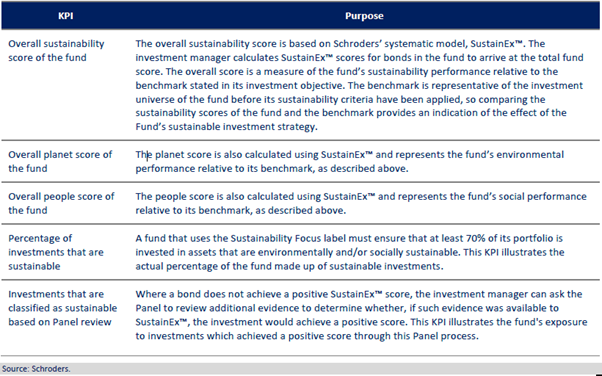
- Consumer Facing Disclosure
SDR Literature:
Disclaimer
Investment Policy
Bonds denominated in sterling (or in other currencies and hedged back into sterling) (“bonds”) issued by governments, government agencies, supranational and corporate issuers worldwide, (including emerging markets and less developed markets). The fund may invest up to 50% of its assets in below investment grade securities as measured by Standard & Poor's or an equivalent credit rating agency, or in unrated securities. The fund may invest up to 40% of its assets in asset-backed securities, specifically whole business corporate loans, and covered bonds.
The fund may also invest directly or indirectly in other securities (including in other asset classes), countries, regions, industries or currencies, collective investment schemes (including Schroder funds) and money market instruments and hold cash. The fund may use derivatives with the aim of achieving investment gains, reducing risk or managing the fund more efficiently (for more information please refer to section 6 of Appendix 2 of the prospectus).
The fund may use leverage and take short positions.
The fund invests at least 70% of its portfolio in bonds that the investment manager classifies as sustainable. A bond is considered to be sustainable if either the issuer itself or the activity funded by the proceeds of the bond makes a positive contribution to:
- Planet. This includes contributions to the environment - such as reducing greenhouse gas (GHG) emissions, which helps slow down climate change.
and/or
- People. This includes contributions to one or more of the following:
- Workforce wellbeing - such as a company paying more than living wages or providing education and training, or a sovereign providing education and protecting human rights.
- public and consumer wellbeing - such as a company developing new products and services that improve customers' quality of life or a sovereign setting policies against cybercrime.
- healthy, inclusive and connected communities – such as a company providing access to clean water and sanitation or a sovereign setting policies that tackle discrimination.
- effective and accountable institutions – such as a company promoting financial stability or a sovereign setting policies that support sociopolitical stability.
Bonds are classified as sustainable if they achieve a positive score in Schroders' systematic model (SustainEx™). SustainEx™ produces an assessment of the bond issuer's effect on a defined set of benefits and costs for people and the planet, which are then combined to calculate an overall sustainability score for the bond. A bond must achieve a positive score to be deemed sustainable. The model is based on in-depth internal research, which has included establishing the relevance of various factors to the sustainability outcomes referred to above.
In some exceptional cases, SustainEx™, does not provide a fair reflection of an issuer's contribution to people and/or the planet. The investment manager can refer such investments to Schroders' Sustainable Investment Panel (the “Panel”), an independent panel of experts.
The fund may also invest in green, social or sustainable bonds (“GSS Bonds”) as part of the 70% referred to above. For these investments, the investment manager does not take into account the SustainEx™ score of the issuer, but instead analyses the use of proceeds of the GSS Bond to determine whether a positive contribution to the planet or people can be expected as a result of the specific activity that the bond is designed to finance.
The fund is not permitted to invest in any assets that conflict with the sustainability objective. The investment manager also engages with selected companies held by the fund on sustainability issues.
Please see the fund's Consumer Facing Disclosure, available via https://www.schroders.com/en-gb/uk/individual/fund-centre for more details on the investment manager's approach to sustainability.
Important Information
Marketing material for Professional Clients only.
The fund is an authorised unit trust. Subscriptions for fund units can only be made on the basis of its latest Key Investor Information Document, Supplementary Information Document and Prospectus, together with the latest audited annual report (and subsequent unaudited semi-annual report, if published), copies are available in English and can be obtained, free of charge, from Schroder Unit Trusts Limited. These can be requested via out website at www.schroders.co.uk, or by calling the Investor Services Team on 0800 182 2399 requesting a printed version.
Any reference to regions/ countries/ sectors/ stocks/ securities is for illustrative purposes only and not a recommendation to buy or sell any financial instruments or adopt a specific investment strategy.
Reliance should not be placed on any views or information in the material when taking individual investment and/or strategic decisions.
The material is not intended to provide, and should not be relied on for, accounting, legal or tax advice, or investment recommendations.
Past Performance is not a guide to future performance and may not be repeated.
The value of investments and the income from them may go down as well as up and investors may not get back the amounts originally invested. Exchange rate changes may cause the value of investments to fall as well as rise.
Performance data does not take into account any commissions and costs, if any, charged when units or shares of any fund, as applicable, are issued and redeemed.
Schroders has expressed its own views and opinions in this document, and these may change.
This information is a marketing communication.
Information herein is believed to be reliable, but Schroders does not warrant its completeness or accuracy.
No Schroders entity accepts any liability for any error or omission in this material or for any resulting loss or damage (whether direct, indirect, consequential or otherwise), in each case save to the extent such liability cannot be excluded under applicable laws.
The data contained in this document has been sourced by Schroders and should be independently verified. Third party data is owned or licenced by the data provider and may not be reproduced, extracted or used for any other purpose without the data provider’s consent. Neither Schroders, nor the data provider, will have any liability in connection with the third-party data.
CONTEXT™ is a proprietary tool used by Schroders to support the analysis of companies’ and issuers’ management of the environmental, social and governance trends, challenges and opportunities that Schroders believes to be most relevant to that company’s or issuer’s industry. It provides access to a wide range of data sources chosen by Schroders. Any views or conclusions integrated into Schroders’ investment-decision making or research by fund managers or analysts through the use of CONTEXT™ will reflect their judgement of the sustainability of one or more aspects of the relevant company’s or issuer’s business model, rather than a systematic and data-driven score of the company or issuer in question.
Schroders uses SustainEx™ to estimate the net social and environmental “cost” or “benefit” of an investment portfolio having regard to certain sustainability measures in comparison to a product’s benchmark where relevant. It does this using third party data as well as Schroders own estimates and assumptions and the outcome may differ from other sustainability tools and measures.
Schroders will be a data controller in respect of your personal data. For information on how Schroders might process your personal data, please view our Privacy Policy available at https://www.schroders.com/en/global/individual/footer/privacy-statement/ or on request should you not have access to this webpage.
For your security, communications may be recorded or monitored.
Issued by Schroder Unit Trusts Limited, 1 London Wall Place, London EC2Y 5AU. Registration No 4191730 England. Authorised and regulated by the Financial Conduct Authority.
Issued in April 2025. 03176.
| Fund Name | SRI Style | SDR Labelling | Product | Region | Asset Type | Launch Date | Last Amended |
|
|---|---|---|---|---|---|---|---|---|
Schroder Sustainable Bond Fund |
Sustainability Tilt | Sustainability Focus label | OEIC | Global | Fixed Interest | 05/09/2003 | Oct 2025 | |
ObjectivesThe fund’s sustainability objective is to invest in bonds that the investment manager classifies as sustainable. These are investments that make a positive contribution to: (1) the planet (the environment); and/or (2) people (workforce wellbeing; public and consumer wellbeing; healthy, inclusive and connected communities; and/or effective and accountable institutions). By investing in bonds that are assessed as providing a positive contribution to people and/or the planet, the fund aims to help the issuers continue to implement (and potentially expand) their sustainable activities, or in the case of green, social or sustainable bonds (GSS Bonds), to support the sustainable activities that the bonds are designed to fund.
|
Fund/Portfolio Size: £51.16m (as at: 31/03/2026) Total Responsible Ownership Assets: £646500.00m (as at: 31/12/2024) Total Assets Under Management: £776613.00m (as at: 30/06/2025) ISIN: GB0007905945, GB0007905721, GB00BJRSV066, GB00BJRSTZ73, GB00BDD27918, GB00B57BFC79, GB00BJRSVG23, GB00BDD27793, GB00B5W01T86 Contact Us: Arvin.Bains@Schroders.com / Meriel.Turner@schroders.com |
|||||||
Sustainable, Responsible &/or ESG OverviewOur strategy is designed for investors that seek capital growth and income from sustainable issuers from across the fixed income universe (including but not limited to corporate credit, government related and sovereign issuers). We use the flexibility of an unconstrained, active strategy to capture the most compelling opportunities within a clearly defined sustainable global fixed income universe, in a diversified risk managed portfolio. The sustainable investment universe is constructed through proprietary research that that seeks to exclude harmful and destructive practices and aligns a best-in-class approach to corporate bonds with a unique, transparent approach to sovereign sustainability, that accounts for a sovereign’s level of income. A bond is considered to be sustainable if either the issuer itself or the activity funded by the proceeds of the bond makes a positive contribution to: (1) Planet, which includes contributions to the environment and/or (2) People. |
||||||||
|
Primary fund last amended: Oct 2025 |
||||||||
|
Information received directly from Fund Manager |
||||||||
|
Please select what you would like to read:
Fund FiltersSustainability - General
Sustainability policy
Has policies that consider (environmental and social) sustainability issues. Strategies vary but are likely to consider environmental issues like climate change, carbon emissions, biodiversity loss, resource management, environmental impacts; and social issues like equal opportunities, human rights, labour standards, diversity and adherence to internationally recognised codes. See individual entry information.
Sustainability focus
Has a significant focus on sustainability issues
Encourage more sustainable practices through stewardship
Aim to encourage higher sustainability standards through responsible ownership / stewardship / engagement / voting activity
UN Global Compact linked exclusion policy
Use the UN Global Compact to inform or help direct where they can or cannot invest. Will typically not invest in companies with significant breaches (low standards) - strategies vary. (The UNGC covers a wide range of issues - search 'UNGC'). See https://unglobalcompact.org/
UN Sustainable Development Goals (SDG) focus
Aim to invest (and manage assets) in ways that help to address all or some of the UN's Sustainable Development Goals (SDGs). See https://sdgs.un.org/goals).
Report against sustainability objectives
Publicly report performance against named sustainability objectives Environmental - General
Limits exposure to carbon intensive industries
Options that limit or 'reduce' their exposure to carbon intensive industries (ie sectors which are major contributors to climate change). Strategies vary.
Favours cleaner, greener companies
Aims to invest in companies with strong or market leading environmental policies and practices. Strategies vary. See individual entry information for more detail. Climate Change & Energy
Coal, oil & / or gas majors excluded
Avoid investment in major coal, oil and/or gas (extraction) companies. Strategies vary.
Fracking & tar sands excluded
Avoid companies involved in fracking and tar sands - which are widely regarded as controversial methods of oil and gas extraction. Strategies vary.
Encourage transition to low carbon through stewardship activity
Encourage the transition to lower carbon activities through asset selection and / or responsible ownership activity.
Invests in clean energy / renewables
Invest in renewable energy companies and / or companies where renewable energy is a significant part of their business. Strategies vary.
Nuclear exclusion policy
Has a policy which describes the avoidance or limited investment in the nuclear industry. Strategies vary.
Fossil fuel exploration exclusion - direct involvement
Excludes companies and other assets with direct involvement in fossil fuel exploration (eg coal, oil and gas companies) Social / Employment
Social policy
Has policies which set out their approach to social issues (e.g. human rights, labour standards, equal opportunities, child labour and/or adherence to internationally recognised codes such as the UN Global Compact). Strategies with social policies typically avoid companies with low standards and/or work to encourage higher standards. See fund information for detail.
Labour standards policy
Has a labour standards policy - likely to mean they will invest in / favour companies that have higher employment related standards and avoid those with low standards. Strategies vary. See eg https://www.ilo.org/international-labour-standards
Health & wellbeing policies or theme
Has policies or themes that set out their approach to health and wellbeing issues, typically aims to invest in companies with high standards - or encourage high standards.
Diversity, equality & inclusion Policy (product level)
Has a written diversity policy – where the manager will aim to select companies with a carefully considered, positive employment standards. This may cover a range of issues including gender, ethnicity, disability, beliefs and sexual orientation. Ethical Values Led Exclusions
Tobacco & related products - avoid where revenue > 5%
Companies are excluded if they make more than 5% of their revenue from the manufacture, sale or distribution of tobacco products including cigarettes, vaping, e-cigarettes, chewing tobacco and cigars.
Armaments manufacturers avoided
Avoids companies that manufacture weapons intended specifically for military use. Strategies vary - may or may not include non-strategic military products.
Civilian firearms production exclusion
Has a written civilian firearms exclusion policy - meaning that they will not invest in companies that make (or perhaps also sell) handguns made for non-military users.
Alcohol production excluded
Avoids companies that produce alcohol. Strategies vary; some may allow a small proportion of revenue to come from this area.
Gambling avoidance policy
Avoids companies with significant involvement in the gambling industry. Some may allow a small proportion of revenues to come from this area.
Pornography avoidance policy
Avoids companies that derive significant income from pornography and related areas. Strategies vary. Human Rights
Human rights policy
Has policies relating to human rights issues. Typically require companies to demonstrate higher standards, although some managers work to encourage improvements. Investee companies are often judged against internationally agreed norms or standards. Strategies vary.
Oppressive regimes (not free or democratic) exclusion policy
Has policies that exclude companies or other assets which operate in, or are owned by regimes which are not democratic, or where people may be oppressed. May use eg. Freedom House research. Strategies vary.
Modern slavery exclusion policy
Has a policy which excludes assets with involvement in Modern Slavery Gilts & Sovereigns
Gilts / government bonds - exclude some
Avoids investing in 'some' gilts or government bonds. Strategies vary, but this may relate to avoiding specific countries or particular reasons for bond issuance. 'Green gilts' for example would be likely to be acceptable.
Invests in sovereigns subject to screening criteria
Invest in financial instruments issued by governments, but will only hold those that meet certain environmental and or social criteria. This may, for example mean certain assets are excluded in line with eg Freedom House research. Strategies vary. Banking & Financials
Invests in banks
Can include banks as part of their holdings / portfolio.
Invests in financial instruments issued by banks
Invests in financial instruments (cash, derivatives and / or foreign exchange) issued by banks. Strategies vary.
Invests in insurers
May invest in insurance companies. Governance & Management
Governance policy
Has policies that relate to corporate governance issues such as board structure, executive remuneration, bribery and/or corporate corruption. These funds will typically avoid companies with poor practices. Strategies vary.
Avoids companies with poor governance
Avoids investing in companies with poor governance practices.(e.g. board structure, management practices etc.) Views may however vary on what counts as 'poor' practices - and funds may not immediately divest as they may prefer to work to encourage higher standards.
UN sanctions exclusion
Exclude companies that are subject to United Nations sanctions. See eg https://main.un.org/securitycouncil/en/content/un-sc-consolidated-list
Encourage board diversity e.g. gender
Encourage the companies they invest in to have more diverse board structures (e.g. more women on boards)
Encourage higher ESG standards through stewardship activity
Aim to encourage higher ESG standards through responsible ownership / stewardship / engagement /voting activity Product / Service Governance
ESG integration strategy
Find fund / asset managers that factor in 'environmental, social and governance' issues as part of their investment decision making process. A focus on 'ESG' typically means a fund is carrying out additional research to help reduce ESG related risks. It does not necessarily mean a focus on sustainability. Strategies vary. See fund literature. Asset Size
Invests in small, mid & large cap companies / assets
Invests in a combination of small, medium and larger (potentially multinational) companies / assets.
Invest in supranationals
Invests in international entities or bodies with agreed remits that are broadly similar to those that may otherwise be undertaken by individual governments eg the UN Targeted Positive Investments
Invests > 5% in sustainable bonds
Invests in loan stock that is exclusively used to finance environmental and social projects. See ICMA Sustainable Bond Guidelines.
Invests > 5% in green bonds
Invests in green bonds (also known as climate bonds) which encourage sustainability and support climate related or special environmental projects. How The Fund/Portfolio Works
Positive selection bias
Focuses on finding and investing in companies with positive / beneficial attributes. This strategy can be applied in addition to exclusion criteria and engagement/stewardship activity.
Combines ESG strategy with other SRI criteria
Invests in assets which have an ESG strategy (which is typically focused on avoiding companies that pose environmental, social or governance related risks) together with additional criteria such as positive and/or negative screens, themes and stewardship strategies.
SRI / ESG / Ethical policies explained on website
Publish explanations of their ethical, social and/or environmental policies online (i.e. investment decision making strategies/ buy/sell &/or asset management strategies).
Converted from ‘non ESG’ strategy
Has changed its mandate. It was previously not an ESG/sustainable fund. The information published here shows the upgraded strategy.
Do not use stock / securities lending
Does not use stock lending for performance or risk purposes. Unscreened Assets & Cash
Assets typically aligned to sustainability objectives 70 - 79%
Holds between 70-79% of assets which align to the sustainability objectives; which are not being held purely for risk management purposes, such as derivatives and cash equivalent assets. Intended Clients & Product Options
Intended for clients interested in sustainability
Designed to meet the needs of individual investors with an interest in sustainability issues. Labels & Accreditations
SDR Labelled
Find options that have chosen to adopt one of the Financial Conduct Authority (FCA) SDR labels. Please note: there are a range of reasons why potentially relevant options may not use an SDR label eg. adopting a label may be work in progress, the manager may not yet be allowed to do so because of the product type, a manager may feel they are insufficiently aligned to SDR requirements. Fund Management Company InformationAbout The Business
Specialist positive impact fund management company
Find fund / asset management companies (or subsidiaries) that specialise in - or focus entirely on - investing in assets that are helping to deliver positive environmental and / or social impacts.
Responsible ownership / stewardship policy or strategy (AFM companywide)
Finds fund / asset management companies that have a published company wide stewardship, engagement and / or responsible ownership policy or strategy that covers all investments. Stewardship typically involves encouraging higher ESG standards through voting and dialogue.
ESG / SRI engagement (AFM companywide)
Find fund / asset management companies that actively encourage higher 'environmental, social and governance' and / or 'sustainable and responsible investment' practices across investee companies - typically where the aim is to encourage positive change that is aligned with the best interests of investors. Strategies vary. See additional information and options.
Vote all* shares at AGMs / EGMs (AFM companywide)
Find fund / asset managers that vote all* the shares they own at Annual General Meetings and Extraordinary General Meetings. A commitment to voting shares is a key indicator of 'responsible share ownership' demonstrating their support for or disagreement with management policy. (*situations can legitimately, occasionally occur where voting proves impossible, but in principle all shares should be voted.)
Responsible ownership / ESG a key differentiator (AFM companywide)
Find fund / asset managers that consider responsible ownership and ESG to be a key differentiator for their business.
Sustainable property strategy (AFM companywide)
Find fund / asset management companies that take sustainability criteria into account when selecting and/or managing all of their property / real estate investments.
Senior management KPIs include environmental goals (AFM companywide)
The leadership team of this fund / asset manager have performance targets linked to environmental goals.
SDG aligned aims / objectives (AFM companywide)
Find fund / asset management companies that aim to align all their investments (across all funds) to help meet the aims of the UN Sustainable Development Goals.
Responsible ownership policy for non SRI / sustainable options (AFM companywide)
Find options run by managers that apply Responsible ownership or 'Stewardship' policies to all or most of their investment assets. This means active involvement (e.g. voting, dialogue) with the companies across all or most funds, products and services.
Integrates ESG factors into all / most research (AFM companywide)
Find fund / asset management companies that consider environmental, social and governance (ESG) issues when deciding whether or not to invest in a company for all / almost all of their funds and other assets. This is increasingly seen as part of sound risk management.
In-house diversity improvement programme (AFM companywide)
Finds organisations / fund managers that have an in-house (company wide) diversity improvement programme - meaning that they are working to ensure that within their own businesses they employ people from diverse backgrounds - often typically focused on ethnicity and/or sex.
Diversity, equality & inclusion engagement policy (AFM companywide)
Find fund / asset management companies that encourage the companies they invest in to have strong diversity, race, gender and other equality policies across all assets held, not simply screened or themed SRI/ESG funds. (ie Asset Management company wide).
Invests in newly listed companies (AFM companywide)
This fund / asset management company invests in companies which have recently listed on a stock exchange (which is important as it can help grow new businesses).
Invests in new sustainability linked bond issuances (AFM companywide)
Fund / asset management company has investments in bonds designed to meet sustainability requirements - however these assets may not be 'ringfenced' for this purpose. See website for details.
Offer structured intermediary sustainable investment training
Fund management entity offers unstructured intermediary training on sustainable investment (ie for financial advisers and wealth managers)
Offer unstructured intermediary sustainable investment training
Fund management entity offers unstructured intermediary training on sustainable investment (ie for financial advisers and wealth managers) Collaborations & Affiliations
PRI signatory
Find fund / asset management companies that have signed up to the UN backed 'Principles of Responsible Investment'.
UKSIF member
Find fund / asset management companies that are members of UKSIF - the UK Sustainable Investment and Finance association
Fund EcoMarket partner
Find fund / asset management companies that have partnered with Fund EcoMarket - meaning that they are helping to improve access to information on sustainable and responsible investment by paying an annual fee to us which enables us to publish information for free. Partner funds are listed ahead of other funds and have their logos displayed.
UN Principles of Responsible Banking framework signatory (AFM companywide)
This fund / asset manager has signed up to the UNEP (United Nations Environment Program) program which aims to encourage more responsible banking practices – focused on environmental and social issues.
TNFD forum member (AFM companywide)
A member of the Taskforce for Nature Related Financial Disclosures group which aims to aid risk management and shift money towards nature-positive outcomes.
Investment Association (IA) member
Fund management entity is a member of the Investment Association https://www.theia.org/ Resources
In-house responsible ownership / voting expertise
Find fund / asset management companies that employ people to steer and support fund managers in voting shares at company AGM's and EGMs in ways that are consistent with encouraging higher ESG/sustainability standards.
Employ specialist ESG / SRI / sustainability researchers
Find a fund / asset management company that directly employs specialist ESG/SRI/sustainability researchers or analysts. This allows asset managers to discuss environmental, social and governance risks and opportunities directly with companies.
Use specialist ESG / SRI / sustainability research companies
Find fund / asset management companies that makes use of expert external research companies. This can help deliver specialist expertise and means resources are pooled with other investors.
ESG specialists on all investment desks (AFM companywide)
Finds organisations / fund managers that have one or more ESG/sustainability experts on all investment teams or 'desks' (all asset types) Accreditations
PRI A+ rated (AFM companywide)
Finds organisations / fund managers that have an A+ PRI rating - meaning they are highly rated according to the 'Principles of Responsible Investment'
UK Stewardship Code signatory (AFM companywide)
Find fund / asset managers that are signatories to the FRC UK Stewardship Code, which sets out a framework for constructive investor / investee relations where managers are encouraged to behave like responsible, typically longer term 'company owners'. Engagement Approach
Regularly lead collaborative ESG initiatives (AFM companywide)
Find fund / asset management companies that regularly initiate or run industry wide (collaborative) investor projects aimed at raising environmental, social and governance standards amongst investee companies.
Encourage responsible corporate taxation (AFM companywide)
Find fund / asset management companies that are working with the companies they invest in to encourage more responsible corporate taxation.
Engaging on climate change issues
Fund / asset manager has stewardship /responsible ownership strategy that is focused on addressing climate change with investee assets.
Engaging with fossil fuel companies on climate change
Fund / asset manager has a stewardship /responsible ownership strategy that involves working with fossil fuel companies on climate change related issues. See fund manager website for details.
Engaging to reduce plastics pollution / waste
Fund / asset manager has stewardship /responsible ownership strategy with involves encouraging investee asset to reduce plastic waste and pollution.
Engaging to encourage responsible mining practices
Fund / asset manager has a stewardship / responsible ownership policy that means they are working to encourage more responsible mining practices - where environmental and social issues are properly dealt with by the companies they invest in.
Engaging on biodiversity / nature issues
The fund / asset manager has a responsible ownership / stewardship strategy that focuses on biodiversity and nature issues relating to the assets they invest the aim of which will be to reduce harm and or deliver improvement. Strategies vary. https://tnfd.global
Engaging to encourage a Just Transition
Fund / asset manager has a responsible ownership / stewardship strategy which means they are working to encourage the shift to more sustainable business practices in ways that respect and are sensitive to social issues and the impact change has on people effected by the changes that are taking place. https://www.transitionpathwayinitiative.org/ https://transitiontaskforce.net/
Engaging on human rights issues
Fund / asset manager has responsible ownership / stewardship strategy in place which aims to address human rights issues in investee companies (and potentially their suppliers) with the aim of raising standards
Engaging on labour / employment issues
Fund / asset manager has responsible ownership / stewardship strategy in place that aims to improve labour standards for the benefit of employees in investee companies (and potentially their suppliers)
Engaging on diversity, equality & / or inclusion issues
Fund / asset management company has a stewardship strategy in place which involves working to raise diversity, equality and inclusion standards across investee assets
Engaging to stop modern slavery
Fund / asset manager is working with the assets they hold to help stamp out modern slavery - where direct or indirect company employees are exploited for business benefits.
Engaging on governance issues
Fund / asset managers have stewardship strategies in place that focus on improving governance standards across investee assets
Engaging on mental health issues
Fund / asset manager has stewardship strategy in place which involves discussing mental health issues with investee companies - with the aim of raising standards
Engaging on responsible supply chain issues
Has a stewardship / responsible ownership strategy that encourages responsible supply chain - ie the managers will discuss environmental, social and governance issues with investee companies with the aim of raising standards
Stewardship escalation policy
Escalation policies describe how a manager will proceed if stewardship / engagement activity is not successful in the short term. Company Wide Exclusions
Controversial weapons avoidance policy (AFM companywide)
Find fund / asset management companies (not funds) that avoid investment in 'controversial weapons' across all of their funds and other investment vehicles.
Review(ing) carbon / fossil fuel exposure for all funds (AFM companywide)
Find funds / asset managers that are reviewing, or have reviewed, their exposure to carbon intensive industries including (but not only) mining, oil and gas companies. (Typically with reference to climate change.) Climate & Net Zero Transition
Net Zero commitment (AFM companywide)
Fund / asset management organisations that have pledged to reduce their greenhouse gas emissions to ‘net zero’. Strategies vary - this area is changing rapidly.
Voting policy includes net zero targets (AFM companywide)
Fund / asset manager AGM / EGM voting strategy has processes in place that mean they will normally be expected to vote in a way that will encourage the transition to net zero greenhouse gas emissions.
Publish 'CEO owned' Climate Risk policy (AFM companywide)
Find fund / asset management companies that have published a Climate Risk policy or statement that is signed / owned by their Chief Executive.
Net Zero - have set a Net Zero target date (AFM companywide)
This fund / asset management company has set a date by which they plan to achieve net zero greenhouse gas / CO2e emissions.
Encourage carbon / greenhouse gas reduction (AFM companywide)
Find fund / asset management companies that are working with the companies they invest in to encourage reductions in carbon dioxide and other greenhouse gas emissions.
Carbon transition plan published (AFM companywide)
Finds organisations / fund managers that have a company wide carbon transition plan - meaning that they have plotted a path to how they will move away from activities that produce or use carbon based energy sources (that emit greenhouse gases) towards clean, alternative, renewable energy sources.
‘Forward Looking Climate Metrics’ published / ITR (AFM companywide)
Finds organisations / fund managers that have published ‘forward looking climate metrics’ e.g. 'implied temperature rise' data that are a total of the asset management company's share (% owned) of all the investee company emissions of the assets they manage, as well as their own direct and other indirect emissions.
In-house carbon / GHG reduction policy (AFM companywide)
Find fund / asset management companies that are working to reduce their own (fund management company) carbon/greenhouse gas emissions.
Working towards a ‘Net Zero’ commitment (AFM companywide)
Finds organisations / fund management companies that are in the process of working out how to make a ‘net zero commitment’ - meaning that when that is finalised they will have started the process of reducing their total greenhouse gas emissions to 'zero'.
Committed to SBTi / Science Based Targets Initiative
See https://sciencebasedtargets.org/ Transparency
Publish responsible ownership / stewardship report (AFM companywide)
Find fund / asset management companies that publish a report detailing their responsible investment ownership - also known as 'Stewardship' - activity.
Full stewardship / responsible ownership policy information on company website
Find fund / asset management companies that publish information about their sustainable and responsible investment strategies on their company website.
Publish full voting record (AFM companywide)
Fund / asset management companies that publish a full record of how they vote their shares at AGMs (annual general meetings) and EGMs (extraordinary general meetings). Voting strategies have an important role to play encouraging higher environmental, social and governance standards.
Sustainability transition plan publicly available (AFM companywide)
This fund / asset management company has published a plan that explains how they are to become a sustainable business - without significant negative environmental or social impacts.
Paris Alignment plan publicly available (AFM companywide)
This fund / asset management company has published a plan that explains how they will align to the climate change commitments made at the Paris Climate Talks, COP21.
Net Zero transition plan publicly available (AFM companywide)
This fund / asset management company has published a plan that explains how they are going to achieve net zero greenhouse gas / CO2e emissions.
Dialshifter statement
Find fund / asset management companies that have supplied Dialshifter information. See Dialshifter tab within record for more information. CommentsAppendix –1
Sustainable, Responsible &/or ESG Policy:The Schroder Sustainable Bond Fund is a global total return bond fund. The aim is to allocate capital to sovereign and corporate issuers that are acting in a sustainable manner and are contributing towards to a more economically sustainable future over the medium to long term. Our approach establishes a transparent and credible framework for sustainable investing across both sovereigns and credit. Uniquely, the fund seeks to address some of the well-known challenges associated with sovereign sustainability, such as a lack of clarity around sustainable objectives, poor data quality and an inherent income bias (to the extent that sustainability scores such as SDGs are highly correlated with a country’s wealth). The United Nations’ Sustainable Development Goals (UN SDGs) are the anchor point for the fund’s sovereign investment universe, on which we overlay additional social and environmental criteria to ensure countries included in the investment universe have the appropriate sustainability profile. The fund applies its sustainable approach through:
Fund-level sustainability commitments: The fund invests at least 70% of its portfolio in bonds that the investment manager classifies as sustainable. A bond is considered to be sustainable if either the issuer itself or the activity funded by the proceeds of the bond makes a positive contribution to:
and/or
Bonds are classified as sustainable if they achieve a positive score in Schroders’ systematic model (SustainEx™). SustainEx™ produces an assessment of the bond issuer’s effect on a defined set of benefits and costs for people and the planet, which are then combined to calculate an overall sustainability score for the bond. A bond must achieve a positive score to be deemed sustainable. The model is based on in-depth internal research, which has included establishing the relevance of various factors to the sustainability outcomes referred to above. In some exceptional cases, SustainEx™, does not provide a fair reflection of an issuer’s contribution to people and/or the planet. The investment manager can refer such investments to Schroders’ Sustainable Investment Panel (the “Panel”), an independent panel of experts. The Panel reviews additional robust evidence provided by the investment manager to determine whether, if such evidence was available to SustainEx™, the investment would achieve a positive score. This could be relevant where SustainEx™, does not capture a relevant area of positive contribution – such as where an issuer produces a particularly sustainable product whose importance to people, or the planet is not fully captured by the issuer’s overall score. Alternatively, it could be relevant where the investment manager is able to supply additional data to enhance a calculation – such as where an issuer does not publish details of employee salaries, but the investment manager is able to obtain or more accurately estimate this from other sources. The fund may also invest in GSS Bonds as part of the 70% referred to above. For these investments, the investment manager does not take into account the SustainEx™ score of the issuer but instead analyses the use of proceeds of the GSS Bond to determine whether a positive contribution to the planet or people can be expected as a result of the specific activity that the bond is designed to finance. It does this by assessing each GSS Bond’s adherence to a set of robust principles established by the International Capital Market Association or an equivalent body. The fund does not directly invest in assets that the investment manager deems to conflict with the sustainability objective. This refers to assets that not only fail to meet the sustainability objective, but also actively conflict with the positive outcome it seeks. As the fund aims to invest in bonds that provide a positive contribution to people and/or the planet, the investment manager defines conflicting assets as bonds which have a significant negative effect on people and/or the planet. These are bonds of issuers that are directly and materially exposed to activities that are significantly damaging to the environment; and bonds of issuers that are directly and materially exposed to activities or actions and/or have an unjustifiable cost to society. Process:The definition of Schroder Sustainable Bond’s investment universe is the foundation of its approach. The fund invests in fixed and floating rate securities issued by governments, government agencies, supranational and corporate issuers worldwide, of which 80% are denominated in (or hedged back into) Sterling. All holdings must satisfy the fund’s sustainability criteria to qualify, and while there are differences between the criteria for sovereigns and credit, the goal is the same in both cases: ensuring capital is allocated to those issuers working towards a more sustainable future. i. Inclusion of Corporate Credit in the sustainable investment universe We have long recognised that non-financial considerations including environmental, social and governance issues have a material influence on supply and demand within an investible horizon and the sustainability of issuer cash-flows through changing consumer expectations, increasing regulation, supply chain risk, brand reputation etc. We recognise that ESG issues can and do have a material impact on the short, medium and long-term performance of corporate issuers. We believe that integrating E, S and G into an investment process is not a simple filter based on snapshot external metrics that are often static and backward-looking. Experience has told us that a lot of bondholder value can be overlooked by short-sighted decision-making. We integrate ESG into our investment process in the following ways:
ii. Inclusion of Sovereigns & Supranationals in the sustainable investment universe The sustainable investment universe uses three key pillars and only countries that satisfy the three criteria are included in the investment universe:
Addressing the ingrained income bias in sovereign ESG scores Sustainability scores are highly correlated with a country’s gross national income per capita, with richer nations inevitably receiving better ESG scores, reflecting their stronger institutional frameworks. Investing in countries with the ‘best’ scores would therefore direct capital flows away from countries who arguably need them the most. It is fundamentally unhelpful both from a sustainability ethos and on pure investment grounds to penalise countries that may be trying to do ‘the right thing’ simply because they come from a lower developmental starting point. We seek to address this through the definition of our sovereign investment universe and to ensure that we include all countries that are demonstrating suitable progress towards meeting the SDGs. To do this we assess countries’ progress relative to other countries at a similar development level – therefore preventing the entrenched income bias skewing the universe towards more developed countries. We achieve this firstly by grouping countries into the four income brackets (high, upper-middle, lower-middle and low income) defined by the World Bank, using gross national income (GNI) per capita. We then use the SDG index scores to compare the relative progress of countries in achieving the SDGs for countries against others in the same income bracket. Only the top proportion of each income bracket are permitted in the investment universe. This means we compare the relative progress of the US vs Canada, for example, rather than, say, South Africa, given the relative stages of economic development of the two nations. By comparing SDG progress for countries of a similar level of development, we can ensure our universe includes those that are outperforming their peers, while avoiding the inclusion of relative laggards. We believe this structure addresses the inherent bias, while maintaining transparency and ensuring that criteria are clearly defined and can be readily understood by our clients. To further ensure the sustainability characteristics of countries that are investable under our framework, we employ two further criteria. Social criteria: We believe sustainable development at a sovereign level requires a country’s citizens to enjoy a suitable degree of political and civil liberty. To ensure our impartiality in assessing this, we use from the annual World Report issued by Freedom House, a leading independent arbiter of levels of democracy and political freedom. We only include countries that are designated ‘Free’ or ‘Partly Free’ by Freedom House in our investible universe. Environmental criteria: For the assessment of a particular country’s engagement with climate risk management, we use the Energy and Climate Intelligence Unit’s ‘net zero emissions tracker’. For inclusion in our investible universe, we require evidence of a government’s solid commitment to addressing client change and to at least have a net zero pledge contained in an official policy document, which can be credibly expected to be signed into law in the short to medium term. Inclusion of supranationals and agencies to complete the sustainable investment universe: We take the view that investment in supranational agencies is fundamentally aligned to our overall philosophy and while these issuers’ sustainable merits can often be underappreciated by investors, we expect them to make up an important part of our investable universe. While the activities of supranationals vary considerably, multilateral development banks (such as the Asian Development Bank, African Development Bank, European Bank for Reconstruction & Development etc.) play a crucial role in promoting sustainable economic and social development. A qualitative assessment of SSA issuers is reflected through an uplift of SustainEx™ scores for those institutions at the forefront of sustainable funding and development. iii. Additional scoring-based exclusions: MSCI Ratings Green, Social and Sustainability bonds Investment in these types of assets is fundamentally in line with the philosophy and objectives of the fund, and we look to encourage sovereign and corporate issuers to widen their use of such issues. Investment process The key elements of our team’s investment process:
And its four “pillars”:
We also believe that there are significant opportunities to deliver consistent alpha from bottom-up credit analysis throughout the market cycle, across global credit markets. Our team of analysts look deeply into the business models of companies – including from a sustainability perspective – to assess which companies will prosper and which will be vulnerable as the world changes. To help focus this work, Schroders has developed an innovative forward-looking themes-based selection process, which provides a framework (again with a strong sustainability component) to guide our research and differentiate between issuers. Where multiple themes combine in support of, or to highlight potential risks to, a company, this helps drive the conviction behind a particular position. Resources, Affiliations & Corporate Strategies:Fixed Income ESG expertise Our investment teams, including portfolio managers, are aligned in their efforts to integrate sustainability factors alongside financial considerations in their analysis and throughout portfolio construction. While our ESG integration process was only formalised in 2020, environmental and social considerations have long formed a part of our analysis, with governance concerns remaining critical to the analysis of corporate issuers. Our credit analysts (40+) integrate ESG considerations, including climate and decarbonisation, within their issuer and sector-level analysis. Our team of credit analysts are responsible for conducting fundamental, financial and sustainability analysis for the issuers they cover. All our new single-name investment research includes financial and sustainability analysis side-by-side, including analysis on the environmental considerations for each issuer. We also employ dedicated sustainable credit analysts who are integrated within the fixed income platform. These analysts have specific responsibilities, including carrying out and coordinating strategic engagement programs with credit issuers on ESG topics; facilitating the implementation of ESG insights; developing frameworks for sustainability-focused funds; assessing ESG-labelled credit instruments; collaborating with the sustainable investment team. Sustainable Investment Team Sustainability is fundamental to our investment principles at Schroders, and we have an experienced and well-resourced Sustainable Investment team, who are embedded within our Investment function. We are a global team, spread across four regional hubs in London, Paris, Singapore and New York, aiming to ensure that sustainability is embedded through our global investment teams and client functions. The team is led by Andrew Howard, Global Head of Sustainable Investment. As team head, he oversees our approach to ESG integration, active ownership, our sustainability research and tools, and our reporting and product strategy. Our central Sustainable Investment team sits alongside investment teams rather than operating in a silo, which facilitates regular dialogue with our analysts and portfolio managers. It is organised into four pillars: We outline their key responsibilities and areas of focus below. Our Advisory and Integration team acts as a central contact point and consultant for a range of stakeholders across the business. This includes advising investment teams on ESG integration best practice; compliance, risk and legal teams on ESG regulation; and working with our regional experts; across Asia Pacific, Europe and North America, as outlined under pillar four. Our Models and Data team is responsible for the maintenance and evolution of our suite of proprietary tools. They are also responsible for ESG data, ensuring we harness sustainability data effectively from both conventional and unconventional sources. Our Strategy and Research team is responsible for undertaking sustainability research to: inform firmwide strategy and commitments; provide insights for investment teams to analyse sustainability-related risks and opportunities; and provide research-related and technical support for other stakeholders across the firm. 2. Active ownership Our Engagement team partners with investors to have dialogue with the companies in which we invest, seeking to understand how prepared they are for a changing world and pushing them towards more sustainable practices. The team track the progress of these engagements and hold companies to account. Our Corporate Governance team is responsible for voting in line with our Voting Policy and Principles. 3. Impact Our Impact team is responsible for scaling our impact product offering in line with best-practice impact principles. The team works closely with investment desks and is responsible for developing and implementing our impact management and measurement framework, including impact assessment and monitoring at transaction and portfolio level, product development, impact strategy and impact reporting. 4. Regional Expertise Our Regional Experts based in Asia Pacific, Europe and North America have a deep understanding of local market characteristics and nuances, and are responsible for staying abreast of sustainability-related developments. Our experts work with clients and internal teams to navigate and support clients’ ESG aspirations and challenges, utilising Schroders’ proprietary tools and research to develop investment solutions that meet their needs. They also engage with regulators and industry bodies to shape and support the global sustainable finance agenda. Our regional experts are a critical extension of the central team in London as the firm continues to evolve its global ESG strategy. Governance of our ESG strategy and policies We have a number of governance structures in place for decision-making and oversight of our approach to sustainable investment. The Board of Schroders plc (the Board) has collective responsibility for the management, direction and performance of the Group, and is accountable for our overall business strategy. The Group Chief Executive is responsible for proposing the strategy for the Group and for its implementation, supported by the Group’s senior management team and a number of Committees, some of which are noted below. The Group Sustainability and Impact (GSI) Committee provides advice to the Group Chief Executive on sustainability and impact matters. The Committee considers, reviews and recommends the overall global sustainability and impact strategy, including key initiatives, new commitments and policies for approval. The Global Head of Sustainable Investment and Global Head of Corporate Sustainability are members of the Committee and report to the Group Executive Committee and to the Board. The Sustainability Executive Committee (Sustainability ExCo) develops and oversees the delivery of our Group-level sustainable investment management strategy. The ExCo also advises on the development of our sustainability and impact investment and product frameworks. The ExCo has senior representation from across the business including Investment, Client Group, Wealth Management, Schroders Capital and Corporate Sustainability. The Sustainability Regulations Steering Committee (Sustainability Reg SteerCo) oversees the progress of in-flight sustainability regulatory change programmes, as well as monitoring emergent sustainability regulations and determining their high-level impact on our Group sustainability strategy and supporting operations. The Sustainability Reg SteerCo receives input on planned or potential sustainability-related regulation from our Public Policy team, which actively engages with relevant regulators, industry trade associations and other bodies in the United Kingdom (UK) and European Union (EU). The Sustainability Reg Steerco has senior representation from across the business including Investment, Wealth Management, Schroders Capital, Legal, Risk & Compliance, Product and Operations Management. Certain Schroders entities, businesses and Investment teams also have their own committees which consider their sustainable investment activities. For example, the Private Assets Sustainability and Impact Steering Committee (PA S&I SteerCo) develops and oversees the implementation of the Private Assets Sustainability and Impact strategy. In addition, the Wealth Management Sustainable Investment Committee (WMSIC), a sub-committee of the Wealth Management Investment Committee (WMIC), has delegated responsibility for recommending Wealth Management's Sustainability models, as well as providing investment strategy and direction for client portfolios that are linked to the sustainable models. Alongside our central Sustainable Investment team, sustainable investing is also overseen and delivered by dedicated teams and expert individuals embedded throughout the firm (including across Investment teams and Client Group functions). Industry involvement We believe we have a particular role to play in sharing our expertise on different areas, supporting best practice but also learning from others. We have a long-standing commitment to support and collaborate with several industry groups, organisations and initiatives to promote well-functioning financial markets. Our key stakeholders include exchanges, regulators and international and regional trade associations. For example, Schroders is a member of trade bodies such as the Investment Association in the UK, the European Fund and Asset Management Association (EFAMA), the Asia Securities Industry and Financial Markets Association (ASIFMA) in Hong Kong and the Securities Industry and Financial Markets Association (SIFMA) in the US. Through this participation we share our insights to support the development of policy recommendations, share best practice and build coalitions of like-minded market participants to advocate for better functioning markets. We consider this to be key in improving responsible investment standards across sectors, establishing a consistent dialogue with companies, and in promoting the ongoing development and recognition of sustainability and ESG within the investment industry. A list of organisations and initiatives of which Schroders is a member or signatory is available on our website (Industry involvement| Schroders global). Dialshifter (Corporate)Our organisation is helping to support the Paris Climate Agreement and the Race to Net Zero by…
SDR Labelling:Sustainability Focus label Key Performance Indicators:
The investment manager uses KPIs to assess whether the Fund is meeting its sustainability objective. Within SustainEx™, each metric has certain KPIs that are used, for example:
An investment’s performance against these KPIs is used to calculate its overall SustainEx™ score, which is monitored on an ongoing basis to ensure that investments remain aligned with the sustainability objective. The manager also reports on the KPIs below, which aim to illustrate whether the Fund has invested in bonds that the investment manager assessed as providing a positive contribution to people and/or the planet during the previous reporting period. The reporting frequency will usually be 12 months but may be shorter during the first year that the fund applies a Sustainability Label.
SDR Literature:DisclaimerInvestment Policy Bonds denominated in sterling (or in other currencies and hedged back into sterling) (“bonds”) issued by governments, government agencies, supranational and corporate issuers worldwide, (including emerging markets and less developed markets). The fund may invest up to 50% of its assets in below investment grade securities as measured by Standard & Poor's or an equivalent credit rating agency, or in unrated securities. The fund may invest up to 40% of its assets in asset-backed securities, specifically whole business corporate loans, and covered bonds. The fund may also invest directly or indirectly in other securities (including in other asset classes), countries, regions, industries or currencies, collective investment schemes (including Schroder funds) and money market instruments and hold cash. The fund may use derivatives with the aim of achieving investment gains, reducing risk or managing the fund more efficiently (for more information please refer to section 6 of Appendix 2 of the prospectus). The fund may use leverage and take short positions. The fund invests at least 70% of its portfolio in bonds that the investment manager classifies as sustainable. A bond is considered to be sustainable if either the issuer itself or the activity funded by the proceeds of the bond makes a positive contribution to:
and/or
Bonds are classified as sustainable if they achieve a positive score in Schroders' systematic model (SustainEx™). SustainEx™ produces an assessment of the bond issuer's effect on a defined set of benefits and costs for people and the planet, which are then combined to calculate an overall sustainability score for the bond. A bond must achieve a positive score to be deemed sustainable. The model is based on in-depth internal research, which has included establishing the relevance of various factors to the sustainability outcomes referred to above. In some exceptional cases, SustainEx™, does not provide a fair reflection of an issuer's contribution to people and/or the planet. The investment manager can refer such investments to Schroders' Sustainable Investment Panel (the “Panel”), an independent panel of experts. The fund is not permitted to invest in any assets that conflict with the sustainability objective. The investment manager also engages with selected companies held by the fund on sustainability issues. Please see the fund's Consumer Facing Disclosure, available via https://www.schroders.com/en-gb/uk/individual/fund-centre for more details on the investment manager's approach to sustainability. Important Information Marketing material for Professional Clients only. The fund is an authorised unit trust. Subscriptions for fund units can only be made on the basis of its latest Key Investor Information Document, Supplementary Information Document and Prospectus, together with the latest audited annual report (and subsequent unaudited semi-annual report, if published), copies are available in English and can be obtained, free of charge, from Schroder Unit Trusts Limited. These can be requested via out website at www.schroders.co.uk, or by calling the Investor Services Team on 0800 182 2399 requesting a printed version. Any reference to regions/ countries/ sectors/ stocks/ securities is for illustrative purposes only and not a recommendation to buy or sell any financial instruments or adopt a specific investment strategy. Reliance should not be placed on any views or information in the material when taking individual investment and/or strategic decisions. The value of investments and the income from them may go down as well as up and investors may not get back the amounts originally invested. Exchange rate changes may cause the value of investments to fall as well as rise. Performance data does not take into account any commissions and costs, if any, charged when units or shares of any fund, as applicable, are issued and redeemed. Schroders has expressed its own views and opinions in this document, and these may change. This information is a marketing communication. Information herein is believed to be reliable, but Schroders does not warrant its completeness or accuracy. No Schroders entity accepts any liability for any error or omission in this material or for any resulting loss or damage (whether direct, indirect, consequential or otherwise), in each case save to the extent such liability cannot be excluded under applicable laws. The data contained in this document has been sourced by Schroders and should be independently verified. Third party data is owned or licenced by the data provider and may not be reproduced, extracted or used for any other purpose without the data provider’s consent. Neither Schroders, nor the data provider, will have any liability in connection with the third-party data. CONTEXT™ is a proprietary tool used by Schroders to support the analysis of companies’ and issuers’ management of the environmental, social and governance trends, challenges and opportunities that Schroders believes to be most relevant to that company’s or issuer’s industry. It provides access to a wide range of data sources chosen by Schroders. Any views or conclusions integrated into Schroders’ investment-decision making or research by fund managers or analysts through the use of CONTEXT™ will reflect their judgement of the sustainability of one or more aspects of the relevant company’s or issuer’s business model, rather than a systematic and data-driven score of the company or issuer in question. Schroders uses SustainEx™ to estimate the net social and environmental “cost” or “benefit” of an investment portfolio having regard to certain sustainability measures in comparison to a product’s benchmark where relevant. It does this using third party data as well as Schroders own estimates and assumptions and the outcome may differ from other sustainability tools and measures. Schroders will be a data controller in respect of your personal data. For information on how Schroders might process your personal data, please view our Privacy Policy available at https://www.schroders.com/en/global/individual/footer/privacy-statement/ or on request should you not have access to this webpage. For your security, communications may be recorded or monitored. Issued by Schroder Unit Trusts Limited, 1 London Wall Place, London EC2Y 5AU. Registration No 4191730 England. Authorised and regulated by the Financial Conduct Authority. |
||||||||