Invesco FTSE All Share Screened & Tilted UCITS ETF
SRI Style:
Unclassified
SDR Labelling:
Not eligible to use label (out of scope)
Product:
ETF
Fund Region:
UK
Fund Asset Type:
Passive / Index
Launch Date:
10/03/2021
Last Amended:
Sep 2025
Dialshifter ( ):
):
Fund/Portfolio Size:
£56.49m
(as at: 30/11/2025)
Total Screened Themed SRI Assets:
£99303.10m
(as at: 30/06/2025)
Total Responsible Ownership Assets:
£99303.10m
(as at: 30/06/2025)
Total Assets Under Management:
£2001384.50m
(as at: 30/06/2025)
ISIN:
IE00BN7J5Z03, IE0003RA2ZR3
Contact Us:
Objectives:
The Invesco FTSE All Share Screened & Tilted UCITS ETF aims to deliver the net total return of the FTSE All Share ex Investment Trusts ESG Climate Select Index, minus fees. The Index tracks large- and mid-cap UK companies, re-weighted based on ESG metrics to favour firms with strong ESG profiles, higher green revenue, and lower carbon emissions and fossil fuel reserves.
It excludes companies with severe ESG controversies or involvement in activities such as Arctic oil and gas, adult entertainment, controversial weapons, gambling, nuclear power, thermal coal, and tobacco. Firms with an S&P Governance Score below five are also excluded. Securities must meet liquidity and tradability criteria.
The fund seeks to replicate the Index by holding all its securities in their respective weights and rebalances in line with the Index. This ETF is passively managed.
Sustainable, Responsible
&/or ESG Overview:
The environmental and social characteristics promoted by the Fund are to gain exposure to issuers demonstrating a robust ESG profile. The Fund also aims to gain increased exposure to issuers generating revenue from green projects, and those that exhibit lower levels of carbon emissions and fossil fuel reserves, relative to the companies that comprise the Parent Index. The Fund achieves this by tracking the Reference Index, which has a methodology that is consistent with attaining the environmental and social characteristics promoted by the Fund.
The environmental and/or social characteristics are achieved by applying the Index Provider’s exclusion criteria to the Parent Index and by applying re-weighting factors to the remaining eligible securities such that, relative to the Parent Index, the Index achieves an uplift in its ESG rating, increased exposure to revenue generated by green projects, and a reduction in its weighted average carbon emissions and fossil fuel reserve intensity.
Primary fund last amended:
Sep 2025
Information directly from fund manager.
Fund Filters
Sustainability - General
Has a significant focus on sustainability issues
Use the UN Global Compact to inform or help direct where they can or cannot invest. Will typically not invest in companies with significant breaches (low standards) - strategies vary. (The UNGC covers a wide range of issues - search 'UNGC'). See https://unglobalcompact.org/
Environmental - General
Options that limit or 'reduce' their exposure to carbon intensive industries (ie sectors which are major contributors to climate change). Strategies vary.
Aims to invest in companies with strong or market leading environmental policies and practices. Strategies vary. See individual entry information for more detail.
Climate Change & Energy
Has policies (documented strategies that explain their position) on climate change related issues such as greenhouse gas/carbon emissions, net zero, transitioning to lower carbon. Strategies vary.
Avoid investment in major coal, oil and/or gas (extraction) companies. Strategies vary.
Avoid companies involved in fracking and tar sands - which are widely regarded as controversial methods of oil and gas extraction. Strategies vary.
Avoid companies that are involved in extracting oil from the Arctic regions.
Avoid investing in companies / assets with coal, oil and gas reserves. See individual entry information for further details.
Has a policy which describes the avoidance or limited investment in the nuclear industry. Strategies vary.
Excludes companies / assets with indirect involvement in fossil fuel exploration. This may relate to providers of finance and / or insurance and providers of other services.
Social / Employment
Has policies which set out their approach to social issues (e.g. human rights, labour standards, equal opportunities, child labour and/or adherence to internationally recognised codes such as the UN Global Compact). Strategies with social policies typically avoid companies with low standards and/or work to encourage higher standards. See fund information for detail.
Has a labour standards policy - likely to mean they will invest in / favour companies that have higher employment related standards and avoid those with low standards. Strategies vary. See eg https://www.ilo.org/international-labour-standards
All mining companies excluded
Ethical Values Led Exclusions
Companies are excluded if they are involved in any aspect of the production chain for tobacco products, including cigarettes, vaping, e-cigarettes, chewing tobacco and cigars.
Companies are excluded if they make more than 5% of their revenue from the manufacture, sale or distribution of tobacco products including cigarettes, vaping, e-cigarettes, chewing tobacco and cigars.
Excludes companies which make controversial weapons such as landmines, cluster munitions and chemical weapons.
Avoids companies that manufacture weapons intended specifically for military use. Strategies vary - may or may not include non-strategic military products.
Has a written civilian firearms exclusion policy - meaning that they will not invest in companies that make (or perhaps also sell) handguns made for non-military users.
Avoids companies with significant involvement in the gambling industry. Some may allow a small proportion of revenues to come from this area.
Avoids companies that derive significant income from pornography and related areas. Strategies vary.
Human Rights
Has policies relating to human rights issues. Typically require companies to demonstrate higher standards, although some managers work to encourage improvements. Investee companies are often judged against internationally agreed norms or standards. Strategies vary.
Has policies to avoid companies that employ children.
Gilts & Sovereigns
Does not invest in / excludes 'sovereigns' - debt issued by governments. See eg https://www.investopedia.com/terms/s/sovereign-debt.asp
Banking & Financials
Can include banks as part of their holdings / portfolio.
Avoids banks that have a large part of their loan book (or other assets) invested in fossil fuels companies - particular coal, oil and gas.
May invest in insurance companies.
Governance & Management
Has policies that relate to corporate governance issues such as board structure, executive remuneration, bribery and/or corporate corruption. These funds will typically avoid companies with poor practices. Strategies vary.
Avoids investing in companies with poor governance practices.(e.g. board structure, management practices etc.) Views may however vary on what counts as 'poor' practices - and funds may not immediately divest as they may prefer to work to encourage higher standards.
Exclude companies that are subject to United Nations sanctions. See eg https://main.un.org/securitycouncil/en/content/un-sc-consolidated-list
Has policies explaining how managers will respond to assets / companies that do not comply with relevant anti-bribery and anti-corruption standards or laws. Strategies vary; options include stewardship/ engagement and divestment - or a combination.
Product / Service Governance
Find fund / asset managers that factor in 'environmental, social and governance' issues as part of their investment decision making process. A focus on 'ESG' typically means a fund is carrying out additional research to help reduce ESG related risks. It does not necessarily mean a focus on sustainability. Strategies vary. See fund literature.
Asset Size
Invests mainly in larger companies / assets. (e.g. over circa £5-£10bn)
How The Fund/Portfolio Works
Has principle 'ethical approach' to avoid companies by using negative screening criteria. Strategies vary.
Invest more heavily in assets which have higher ESG ratings/standards or scores and less heavily in companies with lower ESG ratings. Where this is central to the strategy you should expect assets in most sectors. Strategies vary.
Makes stock selection (and ongoing management) decisions based on ESG data or company ratings (normally supplied by third parties) rather than focusing on what individual companies do, how they operate or their plans for the future
Only uses an investment index to direct where they can invest. Fund strategies and indices vary.
Aims to avoid companies that do significant harm. This originates from the EU’s sustainable finance ‘DNSH’ (do no significant harm) work, which is not necessarily used by UK investors.
Investment selection process uses internationally agreed 'norms' (e.g. United Nations Global Compact - UNGC - or the UN Sustainable Development Goals - SDGs) alongside additional SRI criteria such as positive or negative stock selection policies and/or stewardship strategies.
Invests in assets which have an ESG strategy (which is typically focused on avoiding companies that pose environmental, social or governance related risks) together with additional criteria such as positive and/or negative screens, themes and stewardship strategies.
Uses specialist strategies to aid performance which involve ‘lending’ assets to others at specific points in time.
Unscreened Assets & Cash
Holds between 70-79% of assets which align to the sustainability objectives; which are not being held purely for risk management purposes, such as derivatives and cash equivalent assets.
Holds between 80-89% of assets which align to the sustainability objectives; which are not being held purely for risk management purposes, such as derivatives and cash equivalent assets.
Holds at least 90% of assets which align to the sustainability objectives; which are not being held purely for risk management purposes, such as derivatives and cash equivalent assets.
Intended Clients & Product Options
Designed to meet the needs of individual investors with an interest in sustainability issues.
Labels & Accreditations
Find options classified under Article 8 of the EU’s SFDR (Sustainable Finance Disclosure Requirements). Article 8 of the SFDR is a set of requirements that apply to financial products that 'promote' environmental or social characteristics together with high governance. These rules do not currently apply to UK products so many managers may leave this field blank.
Sustainable, Responsible &/or ESG Policy:
In order to achieve the investment objective, the Fund employs a replication method that looks to invest as far as possible and practicable in the constituents of the Reference Index. As such, the fund replicates the Sustainable, Responsible &/or ESG Policy embedded in its Reference Index.
This Fund promotes environmental and/or social characteristics but does not have as its objective sustainable investment, however the Fund intends to make sustainable investments. The environmental and/or social characteristics promoted by the Fund are to gain exposure to issuers demonstrating a robust ESG profile, i.e. issuers with limited/ no involvement in certain business activities and with no involvement in severe ESG controversies. The Fund also aims to gain increased exposure to those issuers generating revenue from green projects, and those that exhibit lower levels of carbon emissions and fossil fuel reserves, relative to the companies that comprise the FTSE All-Share ex Investment Trusts Index (the “Parent Index”). The Fund achieves this by tracking the Reference Index, which has a methodology that is consistent with attaining the environmental and social characteristics promoted by the Fund.
Through a combination of the exclusion criteria detailed in the methodology of the Reference Index and the qualitative assessment and/or engagement of Invesco’s ESG team, it is ensured that investee companies follow good governance practices. The Fund takes into account the PAI indicators defined in Table 1 of Annex I of the RTS and ensures alignment with the OECD guidelines and UNGP, thereby ensuring that the sustainable investments do not cause any significant harm to environmental and/or social objectives.
A minimum of 90% of the Fund’s NAV will be selected according to the binding elements of the investment strategy. Up to 10% of the Fund’s NAV may not be aligned with the environmental and/or social characteristics of the Fund, this portion of the Fund may be invested in financial derivative instruments for hedging and/or efficient portfolio management purposes and cash for ancillary liquidity purposes. A minimum of 10% of the Fund’s NAV will be in sustainable investments.
Process:
The Fund’s objective is to achieve the net total return performance of the Reference Index, less fees, expenses and transaction costs. In order to achieve the investment objective, the Fund will employ a replication method that looks to invest as far as possible and practicable in the constituents of the Reference Index. The Fund intends to replicate the Reference Index by holding all of its constituent securities in a similar proportion to their weightings in the Reference Index.
The Index methodology of the Reference Index applies exclusion criteria to the FTSE All-Share ex Investment Trusts Index (the “Parent Index”) to exclude securities that:
- have faced very severe controversies pertaining to ESG issues (including UN Global Compact violations);
- are involved (as defined by the Index Provider) in any of the following business activities: Arctic oil and gas exploration, adult entertainment, controversial weapons, small arms, gambling, military contracting, nuclear power, oil sands, thermal coal, recreational cannabis and tobacco ; and
- do not have a FTSE Russell ESG Rating.
The Reference Index then applies a target exposure approach that assigns re-weighting factors to each of the remaining eligible securities. These factors are determined such that the Reference Index targets as near as possible:
- an uplift in the FTSE Russell ESG Rating, relative to the Parent Index, of the minimum of either 10% or one market cap weighted standard deviation;
- an increase in the weighted average percentage of revenue generated by green projects of 50%, relative to the Parent Index, based on data available to the Index Provider;
- a reduction in both the weighted average carbon emissions intensity (measured as Greenhouse Gas (GHG) Protocol Scope 1 and 2 emissions and calculated as operational carbon emissions in metric tons per million dollars revenue) and the weighted average fossil fuel reserve intensity of 50%, relative to the Parent Index, based on data available to the Index Provider.
The Reference Index is subject to the following constraints when applying the target exposure approach:
1) at each quarterly rebalance the two-way turnover (i.e. the sum of the individual weighting changes across all index constituents) of the Reference Index will not exceed 10%, unless it is not possible for the resultant target exposures, detailed above, to be achieved without a significant deviation from the targeted level for each, in which case this turnover constraint is relaxed in stages, whereby it is first set to 15% and then removed entirely if no feasible solution can be found. This process is set out in detail in the index methodology linked herein;
2) to limit industry divergence, aggregate Industry Classification Benchmark (“ICB”) industry weightings will not deviate by more than 2% from those in the Parent Index;
3) the weight of each individual constituent will not deviate by more than 3% from its weight in the Parent Index and will not exceed its weight in the Parent Index multiplied by a factor of five; and 4) the weight of each individual constituent will be capped at 7.5% and a floor of 0.05% will be applied such that eligible constituents with weights below the floor are removed. These conditions mean that any constituent with a weight in the Parent Index of less than 3% could be completely removed from the Reference Index.
The index methodology of the Reference Index includes good governance criteria whereby companies are assessed against indicators such as sound management structures, employee relations, remuneration of staff and tax compliance. Companies that are deemed not to meet good governance practices according to the methodology of the Reference Index will be excluded.
In addition to the assessment of good governance practices of companies by the index provider, the Investment Manager also implements a review of the constituents of the Reference Index at each rebalance to identify any gaps from a data coverage perspective in the methodology of the Reference Index. In the unlikely event that a company is not assessed in relation to good governance practices by the index provider, the Investment Manager and Invesco’s ESG team implements an internal process to review publicly available data and perform checks against UN Global Compact principles to verify that those companies follow good governance practices.
Resources, Affiliations & Corporate Strategies:
Created in 2013, Invesco’s dedicated Sustainable Investing Services (SIS) team and the Proxy Voting team are responsible for leveraging best practices globally in sustainable investing capabilities across Invesco including ESG integration, voting and engagement, supporting distribution teams with client engagement, and advising product teams on sustainability innovation.
Our Global SIS and Proxy Voting teams act as a centralised resource to guide, support and inform Invesco's investment teams on all work in this area. The teams are organized across five pillars:
- Client: Guides messaging and training for distribution teams, engages clients on ESG issues, and supports product strategy.
- Research: Conducts proprietary ESG research and collaborates with investment teams on engagements.
- Analytics: Manages ESG analytics, data vendor selection, portfolio screening and reviews.
- Operations: Project manages sustainability-focused initiatives and manages the scheduling and organization for the SIS team.
- Proxy: Provides guidance on governance issues and supports development of our PROXYintel voting platform and Global Proxy Voting Policy.
The combined SIS and proxy Voting teams includes 36 ESG professionals (as at 30 June 2025) located in North America, Asia Pacific, and EMEA who provide localized support and analysis to our investment teams across the globe.
Our sustainable investing services professionals collaborate closely with these investment teams, providing support, insights and analysis while investment teams maintain discretion on portfolio decisions. Our governance structure enables oversight and accountability through the ESG Steering Committee, while allowing our investment teams to integrate sustainable investing approaches tailored to their asset classes and styles.
As shown in the following organizational chart, the combined team comprises five pillars to support sustainable investing efforts across specific functions firm-wide. The team's geographic structure also ensures that most Invesco teams have an appropriate local contact. The ESG Steering Committee, asset class-specific investment teams, and firm-wide functional units also collaborate with SIS team members from each of the five pillars.
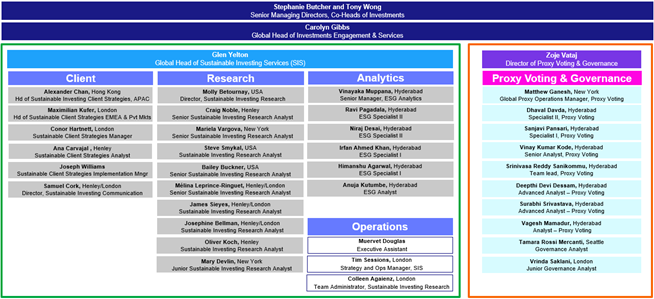
Source: Invesco as of 30 June 2025. For illustrative purposes only.
Each investment team has a unique approach to incorporating sustainable investing considerations, as defined in its investment process and appropriate for the respective asset class. To support this effort, Invesco has dedicated specialists and champions within individual investment teams across the globe. These individuals are closely connected with the SIS team and formally collaborate via the ESG Steering Committee.
Governance oversight structure
Managing risk is an integral part of our investment culture at Invesco, and it starts with the recognition that everyone plays a role in risk management. Built with multiple lines of defense, our risk management approach seeks to ensure that our managers adhere to best practices. The goal is for portfolios to perform as expected and for clients to feel confident in their investment.
Investment teams
We believe the best outcomes are achieved through distinct investment teams across the globe, with discrete investment perspectives, operating under a disciplined philosophy and process. To support the unique needs of each investment team, each one deploys a robust risk management framework that is tailored to its investment process and is owned by its CIO. Each of our teams uses its framework to thoroughly assess the risk and return characteristics of each individual security and carefully calibrates the overall risk level of the portfolio when these investments are combined. Teams incorporate environmental, social, or governance related considerations where relevant or required to achieve portfolio objectives. Investment team leaders have responsibility for overseeing the implementation of investment strategies including those with ESG related objectives or incorporating ESG factors.
Multiple groups within Invesco
At each step in the process, the investment teams are provided with global expertise and support that enhances their risk management efforts. The following groups provide oversight of the investment teams to make sure they are operating within best practices as well as their stated objectives:
- Investment Risk Management is responsible for identifying, measuring, and monitoring appropriate portfolio risks to ensure that each portfolio is managed as intended
- Global Performance delivers customized portfolio performance analysis and attribution reporting that facilitates the Investment Risk evaluation of whether ex-post performance results are aligned with ex-ante risk expectations
- Global Compliance monitors pre- and post-trade compliance and performs other fiduciary assurance functions
- Other governance structures that assure best practices include the Global Trade Operations Committee, the New Instrument Committee, the Pricing Committee and the Proxy Committee
Senior leaders, independent boards and audit teams
Oversight is critical. The following groups provide a high-level review of the entire process:
- The Invesco Performance and Risk Committeeis composed of senior leaders who review risk and performance issues and monitor progress against the firm-wide strategic priority of achieving strong investment performance.
- Internal Audit provides end-to-end process review to identify any control gaps and execution challenges.
Given the importance that Invesco places on ESG at an investment level, Invesco has a governance structure across multiple dimensions, which enables oversight and accountability for effective stewardship.
Invesco’s Sustainable Investing Services Team acts as a global resource, responsible for investment team support and analysis related to ESG risks and opportunities, voting and engagement, supporting the distribution teams with client engagement, and advising product teams on ESG innovation, while investment teams maintain discretion on portfolio decisions. The team comprises professionals located across three regions: North America, Asia Pacific and EMEA. The team is organized across four pillars that define their major responsibilities: Client, Research, Proxy and Analytics.
The ESG Executive Steering Committee (ESG Executive Steerco) establishes strategic direction for and implementation of ESG related investment management initiatives at Invesco. The Committee is composed of representatives from Investments, Distribution, and many functional areas. It provides direction for resource allocation and operational implementation while facilitating communication across the firm. The Committee aids in fostering global collaboration on ESG issues, enabling us to benefit from diverse perspectives and maintain consistent standards. Alongside various cross-functional working groups, it encapsulates our inclusive approach to ESG, ensuring a purposeful, holistic strategy that aligns with client objectives.
We have created a variety of working groups across the organization in support of delivering ESG related investment capabilities. Some groups are tasked with delivering on a specific initiative or facilitating collaboration across an asset class or region. Others are designed for providing broad communication about current themes or regulation, tools or resources such as data, or they focus on evergreen priorities including proxy voting.
Invesco's Global Invesco Proxy Advisory Committee is guided by our philosophy that investment teams should manage proxy voting. It is a global investments-driven committee comprised of representatives from various investment management teams and chaired by the Director of Proxy Voting and Governance. The committee provides a forum for investment teams to monitor, understand and discuss key proxy issues and voting trends within the Invesco complex, to assist us in meeting regulatory obligations, and to consider conflicts of interest in the proxy voting process.
Assurance
Internal Audit prepares a risk-based audit plan at least semi-annually based on its assessment of the risks presented by various activities within the firm. The Department begins by determining and closely examining the universe of Invesco’s functional areas and entities, engaging in discussions with responsible parties and various assurance functions, reviewing market and industry developments, reviewing discussion topics raised by risk management committees, and considering regulatory expectations.
Each item in the universe is given a ranking of Critical, Major, Moderate or Minor risk that accounts for both the likelihood a particular risk event could occur and the associated impact to the organization. Determination of the appropriate risk ratings involves an evaluation of many factors including but not limited to: Financial, Legal/Regulatory, Reputational, Operational, Customer or Client, and Market Detriment impacts.
During this process, other assurance reviews are also considered. Internal Audit uses the overall risk assessment scores noted above, along with the regulatory requirements, guidance and feedback from the Audit Committee and senior management, to preliminarily assess whether a process should be considered for inclusion in the audit plan. Based on the result of risk assessment, ESG related matters may be identified for audit coverage as part of the audit plan
Additionally, the Global Compliance department's annual testing plan seeks to assess compliance in key risk areas, avoiding duplication of testing and considering other control reviews, including internal audits. Our Compliance Monitoring team seeks to apply testing standards consistent with regulatory expectations in each region in which Invesco operates, and reports findings to senior management of Compliance and other impacted business functions. For example, in 2020 the Compliance Monitoring team conducted an advisory review of proxy voting in North America. The purpose of this review was to provide guidance and recommendations around the region's proxy voting process, to evaluate whether policies and procedures were reasonably designed and to determine how effectively the controls in place comply with regulations.
Membership of other ESG/RI associations
Invesco is an active member and supporter of several external organisations, largely via our global investment teams. Following is a representative list of current affiliations.
A member of:
- 30% Club Japan Investors Group
- Asian Corporate Governance Association (ACGA)
- Asia Investor Group on Climate Change (AIGCC)
- Better Building Partnership (BBP)
- Carbon Disclosure Project
- Climate Bonds Initiative
- Corporate Responsibility Interface Center (CRIC) (DACH countries)
- Council of Institutional Investors (CII) (US)
- Farm Animal Investment Risk & Return Initiative (FAIRR)
- Global Real Estate Sustainability Benchmark (GRESB)
- EFAMA Sustainable Finance Committee
- ESG Disclosure Study Group (Japan)
- Hong Kong Green Finance Association (HKGFA)
- IFRS Advisory Council (oversees ISSB – successor to SASB)
- Investment Company Institute (ICI) (ICI Fund Disclosure Working Group, ICI Global ESG Task Force, and ICI Proxy Issues Working Group)
- Investment Association (UK)
- Investor Forum (UK)
- Institutional Investors Group on Climate Change (IIGCC), including Net Zero Investment Framework working group
- Investment Management Education Alliance (IMEA)
- Ireland Central Bank group (Invesco Investment Management Limited)
- Irish Funds ESG Legal committee
- One Planet Asset Managers
- Quoted Companies Alliance (QCA)
- Responsible Investment Association (RIA) (Canada)
- Responsible Investment Association Australasia (RIAA)
- Task force on Climate-Related Financial Disclosures (TCFD) (Supporter and Discloser), TCFD Consortium
- Transition Pathway Initiative
- Task force on Nature-Related Financial Disclosures’ (TNFD) Forum
- UK Sustainable Investment and Finance Association (UKSIF)
A signatory to:
- Principles for Responsible Investment (PRI)
- EFAMA Stewardship Code
- Indian Stewardship Code
- Japan’s Stewardship Code
- UK Stewardship Code
- Net Zero Asset Managers Initiative
Additionally, GRESB provides the basis for the reporting, scoring and peer ranking of Invesco Real Estate's (IRE’s) ESG management and policies:
- IRE has submitted data to GRESB since 2012 and has been a GRESB member since 2014.
- In 2024, six IRE-managed strategies achieved five out of five Green Stars, placing them in the top 20% of all global submissions in 2024.
Source: Invesco as at 30 June 2025.
Invesco is committed to adopting and implementing responsible investment principles in a manner that is consistent with its fiduciary responsibilities to clients. We have a client-centric approach to responsible investing which focuses on customising solutions to client needs and objectives. Therefore, we do not apply a single, top-down, firm-wide responsible investing policy or process, instead, our investment teams implement policies or processes tailored to their asset classes, investment styles and client objectives. Where appropriate, sustainable and responsible investing policies are applied on a product-by-product basis in alignment with regional regulatory or client requirements.
We believe this approach is better than a one-size-fits-all methodology and allows us to provide a range of sustainable investing capabilities that support our clients in meeting their various objectives.
While we do not have a specific firm-wide responsible investing policy in the strictest definition, we do have a number of sustainability-related policies, statements and reports at the firm level which in aggregate lay out a high-level vision for responsible investing. These are listed below.
- Investment Stewardship Report outlines Invesco's accomplishments, reaffirming our commitment to global stewardship and detailing how our endeavours reinforce this core mission.
- Invesco’s Policy Statement on Global Corporate Governance and Proxy Voting describes Invesco's commitment to responsible investing and proxy voting, as well as the good governance principles that inform our approach to engagement and voting at shareholder meetings.
Invesco's Task Force on Climate Related Financial Disclosures (TCFD) Report seeks to build on our past experience and provide a comparable, investor-relevant disclosure on our activities and capabilities in climate-aware investing.
SDR Labelling:
Not eligible to use label (out of scope)
Key Performance Indicators:
The Investment objective is to track the FTSE All Share ex Investment Trusts ESG Climate Select Index.
The index excludes:
- Companies deemed to be UNGC non-compliant
- Companies involved in controversial weapons, military contracting, small arms, oil sands, Arctic Oil & Gas Exploration, Thermal coal, Nuclear Power, Tobacco, Recreational cannabis, adult entertainment, gambling.
The index targets a minimum:
- ESG uplift of 10%
- Operational Carbon Emissions Intensity reduction of 50%
- Fossil Fuel Reserves reduction of 50%
- Green Revenues increase of 50%
The index tilts exposure to companies with a high ESG rating and Green Revenue focus, tilts away from those with high carbon emissions or fossil fuel reserves.
Literature
Voting Record
Disclaimer
Investment risks
The value of investments and any income will fluctuate (this may partly be the result of exchange rate fluctuations) and investors may not get back the full amount invested.
The use of ESG criteria may affect the Fund’s investment performance and therefore may perform differently compared to similar products that do not screen investment opportunities against ESG criteria.
The issuers of the debt securities to which the product is exposed may not always make interest and other payments due to financial difficulties or insolvency. The value of the debt securities may fall due to poor market conditions, such as a decrease in market liquidity, and/or variations in interest rates. These risks increase where the product invests in high yield, or lower credit quality, bonds.
The product may be exposed to securities of emerging and developing markets, where difficulties in relation to market liquidity, dealing, settlement and custody problems could arise which could result in losses.
The product's use of financial derivatives may result in the product being leveraged, that is, the economic exposure created by using a derivative may be greater than the amount invested. The product, therefore, has the potential to lose more than it paid. If a counterparty becomes insolvent this will also result in a loss. The use of certain derivatives may also impair the product’s liquidity which may mean the product has to close positions at an unfavourable price.
Important information
This marketing communication is for Professional Clients only.
Data as at 31 August 2025, unless otherwise stated.
This is marketing material and not financial advice. It is not intended as a recommendation to buy or sell any particular asset class, security or strategy. Regulatory requirements that require impartiality of investment/investment strategy recommendations are therefore not applicable nor are any prohibitions to trade before publication.
Views and opinions are based on current market conditions and are subject to change.
Telephone calls may be recorded.
For the most up to date information on our funds, please refer to the relevant fund and share class-specific [Key Investor Information Documents/Key Information Documents], the Supplementary Information Document, the ICVC ISA Terms and Conditions, the financial reports and the Prospectus, which are available using the contact details shown. For details of fund specific risks, please refer to the relevant [Key Investor Information Documents/Key Information Documents].
The Fund does not have a UK sustainability investment label because it does not meet the criteria set by the FCA’s Sustainability Disclosure Requirements. These labels are designed to help investors identify products with specific sustainability goals.
Issued by: Invesco Fund Managers Limited, Perpetual Park, Perpetual Park Drive, Henley-on-Thames, Oxfordshire RG9 1HH, UK. Authorised and regulated by the Financial Conduct Authority.
| Fund Name | SRI Style | SDR Labelling | Product | Region | Asset Type | Launch Date | Last Amended |
|
|---|---|---|---|---|---|---|---|---|
Invesco FTSE All Share Screened & Tilted UCITS ETF |
Unclassified | Not eligible to use label (out of scope) | ETF | UK | Passive / Index | 10/03/2021 | Sep 2025 | |
ObjectivesThe Invesco FTSE All Share Screened & Tilted UCITS ETF aims to deliver the net total return of the FTSE All Share ex Investment Trusts ESG Climate Select Index, minus fees. The Index tracks large- and mid-cap UK companies, re-weighted based on ESG metrics to favour firms with strong ESG profiles, higher green revenue, and lower carbon emissions and fossil fuel reserves. It excludes companies with severe ESG controversies or involvement in activities such as Arctic oil and gas, adult entertainment, controversial weapons, gambling, nuclear power, thermal coal, and tobacco. Firms with an S&P Governance Score below five are also excluded. Securities must meet liquidity and tradability criteria. The fund seeks to replicate the Index by holding all its securities in their respective weights and rebalances in line with the Index. This ETF is passively managed. |
Fund/Portfolio Size: £56.49m (as at: 30/11/2025) Total Screened Themed SRI Assets: £99303.10m (as at: 30/06/2025) Total Responsible Ownership Assets: £99303.10m (as at: 30/06/2025) Total Assets Under Management: £2001384.50m (as at: 30/06/2025) ISIN: IE00BN7J5Z03, IE0003RA2ZR3 Contact Us: InvescoEMEARFPteam@invesco.com |
|||||||
Sustainable, Responsible &/or ESG OverviewThe environmental and social characteristics promoted by the Fund are to gain exposure to issuers demonstrating a robust ESG profile. The Fund also aims to gain increased exposure to issuers generating revenue from green projects, and those that exhibit lower levels of carbon emissions and fossil fuel reserves, relative to the companies that comprise the Parent Index. The Fund achieves this by tracking the Reference Index, which has a methodology that is consistent with attaining the environmental and social characteristics promoted by the Fund. The environmental and/or social characteristics are achieved by applying the Index Provider’s exclusion criteria to the Parent Index and by applying re-weighting factors to the remaining eligible securities such that, relative to the Parent Index, the Index achieves an uplift in its ESG rating, increased exposure to revenue generated by green projects, and a reduction in its weighted average carbon emissions and fossil fuel reserve intensity. |
||||||||
|
Primary fund last amended: Sep 2025 |
||||||||
|
Information received directly from Fund Manager |
||||||||
|
Please select what you would like to read:
Fund FiltersSustainability - General
Sustainability focus
Has a significant focus on sustainability issues
UN Global Compact linked exclusion policy
Use the UN Global Compact to inform or help direct where they can or cannot invest. Will typically not invest in companies with significant breaches (low standards) - strategies vary. (The UNGC covers a wide range of issues - search 'UNGC'). See https://unglobalcompact.org/ Environmental - General
Limits exposure to carbon intensive industries
Options that limit or 'reduce' their exposure to carbon intensive industries (ie sectors which are major contributors to climate change). Strategies vary.
Favours cleaner, greener companies
Aims to invest in companies with strong or market leading environmental policies and practices. Strategies vary. See individual entry information for more detail. Climate Change & Energy
Climate change / greenhouse gas emissions policy
Has policies (documented strategies that explain their position) on climate change related issues such as greenhouse gas/carbon emissions, net zero, transitioning to lower carbon. Strategies vary.
Coal, oil & / or gas majors excluded
Avoid investment in major coal, oil and/or gas (extraction) companies. Strategies vary.
Fracking & tar sands excluded
Avoid companies involved in fracking and tar sands - which are widely regarded as controversial methods of oil and gas extraction. Strategies vary.
Arctic drilling exclusion
Avoid companies that are involved in extracting oil from the Arctic regions.
Fossil fuel reserves exclusion
Avoid investing in companies / assets with coal, oil and gas reserves. See individual entry information for further details.
Nuclear exclusion policy
Has a policy which describes the avoidance or limited investment in the nuclear industry. Strategies vary.
Fossil fuel exploration exclusion – indirect involvement
Excludes companies / assets with indirect involvement in fossil fuel exploration. This may relate to providers of finance and / or insurance and providers of other services. Social / Employment
Social policy
Has policies which set out their approach to social issues (e.g. human rights, labour standards, equal opportunities, child labour and/or adherence to internationally recognised codes such as the UN Global Compact). Strategies with social policies typically avoid companies with low standards and/or work to encourage higher standards. See fund information for detail.
Labour standards policy
Has a labour standards policy - likely to mean they will invest in / favour companies that have higher employment related standards and avoid those with low standards. Strategies vary. See eg https://www.ilo.org/international-labour-standards
Mining exclusion
All mining companies excluded Ethical Values Led Exclusions
Tobacco & related product manufacturers excluded
Companies are excluded if they are involved in any aspect of the production chain for tobacco products, including cigarettes, vaping, e-cigarettes, chewing tobacco and cigars.
Tobacco & related products - avoid where revenue > 5%
Companies are excluded if they make more than 5% of their revenue from the manufacture, sale or distribution of tobacco products including cigarettes, vaping, e-cigarettes, chewing tobacco and cigars.
Controversial weapons exclusion
Excludes companies which make controversial weapons such as landmines, cluster munitions and chemical weapons.
Armaments manufacturers avoided
Avoids companies that manufacture weapons intended specifically for military use. Strategies vary - may or may not include non-strategic military products.
Civilian firearms production exclusion
Has a written civilian firearms exclusion policy - meaning that they will not invest in companies that make (or perhaps also sell) handguns made for non-military users.
Gambling avoidance policy
Avoids companies with significant involvement in the gambling industry. Some may allow a small proportion of revenues to come from this area.
Pornography avoidance policy
Avoids companies that derive significant income from pornography and related areas. Strategies vary. Human Rights
Human rights policy
Has policies relating to human rights issues. Typically require companies to demonstrate higher standards, although some managers work to encourage improvements. Investee companies are often judged against internationally agreed norms or standards. Strategies vary.
Child labour exclusion
Has policies to avoid companies that employ children. Gilts & Sovereigns
Does not invest in sovereigns
Does not invest in / excludes 'sovereigns' - debt issued by governments. See eg https://www.investopedia.com/terms/s/sovereign-debt.asp Banking & Financials
Invests in banks
Can include banks as part of their holdings / portfolio.
Exclude banks with significant fossil fuel investments
Avoids banks that have a large part of their loan book (or other assets) invested in fossil fuels companies - particular coal, oil and gas.
Invests in insurers
May invest in insurance companies. Governance & Management
Governance policy
Has policies that relate to corporate governance issues such as board structure, executive remuneration, bribery and/or corporate corruption. These funds will typically avoid companies with poor practices. Strategies vary.
Avoids companies with poor governance
Avoids investing in companies with poor governance practices.(e.g. board structure, management practices etc.) Views may however vary on what counts as 'poor' practices - and funds may not immediately divest as they may prefer to work to encourage higher standards.
UN sanctions exclusion
Exclude companies that are subject to United Nations sanctions. See eg https://main.un.org/securitycouncil/en/content/un-sc-consolidated-list
Anti-bribery & corruption policy
Has policies explaining how managers will respond to assets / companies that do not comply with relevant anti-bribery and anti-corruption standards or laws. Strategies vary; options include stewardship/ engagement and divestment - or a combination. Product / Service Governance
ESG integration strategy
Find fund / asset managers that factor in 'environmental, social and governance' issues as part of their investment decision making process. A focus on 'ESG' typically means a fund is carrying out additional research to help reduce ESG related risks. It does not necessarily mean a focus on sustainability. Strategies vary. See fund literature. Asset Size
Invests mostly in large cap companies / assets
Invests mainly in larger companies / assets. (e.g. over circa £5-£10bn) How The Fund/Portfolio Works
Negative selection bias
Has principle 'ethical approach' to avoid companies by using negative screening criteria. Strategies vary.
ESG weighted / tilt
Invest more heavily in assets which have higher ESG ratings/standards or scores and less heavily in companies with lower ESG ratings. Where this is central to the strategy you should expect assets in most sectors. Strategies vary.
Data led strategy
Makes stock selection (and ongoing management) decisions based on ESG data or company ratings (normally supplied by third parties) rather than focusing on what individual companies do, how they operate or their plans for the future
Passive / index driven strategy
Only uses an investment index to direct where they can invest. Fund strategies and indices vary.
Significant harm exclusion
Aims to avoid companies that do significant harm. This originates from the EU’s sustainable finance ‘DNSH’ (do no significant harm) work, which is not necessarily used by UK investors.
Combines norms based exclusions with other SRI criteria
Investment selection process uses internationally agreed 'norms' (e.g. United Nations Global Compact - UNGC - or the UN Sustainable Development Goals - SDGs) alongside additional SRI criteria such as positive or negative stock selection policies and/or stewardship strategies.
Combines ESG strategy with other SRI criteria
Invests in assets which have an ESG strategy (which is typically focused on avoiding companies that pose environmental, social or governance related risks) together with additional criteria such as positive and/or negative screens, themes and stewardship strategies.
Use stock / securities lending
Uses specialist strategies to aid performance which involve ‘lending’ assets to others at specific points in time. Unscreened Assets & Cash
Assets typically aligned to sustainability objectives 70 - 79%
Holds between 70-79% of assets which align to the sustainability objectives; which are not being held purely for risk management purposes, such as derivatives and cash equivalent assets.
Assets typically aligned to sustainability objectives 80 – 89%
Holds between 80-89% of assets which align to the sustainability objectives; which are not being held purely for risk management purposes, such as derivatives and cash equivalent assets.
Assets typically aligned to sustainability objectives > 90%
Holds at least 90% of assets which align to the sustainability objectives; which are not being held purely for risk management purposes, such as derivatives and cash equivalent assets. Intended Clients & Product Options
Intended for clients interested in sustainability
Designed to meet the needs of individual investors with an interest in sustainability issues. Labels & Accreditations
SFDR Article 8 fund / product (EU)
Find options classified under Article 8 of the EU’s SFDR (Sustainable Finance Disclosure Requirements). Article 8 of the SFDR is a set of requirements that apply to financial products that 'promote' environmental or social characteristics together with high governance. These rules do not currently apply to UK products so many managers may leave this field blank. Sustainable, Responsible &/or ESG Policy:In order to achieve the investment objective, the Fund employs a replication method that looks to invest as far as possible and practicable in the constituents of the Reference Index. As such, the fund replicates the Sustainable, Responsible &/or ESG Policy embedded in its Reference Index. This Fund promotes environmental and/or social characteristics but does not have as its objective sustainable investment, however the Fund intends to make sustainable investments. The environmental and/or social characteristics promoted by the Fund are to gain exposure to issuers demonstrating a robust ESG profile, i.e. issuers with limited/ no involvement in certain business activities and with no involvement in severe ESG controversies. The Fund also aims to gain increased exposure to those issuers generating revenue from green projects, and those that exhibit lower levels of carbon emissions and fossil fuel reserves, relative to the companies that comprise the FTSE All-Share ex Investment Trusts Index (the “Parent Index”). The Fund achieves this by tracking the Reference Index, which has a methodology that is consistent with attaining the environmental and social characteristics promoted by the Fund. Through a combination of the exclusion criteria detailed in the methodology of the Reference Index and the qualitative assessment and/or engagement of Invesco’s ESG team, it is ensured that investee companies follow good governance practices. The Fund takes into account the PAI indicators defined in Table 1 of Annex I of the RTS and ensures alignment with the OECD guidelines and UNGP, thereby ensuring that the sustainable investments do not cause any significant harm to environmental and/or social objectives. A minimum of 90% of the Fund’s NAV will be selected according to the binding elements of the investment strategy. Up to 10% of the Fund’s NAV may not be aligned with the environmental and/or social characteristics of the Fund, this portion of the Fund may be invested in financial derivative instruments for hedging and/or efficient portfolio management purposes and cash for ancillary liquidity purposes. A minimum of 10% of the Fund’s NAV will be in sustainable investments. Process:The Fund’s objective is to achieve the net total return performance of the Reference Index, less fees, expenses and transaction costs. In order to achieve the investment objective, the Fund will employ a replication method that looks to invest as far as possible and practicable in the constituents of the Reference Index. The Fund intends to replicate the Reference Index by holding all of its constituent securities in a similar proportion to their weightings in the Reference Index. The Index methodology of the Reference Index applies exclusion criteria to the FTSE All-Share ex Investment Trusts Index (the “Parent Index”) to exclude securities that:
The Reference Index then applies a target exposure approach that assigns re-weighting factors to each of the remaining eligible securities. These factors are determined such that the Reference Index targets as near as possible:
The Reference Index is subject to the following constraints when applying the target exposure approach: 1) at each quarterly rebalance the two-way turnover (i.e. the sum of the individual weighting changes across all index constituents) of the Reference Index will not exceed 10%, unless it is not possible for the resultant target exposures, detailed above, to be achieved without a significant deviation from the targeted level for each, in which case this turnover constraint is relaxed in stages, whereby it is first set to 15% and then removed entirely if no feasible solution can be found. This process is set out in detail in the index methodology linked herein; 2) to limit industry divergence, aggregate Industry Classification Benchmark (“ICB”) industry weightings will not deviate by more than 2% from those in the Parent Index; 3) the weight of each individual constituent will not deviate by more than 3% from its weight in the Parent Index and will not exceed its weight in the Parent Index multiplied by a factor of five; and 4) the weight of each individual constituent will be capped at 7.5% and a floor of 0.05% will be applied such that eligible constituents with weights below the floor are removed. These conditions mean that any constituent with a weight in the Parent Index of less than 3% could be completely removed from the Reference Index.
The index methodology of the Reference Index includes good governance criteria whereby companies are assessed against indicators such as sound management structures, employee relations, remuneration of staff and tax compliance. Companies that are deemed not to meet good governance practices according to the methodology of the Reference Index will be excluded. In addition to the assessment of good governance practices of companies by the index provider, the Investment Manager also implements a review of the constituents of the Reference Index at each rebalance to identify any gaps from a data coverage perspective in the methodology of the Reference Index. In the unlikely event that a company is not assessed in relation to good governance practices by the index provider, the Investment Manager and Invesco’s ESG team implements an internal process to review publicly available data and perform checks against UN Global Compact principles to verify that those companies follow good governance practices. Resources, Affiliations & Corporate Strategies:Created in 2013, Invesco’s dedicated Sustainable Investing Services (SIS) team and the Proxy Voting team are responsible for leveraging best practices globally in sustainable investing capabilities across Invesco including ESG integration, voting and engagement, supporting distribution teams with client engagement, and advising product teams on sustainability innovation. Our Global SIS and Proxy Voting teams act as a centralised resource to guide, support and inform Invesco's investment teams on all work in this area. The teams are organized across five pillars:
The combined SIS and proxy Voting teams includes 36 ESG professionals (as at 30 June 2025) located in North America, Asia Pacific, and EMEA who provide localized support and analysis to our investment teams across the globe. Our sustainable investing services professionals collaborate closely with these investment teams, providing support, insights and analysis while investment teams maintain discretion on portfolio decisions. Our governance structure enables oversight and accountability through the ESG Steering Committee, while allowing our investment teams to integrate sustainable investing approaches tailored to their asset classes and styles. As shown in the following organizational chart, the combined team comprises five pillars to support sustainable investing efforts across specific functions firm-wide. The team's geographic structure also ensures that most Invesco teams have an appropriate local contact. The ESG Steering Committee, asset class-specific investment teams, and firm-wide functional units also collaborate with SIS team members from each of the five pillars.
Source: Invesco as of 30 June 2025. For illustrative purposes only. Each investment team has a unique approach to incorporating sustainable investing considerations, as defined in its investment process and appropriate for the respective asset class. To support this effort, Invesco has dedicated specialists and champions within individual investment teams across the globe. These individuals are closely connected with the SIS team and formally collaborate via the ESG Steering Committee. Governance oversight structure Managing risk is an integral part of our investment culture at Invesco, and it starts with the recognition that everyone plays a role in risk management. Built with multiple lines of defense, our risk management approach seeks to ensure that our managers adhere to best practices. The goal is for portfolios to perform as expected and for clients to feel confident in their investment. Investment teams We believe the best outcomes are achieved through distinct investment teams across the globe, with discrete investment perspectives, operating under a disciplined philosophy and process. To support the unique needs of each investment team, each one deploys a robust risk management framework that is tailored to its investment process and is owned by its CIO. Each of our teams uses its framework to thoroughly assess the risk and return characteristics of each individual security and carefully calibrates the overall risk level of the portfolio when these investments are combined. Teams incorporate environmental, social, or governance related considerations where relevant or required to achieve portfolio objectives. Investment team leaders have responsibility for overseeing the implementation of investment strategies including those with ESG related objectives or incorporating ESG factors. Multiple groups within Invesco At each step in the process, the investment teams are provided with global expertise and support that enhances their risk management efforts. The following groups provide oversight of the investment teams to make sure they are operating within best practices as well as their stated objectives:
Senior leaders, independent boards and audit teams Oversight is critical. The following groups provide a high-level review of the entire process:
Given the importance that Invesco places on ESG at an investment level, Invesco has a governance structure across multiple dimensions, which enables oversight and accountability for effective stewardship. Invesco’s Sustainable Investing Services Team acts as a global resource, responsible for investment team support and analysis related to ESG risks and opportunities, voting and engagement, supporting the distribution teams with client engagement, and advising product teams on ESG innovation, while investment teams maintain discretion on portfolio decisions. The team comprises professionals located across three regions: North America, Asia Pacific and EMEA. The team is organized across four pillars that define their major responsibilities: Client, Research, Proxy and Analytics. The ESG Executive Steering Committee (ESG Executive Steerco) establishes strategic direction for and implementation of ESG related investment management initiatives at Invesco. The Committee is composed of representatives from Investments, Distribution, and many functional areas. It provides direction for resource allocation and operational implementation while facilitating communication across the firm. The Committee aids in fostering global collaboration on ESG issues, enabling us to benefit from diverse perspectives and maintain consistent standards. Alongside various cross-functional working groups, it encapsulates our inclusive approach to ESG, ensuring a purposeful, holistic strategy that aligns with client objectives. We have created a variety of working groups across the organization in support of delivering ESG related investment capabilities. Some groups are tasked with delivering on a specific initiative or facilitating collaboration across an asset class or region. Others are designed for providing broad communication about current themes or regulation, tools or resources such as data, or they focus on evergreen priorities including proxy voting. Invesco's Global Invesco Proxy Advisory Committee is guided by our philosophy that investment teams should manage proxy voting. It is a global investments-driven committee comprised of representatives from various investment management teams and chaired by the Director of Proxy Voting and Governance. The committee provides a forum for investment teams to monitor, understand and discuss key proxy issues and voting trends within the Invesco complex, to assist us in meeting regulatory obligations, and to consider conflicts of interest in the proxy voting process. Assurance Internal Audit prepares a risk-based audit plan at least semi-annually based on its assessment of the risks presented by various activities within the firm. The Department begins by determining and closely examining the universe of Invesco’s functional areas and entities, engaging in discussions with responsible parties and various assurance functions, reviewing market and industry developments, reviewing discussion topics raised by risk management committees, and considering regulatory expectations. Additionally, the Global Compliance department's annual testing plan seeks to assess compliance in key risk areas, avoiding duplication of testing and considering other control reviews, including internal audits. Our Compliance Monitoring team seeks to apply testing standards consistent with regulatory expectations in each region in which Invesco operates, and reports findings to senior management of Compliance and other impacted business functions. For example, in 2020 the Compliance Monitoring team conducted an advisory review of proxy voting in North America. The purpose of this review was to provide guidance and recommendations around the region's proxy voting process, to evaluate whether policies and procedures were reasonably designed and to determine how effectively the controls in place comply with regulations. Membership of other ESG/RI associations Invesco is an active member and supporter of several external organisations, largely via our global investment teams. Following is a representative list of current affiliations. A member of:
A signatory to:
Additionally, GRESB provides the basis for the reporting, scoring and peer ranking of Invesco Real Estate's (IRE’s) ESG management and policies:
Source: Invesco as at 30 June 2025. Invesco is committed to adopting and implementing responsible investment principles in a manner that is consistent with its fiduciary responsibilities to clients. We have a client-centric approach to responsible investing which focuses on customising solutions to client needs and objectives. Therefore, we do not apply a single, top-down, firm-wide responsible investing policy or process, instead, our investment teams implement policies or processes tailored to their asset classes, investment styles and client objectives. Where appropriate, sustainable and responsible investing policies are applied on a product-by-product basis in alignment with regional regulatory or client requirements.
Invesco's Task Force on Climate Related Financial Disclosures (TCFD) Report seeks to build on our past experience and provide a comparable, investor-relevant disclosure on our activities and capabilities in climate-aware investing. SDR Labelling:Not eligible to use label (out of scope) Key Performance Indicators:
The Investment objective is to track the FTSE All Share ex Investment Trusts ESG Climate Select Index. The index excludes:
The index targets a minimum:
The index tilts exposure to companies with a high ESG rating and Green Revenue focus, tilts away from those with high carbon emissions or fossil fuel reserves. LiteratureVoting RecordDisclaimerInvestment risks The value of investments and any income will fluctuate (this may partly be the result of exchange rate fluctuations) and investors may not get back the full amount invested. The use of ESG criteria may affect the Fund’s investment performance and therefore may perform differently compared to similar products that do not screen investment opportunities against ESG criteria. The issuers of the debt securities to which the product is exposed may not always make interest and other payments due to financial difficulties or insolvency. The value of the debt securities may fall due to poor market conditions, such as a decrease in market liquidity, and/or variations in interest rates. These risks increase where the product invests in high yield, or lower credit quality, bonds. The product may be exposed to securities of emerging and developing markets, where difficulties in relation to market liquidity, dealing, settlement and custody problems could arise which could result in losses. The product's use of financial derivatives may result in the product being leveraged, that is, the economic exposure created by using a derivative may be greater than the amount invested. The product, therefore, has the potential to lose more than it paid. If a counterparty becomes insolvent this will also result in a loss. The use of certain derivatives may also impair the product’s liquidity which may mean the product has to close positions at an unfavourable price. Important information This marketing communication is for Professional Clients only. Data as at 31 August 2025, unless otherwise stated. This is marketing material and not financial advice. It is not intended as a recommendation to buy or sell any particular asset class, security or strategy. Regulatory requirements that require impartiality of investment/investment strategy recommendations are therefore not applicable nor are any prohibitions to trade before publication. Views and opinions are based on current market conditions and are subject to change. Telephone calls may be recorded. For the most up to date information on our funds, please refer to the relevant fund and share class-specific [Key Investor Information Documents/Key Information Documents], the Supplementary Information Document, the ICVC ISA Terms and Conditions, the financial reports and the Prospectus, which are available using the contact details shown. For details of fund specific risks, please refer to the relevant [Key Investor Information Documents/Key Information Documents]. The Fund does not have a UK sustainability investment label because it does not meet the criteria set by the FCA’s Sustainability Disclosure Requirements. These labels are designed to help investors identify products with specific sustainability goals. Issued by: Invesco Fund Managers Limited, Perpetual Park, Perpetual Park Drive, Henley-on-Thames, Oxfordshire RG9 1HH, UK. Authorised and regulated by the Financial Conduct Authority. |
||||||||