EdenTree Green Impact Infrastructure Fund
SRI Style:
Environmental Style
SDR Labelling:
Sustainability Impact label
Product:
OEIC
Fund Region:
Global
Fund Asset Type:
Infrastructure
Launch Date:
28/09/2022
Last Amended:
May 2026
Dialshifter ( ):
):
Fund/Portfolio Size:
£29.94m
(as at: 31/03/2026)
Total Screened Themed SRI Assets:
£1582.35m
(as at: 31/03/2026)
Total Responsible Ownership Assets:
£1116.17m
(as at: 31/03/2026)
Total Assets Under Management:
£2698.52m
(as at: 31/03/2026)
ISIN:
GB00BNG5Z717, GB00BNG5ZH11, GB00BNG5ZG04, GB00BQMRSF18
Contact Us:
Objectives:
Financial Objective
To generate income with the potential for capital growth by investing in infrastructure-related companies around the globe.
Sustainability Objective
To support a reduction in the level of greenhouse gas emissions, measured in tonnes of CO2e avoided on an annual basis, through the Fund’s investment in, and engagement with companies whose business is based on the ownership, operation, construction, development, or debt funding of real assets and infrastructure projects that mitigate the effects of climate change.
Sustainable, Responsible
&/or ESG Overview:
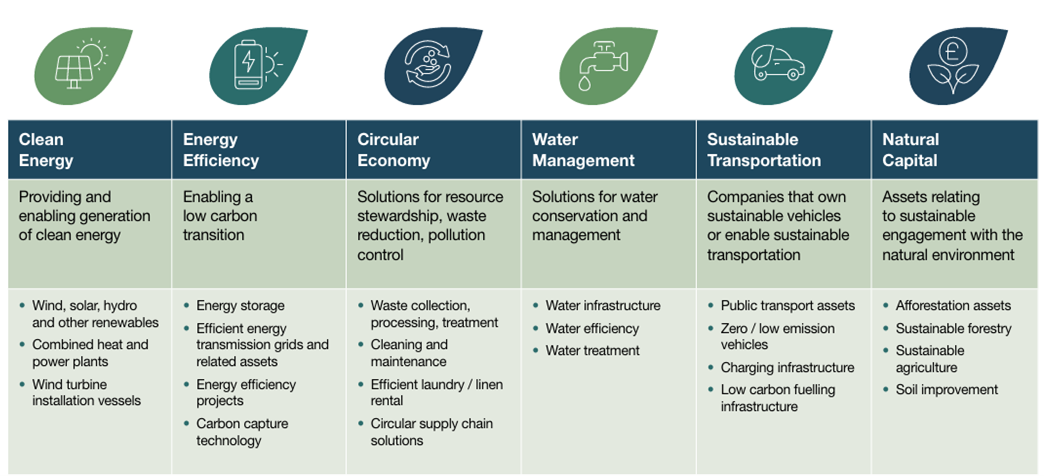
The Fund invests in companies whose products, services or assets enable a reduction in the level of greenhouse gas emissions across six pre-defined themes which offer solutions that address aspects of climate change. How assets are selected is described in the “Asset Contribution: How we select assets” (detailed in next response). The Manager will also engage with companies it invests in to enhance the Investors’ contribution to the Sustainability Objective. This is described further in the “Investor Contribution: Investor Stewardship” (detailed in next response). The table on page no. 42 to 43 of EdenTree Investment Funds Series 2 Prospectus illustrates the solutions provided under each theme (“what”) and how that solution supports the Sustainable Objective and contributes to a reduction in the level of greenhouse gas emissions (“why”). The Fund may not be invested across all of these themes at all times.
Primary fund last amended:
May 2026
Information directly from fund manager.
Fund Filters
Sustainability - General
Has policies that consider (environmental and social) sustainability issues. Strategies vary but are likely to consider environmental issues like climate change, carbon emissions, biodiversity loss, resource management, environmental impacts; and social issues like equal opportunities, human rights, labour standards, diversity and adherence to internationally recognised codes. See individual entry information.
Has a significant focus on sustainability issues
Has documented policies or thematic investment approaches supporting investment in more sustainable, greener transport methods. These will typically set out a preference for companies that run, enable or support more sustainable methods of transport.
Aim to encourage higher sustainability standards through responsible ownership / stewardship / engagement / voting activity
Use the UN Global Compact to inform or help direct where they can or cannot invest. Will typically not invest in companies with significant breaches (low standards) - strategies vary. (The UNGC covers a wide range of issues - search 'UNGC'). See https://unglobalcompact.org/
Aim to support the shift to a sustainable future. See eg https://www.transitionpathwayinitiative.org/
Has a theme or investment strand focused on the shift to a circular economy - where products are reused and recycled not incinerated or dumped. See eg https://www.ellenmacarthurfoundation.org/topics/circular-economy-introduction/overview
Environmental - General
Has policies which relate to environmental issues. These will typically set out their stance on issues such as pollution, climate change, resource management, biodiversity loss, carbon emissions, plastics and/or additional environmental impacts. Strategies vary.
Options that limit or 'reduce' their exposure to carbon intensive industries (ie sectors which are major contributors to climate change). Strategies vary.
Has documented policies explaining the approach to environmental damage and pollution. Strategies vary.
Has a policy or theme that relates to managing natural resources more efficiently. Strategies vary. See individual entry information.
Aims to invest in companies with strong or market leading environmental policies and practices. Strategies vary. See individual entry information for more detail.
Has a written policy or theme focused on waste management - typically to support or encouraging higher levels of recycling and better efficiency / reducing waste. Strategies vary.
Nature & Biodiversity
Has a written biodiversity policy or theme typically aimed at supporting, encouraging and improving environmental protection and safeguarding the natural world (sometimes referred to as 'natural capital'). See eg https://www.un.org/en/climatechange/science/climate-issues/biodiversity
A significant focus on investments that aim to protect, improve and / or restore natural habitat.
Has policies designed to address involvement in irresponsibly managed palm oil or other forms of deforestation (typically exclusion led). Strategies vary.
Avoids assets that are involved in illegal deforestation. This may relate to palm oil, cattle farming or other areas. Strategies vary.
Has a responsible palm oil policy - typically likely to divert investment away from poor practices.
Has a sustainable fisheries policy that will inform where they can and cannot invest.
Aims to avoid investing in companies that produce genetically modified seeds or crops. (This does not typically include avoiding companies such as supermarkets).
Avoids assets / companies directly involved in genetic engineering
Has a policy which sets out their expectations for how investee assets should manage their use of water - likely to focus on high users.
Climate Change & Energy
Has policies (documented strategies that explain their position) on climate change related issues such as greenhouse gas/carbon emissions, net zero, transitioning to lower carbon. Strategies vary.
Avoid investment in major coal, oil and/or gas (extraction) companies. Strategies vary.
Avoid companies involved in fracking and tar sands - which are widely regarded as controversial methods of oil and gas extraction. Strategies vary.
Avoid companies that are involved in extracting oil from the Arctic regions.
Avoid investing in companies / assets with coal, oil and gas reserves. See individual entry information for further details.
Invest (or may invest) in clean / renewable energy companies and other assets. The proportion directly or indirectly invested in renewable energy may vary over time.
Encourage the transition to lower carbon activities through asset selection and / or responsible ownership activity.
Has an energy efficiency theme - typically meaning that the manager is focused on investing in organisations that manage - or help others to manage - energy use more carefully and less wastefully - and so reduce greenhouse gas emissions.
Invest in renewable energy companies and / or companies where renewable energy is a significant part of their business. Strategies vary.
Has a policy which describes the avoidance or limited investment in the nuclear industry. Strategies vary.
Has a supply chain decarbonisation policy which sets out their position on the need to reduce carbon emissions.
Excludes companies and other assets with direct involvement in fossil fuel exploration (eg coal, oil and gas companies)
Aims to ensure holdings will reduce their greenhouse gas emissions in line with targets set at COP21 in Paris. The core aim is to help achieve ‘net zero emissions by 2050’ and a ‘maximum global temperature increase of +1.5 to +2 degrees above preindustrial levels’. Strategies and opinions vary.
Requires all, or most of, the assets they invest in to have a ‘net zero action plan’ - describing how they will reduce their greenhouse gas emissions.
Social / Employment
Has policies which set out their approach to social issues (e.g. human rights, labour standards, equal opportunities, child labour and/or adherence to internationally recognised codes such as the UN Global Compact). Strategies with social policies typically avoid companies with low standards and/or work to encourage higher standards. See fund information for detail.
Has a labour standards policy - likely to mean they will invest in / favour companies that have higher employment related standards and avoid those with low standards. Strategies vary. See eg https://www.ilo.org/international-labour-standards
Aims to invest in assets with high social values - this may include strong human rights, labour standards and equal opportunities or safety related practices.
Has policies or themes that set out their approach to health and wellbeing issues, typically aims to invest in companies with high standards - or encourage high standards.
Has a written diversity policy – where the manager will aim to select companies with a carefully considered, positive employment standards. This may cover a range of issues including gender, ethnicity, disability, beliefs and sexual orientation.
All mining companies excluded
Has a policy aimed at protecting vulnerable workers such as those on zero hour / informal contracts working in the gig economy
Ethical Values Led Exclusions
Companies are excluded if they are involved in any aspect of the production chain for tobacco products, including cigarettes, vaping, e-cigarettes, chewing tobacco and cigars.
Companies are excluded if they make more than 5% of their revenue from the manufacture, sale or distribution of tobacco products including cigarettes, vaping, e-cigarettes, chewing tobacco and cigars.
Excludes companies which make controversial weapons such as landmines, cluster munitions and chemical weapons.
Avoids companies that manufacture weapons intended specifically for military use. Strategies vary - may or may not include non-strategic military products.
Avoids companies with military contracts. This may include medical supplies, food, safety equipment, housing, technology etc
Has a written civilian firearms exclusion policy - meaning that they will not invest in companies that make (or perhaps also sell) handguns made for non-military users.
Avoids companies that produce alcohol. Strategies vary; some may allow a small proportion of revenue to come from this area.
Avoids companies with significant involvement in the gambling industry. Some may allow a small proportion of revenues to come from this area.
Avoids companies that derive significant income from pornography and related areas. Strategies vary.
Has policies that require specific animal welfare standards to be met. These may reference well-known welfare standards (3Rs - Replace, Reduce, Refine) or certification schemes. Strategies vary.
Avoids companies that test their products on animals for purposes other than medical benefit (e.g. for cosmetics). Strategies vary.
Human Rights
Has policies relating to human rights issues. Typically require companies to demonstrate higher standards, although some managers work to encourage improvements. Investee companies are often judged against internationally agreed norms or standards. Strategies vary.
Has policies to avoid companies that employ children.
Has policies that exclude companies or other assets which operate in, or are owned by regimes which are not democratic, or where people may be oppressed. May use eg. Freedom House research. Strategies vary.
Has policies or a theme that relates to the responsible management of supply chains. These may relate to employment issues, notably people employed by their suppliers, as well as the sourcing of materials and products.
Has a policy which excludes assets with involvement in Modern Slavery
Meeting Peoples' Basic Needs
Have policies or themes that set out the position on investment in the water sector and/or sanitation. Strategies vary.
Healthcare and or medical theme or area of investment - may have a single or many themes
Has a policy on ‘antimicrobial resistance’ - which is when organisms that cause infection can survive treatment - which is commonly associated with the overuse of antibiotics in factory farming.
Banking & Financials
Can include banks as part of their holdings / portfolio.
Invest in banks and other financial institutions that implement the Task Force on Climate Related Financial Disclosures recommendations on climate change related financial disclosures - which aim to help financial markets measure and respond to climate risk.
Avoids banks that have a large part of their loan book (or other assets) invested in fossil fuels companies - particular coal, oil and gas.
Avoids investing in insurance companies that insure major fossil fuels companies – particularly coal, oil and gas. Strategies (eg definition of ‘major’) vary.
May invest in insurance companies.
Governance & Management
Has policies that relate to corporate governance issues such as board structure, executive remuneration, bribery and/or corporate corruption. These funds will typically avoid companies with poor practices. Strategies vary.
Avoids investing in companies with poor governance practices.(e.g. board structure, management practices etc.) Views may however vary on what counts as 'poor' practices - and funds may not immediately divest as they may prefer to work to encourage higher standards.
Exclude companies that are subject to United Nations sanctions. See eg https://main.un.org/securitycouncil/en/content/un-sc-consolidated-list
Has policies explaining how managers will respond to assets / companies that do not comply with relevant anti-bribery and anti-corruption standards or laws. Strategies vary; options include stewardship/ engagement and divestment - or a combination.
Encourage the companies they invest in to have more diverse board structures (e.g. more women on boards)
Encourage the banks and insurance companies they invest in to publish climate change related financial information - as set out by the Task Force on Climate Related Financial Disclosures (with the aim of helping investors measure and respond to climate risk).
Aim to encourage higher ESG standards through responsible ownership / stewardship / engagement /voting activity
Requires the companies they invest in to report on climate risks that are relevant to their business in their report and accounts
Product / Service Governance
Find options that have an external committee that helps steer or advise managers on sustainability, ethical, stewardship or ESG policy or strategy related issues. These people may be paid for their time but are not employees of the fund manager.
Find fund / asset managers that factor in 'environmental, social and governance' issues as part of their investment decision making process. A focus on 'ESG' typically means a fund is carrying out additional research to help reduce ESG related risks. It does not necessarily mean a focus on sustainability. Strategies vary. See fund literature.
Environmental, social and governance issues are part of this fund’s reporting of their ‘value’ to clients. AoV reporting is a statutory requirement. Including ESG factors in its calculation is not.
Asset Size
Invests more than half of their money in smaller or medium sized companies. (i.e. below around £5 -10 billion)
Has SRI strategies which focus their investment stock selection on small or mid cap companies / assets. (e.g. below circa £10bn)
Targeted Positive Investments
Invests >25% of their capital in companies where a major part of their business is focused on helping to address environmental or social challenges.
Invests >50% of their capital in companies where a major part of their business is focused on helping to address environmental or social challenges.
Impact Methodologies
Has policies that aim to help or support the delivery of positive social or environmental impacts (or societal/real world outcomes) by investing in companies they regard as beneficial to people and / or the planet. Strategies vary.
Aims to measure the positive real world environmental and / or social benefits that are associated with their investment strategy. Investments that aim to deliver positive impacts and measure those impacts may be referred to as 'Impact' - although impact measurement is not restricted to Impact investments. Strategies vary.
Investments which are specifically marketed as ‘Impact investments' and work to deliver both financial performance and specific, measurable positive, real world social and/or environmental benefits. Strategies vary.
Specifically sets out to help deliver positive environmental impacts, benefits or 'real world' outcomes.
Specifically states that they aim to deliver positive social (i.e. people related) impacts and/or outcomes.
Directs investment towards companies where a major part of their business is about solving environmental challenges. e.g. companies helping to address climate change.
Invest in companies where a major part of their business is specifically aimed at helping to address social challenges. e.g. companies helping to address poverty.
Specifically sets out to invest in companies that are regarded as 'disrupting' existing business practices - typically through the development of innovative (sustainability aware) products and/or practices.
Aims to deliver positive environmental and or social impacts (real world benefits) through its engagement with investee assets
Invests more than 50% of capital in assets which are regarded as being significantly focused on providing solutions to environmental or social challenges. Strategies vary.
Policy explains the ways in which the manager believes things need to change in order to deliver a more sustainable future, which they are working to help achieve.
How The Fund/Portfolio Works
Focuses on finding and investing in companies with positive / beneficial attributes. This strategy can be applied in addition to exclusion criteria and engagement/stewardship activity.
Has principle 'ethical approach' to avoid companies by using negative screening criteria. Strategies vary.
Has principle approach to apply positive or negative ethical, social and / or environmental screens. Strictly screened investments are likely to exclude more companies than other related options. Strategies vary.
Invest more heavily in assets which have higher ESG ratings/standards or scores and less heavily in companies with lower ESG ratings. Where this is central to the strategy you should expect assets in most sectors. Strategies vary.
Aims to avoid companies that do significant harm. This originates from the EU’s sustainable finance ‘DNSH’ (do no significant harm) work, which is not necessarily used by UK investors.
Investment selection process uses internationally agreed 'norms' (e.g. United Nations Global Compact - UNGC - or the UN Sustainable Development Goals - SDGs) alongside additional SRI criteria such as positive or negative stock selection policies and/or stewardship strategies.
Invests in assets which have an ESG strategy (which is typically focused on avoiding companies that pose environmental, social or governance related risks) together with additional criteria such as positive and/or negative screens, themes and stewardship strategies.
Focuses on the careful management of environmental, social and governance (ESG) related risks - typically by avoiding or being underweight in companies seen as posing major risks in these areas (i.e. not necessarily by using themes, exclusions etc).
Publish explanations of their ethical, social and/or environmental policies online (i.e. investment decision making strategies/ buy/sell &/or asset management strategies).
Does not use stock lending for performance or risk purposes.
Unscreened Assets & Cash
Holds between 70-79% of assets which align to the sustainability objectives; which are not being held purely for risk management purposes, such as derivatives and cash equivalent assets.
Holds between 80-89% of assets which align to the sustainability objectives; which are not being held purely for risk management purposes, such as derivatives and cash equivalent assets.
Holds at least 90% of assets which align to the sustainability objectives; which are not being held purely for risk management purposes, such as derivatives and cash equivalent assets.
All assets - except cash - meet the sustainability criteria published in strategy documentation.
Intended Clients & Product Options
Designed to meet the needs of individual investors with an interest in sustainability issues.
Designed for clients who care about ethical and values-based issues, often alongside sustainability issues also.
Designed to meet the needs of individual investors with an interest in ‘Impact investment’ which help or support the delivery of positive social or environmental impacts (or societal/real world outcomes) by investing in companies regarded as beneficial to people and / or the planet. Strategies vary.
Has attributes that commonly suit the aims of investors of faith - although they may not be specifically marketed as being only for religious investors. Strategies vary (as do investor aims).
Available via a tax efficient ISA product wrapper.
Only applicable for DFM’s & portfolio providers. Finds those that offer an SRI / ESG portfolio option
Only applicable for DFM’s & portfolio providers. Find service providers who offer multiple SRI / ESG portfolio options
Only applicable for DFM’s & portfolio providers. Find service providers who offer bespoke ('personalised') SRI / ESG portfolio options
Labels & Accreditations
Find options that have chosen to adopt one of the Financial Conduct Authority (FCA) SDR labels. Please note: there are a range of reasons why potentially relevant options may not use an SDR label eg. adopting a label may be work in progress, the manager may not yet be allowed to do so because of the product type, a manager may feel they are insufficiently aligned to SDR requirements.
A voluntary corporate culture standard for investment managers, see https://www.investorsact.com/ - City Hive
Fund Management Company Information
About The Business
Find fund / asset management companies that are smaller or specialise in particular areas - notably, ideally ESG related. Strategies vary.
Finds fund / asset management companies that have a published company wide stewardship, engagement and / or responsible ownership policy or strategy that covers all investments. Stewardship typically involves encouraging higher ESG standards through voting and dialogue.
Find fund / asset management companies that actively encourage higher 'environmental, social and governance' and / or 'sustainable and responsible investment' practices across investee companies - typically where the aim is to encourage positive change that is aligned with the best interests of investors. Strategies vary. See additional information and options.
Find fund / asset managers that vote all* the shares they own at Annual General Meetings and Extraordinary General Meetings. A commitment to voting shares is a key indicator of 'responsible share ownership' demonstrating their support for or disagreement with management policy. (*situations can legitimately, occasionally occur where voting proves impossible, but in principle all shares should be voted.)
Find fund / asset managers that consider responsible ownership and ESG to be a key differentiator for their business.
Find fund / asset management companies that take sustainability criteria into account when selecting and/or managing all of their property / real estate investments.
The leadership team of this fund / asset manager have performance targets linked to environmental goals.
Find fund / asset management companies that aim to align all their investments (across all funds) to help meet the aims of the UN Sustainable Development Goals.
Find fund / asset management companies that consider environmental, social and governance (ESG) issues when deciding whether or not to invest in a company for all / almost all of their funds and other assets. This is increasingly seen as part of sound risk management.
Finds organisations / fund managers that have an in-house (company wide) diversity improvement programme - meaning that they are working to ensure that within their own businesses they employ people from diverse backgrounds - often typically focused on ethnicity and/or sex.
Find fund / asset management companies that encourage the companies they invest in to have strong diversity, race, gender and other equality policies across all assets held, not simply screened or themed SRI/ESG funds. (ie Asset Management company wide).
Fund / asset manager has information on their website that explains how they treat 'vulnerable clients' (as set out in FCA regulation)
This fund / asset management company invests in companies which have recently listed on a stock exchange (which is important as it can help grow new businesses).
Fund / asset management company has investments in bonds designed to meet sustainability requirements - however these assets may not be 'ringfenced' for this purpose. See website for details.
Fund management entity offers unstructured intermediary training on sustainable investment (ie for financial advisers and wealth managers)
Fund management entity offers unstructured intermediary training on sustainable investment (ie for financial advisers and wealth managers)
Collaborations & Affiliations
Find fund / asset management companies that have signed up to the UN backed 'Principles of Responsible Investment'.
Find fund / asset management companies that are members of UKSIF - the UK Sustainable Investment and Finance association
Find fund / asset management companies that have partnered with Fund EcoMarket - meaning that they are helping to improve access to information on sustainable and responsible investment by paying an annual fee to us which enables us to publish information for free. Partner funds are listed ahead of other funds and have their logos displayed.
Fund management entity is a member of the Investment Association https://www.theia.org/
Resources
Find fund / asset management companies that employ people to steer and support fund managers in voting shares at company AGM's and EGMs in ways that are consistent with encouraging higher ESG/sustainability standards.
Find a fund / asset management company that directly employs specialist ESG/SRI/sustainability researchers or analysts. This allows asset managers to discuss environmental, social and governance risks and opportunities directly with companies.
Find fund / asset management companies that makes use of expert external research companies. This can help deliver specialist expertise and means resources are pooled with other investors.
Accreditations
Finds organisations / fund managers that have an A+ PRI rating - meaning they are highly rated according to the 'Principles of Responsible Investment'
Find fund / asset managers that are signatories to the FRC UK Stewardship Code, which sets out a framework for constructive investor / investee relations where managers are encouraged to behave like responsible, typically longer term 'company owners'.
Engagement Approach
Find fund / asset management companies that regularly initiate or run industry wide (collaborative) investor projects aimed at raising environmental, social and governance standards amongst investee companies.
Find fund / asset management companies that are working with the companies they invest in to encourage more responsible corporate taxation.
Fund / asset manager has stewardship /responsible ownership strategy that is focused on addressing climate change with investee assets.
Fund / asset manager has a stewardship /responsible ownership strategy that involves working with fossil fuel companies on climate change related issues. See fund manager website for details.
Fund / asset manager has stewardship /responsible ownership strategy with involves encouraging investee asset to reduce plastic waste and pollution.
The fund / asset manager has a responsible ownership / stewardship strategy that focuses on biodiversity and nature issues relating to the assets they invest the aim of which will be to reduce harm and or deliver improvement. Strategies vary. https://tnfd.global
Fund / asset manager has a responsible ownership / stewardship strategy which means they are working to encourage the shift to more sustainable business practices in ways that respect and are sensitive to social issues and the impact change has on people effected by the changes that are taking place. https://www.transitionpathwayinitiative.org/ https://transitiontaskforce.net/
Fund / asset manager has responsible ownership / stewardship strategy in place which aims to address human rights issues in investee companies (and potentially their suppliers) with the aim of raising standards
Fund / asset manager has responsible ownership / stewardship strategy in place that aims to improve labour standards for the benefit of employees in investee companies (and potentially their suppliers)
Fund / asset management company has a stewardship strategy in place which involves working to raise diversity, equality and inclusion standards across investee assets
Fund / asset manager is working with the assets they hold to help stamp out modern slavery - where direct or indirect company employees are exploited for business benefits.
Fund / asset managers have stewardship strategies in place that focus on improving governance standards across investee assets
Has a stewardship / responsible ownership strategy that encourages responsible supply chain - ie the managers will discuss environmental, social and governance issues with investee companies with the aim of raising standards
Working to address sustainability, ESG and related concerns around artificial intelligence.
Escalation policies describe how a manager will proceed if stewardship / engagement activity is not successful in the short term.
Company Wide Exclusions
Find fund / asset management companies (not funds) that avoid investment in 'controversial weapons' across all of their funds and other investment vehicles.
Find fund / asset management companies that avoid investment in fossil fuel companies (e.g. coal, oil and gas) across all of their funds. (and/ or other assets.)
This fund / asset manager excludes direct investment in the coal mining industry. Managers ability to do this may depend on the geographic regions in which they invest.
Fund / asset management company excludes companies with fossil fuel reserves across all assets / funds
Climate & Net Zero Transition
Fund / asset management organisations that have pledged to reduce their greenhouse gas emissions to ‘net zero’. Strategies vary - this area is changing rapidly.
Fund / asset manager AGM / EGM voting strategy has processes in place that mean they will normally be expected to vote in a way that will encourage the transition to net zero greenhouse gas emissions.
This fund / asset management company has set a date by which they plan to achieve net zero greenhouse gas / CO2e emissions.
Find fund / asset management companies that are working with the companies they invest in to encourage reductions in carbon dioxide and other greenhouse gas emissions.
Finds organisations / fund managers that have a company wide carbon transition plan - meaning that they have plotted a path to how they will move away from activities that produce or use carbon based energy sources (that emit greenhouse gases) towards clean, alternative, renewable energy sources.
Finds organisations / fund managers that have published ‘forward looking climate metrics’ e.g. 'implied temperature rise' data that are a total of the asset management company's share (% owned) of all the investee company emissions of the assets they manage, as well as their own direct and other indirect emissions.
This fund / asset management company plans to achieve net zero greenhouse gas (CO2e) emissions with the help of a scheme that will lock away an amount of carbon that is equivalent to the company’s own emissions – so that the end result is ‘net zero’. Calculations and scope vary.
Find fund / asset management companies that are working to reduce their own (fund management company) carbon/greenhouse gas emissions.
Finds organisations / fund management companies that are in the process of working out how to make a ‘net zero commitment’ - meaning that when that is finalised they will have started the process of reducing their total greenhouse gas emissions to 'zero'.
See https://sciencebasedtargets.org/
Transparency
Find fund / asset management companies that publish a report detailing their responsible investment ownership - also known as 'Stewardship' - activity.
Find fund / asset management companies that publish information about their sustainable and responsible investment strategies on their company website.
Find fund / asset management companies that will supply information about their sustainable and responsible investment activity on request.
This fund / asset management company has published information on their website about the delivery of a 'just transition' - ie the delivery of the necessary shift to a sustainable future that takes full account of social implications - how change effects people. See eg https://www.unepfi.org/social-issues/just-transition/ or LSE Grantham
Fund / asset management companies that publish a full record of how they vote their shares at AGMs (annual general meetings) and EGMs (extraordinary general meetings). Voting strategies have an important role to play encouraging higher environmental, social and governance standards.
This fund / asset management company has published a plan that explains how they are to become a sustainable business - without significant negative environmental or social impacts.
This fund / asset management company has published a plan that explains how they will align to the climate change commitments made at the Paris Climate Talks, COP21.
This fund / asset management company has published a plan that explains how they are going to achieve net zero greenhouse gas / CO2e emissions.
Find fund / asset management companies that have supplied Dialshifter information. See Dialshifter tab within record for more information.
Comments
Please note:
- Tobacco and related products - avoid where revenue > 5% - exclusion is technically 10% on tobacco, not 5%. In practise we don’t hold any companies between 5-10% of revenue.
Sustainable, Responsible &/or ESG Policy:
Theory of Change
The Fund has a Theory of Change which explains the link between the Fund’s investment activity and the reduction in greenhouse gas emissions that it is seeking.
There is scientific consensus that the Earth’s climate is becoming warmer. The chief causes of this climate change are greenhouse gases in Earth’s atmosphere, such as carbon dioxide. Human activities currently release more greenhouse gases into the atmosphere than natural processes (like trees) can remove. At the current rate of climate change, experts expect far-reaching and highly damaging environmental and social impacts. A reduction in man-made greenhouse gas emissions will slow the rate of climate change and prevent these damaging effects.
Unsustainable business practices are currently contributing to this problem (such as products/services that rely on the burning of fossil fuels as an energy source). Addressing climate change requires rapid changes to the world’s energy, transport, agriculture, build environment and industrial systems through large-scale and targeted investment in infrastructure related products, services and technologies that provide either alternative, sustainable solutions, or help to mitigate and reverse the harmful effects that have already occurred.
We expect the fund to contribute to a reduction in greenhouse gas emissions through our asset contribution and investor contribution, as detailed below:
Asset contribution: The Fund, as shareholder, will have an ownership stake in companies whose business is based on the ownership, operation, construction, development, or debt funding of real assets and infrastructure projects that mitigate the effects of climate change in line with one or more of the six themes set out above. We believe companies whose business is based on infrastructure projects that reduce the causes of climate change will enable a reduction in the level of greenhouse gas emissions. For a description of how the assets in each theme will contribute towards the Fund’s sustainability objective, please refer to the “Why” column in the “Investment Themes” section above. How we select assets is detailed further in the “Asset Contribution: How we Select Assets” section.
Investor Contribution: The Investor Contribution will be realised through our engagement activities. The Manager has an active engagement approach, delivered with the intention of enhancing the investee companies’ contribution to the Sustainability Objective. The Manager seeks to establish positive, collaborative and long-term relationships with companies, which facilitates constructive engagement. Our engagement activities are categorised by the following two broad objectives, both of which support the overall Fund’s sustainability objective of reducing greenhouse gas emissions. As described below, our engagement activities seek to: 1) accelerate an asset’s positive impact by increasing the company’s contribution to avoided emissions through its products and services and, 2) reduce an asset’s potential negative impact by improving the company’s management of ESG risks, which if left unmanaged could lessen the overall quantum of greenhouse gas emissions reductions delivered.
Engagement activities
- Increase Positive Impacts: This type of engagement activity seeks to increase the investee company’s delivery of positive impact. It will increase the greenhouse gas emissions reductions delivered by a company by encouraging them to increase the rate of avoided emissions generated via their climate solutions. This type of engagement will seek to influence a business’s strategy in regard to increasing the delivery of a reduction in greenhouse gas emissions, for example encouraging a Utility to hasten plans to phase out fossil fuel power and increasing the percentage of renewable power in its energy mix. It will also seek to influence the company’s reinvestment decisions (including capital raising and allocation) to increase the reduction in greenhouse gas emissions, such as through the development of new renewable energy capacity or encouraging growth in a part of the business that is supporting industrial efficiency. These activities support an increase in the quantum of avoided emissions and hence support the Fund’s overall Theory of Change.
- Reduce Potential Negative Impacts: This type of engagement activity seeks to decrease the investee company’s potential negative impacts. It will increase the greenhouse gas emissions reductions delivered by a company by reducing the scope 1, 2 & 3 emissions that are a consequence of solutions production, and via ensuring a company maintains its licence to operate (which can be affected by a variety of E, S and G factors) and can therefore continue to generate avoided emissions.
For detailed Information on engagement activities refer to the page number 44 of EdenTree Prospectus EIF Series 2.
Asset Contribution: How we select assets
To determine whether a company is focused on the increased provision of solutions that mitigate the effects of climate change, the Fund assess companies against its proprietary Green Infrastructure Framework, which involves two levels of sustainability assessments.
- An assessment of the intentionality and materiality of a company’s business activities.
- An assessment of the company’s own operations
For detailed Information refer to the page number 44 and 45 of EdenTree Prospectus EIF Series 2.
Exclusions
There are certain sectors and economic activities that we consider fundamentally unethical or misaligned with our sustainability objective, and we apply baseline exclusions to remove such companies from the pool of potential investments. The Fund will avoid investments where there is a material involvement (10% or more) in alcohol and tobacco production, conventional weapon production, gambling, the publication of violent or explicit materials, intensive farming, fossil fuel exploration and production and high-interest (sub-prime) lending. The Fund will also avoid investment where there is material involvement (10% or more) in alcohol and tobacco production, conventional weapon production, gambling, publication of violent or explicit materials, intensive farming, fossil fuel exploration and production and high interest (sub-prime) lending. The Fund will avoid companies with material operations in oppressive regimes. It will also seek to avoid companies that have exposure to the manufacture of unconventional weapons where these are defined as nuclear, biological and chemical weapons, land mines and cluster bombs. Finally, the Fund will seek to avoid companies using animals to test cosmetic, beauty or household products.
Investor Contribution: Investor Stewardship
We will engage with companies held in the Fund, as set out the Theory of Change above (“Engagement Contribution”), to support, accelerate or enhance their delivery of infrastructure related climate solutions, and to fulfil our investor contribution. We will engage directly with companies and will also seek to collaborate with other investors and organisations where appropriate, for example with policy makers or other asset managers where supportive of our engagement goals. Our engagement is carried out across all seven themes. Successful engagement can take time to be realised, potentially stretching over several years and we seek to invest for long holding periods to create successful engagement partnerships with investee businesses. With this in mind, we will engage with at least 70% of the portfolio (i.e. all holdings that meet the Fund’s minimum Sustainability Impact threshold) over the average holding period.
For detailed Information refer to the page number 45 to 47 of EdenTree Prospectus EIF Series 2.
Escalation Plans
Where progress through the milestones is deemed to be insufficient, we will employ a combination of the steps outlined below to escalate our concerns. There are several indicators that typically raise concerns that an engagement may not succeed, including poor levels of responsiveness from companies (steps 1 and 2), a lack of progress towards previously stated targets despite assurances (between steps 4 and 5 above), or notably slower progress than peers. If the concern is severe and requires immediate action, we will move immediately to step 5 and sell the investment within an appropriate timeframe, usually within 90 days.
- Initial outreach and conversations with company – The engagement approach usually begins with an initial outreach via email or letter, followed by meetings with management and/or subject matter experts.
- Formal correspondence – If a company does not respond to multiple attempts of contact, or if it demonstrates insufficient progress and the topic is of a severity that necessitates further action, we will initially escalate via a formal letter to the CEO or Board. This will set out our expectations, and potential means of escalation.
- Collaborative intervention with other investors – Failing this, we will actively collaborate with other investors to escalate the engagement. This will include joining or leading collaborative engagement efforts or signing onto joint letters.
- AGM Voting – Where necessary, and where there is further need for escalation, we will exercise its voting power at company meetings.
- Divestment – If following a period of engagement, we fail to achieve adequate progress, the position may be sold within an appropriate timeframe.
Our in-house Sustainability Team oversees engagement and stewardship activities. Engagement is an internal function and is not outsourced to third parties. In addition, the stewardship approach is overseen by the EdenTree Sustainability Investment Advisory Panel. We are a signatory of the UK Stewardship Code 2020, published by the Financial Reporting Council, demonstrating its commitment to appropriately resourcing and conducting stewardship.
Ongoing Monitoring and Sustainability Metrics
We will monitor performance against the Fund’s Sustainability Objective on an ongoing basis, against a range of KPIs. All KPIs will be reported on an annual basis.
Asset Activities
This KPI monitors asset-level activities. It demonstrates the positive outcomes that arise as a result of directing capital towards companies that, through their assets and operations, address the causes of climate change.
- Avoided emissions (tCO2e) – emissions reductions that occur as a result of the use of the product/service, or operation of the asset. Avoided emissions represent CO2e emissions that have not been released into the atmosphere, thus reducing global warming, and so mitigating the harmful consequences of climate change. CO2e stands for carbon dioxide equivalent and includes other greenhouse gases with the same global warming potential. This KPI applies across all six investment themes as they all have the potential to generate avoided emissions.
At a minimum, we expect each of the Fund’s assets to contribute positively towards a reduction in greenhouse gas emissions every year, measured by avoided emissions. If an asset fails to make a positive contribution to avoided emissions within a year, this would be addressed through the escalation plans (as detailed under the “Escalation Plans” section).
In addition, over a 5-year rolling period we would expect to see an increase in the rate of avoided emissions delivered through the Fund’s activities as a result of the growth in output of the underlying assets, the growth of the fund and our investor contribution, and our engagement activity to increase the contribution of companies in the fund. However, we recognise that the rate of avoided emissions delivered by the Fund may fluctuate year-on-year due to external factors such as changes to broader economic conditions.
Please refer to the “Additional Metrics” section on page number 47 and 48 of EdenTree Investment Funds Series 2 Prospectus for more details.
Please refer to the “Methodology for monitoring and KPI data collection” below for further information about how we calculate the Fund’s impact.
Investor Activities
This KPI monitors the success of our engagement activities and our investor contribution in line with the Fund’s theory of change. Our engagement activities seek to increase the greenhouse gas emissions reductions delivered by a company.
To deliver this contribution, we engage via two broad categories:
- Increase Positive Impacts. This type of engagement seeks to increase the greenhouse gas emissions reductions delivered by a company by encouraging them to increase the rate of avoided emissions generated via their climate solutions.
- Reduce Potential Negative Impacts. This type of engagement seeks to increase the greenhouse gas emissions reductions delivered by a company by reducing their scope 1, 2 & 3 emissions that are a consequence of solutions production, and via ensuring a company maintains its licence to operate (which can be affected by a variety of E, S and G factors) and can therefore continue to generate avoided emissions.
For each engagement we undertake, we will set a specific engagement objective, bespoke to the topic and company in question. This objective will be aligned to the Theory of Change with a clear and relevant link back to the Fund’s overarching Sustainability Objective, meaning all objectives will ultimately seek to generate a reduction in greenhouse gas emissions.
A list of commonly used KPIs that would be used for reporting the outcomes of our engagement is provided in table on page number 49 of EdenTree Investment Funds Series 2 Prospectus to illustrate the link between an engagement objective and the engagement KPI.
Process:
Green Impact Infrastructure Framework
The Fund operates under our Green Impact Infrastructure Framework, which is a thematic approach that incorporates both bottom-up and top-down analysis. The Fund will seek to invest in companies that own, operate, construct, develop, or provide debt funding for real assets and projects that enable the systems and services that a society needs to work effectively in a way that demonstrates positive environmental outcomes. These investments will take place within these six themes, outlined below:
Idea generation
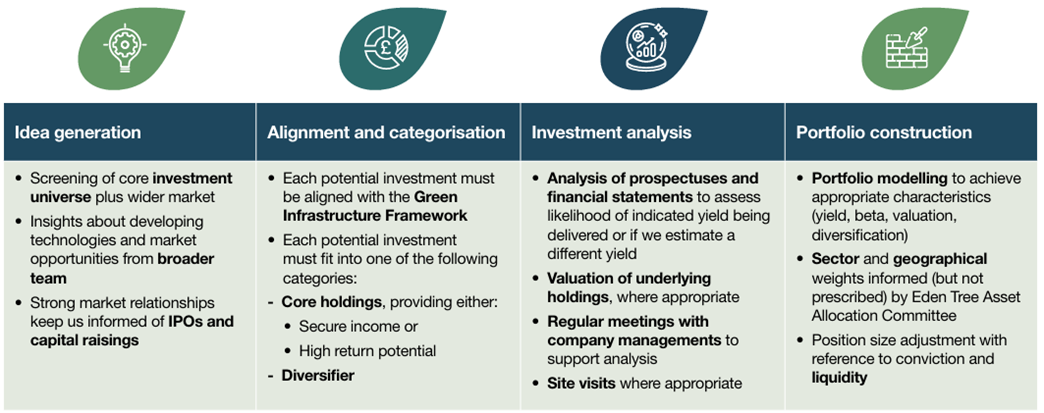
The Fund’s current core investment universe consists of about 200 stocks, which is continually reviewed. This number of potential investments is anticipated to grow substantially due to the investment required to meet long term governmental climate change targets and corporate net zero ambitions.
Furthermore, new additions to this universe arise through insights about market opportunities arising from the broader team at EdenTree, with particularly pertinent insights into developing technologies coming from work related to the EdenTree Green Impact Equity Fund, and insights into debt funding of related projects from work related to the EdenTree Global Impact Bond Fund. External sources of ideas include longstanding market relationships that allow us to keep informed of IPOs and capital raisings.
The investment universe is now at a scale to provide a wide selection of potential investments for different market conditions but has up until now been small enough to allow specialist firms that have been engaging with green and sustainable themes from the beginning to develop strong networks with both emerging and long established investment operators in the sector.
Alignment and Categorization
Once an investment has been determined to be aligned with the Green Infrastructure Framework, it will be assessed for its investment potential within one of the following categories:
- Core holdings, for which we would be seeking either ‘Secure income potential' or ‘High return potential’
- Diversifiers
When it comes to categorization by investment criteria, potential holdings will have to clearly fit into one of three investment categories: secure income, high return potential, and diversifiers.
Secure income indicates holdings that are judged to be likely to provide a more secure source of income even if they may not have as much upside potential as holdings in the ‘high return potential’ category. Canadian Solar Infrastructure, for example, had a stable long term dividend history at the time of investment, supported by a financial model based not on receiving merchant power prices but on receiving base rent for its assets related to a percentage of projected power generated, with the potential for performance-linked rent on top of this.
High return potential indicates holdings that are valued in such a way that we believe there is potential for greater returns, although they may or may not have a past track record of this. For example, Gore Street Energy Storage was supported by an investment thesis that posited that the value of its portfolio should rise substantially as its assets went through construction milestones, even though it had at the time of investment yet to pay a covered dividend. As such, we deemed that it had potential for high returns but has not yet demonstrated an ability to deliver secure income.
Diversifiers are holdings where we believe past or likely future return profiles clearly complements those of existing holdings. They may not offer high (or any) income, but they will be deemed likely to help preserve capital in the portfolio as a whole. Cadeler, for example, paid no dividend at the time of investment, but operated in a completely different part of the renewable energy value chain from other holdings in the portfolio.
Investment Analysis
Core holdings should demonstrate either an ability to generate a secure, stable income stream, or the potential for high total returns, grounded in income-generation potential. A potential core holding will be assessed on the basis of whether or not the anticipated yield indicates it should contribute to the portfolio meeting or exceeding its CPI-based yield target, and if any premium to NAV is deemed likely to pay for itself with near term income or is justified by alternative valuation.
For direct equity investment in companies that are not investment companies, different valuation methods will be employed depending on the nature of the company and the market opportunity that has been identified; these will generally be grounded in assessing the value of the company’s balance sheet or its anticipated future earnings with a view to gaining conviction about the company’s ability to sustain required dividend payments.
The core investment analysis process is grounded in close reading of prospectuses and analysis of financial statements to assess the likelihood of indicated yield being delivered, or if we would estimate a different yield. Where appropriate, this may be supported by valuation of underlying assets. Central to the fundamental analysis process is conducting regular meetings with company managements to support our analytical activities and to gauge conviction in the management teams. Similarly, we will conduct site visits where appropriate.
Diversifiers are not necessarily focused on income-generation. Instead, diversifiers should preserve the capital value of the Fund – especially under market conditions where the core holdings may do less well.
As such, a potential diversifier will be assessed on the basis of whether or not its price implies a high likelihood of capital preservation or appreciation, and on the basis of whether or not likely future return profiles will complement the return profiles of existing holdings. This can take the form both of a logical assessment of how it generates its returns (e.g. the place it occupies in the value chain of the industry within which it sits), and through conducting correlation analysis of its past returns relative to existing assets in the portfolio.
Portfolio construction
The Fund takes a focused yet diversified approach. By focusing on diversified investment companies, we can reduce the number of top level holdings, allowing us to regularly meet with their management teams as well as increase the frequency with which we can review each holding – without compromising on diversification because each investment company will itself have a diversified portfolio of investments. The Fund currently has under 25 holdings, but we do not intend for the Fund to diverge from its focused yet diversified approach, and, as such, we do not anticipate holdings to go above 40.
The Fund will generally invest inflows and divest outflows as they occur, seeking to remain as close to fully invested as is practicable under various market conditions. The Fund has a focus on investment companies, which tend to be most liquid during times of capital raisings and around NAV announcements. As such, we may therefore at times allow cash balances to build up to allow participation in capital raising or to await more liquid times in the market, when we believe this will be most beneficial to our investors.
At the time of investment, no holding (with the potential exception of cash) will be more than 7% of the Fund. Otherwise, position sizes will reflect conviction, liquidity, and be further modified by portfolio modelling, which will be undertaken on an ongoing basis to target appropriate aggregate characteristics for varying market conditions, such as yield, valuation, beta, and diversification.
Alignment to Green Impact Infrastructure Framework
Alignment to the Green Impact Infrastructure Framework is required prior to an investment being selected for the Fund. The Green Impact Infrastructure Framework sets out six acceptable core investment themes, and the Fund Manager will assess against the framework to provide assurance the companies are providing appropriate solutions. This thematic alignment is reviewed by our SI Team to determine if they agree with this assessment. All orders are submitted and processed via Charles River. Only authorised personnel are permitted to carry out restricted functions related to generation and execution of market orders. All orders must first pass through Charles River compliance checks, which ensure adherence to a range of restrictions. For stocks that fail on ethical, or controversy grounds, Compliance and Operations are informed to ensure that there is a hard stop within the trading system (Charles River) to prevent breaches of the process.
Resources, Affiliations & Corporate Strategies:
As a dedicated sustainable investment manager, all of EdenTree’s investment expertise and resources are directed towards sustainable investing. At the heart of EdenTree’s investment process is the close collaboration of its Sustainable Investment Team.
EdenTree’s Sustainable Investment Team comprises both its fund managers and its sustainability specialists. The individuals within these teams work side by side on stock selection, stewardship and thematic research. EdenTree thus employs a dual due diligence process, endeavoring to ensure robust risk management and positive sustainability outcomes.
EdenTree’s activities are overseen by its Sustainable Investment Advisory Panel, which comprises industry and business experts appointed for their specialist knowledge. For investors, it’s an added layer of assurance that their money is being invested in companies that are operating in a sustainable way.
Our Sustainability Specialists
The dedicated sustainability component of our Sustainable Investment Team is made up of five sustainability specialists who oversee EdenTree’s sustainability research and stewardship activity. The team has oversight of how EdenTree assesses and integrates sustainability across all funds.
- Carlota Esguevillas, Head of Sustainable Investment - Carlota leads the sustainability team and has oversight of EdenTree’s sustainability and stewardship activities. She joined the firm in 2021, having previously worked for a leading sustainability consultancy advising global companies on their ESG strategies and disclosures. She holds a First-Class Honours BA in Geography from Oxford University, a master’s certificate with distinction in Business & Human Rights from Bergen University, and the Investment Management Certificate (IMC). She is also a member of the PA Future (formerly ESG Clarity) Committee, the IA’s Sustainability & Responsible Investment Committee, winner of Investment Week’s Rising Star Sustainable Investment Champion of the Year 2024 and highly commended Sustainable & ESG Woman of the Year at Investment Week’s Women in Investment Awards 2025.
- Hayley Grafton, Senior Sustainable Investment Analyst - Hayley Leads on the firm's approach to corporate governance and proxy voting. Hayley joined EdenTree in 2024 and leads the firm’s corporate governance approach and proxy voting activity. She is also responsible for EdenTree’s long-term engagement on financial inclusion in the UK. Hayley holds the Investment Management Certificate and is a student member of the Chartered Governance Institute UK & Ireland (CGIUKI), through which she is completing the Chartered Governance Qualifying Programme. Before joining EdenTree, she worked at Mercer as a Sustainable Investment Specialist, where she focused on the firm’s stewardship approach and activity across portfolio funds.
- Cordelia Dower-Tylee, Senior Sustainable Investment Analyst- Cordelia joined EdenTree in 2022 and leads the firm’s engagement strategy, overseeing activity across the team’s priority themes. She also leads EdenTree’s environmental work, with an emphasis on water, and supports the company’s work on governance. She holds the Investment Management Certificate, an MA in History from the University of Edinburgh, and a Certificate in Sustainable Finance from the University of Cambridge. She is also a member of the UKSIF Future Leaders Cohort and the PRI Nature Reference Group. Prior to joining EdenTree, Cordelia worked with the International Water Management Institute and in a green-focused corporate advisory firm.
- Aaron Cox, Impact Strategist - Aaron Leads the firm’s public market impact strategy across equities, listed infrastructure, and fixed income. He joined EdenTree in June 2022 and is an Impact Strategist within the Sustainability Team. Prior to joining EdenTree, Aaron had roles at First State Investments (now First Sentier), Jupiter and Majedie as a writer and researcher with a focus on ESG and sustainable investing. He started his career as a derivatives broker in Sydney. Aaron has a BA in English from the University of New South Wales, Post Grad Certificate in Environmental Economics from SOAS and Certificate in Sustainable Investing from Harvard Business School. He is currently undertaking a post graduate research project at Birmingham University on computational linguistic methods to identify sustainability stretch goal tensions and the risk of greenwashing and corporate misbehaviour.
- Ross Albany-Ward, Sustainable Investment Analyst - Ross joined EdenTree in 2025, and is a Sustainable Investment Analyst on the Sustainability Team and leads EdenTree’s work on climate strategy. Working across the firm’s sustainability research and stewardship activities, he leads EdenTree’s work on climate, including carbon footprinting the funds. Prior to joining EdenTree, Ross worked in the Sustainable Investment team at CCLA, assessing companies and supporting stewardship activities. Ross has a First-Class Honours degree in Geography from Nottingham University, completing his dissertation on sustainable finance and corporate sustainability.
The team leverages both proprietary and third-party research applies value orientated screens, attends conferences and often meets with company management. The investment research undertaken provides the foundations for the lead fund manager to decide whether it is appropriate to include the stock in the overall portfolio.
Proprietary analysis sits at the core of our investment process at EdenTree. For our sustainability analysis we believe a qualitative approach is needed to capture the nuances and hence we choose to rely on in-depth analyst research, rather than third-party ratings, to form an opinion on suitability. To complete the assessment, the analyst utilises a variety of sources, including: Newsflow, annual and sustainability reports, policies, industry publications and websites, NGO research, investor databases, benchmark initiatives, and government and academic research. As mentioned above, EdenTree also has access to several third-party research providers, including Bloomberg, Sustainalytics, ISS ESG, and Glass Lewis, which are used to support the analyst assessment.
Partnerships
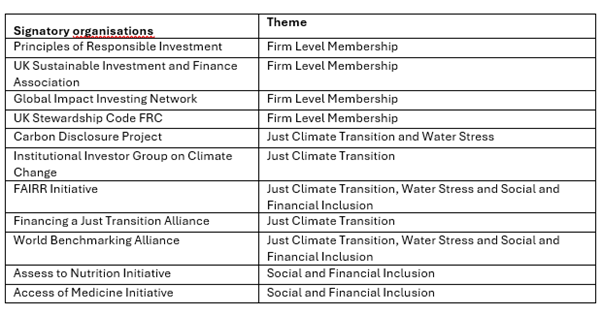
We are members or signatories to several industry partnerships involving the sustainable investment community. Ultimately, membership of organisations such as the Principles for Responsible Investment (PRI) affords specific opportunity to work with like-minded global investors on material issues. The SI Team oversee periodic review of our involvement in these industry partnerships and collaborative initiatives, particularly assessing effectiveness, progress made and alignment with our engagement priorities. Over the period, our partnerships included:
Collaborative engagement memberships
Most engagement is conducted by EdenTree directly. However, we seek to collaborate positively with like minded investors wherever possible or as part of collaborative industry initiatives. Detailed below is a list of the initiatives we were involved in, and in what capacity, over the period. Further detail and updates on our involvement in these collaborations are shared in our quarterly reports.
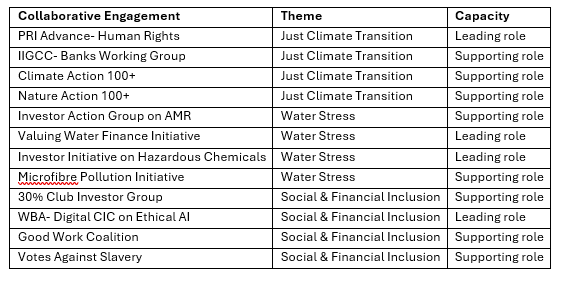
EdenTree believes these partnerships signals their commitment to having an active and positive role in the investment community. Collaborations are critical to driving change, whilst learning from expert sources allows them to provide more for their clients.
EdenTree also sits on UKSIF’s Analyst Committee, which advises on the development of UKSIF’s knowledge sharing programme on evolving sustainability issues. They also sit on the PRI’s Circular Economy Reference Group, which explores how investors can better integrate the principles of a circular economy into investment processes. EdenTree’s CIO, Charlie Thomas, sits on the IA’s Sustainability and Responsible Investment Committee.
EdenTree Sustainable Investment Advisory Panel
The EdenTree Sustainable Investment Advisory Panel is an external advisory panel of seven senior industry practitioners with expertise in the field of sustainable investment. The Sustainable Investment Advisory Panel (“the Panel”) has independent oversight over the Sustainability Team, led by Carlota Esguevillas, Head of Sustainable Investment. The Panel meets three times each year to provide oversight to EdenTree’s proprietary sustainable investment process (the “EdenTree Standard” edentree-identifying-sustainable-companies.pdf) and to discuss the latest trends and developments in sustainable investment and research. The purpose of the Panel is to:
- Ensure that EdenTree’s range of funds meet the stated sustainable aims and objectives.
- Provide advice in the formulation of policy in the light of changing social and sustainability issues.
- Advise on emerging issues or topics relevant to EdenTree’s sustainable investment criteria.
- Provide advice and guidance on individual companies or sectors, and engagement work with regards to sustainable and social topics.
EdenTree Sustainable Investment Advisory Panel Members:
- Will Oulton, Panel Chair - Will Oulton is the Chair of the European Sustainable Investment Forum (Eurosif), a Non-Exec Director and Board Champion for Ocean Recovery at the UK based Marine Conservation Society, and Chair of King Charles III’s Accounting for Sustainability (A4S) Expert Panel. Prior to these positions he was for over a decade the Global Head of Responsible Investment at global asset manager First Sentier Investors, where he led the delivery of an award winning RI strategy for the business. He was also the Head of Responsible Investment for EMEA at Mercer Investments and the Director of Responsible Investment at FTSE, leading the ongoing management and development of FTSE’s responsible investment services.
- Paul Simpson OBE, Strategic Advisor - Paul is an advisor to organisations focussed on accelerating the transition to a net zero economy. He pioneered climate and environmental disclosure globally having co-founded CDP (Carbon Disclosure Project) in 2001 and spent 12 years as the CEO until 2022. Paul received an OBE for services to tackling climate change in the 2022 Honours List. He initiated the Science Based Targets Initiative (SBTi) in 2014 and has held board positions with SBTi, We Mean Business, EIRIS, The Investor Agenda and the Climate Disclosure Standards Board (now part of the International Sustainability Standards Board).
- Verity Mitchell, Independent Consultant - Verity Mitchell is UK Analyst and editor of What's Next for UK Water for Global Water Intelligence magazine. Previously she was Director, Utilities for HSBC Global Research. Her equity coverage included Pennon, Severn Trent and United Utilities in the UK; Veolia in France; and American Water and Essential Utilities in the US, together with Centrica, Drax, National Grid, SSE and Biffa. She covered most of the larger UK water companies before they were taken private. She has been involved in bringing a number of global water and waste management companies to the listed equity markets in the UK, US and Middle East. Previously she worked in project finance for HSBC on a number of infrastructure mandates including water projects. She began her career at what is now the Department of Business and Trade.
- Annette Fergusson, Independent Consultant - Annette is an independent consultant with over 25 years of experience working on sustainability and business and human rights, with a particular focus on the telecoms and technology sectors. She advises companies, industry associations and non-governmental organisations on a wide range of human rights issues including digital rights, children’s rights and labour standards. Annette was previously Vodafone Group’s Head of Sustainable Business and for over 10 years led the company’s human rights programme. From 2016 to 2018, she was a member of the Board of the multi-stakeholder Global Network Initiative.
- Julian Parrott, Client Member, Ethical Futures - Julian Parrott is an independent financial planner specialising in ethical and sustainable investment advice. Julian has over 25 years’ experience in financial services, encompassing building society management, life assurance sales and financial planning & advice. He is the founding partner of the Ethical Futures LLP and holds the ISO 22222 standard in financial planning. Julian is active in promoting ethical investment to the public and adviser community. He has served on the board of UKSIF & Ethical Investment Association. He is a Director of the Ethical Finance Hub project as well as other consultancy roles. Julian is a fellow of the RSA.
- Mike Barry, Former Director of Sustainable Business - Until recently, Mike was Director of Sustainable Business at Marks & Spencer, spearheading its ground-breaking Plan A sustainability programme. He also co-chaired the Consumer Goods Forum’s sustainability work, bringing together the world’s largest retailers and fast moving consumer goods brands to work on issues such as deforestation, plastics and forced labour. He is a Senior Associate at the Cambridge Institute for Sustainability Leadership.
- Sue Round, Chair, EdenTree Investment Management - Following more than 40 years in investment management, Sue retired in 2022. Prior to retirement she had developed and led EdenTree and is currently Chair of EdenTree Investment Management.
Sue joined what was then Ecclesiastical Investment Management in 1984 and as a senior fund manager, launched one of the first responsible (ethical) retail funds in 1988. She went to develop and reposition a range of funds to integrate environmental, social and governance into the investment process. Prior to retirement, Sue was a member of FCA Smaller Business Practitioners Panel and an advocate for improvements across the broader investment industry to promote greater clarity of approach to avoid “greenwash “ to clients. Prior to joining Ecclesiastical, Sue spent five years at Philip Hill, the Investment Trust specialist management house.
Dialshifter
This fund is helping to ‘shift the dial from brown to green’ by…
Progressing towards our goals is driven by our Climate Change Strategy. It is based on four pillars where we believe there is both a need for action and where we can make a difference. The four pillars – Decarbonise, Accelerate, Collaborate and Embody – each address a different part of the low carbon transition, targeting the areas where investors have the biggest role to play.
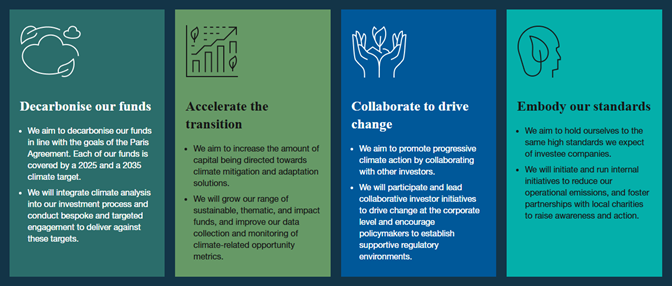
Please refer to the Climate Stewardship Report 2024/25 for more details.
SDR Labelling:
Sustainability Impact label
Key Performance Indicators:
We will monitor performance against the Fund’s Sustainability Objective on an ongoing basis, against a range of KPIs. All KPIs will be reported on an annual basis.
Asset Activities: This KPI monitors asset-level activities. It demonstrates the positive outcomes that arise as a result of directing capital towards companies that, through their assets and operations, address the causes of climate change.
- Avoided emissions (tCO2e) – emissions reductions that occur as a result of the use of the product/service, or operation of the asset. Avoided emissions represent CO2e emissions that have not been released into the atmosphere, thus reducing global warming, and so mitigating the harmful consequences of climate change. CO2e stands for carbon dioxide equivalent and includes other greenhouse gases with the same global warming potential. This KPI applies across all six investment themes as they all have the potential to generate avoided emissions.
At a minimum, we expect each of the Fund’s assets to contribute positively towards a reduction in greenhouse gas emissions every year, measured by avoided emissions. If an asset fails to make a positive contribution to avoided emissions within a year, this would be addressed through the escalation plans (as detailed under the “Escalation Plans” section).
In addition, over a 5-year rolling period we would expect to see an increase in the rate of avoided emissions delivered through the Fund’s activities as a result of the growth in output of the underlying assets, the growth of the fund and our investor contribution, and our engagement activity to increase the contribution of companies in the fund. However, we recognise that the rate of avoided emissions delivered by the Fund may fluctuate year-on-year due to external factors such as changes to broader economic conditions.
Please refer to the “Additional Metrics” section on page number 47 and 48 of EdenTree Investment Funds Series 2 Prospectus for more details.
Please refer to the “Methodology for monitoring and KPI data collection” below for further information about how we calculate the Fund’s impact.
Investor Activities: This KPI monitors the success of our engagement activities and our investor contribution in line with the Fund’s theory of change. Our engagement activities seek to increase the greenhouse gas emissions reductions delivered by a company.
To deliver this contribution, we engage via two broad categories:
- Increase Positive Impacts. This type of engagement seeks to increase the greenhouse gas emissions reductions delivered by a company by encouraging them to increase the rate of avoided emissions generated via their climate solutions.
- Reduce Potential Negative Impacts. This type of engagement seeks to increase the greenhouse gas emissions reductions delivered by a company by reducing their scope 1, 2 & 3 emissions that are a consequence of solutions production, and via ensuring a company maintains its licence to operate (which can be affected by a variety of E, S and G factors) and can therefore continue to generate avoided emissions.
For each engagement we undertake, we will set a specific engagement objective, bespoke to the topic and company in question. This objective will be aligned to the Theory of Change with a clear and relevant link back to the Fund’s overarching Sustainability Objective, meaning all objectives will ultimately seek to generate a reduction in greenhouse gas emissions.
A list of commonly used KPIs that would be used for reporting the outcomes of our engagement is provided in table on page number 49 of EdenTree Investment Funds Series 2 Prospectus to illustrate the link between an engagement objective and the engagement KPI.
- Sustainability Disclosure
SDR Literature:
Literature
Voting Record
Disclaimer
Regulatory Notice
To obtain further information please speak to your EdenTree representative, visit www.edentreeim.com or call our support team on 0800 011 3821. This document has been prepared by EdenTree Investment Management Limited for Financial Advisors, other intermediaries and other investment professionals only. It is not suitable for private individuals.
This document has been produced for information purposes only and as such the views contained herein are not to be taken as advice or recommendation to buy or sell any investment or interest thereto. A full explanation of the characteristics of the investments is given in the Key Investor Information Document (KIID). Any forecast, figures, opinions statements of financial market trends or investment techniques and strategies expressed are unless otherwise stated, EdenTree Investment Management’s own at the date of this document. There is no guarantee that any forecast made will come to pass. Please note that the value of an investment and the income from it can fall as well as rise as a result of market and currency fluctuations, you may not get back the amount originally invested. Past performance is not necessarily a guide to future returns.
| Fund Name | SRI Style | SDR Labelling | Product | Region | Asset Type | Launch Date | Last Amended |
|
|---|---|---|---|---|---|---|---|---|
EdenTree Green Impact Infrastructure Fund |
Environmental Style | Sustainability Impact label | OEIC | Global | Infrastructure | 28/09/2022 | May 2026 | |
ObjectivesFinancial Objective To generate income with the potential for capital growth by investing in infrastructure-related companies around the globe. Sustainability Objective To support a reduction in the level of greenhouse gas emissions, measured in tonnes of CO2e avoided on an annual basis, through the Fund’s investment in, and engagement with companies whose business is based on the ownership, operation, construction, development, or debt funding of real assets and infrastructure projects that mitigate the effects of climate change. |
Fund/Portfolio Size: £29.94m (as at: 31/03/2026) Total Screened Themed SRI Assets: £1582.35m (as at: 31/03/2026) Total Responsible Ownership Assets: £1116.17m (as at: 31/03/2026) Total Assets Under Management: £2698.52m (as at: 31/03/2026) ISIN: GB00BNG5Z717, GB00BNG5ZH11, GB00BNG5ZG04, GB00BQMRSF18 Contact Us: Clare.Setchfield@edentreeim.com |
|||||||
Sustainable, Responsible &/or ESG OverviewThe Fund invests in companies whose products, services or assets enable a reduction in the level of greenhouse gas emissions across six pre-defined themes which offer solutions that address aspects of climate change. How assets are selected is described in the “Asset Contribution: How we select assets” (detailed in next response). The Manager will also engage with companies it invests in to enhance the Investors’ contribution to the Sustainability Objective. This is described further in the “Investor Contribution: Investor Stewardship” (detailed in next response). The table on page no. 42 to 43 of EdenTree Investment Funds Series 2 Prospectus illustrates the solutions provided under each theme (“what”) and how that solution supports the Sustainable Objective and contributes to a reduction in the level of greenhouse gas emissions (“why”). The Fund may not be invested across all of these themes at all times. |
||||||||
|
Primary fund last amended: May 2026 |
||||||||
|
Information received directly from Fund Manager |
||||||||
|
Please select what you would like to read:
Fund FiltersSustainability - General
Sustainability policy
Has policies that consider (environmental and social) sustainability issues. Strategies vary but are likely to consider environmental issues like climate change, carbon emissions, biodiversity loss, resource management, environmental impacts; and social issues like equal opportunities, human rights, labour standards, diversity and adherence to internationally recognised codes. See individual entry information.
Sustainability focus
Has a significant focus on sustainability issues
Sustainable transport policy or theme
Has documented policies or thematic investment approaches supporting investment in more sustainable, greener transport methods. These will typically set out a preference for companies that run, enable or support more sustainable methods of transport.
Encourage more sustainable practices through stewardship
Aim to encourage higher sustainability standards through responsible ownership / stewardship / engagement / voting activity
UN Global Compact linked exclusion policy
Use the UN Global Compact to inform or help direct where they can or cannot invest. Will typically not invest in companies with significant breaches (low standards) - strategies vary. (The UNGC covers a wide range of issues - search 'UNGC'). See https://unglobalcompact.org/
Transition focus
Aim to support the shift to a sustainable future. See eg https://www.transitionpathwayinitiative.org/
Circular economy theme
Has a theme or investment strand focused on the shift to a circular economy - where products are reused and recycled not incinerated or dumped. See eg https://www.ellenmacarthurfoundation.org/topics/circular-economy-introduction/overview Environmental - General
Environmental policy
Has policies which relate to environmental issues. These will typically set out their stance on issues such as pollution, climate change, resource management, biodiversity loss, carbon emissions, plastics and/or additional environmental impacts. Strategies vary.
Limits exposure to carbon intensive industries
Options that limit or 'reduce' their exposure to carbon intensive industries (ie sectors which are major contributors to climate change). Strategies vary.
Environmental damage & pollution policy
Has documented policies explaining the approach to environmental damage and pollution. Strategies vary.
Resource efficiency policy or theme
Has a policy or theme that relates to managing natural resources more efficiently. Strategies vary. See individual entry information.
Favours cleaner, greener companies
Aims to invest in companies with strong or market leading environmental policies and practices. Strategies vary. See individual entry information for more detail.
Waste management policy or theme
Has a written policy or theme focused on waste management - typically to support or encouraging higher levels of recycling and better efficiency / reducing waste. Strategies vary. Nature & Biodiversity
Biodiversity / nature policy
Has a written biodiversity policy or theme typically aimed at supporting, encouraging and improving environmental protection and safeguarding the natural world (sometimes referred to as 'natural capital'). See eg https://www.un.org/en/climatechange/science/climate-issues/biodiversity
Nature / biodiversity based solutions theme
A significant focus on investments that aim to protect, improve and / or restore natural habitat.
Deforestation / palm oil policy
Has policies designed to address involvement in irresponsibly managed palm oil or other forms of deforestation (typically exclusion led). Strategies vary.
Illegal deforestation exclusion policy
Avoids assets that are involved in illegal deforestation. This may relate to palm oil, cattle farming or other areas. Strategies vary.
Responsible palm oil policy
Has a responsible palm oil policy - typically likely to divert investment away from poor practices.
Sustainable fisheries policy
Has a sustainable fisheries policy that will inform where they can and cannot invest.
Avoids genetically modified seeds / crop production
Aims to avoid investing in companies that produce genetically modified seeds or crops. (This does not typically include avoiding companies such as supermarkets).
Genetic engineering exclusion
Avoids assets / companies directly involved in genetic engineering
Water stewardship policy
Has a policy which sets out their expectations for how investee assets should manage their use of water - likely to focus on high users. Climate Change & Energy
Climate change / greenhouse gas emissions policy
Has policies (documented strategies that explain their position) on climate change related issues such as greenhouse gas/carbon emissions, net zero, transitioning to lower carbon. Strategies vary.
Coal, oil & / or gas majors excluded
Avoid investment in major coal, oil and/or gas (extraction) companies. Strategies vary.
Fracking & tar sands excluded
Avoid companies involved in fracking and tar sands - which are widely regarded as controversial methods of oil and gas extraction. Strategies vary.
Arctic drilling exclusion
Avoid companies that are involved in extracting oil from the Arctic regions.
Fossil fuel reserves exclusion
Avoid investing in companies / assets with coal, oil and gas reserves. See individual entry information for further details.
Clean / renewable energy theme or focus
Invest (or may invest) in clean / renewable energy companies and other assets. The proportion directly or indirectly invested in renewable energy may vary over time.
Encourage transition to low carbon through stewardship activity
Encourage the transition to lower carbon activities through asset selection and / or responsible ownership activity.
Energy efficiency theme
Has an energy efficiency theme - typically meaning that the manager is focused on investing in organisations that manage - or help others to manage - energy use more carefully and less wastefully - and so reduce greenhouse gas emissions.
Invests in clean energy / renewables
Invest in renewable energy companies and / or companies where renewable energy is a significant part of their business. Strategies vary.
Nuclear exclusion policy
Has a policy which describes the avoidance or limited investment in the nuclear industry. Strategies vary.
Supply chain decarbonisation policy
Has a supply chain decarbonisation policy which sets out their position on the need to reduce carbon emissions.
Fossil fuel exploration exclusion - direct involvement
Excludes companies and other assets with direct involvement in fossil fuel exploration (eg coal, oil and gas companies)
Paris aligned strategy
Aims to ensure holdings will reduce their greenhouse gas emissions in line with targets set at COP21 in Paris. The core aim is to help achieve ‘net zero emissions by 2050’ and a ‘maximum global temperature increase of +1.5 to +2 degrees above preindustrial levels’. Strategies and opinions vary.
Require net zero action plan from all / most companies
Requires all, or most of, the assets they invest in to have a ‘net zero action plan’ - describing how they will reduce their greenhouse gas emissions. Social / Employment
Social policy
Has policies which set out their approach to social issues (e.g. human rights, labour standards, equal opportunities, child labour and/or adherence to internationally recognised codes such as the UN Global Compact). Strategies with social policies typically avoid companies with low standards and/or work to encourage higher standards. See fund information for detail.
Labour standards policy
Has a labour standards policy - likely to mean they will invest in / favour companies that have higher employment related standards and avoid those with low standards. Strategies vary. See eg https://www.ilo.org/international-labour-standards
Favours companies with strong social policies
Aims to invest in assets with high social values - this may include strong human rights, labour standards and equal opportunities or safety related practices.
Health & wellbeing policies or theme
Has policies or themes that set out their approach to health and wellbeing issues, typically aims to invest in companies with high standards - or encourage high standards.
Diversity, equality & inclusion Policy (product level)
Has a written diversity policy – where the manager will aim to select companies with a carefully considered, positive employment standards. This may cover a range of issues including gender, ethnicity, disability, beliefs and sexual orientation.
Mining exclusion
All mining companies excluded
Vulnerable / gig workers protection policy
Has a policy aimed at protecting vulnerable workers such as those on zero hour / informal contracts working in the gig economy Ethical Values Led Exclusions
Tobacco & related product manufacturers excluded
Companies are excluded if they are involved in any aspect of the production chain for tobacco products, including cigarettes, vaping, e-cigarettes, chewing tobacco and cigars.
Tobacco & related products - avoid where revenue > 5%
Companies are excluded if they make more than 5% of their revenue from the manufacture, sale or distribution of tobacco products including cigarettes, vaping, e-cigarettes, chewing tobacco and cigars.
Controversial weapons exclusion
Excludes companies which make controversial weapons such as landmines, cluster munitions and chemical weapons.
Armaments manufacturers avoided
Avoids companies that manufacture weapons intended specifically for military use. Strategies vary - may or may not include non-strategic military products.
Military involvement exclusion
Avoids companies with military contracts. This may include medical supplies, food, safety equipment, housing, technology etc
Civilian firearms production exclusion
Has a written civilian firearms exclusion policy - meaning that they will not invest in companies that make (or perhaps also sell) handguns made for non-military users.
Alcohol production excluded
Avoids companies that produce alcohol. Strategies vary; some may allow a small proportion of revenue to come from this area.
Gambling avoidance policy
Avoids companies with significant involvement in the gambling industry. Some may allow a small proportion of revenues to come from this area.
Pornography avoidance policy
Avoids companies that derive significant income from pornography and related areas. Strategies vary.
Animal welfare policy
Has policies that require specific animal welfare standards to be met. These may reference well-known welfare standards (3Rs - Replace, Reduce, Refine) or certification schemes. Strategies vary.
Animal testing - excluded except if for medical purposes
Avoids companies that test their products on animals for purposes other than medical benefit (e.g. for cosmetics). Strategies vary. Human Rights
Human rights policy
Has policies relating to human rights issues. Typically require companies to demonstrate higher standards, although some managers work to encourage improvements. Investee companies are often judged against internationally agreed norms or standards. Strategies vary.
Child labour exclusion
Has policies to avoid companies that employ children.
Oppressive regimes (not free or democratic) exclusion policy
Has policies that exclude companies or other assets which operate in, or are owned by regimes which are not democratic, or where people may be oppressed. May use eg. Freedom House research. Strategies vary.
Responsible supply chain policy or theme
Has policies or a theme that relates to the responsible management of supply chains. These may relate to employment issues, notably people employed by their suppliers, as well as the sourcing of materials and products.
Modern slavery exclusion policy
Has a policy which excludes assets with involvement in Modern Slavery Meeting Peoples' Basic Needs
Water / sanitation policy or theme
Have policies or themes that set out the position on investment in the water sector and/or sanitation. Strategies vary.
Healthcare / medical theme
Healthcare and or medical theme or area of investment - may have a single or many themes
Antimicrobial resistance policy
Has a policy on ‘antimicrobial resistance’ - which is when organisms that cause infection can survive treatment - which is commonly associated with the overuse of antibiotics in factory farming. Banking & Financials
Invests in banks
Can include banks as part of their holdings / portfolio.
Only invest in TCFD (ISSB) aligned banks / financial institutions
Invest in banks and other financial institutions that implement the Task Force on Climate Related Financial Disclosures recommendations on climate change related financial disclosures - which aim to help financial markets measure and respond to climate risk.
Exclude banks with significant fossil fuel investments
Avoids banks that have a large part of their loan book (or other assets) invested in fossil fuels companies - particular coal, oil and gas.
Exclude insurers of major fossil fuel companies
Avoids investing in insurance companies that insure major fossil fuels companies – particularly coal, oil and gas. Strategies (eg definition of ‘major’) vary.
Invests in insurers
May invest in insurance companies. Governance & Management
Governance policy
Has policies that relate to corporate governance issues such as board structure, executive remuneration, bribery and/or corporate corruption. These funds will typically avoid companies with poor practices. Strategies vary.
Avoids companies with poor governance
Avoids investing in companies with poor governance practices.(e.g. board structure, management practices etc.) Views may however vary on what counts as 'poor' practices - and funds may not immediately divest as they may prefer to work to encourage higher standards.
UN sanctions exclusion
Exclude companies that are subject to United Nations sanctions. See eg https://main.un.org/securitycouncil/en/content/un-sc-consolidated-list
Anti-bribery & corruption policy
Has policies explaining how managers will respond to assets / companies that do not comply with relevant anti-bribery and anti-corruption standards or laws. Strategies vary; options include stewardship/ engagement and divestment - or a combination.
Encourage board diversity e.g. gender
Encourage the companies they invest in to have more diverse board structures (e.g. more women on boards)
Encourage TCFD alignment for banks & insurance companies
Encourage the banks and insurance companies they invest in to publish climate change related financial information - as set out by the Task Force on Climate Related Financial Disclosures (with the aim of helping investors measure and respond to climate risk).
Encourage higher ESG standards through stewardship activity
Aim to encourage higher ESG standards through responsible ownership / stewardship / engagement /voting activity
Require investee companies to report climate risk in R&A
Requires the companies they invest in to report on climate risks that are relevant to their business in their report and accounts Product / Service Governance
External oversight / advisory committee (fund / service)
Find options that have an external committee that helps steer or advise managers on sustainability, ethical, stewardship or ESG policy or strategy related issues. These people may be paid for their time but are not employees of the fund manager.
ESG integration strategy
Find fund / asset managers that factor in 'environmental, social and governance' issues as part of their investment decision making process. A focus on 'ESG' typically means a fund is carrying out additional research to help reduce ESG related risks. It does not necessarily mean a focus on sustainability. Strategies vary. See fund literature.
ESG factors included in Assessment of Value (AoV) report
Environmental, social and governance issues are part of this fund’s reporting of their ‘value’ to clients. AoV reporting is a statutory requirement. Including ESG factors in its calculation is not. Asset Size
Over 50% small / mid cap companies
Invests more than half of their money in smaller or medium sized companies. (i.e. below around £5 -10 billion)
Invests mostly in small or mid cap companies / assets
Has SRI strategies which focus their investment stock selection on small or mid cap companies / assets. (e.g. below circa £10bn) Targeted Positive Investments
Invests >25% in environmental / social solutions companies
Invests >25% of their capital in companies where a major part of their business is focused on helping to address environmental or social challenges.
Invests >50% of fund in environmental / social solutions companies
Invests >50% of their capital in companies where a major part of their business is focused on helping to address environmental or social challenges. Impact Methodologies
Aims to generate positive impacts (or 'outcomes')
Has policies that aim to help or support the delivery of positive social or environmental impacts (or societal/real world outcomes) by investing in companies they regard as beneficial to people and / or the planet. Strategies vary.
Measures positive impacts
Aims to measure the positive real world environmental and / or social benefits that are associated with their investment strategy. Investments that aim to deliver positive impacts and measure those impacts may be referred to as 'Impact' - although impact measurement is not restricted to Impact investments. Strategies vary.
Described as an ‘impact investment’
Investments which are specifically marketed as ‘Impact investments' and work to deliver both financial performance and specific, measurable positive, real world social and/or environmental benefits. Strategies vary.
Positive environmental impact theme
Specifically sets out to help deliver positive environmental impacts, benefits or 'real world' outcomes.
Positive social impact theme
Specifically states that they aim to deliver positive social (i.e. people related) impacts and/or outcomes.
Invests in environmental solutions companies
Directs investment towards companies where a major part of their business is about solving environmental challenges. e.g. companies helping to address climate change.
Invests in social solutions companies
Invest in companies where a major part of their business is specifically aimed at helping to address social challenges. e.g. companies helping to address poverty.
Invests in sustainability / ESG disruptors
Specifically sets out to invest in companies that are regarded as 'disrupting' existing business practices - typically through the development of innovative (sustainability aware) products and/or practices.
Aim to deliver positive impacts through engagement
Aims to deliver positive environmental and or social impacts (real world benefits) through its engagement with investee assets
Over 50% in assets providing environmental or social ‘solutions’
Invests more than 50% of capital in assets which are regarded as being significantly focused on providing solutions to environmental or social challenges. Strategies vary.
Publish ‘Theory of Change’ explanation
Policy explains the ways in which the manager believes things need to change in order to deliver a more sustainable future, which they are working to help achieve. How The Fund/Portfolio Works
Positive selection bias
Focuses on finding and investing in companies with positive / beneficial attributes. This strategy can be applied in addition to exclusion criteria and engagement/stewardship activity.
Negative selection bias
Has principle 'ethical approach' to avoid companies by using negative screening criteria. Strategies vary.
Strictly screened ethical investment
Has principle approach to apply positive or negative ethical, social and / or environmental screens. Strictly screened investments are likely to exclude more companies than other related options. Strategies vary.
ESG weighted / tilt
Invest more heavily in assets which have higher ESG ratings/standards or scores and less heavily in companies with lower ESG ratings. Where this is central to the strategy you should expect assets in most sectors. Strategies vary.
Significant harm exclusion
Aims to avoid companies that do significant harm. This originates from the EU’s sustainable finance ‘DNSH’ (do no significant harm) work, which is not necessarily used by UK investors.
Combines norms based exclusions with other SRI criteria
Investment selection process uses internationally agreed 'norms' (e.g. United Nations Global Compact - UNGC - or the UN Sustainable Development Goals - SDGs) alongside additional SRI criteria such as positive or negative stock selection policies and/or stewardship strategies.
Combines ESG strategy with other SRI criteria
Invests in assets which have an ESG strategy (which is typically focused on avoiding companies that pose environmental, social or governance related risks) together with additional criteria such as positive and/or negative screens, themes and stewardship strategies.
ESG risk mitigation focus
Focuses on the careful management of environmental, social and governance (ESG) related risks - typically by avoiding or being underweight in companies seen as posing major risks in these areas (i.e. not necessarily by using themes, exclusions etc).
SRI / ESG / Ethical policies explained on website
Publish explanations of their ethical, social and/or environmental policies online (i.e. investment decision making strategies/ buy/sell &/or asset management strategies).
Do not use stock / securities lending
Does not use stock lending for performance or risk purposes. Unscreened Assets & Cash
Assets typically aligned to sustainability objectives 70 - 79%
Holds between 70-79% of assets which align to the sustainability objectives; which are not being held purely for risk management purposes, such as derivatives and cash equivalent assets.
Assets typically aligned to sustainability objectives 80 – 89%
Holds between 80-89% of assets which align to the sustainability objectives; which are not being held purely for risk management purposes, such as derivatives and cash equivalent assets.
Assets typically aligned to sustainability objectives > 90%
Holds at least 90% of assets which align to the sustainability objectives; which are not being held purely for risk management purposes, such as derivatives and cash equivalent assets.
All assets (except cash) meet published sustainability criteria
All assets - except cash - meet the sustainability criteria published in strategy documentation. Intended Clients & Product Options
Intended for clients interested in sustainability
Designed to meet the needs of individual investors with an interest in sustainability issues.
Intended for clients interested in ethical issues
Designed for clients who care about ethical and values-based issues, often alongside sustainability issues also.
Intended for clients who want to have a positive impact
Designed to meet the needs of individual investors with an interest in ‘Impact investment’ which help or support the delivery of positive social or environmental impacts (or societal/real world outcomes) by investing in companies regarded as beneficial to people and / or the planet. Strategies vary.
Faith friendly
Has attributes that commonly suit the aims of investors of faith - although they may not be specifically marketed as being only for religious investors. Strategies vary (as do investor aims).
Available via an ISA (OEIC only)
Available via a tax efficient ISA product wrapper.
Portfolio SRI / ESG options available
Only applicable for DFM’s & portfolio providers. Finds those that offer an SRI / ESG portfolio option
Multiple SRI / ESG portfolio options available
Only applicable for DFM’s & portfolio providers. Find service providers who offer multiple SRI / ESG portfolio options
Bespoke SRI / ESG portfolios available
Only applicable for DFM’s & portfolio providers. Find service providers who offer bespoke ('personalised') SRI / ESG portfolio options Labels & Accreditations
SDR Labelled
Find options that have chosen to adopt one of the Financial Conduct Authority (FCA) SDR labels. Please note: there are a range of reasons why potentially relevant options may not use an SDR label eg. adopting a label may be work in progress, the manager may not yet be allowed to do so because of the product type, a manager may feel they are insufficiently aligned to SDR requirements.
ACT signatory
A voluntary corporate culture standard for investment managers, see https://www.investorsact.com/ - City Hive Fund Management Company InformationAbout The Business
Boutique / specialist fund management company
Find fund / asset management companies that are smaller or specialise in particular areas - notably, ideally ESG related. Strategies vary.
Responsible ownership / stewardship policy or strategy (AFM companywide)
Finds fund / asset management companies that have a published company wide stewardship, engagement and / or responsible ownership policy or strategy that covers all investments. Stewardship typically involves encouraging higher ESG standards through voting and dialogue.
ESG / SRI engagement (AFM companywide)
Find fund / asset management companies that actively encourage higher 'environmental, social and governance' and / or 'sustainable and responsible investment' practices across investee companies - typically where the aim is to encourage positive change that is aligned with the best interests of investors. Strategies vary. See additional information and options.
Vote all* shares at AGMs / EGMs (AFM companywide)
Find fund / asset managers that vote all* the shares they own at Annual General Meetings and Extraordinary General Meetings. A commitment to voting shares is a key indicator of 'responsible share ownership' demonstrating their support for or disagreement with management policy. (*situations can legitimately, occasionally occur where voting proves impossible, but in principle all shares should be voted.)
Responsible ownership / ESG a key differentiator (AFM companywide)
Find fund / asset managers that consider responsible ownership and ESG to be a key differentiator for their business.
Sustainable property strategy (AFM companywide)
Find fund / asset management companies that take sustainability criteria into account when selecting and/or managing all of their property / real estate investments.
Senior management KPIs include environmental goals (AFM companywide)
The leadership team of this fund / asset manager have performance targets linked to environmental goals.
SDG aligned aims / objectives (AFM companywide)
Find fund / asset management companies that aim to align all their investments (across all funds) to help meet the aims of the UN Sustainable Development Goals.
Integrates ESG factors into all / most research (AFM companywide)
Find fund / asset management companies that consider environmental, social and governance (ESG) issues when deciding whether or not to invest in a company for all / almost all of their funds and other assets. This is increasingly seen as part of sound risk management.
In-house diversity improvement programme (AFM companywide)
Finds organisations / fund managers that have an in-house (company wide) diversity improvement programme - meaning that they are working to ensure that within their own businesses they employ people from diverse backgrounds - often typically focused on ethnicity and/or sex.
Diversity, equality & inclusion engagement policy (AFM companywide)
Find fund / asset management companies that encourage the companies they invest in to have strong diversity, race, gender and other equality policies across all assets held, not simply screened or themed SRI/ESG funds. (ie Asset Management company wide).
Vulnerable client policy on website (AFM companywide)
Fund / asset manager has information on their website that explains how they treat 'vulnerable clients' (as set out in FCA regulation)
Invests in newly listed companies (AFM companywide)
This fund / asset management company invests in companies which have recently listed on a stock exchange (which is important as it can help grow new businesses).
Invests in new sustainability linked bond issuances (AFM companywide)
Fund / asset management company has investments in bonds designed to meet sustainability requirements - however these assets may not be 'ringfenced' for this purpose. See website for details.
Offer structured intermediary sustainable investment training
Fund management entity offers unstructured intermediary training on sustainable investment (ie for financial advisers and wealth managers)
Offer unstructured intermediary sustainable investment training
Fund management entity offers unstructured intermediary training on sustainable investment (ie for financial advisers and wealth managers) Collaborations & Affiliations
PRI signatory
Find fund / asset management companies that have signed up to the UN backed 'Principles of Responsible Investment'.
UKSIF member
Find fund / asset management companies that are members of UKSIF - the UK Sustainable Investment and Finance association
Fund EcoMarket partner
Find fund / asset management companies that have partnered with Fund EcoMarket - meaning that they are helping to improve access to information on sustainable and responsible investment by paying an annual fee to us which enables us to publish information for free. Partner funds are listed ahead of other funds and have their logos displayed.
Investment Association (IA) member
Fund management entity is a member of the Investment Association https://www.theia.org/ Resources
In-house responsible ownership / voting expertise
Find fund / asset management companies that employ people to steer and support fund managers in voting shares at company AGM's and EGMs in ways that are consistent with encouraging higher ESG/sustainability standards.
Employ specialist ESG / SRI / sustainability researchers
Find a fund / asset management company that directly employs specialist ESG/SRI/sustainability researchers or analysts. This allows asset managers to discuss environmental, social and governance risks and opportunities directly with companies.
Use specialist ESG / SRI / sustainability research companies
Find fund / asset management companies that makes use of expert external research companies. This can help deliver specialist expertise and means resources are pooled with other investors. Accreditations
PRI A+ rated (AFM companywide)
Finds organisations / fund managers that have an A+ PRI rating - meaning they are highly rated according to the 'Principles of Responsible Investment'
UK Stewardship Code signatory (AFM companywide)
Find fund / asset managers that are signatories to the FRC UK Stewardship Code, which sets out a framework for constructive investor / investee relations where managers are encouraged to behave like responsible, typically longer term 'company owners'. Engagement Approach
Regularly lead collaborative ESG initiatives (AFM companywide)
Find fund / asset management companies that regularly initiate or run industry wide (collaborative) investor projects aimed at raising environmental, social and governance standards amongst investee companies.
Encourage responsible corporate taxation (AFM companywide)
Find fund / asset management companies that are working with the companies they invest in to encourage more responsible corporate taxation.
Engaging on climate change issues
Fund / asset manager has stewardship /responsible ownership strategy that is focused on addressing climate change with investee assets.
Engaging with fossil fuel companies on climate change
Fund / asset manager has a stewardship /responsible ownership strategy that involves working with fossil fuel companies on climate change related issues. See fund manager website for details.
Engaging to reduce plastics pollution / waste
Fund / asset manager has stewardship /responsible ownership strategy with involves encouraging investee asset to reduce plastic waste and pollution.
Engaging on biodiversity / nature issues
The fund / asset manager has a responsible ownership / stewardship strategy that focuses on biodiversity and nature issues relating to the assets they invest the aim of which will be to reduce harm and or deliver improvement. Strategies vary. https://tnfd.global
Engaging to encourage a Just Transition
Fund / asset manager has a responsible ownership / stewardship strategy which means they are working to encourage the shift to more sustainable business practices in ways that respect and are sensitive to social issues and the impact change has on people effected by the changes that are taking place. https://www.transitionpathwayinitiative.org/ https://transitiontaskforce.net/
Engaging on human rights issues
Fund / asset manager has responsible ownership / stewardship strategy in place which aims to address human rights issues in investee companies (and potentially their suppliers) with the aim of raising standards
Engaging on labour / employment issues
Fund / asset manager has responsible ownership / stewardship strategy in place that aims to improve labour standards for the benefit of employees in investee companies (and potentially their suppliers)
Engaging on diversity, equality & / or inclusion issues
Fund / asset management company has a stewardship strategy in place which involves working to raise diversity, equality and inclusion standards across investee assets
Engaging to stop modern slavery
Fund / asset manager is working with the assets they hold to help stamp out modern slavery - where direct or indirect company employees are exploited for business benefits.
Engaging on governance issues
Fund / asset managers have stewardship strategies in place that focus on improving governance standards across investee assets
Engaging on responsible supply chain issues
Has a stewardship / responsible ownership strategy that encourages responsible supply chain - ie the managers will discuss environmental, social and governance issues with investee companies with the aim of raising standards
Engaging on the responsible use of AI
Working to address sustainability, ESG and related concerns around artificial intelligence.
Stewardship escalation policy
Escalation policies describe how a manager will proceed if stewardship / engagement activity is not successful in the short term. Company Wide Exclusions
Controversial weapons avoidance policy (AFM companywide)
Find fund / asset management companies (not funds) that avoid investment in 'controversial weapons' across all of their funds and other investment vehicles.
Fossil fuel exclusion policy (AFM companywide)
Find fund / asset management companies that avoid investment in fossil fuel companies (e.g. coal, oil and gas) across all of their funds. (and/ or other assets.)
Coal exclusion policy (group wide coal mining exclusion policy)
This fund / asset manager excludes direct investment in the coal mining industry. Managers ability to do this may depend on the geographic regions in which they invest.
Do not invest in companies with fossil fuel reserves
Fund / asset management company excludes companies with fossil fuel reserves across all assets / funds Climate & Net Zero Transition
Net Zero commitment (AFM companywide)
Fund / asset management organisations that have pledged to reduce their greenhouse gas emissions to ‘net zero’. Strategies vary - this area is changing rapidly.
Voting policy includes net zero targets (AFM companywide)
Fund / asset manager AGM / EGM voting strategy has processes in place that mean they will normally be expected to vote in a way that will encourage the transition to net zero greenhouse gas emissions.
Net Zero - have set a Net Zero target date (AFM companywide)
This fund / asset management company has set a date by which they plan to achieve net zero greenhouse gas / CO2e emissions.
Encourage carbon / greenhouse gas reduction (AFM companywide)
Find fund / asset management companies that are working with the companies they invest in to encourage reductions in carbon dioxide and other greenhouse gas emissions.
Carbon transition plan published (AFM companywide)
Finds organisations / fund managers that have a company wide carbon transition plan - meaning that they have plotted a path to how they will move away from activities that produce or use carbon based energy sources (that emit greenhouse gases) towards clean, alternative, renewable energy sources.
‘Forward Looking Climate Metrics’ published / ITR (AFM companywide)
Finds organisations / fund managers that have published ‘forward looking climate metrics’ e.g. 'implied temperature rise' data that are a total of the asset management company's share (% owned) of all the investee company emissions of the assets they manage, as well as their own direct and other indirect emissions.
Carbon offsetting - offset carbon as part of net zero plan (AFM companywide)
This fund / asset management company plans to achieve net zero greenhouse gas (CO2e) emissions with the help of a scheme that will lock away an amount of carbon that is equivalent to the company’s own emissions – so that the end result is ‘net zero’. Calculations and scope vary.
In-house carbon / GHG reduction policy (AFM companywide)
Find fund / asset management companies that are working to reduce their own (fund management company) carbon/greenhouse gas emissions.
Working towards a ‘Net Zero’ commitment (AFM companywide)
Finds organisations / fund management companies that are in the process of working out how to make a ‘net zero commitment’ - meaning that when that is finalised they will have started the process of reducing their total greenhouse gas emissions to 'zero'.
Committed to SBTi / Science Based Targets Initiative
See https://sciencebasedtargets.org/ Transparency
Publish responsible ownership / stewardship report (AFM companywide)
Find fund / asset management companies that publish a report detailing their responsible investment ownership - also known as 'Stewardship' - activity.
Full stewardship / responsible ownership policy information on company website
Find fund / asset management companies that publish information about their sustainable and responsible investment strategies on their company website.
Full stewardship / responsible ownership policy information available on request
Find fund / asset management companies that will supply information about their sustainable and responsible investment activity on request.
Just Transition policy on website (AFM companywide)
This fund / asset management company has published information on their website about the delivery of a 'just transition' - ie the delivery of the necessary shift to a sustainable future that takes full account of social implications - how change effects people. See eg https://www.unepfi.org/social-issues/just-transition/ or LSE Grantham
Publish full voting record (AFM companywide)
Fund / asset management companies that publish a full record of how they vote their shares at AGMs (annual general meetings) and EGMs (extraordinary general meetings). Voting strategies have an important role to play encouraging higher environmental, social and governance standards.
Sustainability transition plan publicly available (AFM companywide)
This fund / asset management company has published a plan that explains how they are to become a sustainable business - without significant negative environmental or social impacts.
Paris Alignment plan publicly available (AFM companywide)
This fund / asset management company has published a plan that explains how they will align to the climate change commitments made at the Paris Climate Talks, COP21.
Net Zero transition plan publicly available (AFM companywide)
This fund / asset management company has published a plan that explains how they are going to achieve net zero greenhouse gas / CO2e emissions.
Dialshifter statement
Find fund / asset management companies that have supplied Dialshifter information. See Dialshifter tab within record for more information. CommentsPlease note:
Sustainable, Responsible &/or ESG Policy:Theory of Change The Fund has a Theory of Change which explains the link between the Fund’s investment activity and the reduction in greenhouse gas emissions that it is seeking. There is scientific consensus that the Earth’s climate is becoming warmer. The chief causes of this climate change are greenhouse gases in Earth’s atmosphere, such as carbon dioxide. Human activities currently release more greenhouse gases into the atmosphere than natural processes (like trees) can remove. At the current rate of climate change, experts expect far-reaching and highly damaging environmental and social impacts. A reduction in man-made greenhouse gas emissions will slow the rate of climate change and prevent these damaging effects. Unsustainable business practices are currently contributing to this problem (such as products/services that rely on the burning of fossil fuels as an energy source). Addressing climate change requires rapid changes to the world’s energy, transport, agriculture, build environment and industrial systems through large-scale and targeted investment in infrastructure related products, services and technologies that provide either alternative, sustainable solutions, or help to mitigate and reverse the harmful effects that have already occurred. We expect the fund to contribute to a reduction in greenhouse gas emissions through our asset contribution and investor contribution, as detailed below: Asset contribution: The Fund, as shareholder, will have an ownership stake in companies whose business is based on the ownership, operation, construction, development, or debt funding of real assets and infrastructure projects that mitigate the effects of climate change in line with one or more of the six themes set out above. We believe companies whose business is based on infrastructure projects that reduce the causes of climate change will enable a reduction in the level of greenhouse gas emissions. For a description of how the assets in each theme will contribute towards the Fund’s sustainability objective, please refer to the “Why” column in the “Investment Themes” section above. How we select assets is detailed further in the “Asset Contribution: How we Select Assets” section. Investor Contribution: The Investor Contribution will be realised through our engagement activities. The Manager has an active engagement approach, delivered with the intention of enhancing the investee companies’ contribution to the Sustainability Objective. The Manager seeks to establish positive, collaborative and long-term relationships with companies, which facilitates constructive engagement. Our engagement activities are categorised by the following two broad objectives, both of which support the overall Fund’s sustainability objective of reducing greenhouse gas emissions. As described below, our engagement activities seek to: 1) accelerate an asset’s positive impact by increasing the company’s contribution to avoided emissions through its products and services and, 2) reduce an asset’s potential negative impact by improving the company’s management of ESG risks, which if left unmanaged could lessen the overall quantum of greenhouse gas emissions reductions delivered. Engagement activities
For detailed Information on engagement activities refer to the page number 44 of EdenTree Prospectus EIF Series 2. Asset Contribution: How we select assets To determine whether a company is focused on the increased provision of solutions that mitigate the effects of climate change, the Fund assess companies against its proprietary Green Infrastructure Framework, which involves two levels of sustainability assessments.
For detailed Information refer to the page number 44 and 45 of EdenTree Prospectus EIF Series 2. Exclusions There are certain sectors and economic activities that we consider fundamentally unethical or misaligned with our sustainability objective, and we apply baseline exclusions to remove such companies from the pool of potential investments. The Fund will avoid investments where there is a material involvement (10% or more) in alcohol and tobacco production, conventional weapon production, gambling, the publication of violent or explicit materials, intensive farming, fossil fuel exploration and production and high-interest (sub-prime) lending. The Fund will also avoid investment where there is material involvement (10% or more) in alcohol and tobacco production, conventional weapon production, gambling, publication of violent or explicit materials, intensive farming, fossil fuel exploration and production and high interest (sub-prime) lending. The Fund will avoid companies with material operations in oppressive regimes. It will also seek to avoid companies that have exposure to the manufacture of unconventional weapons where these are defined as nuclear, biological and chemical weapons, land mines and cluster bombs. Finally, the Fund will seek to avoid companies using animals to test cosmetic, beauty or household products. Investor Contribution: Investor Stewardship We will engage with companies held in the Fund, as set out the Theory of Change above (“Engagement Contribution”), to support, accelerate or enhance their delivery of infrastructure related climate solutions, and to fulfil our investor contribution. We will engage directly with companies and will also seek to collaborate with other investors and organisations where appropriate, for example with policy makers or other asset managers where supportive of our engagement goals. Our engagement is carried out across all seven themes. Successful engagement can take time to be realised, potentially stretching over several years and we seek to invest for long holding periods to create successful engagement partnerships with investee businesses. With this in mind, we will engage with at least 70% of the portfolio (i.e. all holdings that meet the Fund’s minimum Sustainability Impact threshold) over the average holding period. For detailed Information refer to the page number 45 to 47 of EdenTree Prospectus EIF Series 2. Escalation Plans Where progress through the milestones is deemed to be insufficient, we will employ a combination of the steps outlined below to escalate our concerns. There are several indicators that typically raise concerns that an engagement may not succeed, including poor levels of responsiveness from companies (steps 1 and 2), a lack of progress towards previously stated targets despite assurances (between steps 4 and 5 above), or notably slower progress than peers. If the concern is severe and requires immediate action, we will move immediately to step 5 and sell the investment within an appropriate timeframe, usually within 90 days.
Our in-house Sustainability Team oversees engagement and stewardship activities. Engagement is an internal function and is not outsourced to third parties. In addition, the stewardship approach is overseen by the EdenTree Sustainability Investment Advisory Panel. We are a signatory of the UK Stewardship Code 2020, published by the Financial Reporting Council, demonstrating its commitment to appropriately resourcing and conducting stewardship. Ongoing Monitoring and Sustainability Metrics We will monitor performance against the Fund’s Sustainability Objective on an ongoing basis, against a range of KPIs. All KPIs will be reported on an annual basis. Asset Activities This KPI monitors asset-level activities. It demonstrates the positive outcomes that arise as a result of directing capital towards companies that, through their assets and operations, address the causes of climate change.
At a minimum, we expect each of the Fund’s assets to contribute positively towards a reduction in greenhouse gas emissions every year, measured by avoided emissions. If an asset fails to make a positive contribution to avoided emissions within a year, this would be addressed through the escalation plans (as detailed under the “Escalation Plans” section). In addition, over a 5-year rolling period we would expect to see an increase in the rate of avoided emissions delivered through the Fund’s activities as a result of the growth in output of the underlying assets, the growth of the fund and our investor contribution, and our engagement activity to increase the contribution of companies in the fund. However, we recognise that the rate of avoided emissions delivered by the Fund may fluctuate year-on-year due to external factors such as changes to broader economic conditions. Please refer to the “Additional Metrics” section on page number 47 and 48 of EdenTree Investment Funds Series 2 Prospectus for more details. Please refer to the “Methodology for monitoring and KPI data collection” below for further information about how we calculate the Fund’s impact. Investor Activities This KPI monitors the success of our engagement activities and our investor contribution in line with the Fund’s theory of change. Our engagement activities seek to increase the greenhouse gas emissions reductions delivered by a company. To deliver this contribution, we engage via two broad categories:
For each engagement we undertake, we will set a specific engagement objective, bespoke to the topic and company in question. This objective will be aligned to the Theory of Change with a clear and relevant link back to the Fund’s overarching Sustainability Objective, meaning all objectives will ultimately seek to generate a reduction in greenhouse gas emissions. A list of commonly used KPIs that would be used for reporting the outcomes of our engagement is provided in table on page number 49 of EdenTree Investment Funds Series 2 Prospectus to illustrate the link between an engagement objective and the engagement KPI. Process:Green Impact Infrastructure Framework The Fund operates under our Green Impact Infrastructure Framework, which is a thematic approach that incorporates both bottom-up and top-down analysis. The Fund will seek to invest in companies that own, operate, construct, develop, or provide debt funding for real assets and projects that enable the systems and services that a society needs to work effectively in a way that demonstrates positive environmental outcomes. These investments will take place within these six themes, outlined below:
Idea generation The Fund’s current core investment universe consists of about 200 stocks, which is continually reviewed. This number of potential investments is anticipated to grow substantially due to the investment required to meet long term governmental climate change targets and corporate net zero ambitions. Furthermore, new additions to this universe arise through insights about market opportunities arising from the broader team at EdenTree, with particularly pertinent insights into developing technologies coming from work related to the EdenTree Green Impact Equity Fund, and insights into debt funding of related projects from work related to the EdenTree Global Impact Bond Fund. External sources of ideas include longstanding market relationships that allow us to keep informed of IPOs and capital raisings. The investment universe is now at a scale to provide a wide selection of potential investments for different market conditions but has up until now been small enough to allow specialist firms that have been engaging with green and sustainable themes from the beginning to develop strong networks with both emerging and long established investment operators in the sector. Alignment and Categorization Once an investment has been determined to be aligned with the Green Infrastructure Framework, it will be assessed for its investment potential within one of the following categories:
When it comes to categorization by investment criteria, potential holdings will have to clearly fit into one of three investment categories: secure income, high return potential, and diversifiers. Secure income indicates holdings that are judged to be likely to provide a more secure source of income even if they may not have as much upside potential as holdings in the ‘high return potential’ category. Canadian Solar Infrastructure, for example, had a stable long term dividend history at the time of investment, supported by a financial model based not on receiving merchant power prices but on receiving base rent for its assets related to a percentage of projected power generated, with the potential for performance-linked rent on top of this. High return potential indicates holdings that are valued in such a way that we believe there is potential for greater returns, although they may or may not have a past track record of this. For example, Gore Street Energy Storage was supported by an investment thesis that posited that the value of its portfolio should rise substantially as its assets went through construction milestones, even though it had at the time of investment yet to pay a covered dividend. As such, we deemed that it had potential for high returns but has not yet demonstrated an ability to deliver secure income. Diversifiers are holdings where we believe past or likely future return profiles clearly complements those of existing holdings. They may not offer high (or any) income, but they will be deemed likely to help preserve capital in the portfolio as a whole. Cadeler, for example, paid no dividend at the time of investment, but operated in a completely different part of the renewable energy value chain from other holdings in the portfolio. Investment Analysis Core holdings should demonstrate either an ability to generate a secure, stable income stream, or the potential for high total returns, grounded in income-generation potential. A potential core holding will be assessed on the basis of whether or not the anticipated yield indicates it should contribute to the portfolio meeting or exceeding its CPI-based yield target, and if any premium to NAV is deemed likely to pay for itself with near term income or is justified by alternative valuation. For direct equity investment in companies that are not investment companies, different valuation methods will be employed depending on the nature of the company and the market opportunity that has been identified; these will generally be grounded in assessing the value of the company’s balance sheet or its anticipated future earnings with a view to gaining conviction about the company’s ability to sustain required dividend payments. The core investment analysis process is grounded in close reading of prospectuses and analysis of financial statements to assess the likelihood of indicated yield being delivered, or if we would estimate a different yield. Where appropriate, this may be supported by valuation of underlying assets. Central to the fundamental analysis process is conducting regular meetings with company managements to support our analytical activities and to gauge conviction in the management teams. Similarly, we will conduct site visits where appropriate. Diversifiers are not necessarily focused on income-generation. Instead, diversifiers should preserve the capital value of the Fund – especially under market conditions where the core holdings may do less well. As such, a potential diversifier will be assessed on the basis of whether or not its price implies a high likelihood of capital preservation or appreciation, and on the basis of whether or not likely future return profiles will complement the return profiles of existing holdings. This can take the form both of a logical assessment of how it generates its returns (e.g. the place it occupies in the value chain of the industry within which it sits), and through conducting correlation analysis of its past returns relative to existing assets in the portfolio. Portfolio construction The Fund takes a focused yet diversified approach. By focusing on diversified investment companies, we can reduce the number of top level holdings, allowing us to regularly meet with their management teams as well as increase the frequency with which we can review each holding – without compromising on diversification because each investment company will itself have a diversified portfolio of investments. The Fund currently has under 25 holdings, but we do not intend for the Fund to diverge from its focused yet diversified approach, and, as such, we do not anticipate holdings to go above 40. The Fund will generally invest inflows and divest outflows as they occur, seeking to remain as close to fully invested as is practicable under various market conditions. The Fund has a focus on investment companies, which tend to be most liquid during times of capital raisings and around NAV announcements. As such, we may therefore at times allow cash balances to build up to allow participation in capital raising or to await more liquid times in the market, when we believe this will be most beneficial to our investors. At the time of investment, no holding (with the potential exception of cash) will be more than 7% of the Fund. Otherwise, position sizes will reflect conviction, liquidity, and be further modified by portfolio modelling, which will be undertaken on an ongoing basis to target appropriate aggregate characteristics for varying market conditions, such as yield, valuation, beta, and diversification. Alignment to Green Impact Infrastructure Framework Alignment to the Green Impact Infrastructure Framework is required prior to an investment being selected for the Fund. The Green Impact Infrastructure Framework sets out six acceptable core investment themes, and the Fund Manager will assess against the framework to provide assurance the companies are providing appropriate solutions. This thematic alignment is reviewed by our SI Team to determine if they agree with this assessment. All orders are submitted and processed via Charles River. Only authorised personnel are permitted to carry out restricted functions related to generation and execution of market orders. All orders must first pass through Charles River compliance checks, which ensure adherence to a range of restrictions. For stocks that fail on ethical, or controversy grounds, Compliance and Operations are informed to ensure that there is a hard stop within the trading system (Charles River) to prevent breaches of the process. Resources, Affiliations & Corporate Strategies:As a dedicated sustainable investment manager, all of EdenTree’s investment expertise and resources are directed towards sustainable investing. At the heart of EdenTree’s investment process is the close collaboration of its Sustainable Investment Team. EdenTree’s Sustainable Investment Team comprises both its fund managers and its sustainability specialists. The individuals within these teams work side by side on stock selection, stewardship and thematic research. EdenTree thus employs a dual due diligence process, endeavoring to ensure robust risk management and positive sustainability outcomes. EdenTree’s activities are overseen by its Sustainable Investment Advisory Panel, which comprises industry and business experts appointed for their specialist knowledge. For investors, it’s an added layer of assurance that their money is being invested in companies that are operating in a sustainable way. Our Sustainability Specialists The dedicated sustainability component of our Sustainable Investment Team is made up of five sustainability specialists who oversee EdenTree’s sustainability research and stewardship activity. The team has oversight of how EdenTree assesses and integrates sustainability across all funds.
The team leverages both proprietary and third-party research applies value orientated screens, attends conferences and often meets with company management. The investment research undertaken provides the foundations for the lead fund manager to decide whether it is appropriate to include the stock in the overall portfolio. Proprietary analysis sits at the core of our investment process at EdenTree. For our sustainability analysis we believe a qualitative approach is needed to capture the nuances and hence we choose to rely on in-depth analyst research, rather than third-party ratings, to form an opinion on suitability. To complete the assessment, the analyst utilises a variety of sources, including: Newsflow, annual and sustainability reports, policies, industry publications and websites, NGO research, investor databases, benchmark initiatives, and government and academic research. As mentioned above, EdenTree also has access to several third-party research providers, including Bloomberg, Sustainalytics, ISS ESG, and Glass Lewis, which are used to support the analyst assessment. Partnerships We are members or signatories to several industry partnerships involving the sustainable investment community. Ultimately, membership of organisations such as the Principles for Responsible Investment (PRI) affords specific opportunity to work with like-minded global investors on material issues. The SI Team oversee periodic review of our involvement in these industry partnerships and collaborative initiatives, particularly assessing effectiveness, progress made and alignment with our engagement priorities. Over the period, our partnerships included:
Collaborative engagement memberships Most engagement is conducted by EdenTree directly. However, we seek to collaborate positively with like minded investors wherever possible or as part of collaborative industry initiatives. Detailed below is a list of the initiatives we were involved in, and in what capacity, over the period. Further detail and updates on our involvement in these collaborations are shared in our quarterly reports.
EdenTree believes these partnerships signals their commitment to having an active and positive role in the investment community. Collaborations are critical to driving change, whilst learning from expert sources allows them to provide more for their clients. EdenTree also sits on UKSIF’s Analyst Committee, which advises on the development of UKSIF’s knowledge sharing programme on evolving sustainability issues. They also sit on the PRI’s Circular Economy Reference Group, which explores how investors can better integrate the principles of a circular economy into investment processes. EdenTree’s CIO, Charlie Thomas, sits on the IA’s Sustainability and Responsible Investment Committee. EdenTree Sustainable Investment Advisory Panel The EdenTree Sustainable Investment Advisory Panel is an external advisory panel of seven senior industry practitioners with expertise in the field of sustainable investment. The Sustainable Investment Advisory Panel (“the Panel”) has independent oversight over the Sustainability Team, led by Carlota Esguevillas, Head of Sustainable Investment. The Panel meets three times each year to provide oversight to EdenTree’s proprietary sustainable investment process (the “EdenTree Standard” edentree-identifying-sustainable-companies.pdf) and to discuss the latest trends and developments in sustainable investment and research. The purpose of the Panel is to:
EdenTree Sustainable Investment Advisory Panel Members:
Sue joined what was then Ecclesiastical Investment Management in 1984 and as a senior fund manager, launched one of the first responsible (ethical) retail funds in 1988. She went to develop and reposition a range of funds to integrate environmental, social and governance into the investment process. Prior to retirement, Sue was a member of FCA Smaller Business Practitioners Panel and an advocate for improvements across the broader investment industry to promote greater clarity of approach to avoid “greenwash “ to clients. Prior to joining Ecclesiastical, Sue spent five years at Philip Hill, the Investment Trust specialist management house. Dialshifter (Fund)This fund is helping to ‘shift the dial from brown to green’ by… Progressing towards our goals is driven by our Climate Change Strategy. It is based on four pillars where we believe there is both a need for action and where we can make a difference. The four pillars – Decarbonise, Accelerate, Collaborate and Embody – each address a different part of the low carbon transition, targeting the areas where investors have the biggest role to play.
Please refer to the Climate Stewardship Report 2024/25 for more details. Dialshifter (Corporate)‘Our organisation is helping to support the Paris Climate Agreement and the Race to Net Zero by…’ Aiming to decarbonise our Funds in line with the goals of the Paris Agreement. We have set two climate-targets for each of our Funds, designed to position our Funds onto a 1.5C-aligned pathway. Our parent the Benefact Group, worked with its subsidiary businesses and partners to deliver net zero direct impact (scopes 1&2) in 2023 and will work for net zero across all scopes (1, 2 & 3) by 2040. As a Group subsidiary we form part of this overall net zero ambition. Our scope 1 & 2 emissions are fully covered under the Group’s targets. SDR Labelling:Sustainability Impact label Key Performance Indicators:
We will monitor performance against the Fund’s Sustainability Objective on an ongoing basis, against a range of KPIs. All KPIs will be reported on an annual basis. Asset Activities: This KPI monitors asset-level activities. It demonstrates the positive outcomes that arise as a result of directing capital towards companies that, through their assets and operations, address the causes of climate change.
At a minimum, we expect each of the Fund’s assets to contribute positively towards a reduction in greenhouse gas emissions every year, measured by avoided emissions. If an asset fails to make a positive contribution to avoided emissions within a year, this would be addressed through the escalation plans (as detailed under the “Escalation Plans” section). In addition, over a 5-year rolling period we would expect to see an increase in the rate of avoided emissions delivered through the Fund’s activities as a result of the growth in output of the underlying assets, the growth of the fund and our investor contribution, and our engagement activity to increase the contribution of companies in the fund. However, we recognise that the rate of avoided emissions delivered by the Fund may fluctuate year-on-year due to external factors such as changes to broader economic conditions. Please refer to the “Additional Metrics” section on page number 47 and 48 of EdenTree Investment Funds Series 2 Prospectus for more details. Please refer to the “Methodology for monitoring and KPI data collection” below for further information about how we calculate the Fund’s impact. Investor Activities: This KPI monitors the success of our engagement activities and our investor contribution in line with the Fund’s theory of change. Our engagement activities seek to increase the greenhouse gas emissions reductions delivered by a company. To deliver this contribution, we engage via two broad categories:
For each engagement we undertake, we will set a specific engagement objective, bespoke to the topic and company in question. This objective will be aligned to the Theory of Change with a clear and relevant link back to the Fund’s overarching Sustainability Objective, meaning all objectives will ultimately seek to generate a reduction in greenhouse gas emissions. A list of commonly used KPIs that would be used for reporting the outcomes of our engagement is provided in table on page number 49 of EdenTree Investment Funds Series 2 Prospectus to illustrate the link between an engagement objective and the engagement KPI.
SDR Literature:LiteratureVoting RecordDisclaimerRegulatory Notice To obtain further information please speak to your EdenTree representative, visit www.edentreeim.com or call our support team on 0800 011 3821. This document has been prepared by EdenTree Investment Management Limited for Financial Advisors, other intermediaries and other investment professionals only. It is not suitable for private individuals. This document has been produced for information purposes only and as such the views contained herein are not to be taken as advice or recommendation to buy or sell any investment or interest thereto. A full explanation of the characteristics of the investments is given in the Key Investor Information Document (KIID). Any forecast, figures, opinions statements of financial market trends or investment techniques and strategies expressed are unless otherwise stated, EdenTree Investment Management’s own at the date of this document. There is no guarantee that any forecast made will come to pass. Please note that the value of an investment and the income from it can fall as well as rise as a result of market and currency fluctuations, you may not get back the amount originally invested. Past performance is not necessarily a guide to future returns. |
||||||||