
Janus Henderson Global Sustainable Equity Fund
SRI Style:
Sustainable Style
SDR Labelling:
Sustainability Focus label
Product:
OEIC
Fund Region:
Global
Fund Asset Type:
Equity
Launch Date:
01/08/1991
Last Amended:
May 2026
Dialshifter ( ):
):
Fund/Portfolio Size:
£1739.72m
(as at: 31/12/2025)
Total Screened Themed SRI Assets:
£6466.27m
(as at: 31/12/2025)
Total Responsible Ownership Assets:
£316155.97m
(as at: 31/12/2025)
Total Assets Under Management:
£366678.25m
(as at: 31/12/2025)
ISIN:
GB0005027221, GB00B71DPP64, GB0005030043, GB00B5VYGQ34, GB00B7KYJH09, GB00BF8DGS54, GB00BGQVHT66, GB00BJ0LFS89, GB00BMX58X45
Objectives:
The Fund aims to provide capital growth over the long term (5 years or more) by investing in companies that the Investment Manager believes contribute to positive environmental or social change by reference to the sustainability themes. The Investment Manager has identified nine environmental and social sustainability themes that it believes will help drive a sustainable global economy by addressing current global challenges such as population growth, ageing population, resource constraints and climate change. The Investment Manager will invest in companies whose products and/or services are aligned with the sustainability themes.
For further information on sustainability goals and objectives, please refer to the consumer facing disclosures of the Fund.
Sustainable, Responsible
&/or ESG Overview:
The Fund’s objective is to invest in a portfolio of global companies that will contribute to a more sustainable global economy, that will generate attractive excess returns for our clients. The team manages the Janus Henderson Global Sustainable Equity Strategy (the ‘Strategy’) with an aim to generate material outperformance against the MSCI World benchmark over the long term.
We believe that there is a strong link between sustainable development, innovation, and long-term compounding growth.
Our investment framework leads us to invest in companies that we believe contribute to the development of a more sustainable global economy, through their revenue alignment with ten environmental and social themes. At the same time, it helps us stay on the right side of disruption by seeking to avoid companies we consider to be involved in activities that are harmful to the environment and society.
We believe this approach will provide clients with a persistent return source, deliver future compound growth, and help mitigate downside risk.
Primary fund last amended:
May 2026
Information directly from fund manager.
Fund Filters
Sustainability - General
Has policies that consider (environmental and social) sustainability issues. Strategies vary but are likely to consider environmental issues like climate change, carbon emissions, biodiversity loss, resource management, environmental impacts; and social issues like equal opportunities, human rights, labour standards, diversity and adherence to internationally recognised codes. See individual entry information.
Has a significant focus on sustainability issues
Has documented policies or thematic investment approaches supporting investment in more sustainable, greener transport methods. These will typically set out a preference for companies that run, enable or support more sustainable methods of transport.
Aim to encourage higher sustainability standards through responsible ownership / stewardship / engagement / voting activity
Use the UN Global Compact to inform or help direct where they can or cannot invest. Will typically not invest in companies with significant breaches (low standards) - strategies vary. (The UNGC covers a wide range of issues - search 'UNGC'). See https://unglobalcompact.org/
Aim to support the shift to a sustainable future. See eg https://www.transitionpathwayinitiative.org/
Publicly report performance against named sustainability objectives
Has a strategy on - and may focus investment on sustainability issues in the property sector - they may eg use GRESB / BREEAM scores to inform investment decisions.
Environmental - General
Has policies which relate to environmental issues. These will typically set out their stance on issues such as pollution, climate change, resource management, biodiversity loss, carbon emissions, plastics and/or additional environmental impacts. Strategies vary.
Options that limit or 'reduce' their exposure to carbon intensive industries (ie sectors which are major contributors to climate change). Strategies vary.
Has documented policies explaining the approach to environmental damage and pollution. Strategies vary.
Has a policy or theme that relates to managing natural resources more efficiently. Strategies vary. See individual entry information.
Aims to invest in companies with strong or market leading environmental policies and practices. Strategies vary. See individual entry information for more detail.
Has a written policy or theme focused on waste management - typically to support or encouraging higher levels of recycling and better efficiency / reducing waste. Strategies vary.
Nature & Biodiversity
Has policies designed to address involvement in irresponsibly managed palm oil or other forms of deforestation (typically exclusion led). Strategies vary.
Avoids assets that are involved in illegal deforestation. This may relate to palm oil, cattle farming or other areas. Strategies vary.
Has a sustainable fisheries policy that will inform where they can and cannot invest.
Aims to avoid investing in companies that produce genetically modified seeds or crops. (This does not typically include avoiding companies such as supermarkets).
Avoids assets / companies directly involved in genetic engineering
Has a policy which sets out their expectations for how investee assets should manage their use of water - likely to focus on high users.
Climate Change & Energy
Has policies (documented strategies that explain their position) on climate change related issues such as greenhouse gas/carbon emissions, net zero, transitioning to lower carbon. Strategies vary.
Avoid investment in major coal, oil and/or gas (extraction) companies. Strategies vary.
Avoid companies involved in fracking and tar sands - which are widely regarded as controversial methods of oil and gas extraction. Strategies vary.
Avoid companies that are involved in extracting oil from the Arctic regions.
Avoid investing in companies / assets with coal, oil and gas reserves. See individual entry information for further details.
Invest (or may invest) in clean / renewable energy companies and other assets. The proportion directly or indirectly invested in renewable energy may vary over time.
Encourage the transition to lower carbon activities through asset selection and / or responsible ownership activity.
Has an energy efficiency theme - typically meaning that the manager is focused on investing in organisations that manage - or help others to manage - energy use more carefully and less wastefully - and so reduce greenhouse gas emissions.
Invest in renewable energy companies and / or companies where renewable energy is a significant part of their business. Strategies vary.
Has a policy which describes the avoidance or limited investment in the nuclear industry. Strategies vary.
Has a supply chain decarbonisation policy which sets out their position on the need to reduce carbon emissions.
Excludes companies and other assets with direct involvement in fossil fuel exploration (eg coal, oil and gas companies)
Will only invest in companies that report greenhouse gas emissions in line with this international reporting framework. See https://www.fsb-tcfd.org/ https ://www.ifrs.org/sustainability/tcfd/
Requires all, or most of, the assets they invest in to have a ‘net zero action plan’ - describing how they will reduce their greenhouse gas emissions.
Social / Employment
Has a labour standards policy - likely to mean they will invest in / favour companies that have higher employment related standards and avoid those with low standards. Strategies vary. See eg https://www.ilo.org/international-labour-standards
Has policies or themes that set out their approach to health and wellbeing issues, typically aims to invest in companies with high standards - or encourage high standards.
Has a written diversity policy – where the manager will aim to select companies with a carefully considered, positive employment standards. This may cover a range of issues including gender, ethnicity, disability, beliefs and sexual orientation.
All mining companies excluded
Ethical Values Led Exclusions
Has policies that set out their position on ethical or 'personal values' based issues. Strategies vary.
Companies are excluded if they are involved in any aspect of the production chain for tobacco products, including cigarettes, vaping, e-cigarettes, chewing tobacco and cigars.
Companies are excluded if they make more than 5% of their revenue from the manufacture, sale or distribution of tobacco products including cigarettes, vaping, e-cigarettes, chewing tobacco and cigars.
Excludes companies which make controversial weapons such as landmines, cluster munitions and chemical weapons.
Avoids companies that manufacture weapons intended specifically for military use. Strategies vary - may or may not include non-strategic military products.
Avoids companies with military contracts. This may include medical supplies, food, safety equipment, housing, technology etc
Has a written civilian firearms exclusion policy - meaning that they will not invest in companies that make (or perhaps also sell) handguns made for non-military users.
Avoids companies that produce alcohol. Strategies vary; some may allow a small proportion of revenue to come from this area.
Avoids companies with significant involvement in the gambling industry. Some may allow a small proportion of revenues to come from this area.
Avoids companies that derive significant income from pornography and related areas. Strategies vary.
Has policies that require specific animal welfare standards to be met. These may reference well-known welfare standards (3Rs - Replace, Reduce, Refine) or certification schemes. Strategies vary.
Avoids companies that test their products on animals for purposes other than medical benefit (e.g. for cosmetics). Strategies vary.
Human Rights
Has policies relating to human rights issues. Typically require companies to demonstrate higher standards, although some managers work to encourage improvements. Investee companies are often judged against internationally agreed norms or standards. Strategies vary.
Has policies to avoid companies that employ children.
Has policies that exclude companies or other assets which operate in, or are owned by regimes which are not democratic, or where people may be oppressed. May use eg. Freedom House research. Strategies vary.
Has a policy which excludes assets with involvement in Modern Slavery
Meeting Peoples' Basic Needs
Have policies or themes that set out the position on investment in the water sector and/or sanitation. Strategies vary.
Has a thematic investment approach focusing on the ‘silver economy’ - in particular (typically) the issues and opportunities presented by changing demographics. This could include finance, healthcare and medicines and/ or longevity science to extend lifespans. Strategies vary.
Healthcare and or medical theme or area of investment - may have a single or many themes
Gilts & Sovereigns
Does not invest in / excludes 'sovereigns' - debt issued by governments. See eg https://www.investopedia.com/terms/s/sovereign-debt.asp
Banking & Financials
Can include banks as part of their holdings / portfolio.
Avoids banks which finance fossil fuels extraction (coal, oil, gas)
Excludes financial services companies with widely criticised, aggressive lending practices where interest rates are typically very high, (eg ‘doorstep lending’)
Avoids banks that have a large part of their loan book (or other assets) invested in fossil fuels companies - particular coal, oil and gas.
May invest in insurance companies.
Governance & Management
Has policies that relate to corporate governance issues such as board structure, executive remuneration, bribery and/or corporate corruption. These funds will typically avoid companies with poor practices. Strategies vary.
Avoids investing in companies with poor governance practices.(e.g. board structure, management practices etc.) Views may however vary on what counts as 'poor' practices - and funds may not immediately divest as they may prefer to work to encourage higher standards.
Exclude companies that are subject to United Nations sanctions. See eg https://main.un.org/securitycouncil/en/content/un-sc-consolidated-list
Has policies explaining how managers will respond to assets / companies that do not comply with relevant anti-bribery and anti-corruption standards or laws. Strategies vary; options include stewardship/ engagement and divestment - or a combination.
Encourage the companies they invest in to have more diverse board structures (e.g. more women on boards)
Encourage the banks and insurance companies they invest in to publish climate change related financial information - as set out by the Task Force on Climate Related Financial Disclosures (with the aim of helping investors measure and respond to climate risk).
Aim to encourage higher ESG standards through responsible ownership / stewardship / engagement /voting activity
Requires the companies they invest in to report on climate risks that are relevant to their business in their report and accounts
Product / Service Governance
Find options that have an external committee that helps steer or advise managers on sustainability, ethical, stewardship or ESG policy or strategy related issues. These people may be paid for their time but are not employees of the fund manager.
Find options that employ an external committee (i.e. not company employees) that has the power to veto (i.e. overrule) fund/asset managers selection decisions. (This would typically mean the committee can tell the manager not to buy / sell a specific investment.)
Find fund / asset managers that factor in 'environmental, social and governance' issues as part of their investment decision making process. A focus on 'ESG' typically means a fund is carrying out additional research to help reduce ESG related risks. It does not necessarily mean a focus on sustainability. Strategies vary. See fund literature.
Asset Size
Invests more than half of their money into what are commonly regarded as 'large companies'. This will typically mean that the market capitalisation (or value) of the companies they hold is in excess of £5 to £10 billion.
Invests in a combination of small, medium and larger (potentially multinational) companies / assets.
Targeted Positive Investments
Invests >25% of their capital in companies where a major part of their business is focused on helping to address environmental or social challenges.
Invests >50% of their capital in companies where a major part of their business is focused on helping to address environmental or social challenges.
Impact Methodologies
Has policies that aim to help or support the delivery of positive social or environmental impacts (or societal/real world outcomes) by investing in companies they regard as beneficial to people and / or the planet. Strategies vary.
Directs investment towards companies where a major part of their business is about solving environmental challenges. e.g. companies helping to address climate change.
Invest in companies where a major part of their business is specifically aimed at helping to address social challenges. e.g. companies helping to address poverty.
Specifically sets out to invest in companies that are regarded as 'disrupting' existing business practices - typically through the development of innovative (sustainability aware) products and/or practices.
Aims to deliver positive environmental and or social impacts (real world benefits) through its engagement with investee assets
Invests more than 50% of capital in assets which are regarded as being significantly focused on providing solutions to environmental or social challenges. Strategies vary.
How The Fund/Portfolio Works
Focuses on finding and investing in companies with positive / beneficial attributes. This strategy can be applied in addition to exclusion criteria and engagement/stewardship activity.
Aims to avoid companies that do significant harm. This originates from the EU’s sustainable finance ‘DNSH’ (do no significant harm) work, which is not necessarily used by UK investors.
Invests in assets which can be 'mapped' (reviewed) their investment selection and management strategies to identify which of the UN Sustainable Development Goals (SDGs) the fund is helping to address.
Investment selection process uses internationally agreed 'norms' (e.g. United Nations Global Compact - UNGC - or the UN Sustainable Development Goals - SDGs) alongside additional SRI criteria such as positive or negative stock selection policies and/or stewardship strategies.
Invests in assets which have an ESG strategy (which is typically focused on avoiding companies that pose environmental, social or governance related risks) together with additional criteria such as positive and/or negative screens, themes and stewardship strategies.
Focuses on the careful management of environmental, social and governance (ESG) related risks - typically by avoiding or being underweight in companies seen as posing major risks in these areas (i.e. not necessarily by using themes, exclusions etc).
Publish explanations of their ethical, social and/or environmental policies online (i.e. investment decision making strategies/ buy/sell &/or asset management strategies).
Does not use stock lending for performance or risk purposes.
Unscreened Assets & Cash
Holds between 70-79% of assets which align to the sustainability objectives; which are not being held purely for risk management purposes, such as derivatives and cash equivalent assets.
Holds between 80-89% of assets which align to the sustainability objectives; which are not being held purely for risk management purposes, such as derivatives and cash equivalent assets.
Only invests in cash to aid the practical management (buying and selling) of assets and so do not use additional financial instruments.
Intended Clients & Product Options
Designed to meet the needs of individual investors with an interest in sustainability issues.
Designed for clients who care about ethical and values-based issues, often alongside sustainability issues also.
Available via a tax efficient ISA product wrapper.
Labels & Accreditations
Find options that have chosen to adopt one of the Financial Conduct Authority (FCA) SDR labels. Please note: there are a range of reasons why potentially relevant options may not use an SDR label eg. adopting a label may be work in progress, the manager may not yet be allowed to do so because of the product type, a manager may feel they are insufficiently aligned to SDR requirements.
Find options that are rated by research agency 'Rayner Spencer Mills Research' (awarded 'RSMR Rated' status). Contact RSMR for further information.
Fund Management Company Information
About The Business
Finds fund / asset management companies that have a published company wide stewardship, engagement and / or responsible ownership policy or strategy that covers all investments. Stewardship typically involves encouraging higher ESG standards through voting and dialogue.
Find fund / asset management companies that actively encourage higher 'environmental, social and governance' and / or 'sustainable and responsible investment' practices across investee companies - typically where the aim is to encourage positive change that is aligned with the best interests of investors. Strategies vary. See additional information and options.
Find fund / asset managers that vote all* the shares they own at Annual General Meetings and Extraordinary General Meetings. A commitment to voting shares is a key indicator of 'responsible share ownership' demonstrating their support for or disagreement with management policy. (*situations can legitimately, occasionally occur where voting proves impossible, but in principle all shares should be voted.)
Find fund / asset managers that consider responsible ownership and ESG to be a key differentiator for their business.
The leadership team of this fund / asset manager have performance targets linked to environmental goals.
Find fund / asset management companies that aim to align all their investments (across all funds) to help meet the aims of the UN Sustainable Development Goals.
Find options run by managers that apply Responsible ownership or 'Stewardship' policies to all or most of their investment assets. This means active involvement (e.g. voting, dialogue) with the companies across all or most funds, products and services.
Find fund / asset management companies that consider environmental, social and governance (ESG) issues when deciding whether or not to invest in a company for all / almost all of their funds and other assets. This is increasingly seen as part of sound risk management.
Finds organisations / fund managers that have an in-house (company wide) diversity improvement programme - meaning that they are working to ensure that within their own businesses they employ people from diverse backgrounds - often typically focused on ethnicity and/or sex.
This fund / asset management company invests in companies which have recently listed on a stock exchange (which is important as it can help grow new businesses).
Fund / asset management company has investments in bonds designed to meet sustainability requirements - however these assets may not be 'ringfenced' for this purpose. See website for details.
Fund management entity offers unstructured intermediary training on sustainable investment (ie for financial advisers and wealth managers)
Fund management entity offers unstructured intermediary training on sustainable investment (ie for financial advisers and wealth managers)
Collaborations & Affiliations
Find fund / asset management companies that have signed up to the UN backed 'Principles of Responsible Investment'.
Find fund / asset management companies that are members of UKSIF - the UK Sustainable Investment and Finance association
Find fund / asset management companies that have partnered with Fund EcoMarket - meaning that they are helping to improve access to information on sustainable and responsible investment by paying an annual fee to us which enables us to publish information for free. Partner funds are listed ahead of other funds and have their logos displayed.
A member of the Taskforce for Nature Related Financial Disclosures group which aims to aid risk management and shift money towards nature-positive outcomes.
Fund management entity is a member of the Investment Association https://www.theia.org/
Resources
Find fund / asset management companies that employ people to steer and support fund managers in voting shares at company AGM's and EGMs in ways that are consistent with encouraging higher ESG/sustainability standards.
Find a fund / asset management company that directly employs specialist ESG/SRI/sustainability researchers or analysts. This allows asset managers to discuss environmental, social and governance risks and opportunities directly with companies.
Find fund / asset management companies that makes use of expert external research companies. This can help deliver specialist expertise and means resources are pooled with other investors.
Finds organisations / fund managers that have one or more ESG/sustainability experts on all investment teams or 'desks' (all asset types)
Accreditations
Find fund / asset managers that are signatories to the FRC UK Stewardship Code, which sets out a framework for constructive investor / investee relations where managers are encouraged to behave like responsible, typically longer term 'company owners'.
Engagement Approach
Find fund / asset management companies that regularly initiate or run industry wide (collaborative) investor projects aimed at raising environmental, social and governance standards amongst investee companies.
Find fund / asset management companies that are working with the companies they invest in to encourage more responsible corporate taxation.
Fund / asset manager has stewardship /responsible ownership strategy that is focused on addressing climate change with investee assets.
Fund / asset manager has a stewardship /responsible ownership strategy that involves working with fossil fuel companies on climate change related issues. See fund manager website for details.
Fund / asset manager has stewardship /responsible ownership strategy with involves encouraging investee asset to reduce plastic waste and pollution.
Fund / asset manager has a stewardship / responsible ownership policy that means they are working to encourage more responsible mining practices - where environmental and social issues are properly dealt with by the companies they invest in.
The fund / asset manager has a responsible ownership / stewardship strategy that focuses on biodiversity and nature issues relating to the assets they invest the aim of which will be to reduce harm and or deliver improvement. Strategies vary. https://tnfd.global
Fund / asset manager has responsible ownership / stewardship strategy in place which aims to address human rights issues in investee companies (and potentially their suppliers) with the aim of raising standards
Fund / asset manager has responsible ownership / stewardship strategy in place that aims to improve labour standards for the benefit of employees in investee companies (and potentially their suppliers)
Fund / asset management company has a stewardship strategy in place which involves working to raise diversity, equality and inclusion standards across investee assets
Fund / asset manager is working with the assets they hold to help stamp out modern slavery - where direct or indirect company employees are exploited for business benefits.
Fund / asset managers have stewardship strategies in place that focus on improving governance standards across investee assets
Has a stewardship / responsible ownership strategy that encourages responsible supply chain - ie the managers will discuss environmental, social and governance issues with investee companies with the aim of raising standards
Working to address sustainability, ESG and related concerns around artificial intelligence.
Escalation policies describe how a manager will proceed if stewardship / engagement activity is not successful in the short term.
Company Wide Exclusions
Find fund / asset management companies (not funds) that avoid investment in 'controversial weapons' across all of their funds and other investment vehicles.
Find funds / asset managers that are reviewing, or have reviewed, their exposure to carbon intensive industries including (but not only) mining, oil and gas companies. (Typically with reference to climate change.)
Climate & Net Zero Transition
Find fund / asset management companies that are working with the companies they invest in to encourage reductions in carbon dioxide and other greenhouse gas emissions.
Finds organisations / fund managers that have published ‘forward looking climate metrics’ e.g. 'implied temperature rise' data that are a total of the asset management company's share (% owned) of all the investee company emissions of the assets they manage, as well as their own direct and other indirect emissions.
This fund / asset management company plans to achieve net zero greenhouse gas (CO2e) emissions with the help of a scheme that will lock away an amount of carbon that is equivalent to the company’s own emissions – so that the end result is ‘net zero’. Calculations and scope vary.
Find fund / asset management companies that are working to reduce their own (fund management company) carbon/greenhouse gas emissions.
Transparency
Find fund / asset management companies that publish a report detailing their responsible investment ownership - also known as 'Stewardship' - activity.
Find fund / asset management companies that publish information about their sustainable and responsible investment strategies on their company website.
Find fund / asset management companies that will supply information about their sustainable and responsible investment activity on request.
Fund / asset management companies that publish a full record of how they vote their shares at AGMs (annual general meetings) and EGMs (extraordinary general meetings). Voting strategies have an important role to play encouraging higher environmental, social and governance standards.
Find fund / asset management companies that have supplied Dialshifter information. See Dialshifter tab within record for more information.
Comments
Please note:
Coal Exclusion: We do not invest in companies engaged in activities related to fossil fuels*.
* We may invest in companies generating power from natural gas if the company’s strategy involves a transition to renewable energy power generation and they have a carbon intensity aligned with the Paris Agreement.
Sustainable, Responsible &/or ESG Policy:
The Global Sustainable Equities Team (the ‘team’) aims to outperform the market over the long term through creating a differentiated global equity portfolio of the best sustainability ideas. The team’s investment approach is explicitly low carbon and by incorporating environmental, social, and governance factors into their analysis they seek to construct a portfolio with a favourable risk profile.
The team believe there is a strong link between sustainable development, innovation, and long-term compounding growth. Our investment framework leads us to invest in companies that we believe contribute to the development of a more sustainable global economy, through their revenue alignment with ten environmental and social themes. At the same time, it helps us stay on the right side of disruption by seeking to avoid companies we consider to be involved in activities that are harmful to the environment and society.
We believe this approach will provide clients with a persistent return source, deliver future compound growth, and help mitigate downside risk.
Key distinctions
30 years of sustainability thought leadership
We have a long and successful track record in the consistent application of our sustainability framework – the strategy was launched in 1991 and Hamish Chamberlayne has been managing the strategy since January 2012. We have been thought leaders on sustainability issues since the inception of the strategy and were founding signatories of the UNPRI in 2006.
Investing for sustainable outcomes
Environmental and social considerations are integral to the investment philosophy and process, from universe definition and idea generation through to fundamental analysis, engagement, and portfolio management. A dedicated sustainability professional within the team enables deep integration of sustainability issues into investment process and enhances our ability to analyse issues from multiple angles.
Deep investment resource
The dedicated Global Sustainable Equity (GSE) portfolio management team works in collaboration with Janus Henderson Investors’ (the “firm” or “Janus Henderson”) global equity research platform and draws upon the deep knowledge and domain expertise of the sector and regional teams.
Explicitly low carbon
We consider six levels in our approach to low carbon investing. We believe this approach will be a significant source of alpha as the transition to the low carbon economy continues over the next decade and beyond. Hamish Chamberlayne has had training in climate change and has written a paper on the investment implications. The team have many years of experience in analysing, understanding, and managing both climate risk and transition risk within portfolios (the strategy has had this low carbon approach since inception in 1991).
Continuous improvement
We have a philosophy of continuous improvement that applies both to ourselves and the companies we invest in. We are always looking to enhance our understanding of evolving sustainability issues and how to incorporate them into our investment process. Our portfolio management is driven by this philosophy.
Our alignment with sustainable development
The guiding principle of our investment philosophy is: ‘Is the world a better place because of this company?’ and we always consider whether a company’s products contribute beneficially to the environment and society. Ten environmental and social investment themes help us identify long-term business opportunities. These have been informed by both the environmental and social megatrends that are pressuring the global economy, and by the UN’s 1987 Brundtland Report that defined sustainable development. Consequently, there is high alignment between our investment process and the UN Sustainable Development Goals (SDGs), and our portfolio contributes to all 17. Identifying companies that contribute towards the goals is inherent to our investment approach and we measure and report on this.
We believe there are a myriad of investment opportunities arising from the migration towards a more sustainable global economy, and that the best investment returns will be generated by companies that are on the right side of these. Looking for these long-term compounding characteristics and staying focused on long-term value not short-term valuation metrics, can generate exciting investment returns. We also believe there are substantial risks to companies and shareholder returns that come from factors such as asset obsolescence, regulatory risk, weak corporate cultures, or damaged franchises that are on the wrong side of ESG. While these risks can appear small in the short term, they also compound over time and can dramatically hurt company fundamentals.
Please refer to the Global Sustainable Equity Strategy_Investment Principles for further details.
Process:
Investment approach
There are four pillars to our sustainable investment process which incorporates both positive and negative selection criteria and includes both product and operational impact analysis. It is through this rigorous and repeatable stock-selection process that we believe we add value to our clients.
- Thematic revenue alignment: Ten environmental and social themes guide idea generation and identify long-term investment opportunities.
- ‘Do no harm’: Strict avoidance criteria are adopted. We will not invest in activities that contribute to environmental and social harm. This also helps us avoid investing in industries most likely to be disrupted.
- 'Triple bottom-line’ framework: Fundamental research evaluates how companies focus on profits, people, and the planet in equal measure.
- Active portfolio and engagement: We construct a differentiated portfolio with typically high active share (>85%). Collaborative, continuous, and collective engagement is a key aspect of our process.

Source: Janus Henderson Investors as at 31 December 2025.
Thematic framework
Our thematic criteria lead us to invest in businesses that contribute to a more sustainable society and environment by virtue of the products or services they sell and by the way in which they manage their operations, thereby supporting the Sustainable Development Goals.
Idea generation
Idea generation is derived from four ‘core’ megatrends that are pressuring the global economy: population growth, ageing populations, resource constrains, and climate change.
The team believes that the defining investment issue of our time will be transitioning to a low-carbon and sustainable economy, while maintaining the levels of productivity necessary to deliver the goods and services that an ageing and growing population requires. Derived from these four megatrends, we identify ten environmental and social sustainable development themes. For a company to be eligible for our portfolio at least 50% of its revenues will be aligned with at least one of these sustainable development themes.
Environmental and social investment themes

Source: Janus Henderson Investors, as at 31 December 2025.
Note: As of 15 April 2025, under the FCA SDR, Quality of Life holdings are not included in the 70% which contribute towards the Fund’s sustainability objective.
Investing for sustainable development is inherent in our approach and integral to all investment decisions. All investments must demonstrate thematic alignment and we measure and report on this. We do this by measuring the proportion of portfolio revenues that are aligned with each of our ten sustainable development themes; by mapping our portfolio holdings against the United Nations Social Development Goals (SDGs); by reporting our carbon footprint, and by measuring our portfolio against a set of ESG KPIs that are informed by the Global Impact Investing Network’s IRIS metrics.
Do no harm, avoidance criteria
The negative impact on global prosperity from the cost of economic externalities is becoming increasingly recognised. The team seeks to avoid businesses involved in activities contrary to the development of a sustainable economy, believing these types of business to be at a higher risk from government regulation or disruption.
We believe our exclusions make sense ethically, socially, environmentally, and financially. We seek to avoid investing in businesses that have products or operations directly associated with:

Source: Janus Henderson Investors, as at 31 December 2025.
Note: For a full list of avoidance criteria, please refer to the Global Sustainable Equity Strategy’s Investment Principles document at www.janushenderson.com.
All holdings are compliant with the UN Global Compact, whose Ten Principles cover human rights, the International Labour Organisation’s declaration on workers’ rights, corruption, and environmental pollution. Additional oversight is provided by Janus Henderson’s ESG Oversight Committee, an independent committee comprising senior figures from across Janus Henderson, responsible for ensuring the strategy’s adherence to its exclusion criteria.
Fundamental and valuation analysis
The third pillar of the investment approach is constructed around two key questions, ‘Is the world a better place because of this company?’ and ‘Is there a large growth opportunity?’. The team have a rigorous fundamental research process looking at both ESG and financial factors in an integrated fashion. The team ultimately analyses every company based on the ‘3 Ps’ of their ‘triple bottom line’ framework: how they generate Profits, how they impact People; and how they impact the Planet.

Source: Janus Henderson Investors, as at 31 December 2025.
Note: The triple bottom line (TBL) is a framework or theory that recommends that companies commit to focus on social and environmental concerns just as they do on profits.
The team seeks to identify businesses with long-term compounding characteristics, and with optionality upside, which are trading at discounts to their intrinsic value. Typically, the team looks for companies with the ability to generate and compound long-term free cash flows, where the equity market is currently under-valuing those. There is a specific focus to the financial analysis that the team does to identify intrinsic value.
The team looks for:
- The potential for multi-year revenue compounding
- A culture of innovation, that in turn drives that upside optionality
- Durable business models
- Greater predictability of revenues
- Consistency of margins and cash flows
- Strong balance sheets
The team also believes there are substantial risks to companies and shareholder returns from factors such as asset obsolescence, regulatory risk, the loss of key talent arising from weak corporate culture, or the loss of customers given the perception that a company operates on the wrong side of ESG. While these risks can appear small in the short term, they also compound over time and can dramatically hurt company fundamentals.
We believe that the equity market often fails to see both the long-term value being created by some companies and under-appreciates the long-term risks to others. We consider all these factors as we think about a business’ fair value and stay focused on the potential for long-term value creation rather than on shorter-term valuation metrics.
Active portfolio construction and risk management
Every stock selected for the portfolio must fit at least one theme; but for the purposes of portfolio construction, there is no forced distribution of themes. Portfolio construction is driven by stock selection, with each stock assessed within the disciplined analytical framework.
The portfolio is constructed with the aim of generating attractive excess returns, but with a good level of overall risk diversification. The intention is to construct a high-conviction portfolio with high active share against the benchmark. There are some key principles to this.
- Portfolio construction is driven by stock selection, with each stock being assessed within the disciplined analytical framework. There are 3 levels of position size

Source: Janus Henderson Investors, as at 31 December 2025.
- The portfolio will be regionally balanced to avoid unintended country and currency risk. Emerging market investments will be limited to a maximum of 3% of the portfolio.
- The portfolio will comprise 50 to 70 equity investments. Every investment is selected on its own fundamental stock attributes but must contribute to overall portfolio fit and risk diversification.
The team believes that a high-conviction portfolio of stocks that align with the investment philosophy, which looks very different to the benchmark, but is managed with this high awareness of geographic, thematic and liquidity risk, can generate attractive risk-aware returns for our clients.
Sell discipline
Sales will be executed when the long-term investment thesis is impaired, or when corporate responsibility issues emerge and there is no possible resolution from engagement with the company. Additionally, a position will be sold if new information identifies a breach of the strategy’s avoidance criteria.
Engagement and reporting
Company engagement forms an important part of the investment process. We take an active approach to communicating our views to companies and seeking improvements in performance. We participate in various forms of engagement:
- Collaborative engagement: coming together with a group of other institutional investors to engage with companies on a range of ESG issues
- Continuous engagement: working with companies on ESG issues that have long-duration and do not result in immediate outcomes
- Collective engagement: bringing together ideas and resources from a diverse range of stakeholders from outside the organisation to engage with companies on key issues.
On a quarterly basis we publish our Quarterly ESG, Sustainability and Climate report. This details how the portfolio holdings are having an environmental or social outcome, demonstrating the portfolio thematic alignment as well as providing depth on our corporate engagement and proxy voting activity. We also review and map our portfolio to the UN SDGs and report the outcome of this analysis. This report also discloses details on portfolio ESG Scores and controversies as well as the portfolio environmental, social and governance KPIs in great detail. We also produce an Investment Principles document and update this periodically and this covers details on our investment philosophy, our definition of sustainability, and an in-depth description of our investment framework that leads us to invest in companies that contribute to the development of a more sustainable global economy, through their revenue alignment with ten environmental and social themes, along with avoidance criteria.
Please refer to the link Global Sustainable Equity Strategy_Investment Principles and Janus Henderson Global Sustainable Equity Fund_ESG Report Q4 2025 for further details.
Resources, Affiliations & Corporate Strategies:
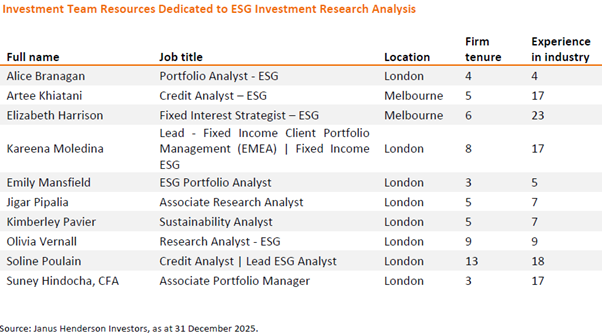
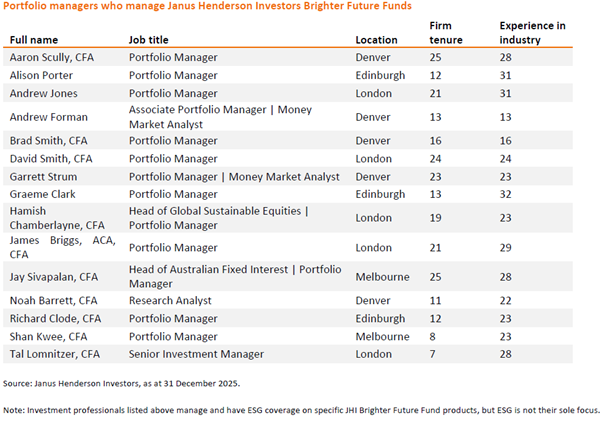
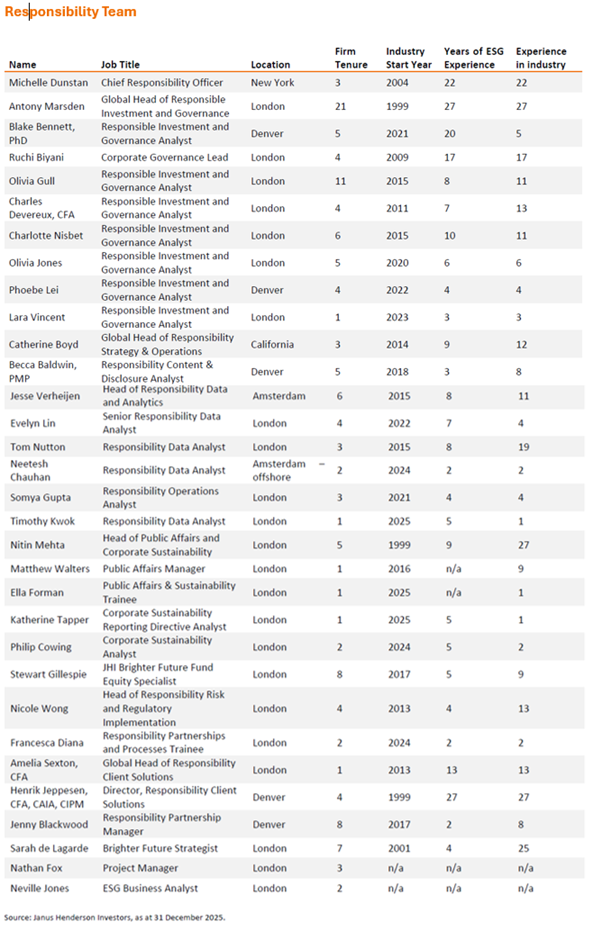
As at 31 December 2025, Janus Henderson has 32 Responsibility Team resources. This centralised team are our ESG subject-matter experts who partner with our investment teams on ESG. On our investment teams, we have 10 dedicated ESG experts embedded within numerous investment teams. Additionally, we have 15 portfolio managers* on Janus Henderson’s Brighter Future (ESG-focused) Funds. Our portfolio managers are further supported by our central research functions and/or investment team analysts.
Source: Janus Henderson Investors, as at 31 December 2025.
*Portfolio managers manage multiple strategies, so may not be fully dedicated to ESG-focused products. Note: the methodology to calculate this data has changed and previously included portfolio managers who manage ESG-integrated funds rather than ESG-labelled products.
Our approach to Responsibility
Janus Henderson has a three-pronged approach to Responsibility.
- The first is our own corporate responsibility. Our commitment to responsibility extends to our corporate practices, embodying the principle that ‘Responsibility starts at home.’ We need to ensure our own policies and practices reflect what our stakeholders demand. At a corporate level, behaving responsibly impacts our people, our culture, and our choices with the ultimate aim of investing in a brighter future for our clients. We leverage our influence to responsibly deliver value to our clients, employees, shareholders, and the wider community.
- The second is ESG integration. At an investment level, we integrate financially material ESG factors into our analysis and processes for most of our actively managed strategies, as appropriate, to help us identify opportunities and risks and to drive the long-term value of the companies in which we invest.
- The third is our JHI Brighter Future Funds. For those clients who want to achieve their risk and return objectives using ESG criteria, we have and continue to build our suite of JHI Brighter Future Fund strategies that have an ESG focus, alongside the primary financial objective.
Responsible Investment Policy overview and Integration
Janus Henderson’s has had a Responsible Investment Policy since approximately 2001, referring to the legal Henderson policy established at this time. In 2023, we implemented our revised Responsible Investment Policy, which sets out our approach to Responsible Investing and ESG Governance and Oversight.
As an active manager, integrating financially material ESG factors into our investment decision-making and ownership practices is fundamental to delivering the results our clients seek from us. Financially material ESG considerations are a key component of the investment processes employed by our investment teams for most of our actively managed strategies. Our investment teams operate and are structured in ways most suited to their respective asset classes. Aside from expectations outlined within our Responsible Investment Policy, the precise approach to and depth of ESG integration is down to the discretion and judgement of our investment teams, who apply their differentiated perspectives, insight and experience to identify sustainable business practices that can generate long-term value for investors. While the evaluation of our implementation of ESG criteria is carried out at the strategy level, our central Responsibility Team supports each team in their ESG integration with data, tools, stewardship, and ESG research.
Engagement and stewardship approach
Engagement and stewardship are integral and natural parts of our long-term, active approach to investment management. We believe engagement is vital to understanding and promoting practices that position the companies and issuers we invest in for future financial success.
Our investment teams often partner with our central Responsibility Team on engagements with company management teams. We prefer an engagement-focused approach to a firm-level exclusion or divestment policy for companies and issuers where we have identified financially material ESG risks. We believe this approach is best for maximising risk-adjusted returns for our clients.
We have a wide range of engagement themes and topics chosen by individual investment teams or the Responsible Investment and Governance Team, which is part of the broader Responsibility Team. These range from longstanding engagement themes such as climate change and diversity, equity & inclusion, to biodiversity, human capital and culture, health and wellbeing, and sustainable corporate governance.
Most products and services offered by a company or issuer play necessary roles for the global economy – including sectors with higher carbon emissions such as energy, industrials, materials, and utilities. Rather than ignoring companies or issuers in these sectors through automatic exclusion or divestment, engagement leads to two benefits:
- Insight: Knowledge gained through engagements with companies or issuers can be leveraged in the investment process to better inform our research, financial modeling, and investment decisions. Engaging for insight helps us assess the magnitude of any potential risk, how well a company or issuer is managing that risk, and the potential impact on that company or issuer’s financial outcomes.
- Outcomes: Where a company or issuer may be ignoring or not managing a financially material ESG risk, engaging for outcomes can encourage that company or issuer to adopt policies or practices that will address that risk and better position it for the future.
Engagement with the company or issuer’s management or board of directors directly link the ESG consideration to why we believe addressing it makes them a better company, leading to improved cash flows, valuations, cost of capital, or credit ratings. In 2024, we conducted a total of 716 engagement discussions – 666 for insight and 50 for outcomes.
Stewardship is an integral and natural part of Janus Henderson’s long-term, active approach to investment management. We believe that strong ownership practices such as management engagement can help protect and enhance long-term shareholder value.
We continue to remain a signatory to the Financial Reporting Council’s UK Stewardship Code, regarded as a benchmark in investment stewardship, as well as supporting Japan’s Stewardship Code, and broader initiatives around the world including the UN-supported Principles for Responsible Investment (PRI).
Our commitment to clients
Janus Henderson understands responsible investing continues to evolve and mature. We are committed to maintaining an open dialogue with our clients, shareholders, employees, industry groups, and regional regulators to ensure we continue to meet their expectations and hold true to our values as a steward of our clients’ capital. This includes listening to client needs and developing new products to meet changing requirements. It also means actively sharing the views of our managers on how they see financially material ESG issues reshaping the investment landscape and where the risks and opportunities lie. The Janus Henderson website provides access to manager insights as well as our Responsibility policies, voting records and annual reports.
Janus Henderson Investors Brighter Future Funds
Many of Janus Henderson’s clients want to achieve their risk and return objectives using ESG criteria. To meet the needs of these clients, we have and continue to build our suite of JHI Brighter Future Fund strategies that have an ESG focus, alongside the primary financial objective..
Companies that have leading ESG practices
Invest in companies that excel in managing ESG risks or take advantage of financially material ESG opportunities.
Companies that are improving or transitioning
Invest in companies that actively enact positive change in their own operations to address financially material ESG issues.
Companies that provide ESG solutions or enable others
Invest in companies that offer products and services that are essential to addressing financially-material ESG issues.
Firm-wide exclusions policy
Except as noted below, the firmwide exclusions generally apply to all Janus Henderson Funds and discretionary segregated mandates. They do not apply to index and certain other derivatives or passive portfolios (including ETFs) intended to track a benchmark.
Weapons (or Controversial Weapons) Exclusions
No investments in direct manufacturers of the below:
▪ Cluster munitions
▪ Anti-personnel mines
▪ Chemical weapons
▪ Biological weapons (‘non-conventional weapons’)
Further to this, investments cannot be made in issuers which invest in/have minority shareholdings of 20% or more in manufacturers of the above.
Cannabis related issuers
To ensure Janus Henderson complies with regional legal and regulatory obligations ‘Cannabis-Related Issuers’ (CRI) may be excluded where an issuer’s revenue from cannabis related activities is understood to constitute more than 5% of their total revenue. A permissibility assessment is undertaken that gives consideration to various factors, including, without limitation:
▪ Domicile of Janus Henderson Group Fund;
▪ Domicile of Janus Henderson Group Fund Manager, including any sub-delegations;
▪ Domicile of the CRI; and
▪ Type of cannabis business operation, product, or activity conducted by the CRI.
Exceptions investing in CRI more broadly may be permitted following request to, and approval from, the ESGOC. All exceptions to this Policy requirement must be suitably documented with the accompanying rationale.
Implementation
Classification of issuers is primarily based on activity identification fields supplied by our third-party ESG data providers. This classification may be subject to an investment research override, following approval by the ESG Oversight Committee (ESGOC), in cases where sufficient evidence exists that the third-party field is not accurate or appropriate
In any scenario where a portfolio position is identified as not meeting this exclusion criteria for any reason (legacy holding, transition holding, etc.) the portfolio manager shall generally be granted 90 days to review or challenge classification of the issuer if appropriate. After this period, in the event an investment research override is not granted, divestment is required under normal market trading circumstances.
Responsibility Team History
We have had employees focused on ESG research, stewardship, etc. since 1991; typically embedded within the investment teams. In 2012, we formally created a separate Responsibility team, independent from the investment teams.
Responsibility Team
The central Responsibility Team is a specialised in-house group that brings together expertise in responsible investment and governance, ESG data and analytics, thematic research, engagement advisory, proxy voting, and regulatory strategy, partnering with and serving as a resource for our investment desks. They play a leading role in working with investment desks to enhance their ESG integration processes and externally leading our active participation in numerous responsibility initiatives. Fundamental, bottom-up research has been at the core of our investment process for more than 45 years and this partnership leads to enhanced research and decision-making by marrying the sector and industry expertise of the investment teams with the responsibility skills of the Responsibility Team.
Beyond investment support, the Responsibility Team drives strategic initiatives, develops new ESG products, provides bespoke client advisory, and leads corporate sustainability programs. They also represent the Firm externally through active participation in global responsibility initiatives and stewardship codes, reinforcing our commitment to transparency and long-term value creation.
Michelle Dunstan, an experienced leader in Responsibility strategy and responsible investing, is our Chief Responsibility Officer (CRO), overseeing our Responsibility strategy. To emphasise the importance of our responsibility efforts and embed them across our entire Firm, the CRO reports directly to the CEO, provides quarterly reports to our Board of Directors on established metrics and targets, and sits on the Firm’s Strategic Leadership Team.
Goals for Responsibility Team and Chief Responsibility Officer
Our Chief Responsibility Officer oversees the areas of our three-pronged approach to Responsibility.
- The first is our own corporate responsibility. Our commitment to responsibility extends to our corporate practices, embodying the principle that ‘Responsibility starts at home’. We need to ensure our own policies and practices reflect what our stakeholders demand. At a corporate level, behaving responsibly impacts our people, our culture, and our choices with the ultimate aim of investing in a brighter future for our clients. We leverage our influence to responsibly deliver value to our clients, employees, shareholders, and the wider community.
- The second is ESG integration. At an investment level, we integrate financially material ESG factors into our analysis and processes for most of our actively managed strategies, as appropriate, to help us identify opportunities and risks and to drive the long-term value of the companies in which we invest.
- The third is our JHI Brighter Future Funds. For those clients who want to achieve their risk and return objectives using ESG criteria, we have and continue to build our suite of JHI Brighter Future Fund strategies that have an ESG focus, alongside the primary financial objective. This can be evidenced by, for example, thematic selection criteria, commitments to beat a benchmark on specific ESG metrics, or targeting a positive environmental or social impact.
To accomplish this, the Responsibility Team and Chief Responsibility Officer have five goals, as agreed upon by the Janus Henderson Group Board of Directors:
- Enhance Responsibility insight and integration within investment teams
- Embed a long-term strategic approach to addressing ESG regulations. Systematise Responsibility data for enhanced insights and reporting▪
- Integrate our corporate responsibility strategy in broader corporate strategy. Offer clients a comprehensive, customised Responsibility Solution.
The team’s three business lines are set up to accomplish these goals:
- Our Responsibility Strategy and Operations pillar oversees firmwide responsibility delivery by providing the data, infrastructure, regulatory coordination, and operational support that underpin investment decision-making, client outcomes, and corporate sustainability. They support our investment and non-investment teams in areas of ESG data and analytics, regulations and risk (collaborating with Regulatory, Risk, Compliance, and Legal on relevant regulatory requirements / disclosures), corporate sustainability (development and support of our corporate environmental strategy and execution), and public affairs.
- Our Responsible Investment and Governance pillar provides direct support to our investment teams. The focus of this partnership is on equipping and supporting our analysts and portfolio managers to do what they do best: research industries and securities to select the most attractive candidates for inclusion in our portfolios. Our team will partner with the investment teams to deliver ESG training, support on developing frameworks to identify financially material ESG risks and considerations, planning and conducting engagements, supporting research on issues that can impact cash flows or valuation, and advising proxy voting.
- Our Responsibility Client Solutions pillar focuses on partnering with our product distribution teams, and investment teams to enhance existing portfolios and deliver new portfolios to clients across varying levels of responsibility needs, from robust integration to ESG-focused strategies. They also partner with investment desks to continuously evolve our integration capabilities, including developing and refining integration frameworks that inform research, stewardship, and portfolio construction. The team also contributes to the development of training, reports, client responses, external communications, and Responsibility thought leadership topics.
Beyond the three core pillars, in 2025, we introduced a new position designed to amplify the intersection of purpose and financial impact: the Brighter Future Strategist. The Team’s Brighter Future Strategist role helps connect Janus Henderson’s purpose, responsible investing priorities, and philanthropic initiatives in a way that is meaningful and accessible for clients. The Brighter Future Strategist works across investments, responsibility team pillars, brand, and client teams to strengthen Janus Henderson’s brand with clients and investors by championing the values that shape our business and define our future.
Our Chief Responsibility Officer provides quarterly updates to the Governance and Nominations Committee on progress against a range of tangible metrics, including science-based targets on our corporate Scope 1 + 2 and Scope 3 upstream emissions, metrics around reporting, thought leadership, and investment strategy development.
Responsible Investment Policy Oversight and Governance
Board of Directors
Oversight of Responsibility, including climate considerations, is part of the formal remit of the Governance and Nominations Committee of the Janus Henderson Group Board of Directors. The Group Governance Committee has established tangible ESG and climate metrics and targets for our operational activities. These metrics include setting science-based targets on our corporate Scope 1 + 2 and Scope 3 upstream emissions, and tracking our CDP score, as well as metrics around reporting, thought leadership, and investment strategy development. At the investment level, the Board receive metrics on how we integrate material climate factors in our research and engagement, our thought leadership, and in our investment strategy development. Our Chief Responsibility Officer, Michelle Dunstan, presents a quarterly update to the Group Governance and Nominations Committee on the metrics, progress against targets, and advancements on strategic Responsibility initiatives. In addition, the Chief Responsibility Officer conducts a Director education session for the Group Governance and Nominations Committee each quarter; this is a “deep dive” into an important Responsibility topic - which could include our own corporate responsibility practices or our responsible investing practices.
ESG Oversight Committee
Our ESG Oversight Committee (ESGOC), which reports to Janus Henderson’s ExCo, provides direct oversight of ESG investment-related matters. The ESGOC provides oversight over ESG investment processes including credibility and feasibility of ESG-related commitments in portfolio design, portfolio management, various ESG data and toolsets, as well as non-investments oversight over ESG processes including regulatory and client reporting standards, and ESG disclosure. The ESGOC is responsible for ensuring that the firm’s framework to manage ESG-related risks is adequate and effective. Specific duties include:
- Review of ESG-related metrics and commitments for new funds and mandates and changes to ESG-related commitments to existing mandates
- Review of ESG-related processes, systems, and resources in place for funds and mandates
- Review of output from ongoing ESG oversight controls monitoring of key ESG-related metrics and exceptions, as well as escalations of matters identified during the course of the monitoring, if any.
The ESGOC is chaired by our Chief Responsibility Officer with additional membership from Responsibility, Product, Investment Controls & Governance, Compliance, Financial Risk, and Legal.
In 2024, our ESGOC successfully established our ESG Strategic Advisory Council, which sits under and supports the ESGOC, strategically by reviewing, challenging, and advising on firm-wide or investment-level ESG regulatory and non-regulatory developments, strategic priorities, pledges and partnerships, and other ESG matters requiring strategic input.
Internal Audit
Janus Henderson has an independent internal audit function, which reports to the Janus Henderson Group Audit Committee. It is responsible for the internal audit of the firm’s worldwide activities. Internal audit operates a multi-year, risk-based audit plan that covers all aspects of the firm’s investment and stewardship activities, such as proxy voting. Internal Audit embeds ESG considerations in all relevant audits within its cyclical risk-based plan. In addition, Internal Audit includes thematic reviews, which in 2024 included a review of the ESG control framework with a focus on regulatory compliance. The findings of these internal audits are regularly shared with the Janus Henderson Group Audit Committee as well as other relevant boards.
Risk management functions
Our Operational Risk function provides support and oversight to each business function to ensure all operational risks are managed in accordance with the risk appetite statement of the firm. Climate risks associated with each operational risk are identified and analysed as qualitative scenarios. Corporate physical and transition risks are reviewed at least annually and reported in a formal corporate Climate Risk Report to the Janus Henderson Group Risk Committee (including escalations of matters identified during the period, if any).
Our Financial Risk team is an independent function reporting directly to the Chief Risk Officer. Its activities include market risk oversight, liquidity risk monitoring and counterparty credit risk management. Further, the team reviews and challenges investment management in light of ESG-related risks— including climate risks—alongside traditional market risk metrics and embeds sustainability risk into the risk profiles of our funds, as appropriate. Beginning in 2023, the Financial Risk team further supports the investment desks in providing portfolio-level oversight of sustainability, climate, and ESG risks. Risk oversight meetings are held with investment desks regularly, with an agenda item to ensure climate-related portfolio risks have been identified.
Compliance
The Compliance team implements automated investment restriction controls within Janus Henderson’s order management system for ESG-related screening and supplements this approach with further controls for qualitative commitments. Additionally, the Compliance team reviews regulatory adherence to the investment policy via the execution of a risk-based monitoring plan. The Compliance team provides board and committee reporting on ESG regulatory matters and are members of the ESGOC.
Front Office Controls
The Front Office Controls & Governance team provide ongoing assurance that investment products are managed in line with documented sustainability commitments, where automated controls and/or third-party data are not available.
ESG Ratings and Recognition
We believe there is a strong link between sustainability issues and the companies that will grow and succeed going forward. This applies to us as an organisation, as well as the companies our investment teams actively engage with in their pursuit of long-term risk-adjusted returns for our clients.
Janus Henderson has been certified as a CarbonNeutral® company since 2007, and we continued to be certified as a CarbonNeutral® company throughout 2024, including for emissions across our corporate Scope 1, 2, and a subset of upstream Scope 3, including business travel, waste, and homeworking. To achieve this certification, Janus Henderson’s emissions inventory has been independently assessed, and we have provided financing to a range of emission reduction projects, supporting essential renewable energy, afforestation, and methane capture from landfill gas to offset our remaining emissions. These projects additionally deliver co-benefits for the environment and society in accordance with the United Nations Sustainable Development Goals (SDGs). Additionally, we have been an investor signatory of the Carbon Disclosure Project since 2000 and we are a registered supporter of the Task Force on Climate-related Financial Disclosures (TCFD). In 2024 we maintained high scores in our Principles for Responsible Investment (PRI) reporting covering the prior year through 30 June 2024. Due to changes in the reporting structure, we elected to disclose only the mandatory PRI signatory reporting through June 2025; therefore we will not receive an updated PRI score until approximately November 2026, covering 1 July 2025 – 30 June 2026.
Janus Henderson actively participates in a variety of independent ESG/CSR benchmarking exercises including with firms such as MSCI, Sustainalytics, and CDP to evaluate the sustainability of our practices alongside our peers.
Janus Henderson Group is rated at the parent company level and continues to maintain the following ESG Ratings.
As at 31 December 2025, our Firm received a AAA rating from MSCI. This rating keeps us in the top 10% of asset management and custody bank industry peers.
- MSCI: AAA as of December 2025
- Sustainalytics: 16.8 / low risk as of December 2024
- CDP: C as at December 2024
- FTSE Russell ESG Scores: 4.4/5 as of June 2025
- ISS: C- ESG Corporate Rating (E&S ratings updated as of September 2025, G updated as of May 2025)
The Responsible Investment Brand Index (RIBI™) is an index scale that evaluates more than 600 asset managers on their commitment to responsible investment and branding. In April 2025, RIBI™ rated Janus Henderson Investors "Avant-Gardist" for the second year in a row. This rating is their highest distinction, with only 20% of asset managers assessed achieving this category.
ESG Affiliations, Memberships, Initiatives and Certifications
In addition to being a founding signatory of the United Nations-supported Principles for Responsible Investment (PRI), Janus Henderson is involved in a wide range of ESG-related initiatives and working groups as a member, supporter or in an advisory capacity.
Our participation in industry working groups along with our sharing of insights and knowledge of ESG through our published materials reflects our status as an active proponent of sustainable investing.
For the full list of our ESG Affiliations, Memberships and Certification details please refer to the Affiliations section in our website: Responsibility-Related Affiliations at Janus Henderson - Janus Henderson Investors
In addition, we publicly support standard setters and industry groups who work with governments to implement stronger sustainability standards in the investment management industry. Where possible, we contribute to ESG policy and regulatory discussions through our response to consultations.
Thought Leadership
As part of our commitment to advancing the industry dialogue around ESG, we seek to make the thinking of our investment teams widely available to our clients, shareholders, and other stakeholders through a variety of content, including white papers, articles, podcasts, videos, and panel debates. As with our ESG research, we aim to publish content that contains thoughtful, practical, research-driven, and forward-looking insights.
In 2025, we generated 28 thought leadership and educational pieces on responsibility topics. Our investment teams also produce papers on ESG investment approaches and relevant topics. The insights included relevant topics such as evaluating corporate transition plans, precision technology in agriculture, responsible mining, and human rights and supply chain management.
In terms of specific themes and topics, we produced broader papers and debates on a variety of ESG issues, including methane emissions from the oil & gas industry, deforestation, the role of metals in decarbonisation, renewable energy, and electric and autonomous vehicles. We also published articles outlining our approach to ESG and natural capital investing.
For further information on Janus Henderson’s ESG capabilities, policies, engagement etc., please visit to the ESG Resource Library in our website: ESG Resource Library at Janus Henderson - Janus Henderson Investors.
Dialshifter
This fund is helping to ‘shift the dial from brown to green’ by…
Built 30 years ago, the four pillars of our sustainable investment approach remain as pertinent today as they were three decades ago. It is these pillars which have enabled the strategy to remain at the forefront of sustainable investing for so long; as knowledge of sustainability has progressed, our investment approach has blossomed all the while remaining rooted in the strategy’s core beliefs. We consider this to be integral to the strategy’s success.
SDR Labelling:
Sustainability Focus label
Key Performance Indicators:
We will measure the alignment of each investment to our Sustainability Themes and will report: (a) the proportion of the portfolio’s investments where a majority of revenues (at least 50%) are aligned with a Sustainability Theme; and (b) the weighted average revenue of the overall portfolio that is aligned to each of the Sustainability Themes. We will also report on the following metrics and commitments that we believe investors will find helpful: Assets with positive quality of life characteristics Metric The weighted average revenue of the overall portfolio that is invested in quality of life assets. Climate Change and Decarbonisation Several of the Investment Manager’s Sustainability Themes relate to helping to address environmental challenges such as climate change and decarbonisation. The Investment Manager believes that the carbon intensity and footprint of the Fund are appropriate indicators of environmental sustainability, informed by the Task Force on Climate related Financial Disclosures “Guidance on Metrics, Targets, and so it commits Transition Plans” and the Partnership for Carbon Accounting Financials, which builds on the Greenhouse Gas Protocol to maintaining them enable financial institutions to consistently measure and disclose the emissions of their financial activities. Carbon intensity and footprint are climate-related measures that are comparable across funds and benchmarks.
- Carbon Intensity Scope 1&2 - The weighted average carbon intensity (Scope 1 and 2) of the Fund represents the Fund’s exposure to emissions-intensive companies, measured as Scope 1 + Scope 2 greenhouse gas emissions normalized by sales, which allows for comparison between companies and funds or benchmarks of different sizes. Scope 1 emissions are those from sources owned or controlled by the company, typically direct combustion of fuel as in a furnace or vehicle. Scope 2 emissions are those caused by the generation of electricity purchased by the company. Scope 3 emissions are those emissions that are indirectly caused by an organisation within its value chain but are not produced by the organisation itself or included in Scope 1 or 2 emissions. Scope 3 emissions are not included due to the limited availability and quality of Scope 3 emissions data. The exclusion of Scope 3 emissions may cause the emissions profile of the Fund to be understated.
- Carbon Footprint Scope 1&2 - The carbon footprint (Scope 1 and 2) of the Fund represents the greenhouse gas emissions owned by the Fund on an enterprise value including cash (EVIC) basis, measured as Scope 1 + Scope 2 greenhouse gas emissions/$million invested in the Fund. EVIC is a calculation that includes a company's cash and cash equivalents, as well as its market capitalisation and total debt.
Metric
Maintaining carbon intensity and footprint of the Fund at least 20% below its benchmark, the MSCI World Index.
Overall UNGC and OECD MNE Compliance Status
UNGC compliance covers matters including human rights, labour, corruption, and environmental pollution.
The exclusion of controversial activities deemed by the Investment Manager to do significant harm to environmental or social sustainability as further described in the “Investment Strategy and Sustainability Approach” section within the Fund’s prospectus, Janus Henderson Global Sustainable Equity Fund_Prospectus.
The Investment Manager aims to invest in companies which are not in breach of both the UNGC and OECD MNE and assesses such compliance thoroughly before any investment. Where a potential investee company is assessed as being not fully compliant, the Investment Manager will not invest in it. Metric 0% investment in non-compliant companies and will report on the percentage of compliant versus non-compliant investee companies.
For further information on the Fund’s key performance indicators (KPIs), please refer to the most recent Quarterly ESG, Sustainability and Climate Report.
- Consumer Facing Disclosure
SDR Literature:
Fund Holdings
Voting Record
Disclaimer
The Global Sustainable Equity fund avoids companies engaged in fossil fuel power generation, however, the fund may invest in companies generating power from natural gas where the company’s strategy involves a transition to renewable energy. Investment in such companies is permitted where carbon intensity is aligned with a below 2°C scenario. Where carbon intensity cannot be determined, a 10% threshold for energy production from natural gas is used.
Funds with a Sustainability Focus label invests mainly in assets that focus on sustainability for people or the planet.
This document is intended solely for the use of professionals, defined as Eligible Counterparties or Professional Clients, and is not for general public distribution. Marketing Communication. Past performance does not predict future returns. The value of an investment and the income from it can fall as well as rise and you may not get back the amount originally invested. Tax assumptions and reliefs depend upon an investor’s particular circumstances and may change if those circumstances or the law change. If you invest through a third party provider you are advised to consult them directly as charges, performance and terms and conditions may differ materially. Nothing in this document is intended to or should be construed as advice. This document is not a recommendation to sell or purchase any investment. It does not form part of any contract for the sale or purchase of any investment. Any investment application will be made solely on the basis of the information contained in the Prospectus (including all relevant covering documents), which will contain investment restrictions. This document is intended as a summary only and potential investors must read the prospectus, and where relevant, the key investor information document before investing. We may record telephone calls for our mutual protection, to improve customer service and for regulatory record keeping purposes.
Issued by Janus Henderson Investors. Janus Henderson Investors is the name under which investment products and services are provided by Janus Henderson Investors International Limited (reg no. 3594615), Janus Henderson Investors UK Limited (reg. no. 906355), Janus Henderson Fund Management UK Limited (reg. no. 2678531), Tabula Investment Management Limited (reg. no. 11286661), (each registered in England and Wales at 201 Bishopsgate, London EC2M 3AE and regulated by the Financial Conduct Authority) and Janus Henderson Investors Europe S.A. (reg no. B22848 at 78, Avenue de la Liberté, L-1930 Luxembourg, Luxembourg and regulated by the Commission de Surveillance du Secteur Financier).
Janus Henderson® and any other trademarks used herein are trademarks of Janus Henderson Group plc or one of its subsidiaries. © Janus Henderson Group plc.
| Fund Name | SRI Style | SDR Labelling | Product | Region | Asset Type | Launch Date | Last Amended |
|
|---|---|---|---|---|---|---|---|---|
Janus Henderson Global Sustainable Equity Fund |
Sustainable Style | Sustainability Focus label | OEIC | Global | Equity | 01/08/1991 | May 2026 | |
ObjectivesThe Fund aims to provide capital growth over the long term (5 years or more) by investing in companies that the Investment Manager believes contribute to positive environmental or social change by reference to the sustainability themes. The Investment Manager has identified nine environmental and social sustainability themes that it believes will help drive a sustainable global economy by addressing current global challenges such as population growth, ageing population, resource constraints and climate change. The Investment Manager will invest in companies whose products and/or services are aligned with the sustainability themes. For further information on sustainability goals and objectives, please refer to the consumer facing disclosures of the Fund. |
Fund/Portfolio Size: £1739.72m (as at: 31/12/2025) Total Screened Themed SRI Assets: £6466.27m (as at: 31/12/2025) Total Responsible Ownership Assets: £316155.97m (as at: 31/12/2025) Total Assets Under Management: £366678.25m (as at: 31/12/2025) ISIN: GB0005027221, GB00B71DPP64, GB0005030043, GB00B5VYGQ34, GB00B7KYJH09, GB00BF8DGS54, GB00BGQVHT66, GB00BJ0LFS89, GB00BMX58X45 Contact Us: Please contact your Sales representative with any queries. |
|||||||
Sustainable, Responsible &/or ESG OverviewThe Fund’s objective is to invest in a portfolio of global companies that will contribute to a more sustainable global economy, that will generate attractive excess returns for our clients. The team manages the Janus Henderson Global Sustainable Equity Strategy (the ‘Strategy’) with an aim to generate material outperformance against the MSCI World benchmark over the long term. We believe that there is a strong link between sustainable development, innovation, and long-term compounding growth. Our investment framework leads us to invest in companies that we believe contribute to the development of a more sustainable global economy, through their revenue alignment with ten environmental and social themes. At the same time, it helps us stay on the right side of disruption by seeking to avoid companies we consider to be involved in activities that are harmful to the environment and society. We believe this approach will provide clients with a persistent return source, deliver future compound growth, and help mitigate downside risk. |
||||||||
|
Primary fund last amended: May 2026 |
||||||||
|
Information received directly from Fund Manager |
||||||||
|
Please select what you would like to read:
Fund FiltersSustainability - General
Sustainability policy
Has policies that consider (environmental and social) sustainability issues. Strategies vary but are likely to consider environmental issues like climate change, carbon emissions, biodiversity loss, resource management, environmental impacts; and social issues like equal opportunities, human rights, labour standards, diversity and adherence to internationally recognised codes. See individual entry information.
Sustainability focus
Has a significant focus on sustainability issues
Sustainable transport policy or theme
Has documented policies or thematic investment approaches supporting investment in more sustainable, greener transport methods. These will typically set out a preference for companies that run, enable or support more sustainable methods of transport.
Encourage more sustainable practices through stewardship
Aim to encourage higher sustainability standards through responsible ownership / stewardship / engagement / voting activity
UN Global Compact linked exclusion policy
Use the UN Global Compact to inform or help direct where they can or cannot invest. Will typically not invest in companies with significant breaches (low standards) - strategies vary. (The UNGC covers a wide range of issues - search 'UNGC'). See https://unglobalcompact.org/
Transition focus
Aim to support the shift to a sustainable future. See eg https://www.transitionpathwayinitiative.org/
Report against sustainability objectives
Publicly report performance against named sustainability objectives
Green / sustainable property strategy
Has a strategy on - and may focus investment on sustainability issues in the property sector - they may eg use GRESB / BREEAM scores to inform investment decisions. Environmental - General
Environmental policy
Has policies which relate to environmental issues. These will typically set out their stance on issues such as pollution, climate change, resource management, biodiversity loss, carbon emissions, plastics and/or additional environmental impacts. Strategies vary.
Limits exposure to carbon intensive industries
Options that limit or 'reduce' their exposure to carbon intensive industries (ie sectors which are major contributors to climate change). Strategies vary.
Environmental damage & pollution policy
Has documented policies explaining the approach to environmental damage and pollution. Strategies vary.
Resource efficiency policy or theme
Has a policy or theme that relates to managing natural resources more efficiently. Strategies vary. See individual entry information.
Favours cleaner, greener companies
Aims to invest in companies with strong or market leading environmental policies and practices. Strategies vary. See individual entry information for more detail.
Waste management policy or theme
Has a written policy or theme focused on waste management - typically to support or encouraging higher levels of recycling and better efficiency / reducing waste. Strategies vary. Nature & Biodiversity
Deforestation / palm oil policy
Has policies designed to address involvement in irresponsibly managed palm oil or other forms of deforestation (typically exclusion led). Strategies vary.
Illegal deforestation exclusion policy
Avoids assets that are involved in illegal deforestation. This may relate to palm oil, cattle farming or other areas. Strategies vary.
Sustainable fisheries policy
Has a sustainable fisheries policy that will inform where they can and cannot invest.
Avoids genetically modified seeds / crop production
Aims to avoid investing in companies that produce genetically modified seeds or crops. (This does not typically include avoiding companies such as supermarkets).
Genetic engineering exclusion
Avoids assets / companies directly involved in genetic engineering
Water stewardship policy
Has a policy which sets out their expectations for how investee assets should manage their use of water - likely to focus on high users. Climate Change & Energy
Climate change / greenhouse gas emissions policy
Has policies (documented strategies that explain their position) on climate change related issues such as greenhouse gas/carbon emissions, net zero, transitioning to lower carbon. Strategies vary.
Coal, oil & / or gas majors excluded
Avoid investment in major coal, oil and/or gas (extraction) companies. Strategies vary.
Fracking & tar sands excluded
Avoid companies involved in fracking and tar sands - which are widely regarded as controversial methods of oil and gas extraction. Strategies vary.
Arctic drilling exclusion
Avoid companies that are involved in extracting oil from the Arctic regions.
Fossil fuel reserves exclusion
Avoid investing in companies / assets with coal, oil and gas reserves. See individual entry information for further details.
Clean / renewable energy theme or focus
Invest (or may invest) in clean / renewable energy companies and other assets. The proportion directly or indirectly invested in renewable energy may vary over time.
Encourage transition to low carbon through stewardship activity
Encourage the transition to lower carbon activities through asset selection and / or responsible ownership activity.
Energy efficiency theme
Has an energy efficiency theme - typically meaning that the manager is focused on investing in organisations that manage - or help others to manage - energy use more carefully and less wastefully - and so reduce greenhouse gas emissions.
Invests in clean energy / renewables
Invest in renewable energy companies and / or companies where renewable energy is a significant part of their business. Strategies vary.
Nuclear exclusion policy
Has a policy which describes the avoidance or limited investment in the nuclear industry. Strategies vary.
Supply chain decarbonisation policy
Has a supply chain decarbonisation policy which sets out their position on the need to reduce carbon emissions.
Fossil fuel exploration exclusion - direct involvement
Excludes companies and other assets with direct involvement in fossil fuel exploration (eg coal, oil and gas companies)
TCFD / IFRS reporting requirement
Will only invest in companies that report greenhouse gas emissions in line with this international reporting framework. See https://www.fsb-tcfd.org/ https ://www.ifrs.org/sustainability/tcfd/
Require net zero action plan from all / most companies
Requires all, or most of, the assets they invest in to have a ‘net zero action plan’ - describing how they will reduce their greenhouse gas emissions. Social / Employment
Labour standards policy
Has a labour standards policy - likely to mean they will invest in / favour companies that have higher employment related standards and avoid those with low standards. Strategies vary. See eg https://www.ilo.org/international-labour-standards
Health & wellbeing policies or theme
Has policies or themes that set out their approach to health and wellbeing issues, typically aims to invest in companies with high standards - or encourage high standards.
Diversity, equality & inclusion Policy (product level)
Has a written diversity policy – where the manager will aim to select companies with a carefully considered, positive employment standards. This may cover a range of issues including gender, ethnicity, disability, beliefs and sexual orientation.
Mining exclusion
All mining companies excluded Ethical Values Led Exclusions
Ethical policies
Has policies that set out their position on ethical or 'personal values' based issues. Strategies vary.
Tobacco & related product manufacturers excluded
Companies are excluded if they are involved in any aspect of the production chain for tobacco products, including cigarettes, vaping, e-cigarettes, chewing tobacco and cigars.
Tobacco & related products - avoid where revenue > 5%
Companies are excluded if they make more than 5% of their revenue from the manufacture, sale or distribution of tobacco products including cigarettes, vaping, e-cigarettes, chewing tobacco and cigars.
Controversial weapons exclusion
Excludes companies which make controversial weapons such as landmines, cluster munitions and chemical weapons.
Armaments manufacturers avoided
Avoids companies that manufacture weapons intended specifically for military use. Strategies vary - may or may not include non-strategic military products.
Military involvement exclusion
Avoids companies with military contracts. This may include medical supplies, food, safety equipment, housing, technology etc
Civilian firearms production exclusion
Has a written civilian firearms exclusion policy - meaning that they will not invest in companies that make (or perhaps also sell) handguns made for non-military users.
Alcohol production excluded
Avoids companies that produce alcohol. Strategies vary; some may allow a small proportion of revenue to come from this area.
Gambling avoidance policy
Avoids companies with significant involvement in the gambling industry. Some may allow a small proportion of revenues to come from this area.
Pornography avoidance policy
Avoids companies that derive significant income from pornography and related areas. Strategies vary.
Animal welfare policy
Has policies that require specific animal welfare standards to be met. These may reference well-known welfare standards (3Rs - Replace, Reduce, Refine) or certification schemes. Strategies vary.
Animal testing - excluded except if for medical purposes
Avoids companies that test their products on animals for purposes other than medical benefit (e.g. for cosmetics). Strategies vary. Human Rights
Human rights policy
Has policies relating to human rights issues. Typically require companies to demonstrate higher standards, although some managers work to encourage improvements. Investee companies are often judged against internationally agreed norms or standards. Strategies vary.
Child labour exclusion
Has policies to avoid companies that employ children.
Oppressive regimes (not free or democratic) exclusion policy
Has policies that exclude companies or other assets which operate in, or are owned by regimes which are not democratic, or where people may be oppressed. May use eg. Freedom House research. Strategies vary.
Modern slavery exclusion policy
Has a policy which excludes assets with involvement in Modern Slavery Meeting Peoples' Basic Needs
Water / sanitation policy or theme
Have policies or themes that set out the position on investment in the water sector and/or sanitation. Strategies vary.
Demographic / ageing population theme
Has a thematic investment approach focusing on the ‘silver economy’ - in particular (typically) the issues and opportunities presented by changing demographics. This could include finance, healthcare and medicines and/ or longevity science to extend lifespans. Strategies vary.
Healthcare / medical theme
Healthcare and or medical theme or area of investment - may have a single or many themes Gilts & Sovereigns
Does not invest in sovereigns
Does not invest in / excludes 'sovereigns' - debt issued by governments. See eg https://www.investopedia.com/terms/s/sovereign-debt.asp Banking & Financials
Invests in banks
Can include banks as part of their holdings / portfolio.
Exclude banks that finance fossil fuels extraction
Avoids banks which finance fossil fuels extraction (coal, oil, gas)
Predatory lending exclusion
Excludes financial services companies with widely criticised, aggressive lending practices where interest rates are typically very high, (eg ‘doorstep lending’)
Exclude banks with significant fossil fuel investments
Avoids banks that have a large part of their loan book (or other assets) invested in fossil fuels companies - particular coal, oil and gas.
Invests in insurers
May invest in insurance companies. Governance & Management
Governance policy
Has policies that relate to corporate governance issues such as board structure, executive remuneration, bribery and/or corporate corruption. These funds will typically avoid companies with poor practices. Strategies vary.
Avoids companies with poor governance
Avoids investing in companies with poor governance practices.(e.g. board structure, management practices etc.) Views may however vary on what counts as 'poor' practices - and funds may not immediately divest as they may prefer to work to encourage higher standards.
UN sanctions exclusion
Exclude companies that are subject to United Nations sanctions. See eg https://main.un.org/securitycouncil/en/content/un-sc-consolidated-list
Anti-bribery & corruption policy
Has policies explaining how managers will respond to assets / companies that do not comply with relevant anti-bribery and anti-corruption standards or laws. Strategies vary; options include stewardship/ engagement and divestment - or a combination.
Encourage board diversity e.g. gender
Encourage the companies they invest in to have more diverse board structures (e.g. more women on boards)
Encourage TCFD alignment for banks & insurance companies
Encourage the banks and insurance companies they invest in to publish climate change related financial information - as set out by the Task Force on Climate Related Financial Disclosures (with the aim of helping investors measure and respond to climate risk).
Encourage higher ESG standards through stewardship activity
Aim to encourage higher ESG standards through responsible ownership / stewardship / engagement /voting activity
Require investee companies to report climate risk in R&A
Requires the companies they invest in to report on climate risks that are relevant to their business in their report and accounts Product / Service Governance
External oversight / advisory committee (fund / service)
Find options that have an external committee that helps steer or advise managers on sustainability, ethical, stewardship or ESG policy or strategy related issues. These people may be paid for their time but are not employees of the fund manager.
External (fund / service) committee has veto powers
Find options that employ an external committee (i.e. not company employees) that has the power to veto (i.e. overrule) fund/asset managers selection decisions. (This would typically mean the committee can tell the manager not to buy / sell a specific investment.)
ESG integration strategy
Find fund / asset managers that factor in 'environmental, social and governance' issues as part of their investment decision making process. A focus on 'ESG' typically means a fund is carrying out additional research to help reduce ESG related risks. It does not necessarily mean a focus on sustainability. Strategies vary. See fund literature. Asset Size
Over 50% large cap companies
Invests more than half of their money into what are commonly regarded as 'large companies'. This will typically mean that the market capitalisation (or value) of the companies they hold is in excess of £5 to £10 billion.
Invests in small, mid & large cap companies / assets
Invests in a combination of small, medium and larger (potentially multinational) companies / assets. Targeted Positive Investments
Invests >25% in environmental / social solutions companies
Invests >25% of their capital in companies where a major part of their business is focused on helping to address environmental or social challenges.
Invests >50% of fund in environmental / social solutions companies
Invests >50% of their capital in companies where a major part of their business is focused on helping to address environmental or social challenges. Impact Methodologies
Aims to generate positive impacts (or 'outcomes')
Has policies that aim to help or support the delivery of positive social or environmental impacts (or societal/real world outcomes) by investing in companies they regard as beneficial to people and / or the planet. Strategies vary.
Invests in environmental solutions companies
Directs investment towards companies where a major part of their business is about solving environmental challenges. e.g. companies helping to address climate change.
Invests in social solutions companies
Invest in companies where a major part of their business is specifically aimed at helping to address social challenges. e.g. companies helping to address poverty.
Invests in sustainability / ESG disruptors
Specifically sets out to invest in companies that are regarded as 'disrupting' existing business practices - typically through the development of innovative (sustainability aware) products and/or practices.
Aim to deliver positive impacts through engagement
Aims to deliver positive environmental and or social impacts (real world benefits) through its engagement with investee assets
Over 50% in assets providing environmental or social ‘solutions’
Invests more than 50% of capital in assets which are regarded as being significantly focused on providing solutions to environmental or social challenges. Strategies vary. How The Fund/Portfolio Works
Positive selection bias
Focuses on finding and investing in companies with positive / beneficial attributes. This strategy can be applied in addition to exclusion criteria and engagement/stewardship activity.
Significant harm exclusion
Aims to avoid companies that do significant harm. This originates from the EU’s sustainable finance ‘DNSH’ (do no significant harm) work, which is not necessarily used by UK investors.
Assets mapped to SDGs
Invests in assets which can be 'mapped' (reviewed) their investment selection and management strategies to identify which of the UN Sustainable Development Goals (SDGs) the fund is helping to address.
Combines norms based exclusions with other SRI criteria
Investment selection process uses internationally agreed 'norms' (e.g. United Nations Global Compact - UNGC - or the UN Sustainable Development Goals - SDGs) alongside additional SRI criteria such as positive or negative stock selection policies and/or stewardship strategies.
Combines ESG strategy with other SRI criteria
Invests in assets which have an ESG strategy (which is typically focused on avoiding companies that pose environmental, social or governance related risks) together with additional criteria such as positive and/or negative screens, themes and stewardship strategies.
ESG risk mitigation focus
Focuses on the careful management of environmental, social and governance (ESG) related risks - typically by avoiding or being underweight in companies seen as posing major risks in these areas (i.e. not necessarily by using themes, exclusions etc).
SRI / ESG / Ethical policies explained on website
Publish explanations of their ethical, social and/or environmental policies online (i.e. investment decision making strategies/ buy/sell &/or asset management strategies).
Do not use stock / securities lending
Does not use stock lending for performance or risk purposes. Unscreened Assets & Cash
Assets typically aligned to sustainability objectives 70 - 79%
Holds between 70-79% of assets which align to the sustainability objectives; which are not being held purely for risk management purposes, such as derivatives and cash equivalent assets.
Assets typically aligned to sustainability objectives 80 – 89%
Holds between 80-89% of assets which align to the sustainability objectives; which are not being held purely for risk management purposes, such as derivatives and cash equivalent assets.
No ‘diversifiers’ used other than cash
Only invests in cash to aid the practical management (buying and selling) of assets and so do not use additional financial instruments. Intended Clients & Product Options
Intended for clients interested in sustainability
Designed to meet the needs of individual investors with an interest in sustainability issues.
Intended for clients interested in ethical issues
Designed for clients who care about ethical and values-based issues, often alongside sustainability issues also.
Available via an ISA (OEIC only)
Available via a tax efficient ISA product wrapper. Labels & Accreditations
SDR Labelled
Find options that have chosen to adopt one of the Financial Conduct Authority (FCA) SDR labels. Please note: there are a range of reasons why potentially relevant options may not use an SDR label eg. adopting a label may be work in progress, the manager may not yet be allowed to do so because of the product type, a manager may feel they are insufficiently aligned to SDR requirements.
RSMR rated
Find options that are rated by research agency 'Rayner Spencer Mills Research' (awarded 'RSMR Rated' status). Contact RSMR for further information. Fund Management Company InformationAbout The Business
Responsible ownership / stewardship policy or strategy (AFM companywide)
Finds fund / asset management companies that have a published company wide stewardship, engagement and / or responsible ownership policy or strategy that covers all investments. Stewardship typically involves encouraging higher ESG standards through voting and dialogue.
ESG / SRI engagement (AFM companywide)
Find fund / asset management companies that actively encourage higher 'environmental, social and governance' and / or 'sustainable and responsible investment' practices across investee companies - typically where the aim is to encourage positive change that is aligned with the best interests of investors. Strategies vary. See additional information and options.
Vote all* shares at AGMs / EGMs (AFM companywide)
Find fund / asset managers that vote all* the shares they own at Annual General Meetings and Extraordinary General Meetings. A commitment to voting shares is a key indicator of 'responsible share ownership' demonstrating their support for or disagreement with management policy. (*situations can legitimately, occasionally occur where voting proves impossible, but in principle all shares should be voted.)
Responsible ownership / ESG a key differentiator (AFM companywide)
Find fund / asset managers that consider responsible ownership and ESG to be a key differentiator for their business.
Senior management KPIs include environmental goals (AFM companywide)
The leadership team of this fund / asset manager have performance targets linked to environmental goals.
SDG aligned aims / objectives (AFM companywide)
Find fund / asset management companies that aim to align all their investments (across all funds) to help meet the aims of the UN Sustainable Development Goals.
Responsible ownership policy for non SRI / sustainable options (AFM companywide)
Find options run by managers that apply Responsible ownership or 'Stewardship' policies to all or most of their investment assets. This means active involvement (e.g. voting, dialogue) with the companies across all or most funds, products and services.
Integrates ESG factors into all / most research (AFM companywide)
Find fund / asset management companies that consider environmental, social and governance (ESG) issues when deciding whether or not to invest in a company for all / almost all of their funds and other assets. This is increasingly seen as part of sound risk management.
In-house diversity improvement programme (AFM companywide)
Finds organisations / fund managers that have an in-house (company wide) diversity improvement programme - meaning that they are working to ensure that within their own businesses they employ people from diverse backgrounds - often typically focused on ethnicity and/or sex.
Invests in newly listed companies (AFM companywide)
This fund / asset management company invests in companies which have recently listed on a stock exchange (which is important as it can help grow new businesses).
Invests in new sustainability linked bond issuances (AFM companywide)
Fund / asset management company has investments in bonds designed to meet sustainability requirements - however these assets may not be 'ringfenced' for this purpose. See website for details.
Offer structured intermediary sustainable investment training
Fund management entity offers unstructured intermediary training on sustainable investment (ie for financial advisers and wealth managers)
Offer unstructured intermediary sustainable investment training
Fund management entity offers unstructured intermediary training on sustainable investment (ie for financial advisers and wealth managers) Collaborations & Affiliations
PRI signatory
Find fund / asset management companies that have signed up to the UN backed 'Principles of Responsible Investment'.
UKSIF member
Find fund / asset management companies that are members of UKSIF - the UK Sustainable Investment and Finance association
Fund EcoMarket partner
Find fund / asset management companies that have partnered with Fund EcoMarket - meaning that they are helping to improve access to information on sustainable and responsible investment by paying an annual fee to us which enables us to publish information for free. Partner funds are listed ahead of other funds and have their logos displayed.
TNFD forum member (AFM companywide)
A member of the Taskforce for Nature Related Financial Disclosures group which aims to aid risk management and shift money towards nature-positive outcomes.
Investment Association (IA) member
Fund management entity is a member of the Investment Association https://www.theia.org/ Resources
In-house responsible ownership / voting expertise
Find fund / asset management companies that employ people to steer and support fund managers in voting shares at company AGM's and EGMs in ways that are consistent with encouraging higher ESG/sustainability standards.
Employ specialist ESG / SRI / sustainability researchers
Find a fund / asset management company that directly employs specialist ESG/SRI/sustainability researchers or analysts. This allows asset managers to discuss environmental, social and governance risks and opportunities directly with companies.
Use specialist ESG / SRI / sustainability research companies
Find fund / asset management companies that makes use of expert external research companies. This can help deliver specialist expertise and means resources are pooled with other investors.
ESG specialists on all investment desks (AFM companywide)
Finds organisations / fund managers that have one or more ESG/sustainability experts on all investment teams or 'desks' (all asset types) Accreditations
UK Stewardship Code signatory (AFM companywide)
Find fund / asset managers that are signatories to the FRC UK Stewardship Code, which sets out a framework for constructive investor / investee relations where managers are encouraged to behave like responsible, typically longer term 'company owners'. Engagement Approach
Regularly lead collaborative ESG initiatives (AFM companywide)
Find fund / asset management companies that regularly initiate or run industry wide (collaborative) investor projects aimed at raising environmental, social and governance standards amongst investee companies.
Encourage responsible corporate taxation (AFM companywide)
Find fund / asset management companies that are working with the companies they invest in to encourage more responsible corporate taxation.
Engaging on climate change issues
Fund / asset manager has stewardship /responsible ownership strategy that is focused on addressing climate change with investee assets.
Engaging with fossil fuel companies on climate change
Fund / asset manager has a stewardship /responsible ownership strategy that involves working with fossil fuel companies on climate change related issues. See fund manager website for details.
Engaging to reduce plastics pollution / waste
Fund / asset manager has stewardship /responsible ownership strategy with involves encouraging investee asset to reduce plastic waste and pollution.
Engaging to encourage responsible mining practices
Fund / asset manager has a stewardship / responsible ownership policy that means they are working to encourage more responsible mining practices - where environmental and social issues are properly dealt with by the companies they invest in.
Engaging on biodiversity / nature issues
The fund / asset manager has a responsible ownership / stewardship strategy that focuses on biodiversity and nature issues relating to the assets they invest the aim of which will be to reduce harm and or deliver improvement. Strategies vary. https://tnfd.global
Engaging on human rights issues
Fund / asset manager has responsible ownership / stewardship strategy in place which aims to address human rights issues in investee companies (and potentially their suppliers) with the aim of raising standards
Engaging on labour / employment issues
Fund / asset manager has responsible ownership / stewardship strategy in place that aims to improve labour standards for the benefit of employees in investee companies (and potentially their suppliers)
Engaging on diversity, equality & / or inclusion issues
Fund / asset management company has a stewardship strategy in place which involves working to raise diversity, equality and inclusion standards across investee assets
Engaging to stop modern slavery
Fund / asset manager is working with the assets they hold to help stamp out modern slavery - where direct or indirect company employees are exploited for business benefits.
Engaging on governance issues
Fund / asset managers have stewardship strategies in place that focus on improving governance standards across investee assets
Engaging on responsible supply chain issues
Has a stewardship / responsible ownership strategy that encourages responsible supply chain - ie the managers will discuss environmental, social and governance issues with investee companies with the aim of raising standards
Engaging on the responsible use of AI
Working to address sustainability, ESG and related concerns around artificial intelligence.
Stewardship escalation policy
Escalation policies describe how a manager will proceed if stewardship / engagement activity is not successful in the short term. Company Wide Exclusions
Controversial weapons avoidance policy (AFM companywide)
Find fund / asset management companies (not funds) that avoid investment in 'controversial weapons' across all of their funds and other investment vehicles.
Review(ing) carbon / fossil fuel exposure for all funds (AFM companywide)
Find funds / asset managers that are reviewing, or have reviewed, their exposure to carbon intensive industries including (but not only) mining, oil and gas companies. (Typically with reference to climate change.) Climate & Net Zero Transition
Encourage carbon / greenhouse gas reduction (AFM companywide)
Find fund / asset management companies that are working with the companies they invest in to encourage reductions in carbon dioxide and other greenhouse gas emissions.
‘Forward Looking Climate Metrics’ published / ITR (AFM companywide)
Finds organisations / fund managers that have published ‘forward looking climate metrics’ e.g. 'implied temperature rise' data that are a total of the asset management company's share (% owned) of all the investee company emissions of the assets they manage, as well as their own direct and other indirect emissions.
Carbon offsetting - offset carbon as part of net zero plan (AFM companywide)
This fund / asset management company plans to achieve net zero greenhouse gas (CO2e) emissions with the help of a scheme that will lock away an amount of carbon that is equivalent to the company’s own emissions – so that the end result is ‘net zero’. Calculations and scope vary.
In-house carbon / GHG reduction policy (AFM companywide)
Find fund / asset management companies that are working to reduce their own (fund management company) carbon/greenhouse gas emissions. Transparency
Publish responsible ownership / stewardship report (AFM companywide)
Find fund / asset management companies that publish a report detailing their responsible investment ownership - also known as 'Stewardship' - activity.
Full stewardship / responsible ownership policy information on company website
Find fund / asset management companies that publish information about their sustainable and responsible investment strategies on their company website.
Full stewardship / responsible ownership policy information available on request
Find fund / asset management companies that will supply information about their sustainable and responsible investment activity on request.
Publish full voting record (AFM companywide)
Fund / asset management companies that publish a full record of how they vote their shares at AGMs (annual general meetings) and EGMs (extraordinary general meetings). Voting strategies have an important role to play encouraging higher environmental, social and governance standards.
Dialshifter statement
Find fund / asset management companies that have supplied Dialshifter information. See Dialshifter tab within record for more information. CommentsPlease note: Coal Exclusion: We do not invest in companies engaged in activities related to fossil fuels*. * We may invest in companies generating power from natural gas if the company’s strategy involves a transition to renewable energy power generation and they have a carbon intensity aligned with the Paris Agreement. Sustainable, Responsible &/or ESG Policy:The Global Sustainable Equities Team (the ‘team’) aims to outperform the market over the long term through creating a differentiated global equity portfolio of the best sustainability ideas. The team’s investment approach is explicitly low carbon and by incorporating environmental, social, and governance factors into their analysis they seek to construct a portfolio with a favourable risk profile. The team believe there is a strong link between sustainable development, innovation, and long-term compounding growth. Our investment framework leads us to invest in companies that we believe contribute to the development of a more sustainable global economy, through their revenue alignment with ten environmental and social themes. At the same time, it helps us stay on the right side of disruption by seeking to avoid companies we consider to be involved in activities that are harmful to the environment and society. We believe this approach will provide clients with a persistent return source, deliver future compound growth, and help mitigate downside risk.
30 years of sustainability thought leadership
We believe there are a myriad of investment opportunities arising from the migration towards a more sustainable global economy, and that the best investment returns will be generated by companies that are on the right side of these. Looking for these long-term compounding characteristics and staying focused on long-term value not short-term valuation metrics, can generate exciting investment returns. We also believe there are substantial risks to companies and shareholder returns that come from factors such as asset obsolescence, regulatory risk, weak corporate cultures, or damaged franchises that are on the wrong side of ESG. While these risks can appear small in the short term, they also compound over time and can dramatically hurt company fundamentals. Please refer to the Global Sustainable Equity Strategy_Investment Principles for further details. Process:Investment approach
Source: Janus Henderson Investors as at 31 December 2025.
Idea generation The team believes that the defining investment issue of our time will be transitioning to a low-carbon and sustainable economy, while maintaining the levels of productivity necessary to deliver the goods and services that an ageing and growing population requires. Derived from these four megatrends, we identify ten environmental and social sustainable development themes. For a company to be eligible for our portfolio at least 50% of its revenues will be aligned with at least one of these sustainable development themes.
Source: Janus Henderson Investors, as at 31 December 2025. Investing for sustainable development is inherent in our approach and integral to all investment decisions. All investments must demonstrate thematic alignment and we measure and report on this. We do this by measuring the proportion of portfolio revenues that are aligned with each of our ten sustainable development themes; by mapping our portfolio holdings against the United Nations Social Development Goals (SDGs); by reporting our carbon footprint, and by measuring our portfolio against a set of ESG KPIs that are informed by the Global Impact Investing Network’s IRIS metrics.
We believe our exclusions make sense ethically, socially, environmentally, and financially. We seek to avoid investing in businesses that have products or operations directly associated with:
Source: Janus Henderson Investors, as at 31 December 2025. All holdings are compliant with the UN Global Compact, whose Ten Principles cover human rights, the International Labour Organisation’s declaration on workers’ rights, corruption, and environmental pollution. Additional oversight is provided by Janus Henderson’s ESG Oversight Committee, an independent committee comprising senior figures from across Janus Henderson, responsible for ensuring the strategy’s adherence to its exclusion criteria.
Source: Janus Henderson Investors, as at 31 December 2025. The team seeks to identify businesses with long-term compounding characteristics, and with optionality upside, which are trading at discounts to their intrinsic value. Typically, the team looks for companies with the ability to generate and compound long-term free cash flows, where the equity market is currently under-valuing those. There is a specific focus to the financial analysis that the team does to identify intrinsic value. The team looks for:
We believe that the equity market often fails to see both the long-term value being created by some companies and under-appreciates the long-term risks to others. We consider all these factors as we think about a business’ fair value and stay focused on the potential for long-term value creation rather than on shorter-term valuation metrics.
The portfolio is constructed with the aim of generating attractive excess returns, but with a good level of overall risk diversification. The intention is to construct a high-conviction portfolio with high active share against the benchmark. There are some key principles to this.
Source: Janus Henderson Investors, as at 31 December 2025.
On a quarterly basis we publish our Quarterly ESG, Sustainability and Climate report. This details how the portfolio holdings are having an environmental or social outcome, demonstrating the portfolio thematic alignment as well as providing depth on our corporate engagement and proxy voting activity. We also review and map our portfolio to the UN SDGs and report the outcome of this analysis. This report also discloses details on portfolio ESG Scores and controversies as well as the portfolio environmental, social and governance KPIs in great detail. We also produce an Investment Principles document and update this periodically and this covers details on our investment philosophy, our definition of sustainability, and an in-depth description of our investment framework that leads us to invest in companies that contribute to the development of a more sustainable global economy, through their revenue alignment with ten environmental and social themes, along with avoidance criteria. Please refer to the link Global Sustainable Equity Strategy_Investment Principles and Janus Henderson Global Sustainable Equity Fund_ESG Report Q4 2025 for further details. Resources, Affiliations & Corporate Strategies:As at 31 December 2025, Janus Henderson has 32 Responsibility Team resources. This centralised team are our ESG subject-matter experts who partner with our investment teams on ESG. On our investment teams, we have 10 dedicated ESG experts embedded within numerous investment teams. Additionally, we have 15 portfolio managers* on Janus Henderson’s Brighter Future (ESG-focused) Funds. Our portfolio managers are further supported by our central research functions and/or investment team analysts. Source: Janus Henderson Investors, as at 31 December 2025. *Portfolio managers manage multiple strategies, so may not be fully dedicated to ESG-focused products. Note: the methodology to calculate this data has changed and previously included portfolio managers who manage ESG-integrated funds rather than ESG-labelled products.
Janus Henderson has a three-pronged approach to Responsibility.
Janus Henderson’s has had a Responsible Investment Policy since approximately 2001, referring to the legal Henderson policy established at this time. In 2023, we implemented our revised Responsible Investment Policy, which sets out our approach to Responsible Investing and ESG Governance and Oversight. As an active manager, integrating financially material ESG factors into our investment decision-making and ownership practices is fundamental to delivering the results our clients seek from us. Financially material ESG considerations are a key component of the investment processes employed by our investment teams for most of our actively managed strategies. Our investment teams operate and are structured in ways most suited to their respective asset classes. Aside from expectations outlined within our Responsible Investment Policy, the precise approach to and depth of ESG integration is down to the discretion and judgement of our investment teams, who apply their differentiated perspectives, insight and experience to identify sustainable business practices that can generate long-term value for investors. While the evaluation of our implementation of ESG criteria is carried out at the strategy level, our central Responsibility Team supports each team in their ESG integration with data, tools, stewardship, and ESG research.
Engagement and stewardship are integral and natural parts of our long-term, active approach to investment management. We believe engagement is vital to understanding and promoting practices that position the companies and issuers we invest in for future financial success. Our investment teams often partner with our central Responsibility Team on engagements with company management teams. We prefer an engagement-focused approach to a firm-level exclusion or divestment policy for companies and issuers where we have identified financially material ESG risks. We believe this approach is best for maximising risk-adjusted returns for our clients. We have a wide range of engagement themes and topics chosen by individual investment teams or the Responsible Investment and Governance Team, which is part of the broader Responsibility Team. These range from longstanding engagement themes such as climate change and diversity, equity & inclusion, to biodiversity, human capital and culture, health and wellbeing, and sustainable corporate governance. Most products and services offered by a company or issuer play necessary roles for the global economy – including sectors with higher carbon emissions such as energy, industrials, materials, and utilities. Rather than ignoring companies or issuers in these sectors through automatic exclusion or divestment, engagement leads to two benefits:
Stewardship is an integral and natural part of Janus Henderson’s long-term, active approach to investment management. We believe that strong ownership practices such as management engagement can help protect and enhance long-term shareholder value. We continue to remain a signatory to the Financial Reporting Council’s UK Stewardship Code, regarded as a benchmark in investment stewardship, as well as supporting Japan’s Stewardship Code, and broader initiatives around the world including the UN-supported Principles for Responsible Investment (PRI).
Janus Henderson understands responsible investing continues to evolve and mature. We are committed to maintaining an open dialogue with our clients, shareholders, employees, industry groups, and regional regulators to ensure we continue to meet their expectations and hold true to our values as a steward of our clients’ capital. This includes listening to client needs and developing new products to meet changing requirements. It also means actively sharing the views of our managers on how they see financially material ESG issues reshaping the investment landscape and where the risks and opportunities lie. The Janus Henderson website provides access to manager insights as well as our Responsibility policies, voting records and annual reports.
Many of Janus Henderson’s clients want to achieve their risk and return objectives using ESG criteria. To meet the needs of these clients, we have and continue to build our suite of JHI Brighter Future Fund strategies that have an ESG focus, alongside the primary financial objective.. Companies that have leading ESG practices Companies that are improving or transitioning Companies that provide ESG solutions or enable others
Firm-wide exclusions policy Except as noted below, the firmwide exclusions generally apply to all Janus Henderson Funds and discretionary segregated mandates. They do not apply to index and certain other derivatives or passive portfolios (including ETFs) intended to track a benchmark. Weapons (or Controversial Weapons) Exclusions ▪ Cluster munitions Further to this, investments cannot be made in issuers which invest in/have minority shareholdings of 20% or more in manufacturers of the above. Cannabis related issuers ▪ Domicile of Janus Henderson Group Fund; Exceptions investing in CRI more broadly may be permitted following request to, and approval from, the ESGOC. All exceptions to this Policy requirement must be suitably documented with the accompanying rationale. Implementation Classification of issuers is primarily based on activity identification fields supplied by our third-party ESG data providers. This classification may be subject to an investment research override, following approval by the ESG Oversight Committee (ESGOC), in cases where sufficient evidence exists that the third-party field is not accurate or appropriate In any scenario where a portfolio position is identified as not meeting this exclusion criteria for any reason (legacy holding, transition holding, etc.) the portfolio manager shall generally be granted 90 days to review or challenge classification of the issuer if appropriate. After this period, in the event an investment research override is not granted, divestment is required under normal market trading circumstances. Responsibility Team History We have had employees focused on ESG research, stewardship, etc. since 1991; typically embedded within the investment teams. In 2012, we formally created a separate Responsibility team, independent from the investment teams. Responsibility Team Beyond investment support, the Responsibility Team drives strategic initiatives, develops new ESG products, provides bespoke client advisory, and leads corporate sustainability programs. They also represent the Firm externally through active participation in global responsibility initiatives and stewardship codes, reinforcing our commitment to transparency and long-term value creation. Michelle Dunstan, an experienced leader in Responsibility strategy and responsible investing, is our Chief Responsibility Officer (CRO), overseeing our Responsibility strategy. To emphasise the importance of our responsibility efforts and embed them across our entire Firm, the CRO reports directly to the CEO, provides quarterly reports to our Board of Directors on established metrics and targets, and sits on the Firm’s Strategic Leadership Team. Goals for Responsibility Team and Chief Responsibility Officer Our Chief Responsibility Officer oversees the areas of our three-pronged approach to Responsibility.
To accomplish this, the Responsibility Team and Chief Responsibility Officer have five goals, as agreed upon by the Janus Henderson Group Board of Directors:
The team’s three business lines are set up to accomplish these goals:
Beyond the three core pillars, in 2025, we introduced a new position designed to amplify the intersection of purpose and financial impact: the Brighter Future Strategist. The Team’s Brighter Future Strategist role helps connect Janus Henderson’s purpose, responsible investing priorities, and philanthropic initiatives in a way that is meaningful and accessible for clients. The Brighter Future Strategist works across investments, responsibility team pillars, brand, and client teams to strengthen Janus Henderson’s brand with clients and investors by championing the values that shape our business and define our future. Our Chief Responsibility Officer provides quarterly updates to the Governance and Nominations Committee on progress against a range of tangible metrics, including science-based targets on our corporate Scope 1 + 2 and Scope 3 upstream emissions, metrics around reporting, thought leadership, and investment strategy development.
Responsible Investment Policy Oversight and Governance Board of Directors Oversight of Responsibility, including climate considerations, is part of the formal remit of the Governance and Nominations Committee of the Janus Henderson Group Board of Directors. The Group Governance Committee has established tangible ESG and climate metrics and targets for our operational activities. These metrics include setting science-based targets on our corporate Scope 1 + 2 and Scope 3 upstream emissions, and tracking our CDP score, as well as metrics around reporting, thought leadership, and investment strategy development. At the investment level, the Board receive metrics on how we integrate material climate factors in our research and engagement, our thought leadership, and in our investment strategy development. Our Chief Responsibility Officer, Michelle Dunstan, presents a quarterly update to the Group Governance and Nominations Committee on the metrics, progress against targets, and advancements on strategic Responsibility initiatives. In addition, the Chief Responsibility Officer conducts a Director education session for the Group Governance and Nominations Committee each quarter; this is a “deep dive” into an important Responsibility topic - which could include our own corporate responsibility practices or our responsible investing practices.
Our ESG Oversight Committee (ESGOC), which reports to Janus Henderson’s ExCo, provides direct oversight of ESG investment-related matters. The ESGOC provides oversight over ESG investment processes including credibility and feasibility of ESG-related commitments in portfolio design, portfolio management, various ESG data and toolsets, as well as non-investments oversight over ESG processes including regulatory and client reporting standards, and ESG disclosure. The ESGOC is responsible for ensuring that the firm’s framework to manage ESG-related risks is adequate and effective. Specific duties include:
In 2024, our ESGOC successfully established our ESG Strategic Advisory Council, which sits under and supports the ESGOC, strategically by reviewing, challenging, and advising on firm-wide or investment-level ESG regulatory and non-regulatory developments, strategic priorities, pledges and partnerships, and other ESG matters requiring strategic input.
Janus Henderson has an independent internal audit function, which reports to the Janus Henderson Group Audit Committee. It is responsible for the internal audit of the firm’s worldwide activities. Internal audit operates a multi-year, risk-based audit plan that covers all aspects of the firm’s investment and stewardship activities, such as proxy voting. Internal Audit embeds ESG considerations in all relevant audits within its cyclical risk-based plan. In addition, Internal Audit includes thematic reviews, which in 2024 included a review of the ESG control framework with a focus on regulatory compliance. The findings of these internal audits are regularly shared with the Janus Henderson Group Audit Committee as well as other relevant boards.
Our Operational Risk function provides support and oversight to each business function to ensure all operational risks are managed in accordance with the risk appetite statement of the firm. Climate risks associated with each operational risk are identified and analysed as qualitative scenarios. Corporate physical and transition risks are reviewed at least annually and reported in a formal corporate Climate Risk Report to the Janus Henderson Group Risk Committee (including escalations of matters identified during the period, if any). Our Financial Risk team is an independent function reporting directly to the Chief Risk Officer. Its activities include market risk oversight, liquidity risk monitoring and counterparty credit risk management. Further, the team reviews and challenges investment management in light of ESG-related risks— including climate risks—alongside traditional market risk metrics and embeds sustainability risk into the risk profiles of our funds, as appropriate. Beginning in 2023, the Financial Risk team further supports the investment desks in providing portfolio-level oversight of sustainability, climate, and ESG risks. Risk oversight meetings are held with investment desks regularly, with an agenda item to ensure climate-related portfolio risks have been identified.
The Compliance team implements automated investment restriction controls within Janus Henderson’s order management system for ESG-related screening and supplements this approach with further controls for qualitative commitments. Additionally, the Compliance team reviews regulatory adherence to the investment policy via the execution of a risk-based monitoring plan. The Compliance team provides board and committee reporting on ESG regulatory matters and are members of the ESGOC.
The Front Office Controls & Governance team provide ongoing assurance that investment products are managed in line with documented sustainability commitments, where automated controls and/or third-party data are not available.
We believe there is a strong link between sustainability issues and the companies that will grow and succeed going forward. This applies to us as an organisation, as well as the companies our investment teams actively engage with in their pursuit of long-term risk-adjusted returns for our clients. Janus Henderson has been certified as a CarbonNeutral® company since 2007, and we continued to be certified as a CarbonNeutral® company throughout 2024, including for emissions across our corporate Scope 1, 2, and a subset of upstream Scope 3, including business travel, waste, and homeworking. To achieve this certification, Janus Henderson’s emissions inventory has been independently assessed, and we have provided financing to a range of emission reduction projects, supporting essential renewable energy, afforestation, and methane capture from landfill gas to offset our remaining emissions. These projects additionally deliver co-benefits for the environment and society in accordance with the United Nations Sustainable Development Goals (SDGs). Additionally, we have been an investor signatory of the Carbon Disclosure Project since 2000 and we are a registered supporter of the Task Force on Climate-related Financial Disclosures (TCFD). In 2024 we maintained high scores in our Principles for Responsible Investment (PRI) reporting covering the prior year through 30 June 2024. Due to changes in the reporting structure, we elected to disclose only the mandatory PRI signatory reporting through June 2025; therefore we will not receive an updated PRI score until approximately November 2026, covering 1 July 2025 – 30 June 2026. Janus Henderson actively participates in a variety of independent ESG/CSR benchmarking exercises including with firms such as MSCI, Sustainalytics, and CDP to evaluate the sustainability of our practices alongside our peers. Janus Henderson Group is rated at the parent company level and continues to maintain the following ESG Ratings. As at 31 December 2025, our Firm received a AAA rating from MSCI. This rating keeps us in the top 10% of asset management and custody bank industry peers.
The Responsible Investment Brand Index (RIBI™) is an index scale that evaluates more than 600 asset managers on their commitment to responsible investment and branding. In April 2025, RIBI™ rated Janus Henderson Investors "Avant-Gardist" for the second year in a row. This rating is their highest distinction, with only 20% of asset managers assessed achieving this category.
ESG Affiliations, Memberships, Initiatives and Certifications In addition to being a founding signatory of the United Nations-supported Principles for Responsible Investment (PRI), Janus Henderson is involved in a wide range of ESG-related initiatives and working groups as a member, supporter or in an advisory capacity. Our participation in industry working groups along with our sharing of insights and knowledge of ESG through our published materials reflects our status as an active proponent of sustainable investing. For the full list of our ESG Affiliations, Memberships and Certification details please refer to the Affiliations section in our website: Responsibility-Related Affiliations at Janus Henderson - Janus Henderson Investors In addition, we publicly support standard setters and industry groups who work with governments to implement stronger sustainability standards in the investment management industry. Where possible, we contribute to ESG policy and regulatory discussions through our response to consultations.
As part of our commitment to advancing the industry dialogue around ESG, we seek to make the thinking of our investment teams widely available to our clients, shareholders, and other stakeholders through a variety of content, including white papers, articles, podcasts, videos, and panel debates. As with our ESG research, we aim to publish content that contains thoughtful, practical, research-driven, and forward-looking insights. In 2025, we generated 28 thought leadership and educational pieces on responsibility topics. Our investment teams also produce papers on ESG investment approaches and relevant topics. The insights included relevant topics such as evaluating corporate transition plans, precision technology in agriculture, responsible mining, and human rights and supply chain management. For further information on Janus Henderson’s ESG capabilities, policies, engagement etc., please visit to the ESG Resource Library in our website: ESG Resource Library at Janus Henderson - Janus Henderson Investors.
Dialshifter (Fund)This fund is helping to ‘shift the dial from brown to green’ by… Built 30 years ago, the four pillars of our sustainable investment approach remain as pertinent today as they were three decades ago. It is these pillars which have enabled the strategy to remain at the forefront of sustainable investing for so long; as knowledge of sustainability has progressed, our investment approach has blossomed all the while remaining rooted in the strategy’s core beliefs. We consider this to be integral to the strategy’s success. Dialshifter (Corporate)Our organisation is helping to support the Paris Climate Agreement and the Race to Net Zero by… We have embedded climate change, including many aspects of the NZAMI framework, within our firm as aligned with the following:
SDR Labelling:Sustainability Focus label Key Performance Indicators:
We will measure the alignment of each investment to our Sustainability Themes and will report: (a) the proportion of the portfolio’s investments where a majority of revenues (at least 50%) are aligned with a Sustainability Theme; and (b) the weighted average revenue of the overall portfolio that is aligned to each of the Sustainability Themes. We will also report on the following metrics and commitments that we believe investors will find helpful: Assets with positive quality of life characteristics Metric The weighted average revenue of the overall portfolio that is invested in quality of life assets. Climate Change and Decarbonisation Several of the Investment Manager’s Sustainability Themes relate to helping to address environmental challenges such as climate change and decarbonisation. The Investment Manager believes that the carbon intensity and footprint of the Fund are appropriate indicators of environmental sustainability, informed by the Task Force on Climate related Financial Disclosures “Guidance on Metrics, Targets, and so it commits Transition Plans” and the Partnership for Carbon Accounting Financials, which builds on the Greenhouse Gas Protocol to maintaining them enable financial institutions to consistently measure and disclose the emissions of their financial activities. Carbon intensity and footprint are climate-related measures that are comparable across funds and benchmarks.
Metric Overall UNGC and OECD MNE Compliance Status The exclusion of controversial activities deemed by the Investment Manager to do significant harm to environmental or social sustainability as further described in the “Investment Strategy and Sustainability Approach” section within the Fund’s prospectus, Janus Henderson Global Sustainable Equity Fund_Prospectus. The Investment Manager aims to invest in companies which are not in breach of both the UNGC and OECD MNE and assesses such compliance thoroughly before any investment. Where a potential investee company is assessed as being not fully compliant, the Investment Manager will not invest in it. Metric 0% investment in non-compliant companies and will report on the percentage of compliant versus non-compliant investee companies. For further information on the Fund’s key performance indicators (KPIs), please refer to the most recent Quarterly ESG, Sustainability and Climate Report.
SDR Literature:Fund HoldingsVoting RecordDisclaimerThe Global Sustainable Equity fund avoids companies engaged in fossil fuel power generation, however, the fund may invest in companies generating power from natural gas where the company’s strategy involves a transition to renewable energy. Investment in such companies is permitted where carbon intensity is aligned with a below 2°C scenario. Where carbon intensity cannot be determined, a 10% threshold for energy production from natural gas is used. Funds with a Sustainability Focus label invests mainly in assets that focus on sustainability for people or the planet. This document is intended solely for the use of professionals, defined as Eligible Counterparties or Professional Clients, and is not for general public distribution. Marketing Communication. Past performance does not predict future returns. The value of an investment and the income from it can fall as well as rise and you may not get back the amount originally invested. Tax assumptions and reliefs depend upon an investor’s particular circumstances and may change if those circumstances or the law change. If you invest through a third party provider you are advised to consult them directly as charges, performance and terms and conditions may differ materially. Nothing in this document is intended to or should be construed as advice. This document is not a recommendation to sell or purchase any investment. It does not form part of any contract for the sale or purchase of any investment. Any investment application will be made solely on the basis of the information contained in the Prospectus (including all relevant covering documents), which will contain investment restrictions. This document is intended as a summary only and potential investors must read the prospectus, and where relevant, the key investor information document before investing. We may record telephone calls for our mutual protection, to improve customer service and for regulatory record keeping purposes. Issued by Janus Henderson Investors. Janus Henderson Investors is the name under which investment products and services are provided by Janus Henderson Investors International Limited (reg no. 3594615), Janus Henderson Investors UK Limited (reg. no. 906355), Janus Henderson Fund Management UK Limited (reg. no. 2678531), Tabula Investment Management Limited (reg. no. 11286661), (each registered in England and Wales at 201 Bishopsgate, London EC2M 3AE and regulated by the Financial Conduct Authority) and Janus Henderson Investors Europe S.A. (reg no. B22848 at 78, Avenue de la Liberté, L-1930 Luxembourg, Luxembourg and regulated by the Commission de Surveillance du Secteur Financier). Janus Henderson® and any other trademarks used herein are trademarks of Janus Henderson Group plc or one of its subsidiaries. © Janus Henderson Group plc. |
||||||||