Impax Environmental Leaders (Ireland) Fund
SRI Style:
Environmental Style
SDR Labelling:
Not eligible to use label (out of scope)
Product:
SICAV/Overseas
Fund Region:
Global
Fund Asset Type:
Equity
Launch Date:
12/01/2016
Last Amended:
Sep 2025
Dialshifter ( ):
):
Fund/Portfolio Size:
£262.40m
(as at: 30/11/2025)
Total Screened Themed SRI Assets:
£25332.00m
(as at: 31/03/2025)
Total Assets Under Management:
£25332.00m
(as at: 31/03/2025)
ISIN:
IE00BLRPMT72, IE00BFX3S844, IE00BFX3S737, IE00BD89J808, IE00BYQNSM89, IE00BYQNSJ50, IE00BYQNSG20, IE00BYQNSH37, IE00BYQNSF13, IE00BYQNSK65, IE00BD2NFJ14
Contact Us:
Objectives:
The Impax Environmental Leaders (Ireland) Fund seeks to achieve sustainable, above market returns over the longer term by investing globally in companies that are developing innovative solutions to resource challenges in environmental markets. These markets address a number of long term macro-economic themes: growing populations, rising living standards, increasing urbanisation, rising consumption, and depletion of limited natural resources.
Sustainable, Responsible
&/or ESG Overview:
The Impax Environmental Leaders (Ireland) Fund is a global thematic strategy investing in companies that are developing innovative solutions to resource challenges in environmental markets.
Impax invests in these companies because it believes they are set to benefit from the long-term trends of rising global populations and wealth, changing demographics, urbanisation, increasing consumption, and the resultant increases in resource demand. Investment is focused on companies within energy efficiency, renewable energy, water, waste/resource recovery, food and agriculture related markets.
Companies in these markets are generally characterised by high levels of corporate activity, lower levels of sell-side coverage, rapid technological innovation and regulatory momentum. This means they are complex to understand and challenging to navigate, leading to mispricing that Impax seeks to exploit for its clients through its specialist focus and expert investment team.
Primary fund last amended:
Sep 2025
Information directly from fund manager.
Fund Filters
Sustainability - General
Has policies that consider (environmental and social) sustainability issues. Strategies vary but are likely to consider environmental issues like climate change, carbon emissions, biodiversity loss, resource management, environmental impacts; and social issues like equal opportunities, human rights, labour standards, diversity and adherence to internationally recognised codes. See individual entry information.
Has a significant focus on sustainability issues
Has documented policies or thematic investment approaches supporting investment in more sustainable, greener transport methods. These will typically set out a preference for companies that run, enable or support more sustainable methods of transport.
Aim to encourage higher sustainability standards through responsible ownership / stewardship / engagement / voting activity
Use the UN Global Compact to inform or help direct where they can or cannot invest. Will typically not invest in companies with significant breaches (low standards) - strategies vary. (The UNGC covers a wide range of issues - search 'UNGC'). See https://unglobalcompact.org/
Aim to support the shift to a sustainable future. See eg https://www.transitionpathwayinitiative.org/
Publicly report performance against named sustainability objectives
Has a theme or investment strand focused on the shift to a circular economy - where products are reused and recycled not incinerated or dumped. See eg https://www.ellenmacarthurfoundation.org/topics/circular-economy-introduction/overview
Environmental - General
Has policies which relate to environmental issues. These will typically set out their stance on issues such as pollution, climate change, resource management, biodiversity loss, carbon emissions, plastics and/or additional environmental impacts. Strategies vary.
Has a policy or theme that relates to managing natural resources more efficiently. Strategies vary. See individual entry information.
Aims to invest in companies with strong or market leading environmental policies and practices. Strategies vary. See individual entry information for more detail.
Has a written policy or theme focused on waste management - typically to support or encouraging higher levels of recycling and better efficiency / reducing waste. Strategies vary.
Nature & Biodiversity
Has a written biodiversity policy or theme typically aimed at supporting, encouraging and improving environmental protection and safeguarding the natural world (sometimes referred to as 'natural capital'). See eg https://www.un.org/en/climatechange/science/climate-issues/biodiversity
A significant focus on investments that aim to protect, improve and / or restore natural habitat.
Has a significant focus on investment in nature and biodiversity related opportunities
Has policies designed to address involvement in irresponsibly managed palm oil or other forms of deforestation (typically exclusion led). Strategies vary.
Aims to avoid investing in companies that produce genetically modified seeds or crops. (This does not typically include avoiding companies such as supermarkets).
Climate Change & Energy
Has policies (documented strategies that explain their position) on climate change related issues such as greenhouse gas/carbon emissions, net zero, transitioning to lower carbon. Strategies vary.
Avoid investment in major coal, oil and/or gas (extraction) companies. Strategies vary.
Avoid companies involved in fracking and tar sands - which are widely regarded as controversial methods of oil and gas extraction. Strategies vary.
Avoid companies that are involved in extracting oil from the Arctic regions.
Avoid investing in companies / assets with coal, oil and gas reserves. See individual entry information for further details.
Invest (or may invest) in clean / renewable energy companies and other assets. The proportion directly or indirectly invested in renewable energy may vary over time.
Encourage the transition to lower carbon activities through asset selection and / or responsible ownership activity.
Has an energy efficiency theme - typically meaning that the manager is focused on investing in organisations that manage - or help others to manage - energy use more carefully and less wastefully - and so reduce greenhouse gas emissions.
Invest in renewable energy companies and / or companies where renewable energy is a significant part of their business. Strategies vary.
Has a policy which describes the avoidance or limited investment in the nuclear industry. Strategies vary.
Excludes companies and other assets with direct involvement in fossil fuel exploration (eg coal, oil and gas companies)
Will only invest in companies that report greenhouse gas emissions in line with this international reporting framework. See https://www.fsb-tcfd.org/ https ://www.ifrs.org/sustainability/tcfd/
Requires all, or most of, the assets they invest in to have a ‘net zero action plan’ - describing how they will reduce their greenhouse gas emissions.
Social / Employment
Has policies which set out their approach to social issues (e.g. human rights, labour standards, equal opportunities, child labour and/or adherence to internationally recognised codes such as the UN Global Compact). Strategies with social policies typically avoid companies with low standards and/or work to encourage higher standards. See fund information for detail.
Aims to invest in assets with high social values - this may include strong human rights, labour standards and equal opportunities or safety related practices.
Ethical Values Led Exclusions
Companies are excluded if they are involved in any aspect of the production chain for tobacco products, including cigarettes, vaping, e-cigarettes, chewing tobacco and cigars.
Companies are excluded if they make more than 5% of their revenue from the manufacture, sale or distribution of tobacco products including cigarettes, vaping, e-cigarettes, chewing tobacco and cigars.
Excludes companies which make controversial weapons such as landmines, cluster munitions and chemical weapons.
Avoids companies that manufacture weapons intended specifically for military use. Strategies vary - may or may not include non-strategic military products.
Avoids companies that derive significant income from pornography and related areas. Strategies vary.
Has policies that require specific animal welfare standards to be met. These may reference well-known welfare standards (3Rs - Replace, Reduce, Refine) or certification schemes. Strategies vary.
Avoids companies that test their products on animals for purposes other than medical benefit (e.g. for cosmetics). Strategies vary.
Human Rights
Has policies relating to human rights issues. Typically require companies to demonstrate higher standards, although some managers work to encourage improvements. Investee companies are often judged against internationally agreed norms or standards. Strategies vary.
Has policies to avoid companies that employ children.
Has policies that exclude companies or other assets which operate in, or are owned by regimes which are not democratic, or where people may be oppressed. May use eg. Freedom House research. Strategies vary.
Has policies or a theme that relates to the responsible management of supply chains. These may relate to employment issues, notably people employed by their suppliers, as well as the sourcing of materials and products.
Has a policy which excludes assets with involvement in Modern Slavery
Meeting Peoples' Basic Needs
Have policies or themes that set out the position on investment in the water sector and/or sanitation. Strategies vary.
Has a responsible food production or agriculture theme or strand of investment. May have a single or many themes.
Gilts & Sovereigns
Does not invest in / excludes 'sovereigns' - debt issued by governments. See eg https://www.investopedia.com/terms/s/sovereign-debt.asp
Governance & Management
Has policies that relate to corporate governance issues such as board structure, executive remuneration, bribery and/or corporate corruption. These funds will typically avoid companies with poor practices. Strategies vary.
Avoids investing in companies with poor governance practices.(e.g. board structure, management practices etc.) Views may however vary on what counts as 'poor' practices - and funds may not immediately divest as they may prefer to work to encourage higher standards.
Exclude companies that are subject to United Nations sanctions. See eg https://main.un.org/securitycouncil/en/content/un-sc-consolidated-list
Has policies explaining how managers will respond to assets / companies that do not comply with relevant anti-bribery and anti-corruption standards or laws. Strategies vary; options include stewardship/ engagement and divestment - or a combination.
Has policies explaining how the managers take into account digital/cyber security related risks. Cyber policies will typically favour companies with higher standards or that are helping to solve problems - but strategies vary.
Encourage the companies they invest in to have more diverse board structures (e.g. more women on boards)
Encourage the banks and insurance companies they invest in to publish climate change related financial information - as set out by the Task Force on Climate Related Financial Disclosures (with the aim of helping investors measure and respond to climate risk).
Aim to encourage higher ESG standards through responsible ownership / stewardship / engagement /voting activity
Product / Service Governance
Find fund / asset managers that factor in 'environmental, social and governance' issues as part of their investment decision making process. A focus on 'ESG' typically means a fund is carrying out additional research to help reduce ESG related risks. It does not necessarily mean a focus on sustainability. Strategies vary. See fund literature.
Asset Size
Invests more than half of their money in smaller or medium sized companies. (i.e. below around £5 -10 billion)
Invests in a combination of small, medium and larger (potentially multinational) companies / assets.
Targeted Positive Investments
Invests >25% of their capital in companies where a major part of their business is focused on helping to address environmental or social challenges.
Invests >50% of their capital in companies where a major part of their business is focused on helping to address environmental or social challenges.
Invests in between 5-25% of capital in assets which meet the EU Taxonomy requirements. This will typically require adding up the proportion of each individual company's activity that is regarded as 'green' so that the manager can produce an overall total for the whole fund or portfolio.
Impact Methodologies
Aims to measure the positive real world environmental and / or social benefits that are associated with their investment strategy. Investments that aim to deliver positive impacts and measure those impacts may be referred to as 'Impact' - although impact measurement is not restricted to Impact investments. Strategies vary.
Specifically sets out to help deliver positive environmental impacts, benefits or 'real world' outcomes.
Directs investment towards companies where a major part of their business is about solving environmental challenges. e.g. companies helping to address climate change.
Specifically sets out to invest in companies that are regarded as 'disrupting' existing business practices - typically through the development of innovative (sustainability aware) products and/or practices.
Aims to deliver positive environmental and or social impacts (real world benefits) through its engagement with investee assets
Invests more than 50% of capital in assets which are regarded as being significantly focused on providing solutions to environmental or social challenges. Strategies vary.
Policy explains the ways in which the manager believes things need to change in order to deliver a more sustainable future, which they are working to help achieve.
How The Fund/Portfolio Works
Focuses on finding and investing in companies with positive / beneficial attributes. This strategy can be applied in addition to exclusion criteria and engagement/stewardship activity.
Aims to avoid companies that do significant harm. This originates from the EU’s sustainable finance ‘DNSH’ (do no significant harm) work, which is not necessarily used by UK investors.
Invests in assets which can be 'mapped' (reviewed) their investment selection and management strategies to identify which of the UN Sustainable Development Goals (SDGs) the fund is helping to address.
Investment selection process uses internationally agreed 'norms' (e.g. United Nations Global Compact - UNGC - or the UN Sustainable Development Goals - SDGs) alongside additional SRI criteria such as positive or negative stock selection policies and/or stewardship strategies.
Invests in assets which have an ESG strategy (which is typically focused on avoiding companies that pose environmental, social or governance related risks) together with additional criteria such as positive and/or negative screens, themes and stewardship strategies.
Focuses on the careful management of environmental, social and governance (ESG) related risks - typically by avoiding or being underweight in companies seen as posing major risks in these areas (i.e. not necessarily by using themes, exclusions etc).
Publish explanations of their ethical, social and/or environmental policies online (i.e. investment decision making strategies/ buy/sell &/or asset management strategies).
Does not use stock lending for performance or risk purposes.
Unscreened Assets & Cash
Holds between 70-79% of assets which align to the sustainability objectives; which are not being held purely for risk management purposes, such as derivatives and cash equivalent assets.
Holds between 80-89% of assets which align to the sustainability objectives; which are not being held purely for risk management purposes, such as derivatives and cash equivalent assets.
Holds at least 90% of assets which align to the sustainability objectives; which are not being held purely for risk management purposes, such as derivatives and cash equivalent assets.
Only invests in cash to aid the practical management (buying and selling) of assets and so do not use additional financial instruments.
All assets - except cash - meet the sustainability criteria published in strategy documentation.
Intended Clients & Product Options
Designed to meet the needs of individual investors with an interest in sustainability issues.
Available via a tax efficient ISA product wrapper.
Labels & Accreditations
Find options classified under Article 9 of the EU’s SFDR (Sustainable Finance Disclosure Requirements). Article 9 of the SFDR applies to financial products that have sustainable investment 'objectives' - including emissions reduction objectives. (These may currently be referred to as 'impact' funds or aiming to deliver clear, specific positive outcomes.) These rules do not currently apply in the UK so product managers may leave this field blank.
Fund Management Company Information
About The Business
Find fund / asset management companies that are smaller or specialise in particular areas - notably, ideally ESG related. Strategies vary.
Find fund / asset management companies (or subsidiaries) that specialise in - or focus entirely on - investing in assets that are helping to deliver positive environmental and / or social impacts.
Finds fund / asset management companies that have a published company wide stewardship, engagement and / or responsible ownership policy or strategy that covers all investments. Stewardship typically involves encouraging higher ESG standards through voting and dialogue.
Find fund / asset management companies that actively encourage higher 'environmental, social and governance' and / or 'sustainable and responsible investment' practices across investee companies - typically where the aim is to encourage positive change that is aligned with the best interests of investors. Strategies vary. See additional information and options.
Find fund / asset managers that vote all* the shares they own at Annual General Meetings and Extraordinary General Meetings. A commitment to voting shares is a key indicator of 'responsible share ownership' demonstrating their support for or disagreement with management policy. (*situations can legitimately, occasionally occur where voting proves impossible, but in principle all shares should be voted.)
Find fund / asset managers that consider responsible ownership and ESG to be a key differentiator for their business.
The leadership team of this fund / asset manager have performance targets linked to environmental goals.
Find fund / asset management companies that consider environmental, social and governance (ESG) issues when deciding whether or not to invest in a company for all / almost all of their funds and other assets. This is increasingly seen as part of sound risk management.
Finds organisations / fund managers that have an in-house (company wide) diversity improvement programme - meaning that they are working to ensure that within their own businesses they employ people from diverse backgrounds - often typically focused on ethnicity and/or sex.
Find fund / asset management companies that encourage the companies they invest in to have strong diversity, race, gender and other equality policies across all assets held, not simply screened or themed SRI/ESG funds. (ie Asset Management company wide).
Fund / asset management company has investments in bonds designed to meet sustainability requirements - however these assets may not be 'ringfenced' for this purpose. See website for details.
Collaborations & Affiliations
Find fund / asset management companies that have signed up to the UN backed 'Principles of Responsible Investment'.
Find fund / asset management companies that are members of UKSIF - the UK Sustainable Investment and Finance association
A member of the Taskforce for Nature Related Financial Disclosures group which aims to aid risk management and shift money towards nature-positive outcomes.
Fund management entity is a member of the Investment Association https://www.theia.org/
Resources
Find fund / asset management companies that employ people to steer and support fund managers in voting shares at company AGM's and EGMs in ways that are consistent with encouraging higher ESG/sustainability standards.
Find a fund / asset management company that directly employs specialist ESG/SRI/sustainability researchers or analysts. This allows asset managers to discuss environmental, social and governance risks and opportunities directly with companies.
Find fund / asset management companies that makes use of expert external research companies. This can help deliver specialist expertise and means resources are pooled with other investors.
Finds organisations / fund managers that have one or more ESG/sustainability experts on all investment teams or 'desks' (all asset types)
Accreditations
Finds organisations / fund managers that have an A+ PRI rating - meaning they are highly rated according to the 'Principles of Responsible Investment'
Find fund / asset managers that are signatories to the FRC UK Stewardship Code, which sets out a framework for constructive investor / investee relations where managers are encouraged to behave like responsible, typically longer term 'company owners'.
Engagement Approach
Find fund / asset management companies that regularly initiate or run industry wide (collaborative) investor projects aimed at raising environmental, social and governance standards amongst investee companies.
Find fund / asset management companies that are working with the companies they invest in to encourage more responsible corporate taxation.
Fund / asset manager has stewardship /responsible ownership strategy that is focused on addressing climate change with investee assets.
Fund / asset manager has a stewardship /responsible ownership strategy that involves working with fossil fuel companies on climate change related issues. See fund manager website for details.
Fund / asset manager has stewardship /responsible ownership strategy with involves encouraging investee asset to reduce plastic waste and pollution.
The fund / asset manager has a responsible ownership / stewardship strategy that focuses on biodiversity and nature issues relating to the assets they invest the aim of which will be to reduce harm and or deliver improvement. Strategies vary. https://tnfd.global
Fund / asset manager has a responsible ownership / stewardship strategy which means they are working to encourage the shift to more sustainable business practices in ways that respect and are sensitive to social issues and the impact change has on people effected by the changes that are taking place. https://www.transitionpathwayinitiative.org/ https://transitiontaskforce.net/
Fund / asset manager has responsible ownership / stewardship strategy in place which aims to address human rights issues in investee companies (and potentially their suppliers) with the aim of raising standards
Fund / asset manager has responsible ownership / stewardship strategy in place that aims to improve labour standards for the benefit of employees in investee companies (and potentially their suppliers)
Fund / asset management company has a stewardship strategy in place which involves working to raise diversity, equality and inclusion standards across investee assets
Fund / asset manager is working with the assets they hold to help stamp out modern slavery - where direct or indirect company employees are exploited for business benefits.
Fund / asset managers have stewardship strategies in place that focus on improving governance standards across investee assets
Fund / asset manager has stewardship strategy in place which involves discussing mental health issues with investee companies - with the aim of raising standards
Has a stewardship / responsible ownership strategy that encourages responsible supply chain - ie the managers will discuss environmental, social and governance issues with investee companies with the aim of raising standards
Working to address sustainability, ESG and related concerns around artificial intelligence.
Escalation policies describe how a manager will proceed if stewardship / engagement activity is not successful in the short term.
Company Wide Exclusions
Find fund / asset management companies (not funds) that avoid investment in 'controversial weapons' across all of their funds and other investment vehicles.
Find funds / asset managers that are reviewing, or have reviewed, their exposure to carbon intensive industries including (but not only) mining, oil and gas companies. (Typically with reference to climate change.)
Climate & Net Zero Transition
Fund / asset management organisations that have pledged to reduce their greenhouse gas emissions to ‘net zero’. Strategies vary - this area is changing rapidly.
Fund / asset manager AGM / EGM voting strategy has processes in place that mean they will normally be expected to vote in a way that will encourage the transition to net zero greenhouse gas emissions.
This fund / asset management company has set a date by which they plan to achieve net zero greenhouse gas / CO2e emissions.
Find fund / asset management companies that are working with the companies they invest in to encourage reductions in carbon dioxide and other greenhouse gas emissions.
Finds organisations / fund managers that have a company wide carbon transition plan - meaning that they have plotted a path to how they will move away from activities that produce or use carbon based energy sources (that emit greenhouse gases) towards clean, alternative, renewable energy sources.
Finds organisations / fund managers that have published ‘forward looking climate metrics’ e.g. 'implied temperature rise' data that are a total of the asset management company's share (% owned) of all the investee company emissions of the assets they manage, as well as their own direct and other indirect emissions.
This fund / asset management company plans to achieve net zero greenhouse gas (CO2e) emissions by reducing their emissions. Calculations and scope vary.
Find fund / asset management companies that are working to reduce their own (fund management company) carbon/greenhouse gas emissions.
Finds organisations / fund management companies that are in the process of working out how to make a ‘net zero commitment’ - meaning that when that is finalised they will have started the process of reducing their total greenhouse gas emissions to 'zero'.
Transparency
Find fund / asset management companies that publish a report detailing their responsible investment ownership - also known as 'Stewardship' - activity.
Find fund / asset management companies that publish information about their sustainable and responsible investment strategies on their company website.
Fund / asset management companies that publish a full record of how they vote their shares at AGMs (annual general meetings) and EGMs (extraordinary general meetings). Voting strategies have an important role to play encouraging higher environmental, social and governance standards.
This fund / asset management company has published a plan that explains how they will align to the climate change commitments made at the Paris Climate Talks, COP21.
This fund / asset management company has published a plan that explains how they are going to achieve net zero greenhouse gas / CO2e emissions.
Find fund / asset management companies that have supplied Dialshifter information. See Dialshifter tab within record for more information.
Sustainable, Responsible &/or ESG Policy:
All of Impax Asset Managements’ investments are aligned to the transition to a more sustainable economy. Activities with lower sustainability risks and higher opportunities are set to benefit from a transition to a more sustainable, low-carbon economy and are well positioned for the long-term. They are less at risk of disruption from new technologies, changing consumer preferences or legislation. These well-positioned areas of the economy are sought and prioritised for investment across the Manager’s listed investment strategies.
ESG-analysis is an integral part of the Manager’s investment process. All investee companies must meet financial and environmental, social and governance (“ESG”) criteria before entering the Fund’s universe of investable companies. The investment team members of the Investment Manager are responsible for integrating ESG analysis into the investment process. Through screening, the Investment Manager intends to avoid companies involved in significant controversies that violate global norms related to human rights, labour, environment and corruption, and through ESG analysis, the Investment Manager conducts a detailed, proprietary ESG analysis of new investee companies considered for the investable universe and reviews the ESG analysis on a periodic basis.
Stewardship through active ESG engagement and proxy voting are important parts of the investment process. They enable monitoring of the investee companies more effectively and aim at further enhancing the structures, processes and disclosures of the companies. Impax Asset Management takes into account relevant regulations when considering the approach to sustainability and ESG, especially as it relates to reporting and disclosures.
Further details on how sustainability risks are integrated into the investment decision making process for the Fund are provided in the Investment Manager’s ESG Policy, available on the Investment Manager’s website at www.impaxam.com.
The full ESG Sub-Policy can be found on the Investment Manager’s website impax-esg-sub-policy.pdf (impaxam.com)
Process:
1.Idea generation – identifying interesting companies
Impax’s thematic environmental market strategies invest in companies that provide solutions to environmental and resource challenges. Inclusion in the Impax Environmental Markets Universe is contingent upon the resource efficiency and environmental markets business typically having >50% of group revenue, profitability or invested capital. Ideas are sourced from an investment universe that captures the following broad themes: Energy (Alternative Energy/Energy Management & Efficiency) | Clean and Efficient Transport | Sustainable Food | Water (Infrastructure & Technologies) | Circular Economy (Resource Efficiency & Waste Management) | Smart Environment (Environmental Services & Resources and Digital Infrastructure).
2.ESG-analysis.
Impax conducts a detailed, proprietary ESG-analysis of new companies considered for the investable universe and review the ESG-analysis on a periodic basis. IAM considers five main pillars within its ESG analysis:
- Governance: Impax analyses companies’ governance structures, taking into account common and best practice in the areas of board structure, compensation, shareholder rights, internal controls and governance of sustainability.
- Material Environmental, Social, and Other Risks: Impax analyses companies’ and issuers’ environmental and social policies, processes and disclosures, identifying the most material risks. Materiality is defined as the sustainability issues or risks that may most materially disrupt a company’s operations through financial, physical, or reputational loss or disruption. These risks can include: Resource use and dependencies, biodiversity risks, waste and pollution externalities, health and safety, supply chain complexities, and product liabilities including cyber risks and data privacy. Impax seeks investments in companies or issuers that have addressed the material risks with robust policies, processes, management systems and incentives that are scaled appropriately to the importance of the risk.
- Climate Change: Climate change is a systemic issue for all companies and this pillar assesses the preparedness, management, target-setting, performance and disclosures by companies in terms of both climate transition risks and physical climate risks.
- Human Capital Management and Equity (Equality), Diversity & Inclusion (E, D&I): Human capital and E, D&I are systemic and critical issues for all companies. This pillar assesses the management, target-setting, performance and disclosures by companies for aspects of diversity in leadership (gender, racial/ethnic diversity in board and management teams), workplace equity (hiring/retention efforts, goals, targets, disclosures), and human capital (talent pipeline, compensation/benefits and employee engagement).
- Controversies: This includes analysis of companies’ past and on-going controversies, seeking strong processes and management systems to address and avoid any repeat events. Analysis includes types of controversies or incidents (repeats, reputational, financial, operational), severity (widespread, systematic, isolated incident), and timeframe and status of issues (ongoing, closed, company has responded or addressed). Company disclosures and reports are analysed by Impax, with external ESG-research as input and support in the analysis.
When all the data is gathered, an ESG report is written, and the company is assigned a proprietary ESG-score. Impax does not seek to exclude a certain number or percentage of companies, but rather seeks an absolute level of ESG-quality. Where this is not achieved, a company is excluded from the investable universe.
ESG scoring
Upon completion of analysis, an ESG report is submitted and a proprietary ESG score assigned by members of the Sustainability & Stewardship team. Ultimately, all companies must be approved on both a financial and an ESG basis before being added to the investable universe as part of Impax’s research and approval process.
The five pillars (corporate governance, material environmental, social, and other risks, climate, human capital/E,D&I, and controversies) are each scored based on tiering of performance, management and disclosures. Each of the five pillars, including sub-pillars, have guidance documents describing what represents best practice from first tier down to the lowest tier. The pillar weights are adjusted where relevant for materiality.
Based on the five pillar scores, companies are assigned an overall rating: Excellent, Good, Average, Fair and Excluded. The Impax ESG scoring system is “absolute” (not a sector best-in-class approach) and is intended to enable a comparison of company ESG quality across countries, sectors, company sizes, etc.
Companies categorised as ‘Excluded’ are not eligible for investment, while those categorized as ‘Fair’ have a cap for the maximum allowed weighting within portfolios, for risk management purposes. Impax does not seek to exclude a certain number or percentage of companies, but rather seeks an absolute level of ESG-quality in companies/issuers eligible for investment (the “A-list” for active listed equities). An improving ESG rating trajectory can give the investment team and portfolio managers further conviction in a company.
Stewardship and engagement
All portfolio managers and analysts are involved in engagement activities and Impax’s Investment Committee has a standing “ESG and Engagement” agenda item to continuously inform and discuss engagement issues across the investment teams.
Engagements are conducted as part of regular meetings with company management teams, or through additional conference calls, meetings, email exchanges, or as part of joint communications with the investment community. Engagements are also regularly conducted together with other investors and partners with or without a lead or coordination from expert organisations. Collaborative engagements are conducted across several ESG issues, specific sectors and companies and can be prioritised where outreach may particularly benefit from a larger group of shareholder involvement or in cases where an issue is being escalated. Impax also conducts public policy advocacy, engaging with public policymakers.
Where material concerns or anomalies at an investee company are identified, Impax will intervene to mitigate risks and preserve shareholder value. The investee company management team is immediately contacted and, where possible, members of the company board.
If the investee company is unresponsive to engagement or unwilling to consider alternative, less risky options, Impax will escalate the dialogue by:
- Seeking alternative or more senior contacts within the company
- Intervening or engaging together with other shareholders
- Intervening or engaging together with other institutions or organisations (multi-stakeholder)
- Highlighting the issue and/or joint engaging regarding the issue through institutional platforms
- Filing or co-filing resolutions at General Meetings
If interventions are unsuccessful and Impax considers that the risk profile of the company has significantly deteriorated or company strategy/governance structures have altered because of an incident, to a degree where the return outlook and the company’s strategy and quality no longer meet expectations, the company would be excluded from the investable universe and/or sold.
Impax seeks to follow up on previous engagements after six months to one year, depending on the nature of the issue and situational context (e.g., reporting cycles). While some engagements may be one-off, as investee companies’ ESG processes mature over time, engagement series often continue over years.
Resources, Affiliations & Corporate Strategies:
The Sustainability Centre:
The Sustainability Centre (SC) acts as Impax’s centre of excellence providing services, tools and knowledge on investing in the transition to a more sustainable global economy (TSE). The SC allows Impax to meet the growing expectations of clients, regulators and other stakeholders. It also enables Impax to focus on the rapidly expanding range and depth of sustainability issues that require the Firm’s attention. The SC is led by Co-Heads Lisa Beauvilain (Global Head of Sustainability & Stewardship) and Chris Dodwell (Global Head of Policy & Advocacy) who share management responsibilities and report directly into Impax’s CEO.
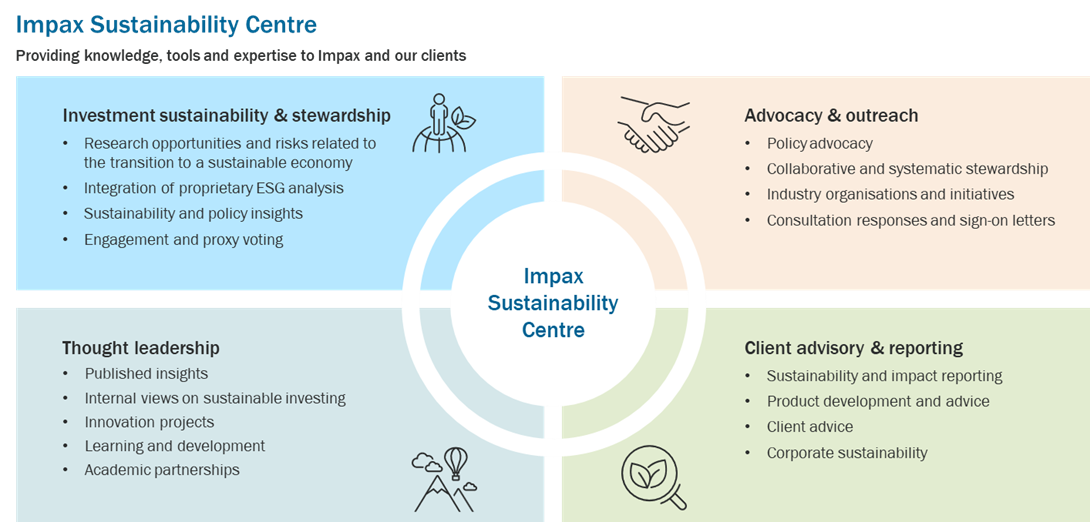
Sustainability continues to be fully integrated within Impax’s investment process. Bringing the functions of the existing Sustainability & Stewardship and Policy & Advocacy teams into a single unit provides:
- further integration of policy insights into the Impax Investment process
- a joined-up approach to planning, delivery and reporting of engagement work with companies and policymakers
- Increased focus and resources for the development of thought leadership, both in terms of integrating insights into Impax’s investment process and sharing them externally
- further development of research partnerships with clients, academics, and other stakeholders
- an enhanced approach to sustainability training and development for Impax staff, including for the investment team
- team structure provides clarity, accountability, and scalability, while enabling specialization and flexibility
The Sustainability Centre team:
The Sustainability Centre is a centre of excellence, providing services, knowledge, tools and expertise on investing in the transition to a more sustainable economy across the four pillars as outlined below:
- Pillar 1 - Investment sustainability & stewardship
Through this pillar, the SC provides leadership, advice and oversight of investment-related sustainability research, thematic and sustainable universe development, impact measurement, development of proprietary tools and methodologies, management of the fundamental and systematic ESG analysis and processes, and stewardship work including proxy voting and company-specific and thematic engagement, as well as policy insights for the investment process. The SC provides advice, coordination and peer review of ESG-analysis and company-specific engagement which are fully integrated in Impax’s investment process and owned by the lead analysts of the companies.
- Pillar 2 – Advocacy & outreach
The focus of this pillar is to support policy makers who are working to create enabling environments that will accelerate the transition to a more sustainable economy. Impax is active across a range of channels, from traditional reactive approaches such as working through industry associations, responding to consultations, and participating in issue-specific initiatives and sign-on letters - to more innovative pro-active interventions such as publishing Impax’s perspectives and commentaries, funding research, piloting new approaches, partnering with clients, and bilateral discussions with policy makers. Impax’s efforts around “systematic stewardship” fall under this pillar. Systemic stewardship combines company thematic engagement and policy advocacy as levers for accelerated change.
- Pillar 3 – Thought leadership
Through this pillar, the SC delivers thought-leadership content that supports the investment process, as well as content produced for external audiences. The SC’s thought leadership output provides Impax’s house view on important and evolving topics, supports research partnerships with academia and clients, and provides Impax’s firm-wide sustainability training and development.
- Pillar 4 – Client advisory and reporting
Under the fourth pillar, the SC advises on sustainability in Impax’s product development, sustainable finance regulatory responses, and reporting, including the metrics and methodologies used by the client advisory and reporting working group. The SC develops Impax’s firm-wide sustainability policies and is responsible for providing sustainability expertise and insights to Impax’s clients.
Sustainability Centre leadership
The leadership within the Sustainability Centre team has specific responsibilities as described below.
- Lisa Beauvilain, Global Head of Sustainability & Stewardship, Co-Head of the Sustainability Centre – responsible for pillars one and four
- Chris Dodwell, Global Head of Policy and Advocacy, Co-Head of the Sustainability Centre - responsible for pillars two and three
- David Loehwing, Head of Sustainability & Stewardship, North America – responsible for oversight and development of Impax’s ESG-related methodologies, frameworks, and analytics
- Heather Smith, Head of Stewardship – responsible for implementing Impax’s company engagement and voting strategy, including development of themes, metrics, and reporting
- Julie Gorte, Ph.D., Senior Vice President, Sustainable Investing – responsible for Impax’s systematic engagement efforts and actively participates in policy advocacy in the US and in working groups with many of Impax’s membership organisations
- Miriam Benarey, Head of Sustainability Client Advisory – leading on developing partnerships with our clients to address key sustainability themes, providing expertise on sustainability in the investment process and the sustainable finance regulatory landscape, as well as co-chairing Impax’s Beyond Financial Returns (BFR) Group
- Nana Li, Head of Sustainability & Stewardship, Asia-Pacific – responsible for sustainability research, thought leadership, and engagement in the Asia-Pacific region
- Paolo Macri, Sustainable Investment Research – responsible for oversight and development of thematic universes and taxonomies, related data and impact measurement and reporting methodology
- Shahbano Soomro, Deputy Head of Policy and Advocacy - responsible for providing policy insights into the investment process
Memberships:
Key collective responsible Investment (RI) initiatives of which Impax is a signatory/member:
- Compliance with the UN Global Compact principles (including human rights, labour rights, environment, and anti-corruption) is a normative investment requirement for Impax. The Impax investible universe is screened for adherence to the UN Global Compact principles. An external research provider is used to support this screening activity. The underlying research provides assessments covering the UN’s Global Compact Principles, International Labour Organization’s (ILO) Conventions, OECD Guidelines for Multinational Enterprises and the UN Guiding Principles on Business and Human Rights (UNGPs).
- Net Zero Asset Managers Initiative (NZAM). Impax joined the Net Zero Asset Managers Initiative in October 2021 and made its Initial Target Disclosure in November 2022.
- UK Stewardship Code. Impax has been a signatory of the Financial Reporting Council’s UK Stewardship Code since 2011. The code aims to enhance the quality of engagement between institutional investors and companies to help improve long-term returns to shareholders and the efficient exercise of governance responsibilities.
- Principles for Responsible Investment (PRI). Impax has been a signatory of the PRI since 2008. The PRI aims to help investors integrate ESG considerations into investment decision making and supports sharing best practice in active ownership.
- Task Force on Climate-related Financial Disclosures (TCFD). Impax has been a signatory of the TCFD recommendations since 2017. The TCFD develops voluntary, consistent climate-related financial risk disclosures for companies providing information to investors, lenders, insurers and other stakeholders.
- Task Force on Nature-related Financial Disclosures (TNFD). Impax has been actively involved in the preparatory work for the TNFD as a member of the informal working group and is now continuing its support through the TNFD Forum, focusing on the development of decision-useful metrics for assessing nature-related risks and opportunities. Impax will continue to participate in discussions around management and disclosure standards on nature-related risks.
Other key collective RI investment groups of which Impax is a signatory/member:
- CDP
- Institutional Investors Group on Climate Change
- Regional Climate Change e.g., IIGCC, AIGCC, or Ceres
- Investor Network on Climate Risk
- Regional Responsible Investment or Sustainable Finance e.g., RIAA, UKSIF, USSIF
- Climate Action 100+
- Corporate Governance Networks
- 30% club or 40:40 Vision or ILPA D&I Initiative
- The Global Impact Investing Network (GIIN)
- FAIRR Initiative
Stewardship:
Engagement is fully integrated in our investment process for listed equities and fixed income. Engagement is used both to mitigate risk and to enhance value and investment opportunities. Engagement allows us to:
- Manage risks by proactively identifying and mitigating issues
- Enhance company/issuer analysis; how companies/issuers respond to engagement is informative of their character
- Strengthen investee companies/issuers over time; improving quality, processes, transparency and resilience
Engagements are conducted as part of our regular meetings with company management teams, or through additional conference calls, meetings, email exchanges or as part of joint communications with the investment community. In cases where engagements are not progressing as anticipated, Impax may utilise escalation processes, which include seeking meetings with alternative contacts at investee companies, including board directors, seeking engagement with other shareholders, industry organisations, standard-setters or regulators, as well as filing or co-filing shareholder resolutions.
Collaborative engagements may be prioritised in cases where an issue is being escalated or where outreach may particularly benefit from a larger group of shareholder involvement. Collaborative engagements are conducted across various, material sustainability issues and specific sectors and companies. Impax does not participate in collaborative engagements that could be interpreted as investors acting in concert.
Impax Investment Committee meetings have a monthly standing agenda item to continuously inform and discuss stewardship issues across the investment team. Members of the Sustainability Centre regularly attend Portfolio Review Meetings to discuss company-specific stewardship priorities and issues at the portfolio and strategy-level with lead analysts and portfolio managers.
Types of Engagement
Impax’s stewardship work can be divided into the following types:
Bottom-up company- and issuer-specific engagement
As part of our ongoing, proprietary company and issuer-level ESG analysis, we identify company- and issuer-specific matters and risks and actively engage regarding these matters as part of monitoring and managing risks. We prioritise engagement with investee companies where we have identified more significant risk issues and/or have larger positions. In addition to risk management, bottom-up company specific engagement is also intended to enhance company value and improve the structures, processes and disclosures of investee companies.
Responsibilities: The lead analysts for the investee companies and issuers are responsible for bottom-up company engagement, with the Sustainability Centre assisting with coordination, preparation and research.
Proxy voting driven engagement
Proxy voting is predominantly related to governance issues such as the election of directors, board structures and management remuneration, but we also express our views on diversity, climate and material sustainability risk management. When Impax has voted against a significant resolution for companies in our active equity strategies, we reach out to the companies to explain our voting rationale and the enhancements we would like to see. We are also in dialogue with companies throughout the year to discuss and comment on proposed governance structures, sustainability processes and disclosures by companies. Impax can also initiate or support shareholder proposals at annual shareholder meetings to encourage greater corporate transparency around a company’s most significant environmental or social risks based on its sector and activities.
Responsibilities: In executing our proxy votes, Impax uses a peer review process, where one Sustainability Centre team member instructs votes and another team member verifies and executes the votes. For resolutions related to financial transactions, including share issuance and M&A or for more contested or controversial resolutions, the Sustainability Centre will engage with the company lead analyst.
Top-down thematic engagement
Every year we assess and outline our thematic engagement priorities. These priorities are based on market developments and emerging sustainability issues that are relevant and material for our companies and issuers. Where possible, we use specific performance data related to the engagement themes, as well as the overall ownership in the companies, as parameters for prioritising companies and issuers for thematic engagements. Companies of all sizes are engaged, including larger companies, with the aim of promoting best practices throughout an industry peer group.
Our engagement themes are often of a long-term nature and do not necessarily change annually.
Engagement themes for 2025:
- Climate
- Net-zero transition planning
- Increasing resilience to physical climate risks
- Nature
- Nature-related dependencies and impacts
- People
- Corporate Culture
- Human rights
- Corporate Governance
- Board composition and structure
- Executive compensation
- Sustainability reporting and assurance
Responsibilities: The lead analysts for the investee companies and issuers are part of thematic company engagements, but the work is driven and coordinated by the Sustainability Centre and its Head of Stewardship, with a lead for each engagement theme or topic.
Systematic engagement
Impax has identified critical and often hard-to-engage areas, with barriers to progress. To remove these impediments, we use ‘systematic engagement,’ which combines company engagement and policy advocacy with the aim of shaping companies’ practices through regulatory or policy change. These areas often cover topics that companies may prefer not to disclose and are not mandatory, such as geolocation data for strategic company assets, but that investors need in order to fully understand companies’ operations and risks.
Responsibilities: One member of the Impax Sustainability Centre is responsible for leading and coordinating the systematic engagement work, bringing together our company engagements and policy advocacy work. Company and issuer lead analysts are involved in these meetings as relevant.
For more information please see: impax-stewardship-policy.pdf
SDR Labelling:
Not eligible to use label (out of scope)
Key Performance Indicators:
At Impax, every strategy is designed to intentionally allocate clients’ capital towards those companies which are expected to benefit as the global economy transitions to a more sustainable model. Our annual Beyond Financial Returns reporting provides post-investment evidence of this intentionality.
This reporting includes the following topics and metrics:
- Stewardship: metrics include companies engaged by theme, engagement dialogue by investee company and proxy voting summary
- Carbon Profile: metrics include GHG emissions (Scopes 1, 2, 3), avoided GHG emissions, Weighted Average Carbon Intensity (WACI)
- Environmental benefits (water provided/saved/treated, Renewable energy generated (MWh), Material recovered/waste treated.
- UN Sustainable Development Goals alignment
- Methodology section including definitions and KPI availability/coverage information
Fund Holdings
Voting Record
Disclaimer
This document (the “Document”) contains information that has been provided at the specific request of the intended recipient and is for discussion purposes only. This Document has been issued by Impax Asset Management (“Impax”) which means one of the following entities depending on the location of the recipient:
- For recipients based outside the European Economic Area (the “EEA”): Impax Asset Management Limited (FRN 197008) and/or Impax Asset Management (AIFM) Limited (FRN 613534) which are authorised and regulated by the Financial Conduct Authority.
- For recipients based inside the EEA: Impax Asset Management (Ireland) Limited which is authorised and regulated by the Central Bank of Ireland (Reference No: C186651).
The information and any opinions contained in this Document have been compiled in good faith, but no representation or warranty, express or implied, is made to their accuracy, completeness or correctness. Impax, its officers, employees, representatives and agents expressly advise that they shall not be liable in any respect whatsoever for any loss or damage, whether direct, indirect, consequential or otherwise however arising (whether in negligence or otherwise) out of or in connection with the contents of or any omissions from this Document. The information in the Document has not been independently verified and is subject at all times to the conditions, caveats and limitations described in the Document. All opinions, projections and estimates constitute the judgment of Impax as of the date of the Document and are subject to change without notice.
This Document does not constitute an offer to sell, purchase, subscribe for or otherwise invest in units or shares of any fund managed by Impax. It may not be relied upon as constituting any form of investment advice and prospective investors are advised to ensure that they obtain appropriate independent professional advice before making any investment. This information is in no way indicative of how the strategy will perform and is not intended as a statement as to the likelihood of Impax achieving particular results in the future. Past performance of a strategy is no guarantee as to its performance in the future. This Document is not an advertisement and is not intended for public use or distribution.
The information contained in the Document is not investment, tax, accounting or legal advice and does not take into consideration the investment objectives, financial situation or particular needs of the recipient. Investing entails certain risks, including the possible loss of the entire principal amount invested. The recipient of this Document should seek its own financial, tax, accounting and legal advice in connection with any proposed investment.
The Document is strictly confidential and is only intended for the intended recipient(s) and must not be forwarded by such intended recipient to anyone else. It must not be copied, reproduced or distributed in whole or in part at any time. The Document may contain proprietary information and any further confidential information made available to the recipient must be held in complete confidence and documents containing such information may not be reproduced, used or disclosed without the prior written consent of Impax.
The Document is not intended to be distributed in any jurisdiction where such distribution is not permitted by the local law.
EEA – The Document is only being made available to and is only directed at persons in member states of the EEA who are professionals, defined as Eligible Counterparties, or Professional Clients, as defined by the applicable jurisdiction. Under no circumstances should any information contained in this document be regarded as an offer or solicitation to deal in investments in any jurisdiction.
UK – The Document is only being made available to and is only directed at persons in the United Kingdom who are professionals, defined as Eligible Counterparties, or Professional Clients, within the meaning of the rules of the Financial Conduct Authority. Under no circumstances should any information contained in this Document be regarded as an offer or solicitation to deal in investments in any jurisdiction. In the United Kingdom, this material is a financial promotion and has been approved by Impax Asset Management Limited OR Impax Asset Management (AIFM) Limited, which is authorised and regulated in the United Kingdom by the Financial Conduct Authority.
Australia – This Document has been prepared and is being made available by Impax Asset Management Limited. Impax Asset Management Limited is exempt from the requirement to hold an Australian financial services license in respect of the financial services it provides to wholesale investors in Australia and is regulated by the Financial Conduct Authority of the United Kingdom under the laws of the United Kingdom which differ from Australian laws. This document is only to be made available to 'wholesale investors' under the Corporations Act 2001 (Cth) receiving this document in Australia. Impax Asset Management Limited is exempt from the requirement to hold an Australian financial services license by operation of ASIC Class Order 03/1099: UK FCA regulated financial service providers, as modified by ASIC Corporations (Repeal and Transitional) Instrument 2016/396.
Impax is trademark of Impax Asset Management Group Plc. Impax is a registered trademark in the UK, EU, US, Hong Kong, Canada, Japan and Australia. © Impax Asset Management LLC, Impax Asset Management Limited and/or Impax Asset Management (Ireland) Limited. All rights reserved.
Impax Asset Management makes its investment and related decisions pursuant to its independently determined policies and practices that seek to serve the risk management objectives and interests of its investors. Any and all engagement by Impax Asset Management with issuers and other market participants on sustainability issues are pursuant to, and consistent with, those independently determined policies and practices.
*CFA® and Chartered Financial Analyst® are registered trademarks owned by CFA Institute.
| Fund Name | SRI Style | SDR Labelling | Product | Region | Asset Type | Launch Date | Last Amended |
|
|---|---|---|---|---|---|---|---|---|
Impax Environmental Leaders (Ireland) Fund |
Environmental Style | Not eligible to use label (out of scope) | SICAV/Overseas | Global | Equity | 12/01/2016 | Sep 2025 | |
ObjectivesThe Impax Environmental Leaders (Ireland) Fund seeks to achieve sustainable, above market returns over the longer term by investing globally in companies that are developing innovative solutions to resource challenges in environmental markets. These markets address a number of long term macro-economic themes: growing populations, rising living standards, increasing urbanisation, rising consumption, and depletion of limited natural resources. |
Fund/Portfolio Size: £262.40m (as at: 30/11/2025) Total Screened Themed SRI Assets: £25332.00m (as at: 31/03/2025) Total Assets Under Management: £25332.00m (as at: 31/03/2025) ISIN: IE00BLRPMT72, IE00BFX3S844, IE00BFX3S737, IE00BD89J808, IE00BYQNSM89, IE00BYQNSJ50, IE00BYQNSG20, IE00BYQNSH37, IE00BYQNSF13, IE00BYQNSK65, IE00BD2NFJ14 Contact Us: clientservices@impaxam.com |
|||||||
Sustainable, Responsible &/or ESG OverviewThe Impax Environmental Leaders (Ireland) Fund is a global thematic strategy investing in companies that are developing innovative solutions to resource challenges in environmental markets. Impax invests in these companies because it believes they are set to benefit from the long-term trends of rising global populations and wealth, changing demographics, urbanisation, increasing consumption, and the resultant increases in resource demand. Investment is focused on companies within energy efficiency, renewable energy, water, waste/resource recovery, food and agriculture related markets. Companies in these markets are generally characterised by high levels of corporate activity, lower levels of sell-side coverage, rapid technological innovation and regulatory momentum. This means they are complex to understand and challenging to navigate, leading to mispricing that Impax seeks to exploit for its clients through its specialist focus and expert investment team. |
||||||||
|
Primary fund last amended: Sep 2025 |
||||||||
|
Information received directly from Fund Manager |
||||||||
|
Please select what you would like to read:
Fund FiltersSustainability - General
Sustainability policy
Has policies that consider (environmental and social) sustainability issues. Strategies vary but are likely to consider environmental issues like climate change, carbon emissions, biodiversity loss, resource management, environmental impacts; and social issues like equal opportunities, human rights, labour standards, diversity and adherence to internationally recognised codes. See individual entry information.
Sustainability focus
Has a significant focus on sustainability issues
Sustainable transport policy or theme
Has documented policies or thematic investment approaches supporting investment in more sustainable, greener transport methods. These will typically set out a preference for companies that run, enable or support more sustainable methods of transport.
Encourage more sustainable practices through stewardship
Aim to encourage higher sustainability standards through responsible ownership / stewardship / engagement / voting activity
UN Global Compact linked exclusion policy
Use the UN Global Compact to inform or help direct where they can or cannot invest. Will typically not invest in companies with significant breaches (low standards) - strategies vary. (The UNGC covers a wide range of issues - search 'UNGC'). See https://unglobalcompact.org/
Transition focus
Aim to support the shift to a sustainable future. See eg https://www.transitionpathwayinitiative.org/
Report against sustainability objectives
Publicly report performance against named sustainability objectives
Circular economy theme
Has a theme or investment strand focused on the shift to a circular economy - where products are reused and recycled not incinerated or dumped. See eg https://www.ellenmacarthurfoundation.org/topics/circular-economy-introduction/overview Environmental - General
Environmental policy
Has policies which relate to environmental issues. These will typically set out their stance on issues such as pollution, climate change, resource management, biodiversity loss, carbon emissions, plastics and/or additional environmental impacts. Strategies vary.
Resource efficiency policy or theme
Has a policy or theme that relates to managing natural resources more efficiently. Strategies vary. See individual entry information.
Favours cleaner, greener companies
Aims to invest in companies with strong or market leading environmental policies and practices. Strategies vary. See individual entry information for more detail.
Waste management policy or theme
Has a written policy or theme focused on waste management - typically to support or encouraging higher levels of recycling and better efficiency / reducing waste. Strategies vary. Nature & Biodiversity
Biodiversity / nature policy
Has a written biodiversity policy or theme typically aimed at supporting, encouraging and improving environmental protection and safeguarding the natural world (sometimes referred to as 'natural capital'). See eg https://www.un.org/en/climatechange/science/climate-issues/biodiversity
Nature / biodiversity based solutions theme
A significant focus on investments that aim to protect, improve and / or restore natural habitat.
Nature / biodiversity focus
Has a significant focus on investment in nature and biodiversity related opportunities
Deforestation / palm oil policy
Has policies designed to address involvement in irresponsibly managed palm oil or other forms of deforestation (typically exclusion led). Strategies vary.
Avoids genetically modified seeds / crop production
Aims to avoid investing in companies that produce genetically modified seeds or crops. (This does not typically include avoiding companies such as supermarkets). Climate Change & Energy
Climate change / greenhouse gas emissions policy
Has policies (documented strategies that explain their position) on climate change related issues such as greenhouse gas/carbon emissions, net zero, transitioning to lower carbon. Strategies vary.
Coal, oil & / or gas majors excluded
Avoid investment in major coal, oil and/or gas (extraction) companies. Strategies vary.
Fracking & tar sands excluded
Avoid companies involved in fracking and tar sands - which are widely regarded as controversial methods of oil and gas extraction. Strategies vary.
Arctic drilling exclusion
Avoid companies that are involved in extracting oil from the Arctic regions.
Fossil fuel reserves exclusion
Avoid investing in companies / assets with coal, oil and gas reserves. See individual entry information for further details.
Clean / renewable energy theme or focus
Invest (or may invest) in clean / renewable energy companies and other assets. The proportion directly or indirectly invested in renewable energy may vary over time.
Encourage transition to low carbon through stewardship activity
Encourage the transition to lower carbon activities through asset selection and / or responsible ownership activity.
Energy efficiency theme
Has an energy efficiency theme - typically meaning that the manager is focused on investing in organisations that manage - or help others to manage - energy use more carefully and less wastefully - and so reduce greenhouse gas emissions.
Invests in clean energy / renewables
Invest in renewable energy companies and / or companies where renewable energy is a significant part of their business. Strategies vary.
Nuclear exclusion policy
Has a policy which describes the avoidance or limited investment in the nuclear industry. Strategies vary.
Fossil fuel exploration exclusion - direct involvement
Excludes companies and other assets with direct involvement in fossil fuel exploration (eg coal, oil and gas companies)
TCFD / IFRS reporting requirement
Will only invest in companies that report greenhouse gas emissions in line with this international reporting framework. See https://www.fsb-tcfd.org/ https ://www.ifrs.org/sustainability/tcfd/
Require net zero action plan from all / most companies
Requires all, or most of, the assets they invest in to have a ‘net zero action plan’ - describing how they will reduce their greenhouse gas emissions. Social / Employment
Social policy
Has policies which set out their approach to social issues (e.g. human rights, labour standards, equal opportunities, child labour and/or adherence to internationally recognised codes such as the UN Global Compact). Strategies with social policies typically avoid companies with low standards and/or work to encourage higher standards. See fund information for detail.
Favours companies with strong social policies
Aims to invest in assets with high social values - this may include strong human rights, labour standards and equal opportunities or safety related practices. Ethical Values Led Exclusions
Tobacco & related product manufacturers excluded
Companies are excluded if they are involved in any aspect of the production chain for tobacco products, including cigarettes, vaping, e-cigarettes, chewing tobacco and cigars.
Tobacco & related products - avoid where revenue > 5%
Companies are excluded if they make more than 5% of their revenue from the manufacture, sale or distribution of tobacco products including cigarettes, vaping, e-cigarettes, chewing tobacco and cigars.
Controversial weapons exclusion
Excludes companies which make controversial weapons such as landmines, cluster munitions and chemical weapons.
Armaments manufacturers avoided
Avoids companies that manufacture weapons intended specifically for military use. Strategies vary - may or may not include non-strategic military products.
Pornography avoidance policy
Avoids companies that derive significant income from pornography and related areas. Strategies vary.
Animal welfare policy
Has policies that require specific animal welfare standards to be met. These may reference well-known welfare standards (3Rs - Replace, Reduce, Refine) or certification schemes. Strategies vary.
Animal testing - excluded except if for medical purposes
Avoids companies that test their products on animals for purposes other than medical benefit (e.g. for cosmetics). Strategies vary. Human Rights
Human rights policy
Has policies relating to human rights issues. Typically require companies to demonstrate higher standards, although some managers work to encourage improvements. Investee companies are often judged against internationally agreed norms or standards. Strategies vary.
Child labour exclusion
Has policies to avoid companies that employ children.
Oppressive regimes (not free or democratic) exclusion policy
Has policies that exclude companies or other assets which operate in, or are owned by regimes which are not democratic, or where people may be oppressed. May use eg. Freedom House research. Strategies vary.
Responsible supply chain policy or theme
Has policies or a theme that relates to the responsible management of supply chains. These may relate to employment issues, notably people employed by their suppliers, as well as the sourcing of materials and products.
Modern slavery exclusion policy
Has a policy which excludes assets with involvement in Modern Slavery Meeting Peoples' Basic Needs
Water / sanitation policy or theme
Have policies or themes that set out the position on investment in the water sector and/or sanitation. Strategies vary.
Responsible food production or agriculture theme
Has a responsible food production or agriculture theme or strand of investment. May have a single or many themes. Gilts & Sovereigns
Does not invest in sovereigns
Does not invest in / excludes 'sovereigns' - debt issued by governments. See eg https://www.investopedia.com/terms/s/sovereign-debt.asp Governance & Management
Governance policy
Has policies that relate to corporate governance issues such as board structure, executive remuneration, bribery and/or corporate corruption. These funds will typically avoid companies with poor practices. Strategies vary.
Avoids companies with poor governance
Avoids investing in companies with poor governance practices.(e.g. board structure, management practices etc.) Views may however vary on what counts as 'poor' practices - and funds may not immediately divest as they may prefer to work to encourage higher standards.
UN sanctions exclusion
Exclude companies that are subject to United Nations sanctions. See eg https://main.un.org/securitycouncil/en/content/un-sc-consolidated-list
Anti-bribery & corruption policy
Has policies explaining how managers will respond to assets / companies that do not comply with relevant anti-bribery and anti-corruption standards or laws. Strategies vary; options include stewardship/ engagement and divestment - or a combination.
Digital / cyber security policy
Has policies explaining how the managers take into account digital/cyber security related risks. Cyber policies will typically favour companies with higher standards or that are helping to solve problems - but strategies vary.
Encourage board diversity e.g. gender
Encourage the companies they invest in to have more diverse board structures (e.g. more women on boards)
Encourage TCFD alignment for banks & insurance companies
Encourage the banks and insurance companies they invest in to publish climate change related financial information - as set out by the Task Force on Climate Related Financial Disclosures (with the aim of helping investors measure and respond to climate risk).
Encourage higher ESG standards through stewardship activity
Aim to encourage higher ESG standards through responsible ownership / stewardship / engagement /voting activity Product / Service Governance
ESG integration strategy
Find fund / asset managers that factor in 'environmental, social and governance' issues as part of their investment decision making process. A focus on 'ESG' typically means a fund is carrying out additional research to help reduce ESG related risks. It does not necessarily mean a focus on sustainability. Strategies vary. See fund literature. Asset Size
Over 50% small / mid cap companies
Invests more than half of their money in smaller or medium sized companies. (i.e. below around £5 -10 billion)
Invests in small, mid & large cap companies / assets
Invests in a combination of small, medium and larger (potentially multinational) companies / assets. Targeted Positive Investments
Invests >25% in environmental / social solutions companies
Invests >25% of their capital in companies where a major part of their business is focused on helping to address environmental or social challenges.
Invests >50% of fund in environmental / social solutions companies
Invests >50% of their capital in companies where a major part of their business is focused on helping to address environmental or social challenges.
EU Sustainable Finance Taxonomy holdings 5-25% of assets
Invests in between 5-25% of capital in assets which meet the EU Taxonomy requirements. This will typically require adding up the proportion of each individual company's activity that is regarded as 'green' so that the manager can produce an overall total for the whole fund or portfolio. Impact Methodologies
Measures positive impacts
Aims to measure the positive real world environmental and / or social benefits that are associated with their investment strategy. Investments that aim to deliver positive impacts and measure those impacts may be referred to as 'Impact' - although impact measurement is not restricted to Impact investments. Strategies vary.
Positive environmental impact theme
Specifically sets out to help deliver positive environmental impacts, benefits or 'real world' outcomes.
Invests in environmental solutions companies
Directs investment towards companies where a major part of their business is about solving environmental challenges. e.g. companies helping to address climate change.
Invests in sustainability / ESG disruptors
Specifically sets out to invest in companies that are regarded as 'disrupting' existing business practices - typically through the development of innovative (sustainability aware) products and/or practices.
Aim to deliver positive impacts through engagement
Aims to deliver positive environmental and or social impacts (real world benefits) through its engagement with investee assets
Over 50% in assets providing environmental or social ‘solutions’
Invests more than 50% of capital in assets which are regarded as being significantly focused on providing solutions to environmental or social challenges. Strategies vary.
Publish ‘Theory of Change’ explanation
Policy explains the ways in which the manager believes things need to change in order to deliver a more sustainable future, which they are working to help achieve. How The Fund/Portfolio Works
Positive selection bias
Focuses on finding and investing in companies with positive / beneficial attributes. This strategy can be applied in addition to exclusion criteria and engagement/stewardship activity.
Significant harm exclusion
Aims to avoid companies that do significant harm. This originates from the EU’s sustainable finance ‘DNSH’ (do no significant harm) work, which is not necessarily used by UK investors.
Assets mapped to SDGs
Invests in assets which can be 'mapped' (reviewed) their investment selection and management strategies to identify which of the UN Sustainable Development Goals (SDGs) the fund is helping to address.
Combines norms based exclusions with other SRI criteria
Investment selection process uses internationally agreed 'norms' (e.g. United Nations Global Compact - UNGC - or the UN Sustainable Development Goals - SDGs) alongside additional SRI criteria such as positive or negative stock selection policies and/or stewardship strategies.
Combines ESG strategy with other SRI criteria
Invests in assets which have an ESG strategy (which is typically focused on avoiding companies that pose environmental, social or governance related risks) together with additional criteria such as positive and/or negative screens, themes and stewardship strategies.
ESG risk mitigation focus
Focuses on the careful management of environmental, social and governance (ESG) related risks - typically by avoiding or being underweight in companies seen as posing major risks in these areas (i.e. not necessarily by using themes, exclusions etc).
SRI / ESG / Ethical policies explained on website
Publish explanations of their ethical, social and/or environmental policies online (i.e. investment decision making strategies/ buy/sell &/or asset management strategies).
Do not use stock / securities lending
Does not use stock lending for performance or risk purposes. Unscreened Assets & Cash
Assets typically aligned to sustainability objectives 70 - 79%
Holds between 70-79% of assets which align to the sustainability objectives; which are not being held purely for risk management purposes, such as derivatives and cash equivalent assets.
Assets typically aligned to sustainability objectives 80 – 89%
Holds between 80-89% of assets which align to the sustainability objectives; which are not being held purely for risk management purposes, such as derivatives and cash equivalent assets.
Assets typically aligned to sustainability objectives > 90%
Holds at least 90% of assets which align to the sustainability objectives; which are not being held purely for risk management purposes, such as derivatives and cash equivalent assets.
No ‘diversifiers’ used other than cash
Only invests in cash to aid the practical management (buying and selling) of assets and so do not use additional financial instruments.
All assets (except cash) meet published sustainability criteria
All assets - except cash - meet the sustainability criteria published in strategy documentation. Intended Clients & Product Options
Intended for clients interested in sustainability
Designed to meet the needs of individual investors with an interest in sustainability issues.
Available via an ISA (OEIC only)
Available via a tax efficient ISA product wrapper. Labels & Accreditations
SFDR Article 9 fund / product (EU)
Find options classified under Article 9 of the EU’s SFDR (Sustainable Finance Disclosure Requirements). Article 9 of the SFDR applies to financial products that have sustainable investment 'objectives' - including emissions reduction objectives. (These may currently be referred to as 'impact' funds or aiming to deliver clear, specific positive outcomes.) These rules do not currently apply in the UK so product managers may leave this field blank. Fund Management Company InformationAbout The Business
Boutique / specialist fund management company
Find fund / asset management companies that are smaller or specialise in particular areas - notably, ideally ESG related. Strategies vary.
Specialist positive impact fund management company
Find fund / asset management companies (or subsidiaries) that specialise in - or focus entirely on - investing in assets that are helping to deliver positive environmental and / or social impacts.
Responsible ownership / stewardship policy or strategy (AFM companywide)
Finds fund / asset management companies that have a published company wide stewardship, engagement and / or responsible ownership policy or strategy that covers all investments. Stewardship typically involves encouraging higher ESG standards through voting and dialogue.
ESG / SRI engagement (AFM companywide)
Find fund / asset management companies that actively encourage higher 'environmental, social and governance' and / or 'sustainable and responsible investment' practices across investee companies - typically where the aim is to encourage positive change that is aligned with the best interests of investors. Strategies vary. See additional information and options.
Vote all* shares at AGMs / EGMs (AFM companywide)
Find fund / asset managers that vote all* the shares they own at Annual General Meetings and Extraordinary General Meetings. A commitment to voting shares is a key indicator of 'responsible share ownership' demonstrating their support for or disagreement with management policy. (*situations can legitimately, occasionally occur where voting proves impossible, but in principle all shares should be voted.)
Responsible ownership / ESG a key differentiator (AFM companywide)
Find fund / asset managers that consider responsible ownership and ESG to be a key differentiator for their business.
Senior management KPIs include environmental goals (AFM companywide)
The leadership team of this fund / asset manager have performance targets linked to environmental goals.
Integrates ESG factors into all / most research (AFM companywide)
Find fund / asset management companies that consider environmental, social and governance (ESG) issues when deciding whether or not to invest in a company for all / almost all of their funds and other assets. This is increasingly seen as part of sound risk management.
In-house diversity improvement programme (AFM companywide)
Finds organisations / fund managers that have an in-house (company wide) diversity improvement programme - meaning that they are working to ensure that within their own businesses they employ people from diverse backgrounds - often typically focused on ethnicity and/or sex.
Diversity, equality & inclusion engagement policy (AFM companywide)
Find fund / asset management companies that encourage the companies they invest in to have strong diversity, race, gender and other equality policies across all assets held, not simply screened or themed SRI/ESG funds. (ie Asset Management company wide).
Invests in new sustainability linked bond issuances (AFM companywide)
Fund / asset management company has investments in bonds designed to meet sustainability requirements - however these assets may not be 'ringfenced' for this purpose. See website for details. Collaborations & Affiliations
PRI signatory
Find fund / asset management companies that have signed up to the UN backed 'Principles of Responsible Investment'.
UKSIF member
Find fund / asset management companies that are members of UKSIF - the UK Sustainable Investment and Finance association
TNFD forum member (AFM companywide)
A member of the Taskforce for Nature Related Financial Disclosures group which aims to aid risk management and shift money towards nature-positive outcomes.
Investment Association (IA) member
Fund management entity is a member of the Investment Association https://www.theia.org/ Resources
In-house responsible ownership / voting expertise
Find fund / asset management companies that employ people to steer and support fund managers in voting shares at company AGM's and EGMs in ways that are consistent with encouraging higher ESG/sustainability standards.
Employ specialist ESG / SRI / sustainability researchers
Find a fund / asset management company that directly employs specialist ESG/SRI/sustainability researchers or analysts. This allows asset managers to discuss environmental, social and governance risks and opportunities directly with companies.
Use specialist ESG / SRI / sustainability research companies
Find fund / asset management companies that makes use of expert external research companies. This can help deliver specialist expertise and means resources are pooled with other investors.
ESG specialists on all investment desks (AFM companywide)
Finds organisations / fund managers that have one or more ESG/sustainability experts on all investment teams or 'desks' (all asset types) Accreditations
PRI A+ rated (AFM companywide)
Finds organisations / fund managers that have an A+ PRI rating - meaning they are highly rated according to the 'Principles of Responsible Investment'
UK Stewardship Code signatory (AFM companywide)
Find fund / asset managers that are signatories to the FRC UK Stewardship Code, which sets out a framework for constructive investor / investee relations where managers are encouraged to behave like responsible, typically longer term 'company owners'. Engagement Approach
Regularly lead collaborative ESG initiatives (AFM companywide)
Find fund / asset management companies that regularly initiate or run industry wide (collaborative) investor projects aimed at raising environmental, social and governance standards amongst investee companies.
Encourage responsible corporate taxation (AFM companywide)
Find fund / asset management companies that are working with the companies they invest in to encourage more responsible corporate taxation.
Engaging on climate change issues
Fund / asset manager has stewardship /responsible ownership strategy that is focused on addressing climate change with investee assets.
Engaging with fossil fuel companies on climate change
Fund / asset manager has a stewardship /responsible ownership strategy that involves working with fossil fuel companies on climate change related issues. See fund manager website for details.
Engaging to reduce plastics pollution / waste
Fund / asset manager has stewardship /responsible ownership strategy with involves encouraging investee asset to reduce plastic waste and pollution.
Engaging on biodiversity / nature issues
The fund / asset manager has a responsible ownership / stewardship strategy that focuses on biodiversity and nature issues relating to the assets they invest the aim of which will be to reduce harm and or deliver improvement. Strategies vary. https://tnfd.global
Engaging to encourage a Just Transition
Fund / asset manager has a responsible ownership / stewardship strategy which means they are working to encourage the shift to more sustainable business practices in ways that respect and are sensitive to social issues and the impact change has on people effected by the changes that are taking place. https://www.transitionpathwayinitiative.org/ https://transitiontaskforce.net/
Engaging on human rights issues
Fund / asset manager has responsible ownership / stewardship strategy in place which aims to address human rights issues in investee companies (and potentially their suppliers) with the aim of raising standards
Engaging on labour / employment issues
Fund / asset manager has responsible ownership / stewardship strategy in place that aims to improve labour standards for the benefit of employees in investee companies (and potentially their suppliers)
Engaging on diversity, equality & / or inclusion issues
Fund / asset management company has a stewardship strategy in place which involves working to raise diversity, equality and inclusion standards across investee assets
Engaging to stop modern slavery
Fund / asset manager is working with the assets they hold to help stamp out modern slavery - where direct or indirect company employees are exploited for business benefits.
Engaging on governance issues
Fund / asset managers have stewardship strategies in place that focus on improving governance standards across investee assets
Engaging on mental health issues
Fund / asset manager has stewardship strategy in place which involves discussing mental health issues with investee companies - with the aim of raising standards
Engaging on responsible supply chain issues
Has a stewardship / responsible ownership strategy that encourages responsible supply chain - ie the managers will discuss environmental, social and governance issues with investee companies with the aim of raising standards
Engaging on the responsible use of AI
Working to address sustainability, ESG and related concerns around artificial intelligence.
Stewardship escalation policy
Escalation policies describe how a manager will proceed if stewardship / engagement activity is not successful in the short term. Company Wide Exclusions
Controversial weapons avoidance policy (AFM companywide)
Find fund / asset management companies (not funds) that avoid investment in 'controversial weapons' across all of their funds and other investment vehicles.
Review(ing) carbon / fossil fuel exposure for all funds (AFM companywide)
Find funds / asset managers that are reviewing, or have reviewed, their exposure to carbon intensive industries including (but not only) mining, oil and gas companies. (Typically with reference to climate change.) Climate & Net Zero Transition
Net Zero commitment (AFM companywide)
Fund / asset management organisations that have pledged to reduce their greenhouse gas emissions to ‘net zero’. Strategies vary - this area is changing rapidly.
Voting policy includes net zero targets (AFM companywide)
Fund / asset manager AGM / EGM voting strategy has processes in place that mean they will normally be expected to vote in a way that will encourage the transition to net zero greenhouse gas emissions.
Net Zero - have set a Net Zero target date (AFM companywide)
This fund / asset management company has set a date by which they plan to achieve net zero greenhouse gas / CO2e emissions.
Encourage carbon / greenhouse gas reduction (AFM companywide)
Find fund / asset management companies that are working with the companies they invest in to encourage reductions in carbon dioxide and other greenhouse gas emissions.
Carbon transition plan published (AFM companywide)
Finds organisations / fund managers that have a company wide carbon transition plan - meaning that they have plotted a path to how they will move away from activities that produce or use carbon based energy sources (that emit greenhouse gases) towards clean, alternative, renewable energy sources.
‘Forward Looking Climate Metrics’ published / ITR (AFM companywide)
Finds organisations / fund managers that have published ‘forward looking climate metrics’ e.g. 'implied temperature rise' data that are a total of the asset management company's share (% owned) of all the investee company emissions of the assets they manage, as well as their own direct and other indirect emissions.
Carbon offsetting – do NOT offset carbon as part of net zero plan (AFM companywide)
This fund / asset management company plans to achieve net zero greenhouse gas (CO2e) emissions by reducing their emissions. Calculations and scope vary.
In-house carbon / GHG reduction policy (AFM companywide)
Find fund / asset management companies that are working to reduce their own (fund management company) carbon/greenhouse gas emissions.
Working towards a ‘Net Zero’ commitment (AFM companywide)
Finds organisations / fund management companies that are in the process of working out how to make a ‘net zero commitment’ - meaning that when that is finalised they will have started the process of reducing their total greenhouse gas emissions to 'zero'. Transparency
Publish responsible ownership / stewardship report (AFM companywide)
Find fund / asset management companies that publish a report detailing their responsible investment ownership - also known as 'Stewardship' - activity.
Full stewardship / responsible ownership policy information on company website
Find fund / asset management companies that publish information about their sustainable and responsible investment strategies on their company website.
Publish full voting record (AFM companywide)
Fund / asset management companies that publish a full record of how they vote their shares at AGMs (annual general meetings) and EGMs (extraordinary general meetings). Voting strategies have an important role to play encouraging higher environmental, social and governance standards.
Paris Alignment plan publicly available (AFM companywide)
This fund / asset management company has published a plan that explains how they will align to the climate change commitments made at the Paris Climate Talks, COP21.
Net Zero transition plan publicly available (AFM companywide)
This fund / asset management company has published a plan that explains how they are going to achieve net zero greenhouse gas / CO2e emissions.
Dialshifter statement
Find fund / asset management companies that have supplied Dialshifter information. See Dialshifter tab within record for more information. Sustainable, Responsible &/or ESG Policy:All of Impax Asset Managements’ investments are aligned to the transition to a more sustainable economy. Activities with lower sustainability risks and higher opportunities are set to benefit from a transition to a more sustainable, low-carbon economy and are well positioned for the long-term. They are less at risk of disruption from new technologies, changing consumer preferences or legislation. These well-positioned areas of the economy are sought and prioritised for investment across the Manager’s listed investment strategies. ESG-analysis is an integral part of the Manager’s investment process. All investee companies must meet financial and environmental, social and governance (“ESG”) criteria before entering the Fund’s universe of investable companies. The investment team members of the Investment Manager are responsible for integrating ESG analysis into the investment process. Through screening, the Investment Manager intends to avoid companies involved in significant controversies that violate global norms related to human rights, labour, environment and corruption, and through ESG analysis, the Investment Manager conducts a detailed, proprietary ESG analysis of new investee companies considered for the investable universe and reviews the ESG analysis on a periodic basis. Stewardship through active ESG engagement and proxy voting are important parts of the investment process. They enable monitoring of the investee companies more effectively and aim at further enhancing the structures, processes and disclosures of the companies. Impax Asset Management takes into account relevant regulations when considering the approach to sustainability and ESG, especially as it relates to reporting and disclosures. Further details on how sustainability risks are integrated into the investment decision making process for the Fund are provided in the Investment Manager’s ESG Policy, available on the Investment Manager’s website at www.impaxam.com. The full ESG Sub-Policy can be found on the Investment Manager’s website impax-esg-sub-policy.pdf (impaxam.com) Process:1.Idea generation – identifying interesting companies Impax’s thematic environmental market strategies invest in companies that provide solutions to environmental and resource challenges. Inclusion in the Impax Environmental Markets Universe is contingent upon the resource efficiency and environmental markets business typically having >50% of group revenue, profitability or invested capital. Ideas are sourced from an investment universe that captures the following broad themes: Energy (Alternative Energy/Energy Management & Efficiency) | Clean and Efficient Transport | Sustainable Food | Water (Infrastructure & Technologies) | Circular Economy (Resource Efficiency & Waste Management) | Smart Environment (Environmental Services & Resources and Digital Infrastructure). 2.ESG-analysis. Impax conducts a detailed, proprietary ESG-analysis of new companies considered for the investable universe and review the ESG-analysis on a periodic basis. IAM considers five main pillars within its ESG analysis:
When all the data is gathered, an ESG report is written, and the company is assigned a proprietary ESG-score. Impax does not seek to exclude a certain number or percentage of companies, but rather seeks an absolute level of ESG-quality. Where this is not achieved, a company is excluded from the investable universe. ESG scoring Upon completion of analysis, an ESG report is submitted and a proprietary ESG score assigned by members of the Sustainability & Stewardship team. Ultimately, all companies must be approved on both a financial and an ESG basis before being added to the investable universe as part of Impax’s research and approval process. The five pillars (corporate governance, material environmental, social, and other risks, climate, human capital/E,D&I, and controversies) are each scored based on tiering of performance, management and disclosures. Each of the five pillars, including sub-pillars, have guidance documents describing what represents best practice from first tier down to the lowest tier. The pillar weights are adjusted where relevant for materiality. Based on the five pillar scores, companies are assigned an overall rating: Excellent, Good, Average, Fair and Excluded. The Impax ESG scoring system is “absolute” (not a sector best-in-class approach) and is intended to enable a comparison of company ESG quality across countries, sectors, company sizes, etc. Companies categorised as ‘Excluded’ are not eligible for investment, while those categorized as ‘Fair’ have a cap for the maximum allowed weighting within portfolios, for risk management purposes. Impax does not seek to exclude a certain number or percentage of companies, but rather seeks an absolute level of ESG-quality in companies/issuers eligible for investment (the “A-list” for active listed equities). An improving ESG rating trajectory can give the investment team and portfolio managers further conviction in a company. Stewardship and engagement All portfolio managers and analysts are involved in engagement activities and Impax’s Investment Committee has a standing “ESG and Engagement” agenda item to continuously inform and discuss engagement issues across the investment teams. Engagements are conducted as part of regular meetings with company management teams, or through additional conference calls, meetings, email exchanges, or as part of joint communications with the investment community. Engagements are also regularly conducted together with other investors and partners with or without a lead or coordination from expert organisations. Collaborative engagements are conducted across several ESG issues, specific sectors and companies and can be prioritised where outreach may particularly benefit from a larger group of shareholder involvement or in cases where an issue is being escalated. Impax also conducts public policy advocacy, engaging with public policymakers. Where material concerns or anomalies at an investee company are identified, Impax will intervene to mitigate risks and preserve shareholder value. The investee company management team is immediately contacted and, where possible, members of the company board. If the investee company is unresponsive to engagement or unwilling to consider alternative, less risky options, Impax will escalate the dialogue by:
If interventions are unsuccessful and Impax considers that the risk profile of the company has significantly deteriorated or company strategy/governance structures have altered because of an incident, to a degree where the return outlook and the company’s strategy and quality no longer meet expectations, the company would be excluded from the investable universe and/or sold. Impax seeks to follow up on previous engagements after six months to one year, depending on the nature of the issue and situational context (e.g., reporting cycles). While some engagements may be one-off, as investee companies’ ESG processes mature over time, engagement series often continue over years. Resources, Affiliations & Corporate Strategies:The Sustainability Centre: The Sustainability Centre (SC) acts as Impax’s centre of excellence providing services, tools and knowledge on investing in the transition to a more sustainable global economy (TSE). The SC allows Impax to meet the growing expectations of clients, regulators and other stakeholders. It also enables Impax to focus on the rapidly expanding range and depth of sustainability issues that require the Firm’s attention. The SC is led by Co-Heads Lisa Beauvilain (Global Head of Sustainability & Stewardship) and Chris Dodwell (Global Head of Policy & Advocacy) who share management responsibilities and report directly into Impax’s CEO.
Sustainability continues to be fully integrated within Impax’s investment process. Bringing the functions of the existing Sustainability & Stewardship and Policy & Advocacy teams into a single unit provides:
The Sustainability Centre team: The Sustainability Centre is a centre of excellence, providing services, knowledge, tools and expertise on investing in the transition to a more sustainable economy across the four pillars as outlined below:
Through this pillar, the SC provides leadership, advice and oversight of investment-related sustainability research, thematic and sustainable universe development, impact measurement, development of proprietary tools and methodologies, management of the fundamental and systematic ESG analysis and processes, and stewardship work including proxy voting and company-specific and thematic engagement, as well as policy insights for the investment process. The SC provides advice, coordination and peer review of ESG-analysis and company-specific engagement which are fully integrated in Impax’s investment process and owned by the lead analysts of the companies.
The focus of this pillar is to support policy makers who are working to create enabling environments that will accelerate the transition to a more sustainable economy. Impax is active across a range of channels, from traditional reactive approaches such as working through industry associations, responding to consultations, and participating in issue-specific initiatives and sign-on letters - to more innovative pro-active interventions such as publishing Impax’s perspectives and commentaries, funding research, piloting new approaches, partnering with clients, and bilateral discussions with policy makers. Impax’s efforts around “systematic stewardship” fall under this pillar. Systemic stewardship combines company thematic engagement and policy advocacy as levers for accelerated change.
Through this pillar, the SC delivers thought-leadership content that supports the investment process, as well as content produced for external audiences. The SC’s thought leadership output provides Impax’s house view on important and evolving topics, supports research partnerships with academia and clients, and provides Impax’s firm-wide sustainability training and development.
Under the fourth pillar, the SC advises on sustainability in Impax’s product development, sustainable finance regulatory responses, and reporting, including the metrics and methodologies used by the client advisory and reporting working group. The SC develops Impax’s firm-wide sustainability policies and is responsible for providing sustainability expertise and insights to Impax’s clients. Sustainability Centre leadership The leadership within the Sustainability Centre team has specific responsibilities as described below.
Memberships: Key collective responsible Investment (RI) initiatives of which Impax is a signatory/member:
Other key collective RI investment groups of which Impax is a signatory/member:
Stewardship: Engagement is fully integrated in our investment process for listed equities and fixed income. Engagement is used both to mitigate risk and to enhance value and investment opportunities. Engagement allows us to:
Engagements are conducted as part of our regular meetings with company management teams, or through additional conference calls, meetings, email exchanges or as part of joint communications with the investment community. In cases where engagements are not progressing as anticipated, Impax may utilise escalation processes, which include seeking meetings with alternative contacts at investee companies, including board directors, seeking engagement with other shareholders, industry organisations, standard-setters or regulators, as well as filing or co-filing shareholder resolutions. Collaborative engagements may be prioritised in cases where an issue is being escalated or where outreach may particularly benefit from a larger group of shareholder involvement. Collaborative engagements are conducted across various, material sustainability issues and specific sectors and companies. Impax does not participate in collaborative engagements that could be interpreted as investors acting in concert. Impax Investment Committee meetings have a monthly standing agenda item to continuously inform and discuss stewardship issues across the investment team. Members of the Sustainability Centre regularly attend Portfolio Review Meetings to discuss company-specific stewardship priorities and issues at the portfolio and strategy-level with lead analysts and portfolio managers. Types of Engagement Impax’s stewardship work can be divided into the following types: Bottom-up company- and issuer-specific engagement As part of our ongoing, proprietary company and issuer-level ESG analysis, we identify company- and issuer-specific matters and risks and actively engage regarding these matters as part of monitoring and managing risks. We prioritise engagement with investee companies where we have identified more significant risk issues and/or have larger positions. In addition to risk management, bottom-up company specific engagement is also intended to enhance company value and improve the structures, processes and disclosures of investee companies. Responsibilities: The lead analysts for the investee companies and issuers are responsible for bottom-up company engagement, with the Sustainability Centre assisting with coordination, preparation and research. Proxy voting driven engagement Proxy voting is predominantly related to governance issues such as the election of directors, board structures and management remuneration, but we also express our views on diversity, climate and material sustainability risk management. When Impax has voted against a significant resolution for companies in our active equity strategies, we reach out to the companies to explain our voting rationale and the enhancements we would like to see. We are also in dialogue with companies throughout the year to discuss and comment on proposed governance structures, sustainability processes and disclosures by companies. Impax can also initiate or support shareholder proposals at annual shareholder meetings to encourage greater corporate transparency around a company’s most significant environmental or social risks based on its sector and activities. Responsibilities: In executing our proxy votes, Impax uses a peer review process, where one Sustainability Centre team member instructs votes and another team member verifies and executes the votes. For resolutions related to financial transactions, including share issuance and M&A or for more contested or controversial resolutions, the Sustainability Centre will engage with the company lead analyst. Top-down thematic engagement Every year we assess and outline our thematic engagement priorities. These priorities are based on market developments and emerging sustainability issues that are relevant and material for our companies and issuers. Where possible, we use specific performance data related to the engagement themes, as well as the overall ownership in the companies, as parameters for prioritising companies and issuers for thematic engagements. Companies of all sizes are engaged, including larger companies, with the aim of promoting best practices throughout an industry peer group. Our engagement themes are often of a long-term nature and do not necessarily change annually. Engagement themes for 2025:
Responsibilities: The lead analysts for the investee companies and issuers are part of thematic company engagements, but the work is driven and coordinated by the Sustainability Centre and its Head of Stewardship, with a lead for each engagement theme or topic. Systematic engagement Impax has identified critical and often hard-to-engage areas, with barriers to progress. To remove these impediments, we use ‘systematic engagement,’ which combines company engagement and policy advocacy with the aim of shaping companies’ practices through regulatory or policy change. These areas often cover topics that companies may prefer not to disclose and are not mandatory, such as geolocation data for strategic company assets, but that investors need in order to fully understand companies’ operations and risks. Responsibilities: One member of the Impax Sustainability Centre is responsible for leading and coordinating the systematic engagement work, bringing together our company engagements and policy advocacy work. Company and issuer lead analysts are involved in these meetings as relevant. For more information please see: impax-stewardship-policy.pdf Dialshifter (Corporate)Our organisation is helping to support the Paris Climate Agreement and the Race to Net Zero by… As an asset manager, Impax supports meeting the goals of the Paris Agreement by:
Impax focuses particularly on investing in climate solutions. As a signatory of the Net Zero Asset Managers Initiative, we support the goal of net-zero emissions by 2050 or sooner. SDR Labelling:Not eligible to use label (out of scope) Key Performance Indicators:
At Impax, every strategy is designed to intentionally allocate clients’ capital towards those companies which are expected to benefit as the global economy transitions to a more sustainable model. Our annual Beyond Financial Returns reporting provides post-investment evidence of this intentionality. This reporting includes the following topics and metrics:
Fund HoldingsVoting RecordDisclaimerThis document (the “Document”) contains information that has been provided at the specific request of the intended recipient and is for discussion purposes only. This Document has been issued by Impax Asset Management (“Impax”) which means one of the following entities depending on the location of the recipient:
The information and any opinions contained in this Document have been compiled in good faith, but no representation or warranty, express or implied, is made to their accuracy, completeness or correctness. Impax, its officers, employees, representatives and agents expressly advise that they shall not be liable in any respect whatsoever for any loss or damage, whether direct, indirect, consequential or otherwise however arising (whether in negligence or otherwise) out of or in connection with the contents of or any omissions from this Document. The information in the Document has not been independently verified and is subject at all times to the conditions, caveats and limitations described in the Document. All opinions, projections and estimates constitute the judgment of Impax as of the date of the Document and are subject to change without notice. This Document does not constitute an offer to sell, purchase, subscribe for or otherwise invest in units or shares of any fund managed by Impax. It may not be relied upon as constituting any form of investment advice and prospective investors are advised to ensure that they obtain appropriate independent professional advice before making any investment. This information is in no way indicative of how the strategy will perform and is not intended as a statement as to the likelihood of Impax achieving particular results in the future. Past performance of a strategy is no guarantee as to its performance in the future. This Document is not an advertisement and is not intended for public use or distribution. The information contained in the Document is not investment, tax, accounting or legal advice and does not take into consideration the investment objectives, financial situation or particular needs of the recipient. Investing entails certain risks, including the possible loss of the entire principal amount invested. The recipient of this Document should seek its own financial, tax, accounting and legal advice in connection with any proposed investment. The Document is strictly confidential and is only intended for the intended recipient(s) and must not be forwarded by such intended recipient to anyone else. It must not be copied, reproduced or distributed in whole or in part at any time. The Document may contain proprietary information and any further confidential information made available to the recipient must be held in complete confidence and documents containing such information may not be reproduced, used or disclosed without the prior written consent of Impax. The Document is not intended to be distributed in any jurisdiction where such distribution is not permitted by the local law. EEA – The Document is only being made available to and is only directed at persons in member states of the EEA who are professionals, defined as Eligible Counterparties, or Professional Clients, as defined by the applicable jurisdiction. Under no circumstances should any information contained in this document be regarded as an offer or solicitation to deal in investments in any jurisdiction. UK – The Document is only being made available to and is only directed at persons in the United Kingdom who are professionals, defined as Eligible Counterparties, or Professional Clients, within the meaning of the rules of the Financial Conduct Authority. Under no circumstances should any information contained in this Document be regarded as an offer or solicitation to deal in investments in any jurisdiction. In the United Kingdom, this material is a financial promotion and has been approved by Impax Asset Management Limited OR Impax Asset Management (AIFM) Limited, which is authorised and regulated in the United Kingdom by the Financial Conduct Authority. Australia – This Document has been prepared and is being made available by Impax Asset Management Limited. Impax Asset Management Limited is exempt from the requirement to hold an Australian financial services license in respect of the financial services it provides to wholesale investors in Australia and is regulated by the Financial Conduct Authority of the United Kingdom under the laws of the United Kingdom which differ from Australian laws. This document is only to be made available to 'wholesale investors' under the Corporations Act 2001 (Cth) receiving this document in Australia. Impax Asset Management Limited is exempt from the requirement to hold an Australian financial services license by operation of ASIC Class Order 03/1099: UK FCA regulated financial service providers, as modified by ASIC Corporations (Repeal and Transitional) Instrument 2016/396. Impax is trademark of Impax Asset Management Group Plc. Impax is a registered trademark in the UK, EU, US, Hong Kong, Canada, Japan and Australia. © Impax Asset Management LLC, Impax Asset Management Limited and/or Impax Asset Management (Ireland) Limited. All rights reserved. Impax Asset Management makes its investment and related decisions pursuant to its independently determined policies and practices that seek to serve the risk management objectives and interests of its investors. Any and all engagement by Impax Asset Management with issuers and other market participants on sustainability issues are pursuant to, and consistent with, those independently determined policies and practices. *CFA® and Chartered Financial Analyst® are registered trademarks owned by CFA Institute. |
||||||||