Unicorn Ethical Income Fund
SRI Style:
Ethical Style
SDR Labelling:
Unlabelled - promotes sustainable characteristics (has CFD)
Product:
OEIC
Fund Region:
UK
Fund Asset Type:
Equity Income
Launch Date:
01/04/2016
Last Amended:
Aug 2025
Dialshifter ( ):
):
Fund/Portfolio Size:
£28.10m
(as at: 28/07/2025)
Total Screened Themed SRI Assets:
£28.10m
(as at: 28/07/2025)
Total Responsible Ownership Assets:
£688.90m
(as at: 28/07/2025)
Total Assets Under Management:
£688.90m
(as at: 28/07/2025)
ISIN:
GB00BYP2Y515, GB00BYQCS257, GB00BDHLG082, GB00BDHLG207
Contact Us:
Objectives:
The Unicorn UK Ethical Income Fund aims to provide an income by investing in UK companies which meet the ACD’s ethical guidelines. For this purpose, UK companies are defined as those which are incorporated or domiciled in the UK or have a significant part of their operations in the UK. Selection of such ethical equities will be undertaken on the basis of thorough company analysis, with ethical and socially responsible criteria reviewed prior to, at the point of investment and quarterly thereafter. The Unicorn Ethical Income Fund builds upon the Core Unicorn Investment Process by implementing a strict exclusionary screening for companies which generate strategic revenue from the excluded business areas as per the Fund’s criteria.
Sustainable, Responsible
&/or ESG Overview:
Unicorn integrates sustainability into its investment strategy, viewing responsible business practices as essential for long-term value creation. The Fund employs a rigorous, sustainability-focused evaluation process across all investment stages, combining quantitative and qualitative assessments. This includes sector-specific analysis using frameworks like SASB to identify key ESG indicators. Companies involved in societal harm, corruption, or ESG controversies are excluded. Unicorn prioritises firms with strong governance, transparency, and stakeholder engagement, and aligns investments with social and environmental themes such as equity, education, clean energy, and resource efficiency. The firm actively engages with companies through regular dialogue, site visits, and voting on resolutions to influence ESG practices and strategic decisions. All evaluation and engagement activities are documented for transparency. This proactive approach helps mitigate financial risks, enhance portfolio resilience, and ensure alignment with long-term sustainability goals.
Primary fund last amended:
Aug 2025
Information directly from fund manager.
Fund Filters
Sustainability - General
Has policies that consider (environmental and social) sustainability issues. Strategies vary but are likely to consider environmental issues like climate change, carbon emissions, biodiversity loss, resource management, environmental impacts; and social issues like equal opportunities, human rights, labour standards, diversity and adherence to internationally recognised codes. See individual entry information.
Aim to encourage higher sustainability standards through responsible ownership / stewardship / engagement / voting activity
Aim to support the shift to a sustainable future. See eg https://www.transitionpathwayinitiative.org/
Nature & Biodiversity
Avoids assets / companies directly involved in genetic engineering
Climate Change & Energy
Has policies (documented strategies that explain their position) on climate change related issues such as greenhouse gas/carbon emissions, net zero, transitioning to lower carbon. Strategies vary.
Avoid investment in major coal, oil and/or gas (extraction) companies. Strategies vary.
Avoid companies involved in fracking and tar sands - which are widely regarded as controversial methods of oil and gas extraction. Strategies vary.
Avoid investing in companies / assets with coal, oil and gas reserves. See individual entry information for further details.
Encourage the transition to lower carbon activities through asset selection and / or responsible ownership activity.
Excludes companies and other assets with direct involvement in fossil fuel exploration (eg coal, oil and gas companies)
Ethical Values Led Exclusions
Companies are excluded if they are involved in any aspect of the production chain for tobacco products, including cigarettes, vaping, e-cigarettes, chewing tobacco and cigars.
Excludes companies which make controversial weapons such as landmines, cluster munitions and chemical weapons.
Avoids companies with military contracts. This may include medical supplies, food, safety equipment, housing, technology etc
Has a written civilian firearms exclusion policy - meaning that they will not invest in companies that make (or perhaps also sell) handguns made for non-military users.
Avoids companies that produce alcohol. Strategies vary; some may allow a small proportion of revenue to come from this area.
Avoids companies with significant involvement in the gambling industry. Some may allow a small proportion of revenues to come from this area.
Avoids companies that derive significant income from pornography and related areas. Strategies vary.
Has policies that require specific animal welfare standards to be met. These may reference well-known welfare standards (3Rs - Replace, Reduce, Refine) or certification schemes. Strategies vary.
Avoids companies that test their products on animals. Strategies may vary, eg where testing is required by law.
Human Rights
Has policies relating to human rights issues. Typically require companies to demonstrate higher standards, although some managers work to encourage improvements. Investee companies are often judged against internationally agreed norms or standards. Strategies vary.
Has policies to avoid companies that employ children.
Has policies that exclude companies or other assets which operate in, or are owned by regimes which are not democratic, or where people may be oppressed. May use eg. Freedom House research. Strategies vary.
Has a policy which excludes assets with involvement in Modern Slavery
Gilts & Sovereigns
Does not invest in / excludes 'sovereigns' - debt issued by governments. See eg https://www.investopedia.com/terms/s/sovereign-debt.asp
Banking & Financials
Can include banks as part of their holdings / portfolio.
May invest in insurance companies.
Governance & Management
Has policies that relate to corporate governance issues such as board structure, executive remuneration, bribery and/or corporate corruption. These funds will typically avoid companies with poor practices. Strategies vary.
Avoids investing in companies with poor governance practices.(e.g. board structure, management practices etc.) Views may however vary on what counts as 'poor' practices - and funds may not immediately divest as they may prefer to work to encourage higher standards.
Exclude companies that are subject to United Nations sanctions. See eg https://main.un.org/securitycouncil/en/content/un-sc-consolidated-list
Has policies explaining how managers will respond to assets / companies that do not comply with relevant anti-bribery and anti-corruption standards or laws. Strategies vary; options include stewardship/ engagement and divestment - or a combination.
Aim to encourage higher ESG standards through responsible ownership / stewardship / engagement /voting activity
Product / Service Governance
Find fund / asset managers that factor in 'environmental, social and governance' issues as part of their investment decision making process. A focus on 'ESG' typically means a fund is carrying out additional research to help reduce ESG related risks. It does not necessarily mean a focus on sustainability. Strategies vary. See fund literature.
Asset Size
Invests more than half of their money in smaller or medium sized companies. (i.e. below around £5 -10 billion)
Has SRI strategies which focus their investment stock selection on small or mid cap companies / assets. (e.g. below circa £10bn)
Impact Methodologies
Aims to deliver positive environmental and or social impacts (real world benefits) through its engagement with investee assets
How The Fund/Portfolio Works
Has principle approach to apply positive or negative ethical, social and / or environmental screens. Strictly screened investments are likely to exclude more companies than other related options. Strategies vary.
Focuses on the careful management of environmental, social and governance (ESG) related risks - typically by avoiding or being underweight in companies seen as posing major risks in these areas (i.e. not necessarily by using themes, exclusions etc).
Publish explanations of their ethical, social and/or environmental policies online (i.e. investment decision making strategies/ buy/sell &/or asset management strategies).
Does not use stock lending for performance or risk purposes.
Unscreened Assets & Cash
All assets - except cash - meet the sustainability criteria published in strategy documentation.
Intended Clients & Product Options
Designed to meet the needs of individual investors with an interest in sustainability issues.
Designed for clients who care about ethical and values-based issues, often alongside sustainability issues also.
Available via a tax efficient ISA product wrapper.
Labels & Accreditations
A voluntary corporate culture standard for investment managers, see https://www.investorsact.com/ - City Hive
Fund Management Company Information
About The Business
Finds fund / asset management companies that have a published company wide stewardship, engagement and / or responsible ownership policy or strategy that covers all investments. Stewardship typically involves encouraging higher ESG standards through voting and dialogue.
Find fund / asset management companies that actively encourage higher 'environmental, social and governance' and / or 'sustainable and responsible investment' practices across investee companies - typically where the aim is to encourage positive change that is aligned with the best interests of investors. Strategies vary. See additional information and options.
Find fund / asset managers that vote all* the shares they own at Annual General Meetings and Extraordinary General Meetings. A commitment to voting shares is a key indicator of 'responsible share ownership' demonstrating their support for or disagreement with management policy. (*situations can legitimately, occasionally occur where voting proves impossible, but in principle all shares should be voted.)
Find fund / asset managers that consider responsible ownership and ESG to be a key differentiator for their business.
Find options run by managers that apply Responsible ownership or 'Stewardship' policies to all or most of their investment assets. This means active involvement (e.g. voting, dialogue) with the companies across all or most funds, products and services.
Find fund / asset management companies that consider environmental, social and governance (ESG) issues when deciding whether or not to invest in a company for all / almost all of their funds and other assets. This is increasingly seen as part of sound risk management.
Find fund / asset management companies that encourage the companies they invest in to have strong diversity, race, gender and other equality policies across all assets held, not simply screened or themed SRI/ESG funds. (ie Asset Management company wide).
Fund management entity offers unstructured intermediary training on sustainable investment (ie for financial advisers and wealth managers)
Collaborations & Affiliations
Find fund / asset management companies that have signed up to the UN backed 'Principles of Responsible Investment'.
Find fund / asset management companies that have partnered with Fund EcoMarket - meaning that they are helping to improve access to information on sustainable and responsible investment by paying an annual fee to us which enables us to publish information for free. Partner funds are listed ahead of other funds and have their logos displayed.
Fund management entity is a member of the Investment Association https://www.theia.org/
Resources
Find fund / asset management companies that employ people to steer and support fund managers in voting shares at company AGM's and EGMs in ways that are consistent with encouraging higher ESG/sustainability standards.
Find a fund / asset management company that directly employs specialist ESG/SRI/sustainability researchers or analysts. This allows asset managers to discuss environmental, social and governance risks and opportunities directly with companies.
Find fund / asset management companies that makes use of expert external research companies. This can help deliver specialist expertise and means resources are pooled with other investors.
Finds organisations / fund managers that have one or more ESG/sustainability experts on all investment teams or 'desks' (all asset types)
Engagement Approach
Fund / asset manager has stewardship /responsible ownership strategy that is focused on addressing climate change with investee assets.
Fund / asset manager has stewardship /responsible ownership strategy with involves encouraging investee asset to reduce plastic waste and pollution.
Fund / asset manager has a responsible ownership / stewardship strategy which means they are working to encourage the shift to more sustainable business practices in ways that respect and are sensitive to social issues and the impact change has on people effected by the changes that are taking place. https://www.transitionpathwayinitiative.org/ https://transitiontaskforce.net/
Fund / asset manager has responsible ownership / stewardship strategy in place that aims to improve labour standards for the benefit of employees in investee companies (and potentially their suppliers)
Fund / asset managers have stewardship strategies in place that focus on improving governance standards across investee assets
Has a stewardship / responsible ownership strategy that encourages responsible supply chain - ie the managers will discuss environmental, social and governance issues with investee companies with the aim of raising standards
Company Wide Exclusions
Find fund / asset management companies (not funds) that avoid investment in 'controversial weapons' across all of their funds and other investment vehicles.
Climate & Net Zero Transition
Fund / asset management organisations that have pledged to reduce their greenhouse gas emissions to ‘net zero’. Strategies vary - this area is changing rapidly.
This fund / asset management company has set a date by which they plan to achieve net zero greenhouse gas / CO2e emissions.
This fund / asset management company plans to achieve net zero greenhouse gas (CO2e) emissions with the help of a scheme that will lock away an amount of carbon that is equivalent to the company’s own emissions – so that the end result is ‘net zero’. Calculations and scope vary.
Transparency
Find fund / asset management companies that publish a report detailing their responsible investment ownership - also known as 'Stewardship' - activity.
Find fund / asset management companies that publish information about their sustainable and responsible investment strategies on their company website.
Fund / asset management companies that publish a full record of how they vote their shares at AGMs (annual general meetings) and EGMs (extraordinary general meetings). Voting strategies have an important role to play encouraging higher environmental, social and governance standards.
Sustainable, Responsible &/or ESG Policy:
Unicorn believes that a company’s commitment to responsible and sustainable operations and business practices serves as a key indicator of its potential for long-term value creation and preservation. The Fund applies a specific sustainability-related evaluation and assessment of stocks selection, which is integrated throughout the investment process. This comprehensive approach involves in-depth analysis and active engagement to identify and mitigate downside risks and minimise potential financial vulnerabilities within a business. Furthermore, each stage of this evaluation and engagement process is thoroughly documented and can be made available upon request, ensuring transparency and accountability in investment practices.
Process:
Unicorn believes that a company’s commitment to responsible and sustainable operations and business practices serves as a key indicator of its potential for long-term value creation and preservation. Each Fund applies a specific sustainability-related evaluation and assessment of stock selection, which is then integrated throughout the investment process. This comprehensive approach involves in-depth analysis and active engagement to identify and mitigate downside risks and minimise potential financial vulnerabilities within a business. Furthermore, each stage of this evaluation and engagement process is thoroughly documented and can be made available upon request, ensuring transparency and accountability in investment practices.
Evaluate: detailed and thorough assessment of investee companies, research focuses on both quantitative and qualitative elements. All financially relevant and material ESG-related financial factors are considered for both existing and potential holdings.
Engage: active engagement including regular meetings with senior management, site visits, and active voting. Unicorn benefits from strong corporate access enabling ongoing dialogue with investee companies
Differentiated Framework
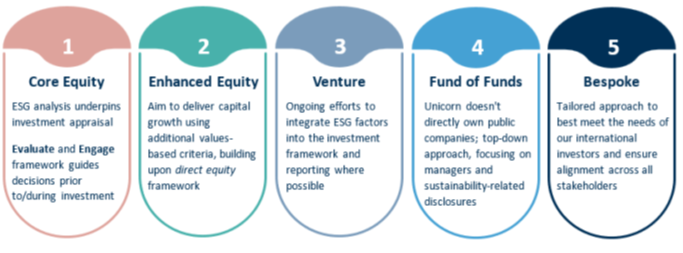
Unicorn employs a differentiated responsible investing framework to best address our ranging client needs and ensure the most appropriate evaluation for investee companies. Incorporating ESG-related financial risk assessment is essential for managing downside risk exposure, revealing underlying vulnerabilities that traditional financial analysis may overlook. Issues such as environmental liabilities, poor labour practices, or weak governance structures can lead to regulatory fines, operational disruptions, reputational damage, or financial loss. By identifying these risks early on, investors can mitigate potential losses, improve portfolio resilience, and avoid exposure to companies with unsustainable practices. Integrating ESG evaluation helps ensure that investments are not only aligned with long-term sustainability goals but are also safeguarded against unforeseen financial and operational challenges.
Evaluate
Unicorn aims to invest in companies that exhibit a robust commitment to key principles of corporate governance, including accountability, transparency, integrity, stakeholder engagement, and prudent financial stewardship. In addition, Unicorn prioritises investments in companies that align with broader social and environmental themes. In the social sphere, these themes encompass social equity and inclusion, community engagement, health and wellness, and education and skills development. On the environmental front, Unicorn seeks companies advancing cleaner energy, environmental services, and resource efficiency.
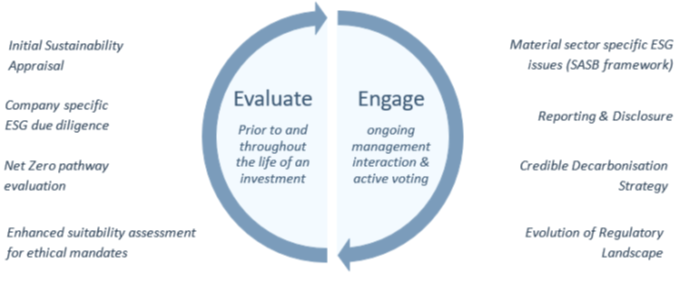
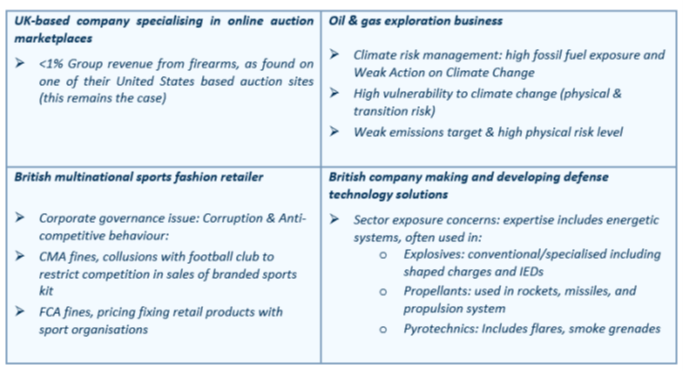
The initial review also aims to prohibit investment in any company which is deemed to have inadequate considerations towards long-term business model sustainability. An examination of a company’s harmful or detrimental characteristics within a sector context is also undertaken. Examples include but are not limited to: negative societal impact, corruption, ESG controversies. Illustrative examples include:
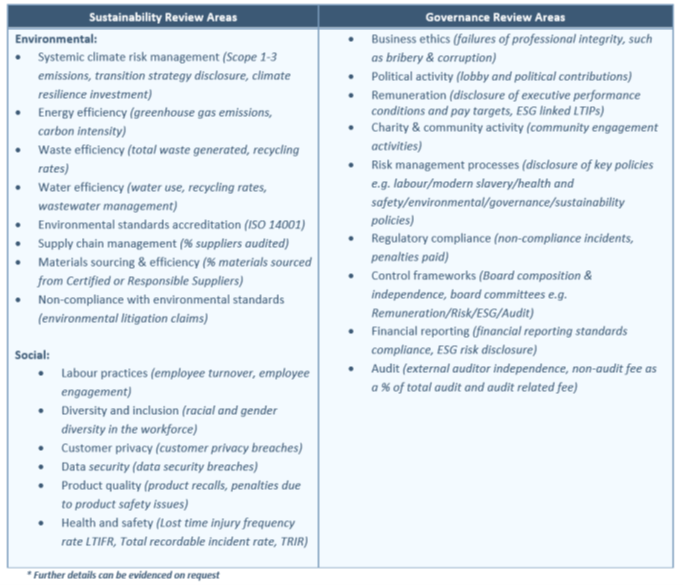
To provide more sector specific KPIs, a more focused analysis is then conducted in line with the Sustainability Accounting Standards Board (SASB) framework, in order to evaluate companies that operate in various sectors in different ways. The table below presents the ESG data considerations we conduct for each individual company when assessing sustainability of the business model and operations. Sources of information include, but are not limited to: corporate filings, industry publications, government databases, third-party platforms, company meetings.
Engage
As long-term shareholders, Unicorn’s investment team benefits from privileged access to senior management and Boards of investee companies, facilitating meaningful engagement through ongoing dialogue and active voting. Engagement is integral to our investment process and ongoing appraisal, with regular (typically biannual) meetings to discuss strategic, operational, and governance matters, including material ESG issues. Progress on these issues is recorded and monitored, and we encourage companies to enhance disclosure and reporting practices where necessary. Site visits further enable the team to assess ESG practices further. Additionally, Unicorn exercises voting rights on all resolutions, challenging management when recommendations conflict with our firmwide responsible investing standards or the interests of our investors. The firm’s voting records are available on the firm’s website. The firm’s SRD annual disclosures are further outlined in our annual Sustainability and Stewardship report which is also available on the firm’s website.
Enhanced Ethical Approach
The Unicorn Ethical Income Fund and IHT Responsible Investment Funds build upon the Core Unicorn Investment Process by implementing a strict exclusionary screening for companies which generate strategic revenue from the excluded business areas as per the Fund’s criteria. Strategic revenue can be defined as any business income, direct or indirect, that contributes to or advances precluded activities or demonstrably supports any of these business areas. Illustrative examples include:
- Payments platform that facilitates gambling company payment transactions
- Logistics businesses who have customers selling cigarettes as part of their supply chain distribution
- Soft drink wholesalers that sell pre-mixed cocktails as part of their product range
The Funds aim for zero investment exposure in these areas, with a maximum 5% strategic revenue exposure threshold. Any company deriving strategic income (direct or indirect) from these industries will be excluded from the Funds’ investments. To learn more about the additional company scrutiny for the Unicorn UK Ethical Income Fund and Responsible AIM IHT & ISA portfolio services, please email esg@unicornam.com for further information.
In line with both the Ottawa Treaty and the Oslo Convention, Unicorn fully supports the international conventions on cluster munitions and controversial weapons including anti-personnel mines, cluster munitions and chemical & biological weapons. In line with our approach to responsible investing and our commitment to the UN PRI, we will not knowingly invest in any company that derives revenues from, or provides funding for, cluster munitions or controversial weapons – this exclusion parameter is imposed in relation to all of Unicorn’s Funds or Mandates.
Resources, Affiliations & Corporate Strategies:
Proprietary Research
Investment research is performed in house, which has been the case since the inception of Unicorn Asset Management in 2000. This approach demands thorough due diligence of all investments, which fosters an in depth understanding of company business models from an operational, financial and ESG perspective. This is especially important when investing in smaller companies where relevant information is often less readily available. Regular meetings with company management teams form an integral part of the proprietary appraisal of investments.
Third Party Providers
Specialist ESG service providers may be utilised to provide supplementary independent analysis of investee companies. ESG research produced by third parties is only used as an indicative guide, and to inform, support and challenge our internal ESG assessment of a company. We work proactively with third party providers, often sharing our expertise to help inform and improve their assessment of companies that do not form part of their standard ESG coverage.
Corporate Governance
Unicorn invests in UK Companies and actively targets investment in those companies that employ strong corporate governance practices. Unicorn is committed to exercising responsible ownership. Our conviction is that companies which adopt best practice in corporate governance, will be more successful in their core activities and their ability to deliver enhanced returns for shareholders over the long term. Corporate governance is the system by which companies are directed and controlled. Boards of directors are responsible for the governance of their companies. The shareholders’ role in governance is to appoint the directors and the auditors and to satisfy themselves that an appropriate governance structure is in place. The responsibilities of the board include setting the company’s strategic aims, providing the leadership to put them into effect, supervising the management of the business and reporting to shareholders on their stewardship. The board’s actions are subject to laws, regulations and the shareholders in general meetings.
Accountability Mechanisms
The ESG team produces a quarterly ESG report detailing interactions with the management teams of investee companies and providing a record of Unicorn’s voting history and any other notable ESG engagements. The report and meeting minutes are then circulated and discussed by the ESG Committee, as a formal agenda item. Any required actions arising from the ESG Committee meetings are implemented as soon as is practicable.
Unicorn’s differentiated Responsible Investing Framework is implemented by the group’s Head of Sustainability and wider ESG team, which is overseen by the ESG Committee. The ESG Committee comprises: Head of Sustainability, ESG Risk Executive, ESG Associate, Director of Operations, Risk Officer, members of the investment team, Compliance Manager and Compliance Officer.
Unicorn is a signatory of the Net Zero Asset Managers Initiative (NZAMI) and the United Nation’s Principles for Responsible Investment (UN PRI).
For more information, please see our Sustainability and Stewardship report available on our company website.
Dialshifter
This fund is helping to ‘shift the dial from brown to green’ by…
Unicorn Asset Management is continually enhancing its proprietary responsible investing framework and deepening the integration of sustainability considerations across both the investment process and the wider organisation.
SDR Labelling:
Unlabelled - promotes sustainable characteristics (has CFD)
- Consumer Facing Disclosure
SDR Literature:
Literature
Voting Record
Disclaimer
Past performance is not a guide to future performance. The value of investments and the income from them may go down as well as up and investors may not get back the full amount of their original investment. Unicorn Asset Management do not give out investment advice, we recommend that you contact a financial advisor if you are unsure whether to invest. Investors should also read the Prospectus and KIID document of the fund before making an investment. Equities are subject to greater degrees of market risk than other types of investment, such as bonds or money market instruments. You should not invest unless you are prepared to accept a higher degree of risk. Investing in smaller companies, including AIM companies, can carry greater risks than those usually associated with large capitalisation companies. Smaller companies are likely to be less established and may not have access to the financial resources available to their larger counterparts. The shares of smaller companies are relatively illiquid and under-researched. Taxation levels, benefits and reliefs may all vary depending on individual circumstances and are subject to change. Opinions expressed are subject to change without notice. A key objective of the Fund is to provide income, therefore, some or all of the annual management charge is taken from capital rather than income. This can reduce the potential for capital growth. Unicorn Asset Management Limited are authorised and regulated by the Financial Conduct Authority.
| Fund Name | SRI Style | SDR Labelling | Product | Region | Asset Type | Launch Date | Last Amended |
|
|---|---|---|---|---|---|---|---|---|
Unicorn Ethical Income Fund |
Ethical Style | Unlabelled - promotes sustainable characteristics (has CFD) | OEIC | UK | Equity Income | 01/04/2016 | Aug 2025 | |
ObjectivesThe Unicorn UK Ethical Income Fund aims to provide an income by investing in UK companies which meet the ACD’s ethical guidelines. For this purpose, UK companies are defined as those which are incorporated or domiciled in the UK or have a significant part of their operations in the UK. Selection of such ethical equities will be undertaken on the basis of thorough company analysis, with ethical and socially responsible criteria reviewed prior to, at the point of investment and quarterly thereafter. The Unicorn Ethical Income Fund builds upon the Core Unicorn Investment Process by implementing a strict exclusionary screening for companies which generate strategic revenue from the excluded business areas as per the Fund’s criteria.
|
Fund/Portfolio Size: £28.10m (as at: 28/07/2025) Total Screened Themed SRI Assets: £28.10m (as at: 28/07/2025) Total Responsible Ownership Assets: £688.90m (as at: 28/07/2025) Total Assets Under Management: £688.90m (as at: 28/07/2025) ISIN: GB00BYP2Y515, GB00BYQCS257, GB00BDHLG082, GB00BDHLG207 Contact Us: esg@unicornam.com |
|||||||
Sustainable, Responsible &/or ESG OverviewUnicorn integrates sustainability into its investment strategy, viewing responsible business practices as essential for long-term value creation. The Fund employs a rigorous, sustainability-focused evaluation process across all investment stages, combining quantitative and qualitative assessments. This includes sector-specific analysis using frameworks like SASB to identify key ESG indicators. Companies involved in societal harm, corruption, or ESG controversies are excluded. Unicorn prioritises firms with strong governance, transparency, and stakeholder engagement, and aligns investments with social and environmental themes such as equity, education, clean energy, and resource efficiency. The firm actively engages with companies through regular dialogue, site visits, and voting on resolutions to influence ESG practices and strategic decisions. All evaluation and engagement activities are documented for transparency. This proactive approach helps mitigate financial risks, enhance portfolio resilience, and ensure alignment with long-term sustainability goals. |
||||||||
|
Primary fund last amended: Aug 2025 |
||||||||
|
Information received directly from Fund Manager |
||||||||
|
Please select what you would like to read:
Fund FiltersSustainability - General
Sustainability policy
Has policies that consider (environmental and social) sustainability issues. Strategies vary but are likely to consider environmental issues like climate change, carbon emissions, biodiversity loss, resource management, environmental impacts; and social issues like equal opportunities, human rights, labour standards, diversity and adherence to internationally recognised codes. See individual entry information.
Encourage more sustainable practices through stewardship
Aim to encourage higher sustainability standards through responsible ownership / stewardship / engagement / voting activity
Transition focus
Aim to support the shift to a sustainable future. See eg https://www.transitionpathwayinitiative.org/ Nature & Biodiversity
Genetic engineering exclusion
Avoids assets / companies directly involved in genetic engineering Climate Change & Energy
Climate change / greenhouse gas emissions policy
Has policies (documented strategies that explain their position) on climate change related issues such as greenhouse gas/carbon emissions, net zero, transitioning to lower carbon. Strategies vary.
Coal, oil & / or gas majors excluded
Avoid investment in major coal, oil and/or gas (extraction) companies. Strategies vary.
Fracking & tar sands excluded
Avoid companies involved in fracking and tar sands - which are widely regarded as controversial methods of oil and gas extraction. Strategies vary.
Fossil fuel reserves exclusion
Avoid investing in companies / assets with coal, oil and gas reserves. See individual entry information for further details.
Encourage transition to low carbon through stewardship activity
Encourage the transition to lower carbon activities through asset selection and / or responsible ownership activity.
Fossil fuel exploration exclusion - direct involvement
Excludes companies and other assets with direct involvement in fossil fuel exploration (eg coal, oil and gas companies) Ethical Values Led Exclusions
Tobacco & related product manufacturers excluded
Companies are excluded if they are involved in any aspect of the production chain for tobacco products, including cigarettes, vaping, e-cigarettes, chewing tobacco and cigars.
Controversial weapons exclusion
Excludes companies which make controversial weapons such as landmines, cluster munitions and chemical weapons.
Military involvement exclusion
Avoids companies with military contracts. This may include medical supplies, food, safety equipment, housing, technology etc
Civilian firearms production exclusion
Has a written civilian firearms exclusion policy - meaning that they will not invest in companies that make (or perhaps also sell) handguns made for non-military users.
Alcohol production excluded
Avoids companies that produce alcohol. Strategies vary; some may allow a small proportion of revenue to come from this area.
Gambling avoidance policy
Avoids companies with significant involvement in the gambling industry. Some may allow a small proportion of revenues to come from this area.
Pornography avoidance policy
Avoids companies that derive significant income from pornography and related areas. Strategies vary.
Animal welfare policy
Has policies that require specific animal welfare standards to be met. These may reference well-known welfare standards (3Rs - Replace, Reduce, Refine) or certification schemes. Strategies vary.
Animal testing exclusion policy
Avoids companies that test their products on animals. Strategies may vary, eg where testing is required by law. Human Rights
Human rights policy
Has policies relating to human rights issues. Typically require companies to demonstrate higher standards, although some managers work to encourage improvements. Investee companies are often judged against internationally agreed norms or standards. Strategies vary.
Child labour exclusion
Has policies to avoid companies that employ children.
Oppressive regimes (not free or democratic) exclusion policy
Has policies that exclude companies or other assets which operate in, or are owned by regimes which are not democratic, or where people may be oppressed. May use eg. Freedom House research. Strategies vary.
Modern slavery exclusion policy
Has a policy which excludes assets with involvement in Modern Slavery Gilts & Sovereigns
Does not invest in sovereigns
Does not invest in / excludes 'sovereigns' - debt issued by governments. See eg https://www.investopedia.com/terms/s/sovereign-debt.asp Banking & Financials
Invests in banks
Can include banks as part of their holdings / portfolio.
Invests in insurers
May invest in insurance companies. Governance & Management
Governance policy
Has policies that relate to corporate governance issues such as board structure, executive remuneration, bribery and/or corporate corruption. These funds will typically avoid companies with poor practices. Strategies vary.
Avoids companies with poor governance
Avoids investing in companies with poor governance practices.(e.g. board structure, management practices etc.) Views may however vary on what counts as 'poor' practices - and funds may not immediately divest as they may prefer to work to encourage higher standards.
UN sanctions exclusion
Exclude companies that are subject to United Nations sanctions. See eg https://main.un.org/securitycouncil/en/content/un-sc-consolidated-list
Anti-bribery & corruption policy
Has policies explaining how managers will respond to assets / companies that do not comply with relevant anti-bribery and anti-corruption standards or laws. Strategies vary; options include stewardship/ engagement and divestment - or a combination.
Encourage higher ESG standards through stewardship activity
Aim to encourage higher ESG standards through responsible ownership / stewardship / engagement /voting activity Product / Service Governance
ESG integration strategy
Find fund / asset managers that factor in 'environmental, social and governance' issues as part of their investment decision making process. A focus on 'ESG' typically means a fund is carrying out additional research to help reduce ESG related risks. It does not necessarily mean a focus on sustainability. Strategies vary. See fund literature. Asset Size
Over 50% small / mid cap companies
Invests more than half of their money in smaller or medium sized companies. (i.e. below around £5 -10 billion)
Invests mostly in small or mid cap companies / assets
Has SRI strategies which focus their investment stock selection on small or mid cap companies / assets. (e.g. below circa £10bn) Impact Methodologies
Aim to deliver positive impacts through engagement
Aims to deliver positive environmental and or social impacts (real world benefits) through its engagement with investee assets How The Fund/Portfolio Works
Strictly screened ethical investment
Has principle approach to apply positive or negative ethical, social and / or environmental screens. Strictly screened investments are likely to exclude more companies than other related options. Strategies vary.
ESG risk mitigation focus
Focuses on the careful management of environmental, social and governance (ESG) related risks - typically by avoiding or being underweight in companies seen as posing major risks in these areas (i.e. not necessarily by using themes, exclusions etc).
SRI / ESG / Ethical policies explained on website
Publish explanations of their ethical, social and/or environmental policies online (i.e. investment decision making strategies/ buy/sell &/or asset management strategies).
Do not use stock / securities lending
Does not use stock lending for performance or risk purposes. Unscreened Assets & Cash
All assets (except cash) meet published sustainability criteria
All assets - except cash - meet the sustainability criteria published in strategy documentation. Intended Clients & Product Options
Intended for clients interested in sustainability
Designed to meet the needs of individual investors with an interest in sustainability issues.
Intended for clients interested in ethical issues
Designed for clients who care about ethical and values-based issues, often alongside sustainability issues also.
Available via an ISA (OEIC only)
Available via a tax efficient ISA product wrapper. Labels & Accreditations
ACT signatory
A voluntary corporate culture standard for investment managers, see https://www.investorsact.com/ - City Hive Fund Management Company InformationAbout The Business
Responsible ownership / stewardship policy or strategy (AFM companywide)
Finds fund / asset management companies that have a published company wide stewardship, engagement and / or responsible ownership policy or strategy that covers all investments. Stewardship typically involves encouraging higher ESG standards through voting and dialogue.
ESG / SRI engagement (AFM companywide)
Find fund / asset management companies that actively encourage higher 'environmental, social and governance' and / or 'sustainable and responsible investment' practices across investee companies - typically where the aim is to encourage positive change that is aligned with the best interests of investors. Strategies vary. See additional information and options.
Vote all* shares at AGMs / EGMs (AFM companywide)
Find fund / asset managers that vote all* the shares they own at Annual General Meetings and Extraordinary General Meetings. A commitment to voting shares is a key indicator of 'responsible share ownership' demonstrating their support for or disagreement with management policy. (*situations can legitimately, occasionally occur where voting proves impossible, but in principle all shares should be voted.)
Responsible ownership / ESG a key differentiator (AFM companywide)
Find fund / asset managers that consider responsible ownership and ESG to be a key differentiator for their business.
Responsible ownership policy for non SRI / sustainable options (AFM companywide)
Find options run by managers that apply Responsible ownership or 'Stewardship' policies to all or most of their investment assets. This means active involvement (e.g. voting, dialogue) with the companies across all or most funds, products and services.
Integrates ESG factors into all / most research (AFM companywide)
Find fund / asset management companies that consider environmental, social and governance (ESG) issues when deciding whether or not to invest in a company for all / almost all of their funds and other assets. This is increasingly seen as part of sound risk management.
Diversity, equality & inclusion engagement policy (AFM companywide)
Find fund / asset management companies that encourage the companies they invest in to have strong diversity, race, gender and other equality policies across all assets held, not simply screened or themed SRI/ESG funds. (ie Asset Management company wide).
Offer unstructured intermediary sustainable investment training
Fund management entity offers unstructured intermediary training on sustainable investment (ie for financial advisers and wealth managers) Collaborations & Affiliations
PRI signatory
Find fund / asset management companies that have signed up to the UN backed 'Principles of Responsible Investment'.
Fund EcoMarket partner
Find fund / asset management companies that have partnered with Fund EcoMarket - meaning that they are helping to improve access to information on sustainable and responsible investment by paying an annual fee to us which enables us to publish information for free. Partner funds are listed ahead of other funds and have their logos displayed.
Investment Association (IA) member
Fund management entity is a member of the Investment Association https://www.theia.org/ Resources
In-house responsible ownership / voting expertise
Find fund / asset management companies that employ people to steer and support fund managers in voting shares at company AGM's and EGMs in ways that are consistent with encouraging higher ESG/sustainability standards.
Employ specialist ESG / SRI / sustainability researchers
Find a fund / asset management company that directly employs specialist ESG/SRI/sustainability researchers or analysts. This allows asset managers to discuss environmental, social and governance risks and opportunities directly with companies.
Use specialist ESG / SRI / sustainability research companies
Find fund / asset management companies that makes use of expert external research companies. This can help deliver specialist expertise and means resources are pooled with other investors.
ESG specialists on all investment desks (AFM companywide)
Finds organisations / fund managers that have one or more ESG/sustainability experts on all investment teams or 'desks' (all asset types) Engagement Approach
Engaging on climate change issues
Fund / asset manager has stewardship /responsible ownership strategy that is focused on addressing climate change with investee assets.
Engaging to reduce plastics pollution / waste
Fund / asset manager has stewardship /responsible ownership strategy with involves encouraging investee asset to reduce plastic waste and pollution.
Engaging to encourage a Just Transition
Fund / asset manager has a responsible ownership / stewardship strategy which means they are working to encourage the shift to more sustainable business practices in ways that respect and are sensitive to social issues and the impact change has on people effected by the changes that are taking place. https://www.transitionpathwayinitiative.org/ https://transitiontaskforce.net/
Engaging on labour / employment issues
Fund / asset manager has responsible ownership / stewardship strategy in place that aims to improve labour standards for the benefit of employees in investee companies (and potentially their suppliers)
Engaging on governance issues
Fund / asset managers have stewardship strategies in place that focus on improving governance standards across investee assets
Engaging on responsible supply chain issues
Has a stewardship / responsible ownership strategy that encourages responsible supply chain - ie the managers will discuss environmental, social and governance issues with investee companies with the aim of raising standards Company Wide Exclusions
Controversial weapons avoidance policy (AFM companywide)
Find fund / asset management companies (not funds) that avoid investment in 'controversial weapons' across all of their funds and other investment vehicles. Climate & Net Zero Transition
Net Zero commitment (AFM companywide)
Fund / asset management organisations that have pledged to reduce their greenhouse gas emissions to ‘net zero’. Strategies vary - this area is changing rapidly.
Net Zero - have set a Net Zero target date (AFM companywide)
This fund / asset management company has set a date by which they plan to achieve net zero greenhouse gas / CO2e emissions.
Carbon offsetting - offset carbon as part of net zero plan (AFM companywide)
This fund / asset management company plans to achieve net zero greenhouse gas (CO2e) emissions with the help of a scheme that will lock away an amount of carbon that is equivalent to the company’s own emissions – so that the end result is ‘net zero’. Calculations and scope vary. Transparency
Publish responsible ownership / stewardship report (AFM companywide)
Find fund / asset management companies that publish a report detailing their responsible investment ownership - also known as 'Stewardship' - activity.
Full stewardship / responsible ownership policy information on company website
Find fund / asset management companies that publish information about their sustainable and responsible investment strategies on their company website.
Publish full voting record (AFM companywide)
Fund / asset management companies that publish a full record of how they vote their shares at AGMs (annual general meetings) and EGMs (extraordinary general meetings). Voting strategies have an important role to play encouraging higher environmental, social and governance standards. Sustainable, Responsible &/or ESG Policy:Unicorn believes that a company’s commitment to responsible and sustainable operations and business practices serves as a key indicator of its potential for long-term value creation and preservation. The Fund applies a specific sustainability-related evaluation and assessment of stocks selection, which is integrated throughout the investment process. This comprehensive approach involves in-depth analysis and active engagement to identify and mitigate downside risks and minimise potential financial vulnerabilities within a business. Furthermore, each stage of this evaluation and engagement process is thoroughly documented and can be made available upon request, ensuring transparency and accountability in investment practices.
Process:Unicorn believes that a company’s commitment to responsible and sustainable operations and business practices serves as a key indicator of its potential for long-term value creation and preservation. Each Fund applies a specific sustainability-related evaluation and assessment of stock selection, which is then integrated throughout the investment process. This comprehensive approach involves in-depth analysis and active engagement to identify and mitigate downside risks and minimise potential financial vulnerabilities within a business. Furthermore, each stage of this evaluation and engagement process is thoroughly documented and can be made available upon request, ensuring transparency and accountability in investment practices. Evaluate: detailed and thorough assessment of investee companies, research focuses on both quantitative and qualitative elements. All financially relevant and material ESG-related financial factors are considered for both existing and potential holdings. Engage: active engagement including regular meetings with senior management, site visits, and active voting. Unicorn benefits from strong corporate access enabling ongoing dialogue with investee companies Differentiated Framework
Unicorn employs a differentiated responsible investing framework to best address our ranging client needs and ensure the most appropriate evaluation for investee companies. Incorporating ESG-related financial risk assessment is essential for managing downside risk exposure, revealing underlying vulnerabilities that traditional financial analysis may overlook. Issues such as environmental liabilities, poor labour practices, or weak governance structures can lead to regulatory fines, operational disruptions, reputational damage, or financial loss. By identifying these risks early on, investors can mitigate potential losses, improve portfolio resilience, and avoid exposure to companies with unsustainable practices. Integrating ESG evaluation helps ensure that investments are not only aligned with long-term sustainability goals but are also safeguarded against unforeseen financial and operational challenges. Evaluate
The initial review also aims to prohibit investment in any company which is deemed to have inadequate considerations towards long-term business model sustainability. An examination of a company’s harmful or detrimental characteristics within a sector context is also undertaken. Examples include but are not limited to: negative societal impact, corruption, ESG controversies. Illustrative examples include:
To provide more sector specific KPIs, a more focused analysis is then conducted in line with the Sustainability Accounting Standards Board (SASB) framework, in order to evaluate companies that operate in various sectors in different ways. The table below presents the ESG data considerations we conduct for each individual company when assessing sustainability of the business model and operations. Sources of information include, but are not limited to: corporate filings, industry publications, government databases, third-party platforms, company meetings.
Engage Enhanced Ethical Approach
The Funds aim for zero investment exposure in these areas, with a maximum 5% strategic revenue exposure threshold. Any company deriving strategic income (direct or indirect) from these industries will be excluded from the Funds’ investments. To learn more about the additional company scrutiny for the Unicorn UK Ethical Income Fund and Responsible AIM IHT & ISA portfolio services, please email esg@unicornam.com for further information. In line with both the Ottawa Treaty and the Oslo Convention, Unicorn fully supports the international conventions on cluster munitions and controversial weapons including anti-personnel mines, cluster munitions and chemical & biological weapons. In line with our approach to responsible investing and our commitment to the UN PRI, we will not knowingly invest in any company that derives revenues from, or provides funding for, cluster munitions or controversial weapons – this exclusion parameter is imposed in relation to all of Unicorn’s Funds or Mandates.
Resources, Affiliations & Corporate Strategies:Proprietary Research Third Party Providers Corporate Governance Accountability Mechanisms Unicorn’s differentiated Responsible Investing Framework is implemented by the group’s Head of Sustainability and wider ESG team, which is overseen by the ESG Committee. The ESG Committee comprises: Head of Sustainability, ESG Risk Executive, ESG Associate, Director of Operations, Risk Officer, members of the investment team, Compliance Manager and Compliance Officer. Unicorn is a signatory of the Net Zero Asset Managers Initiative (NZAMI) and the United Nation’s Principles for Responsible Investment (UN PRI). For more information, please see our Sustainability and Stewardship report available on our company website. Dialshifter (Fund)This fund is helping to ‘shift the dial from brown to green’ by… Unicorn Asset Management is continually enhancing its proprietary responsible investing framework and deepening the integration of sustainability considerations across both the investment process and the wider organisation.
Dialshifter (Corporate)‘Our organisation is helping to support the Paris Climate Agreement and the Race to Net Zero by…’ Unicorn Asset Management continues to be a signatory of the United Nations Principles of Responsible Investment and Net Zero Asset Managers Initiative which supports the Paris Climate Agreement and the Race to Net Zero. SDR Labelling:Unlabelled - promotes sustainable characteristics (has CFD)
SDR Literature:LiteratureVoting RecordDisclaimerPast performance is not a guide to future performance. The value of investments and the income from them may go down as well as up and investors may not get back the full amount of their original investment. Unicorn Asset Management do not give out investment advice, we recommend that you contact a financial advisor if you are unsure whether to invest. Investors should also read the Prospectus and KIID document of the fund before making an investment. Equities are subject to greater degrees of market risk than other types of investment, such as bonds or money market instruments. You should not invest unless you are prepared to accept a higher degree of risk. Investing in smaller companies, including AIM companies, can carry greater risks than those usually associated with large capitalisation companies. Smaller companies are likely to be less established and may not have access to the financial resources available to their larger counterparts. The shares of smaller companies are relatively illiquid and under-researched. Taxation levels, benefits and reliefs may all vary depending on individual circumstances and are subject to change. Opinions expressed are subject to change without notice. A key objective of the Fund is to provide income, therefore, some or all of the annual management charge is taken from capital rather than income. This can reduce the potential for capital growth. Unicorn Asset Management Limited are authorised and regulated by the Financial Conduct Authority. |
||||||||