L&G Future World Global Multi-Factor ESG Tilted and Optimised Index Fund
SRI Style:
Environmental Style
SDR Labelling:
Unlabelled - promotes sustainable characteristics (has CFD)
Product:
OEIC
Fund Region:
Global
Fund Asset Type:
Passive / Index
Launch Date:
18/01/2018
Last Amended:
Aug 2025
Dialshifter ( ):
):
Fund/Portfolio Size:
£189.40m
(as at: 30/04/2025)
Total Screened Themed SRI Assets:
£424600.00m
(as at: 31/12/2024)
Total Responsible Ownership Assets:
£1117672.56m
(as at: 31/12/2024)
Total Assets Under Management:
£1117672.56m
(as at: 31/12/2024)
ISIN:
GB00BF41Q726, GB00BF41Q619
Contact Us:
Objectives:
The objective of the Fund is to track the performance of the iSTOXX L&G Global Multi-Factor ESG Index, the “Benchmark Index” on a net total return basis before fees and expenses are applied.
Sustainability investment labels help investors find products that have a specific sustainability goal. This product does not have a UK sustainability investment label in accordance with the FCA’s Sustainability Disclosure Requirements as it does not have a specific sustainability objective in its investment objective, which is a requirement for a sustainability investment label. However, this Fund and the benchmark index that the Fund replicates apply environmental, social and governance criteria.
Further information on the Fund’s sustainability characteristics can be found in the Fund Details set out in the Prospectus.
Sustainable, Responsible
&/or ESG Overview:
We have provided below the purpose of the fund:
- The fund aims to provide factor exposure to a global and diversified regional basket of shares in companies as represented by the Benchmark Index, where their weights are varied to achieve balanced risk exposure to multiple factors with additional ESG considerations.
- The index excludes shares of companies on the L&G Future World Protection List in order to encourage strong governance and sustainable strategies.
- The fund incorporates L&G’s Climate Impact Pledge, a targeted engagement process, and may exclude companies if engagement proves unsuccessful.
- The fund will invest more in companies with higher ESG scores, and will also invest in companies with lower ESG scores, but by a reduced amount.
Primary fund last amended:
Aug 2025
Information directly from fund manager.
Fund Filters
Sustainability - General
Has policies that consider (environmental and social) sustainability issues. Strategies vary but are likely to consider environmental issues like climate change, carbon emissions, biodiversity loss, resource management, environmental impacts; and social issues like equal opportunities, human rights, labour standards, diversity and adherence to internationally recognised codes. See individual entry information.
Has a significant focus on sustainability issues
Aim to encourage higher sustainability standards through responsible ownership / stewardship / engagement / voting activity
Use the UN Global Compact to inform or help direct where they can or cannot invest. Will typically not invest in companies with significant breaches (low standards) - strategies vary. (The UNGC covers a wide range of issues - search 'UNGC'). See https://unglobalcompact.org/
Publicly report performance against named sustainability objectives
Environmental - General
Has policies which relate to environmental issues. These will typically set out their stance on issues such as pollution, climate change, resource management, biodiversity loss, carbon emissions, plastics and/or additional environmental impacts. Strategies vary.
Options that limit or 'reduce' their exposure to carbon intensive industries (ie sectors which are major contributors to climate change). Strategies vary.
Climate Change & Energy
Has policies (documented strategies that explain their position) on climate change related issues such as greenhouse gas/carbon emissions, net zero, transitioning to lower carbon. Strategies vary.
Avoid investment in major coal, oil and/or gas (extraction) companies. Strategies vary.
Avoid companies involved in fracking and tar sands - which are widely regarded as controversial methods of oil and gas extraction. Strategies vary.
Encourage the transition to lower carbon activities through asset selection and / or responsible ownership activity.
Will only invest in companies that report greenhouse gas emissions in line with this international reporting framework. See https://www.fsb-tcfd.org/ https ://www.ifrs.org/sustainability/tcfd/
Requires all, or most of, the assets they invest in to have a ‘net zero action plan’ - describing how they will reduce their greenhouse gas emissions.
Social / Employment
All mining companies excluded
Ethical Values Led Exclusions
Excludes companies which make controversial weapons such as landmines, cluster munitions and chemical weapons.
Gilts & Sovereigns
Does not invest in / excludes 'sovereigns' - debt issued by governments. See eg https://www.investopedia.com/terms/s/sovereign-debt.asp
Banking & Financials
Can include banks as part of their holdings / portfolio.
May invest in insurance companies.
Asset Size
Invests more than half of their money into what are commonly regarded as 'large companies'. This will typically mean that the market capitalisation (or value) of the companies they hold is in excess of £5 to £10 billion.
Invests mainly in larger companies / assets. (e.g. over circa £5-£10bn)
Impact Methodologies
Has policies that aim to help or support the delivery of positive social or environmental impacts (or societal/real world outcomes) by investing in companies they regard as beneficial to people and / or the planet. Strategies vary.
Aims to measure the positive real world environmental and / or social benefits that are associated with their investment strategy. Investments that aim to deliver positive impacts and measure those impacts may be referred to as 'Impact' - although impact measurement is not restricted to Impact investments. Strategies vary.
Specifically sets out to help deliver positive environmental impacts, benefits or 'real world' outcomes.
How The Fund/Portfolio Works
Has principle 'ethical approach' to avoid companies by using negative screening criteria. Strategies vary.
Invest more heavily in assets which have higher ESG ratings/standards or scores and less heavily in companies with lower ESG ratings. Where this is central to the strategy you should expect assets in most sectors. Strategies vary.
Only uses an investment index to direct where they can invest. Fund strategies and indices vary.
Focuses on the careful management of environmental, social and governance (ESG) related risks - typically by avoiding or being underweight in companies seen as posing major risks in these areas (i.e. not necessarily by using themes, exclusions etc).
Publish explanations of their ethical, social and/or environmental policies online (i.e. investment decision making strategies/ buy/sell &/or asset management strategies).
Does not use stock lending for performance or risk purposes.
Intended Clients & Product Options
Designed to meet the needs of individual investors with an interest in sustainability issues.
Designed for clients who care about ethical and values-based issues, often alongside sustainability issues also.
Fund Management Company Information
About The Business
Finds fund / asset management companies that have a published company wide stewardship, engagement and / or responsible ownership policy or strategy that covers all investments. Stewardship typically involves encouraging higher ESG standards through voting and dialogue.
Find fund / asset management companies that actively encourage higher 'environmental, social and governance' and / or 'sustainable and responsible investment' practices across investee companies - typically where the aim is to encourage positive change that is aligned with the best interests of investors. Strategies vary. See additional information and options.
Find fund / asset managers that vote all* the shares they own at Annual General Meetings and Extraordinary General Meetings. A commitment to voting shares is a key indicator of 'responsible share ownership' demonstrating their support for or disagreement with management policy. (*situations can legitimately, occasionally occur where voting proves impossible, but in principle all shares should be voted.)
Find fund / asset managers that consider responsible ownership and ESG to be a key differentiator for their business.
Find fund / asset management companies that take sustainability criteria into account when selecting and/or managing all of their property / real estate investments.
The leadership team of this fund / asset manager have performance targets linked to environmental goals.
Find options run by managers that apply Responsible ownership or 'Stewardship' policies to all or most of their investment assets. This means active involvement (e.g. voting, dialogue) with the companies across all or most funds, products and services.
Find fund / asset management companies that consider environmental, social and governance (ESG) issues when deciding whether or not to invest in a company for all / almost all of their funds and other assets. This is increasingly seen as part of sound risk management.
Finds organisations / fund managers that have an in-house (company wide) diversity improvement programme - meaning that they are working to ensure that within their own businesses they employ people from diverse backgrounds - often typically focused on ethnicity and/or sex.
Find fund / asset management companies that encourage the companies they invest in to have strong diversity, race, gender and other equality policies across all assets held, not simply screened or themed SRI/ESG funds. (ie Asset Management company wide).
This fund / asset management company invests in companies which have recently listed on a stock exchange (which is important as it can help grow new businesses).
Fund / asset management company has investments in bonds designed to meet sustainability requirements - however these assets may not be 'ringfenced' for this purpose. See website for details.
Collaborations & Affiliations
Find fund / asset management companies that have signed up to the UN backed 'Principles of Responsible Investment'.
A member of the Taskforce for Nature Related Financial Disclosures group which aims to aid risk management and shift money towards nature-positive outcomes.
Fund management entity is a member of the Investment Association https://www.theia.org/
Resources
Find fund / asset management companies that employ people to steer and support fund managers in voting shares at company AGM's and EGMs in ways that are consistent with encouraging higher ESG/sustainability standards.
Find a fund / asset management company that directly employs specialist ESG/SRI/sustainability researchers or analysts. This allows asset managers to discuss environmental, social and governance risks and opportunities directly with companies.
Find fund / asset management companies that makes use of expert external research companies. This can help deliver specialist expertise and means resources are pooled with other investors.
Finds organisations / fund managers that have one or more ESG/sustainability experts on all investment teams or 'desks' (all asset types)
Accreditations
Find fund / asset managers that are signatories to the FRC UK Stewardship Code, which sets out a framework for constructive investor / investee relations where managers are encouraged to behave like responsible, typically longer term 'company owners'.
Engagement Approach
Find fund / asset management companies that regularly initiate or run industry wide (collaborative) investor projects aimed at raising environmental, social and governance standards amongst investee companies.
Fund / asset manager has stewardship /responsible ownership strategy that is focused on addressing climate change with investee assets.
Fund / asset manager has a stewardship /responsible ownership strategy that involves working with fossil fuel companies on climate change related issues. See fund manager website for details.
Fund / asset manager has stewardship /responsible ownership strategy with involves encouraging investee asset to reduce plastic waste and pollution.
Fund / asset manager has a stewardship / responsible ownership policy that means they are working to encourage more responsible mining practices - where environmental and social issues are properly dealt with by the companies they invest in.
The fund / asset manager has a responsible ownership / stewardship strategy that focuses on biodiversity and nature issues relating to the assets they invest the aim of which will be to reduce harm and or deliver improvement. Strategies vary. https://tnfd.global
Fund / asset manager has a responsible ownership / stewardship strategy which means they are working to encourage the shift to more sustainable business practices in ways that respect and are sensitive to social issues and the impact change has on people effected by the changes that are taking place. https://www.transitionpathwayinitiative.org/ https://transitiontaskforce.net/
Fund / asset manager has responsible ownership / stewardship strategy in place which aims to address human rights issues in investee companies (and potentially their suppliers) with the aim of raising standards
Fund / asset manager has responsible ownership / stewardship strategy in place that aims to improve labour standards for the benefit of employees in investee companies (and potentially their suppliers)
Fund / asset management company has a stewardship strategy in place which involves working to raise diversity, equality and inclusion standards across investee assets
Fund / asset manager is working with the assets they hold to help stamp out modern slavery - where direct or indirect company employees are exploited for business benefits.
Fund / asset managers have stewardship strategies in place that focus on improving governance standards across investee assets
Escalation policies describe how a manager will proceed if stewardship / engagement activity is not successful in the short term.
Company Wide Exclusions
Find fund / asset management companies (not funds) that avoid investment in 'controversial weapons' across all of their funds and other investment vehicles.
Find funds / asset managers that are reviewing, or have reviewed, their exposure to carbon intensive industries including (but not only) mining, oil and gas companies. (Typically with reference to climate change.)
This fund / asset manager excludes direct investment in the coal mining industry. Managers ability to do this may depend on the geographic regions in which they invest.
Climate & Net Zero Transition
Fund / asset management organisations that have pledged to reduce their greenhouse gas emissions to ‘net zero’. Strategies vary - this area is changing rapidly.
This fund / asset management company has set a date by which they plan to achieve net zero greenhouse gas / CO2e emissions.
Find fund / asset management companies that are working with the companies they invest in to encourage reductions in carbon dioxide and other greenhouse gas emissions.
Finds organisations / fund managers that have a company wide carbon transition plan - meaning that they have plotted a path to how they will move away from activities that produce or use carbon based energy sources (that emit greenhouse gases) towards clean, alternative, renewable energy sources.
This fund / asset management company plans to achieve net zero greenhouse gas (CO2e) emissions by reducing their emissions. Calculations and scope vary.
Find fund / asset management companies that are working to reduce their own (fund management company) carbon/greenhouse gas emissions.
Finds organisations / fund management companies that are in the process of working out how to make a ‘net zero commitment’ - meaning that when that is finalised they will have started the process of reducing their total greenhouse gas emissions to 'zero'.
See https://sciencebasedtargets.org/
Transparency
Find fund / asset management companies that publish a report detailing their responsible investment ownership - also known as 'Stewardship' - activity.
Find fund / asset management companies that publish information about their sustainable and responsible investment strategies on their company website.
Find fund / asset management companies that will supply information about their sustainable and responsible investment activity on request.
Fund / asset management companies that publish a full record of how they vote their shares at AGMs (annual general meetings) and EGMs (extraordinary general meetings). Voting strategies have an important role to play encouraging higher environmental, social and governance standards.
This fund / asset management company has published a plan that explains how they are going to achieve net zero greenhouse gas / CO2e emissions.
Find fund / asset management companies that have supplied Dialshifter information. See Dialshifter tab within record for more information.
Sustainable, Responsible &/or ESG Policy:
The Fund is a Replicating Fund as it replicates as closely as possible the constituents of the Benchmark Index by holding all, or substantially all, of the assets comprising the Benchmark Index in similar proportions to their weightings in the Benchmark Index.
The Fund will have at least 90% exposure (directly or through depositary receipts) to assets that are included in the Benchmark Index. The Fund will generally hold assets directly but can use depositary receipts (such as American depositary receipts and global depositary receipts) to gain exposure such as when the direct asset cannot be held or is not available.
The Fund may also invest in shares in companies which are reasonably expected to become part of the Benchmark Index in the near future or are an alternative to a constituent of the Benchmark Index and collective investment schemes, including those managed or operated by the Manager or an Associate as well as money market instruments (such as treasury bills), depositary receipts (such as American depositary receipts and global depositary receipts), cash and permitted deposits.
The Fund may only use derivatives for Efficient Portfolio Management purposes.
Multi-factor investing:
The Benchmark Index is designed to reflect the performance of a global and diversified regional basket of shares in companies where their weights are varied to achieve balanced risk exposure to the multiple factors with additional ESG considerations, as explained below.
In order to achieve the factor exposure, the Investment Manager has developed a proprietary scoring system which scores companies based on the below factors compared to their regional and sector peers:
- Value: companies that appear less expensive than comparable companies, providing better value for money associated with trading for less than their intrinsic value based on fundamentals 64 and therefore available at discounted price, expected to increase.
- Momentum: companies with strong recent performance, rapid growth in a short period of time is generally associated with the notion that the price will continue rise and generate additional value, often connected with positive stories which attract further investment.
- Quality: companies with positive characteristics such as positive income, high profitability and low leverage, generally indicating lower financial risk, more stable earnings and durable business models; and are reasonably expected to outperform companies with lower quality characteristics.
- Low volatility: companies with lower volatility, indicating that it is less likely that the price of shares will fluctuate significantly and frequently.
Each company in the Benchmark Index is scored on each of the above factors and these scores are combined into a single multi-factor score (“Multi-Factor Score”).
Environmental, Social and Governance ("ESG") considerations:
The Benchmark Index provider applies the following ESG criteria to the Benchmark Index:
- Benchmark Index exclusions:
- Future World Protection List: the Benchmark Index excludes companies on the Investment Manager's Future World Protection List ("FWPL"). The FWPL consists of companies that the Investment Manager considers to be failing to meet minimum standards of globally accepted business practices, as set out in the FWPL methodology. These include:
- perennial violators of the United Nations Global Compact,
- certain companies involved in the manufacture and production of controversial weapons, and
- certain companies with involvement in mining and extraction of thermal coal, thermal coal power generation or oil sands which have not set out a clear plan aligned with the Paris Agreement to phase out thermal coal in accordance with specific criteria.
The FWPL methodology uses various assessment criteria, including revenue thresholds, to identify companies for incorporation on the list. Only companies that meet the criteria are excluded, consequently the Benchmark Index may hold companies involved in the above activities which do not fully meet the FWPL methodology criteria.
- Multi-Factor Scores and ESG scoring system
In addition to the Multi-Factor Score, the Benchmark Index applies the Investment Manager’s proprietary ESG Scoring system, which is a rulesbased approach to scoring companies (“ESG Score”).
The ESG scoring system combines an environmental score, a social score and a governance score with adjustments made for a company’s overall level of transparency with regards to ESG issues. Higher scores indicate that more of the Investment Manager’s criteria for best practices have been met.
Each company in the Parent Index is assigned an ESG Score and MultiFactor Score. Each company in the Parent Index is:
- tilted based on the ESG Score resulting in companies with higher ESG Scores receiving a higher weight compared to the Parent Index and vice versa; and
- tilted based on the Multi-factor Score resulting in companies with higher Multi-factor Score receiving a higher weight compared to the Parent Index and vice versa.
Whilst there is interaction between the ESG Score and Multi-Factor Score, the tilting based on the Multi-Factor Score is more significant, as the Benchmark Index is primarily a factor-based strategy with integrated ESG criteria. This may result in instances where some companies have higher Multi-Factor Scores but lower ESG Scores and vice versa. However, on average, the Benchmark Index aims to have a 5% improvement over the total aggregate ESG score compared to the Parent Index.
“Parent Index” is defined in the Benchmark Index methodology. The Parent Index is a representation of the broader investment universe before ESG criteria and factors characteristics are taken into consideration by the Benchmark Index provider.
Where data for a given company is unavailable or only partly available across elements of the ESG Score or Multi-Factor Score, the company may be allocated a neutral ESG Score or Multi-Factor Score. Where a company is allocated a neutral score, no tilting will be applied.
- Greenhouse Gas emissions intensity reduction pathway
“GHG Emissions Intensity” means the weighted average of the greenhouse gas emissions intensity of companies in the Benchmark Index, as calculated in accordance with the Benchmark Index methodology.
The Benchmark Index aims to reduce its overall GHG Emissions Intensity in line with a reduction pathway of 7% per year on average, measured from the Benchmark Index inception date of April 2021 (“Index Base Date”). It also aims to keep its GHG Emissions Intensity at least 50% lower than the Parent Index.
An automated optimisation process is applied to the Benchmark Index to achieve these GHG Emissions Intensity reductions, within the Benchmark Index construction constraints (as described in the Benchmark Index methodology). This process includes all companies in the Benchmark Index (provided that such data is available). The Fund's assets are weighted so that the resulting portfolio's GHG Emissions Intensity reduce in line with whichever aim (set out above) results in the largest GHG Emissions Intensity reduction.
Whilst the Benchmark Index may have exposure to companies with higher GHG Emissions Intensity, the Benchmark Index aims to have, on each rebalance date, the lower of: (i) an annual average 7% reduction in GHG Emissions Intensity from the Index Base Date; or (ii) at least a 50% reduction in overall GHG Emissions compared to the Parent Index.
This optimisation process uses data from a range of different types of greenhouse gas emissions. In particular, this includes:
- Scope 1: direct emissions from company-owned resources, like fuel combustion in vehicles; and
- Scope 2: indirect emissions from purchased energy, such as electricity for buildings.
The Benchmark Index does not include other indirect greenhouse gas emissions, such as those from a company's supply chain or product use (Scope 3) as part of the optimisation process. The inclusion of scope 3 emissions may provide a more complete analysis of the Benchmark Index’s Greenhouse Gas Emissions.
Fund exclusions
In addition to the exclusions applied to the Benchmark Index (as set out above), the Fund may exclude companies that are on the Investment Manager's Climate Impact Pledge divestment list, within the anticipated tracking error.
The Climate Impact Pledge divestment list includes companies, which after a certain period of engagement continue to not perform well against the Investment Manager's climate assessment, are unresponsive to engagement recommendations, and/or keep falling behind in meeting the Investment Manager's minimum standards. If the anticipated tracking error percentage is exceeded, exposure to such companies held in the Fund will be reduced where possible, rather than fully excluded.
Subject to market conditions the Investment Manager may, within a reasonable timeframe, disinvest from companies which are subsequently incorporated into the Climate Impact Pledge divestment list.
Process:
The Fund is a Replicating Fund as it replicates as closely as possible the constituents of the Benchmark Index by holding all, or substantially all, of the assets comprising the Benchmark Index in similar proportions to their weightings in the Benchmark Index.
Research is an integral part of our portfolio management process and is performed on an ongoing basis to capture all elements that could affect the risk profile of benchmark indices. It is, therefore, most effective if it is carried out by the same professionals who are involved in managing portfolios as they have a thorough knowledge of index products and market conditions.
We also conduct ad hoc research for clients who wish to achieve a non-conventional index exposure and request professional opinions about associated practical portfolio management issues.
Moreover, we have long-standing relationships with major index providers. We provide guidance regarding index composition and construction, participate in index consultations, and serve on many advisory committees with the aim of improving the quality and investability of indices.
The majority of research is carried out in-house and is a function specific to the asset class. We receive research from external sources, including from major investment bank index research teams, however, L&G does not place any reliance on research by a third party.
Resources, Affiliations & Corporate Strategies:
As of December 2024, there are c.100 L&G - Asset Management (L&G) employees with roles dedicated to ESG, some of which are outlined in more detail below.
Responsible Investment and Investment Stewardship team
- Amelia Tan was appointed Head of Responsible Investment & Stewardship for Legal and General’s Asset Management division in January 2025, having joined in 2022 as Head of Responsible Investment Strategy. In this role, she is responsible for engagement with publicly listed investee companies globally across all of the firm’s assets under management as well as responsible investment processes and products of the public market’s investment teams. She coordinates the strategy for responsible investing in the Asset Management division and is responsible for regulatory and policy engagement regarding environmental, social, governance and responsible investment matters.
- The Investment Stewardship team is responsible for developing and carrying out L&G’s investment stewardship and active ownership activities. The team comprises subject matter experts across our global investment stewardship themes and is organised in a matrix of thematic and sector coverage.
- There are 24 people in our global Investment Stewardship team (as at 31 December 2024). The team includes those located in the US, Japan and Singapore, the latter two led by Aina Fukuda and Trista Chen, respectively.
- The Responsible Investing Strategy team, comprising three colleagues, works with investment teams to integrate responsible investing insights into investment process across asset classes and investment styles. Additionally, the team also looks to innovate on responsible investing products and solutions, with the focus on positioning and ensuring that we are market-leading, credible and consistent.
Climate Solutions team
- Nick Stansbury, Head of Climate Solutions, leads our energy transition approach and is one of our most prominent spokespeople on this topic.
- The Climate Solutions team, which has a total of eight team members, has created a bespoke, detailed and investor-focused model to facilitate construction of fully independent energy scenarios. The framework uses in excess of 10 million data variables to model the energy system. The model, L&G’s Destination@Risk, is now helping to inform our long-term investment decisions and develop dynamic pathways for the energy system.
ESG Distribution
- Laura Brown, Head of Public Markets Distribution, is supported by two further colleagues who are dedicated to ESG and supporting clients in meeting their sustainability and responsible investing objectives.
Real Assets
- L&G’s Real Assets teamhas 11 dedicated ESG experts working across the range of private credit and real estate strategies that we manage. This team is led Shuen Chan, Head of Responsible Investment and Sustainability.
Product Development and Strategy
- Rachel Ahlquistis focused on developing and shaping the strategic direction of the pooled product range with respect to Responsible Investment features. This includes specific focus on product launch or amendment work with more advanced ESG features.
Global Research and Engagement Group (GREGs)
Further to those with roles dedicated to ESG, our Global Research and Engagement Groups (GREGs) bring together representatives from the Investment and Investment Stewardship teams across regions and asset classes. The GREGs enable L&G to connect top-down macro and thematic views with bottom-up analysis of corporate and sector fundamentals to understand the materiality of sustainability risks and opportunities and prioritise them accordingly. Combining the capabilities of the Investment and Investment Stewardship teams also enables L&G to scale and coordinate our engagement efforts with companies at board and executive management levels, across all asset class and investment styles. C.40 research analysts contribute to our GREGs, researching into structural industry changes and risks, and identifying key themes and engagement topics across nine sectors.
Please see L&G Attachment 1 - ESG Memberships and Collaboration for details on list of related affiliations and memberships.
Please find the team organisation chart below.
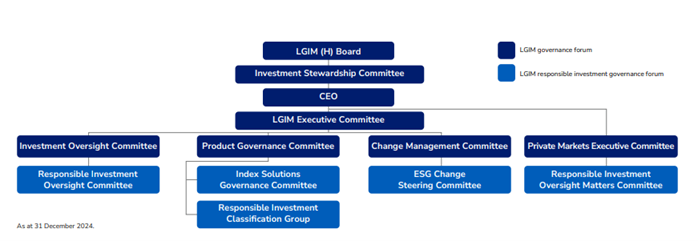
See also: L&G ESG Memberships & Collaborations.docx
Dialshifter
This fund is helping to ‘shift the dial from brown to green’ by…
...balancing exposures to Value, Quality, Low Volatility and Size factors and accounting for risks and opportunities associated with climate change.
SDR Labelling:
Unlabelled - promotes sustainable characteristics (has CFD)
Key Performance Indicators:
The fund’s information on sustainability can be found in the Fund Details set out in the Consumer Facing Disclosure.
- Consumer Facing Disclosure
SDR Literature:
Fund Holdings
Voting Record
Disclaimer
This communication is not a financial promotion and is intended for Professional Clients, Qualified Investors, companies and pension trustees and should not be relied upon by retail customers, pension scheme members, employees, or any other persons.
This document has been prepared by Legal & General Investment Management Limited and/or its affiliates ('L&G', ‘we’ or ‘us’). The information in this document is the property and/or confidential information of L&G and may not be reproduced in whole or in part or distributed or disclosed by you to any other person without the prior written consent of L&G. Not for distribution to any person resident in any jurisdiction where such distribution would be contrary to local law or regulation.
No party shall have any right of action against L&G in relation to the accuracy or completeness of the information in this document. The information and views expressed in this document are believed to be accurate and complete as at the date of publication, but they should not be relied upon and may be subject to change without notice. We are under no obligation to update or amend the information in this document. Where this document contains third party data, we cannot guarantee the accuracy, completeness or reliability of such data and we accept no responsibility or liability whatsoever in respect of such data.
No part of this document should be construed as providing investment advice, and L&G does not accept any liability for any decisions based on this document.
Legal and General Assurance (Pensions Management) Limited. Registered in England and Wales No. 01006112. Registered Office: One Coleman Street, London, EC2R 5AA. Authorised by the Prudential Regulation Authority and regulated by the Financial Conduct Authority and the Prudential Regulation Authority, No. 202202.
LGIM Real Assets (Operator) Limited. Registered in England and Wales, No. 05522016. Registered Office: One Coleman Street, London, EC2R 5AA. Authorised and regulated by the Financial Conduct Authority, No. 447041. Please note that while LGIM Real Assets (Operator) Limited is regulated by the Financial Conduct Authority, it may conduct certain activities that are unregulated.
Legal & General (Unit Trust Managers) Limited. Registered in England and Wales No. 01009418. Registered Office: One Coleman Street, London, EC2R 5AA. Authorised and regulated by the Financial Conduct Authority, No. 119273.
Issued by Legal & General Investment Management Ltd in the UK. Registered in England and Wales No. 02091894. Registered office: One Coleman Street, London EC2R 5AA. Authorised and regulated by the Financial Conduct Authority.
| Fund Name | SRI Style | SDR Labelling | Product | Region | Asset Type | Launch Date | Last Amended |
|
|---|---|---|---|---|---|---|---|---|
L&G Future World Global Multi-Factor ESG Tilted and Optimised Index Fund |
Environmental Style | Unlabelled - promotes sustainable characteristics (has CFD) | OEIC | Global | Passive / Index | 18/01/2018 | Aug 2025 | |
ObjectivesThe objective of the Fund is to track the performance of the iSTOXX L&G Global Multi-Factor ESG Index, the “Benchmark Index” on a net total return basis before fees and expenses are applied. Sustainability investment labels help investors find products that have a specific sustainability goal. This product does not have a UK sustainability investment label in accordance with the FCA’s Sustainability Disclosure Requirements as it does not have a specific sustainability objective in its investment objective, which is a requirement for a sustainability investment label. However, this Fund and the benchmark index that the Fund replicates apply environmental, social and governance criteria. Further information on the Fund’s sustainability characteristics can be found in the Fund Details set out in the Prospectus. |
Fund/Portfolio Size: £189.40m (as at: 30/04/2025) Total Screened Themed SRI Assets: £424600.00m (as at: 31/12/2024) Total Responsible Ownership Assets: £1117672.56m (as at: 31/12/2024) Total Assets Under Management: £1117672.56m (as at: 31/12/2024) ISIN: GB00BF41Q726, GB00BF41Q619 Contact Us: fundsales@lgim.com |
|||||||
Sustainable, Responsible &/or ESG OverviewWe have provided below the purpose of the fund:
|
||||||||
|
Primary fund last amended: Aug 2025 |
||||||||
|
Information received directly from Fund Manager |
||||||||
|
Please select what you would like to read:
Fund FiltersSustainability - General
Sustainability policy
Has policies that consider (environmental and social) sustainability issues. Strategies vary but are likely to consider environmental issues like climate change, carbon emissions, biodiversity loss, resource management, environmental impacts; and social issues like equal opportunities, human rights, labour standards, diversity and adherence to internationally recognised codes. See individual entry information.
Sustainability focus
Has a significant focus on sustainability issues
Encourage more sustainable practices through stewardship
Aim to encourage higher sustainability standards through responsible ownership / stewardship / engagement / voting activity
UN Global Compact linked exclusion policy
Use the UN Global Compact to inform or help direct where they can or cannot invest. Will typically not invest in companies with significant breaches (low standards) - strategies vary. (The UNGC covers a wide range of issues - search 'UNGC'). See https://unglobalcompact.org/
Report against sustainability objectives
Publicly report performance against named sustainability objectives Environmental - General
Environmental policy
Has policies which relate to environmental issues. These will typically set out their stance on issues such as pollution, climate change, resource management, biodiversity loss, carbon emissions, plastics and/or additional environmental impacts. Strategies vary.
Limits exposure to carbon intensive industries
Options that limit or 'reduce' their exposure to carbon intensive industries (ie sectors which are major contributors to climate change). Strategies vary. Climate Change & Energy
Climate change / greenhouse gas emissions policy
Has policies (documented strategies that explain their position) on climate change related issues such as greenhouse gas/carbon emissions, net zero, transitioning to lower carbon. Strategies vary.
Coal, oil & / or gas majors excluded
Avoid investment in major coal, oil and/or gas (extraction) companies. Strategies vary.
Fracking & tar sands excluded
Avoid companies involved in fracking and tar sands - which are widely regarded as controversial methods of oil and gas extraction. Strategies vary.
Encourage transition to low carbon through stewardship activity
Encourage the transition to lower carbon activities through asset selection and / or responsible ownership activity.
TCFD / IFRS reporting requirement
Will only invest in companies that report greenhouse gas emissions in line with this international reporting framework. See https://www.fsb-tcfd.org/ https ://www.ifrs.org/sustainability/tcfd/
Require net zero action plan from all / most companies
Requires all, or most of, the assets they invest in to have a ‘net zero action plan’ - describing how they will reduce their greenhouse gas emissions. Social / Employment
Mining exclusion
All mining companies excluded Ethical Values Led Exclusions
Controversial weapons exclusion
Excludes companies which make controversial weapons such as landmines, cluster munitions and chemical weapons. Gilts & Sovereigns
Does not invest in sovereigns
Does not invest in / excludes 'sovereigns' - debt issued by governments. See eg https://www.investopedia.com/terms/s/sovereign-debt.asp Banking & Financials
Invests in banks
Can include banks as part of their holdings / portfolio.
Invests in insurers
May invest in insurance companies. Asset Size
Over 50% large cap companies
Invests more than half of their money into what are commonly regarded as 'large companies'. This will typically mean that the market capitalisation (or value) of the companies they hold is in excess of £5 to £10 billion.
Invests mostly in large cap companies / assets
Invests mainly in larger companies / assets. (e.g. over circa £5-£10bn) Impact Methodologies
Aims to generate positive impacts (or 'outcomes')
Has policies that aim to help or support the delivery of positive social or environmental impacts (or societal/real world outcomes) by investing in companies they regard as beneficial to people and / or the planet. Strategies vary.
Measures positive impacts
Aims to measure the positive real world environmental and / or social benefits that are associated with their investment strategy. Investments that aim to deliver positive impacts and measure those impacts may be referred to as 'Impact' - although impact measurement is not restricted to Impact investments. Strategies vary.
Positive environmental impact theme
Specifically sets out to help deliver positive environmental impacts, benefits or 'real world' outcomes. How The Fund/Portfolio Works
Negative selection bias
Has principle 'ethical approach' to avoid companies by using negative screening criteria. Strategies vary.
ESG weighted / tilt
Invest more heavily in assets which have higher ESG ratings/standards or scores and less heavily in companies with lower ESG ratings. Where this is central to the strategy you should expect assets in most sectors. Strategies vary.
Passive / index driven strategy
Only uses an investment index to direct where they can invest. Fund strategies and indices vary.
ESG risk mitigation focus
Focuses on the careful management of environmental, social and governance (ESG) related risks - typically by avoiding or being underweight in companies seen as posing major risks in these areas (i.e. not necessarily by using themes, exclusions etc).
SRI / ESG / Ethical policies explained on website
Publish explanations of their ethical, social and/or environmental policies online (i.e. investment decision making strategies/ buy/sell &/or asset management strategies).
Do not use stock / securities lending
Does not use stock lending for performance or risk purposes. Intended Clients & Product Options
Intended for clients interested in sustainability
Designed to meet the needs of individual investors with an interest in sustainability issues.
Intended for clients interested in ethical issues
Designed for clients who care about ethical and values-based issues, often alongside sustainability issues also. Fund Management Company InformationAbout The Business
Responsible ownership / stewardship policy or strategy (AFM companywide)
Finds fund / asset management companies that have a published company wide stewardship, engagement and / or responsible ownership policy or strategy that covers all investments. Stewardship typically involves encouraging higher ESG standards through voting and dialogue.
ESG / SRI engagement (AFM companywide)
Find fund / asset management companies that actively encourage higher 'environmental, social and governance' and / or 'sustainable and responsible investment' practices across investee companies - typically where the aim is to encourage positive change that is aligned with the best interests of investors. Strategies vary. See additional information and options.
Vote all* shares at AGMs / EGMs (AFM companywide)
Find fund / asset managers that vote all* the shares they own at Annual General Meetings and Extraordinary General Meetings. A commitment to voting shares is a key indicator of 'responsible share ownership' demonstrating their support for or disagreement with management policy. (*situations can legitimately, occasionally occur where voting proves impossible, but in principle all shares should be voted.)
Responsible ownership / ESG a key differentiator (AFM companywide)
Find fund / asset managers that consider responsible ownership and ESG to be a key differentiator for their business.
Sustainable property strategy (AFM companywide)
Find fund / asset management companies that take sustainability criteria into account when selecting and/or managing all of their property / real estate investments.
Senior management KPIs include environmental goals (AFM companywide)
The leadership team of this fund / asset manager have performance targets linked to environmental goals.
Responsible ownership policy for non SRI / sustainable options (AFM companywide)
Find options run by managers that apply Responsible ownership or 'Stewardship' policies to all or most of their investment assets. This means active involvement (e.g. voting, dialogue) with the companies across all or most funds, products and services.
Integrates ESG factors into all / most research (AFM companywide)
Find fund / asset management companies that consider environmental, social and governance (ESG) issues when deciding whether or not to invest in a company for all / almost all of their funds and other assets. This is increasingly seen as part of sound risk management.
In-house diversity improvement programme (AFM companywide)
Finds organisations / fund managers that have an in-house (company wide) diversity improvement programme - meaning that they are working to ensure that within their own businesses they employ people from diverse backgrounds - often typically focused on ethnicity and/or sex.
Diversity, equality & inclusion engagement policy (AFM companywide)
Find fund / asset management companies that encourage the companies they invest in to have strong diversity, race, gender and other equality policies across all assets held, not simply screened or themed SRI/ESG funds. (ie Asset Management company wide).
Invests in newly listed companies (AFM companywide)
This fund / asset management company invests in companies which have recently listed on a stock exchange (which is important as it can help grow new businesses).
Invests in new sustainability linked bond issuances (AFM companywide)
Fund / asset management company has investments in bonds designed to meet sustainability requirements - however these assets may not be 'ringfenced' for this purpose. See website for details. Collaborations & Affiliations
PRI signatory
Find fund / asset management companies that have signed up to the UN backed 'Principles of Responsible Investment'.
TNFD forum member (AFM companywide)
A member of the Taskforce for Nature Related Financial Disclosures group which aims to aid risk management and shift money towards nature-positive outcomes.
Investment Association (IA) member
Fund management entity is a member of the Investment Association https://www.theia.org/ Resources
In-house responsible ownership / voting expertise
Find fund / asset management companies that employ people to steer and support fund managers in voting shares at company AGM's and EGMs in ways that are consistent with encouraging higher ESG/sustainability standards.
Employ specialist ESG / SRI / sustainability researchers
Find a fund / asset management company that directly employs specialist ESG/SRI/sustainability researchers or analysts. This allows asset managers to discuss environmental, social and governance risks and opportunities directly with companies.
Use specialist ESG / SRI / sustainability research companies
Find fund / asset management companies that makes use of expert external research companies. This can help deliver specialist expertise and means resources are pooled with other investors.
ESG specialists on all investment desks (AFM companywide)
Finds organisations / fund managers that have one or more ESG/sustainability experts on all investment teams or 'desks' (all asset types) Accreditations
UK Stewardship Code signatory (AFM companywide)
Find fund / asset managers that are signatories to the FRC UK Stewardship Code, which sets out a framework for constructive investor / investee relations where managers are encouraged to behave like responsible, typically longer term 'company owners'. Engagement Approach
Regularly lead collaborative ESG initiatives (AFM companywide)
Find fund / asset management companies that regularly initiate or run industry wide (collaborative) investor projects aimed at raising environmental, social and governance standards amongst investee companies.
Engaging on climate change issues
Fund / asset manager has stewardship /responsible ownership strategy that is focused on addressing climate change with investee assets.
Engaging with fossil fuel companies on climate change
Fund / asset manager has a stewardship /responsible ownership strategy that involves working with fossil fuel companies on climate change related issues. See fund manager website for details.
Engaging to reduce plastics pollution / waste
Fund / asset manager has stewardship /responsible ownership strategy with involves encouraging investee asset to reduce plastic waste and pollution.
Engaging to encourage responsible mining practices
Fund / asset manager has a stewardship / responsible ownership policy that means they are working to encourage more responsible mining practices - where environmental and social issues are properly dealt with by the companies they invest in.
Engaging on biodiversity / nature issues
The fund / asset manager has a responsible ownership / stewardship strategy that focuses on biodiversity and nature issues relating to the assets they invest the aim of which will be to reduce harm and or deliver improvement. Strategies vary. https://tnfd.global
Engaging to encourage a Just Transition
Fund / asset manager has a responsible ownership / stewardship strategy which means they are working to encourage the shift to more sustainable business practices in ways that respect and are sensitive to social issues and the impact change has on people effected by the changes that are taking place. https://www.transitionpathwayinitiative.org/ https://transitiontaskforce.net/
Engaging on human rights issues
Fund / asset manager has responsible ownership / stewardship strategy in place which aims to address human rights issues in investee companies (and potentially their suppliers) with the aim of raising standards
Engaging on labour / employment issues
Fund / asset manager has responsible ownership / stewardship strategy in place that aims to improve labour standards for the benefit of employees in investee companies (and potentially their suppliers)
Engaging on diversity, equality & / or inclusion issues
Fund / asset management company has a stewardship strategy in place which involves working to raise diversity, equality and inclusion standards across investee assets
Engaging to stop modern slavery
Fund / asset manager is working with the assets they hold to help stamp out modern slavery - where direct or indirect company employees are exploited for business benefits.
Engaging on governance issues
Fund / asset managers have stewardship strategies in place that focus on improving governance standards across investee assets
Stewardship escalation policy
Escalation policies describe how a manager will proceed if stewardship / engagement activity is not successful in the short term. Company Wide Exclusions
Controversial weapons avoidance policy (AFM companywide)
Find fund / asset management companies (not funds) that avoid investment in 'controversial weapons' across all of their funds and other investment vehicles.
Review(ing) carbon / fossil fuel exposure for all funds (AFM companywide)
Find funds / asset managers that are reviewing, or have reviewed, their exposure to carbon intensive industries including (but not only) mining, oil and gas companies. (Typically with reference to climate change.)
Coal exclusion policy (group wide coal mining exclusion policy)
This fund / asset manager excludes direct investment in the coal mining industry. Managers ability to do this may depend on the geographic regions in which they invest. Climate & Net Zero Transition
Net Zero commitment (AFM companywide)
Fund / asset management organisations that have pledged to reduce their greenhouse gas emissions to ‘net zero’. Strategies vary - this area is changing rapidly.
Net Zero - have set a Net Zero target date (AFM companywide)
This fund / asset management company has set a date by which they plan to achieve net zero greenhouse gas / CO2e emissions.
Encourage carbon / greenhouse gas reduction (AFM companywide)
Find fund / asset management companies that are working with the companies they invest in to encourage reductions in carbon dioxide and other greenhouse gas emissions.
Carbon transition plan published (AFM companywide)
Finds organisations / fund managers that have a company wide carbon transition plan - meaning that they have plotted a path to how they will move away from activities that produce or use carbon based energy sources (that emit greenhouse gases) towards clean, alternative, renewable energy sources.
Carbon offsetting – do NOT offset carbon as part of net zero plan (AFM companywide)
This fund / asset management company plans to achieve net zero greenhouse gas (CO2e) emissions by reducing their emissions. Calculations and scope vary.
In-house carbon / GHG reduction policy (AFM companywide)
Find fund / asset management companies that are working to reduce their own (fund management company) carbon/greenhouse gas emissions.
Working towards a ‘Net Zero’ commitment (AFM companywide)
Finds organisations / fund management companies that are in the process of working out how to make a ‘net zero commitment’ - meaning that when that is finalised they will have started the process of reducing their total greenhouse gas emissions to 'zero'.
Committed to SBTi / Science Based Targets Initiative
See https://sciencebasedtargets.org/ Transparency
Publish responsible ownership / stewardship report (AFM companywide)
Find fund / asset management companies that publish a report detailing their responsible investment ownership - also known as 'Stewardship' - activity.
Full stewardship / responsible ownership policy information on company website
Find fund / asset management companies that publish information about their sustainable and responsible investment strategies on their company website.
Full stewardship / responsible ownership policy information available on request
Find fund / asset management companies that will supply information about their sustainable and responsible investment activity on request.
Publish full voting record (AFM companywide)
Fund / asset management companies that publish a full record of how they vote their shares at AGMs (annual general meetings) and EGMs (extraordinary general meetings). Voting strategies have an important role to play encouraging higher environmental, social and governance standards.
Net Zero transition plan publicly available (AFM companywide)
This fund / asset management company has published a plan that explains how they are going to achieve net zero greenhouse gas / CO2e emissions.
Dialshifter statement
Find fund / asset management companies that have supplied Dialshifter information. See Dialshifter tab within record for more information. Sustainable, Responsible &/or ESG Policy:The Fund is a Replicating Fund as it replicates as closely as possible the constituents of the Benchmark Index by holding all, or substantially all, of the assets comprising the Benchmark Index in similar proportions to their weightings in the Benchmark Index. The Fund will have at least 90% exposure (directly or through depositary receipts) to assets that are included in the Benchmark Index. The Fund will generally hold assets directly but can use depositary receipts (such as American depositary receipts and global depositary receipts) to gain exposure such as when the direct asset cannot be held or is not available. The Fund may also invest in shares in companies which are reasonably expected to become part of the Benchmark Index in the near future or are an alternative to a constituent of the Benchmark Index and collective investment schemes, including those managed or operated by the Manager or an Associate as well as money market instruments (such as treasury bills), depositary receipts (such as American depositary receipts and global depositary receipts), cash and permitted deposits. The Fund may only use derivatives for Efficient Portfolio Management purposes. Multi-factor investing: The Benchmark Index is designed to reflect the performance of a global and diversified regional basket of shares in companies where their weights are varied to achieve balanced risk exposure to the multiple factors with additional ESG considerations, as explained below. In order to achieve the factor exposure, the Investment Manager has developed a proprietary scoring system which scores companies based on the below factors compared to their regional and sector peers:
Each company in the Benchmark Index is scored on each of the above factors and these scores are combined into a single multi-factor score (“Multi-Factor Score”). Environmental, Social and Governance ("ESG") considerations: The Benchmark Index provider applies the following ESG criteria to the Benchmark Index:
The FWPL methodology uses various assessment criteria, including revenue thresholds, to identify companies for incorporation on the list. Only companies that meet the criteria are excluded, consequently the Benchmark Index may hold companies involved in the above activities which do not fully meet the FWPL methodology criteria.
In addition to the Multi-Factor Score, the Benchmark Index applies the Investment Manager’s proprietary ESG Scoring system, which is a rulesbased approach to scoring companies (“ESG Score”). The ESG scoring system combines an environmental score, a social score and a governance score with adjustments made for a company’s overall level of transparency with regards to ESG issues. Higher scores indicate that more of the Investment Manager’s criteria for best practices have been met. Each company in the Parent Index is assigned an ESG Score and MultiFactor Score. Each company in the Parent Index is:
Whilst there is interaction between the ESG Score and Multi-Factor Score, the tilting based on the Multi-Factor Score is more significant, as the Benchmark Index is primarily a factor-based strategy with integrated ESG criteria. This may result in instances where some companies have higher Multi-Factor Scores but lower ESG Scores and vice versa. However, on average, the Benchmark Index aims to have a 5% improvement over the total aggregate ESG score compared to the Parent Index. “Parent Index” is defined in the Benchmark Index methodology. The Parent Index is a representation of the broader investment universe before ESG criteria and factors characteristics are taken into consideration by the Benchmark Index provider. Where data for a given company is unavailable or only partly available across elements of the ESG Score or Multi-Factor Score, the company may be allocated a neutral ESG Score or Multi-Factor Score. Where a company is allocated a neutral score, no tilting will be applied.
“GHG Emissions Intensity” means the weighted average of the greenhouse gas emissions intensity of companies in the Benchmark Index, as calculated in accordance with the Benchmark Index methodology. The Benchmark Index aims to reduce its overall GHG Emissions Intensity in line with a reduction pathway of 7% per year on average, measured from the Benchmark Index inception date of April 2021 (“Index Base Date”). It also aims to keep its GHG Emissions Intensity at least 50% lower than the Parent Index. An automated optimisation process is applied to the Benchmark Index to achieve these GHG Emissions Intensity reductions, within the Benchmark Index construction constraints (as described in the Benchmark Index methodology). This process includes all companies in the Benchmark Index (provided that such data is available). The Fund's assets are weighted so that the resulting portfolio's GHG Emissions Intensity reduce in line with whichever aim (set out above) results in the largest GHG Emissions Intensity reduction. Whilst the Benchmark Index may have exposure to companies with higher GHG Emissions Intensity, the Benchmark Index aims to have, on each rebalance date, the lower of: (i) an annual average 7% reduction in GHG Emissions Intensity from the Index Base Date; or (ii) at least a 50% reduction in overall GHG Emissions compared to the Parent Index. This optimisation process uses data from a range of different types of greenhouse gas emissions. In particular, this includes:
The Benchmark Index does not include other indirect greenhouse gas emissions, such as those from a company's supply chain or product use (Scope 3) as part of the optimisation process. The inclusion of scope 3 emissions may provide a more complete analysis of the Benchmark Index’s Greenhouse Gas Emissions. Fund exclusions In addition to the exclusions applied to the Benchmark Index (as set out above), the Fund may exclude companies that are on the Investment Manager's Climate Impact Pledge divestment list, within the anticipated tracking error. The Climate Impact Pledge divestment list includes companies, which after a certain period of engagement continue to not perform well against the Investment Manager's climate assessment, are unresponsive to engagement recommendations, and/or keep falling behind in meeting the Investment Manager's minimum standards. If the anticipated tracking error percentage is exceeded, exposure to such companies held in the Fund will be reduced where possible, rather than fully excluded. Subject to market conditions the Investment Manager may, within a reasonable timeframe, disinvest from companies which are subsequently incorporated into the Climate Impact Pledge divestment list. Process:The Fund is a Replicating Fund as it replicates as closely as possible the constituents of the Benchmark Index by holding all, or substantially all, of the assets comprising the Benchmark Index in similar proportions to their weightings in the Benchmark Index. Research is an integral part of our portfolio management process and is performed on an ongoing basis to capture all elements that could affect the risk profile of benchmark indices. It is, therefore, most effective if it is carried out by the same professionals who are involved in managing portfolios as they have a thorough knowledge of index products and market conditions. We also conduct ad hoc research for clients who wish to achieve a non-conventional index exposure and request professional opinions about associated practical portfolio management issues. Moreover, we have long-standing relationships with major index providers. We provide guidance regarding index composition and construction, participate in index consultations, and serve on many advisory committees with the aim of improving the quality and investability of indices. The majority of research is carried out in-house and is a function specific to the asset class. We receive research from external sources, including from major investment bank index research teams, however, L&G does not place any reliance on research by a third party. Resources, Affiliations & Corporate Strategies:As of December 2024, there are c.100 L&G - Asset Management (L&G) employees with roles dedicated to ESG, some of which are outlined in more detail below. Responsible Investment and Investment Stewardship team
Climate Solutions team
ESG Distribution
Real Assets
Product Development and Strategy
Global Research and Engagement Group (GREGs) Further to those with roles dedicated to ESG, our Global Research and Engagement Groups (GREGs) bring together representatives from the Investment and Investment Stewardship teams across regions and asset classes. The GREGs enable L&G to connect top-down macro and thematic views with bottom-up analysis of corporate and sector fundamentals to understand the materiality of sustainability risks and opportunities and prioritise them accordingly. Combining the capabilities of the Investment and Investment Stewardship teams also enables L&G to scale and coordinate our engagement efforts with companies at board and executive management levels, across all asset class and investment styles. C.40 research analysts contribute to our GREGs, researching into structural industry changes and risks, and identifying key themes and engagement topics across nine sectors. Please see L&G Attachment 1 - ESG Memberships and Collaboration for details on list of related affiliations and memberships. Please find the team organisation chart below.
See also: L&G ESG Memberships & Collaborations.docx
Dialshifter (Fund)This fund is helping to ‘shift the dial from brown to green’ by… ...balancing exposures to Value, Quality, Low Volatility and Size factors and accounting for risks and opportunities associated with climate change.
Dialshifter (Corporate)Our organisation is helping to support the Paris Climate Agreement and the Race to Net Zero by… At L&G’s Asset Management division, we take our role in addressing climate change very seriously. We have a duty of looking to mitigate long-term risks and seize emerging opportunities and are a company that is acting today in our clients’ long-term interests. As a founding signatory to the Net Zero Asset Manager Initiative (NZAMI), we have committed to support the goal of net zero greenhouse gas (GHG) emissions by 2050, in line with global efforts to limit warming to 1.5°C. We have committed to work in partnership with our clients to reach net-zero GHG emissions by 2050 or sooner across all assets under management (AUM). SDR Labelling:Unlabelled - promotes sustainable characteristics (has CFD) Key Performance Indicators:
The fund’s information on sustainability can be found in the Fund Details set out in the Consumer Facing Disclosure.
SDR Literature:Fund HoldingsVoting RecordDisclaimerThis communication is not a financial promotion and is intended for Professional Clients, Qualified Investors, companies and pension trustees and should not be relied upon by retail customers, pension scheme members, employees, or any other persons. This document has been prepared by Legal & General Investment Management Limited and/or its affiliates ('L&G', ‘we’ or ‘us’). The information in this document is the property and/or confidential information of L&G and may not be reproduced in whole or in part or distributed or disclosed by you to any other person without the prior written consent of L&G. Not for distribution to any person resident in any jurisdiction where such distribution would be contrary to local law or regulation. No party shall have any right of action against L&G in relation to the accuracy or completeness of the information in this document. The information and views expressed in this document are believed to be accurate and complete as at the date of publication, but they should not be relied upon and may be subject to change without notice. We are under no obligation to update or amend the information in this document. Where this document contains third party data, we cannot guarantee the accuracy, completeness or reliability of such data and we accept no responsibility or liability whatsoever in respect of such data. No part of this document should be construed as providing investment advice, and L&G does not accept any liability for any decisions based on this document. Legal and General Assurance (Pensions Management) Limited. Registered in England and Wales No. 01006112. Registered Office: One Coleman Street, London, EC2R 5AA. Authorised by the Prudential Regulation Authority and regulated by the Financial Conduct Authority and the Prudential Regulation Authority, No. 202202. LGIM Real Assets (Operator) Limited. Registered in England and Wales, No. 05522016. Registered Office: One Coleman Street, London, EC2R 5AA. Authorised and regulated by the Financial Conduct Authority, No. 447041. Please note that while LGIM Real Assets (Operator) Limited is regulated by the Financial Conduct Authority, it may conduct certain activities that are unregulated. Legal & General (Unit Trust Managers) Limited. Registered in England and Wales No. 01009418. Registered Office: One Coleman Street, London, EC2R 5AA. Authorised and regulated by the Financial Conduct Authority, No. 119273. Issued by Legal & General Investment Management Ltd in the UK. Registered in England and Wales No. 02091894. Registered office: One Coleman Street, London EC2R 5AA. Authorised and regulated by the Financial Conduct Authority. |
||||||||