Royal London Emerging Markets Equity Tilt Fund
SRI Style:
ESG Plus
SDR Labelling:
Unlabelled - promotes sustainable characteristics (has CFD)
Product:
OEIC
Fund Region:
Emerging Markets
Fund Asset Type:
Passive / Index
Launch Date:
12/06/2017
Last Amended:
Aug 2025
Dialshifter ( ):
):
Fund/Portfolio Size:
£7084.89m
(as at: 31/12/2025)
Total Screened Themed SRI Assets:
£59860.00m
(as at: 30/04/2025)
Total Assets Under Management:
£177020.00m
(as at: 31/03/2025)
ISIN:
GB00BZ8FWL65
Contact Us:
Objectives:
The Fund aims largely to replicate the composition of the MSCI Emerging Markets ESG Leaders Net Return Index , which is made up of companies that have the highest environmental, social and governance (ESG) performance in each sector of the wider MSCI Emerging Markets Net Return Index.
Sustainable, Responsible
&/or ESG Overview:
The fund tracks The MSCI EM ESG Leaders Index. The index is a market capitalisation weighted index which provides exposure to companies with high environmental, social and governance (ESG) performance. The index targets a 50% sector representation versus the MSCI Emerging Market Index, aiming to include only companies with the highest MSCI ESG Ratings relative to their sector peers. The index uses MSCI’s ESG research which assesses controversies concerning negative ESG impact of company operations, products and services, consistent with international standards set by the UN Declaration of Human Rights, ILO Declaration on Fundamental Principles and Rights at Work and UN Global Compact. MSCI provides an ESG rating to identify companies that have demonstrated an ability to manage their ESG risks and opportunities and therefore their eligibility for inclusion.
Primary fund last amended:
Aug 2025
Information directly from fund manager.
Fund Filters
Sustainability - General
Aim to encourage higher sustainability standards through responsible ownership / stewardship / engagement / voting activity
Climate Change & Energy
Encourage the transition to lower carbon activities through asset selection and / or responsible ownership activity.
Ethical Values Led Exclusions
Companies are excluded if they are involved in any aspect of the production chain for tobacco products, including cigarettes, vaping, e-cigarettes, chewing tobacco and cigars.
Excludes companies which make controversial weapons such as landmines, cluster munitions and chemical weapons.
Avoids companies that manufacture weapons intended specifically for military use. Strategies vary - may or may not include non-strategic military products.
How The Fund/Portfolio Works
Only uses an investment index to direct where they can invest. Fund strategies and indices vary.
Focuses on the careful management of environmental, social and governance (ESG) related risks - typically by avoiding or being underweight in companies seen as posing major risks in these areas (i.e. not necessarily by using themes, exclusions etc).
Uses specialist strategies to aid performance which involve ‘lending’ assets to others at specific points in time.
Intended Clients & Product Options
Designed to meet the needs of individual investors with an interest in sustainability issues.
Available via a tax efficient ISA product wrapper.
Fund Management Company Information
About The Business
Finds fund / asset management companies that have a published company wide stewardship, engagement and / or responsible ownership policy or strategy that covers all investments. Stewardship typically involves encouraging higher ESG standards through voting and dialogue.
Find fund / asset management companies that actively encourage higher 'environmental, social and governance' and / or 'sustainable and responsible investment' practices across investee companies - typically where the aim is to encourage positive change that is aligned with the best interests of investors. Strategies vary. See additional information and options.
Find fund / asset managers that vote all* the shares they own at Annual General Meetings and Extraordinary General Meetings. A commitment to voting shares is a key indicator of 'responsible share ownership' demonstrating their support for or disagreement with management policy. (*situations can legitimately, occasionally occur where voting proves impossible, but in principle all shares should be voted.)
Find fund / asset managers that consider responsible ownership and ESG to be a key differentiator for their business.
Find fund / asset management companies that take sustainability criteria into account when selecting and/or managing all of their property / real estate investments.
Find fund / asset management companies that consider environmental, social and governance (ESG) issues when deciding whether or not to invest in a company for all / almost all of their funds and other assets. This is increasingly seen as part of sound risk management.
Finds organisations / fund managers that have an in-house (company wide) diversity improvement programme - meaning that they are working to ensure that within their own businesses they employ people from diverse backgrounds - often typically focused on ethnicity and/or sex.
This fund / asset management company invests in companies which have recently listed on a stock exchange (which is important as it can help grow new businesses).
Fund / asset management company has investments in bonds designed to meet sustainability requirements - however these assets may not be 'ringfenced' for this purpose. See website for details.
Collaborations & Affiliations
Find fund / asset management companies that have signed up to the UN backed 'Principles of Responsible Investment'.
Find fund / asset management companies that are members of UKSIF - the UK Sustainable Investment and Finance association
Find fund / asset management companies that have partnered with Fund EcoMarket - meaning that they are helping to improve access to information on sustainable and responsible investment by paying an annual fee to us which enables us to publish information for free. Partner funds are listed ahead of other funds and have their logos displayed.
Fund management entity is a member of the Investment Association https://www.theia.org/
Resources
Find fund / asset management companies that employ people to steer and support fund managers in voting shares at company AGM's and EGMs in ways that are consistent with encouraging higher ESG/sustainability standards.
Find a fund / asset management company that directly employs specialist ESG/SRI/sustainability researchers or analysts. This allows asset managers to discuss environmental, social and governance risks and opportunities directly with companies.
Find fund / asset management companies that makes use of expert external research companies. This can help deliver specialist expertise and means resources are pooled with other investors.
Accreditations
Find fund / asset managers that are signatories to the FRC UK Stewardship Code, which sets out a framework for constructive investor / investee relations where managers are encouraged to behave like responsible, typically longer term 'company owners'.
Engagement Approach
Find fund / asset management companies that regularly initiate or run industry wide (collaborative) investor projects aimed at raising environmental, social and governance standards amongst investee companies.
Fund / asset manager has stewardship /responsible ownership strategy that is focused on addressing climate change with investee assets.
Fund / asset manager has a stewardship /responsible ownership strategy that involves working with fossil fuel companies on climate change related issues. See fund manager website for details.
Fund / asset manager has a stewardship / responsible ownership policy that means they are working to encourage more responsible mining practices - where environmental and social issues are properly dealt with by the companies they invest in.
The fund / asset manager has a responsible ownership / stewardship strategy that focuses on biodiversity and nature issues relating to the assets they invest the aim of which will be to reduce harm and or deliver improvement. Strategies vary. https://tnfd.global
Fund / asset manager has a responsible ownership / stewardship strategy which means they are working to encourage the shift to more sustainable business practices in ways that respect and are sensitive to social issues and the impact change has on people effected by the changes that are taking place. https://www.transitionpathwayinitiative.org/ https://transitiontaskforce.net/
Fund / asset manager has responsible ownership / stewardship strategy in place which aims to address human rights issues in investee companies (and potentially their suppliers) with the aim of raising standards
Fund / asset manager has responsible ownership / stewardship strategy in place that aims to improve labour standards for the benefit of employees in investee companies (and potentially their suppliers)
Fund / asset management company has a stewardship strategy in place which involves working to raise diversity, equality and inclusion standards across investee assets
Fund / asset manager is working with the assets they hold to help stamp out modern slavery - where direct or indirect company employees are exploited for business benefits.
Fund / asset managers have stewardship strategies in place that focus on improving governance standards across investee assets
Fund / asset manager has stewardship strategy in place which involves discussing mental health issues with investee companies - with the aim of raising standards
Has a stewardship / responsible ownership strategy that encourages responsible supply chain - ie the managers will discuss environmental, social and governance issues with investee companies with the aim of raising standards
Working to address sustainability, ESG and related concerns around artificial intelligence.
Escalation policies describe how a manager will proceed if stewardship / engagement activity is not successful in the short term.
Company Wide Exclusions
Find fund / asset management companies (not funds) that avoid investment in 'controversial weapons' across all of their funds and other investment vehicles.
Climate & Net Zero Transition
Fund / asset management organisations that have pledged to reduce their greenhouse gas emissions to ‘net zero’. Strategies vary - this area is changing rapidly.
Fund / asset manager AGM / EGM voting strategy has processes in place that mean they will normally be expected to vote in a way that will encourage the transition to net zero greenhouse gas emissions.
Find fund / asset management companies that have published a Climate Risk policy or statement that is signed / owned by their Chief Executive.
This fund / asset management company has set a date by which they plan to achieve net zero greenhouse gas / CO2e emissions.
Find fund / asset management companies that are working with the companies they invest in to encourage reductions in carbon dioxide and other greenhouse gas emissions.
Finds organisations / fund managers that have published ‘forward looking climate metrics’ e.g. 'implied temperature rise' data that are a total of the asset management company's share (% owned) of all the investee company emissions of the assets they manage, as well as their own direct and other indirect emissions.
This fund / asset management company plans to achieve net zero greenhouse gas (CO2e) emissions by reducing their emissions. Calculations and scope vary.
Finds organisations / fund management companies that are in the process of working out how to make a ‘net zero commitment’ - meaning that when that is finalised they will have started the process of reducing their total greenhouse gas emissions to 'zero'.
Transparency
Find fund / asset management companies that publish a report detailing their responsible investment ownership - also known as 'Stewardship' - activity.
Find fund / asset management companies that publish information about their sustainable and responsible investment strategies on their company website.
Find fund / asset management companies that will supply information about their sustainable and responsible investment activity on request.
Fund / asset management companies that publish a full record of how they vote their shares at AGMs (annual general meetings) and EGMs (extraordinary general meetings). Voting strategies have an important role to play encouraging higher environmental, social and governance standards.
Find fund / asset management companies that have supplied Dialshifter information. See Dialshifter tab within record for more information.
Sustainable, Responsible &/or ESG Policy:
The MSCI EM ESG Leaders Index is a market capitalisation weighted index which provides exposure to companies with high environmental, social and governance (ESG) performance. The index targets a 50% sector representation versus the MSCI Emerging Market Index, aiming to include only companies with the highest MSCI ESG Ratings relative to their sector peers. The index uses MSCI’s ESG research which assesses controversies concerning negative ESG impact of company operations, products and services, consistent with international standards set by the UN Declaration of Human Rights, ILO Declaration on Fundamental Principles and Rights at Work and UN Global Compact. MSCI provides an ESG rating to identify companies that have demonstrated an ability to manage their ESG risks and opportunities and therefore their eligibility for inclusion.
MSCI EM ESG Leaders Index consists of large and mid-cap companies across 24 emerging markets countries*. The Index is designed for investors seeking a broad, diversified sustainability benchmark with relatively low tracking error to the underlying equity market. Constituent selection is based on data from MSCI ESG research.
* EM countries include: Brazil, Chile, China, Colombia, Czech Republic, Egypt, Greece, Hungary, India, Indonesia, Korea, Malaysia, Mexico, Pakistan, Peru, Philippines, Poland, Qatar, South Africa, Taiwan, Thailand, Turkey and United Arab Emirates (Russia removed from index by MSCI March 9 2022).
Source: www.msci.com
Process:
PRAGMATIC AND EFFICIENT APPROACH
Closely tracking portfolio using optimisation software
The fund uses an optimised portfolio to closely track its benchmark indices. The optimised portfolio is designed to track the performance of the index without the fund necessarily having to hold all of the constituents in their exact benchmark weights.
The optimiser is used to construct efficient trades designed to maintain a low tracking error without requiring perfect replication. The optimiser uses an algorithm which minimises tracking risk, based on a multi factor model and associated covariance matrix. This provides the fund manager with the flexibility of not having to trade every index or cashflow event, in instances where trading would create disproportionate cost or liquidity issues. In this way, we can assess the trade-off between perfect replication and the reduction of transaction costs via lower turnover, while achieving optimal index tracking. We believe optimisation produces more efficient rebalance trades than perfect replication.
Pragmatic Approach
Index futures are used for cash management purposes. To minimise trading costs, cash is only ‘spent’ on equities when the trade size is economically viable and is hedged with futures at lower levels. Additionally, cash is to some extent saved for quarterly index rebalancing, thereby making efficient use of the rebalance trade.
We take full advantage of any opportunities to add value to the fund. These can occur through corporate actions such as stock dividends, tender offers, rights issues and share offerings. Occasionally, trading around an index event can be timed to benefit the fund and offset implementation costs. Securities lending also provides a small amount of income for the fund.
Daily monitoring
The fund’s relative performance, tracking error, active exposures and cash balances are monitored on a daily basis. Currency exposures are also monitored with respect to the benchmark. Corporate actions and other index events are closely monitored in advance of the event and the fund matches the index action where possible, unless the event is small and the cost of trading outweighs the benefit to tracking error. The fund is rebalanced quarterly in line with the index. If a non-quarterly change in the index constituent is material, the manager undertakes a trade to bring the fund back in line with the index.
MSCI EMERGING MARKET ESG LEADERS INDEX
The MSCI EM ESG Leaders Index is a market capitalisation weighted index which provides exposure to companies with high environmental, social and governance (ESG) performance. The index targets a 50% sector representation versus the MSCI Emerging Market Index, aiming to include only companies with the highest MSCI ESG Ratings relative to their sector peers. The index uses MSCI’s ESG research which assesses controversies concerning negative ESG impact of company operations, products and services, consistent with international standards set by the UN Declaration of Human Rights, ILO Declaration on Fundamental Principles and Rights at Work and UN Global Compact. MSCI provides an ESG rating to identify companies that have demonstrated an ability to manage their ESG risks and opportunities and therefore their eligibility for inclusion.
MSCI EM ESG Leaders Index consists of large and mid-cap companies across 24 emerging markets countries*. The Index is designed for investors seeking a broad, diversified sustainability benchmark with relatively low tracking error to the underlying equity market. Constituent selection is based on data from MSCI ESG research.
* EM countries include: Brazil, Chile, China, Colombia, Czech Republic, Egypt, Greece, Hungary, India, Indonesia, Korea, Malaysia, Mexico, Pakistan, Peru, Philippines, Poland, Qatar, South Africa, Taiwan, Thailand, Turkey and United Arab Emirates (Russia removed from index by MSCI March 9 2022).
Source: www.msci.com
The fund seeks to capitalise on several ongoing trends in emerging markets currently, including:
- Economic growth: ~85% of the global population live in emerging markets. The younger demographic of these markets combined with their increasing wealth can lead to greater consumption and economic growth;
- Earnings growth: Earnings growth and high returning stocks are often found in countries in an emerging growth phase. These countries tend to be resource rich with large labour forces;
- Diversification: The growth potential offered by emerging markets may present investors with diversification opportunities; and
- Opportunity for higher returns: Investing in emerging markets can offer greater rewards but carries greater risk due to the possibility of higher volatility, lower liquidity, high currency fluctuation, the adverse effect of social, political and economic instability, weak supervisory structures and weak accounting standards fluctuations.
As a tracker fund, material ESG risks are largely monitored by the RI team and any major issues are addressed via company engagement and/or voting.
Resources, Affiliations & Corporate Strategies:
Royal London Asset Management’s in-house Responsible Investment (RI) team of 19 professionals is led by Head of Responsible Investment, Ashley Hamilton-Claxton. The RI team works with the investment teams to monitor, assess and analyse ESG factors, vote our shares and engage with companies to encourage better social and environmental outcomes, or better risk management. This team is also responsible for helping to set out our approach and policies around systemic issues such as climate change, providing guidance, feedback and coaching to fund managers and analysts on the latest data, research, policy and industry practices.
Governance of Responsible Investment at Royal London Asset Management is integrated at varying levels of the organisation however is led by senior leadership. The Board has ultimate responsibility for setting Royal London Asset Management’s risk appetite and reviewing our strategic risks. Our Chief Investment Officer (CIO) is a regulated Senior Management Function (SMF) and is the Executive team member that is accountable for setting the investment strategy, and overseeing our Responsible Investment function, including our approach to stewardship and climate investment risk. The CIO, with support from the investment teams, updates the Board and monitors responsible investment in line with Royal London Asset Management’s risk tolerance threshold. The CIO is also responsible for ensuring responsible investment, stewardship and climate change risk management is embedded across Royal London Asset Management’s investment strategies. The CIO is a member of Royal London Asset Management’s Executive Committee and also chairs the Investment Committee.
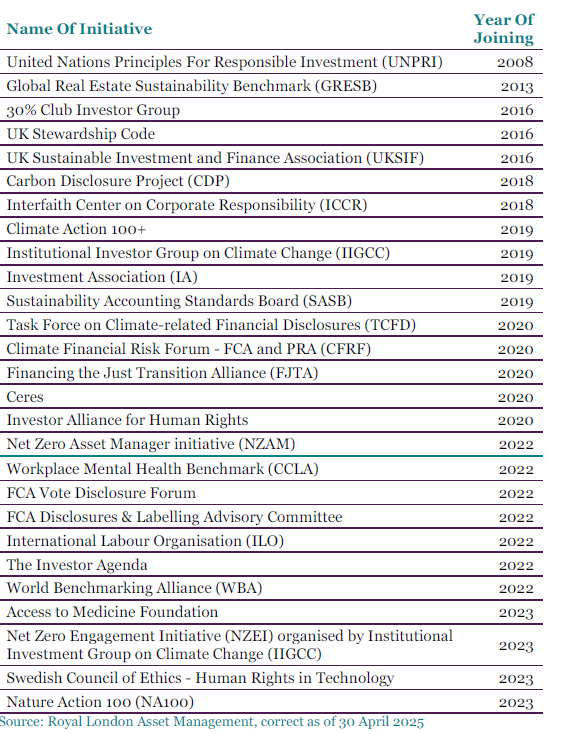
Royal London Asset Management is a member of the following initiatives:
SDR Labelling:
Unlabelled - promotes sustainable characteristics (has CFD)
- Consumer Facing Disclosure
SDR Literature:
Literature
Voting Record
Disclaimer
.
| Fund Name | SRI Style | SDR Labelling | Product | Region | Asset Type | Launch Date | Last Amended |
|
|---|---|---|---|---|---|---|---|---|
Royal London Emerging Markets Equity Tilt Fund |
ESG Plus | Unlabelled - promotes sustainable characteristics (has CFD) | OEIC | Emerging Markets | Passive / Index | 12/06/2017 | Aug 2025 | |
ObjectivesThe Fund aims largely to replicate the composition of the MSCI Emerging Markets ESG Leaders Net Return Index , which is made up of companies that have the highest environmental, social and governance (ESG) performance in each sector of the wider MSCI Emerging Markets Net Return Index. |
Fund/Portfolio Size: £7084.89m (as at: 31/12/2025) Total Screened Themed SRI Assets: £59860.00m (as at: 30/04/2025) Total Assets Under Management: £177020.00m (as at: 31/03/2025) ISIN: GB00BZ8FWL65 Contact Us: bdsupport@RLAM.co.uk |
|||||||
Sustainable, Responsible &/or ESG OverviewThe fund tracks The MSCI EM ESG Leaders Index. The index is a market capitalisation weighted index which provides exposure to companies with high environmental, social and governance (ESG) performance. The index targets a 50% sector representation versus the MSCI Emerging Market Index, aiming to include only companies with the highest MSCI ESG Ratings relative to their sector peers. The index uses MSCI’s ESG research which assesses controversies concerning negative ESG impact of company operations, products and services, consistent with international standards set by the UN Declaration of Human Rights, ILO Declaration on Fundamental Principles and Rights at Work and UN Global Compact. MSCI provides an ESG rating to identify companies that have demonstrated an ability to manage their ESG risks and opportunities and therefore their eligibility for inclusion. |
||||||||
|
Primary fund last amended: Aug 2025 |
||||||||
|
Information received directly from Fund Manager |
||||||||
|
Please select what you would like to read:
Fund FiltersSustainability - General
Encourage more sustainable practices through stewardship
Aim to encourage higher sustainability standards through responsible ownership / stewardship / engagement / voting activity Climate Change & Energy
Encourage transition to low carbon through stewardship activity
Encourage the transition to lower carbon activities through asset selection and / or responsible ownership activity. Ethical Values Led Exclusions
Tobacco & related product manufacturers excluded
Companies are excluded if they are involved in any aspect of the production chain for tobacco products, including cigarettes, vaping, e-cigarettes, chewing tobacco and cigars.
Controversial weapons exclusion
Excludes companies which make controversial weapons such as landmines, cluster munitions and chemical weapons.
Armaments manufacturers avoided
Avoids companies that manufacture weapons intended specifically for military use. Strategies vary - may or may not include non-strategic military products. How The Fund/Portfolio Works
Passive / index driven strategy
Only uses an investment index to direct where they can invest. Fund strategies and indices vary.
ESG risk mitigation focus
Focuses on the careful management of environmental, social and governance (ESG) related risks - typically by avoiding or being underweight in companies seen as posing major risks in these areas (i.e. not necessarily by using themes, exclusions etc).
Use stock / securities lending
Uses specialist strategies to aid performance which involve ‘lending’ assets to others at specific points in time. Intended Clients & Product Options
Intended for clients interested in sustainability
Designed to meet the needs of individual investors with an interest in sustainability issues.
Available via an ISA (OEIC only)
Available via a tax efficient ISA product wrapper. Fund Management Company InformationAbout The Business
Responsible ownership / stewardship policy or strategy (AFM companywide)
Finds fund / asset management companies that have a published company wide stewardship, engagement and / or responsible ownership policy or strategy that covers all investments. Stewardship typically involves encouraging higher ESG standards through voting and dialogue.
ESG / SRI engagement (AFM companywide)
Find fund / asset management companies that actively encourage higher 'environmental, social and governance' and / or 'sustainable and responsible investment' practices across investee companies - typically where the aim is to encourage positive change that is aligned with the best interests of investors. Strategies vary. See additional information and options.
Vote all* shares at AGMs / EGMs (AFM companywide)
Find fund / asset managers that vote all* the shares they own at Annual General Meetings and Extraordinary General Meetings. A commitment to voting shares is a key indicator of 'responsible share ownership' demonstrating their support for or disagreement with management policy. (*situations can legitimately, occasionally occur where voting proves impossible, but in principle all shares should be voted.)
Responsible ownership / ESG a key differentiator (AFM companywide)
Find fund / asset managers that consider responsible ownership and ESG to be a key differentiator for their business.
Sustainable property strategy (AFM companywide)
Find fund / asset management companies that take sustainability criteria into account when selecting and/or managing all of their property / real estate investments.
Integrates ESG factors into all / most research (AFM companywide)
Find fund / asset management companies that consider environmental, social and governance (ESG) issues when deciding whether or not to invest in a company for all / almost all of their funds and other assets. This is increasingly seen as part of sound risk management.
In-house diversity improvement programme (AFM companywide)
Finds organisations / fund managers that have an in-house (company wide) diversity improvement programme - meaning that they are working to ensure that within their own businesses they employ people from diverse backgrounds - often typically focused on ethnicity and/or sex.
Invests in newly listed companies (AFM companywide)
This fund / asset management company invests in companies which have recently listed on a stock exchange (which is important as it can help grow new businesses).
Invests in new sustainability linked bond issuances (AFM companywide)
Fund / asset management company has investments in bonds designed to meet sustainability requirements - however these assets may not be 'ringfenced' for this purpose. See website for details. Collaborations & Affiliations
PRI signatory
Find fund / asset management companies that have signed up to the UN backed 'Principles of Responsible Investment'.
UKSIF member
Find fund / asset management companies that are members of UKSIF - the UK Sustainable Investment and Finance association
Fund EcoMarket partner
Find fund / asset management companies that have partnered with Fund EcoMarket - meaning that they are helping to improve access to information on sustainable and responsible investment by paying an annual fee to us which enables us to publish information for free. Partner funds are listed ahead of other funds and have their logos displayed.
Investment Association (IA) member
Fund management entity is a member of the Investment Association https://www.theia.org/ Resources
In-house responsible ownership / voting expertise
Find fund / asset management companies that employ people to steer and support fund managers in voting shares at company AGM's and EGMs in ways that are consistent with encouraging higher ESG/sustainability standards.
Employ specialist ESG / SRI / sustainability researchers
Find a fund / asset management company that directly employs specialist ESG/SRI/sustainability researchers or analysts. This allows asset managers to discuss environmental, social and governance risks and opportunities directly with companies.
Use specialist ESG / SRI / sustainability research companies
Find fund / asset management companies that makes use of expert external research companies. This can help deliver specialist expertise and means resources are pooled with other investors. Accreditations
UK Stewardship Code signatory (AFM companywide)
Find fund / asset managers that are signatories to the FRC UK Stewardship Code, which sets out a framework for constructive investor / investee relations where managers are encouraged to behave like responsible, typically longer term 'company owners'. Engagement Approach
Regularly lead collaborative ESG initiatives (AFM companywide)
Find fund / asset management companies that regularly initiate or run industry wide (collaborative) investor projects aimed at raising environmental, social and governance standards amongst investee companies.
Engaging on climate change issues
Fund / asset manager has stewardship /responsible ownership strategy that is focused on addressing climate change with investee assets.
Engaging with fossil fuel companies on climate change
Fund / asset manager has a stewardship /responsible ownership strategy that involves working with fossil fuel companies on climate change related issues. See fund manager website for details.
Engaging to encourage responsible mining practices
Fund / asset manager has a stewardship / responsible ownership policy that means they are working to encourage more responsible mining practices - where environmental and social issues are properly dealt with by the companies they invest in.
Engaging on biodiversity / nature issues
The fund / asset manager has a responsible ownership / stewardship strategy that focuses on biodiversity and nature issues relating to the assets they invest the aim of which will be to reduce harm and or deliver improvement. Strategies vary. https://tnfd.global
Engaging to encourage a Just Transition
Fund / asset manager has a responsible ownership / stewardship strategy which means they are working to encourage the shift to more sustainable business practices in ways that respect and are sensitive to social issues and the impact change has on people effected by the changes that are taking place. https://www.transitionpathwayinitiative.org/ https://transitiontaskforce.net/
Engaging on human rights issues
Fund / asset manager has responsible ownership / stewardship strategy in place which aims to address human rights issues in investee companies (and potentially their suppliers) with the aim of raising standards
Engaging on labour / employment issues
Fund / asset manager has responsible ownership / stewardship strategy in place that aims to improve labour standards for the benefit of employees in investee companies (and potentially their suppliers)
Engaging on diversity, equality & / or inclusion issues
Fund / asset management company has a stewardship strategy in place which involves working to raise diversity, equality and inclusion standards across investee assets
Engaging to stop modern slavery
Fund / asset manager is working with the assets they hold to help stamp out modern slavery - where direct or indirect company employees are exploited for business benefits.
Engaging on governance issues
Fund / asset managers have stewardship strategies in place that focus on improving governance standards across investee assets
Engaging on mental health issues
Fund / asset manager has stewardship strategy in place which involves discussing mental health issues with investee companies - with the aim of raising standards
Engaging on responsible supply chain issues
Has a stewardship / responsible ownership strategy that encourages responsible supply chain - ie the managers will discuss environmental, social and governance issues with investee companies with the aim of raising standards
Engaging on the responsible use of AI
Working to address sustainability, ESG and related concerns around artificial intelligence.
Stewardship escalation policy
Escalation policies describe how a manager will proceed if stewardship / engagement activity is not successful in the short term. Company Wide Exclusions
Controversial weapons avoidance policy (AFM companywide)
Find fund / asset management companies (not funds) that avoid investment in 'controversial weapons' across all of their funds and other investment vehicles. Climate & Net Zero Transition
Net Zero commitment (AFM companywide)
Fund / asset management organisations that have pledged to reduce their greenhouse gas emissions to ‘net zero’. Strategies vary - this area is changing rapidly.
Voting policy includes net zero targets (AFM companywide)
Fund / asset manager AGM / EGM voting strategy has processes in place that mean they will normally be expected to vote in a way that will encourage the transition to net zero greenhouse gas emissions.
Publish 'CEO owned' Climate Risk policy (AFM companywide)
Find fund / asset management companies that have published a Climate Risk policy or statement that is signed / owned by their Chief Executive.
Net Zero - have set a Net Zero target date (AFM companywide)
This fund / asset management company has set a date by which they plan to achieve net zero greenhouse gas / CO2e emissions.
Encourage carbon / greenhouse gas reduction (AFM companywide)
Find fund / asset management companies that are working with the companies they invest in to encourage reductions in carbon dioxide and other greenhouse gas emissions.
‘Forward Looking Climate Metrics’ published / ITR (AFM companywide)
Finds organisations / fund managers that have published ‘forward looking climate metrics’ e.g. 'implied temperature rise' data that are a total of the asset management company's share (% owned) of all the investee company emissions of the assets they manage, as well as their own direct and other indirect emissions.
Carbon offsetting – do NOT offset carbon as part of net zero plan (AFM companywide)
This fund / asset management company plans to achieve net zero greenhouse gas (CO2e) emissions by reducing their emissions. Calculations and scope vary.
Working towards a ‘Net Zero’ commitment (AFM companywide)
Finds organisations / fund management companies that are in the process of working out how to make a ‘net zero commitment’ - meaning that when that is finalised they will have started the process of reducing their total greenhouse gas emissions to 'zero'. Transparency
Publish responsible ownership / stewardship report (AFM companywide)
Find fund / asset management companies that publish a report detailing their responsible investment ownership - also known as 'Stewardship' - activity.
Full stewardship / responsible ownership policy information on company website
Find fund / asset management companies that publish information about their sustainable and responsible investment strategies on their company website.
Full stewardship / responsible ownership policy information available on request
Find fund / asset management companies that will supply information about their sustainable and responsible investment activity on request.
Publish full voting record (AFM companywide)
Fund / asset management companies that publish a full record of how they vote their shares at AGMs (annual general meetings) and EGMs (extraordinary general meetings). Voting strategies have an important role to play encouraging higher environmental, social and governance standards.
Dialshifter statement
Find fund / asset management companies that have supplied Dialshifter information. See Dialshifter tab within record for more information. Sustainable, Responsible &/or ESG Policy:The MSCI EM ESG Leaders Index is a market capitalisation weighted index which provides exposure to companies with high environmental, social and governance (ESG) performance. The index targets a 50% sector representation versus the MSCI Emerging Market Index, aiming to include only companies with the highest MSCI ESG Ratings relative to their sector peers. The index uses MSCI’s ESG research which assesses controversies concerning negative ESG impact of company operations, products and services, consistent with international standards set by the UN Declaration of Human Rights, ILO Declaration on Fundamental Principles and Rights at Work and UN Global Compact. MSCI provides an ESG rating to identify companies that have demonstrated an ability to manage their ESG risks and opportunities and therefore their eligibility for inclusion.
* EM countries include: Brazil, Chile, China, Colombia, Czech Republic, Egypt, Greece, Hungary, India, Indonesia, Korea, Malaysia, Mexico, Pakistan, Peru, Philippines, Poland, Qatar, South Africa, Taiwan, Thailand, Turkey and United Arab Emirates (Russia removed from index by MSCI March 9 2022).
Process:PRAGMATIC AND EFFICIENT APPROACH Closely tracking portfolio using optimisation software The optimiser is used to construct efficient trades designed to maintain a low tracking error without requiring perfect replication. The optimiser uses an algorithm which minimises tracking risk, based on a multi factor model and associated covariance matrix. This provides the fund manager with the flexibility of not having to trade every index or cashflow event, in instances where trading would create disproportionate cost or liquidity issues. In this way, we can assess the trade-off between perfect replication and the reduction of transaction costs via lower turnover, while achieving optimal index tracking. We believe optimisation produces more efficient rebalance trades than perfect replication.
Index futures are used for cash management purposes. To minimise trading costs, cash is only ‘spent’ on equities when the trade size is economically viable and is hedged with futures at lower levels. Additionally, cash is to some extent saved for quarterly index rebalancing, thereby making efficient use of the rebalance trade. We take full advantage of any opportunities to add value to the fund. These can occur through corporate actions such as stock dividends, tender offers, rights issues and share offerings. Occasionally, trading around an index event can be timed to benefit the fund and offset implementation costs. Securities lending also provides a small amount of income for the fund.
Daily monitoring The fund’s relative performance, tracking error, active exposures and cash balances are monitored on a daily basis. Currency exposures are also monitored with respect to the benchmark. Corporate actions and other index events are closely monitored in advance of the event and the fund matches the index action where possible, unless the event is small and the cost of trading outweighs the benefit to tracking error. The fund is rebalanced quarterly in line with the index. If a non-quarterly change in the index constituent is material, the manager undertakes a trade to bring the fund back in line with the index.
The MSCI EM ESG Leaders Index is a market capitalisation weighted index which provides exposure to companies with high environmental, social and governance (ESG) performance. The index targets a 50% sector representation versus the MSCI Emerging Market Index, aiming to include only companies with the highest MSCI ESG Ratings relative to their sector peers. The index uses MSCI’s ESG research which assesses controversies concerning negative ESG impact of company operations, products and services, consistent with international standards set by the UN Declaration of Human Rights, ILO Declaration on Fundamental Principles and Rights at Work and UN Global Compact. MSCI provides an ESG rating to identify companies that have demonstrated an ability to manage their ESG risks and opportunities and therefore their eligibility for inclusion. MSCI EM ESG Leaders Index consists of large and mid-cap companies across 24 emerging markets countries*. The Index is designed for investors seeking a broad, diversified sustainability benchmark with relatively low tracking error to the underlying equity market. Constituent selection is based on data from MSCI ESG research.
The fund seeks to capitalise on several ongoing trends in emerging markets currently, including:
As a tracker fund, material ESG risks are largely monitored by the RI team and any major issues are addressed via company engagement and/or voting. Resources, Affiliations & Corporate Strategies:Royal London Asset Management’s in-house Responsible Investment (RI) team of 19 professionals is led by Head of Responsible Investment, Ashley Hamilton-Claxton. The RI team works with the investment teams to monitor, assess and analyse ESG factors, vote our shares and engage with companies to encourage better social and environmental outcomes, or better risk management. This team is also responsible for helping to set out our approach and policies around systemic issues such as climate change, providing guidance, feedback and coaching to fund managers and analysts on the latest data, research, policy and industry practices. Governance of Responsible Investment at Royal London Asset Management is integrated at varying levels of the organisation however is led by senior leadership. The Board has ultimate responsibility for setting Royal London Asset Management’s risk appetite and reviewing our strategic risks. Our Chief Investment Officer (CIO) is a regulated Senior Management Function (SMF) and is the Executive team member that is accountable for setting the investment strategy, and overseeing our Responsible Investment function, including our approach to stewardship and climate investment risk. The CIO, with support from the investment teams, updates the Board and monitors responsible investment in line with Royal London Asset Management’s risk tolerance threshold. The CIO is also responsible for ensuring responsible investment, stewardship and climate change risk management is embedded across Royal London Asset Management’s investment strategies. The CIO is a member of Royal London Asset Management’s Executive Committee and also chairs the Investment Committee. Royal London Asset Management is a member of the following initiatives:
Dialshifter (Corporate)Our organisation is helping to support the Paris Climate Agreement and the Race to Net Zero by… Net Zero Commitment Summary By 2030, Royal London Asset Management aims to engage issuers representing 70% of financed emissions, encouraging science-based targets (e.g., SBTi) and climate transition plans. This firm-level commitment is transparently reported and does not apply to all RLAM funds—please refer to individual fund prospectuses. The focus is on real-economy decarbonisation through engagement, not divestment. RLAM supports decarbonising portfolio companies and collaborates with segregated clients who have net zero goals. This commitment assumes supportive government action and alignment with RLAM’s fiduciary duties. SDR Labelling:Unlabelled - promotes sustainable characteristics (has CFD)
SDR Literature:LiteratureVoting RecordDisclaimer. |
||||||||