
Schroder Global Cities Real Estate Fund
SRI Style:
Sustainability Tilt
SDR Labelling:
Sustainability Focus label
Product:
OEIC
Fund Region:
Global
Fund Asset Type:
Equity
Launch Date:
09/12/2005
Last Amended:
Sep 2025
Dialshifter ( ):
):
Fund/Portfolio Size:
£869.80m
(as at: 31/08/2025)
Total Responsible Ownership Assets:
£646500.00m
(as at: 31/12/2024)
Total Assets Under Management:
£776613.00m
(as at: 30/06/2025)
ISIN:
GB00B1VPTY75, GB00BDD2DR16, GB00BDD2DQ09, GB00BYX7J192, GB00B0LGTF49, GB00B0LGSD59, GB00B1VPTW51
Contact Us:
Objectives:
The fund aims to provide income and capital growth more than the FTSE EPRA NAREIT Developed TR GBP (Net) Index (after fees have been deducted) over a three-to-five-year period by investing in equities of sustainable real estate companies worldwide that own assets in global cities. Sustainable real estate companies contribute to an urban environment that provides a good quality of life for residents while minimising costs to the planet and using resources efficiently. Companies can demonstrate this by prioritising initiatives such as renewable energy; energy efficiency; greenhouse gas (GHG) emissions reduction; effective water management; waste minimisation; responsible tenant and community engagement; setting sustainability targets; and managing their business in a sustainable way.
Sustainable, Responsible
&/or ESG Overview:
The fund’s sustainability objective is to invest in sustainable real estate companies that own assets in global cities. Sustainable real estate companies contribute to an urban environment that provides a good quality of life for residents while minimising costs to the planet and using resources efficiently. Companies can demonstrate this by prioritising initiatives such as renewable energy; energy efficiency; greenhouse gas (GHG) emissions reduction; effective water management; waste minimisation; and responsible tenant and community engagement; setting sustainability targets; and managing their business in a sustainable way.
Primary fund last amended:
Sep 2025
Information directly from fund manager.
Fund Filters
Sustainability - General
Has policies that consider (environmental and social) sustainability issues. Strategies vary but are likely to consider environmental issues like climate change, carbon emissions, biodiversity loss, resource management, environmental impacts; and social issues like equal opportunities, human rights, labour standards, diversity and adherence to internationally recognised codes. See individual entry information.
Has a significant focus on sustainability issues
Aim to encourage higher sustainability standards through responsible ownership / stewardship / engagement / voting activity
Use the UN Global Compact to inform or help direct where they can or cannot invest. Will typically not invest in companies with significant breaches (low standards) - strategies vary. (The UNGC covers a wide range of issues - search 'UNGC'). See https://unglobalcompact.org/
Publicly report performance against named sustainability objectives
Has a strategy on - and may focus investment on sustainability issues in the property sector - they may eg use GRESB / BREEAM scores to inform investment decisions.
Environmental - General
Aims to invest in companies with strong or market leading environmental policies and practices. Strategies vary. See individual entry information for more detail.
Nature & Biodiversity
A significant focus on investments that aim to protect, improve and / or restore natural habitat.
Climate Change & Energy
Avoid investment in major coal, oil and/or gas (extraction) companies. Strategies vary.
Avoid companies involved in fracking and tar sands - which are widely regarded as controversial methods of oil and gas extraction. Strategies vary.
Avoid investing in companies / assets with coal, oil and gas reserves. See individual entry information for further details.
Encourage the transition to lower carbon activities through asset selection and / or responsible ownership activity.
Has an energy efficiency theme - typically meaning that the manager is focused on investing in organisations that manage - or help others to manage - energy use more carefully and less wastefully - and so reduce greenhouse gas emissions.
Has a policy which describes the avoidance or limited investment in the nuclear industry. Strategies vary.
Will only invest in companies that report greenhouse gas emissions in line with this international reporting framework. See https://www.fsb-tcfd.org/ https ://www.ifrs.org/sustainability/tcfd/
Social / Employment
Aims to invest in assets with high social values - this may include strong human rights, labour standards and equal opportunities or safety related practices.
Ethical Values Led Exclusions
Companies are excluded if they are involved in any aspect of the production chain for tobacco products, including cigarettes, vaping, e-cigarettes, chewing tobacco and cigars.
Companies are excluded if they make more than 5% of their revenue from the manufacture, sale or distribution of tobacco products including cigarettes, vaping, e-cigarettes, chewing tobacco and cigars.
Excludes companies which make controversial weapons such as landmines, cluster munitions and chemical weapons.
Avoids companies that manufacture weapons intended specifically for military use. Strategies vary - may or may not include non-strategic military products.
Has a written civilian firearms exclusion policy - meaning that they will not invest in companies that make (or perhaps also sell) handguns made for non-military users.
Avoids companies that produce alcohol. Strategies vary; some may allow a small proportion of revenue to come from this area.
Avoids companies with significant involvement in the gambling industry. Some may allow a small proportion of revenues to come from this area.
Avoids companies that derive significant income from pornography and related areas. Strategies vary.
Human Rights
Has policies relating to human rights issues. Typically require companies to demonstrate higher standards, although some managers work to encourage improvements. Investee companies are often judged against internationally agreed norms or standards. Strategies vary.
Has policies to avoid companies that employ children.
Meeting Peoples' Basic Needs
Has a thematic investment approach focusing on the ‘silver economy’ - in particular (typically) the issues and opportunities presented by changing demographics. This could include finance, healthcare and medicines and/ or longevity science to extend lifespans. Strategies vary.
Governance & Management
Avoids investing in companies with poor governance practices.(e.g. board structure, management practices etc.) Views may however vary on what counts as 'poor' practices - and funds may not immediately divest as they may prefer to work to encourage higher standards.
Exclude companies that are subject to United Nations sanctions. See eg https://main.un.org/securitycouncil/en/content/un-sc-consolidated-list
Encourage the companies they invest in to have more diverse board structures (e.g. more women on boards)
Aim to encourage higher ESG standards through responsible ownership / stewardship / engagement /voting activity
Product / Service Governance
Find fund / asset managers that factor in 'environmental, social and governance' issues as part of their investment decision making process. A focus on 'ESG' typically means a fund is carrying out additional research to help reduce ESG related risks. It does not necessarily mean a focus on sustainability. Strategies vary. See fund literature.
Environmental, social and governance issues are part of this fund’s reporting of their ‘value’ to clients. AoV reporting is a statutory requirement. Including ESG factors in its calculation is not.
Asset Size
Invests in a combination of small, medium and larger (potentially multinational) companies / assets.
How The Fund/Portfolio Works
Focuses on finding and investing in companies with positive / beneficial attributes. This strategy can be applied in addition to exclusion criteria and engagement/stewardship activity.
Has principle 'ethical approach' to avoid companies by using negative screening criteria. Strategies vary.
Makes stock selection (and ongoing management) decisions based on ESG data or company ratings (normally supplied by third parties) rather than focusing on what individual companies do, how they operate or their plans for the future
Aims to avoid companies that do significant harm. This originates from the EU’s sustainable finance ‘DNSH’ (do no significant harm) work, which is not necessarily used by UK investors.
Publish explanations of their ethical, social and/or environmental policies online (i.e. investment decision making strategies/ buy/sell &/or asset management strategies).
Does not use stock lending for performance or risk purposes.
Unscreened Assets & Cash
Holds between 70-79% of assets which align to the sustainability objectives; which are not being held purely for risk management purposes, such as derivatives and cash equivalent assets.
Holds between 80-89% of assets which align to the sustainability objectives; which are not being held purely for risk management purposes, such as derivatives and cash equivalent assets.
Holds at least 90% of assets which align to the sustainability objectives; which are not being held purely for risk management purposes, such as derivatives and cash equivalent assets.
All assets - except cash - meet the sustainability criteria published in strategy documentation.
Intended Clients & Product Options
Designed to meet the needs of individual investors with an interest in sustainability issues.
Designed to meet the needs of individual investors with an interest in ‘Impact investment’ which help or support the delivery of positive social or environmental impacts (or societal/real world outcomes) by investing in companies regarded as beneficial to people and / or the planet. Strategies vary.
Available via a tax efficient ISA product wrapper.
Only applicable for DFM’s & portfolio providers. Finds those that offer an SRI / ESG portfolio option
Only applicable for DFM’s & portfolio providers. Find service providers who offer multiple SRI / ESG portfolio options
Only applicable for DFM’s & portfolio providers. Find service providers who offer bespoke ('personalised') SRI / ESG portfolio options
Labels & Accreditations
Find options that have chosen to adopt one of the Financial Conduct Authority (FCA) SDR labels. Please note: there are a range of reasons why potentially relevant options may not use an SDR label eg. adopting a label may be work in progress, the manager may not yet be allowed to do so because of the product type, a manager may feel they are insufficiently aligned to SDR requirements.
Find options classified under Article 9 of the EU’s SFDR (Sustainable Finance Disclosure Requirements). Article 9 of the SFDR applies to financial products that have sustainable investment 'objectives' - including emissions reduction objectives. (These may currently be referred to as 'impact' funds or aiming to deliver clear, specific positive outcomes.) These rules do not currently apply in the UK so product managers may leave this field blank.
A voluntary corporate culture standard for investment managers, see https://www.investorsact.com/ - City Hive
Fund Management Company Information
About The Business
Find fund / asset management companies (or subsidiaries) that specialise in - or focus entirely on - investing in assets that are helping to deliver positive environmental and / or social impacts.
Finds fund / asset management companies that have a published company wide stewardship, engagement and / or responsible ownership policy or strategy that covers all investments. Stewardship typically involves encouraging higher ESG standards through voting and dialogue.
Find fund / asset management companies that actively encourage higher 'environmental, social and governance' and / or 'sustainable and responsible investment' practices across investee companies - typically where the aim is to encourage positive change that is aligned with the best interests of investors. Strategies vary. See additional information and options.
Find fund / asset managers that vote all* the shares they own at Annual General Meetings and Extraordinary General Meetings. A commitment to voting shares is a key indicator of 'responsible share ownership' demonstrating their support for or disagreement with management policy. (*situations can legitimately, occasionally occur where voting proves impossible, but in principle all shares should be voted.)
Find fund / asset managers that consider responsible ownership and ESG to be a key differentiator for their business.
Find fund / asset management companies that take sustainability criteria into account when selecting and/or managing all of their property / real estate investments.
The leadership team of this fund / asset manager have performance targets linked to environmental goals.
Find fund / asset management companies that aim to align all their investments (across all funds) to help meet the aims of the UN Sustainable Development Goals.
Find options run by managers that apply Responsible ownership or 'Stewardship' policies to all or most of their investment assets. This means active involvement (e.g. voting, dialogue) with the companies across all or most funds, products and services.
Find fund / asset management companies that consider environmental, social and governance (ESG) issues when deciding whether or not to invest in a company for all / almost all of their funds and other assets. This is increasingly seen as part of sound risk management.
Finds organisations / fund managers that have an in-house (company wide) diversity improvement programme - meaning that they are working to ensure that within their own businesses they employ people from diverse backgrounds - often typically focused on ethnicity and/or sex.
Find fund / asset management companies that encourage the companies they invest in to have strong diversity, race, gender and other equality policies across all assets held, not simply screened or themed SRI/ESG funds. (ie Asset Management company wide).
This fund / asset management company invests in companies which have recently listed on a stock exchange (which is important as it can help grow new businesses).
Fund / asset management company has investments in bonds designed to meet sustainability requirements - however these assets may not be 'ringfenced' for this purpose. See website for details.
Fund management entity offers unstructured intermediary training on sustainable investment (ie for financial advisers and wealth managers)
Fund management entity offers unstructured intermediary training on sustainable investment (ie for financial advisers and wealth managers)
Collaborations & Affiliations
Find fund / asset management companies that have signed up to the UN backed 'Principles of Responsible Investment'.
Find fund / asset management companies that are members of UKSIF - the UK Sustainable Investment and Finance association
Find fund / asset management companies that have partnered with Fund EcoMarket - meaning that they are helping to improve access to information on sustainable and responsible investment by paying an annual fee to us which enables us to publish information for free. Partner funds are listed ahead of other funds and have their logos displayed.
This fund / asset manager has signed up to the UNEP (United Nations Environment Program) program which aims to encourage more responsible banking practices – focused on environmental and social issues.
A member of the Taskforce for Nature Related Financial Disclosures group which aims to aid risk management and shift money towards nature-positive outcomes.
Fund management entity is a member of the Investment Association https://www.theia.org/
Resources
Find fund / asset management companies that employ people to steer and support fund managers in voting shares at company AGM's and EGMs in ways that are consistent with encouraging higher ESG/sustainability standards.
Find a fund / asset management company that directly employs specialist ESG/SRI/sustainability researchers or analysts. This allows asset managers to discuss environmental, social and governance risks and opportunities directly with companies.
Find fund / asset management companies that makes use of expert external research companies. This can help deliver specialist expertise and means resources are pooled with other investors.
Finds organisations / fund managers that have one or more ESG/sustainability experts on all investment teams or 'desks' (all asset types)
Accreditations
Finds organisations / fund managers that have an A+ PRI rating - meaning they are highly rated according to the 'Principles of Responsible Investment'
Find fund / asset managers that are signatories to the FRC UK Stewardship Code, which sets out a framework for constructive investor / investee relations where managers are encouraged to behave like responsible, typically longer term 'company owners'.
Engagement Approach
Find fund / asset management companies that regularly initiate or run industry wide (collaborative) investor projects aimed at raising environmental, social and governance standards amongst investee companies.
Find fund / asset management companies that are working with the companies they invest in to encourage more responsible corporate taxation.
Fund / asset manager has stewardship /responsible ownership strategy that is focused on addressing climate change with investee assets.
Fund / asset manager has a stewardship /responsible ownership strategy that involves working with fossil fuel companies on climate change related issues. See fund manager website for details.
Fund / asset manager has stewardship /responsible ownership strategy with involves encouraging investee asset to reduce plastic waste and pollution.
Fund / asset manager has a stewardship / responsible ownership policy that means they are working to encourage more responsible mining practices - where environmental and social issues are properly dealt with by the companies they invest in.
The fund / asset manager has a responsible ownership / stewardship strategy that focuses on biodiversity and nature issues relating to the assets they invest the aim of which will be to reduce harm and or deliver improvement. Strategies vary. https://tnfd.global
Fund / asset manager has a responsible ownership / stewardship strategy which means they are working to encourage the shift to more sustainable business practices in ways that respect and are sensitive to social issues and the impact change has on people effected by the changes that are taking place. https://www.transitionpathwayinitiative.org/ https://transitiontaskforce.net/
Fund / asset manager has responsible ownership / stewardship strategy in place which aims to address human rights issues in investee companies (and potentially their suppliers) with the aim of raising standards
Fund / asset manager has responsible ownership / stewardship strategy in place that aims to improve labour standards for the benefit of employees in investee companies (and potentially their suppliers)
Fund / asset management company has a stewardship strategy in place which involves working to raise diversity, equality and inclusion standards across investee assets
Fund / asset manager is working with the assets they hold to help stamp out modern slavery - where direct or indirect company employees are exploited for business benefits.
Fund / asset managers have stewardship strategies in place that focus on improving governance standards across investee assets
Fund / asset manager has stewardship strategy in place which involves discussing mental health issues with investee companies - with the aim of raising standards
Has a stewardship / responsible ownership strategy that encourages responsible supply chain - ie the managers will discuss environmental, social and governance issues with investee companies with the aim of raising standards
Escalation policies describe how a manager will proceed if stewardship / engagement activity is not successful in the short term.
Company Wide Exclusions
Find fund / asset management companies (not funds) that avoid investment in 'controversial weapons' across all of their funds and other investment vehicles.
Find funds / asset managers that are reviewing, or have reviewed, their exposure to carbon intensive industries including (but not only) mining, oil and gas companies. (Typically with reference to climate change.)
Climate & Net Zero Transition
Fund / asset management organisations that have pledged to reduce their greenhouse gas emissions to ‘net zero’. Strategies vary - this area is changing rapidly.
Fund / asset manager AGM / EGM voting strategy has processes in place that mean they will normally be expected to vote in a way that will encourage the transition to net zero greenhouse gas emissions.
Find fund / asset management companies that have published a Climate Risk policy or statement that is signed / owned by their Chief Executive.
This fund / asset management company has set a date by which they plan to achieve net zero greenhouse gas / CO2e emissions.
Find fund / asset management companies that are working with the companies they invest in to encourage reductions in carbon dioxide and other greenhouse gas emissions.
Finds organisations / fund managers that have a company wide carbon transition plan - meaning that they have plotted a path to how they will move away from activities that produce or use carbon based energy sources (that emit greenhouse gases) towards clean, alternative, renewable energy sources.
Finds organisations / fund managers that have published ‘forward looking climate metrics’ e.g. 'implied temperature rise' data that are a total of the asset management company's share (% owned) of all the investee company emissions of the assets they manage, as well as their own direct and other indirect emissions.
Find fund / asset management companies that are working to reduce their own (fund management company) carbon/greenhouse gas emissions.
Finds organisations / fund management companies that are in the process of working out how to make a ‘net zero commitment’ - meaning that when that is finalised they will have started the process of reducing their total greenhouse gas emissions to 'zero'.
See https://sciencebasedtargets.org/
Transparency
Find fund / asset management companies that publish a report detailing their responsible investment ownership - also known as 'Stewardship' - activity.
Find fund / asset management companies that publish information about their sustainable and responsible investment strategies on their company website.
Fund / asset management companies that publish a full record of how they vote their shares at AGMs (annual general meetings) and EGMs (extraordinary general meetings). Voting strategies have an important role to play encouraging higher environmental, social and governance standards.
This fund / asset management company has published a plan that explains how they are to become a sustainable business - without significant negative environmental or social impacts.
This fund / asset management company has published a plan that explains how they will align to the climate change commitments made at the Paris Climate Talks, COP21.
This fund / asset management company has published a plan that explains how they are going to achieve net zero greenhouse gas / CO2e emissions.
Find fund / asset management companies that have supplied Dialshifter information. See Dialshifter tab within record for more information.
Sustainable, Responsible &/or ESG Policy:
Over 200 million people live in the top 30 global cities, as assessed by the investment manager’s Global Cities Index.2 Considering this, real estate companies that contribute to an urban environment that provides a good quality of life for residents while minimising costs to the planet and using resources efficiently are likely to positively affect the health and wellbeing of a significant portion of the world’s population. By investing in companies that are assessed as contributing to such urban environments, the Fund aims to help them continue to implement (and potentially expand) their sustainable activities. The Fund’s holdings in such companies may also allow the investment manager, through engagement with management teams, to encourage companies to enhance their sustainability credentials further (as assessed by the Scorecard).
A company is classified as contributing to an urban environment that provides a good quality of life for residents while minimising costs to the planet and using resources efficiently if it (i) achieves a score of at least 50% on both components of the Scorecard (and thereby achieves the threshold for GRESB’s Green Star designation); or (ii) the Panel determines that the company would achieve a score of at least 50% on each component if additional robust evidence was available within the Scorecard and included in the calculation of the score. The investment manager’s approach to assessing sustainability described below has been assessed by the investment manager’s Risk and Compliance functions, which are independent of the investment decision making process for the Fund, and they have deemed this approach to be a robust, evidence-based standard that is an absolute measure of environmental and/ or social sustainability.
Each proposed investment is assessed against a scorecard developed by GRESB – an organisation that specialises in providing real asset sustainability information to investors. Full details of the Scorecard can be found at https:// documents.gresb.com/generated_files/real_estate/2024/ real_estate/scoring_document/complete.html.
GRESB scores individual real estate companies based on the factors below, which are used to assess how the real estate assets in the company’s portfolio perform across a range of sustainability matters. GRESB collects data at the building (asset) level, which is then aggregated to the company or portfolio level, typically proportionally based on factors such as each building's square footage. Participating companies provide data to GRESB either automatically through their data management systems—integrated with building smart meters—or manually. GRESB may update the Scorecard periodically and the investment manager will update the summary below within a reasonable timeframe following any such updates.
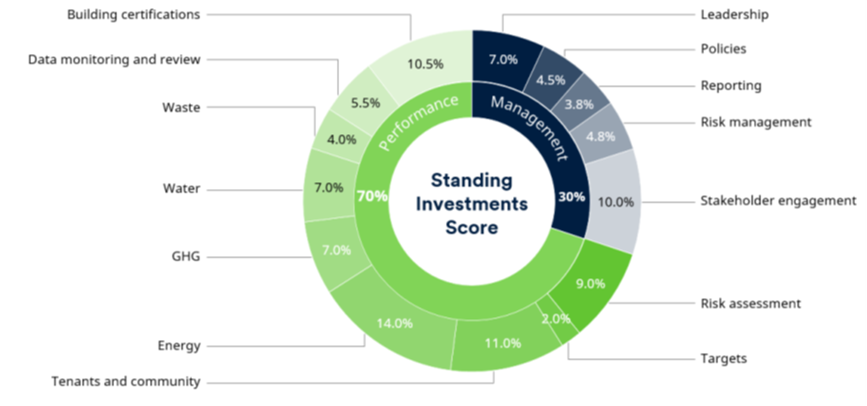
Performance
- Energy – includes total energy consumption and renewable energy generated.
- GHG emissions - includes total GHG emissions.
- Water – includes water consumption and reuse or recycling of water.
- Waste – includes total waste generation.
- Tenant and community wellbeing – includes tenant engagement programmes; community engagement programmes; and tenant health and wellbeing measures.
- Building certification – includes green building certifications at the time of design, construction or renovation; current green building certifications; and current energy efficiency certifications.
- Sustainability risk management – includes performance of environment/social risk assessments; technical building assessments for energy/ water/ waste; and energy/ water/ waste efficiency measures implemented.
- Sustainability data – includes confirmation of whether data on GHG emissions, water and waste has been independently verified.
- Sustainability targets – includes long-term sustainability improvement targets and GHG reduction targets.
Management
- Leadership – includes public commitments to ESG leadership standards, ESG personnel and accountability.
- Policies – includes policies on specific ESG issues.
- Reporting – includes disclosures of ESG-related actions, performance, and incident monitoring.
- Risk management – includes ESG-specific risk management systems, policies and procedures.
- Stakeholder engagement – includes employee, supplier and contractor ESG-related initiatives and monitoring.
In exceptional cases where the investment manager deems that the Scorecard does not provide a fair reflection of a company’s sustainability, or where GRESB has not assessed a company, the investment manager can refer the company to Schroders’ Sustainable Investment Panel (the Panel), an independent panel of experts. The Panel reviews additional robust evidence provided by the investment manager to determine whether, if such evidence was available within the Scorecard, the company would achieve a score of at least 50% on both components. This could be relevant where the Scorecard does not capture a relevant area of contribution – such as where the investment manager believes that a smaller company has strong sustainability credentials, but it does not submit data to GRESB due to resource constraints and therefore is not scored.
There is also an exclusions list for the fund, which can be found here: https://api.schroders.com/document-store/Schroder%20Global%20Cites%20Real%20Estate%20-%20Sustainability%20Information%20Document.pdf
Process:
Summary
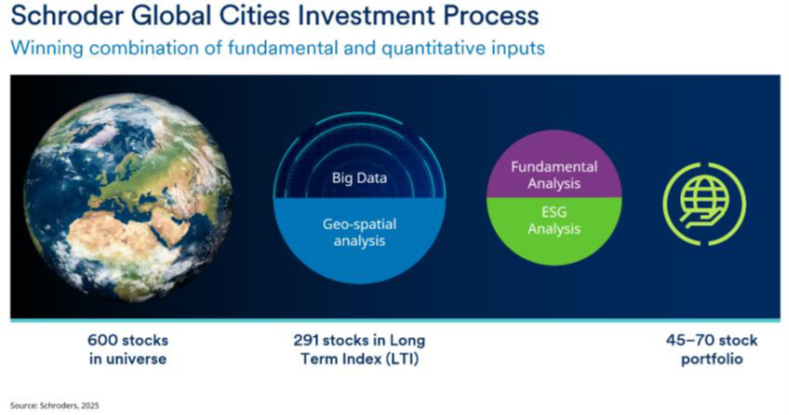
The Schroder Global Cities Strategy is a four-step data led investment process, which combines geo-spatial data science with a ‘quant-ESG’ process enabling the investment team to focus more of their time analysing sustainable companies with the best assets in the best locations.
- Geo-spatial analysis uses asset location data to generate a ‘Global Cities Score’ for each company based on the environmental, transport, innovation and economic characteristics of their assets' locations.
- ESG analysis with investment only possible above a threshold.
- Fundamental analysis is conducted by the analysts to determine potential upside and assess risk.
- Portfolio construction is based on the potential upside and fundamental risk, and a top-down regional allocation restriction. This ensures that the portfolio avoids taking macro positions and roughly matches the benchmark regional allocation.
Stage 1 – Geo-spatial analysis
Asset Database – Process Lynchpin
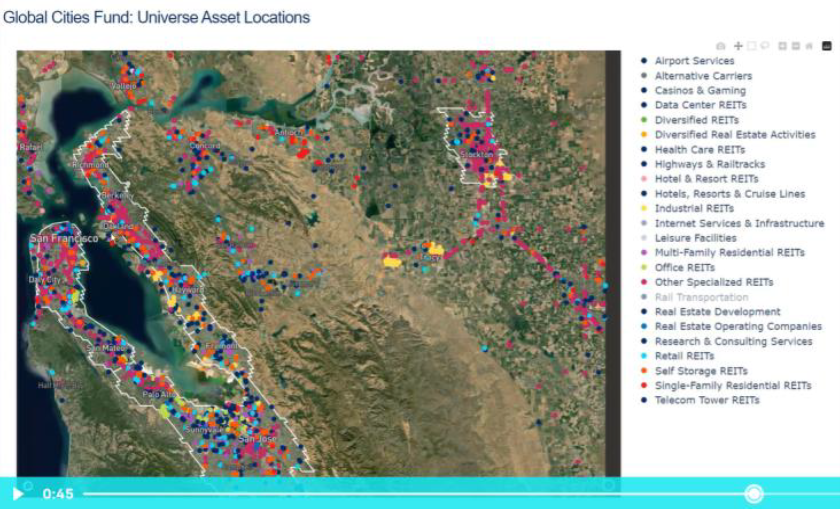
The Asset Database maps every asset of a company anywhere in the world. This provides the latitude and longitude of each asset. The team has visibility of all the assets owned by listed real asset companies. There are over 225,000 assets in the database.
The asset database allows the manager to identify which company owns assets in the strongest global cities.
The asset database in action can be seen in below illustrative charts and a video through link: https://schroders.wistia.com/medias/xbec2bcmhx
Source: Schroders, for illustration purposes only. Any reference to regions/ countries/ sectors/ stocks/ securities is for illustrative purposes only and not a recommendation to buy or sell any financial instruments or adopt a specific investment strategy.
Global Cities Scores
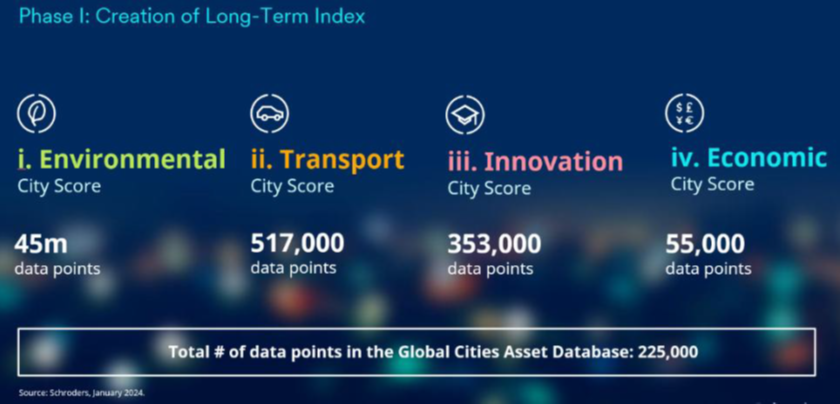
Cities and assets are scored using four City scores (Environmental, Transport, Innovation, and Economic). Cities are defined by the Global Human Settlement Layer (GHSL). This means every asset is scored according to where it intersects with the four City Scores.
Two of the City Scores – Environmental and Transport - integrate environmental and social factors into the process in stage 1.
The City Scores and their data utilisation are listed below:
Source: Schroders, for illustration purposes only. Any reference to regions/ countries/ sectors/ stocks/ securities is for illustrative purposes only and not a recommendation to buy or sell any financial instruments or adopt a specific investment strategy.
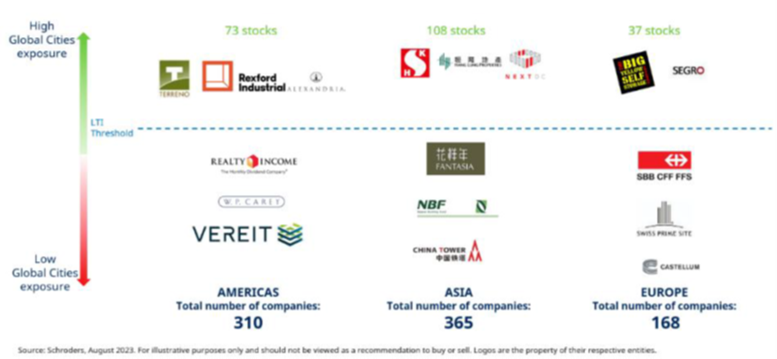
The result is c. 300 companies in the Long-Term Index (LTI) with good global cities scores, from a starting point of c. 600 companies. Around half of the companies under coverage are excluded in stage 1 as shown below. This analysis is carried out for the cities in every country across our investment universe.
Source: Schroders, for illustration purposes only. Any reference to regions/ countries/ sectors/ stocks/ securities is for illustrative purposes only and not a recommendation to buy or sell any financial instruments or adopt a specific investment strategy.
Stage 2 – ESG analysis
Stage 2 focuses on positively screening for sustainable companies. Companies are classed as sustainable through meeting or exceeding the threshold for the ‘Green Star’ designation issued by GRESB1 (the Global Real Estate Sustainability Benchmark), which is achieved by scoring at least 50% on both the performance and management components of the GRESB scorecard. GRESB is widely considered to be the leading sustainability data provider for the real estate industry.
Source: Schroders, GRESB, 2025. For illustrative purposes only. Any reference to regions/ countries/ sectors/ stocks/ securities is for illustrative purposes only and not a recommendation to buy or sell any financial instruments or adopt a specific investment strategy.
In exceptional cases where the team believe that the Scorecard does not provide a fair reflection of a company’s sustainability, or where GRESB has not assessed a company, the team can refer the company to Schroders’ Sustainable Investment Panel (the Panel), an independent panel of experts. The Panel reviews additional robust evidence provided by the team to determine whether, if such evidence was available within the Scorecard, the company would achieve a score of at least 50% on both components. This could be relevant where the Scorecard does not capture a relevant area of contribution – such as where the team believes that a smaller company has strong sustainability credentials, but it does not submit data to GRESB due to resource constraints and therefore is not scored.
Stage 3 - Fundamental Analysis and Valuation
A price target is then calculated by a price target is then calculated by conducting due diligence on every company in the LTI. The proprietary valuation models are built using two distinct types of research, which are complimentary. First, the team will carry out ‘traditional’ research, visiting assets, meeting management and sustainability teams, analysing the balance sheet etc. Second, the team will then work with our data scientist to analyse companies further.
1 GRESB 2024, All intellectual property rights to this data belong exclusively to GRESB B.V. All rights reserved. GRESB B.V. has no liability to any person (including a natural person, corporate or unincorporated body) for any losses, damages, costs, expenses or other liabilities suffered as a result of any use of or reliance on any of the information which may be attributed to it.
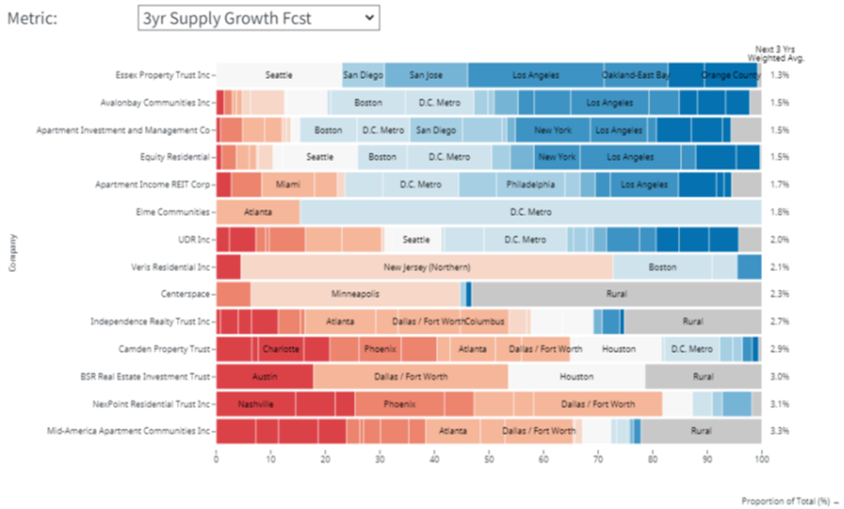
The team has built a number of databases which create efficiencies when analysing stocks. For examples, we have extensive data sets which help to evaluate supply, demand, pricing, and rental dynamics alongside demographic and geo-spatial information. The investment process makes extensive use of the asset database. In the below example, which is one of the many dashboards that we have available, we can look at the Multi-Family companies that make it into our Long Term Index. Amongst many other factors, we have the supply growth in the cities where their assets are located and systematically analyse the sector to see which companies have assets in the most supply constrained locations.
Source: Schroders, for illustrative purposes only. Any reference to regions/ countries/ sectors/ stocks/ securities is for illustrative purposes only and not a recommendation to buy or sell any financial instruments or adopt a specific investment strategy.
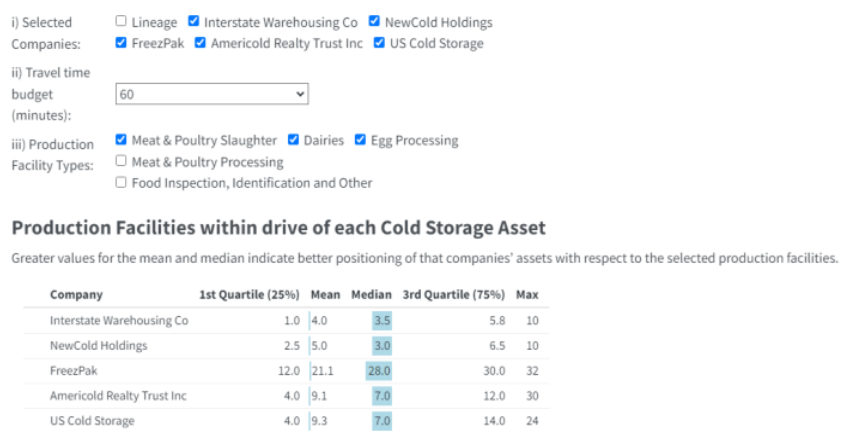
Our data scientist also does ad-hoc geospatial analysis, below is an example of one of the dashboards for a deep dive into the Cold Storage sector.
Source: Schroders, for illustrative purposes only. Any reference to regions/ countries/ sectors/ stocks/ securities is for illustrative purposes only and not a recommendation to buy or sell any financial instruments or adopt a specific investment strategy.
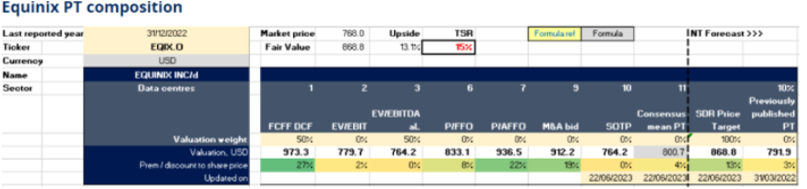
The investment team values companies based on financial modelling. Below is the summary page from the Equinix model from 2023. This shows the Price Target (PT) output derived by a DCF.
Source: Schroders, for illustrative purposes only. Any reference to regions/ countries/ sectors/ stocks/ securities is for illustrative purposes only and not a recommendation to buy or sell any financial instruments or adopt a specific investment strategy.
The model inputs are based on company and asset meetings and an understanding of the demand drivers in the underlying portfolios. Companies will also be compared to their peers as shown below.
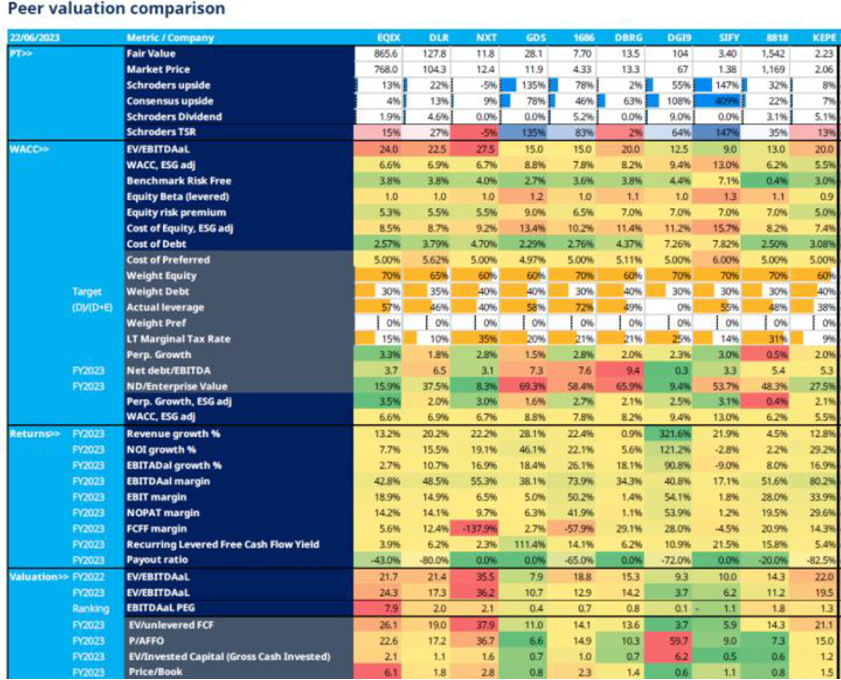
Source: Schroders, for illustrative purposes only. Any reference to regions/ countries/ sectors/ stocks/ securities is for illustrative purposes only and not a recommendation to buy or sell any financial instruments or adopt a specific investment strategy.
Valuation techniques vary between sectors and markets, with the price target indicating the absolute value of a security.
Stage 4 - Portfolio construction
Portfolio construction is based on:
- Potential upside and fundamental risk, including liquidity.
- A top-down regional allocation restriction ensuring the portfolio avoids taking macro bets and roughly matches the benchmark regional allocation
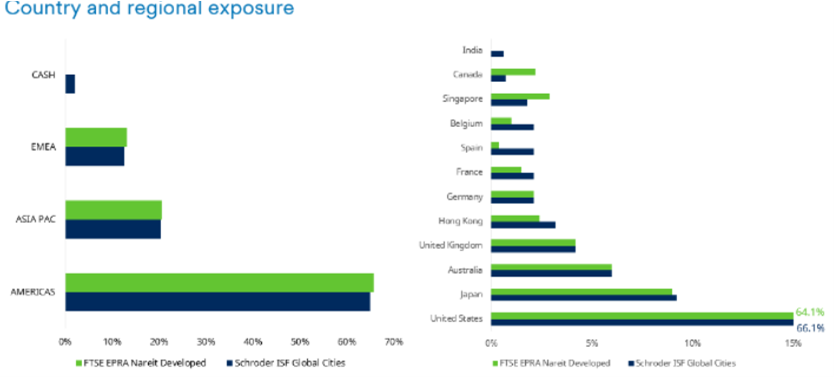
Source: Schroders 30 June 2024. Data subject to rounding. This does not represent any recommendation to invest in the above-mentioned regions. Any reference to regions/ countries/ sectors/ stocks/ securities is for illustrative purposes only and not a recommendation to buy or sell any financial instruments or adopt a specific investment strategy.
Resources, Affiliations & Corporate Strategies:
Sustainability is fundamental to our investment principles at Schroders and we have an experienced and well-resourced Sustainable Investment team, who are embedded within our investment function. We are a global team, spread across four regional hubs in London, Paris, Singapore and New York, aiming to ensure that sustainability is embedded through our global investment teams and client functions.
The team is led by Andrew Howard, Global Head of Sustainable Investment. As team head, he oversees our approach to ESG integration, active ownership, our sustainability research and tools, and our reporting and product strategy.
Our central Sustainable Investment team sits alongside investment teams rather than operating in a silo, which facilitates regular dialogue with our analysts and portfolio managers.
It is organised into four pillars:

We outline their key responsibilities and areas of focus below.
1. Thematics
Comprising sustainability research, active ownership, and models and analytics, our thematics team help power investment decision making with proprietary insights and analysis, working with fund managers and analysts to make better informed investment decisions. Responsibilities include:
- Providing sustainability – related research and technical support for stakeholders across the firm.
- Engaging companies to understand how prepared they are for a changing world and pushing them towards more sustainable practices where relevant to achieve better investment outcomes for our clients.
- Exercising voting rights in line with our Voting Policy and Principles.
- Maintaining and evolving of our suite of proprietary sustainability tools.
- Harnessing sustainability data effectively from both conventional and unconventional sources.
2. Advisory and Integration
Our Advisory and Integration team acts as a central contact point and consultant for a range of stakeholders across the business. This includes advising investment teams on ESG integration best practice; compliance, risk and legal teams on ESG regulation; and working with our regional experts across Asia Pacific, Europe and North America, as outlined under pillar four.
3. Impact
Our Impact team is responsible for scaling our impact product offering in line with best-practice impact principles. The team works closely with investment teams and is responsible for developing and implementing our impact management and measurement framework, including impact assessment and monitoring at transaction and portfolio level, product development, impact strategy and impact reporting.
4. Regional Expertise
Our Regional Experts based in Asia Pacific, Europe and North America have a deep understanding of local market characteristics and nuances, and are responsible for staying abreast of sustainability-related developments. Our experts work with clients and internal teams to navigate and support clients’ ESG aspirations and challenges, utilising Schroders’ proprietary tools and research to develop investment solutions that meet their needs. They also engage with regulators and industry bodies to shape and support the global sustainable finance agenda. Our regional experts are a critical extension of the central team in London as the firm continues to evolve its global sustainable investing strategy.
Governance of ESG Strategies and Policies
We have a number of governance structures in place for decision-making and oversight of our approach to sustainable investment. The Board of Schroders plc (the Board) has collective responsibility for the management, direction and performance of the Group, and is accountable for our overall business strategy. The Group Chief Executive is responsible for proposing the strategy for the Group and for its implementation, supported by the Group’s senior management team and a number of Committees, some of which are noted below.
The Group Sustainability and Impact (GSI) Committee provides advice to the Group Chief Executive on sustainability and impact matters. The Committee considers, reviews and recommends the overall global sustainability and impact strategy, including key initiatives, new commitments and policies for approval. The Global Head of Sustainable Investment and Global Head of Corporate Sustainability are members of the Committee and report to the Board.
The Sustainability Executive Committee (ExCo) develops and oversees the delivery of our Group-level sustainable investment management strategy. The ExCo also advises on the development of our sustainability and impact investment and product frameworks. The ExCo has senior representation from across the business including Investment, Client Group, Wealth Management, Schroders Capital and Corporate Sustainability.
The Group Regulatory Oversight Committee (GROC) oversees the progress of sustainability regulatory change programmes, as well as facilitating the monitoring of emergent sustainability regulations and ensuring we have appropriately determined the impact on our Group sustainability strategy and supporting operations. The GROC receives input on planned or potential sustainability-related regulation from our Public Policy and Compliance teams, which actively engage with relevant regulators, industry trade associations and other bodies in our key markets of the UK and EU. Once the business implications of new legal and regulatory requirements are defined, the relevant sustainability regulations programme workstreams deliver the necessary change to our business operations. The GROC oversees the progress of the programme, including monitoring and mitigating associated risks and issues. Where necessary, risks and key issues from the GROC can be escalated to the Group Risk Committee for resolution.
Certain Schroders entities, businesses and Investment teams also have their own committees which consider their sustainable investment activities. For example, the Private Assets Sustainability and Impact Steering Committee (PA S&I SteerCo) develops and oversees the implementation of the Private Assets Sustainability and Impact strategy. In addition, the Wealth Management Sustainable Investment Committee (WMSIC), a sub-committee of the Wealth Management Investment Committee (WMIC), has delegated responsibility for recommending Wealth Management's Sustainability models, as well as providing investment strategy and direction for client portfolios that are linked to the sustainable models.
Alongside our central Sustainable Investment team, sustainable investing is also overseen and delivered by dedicated teams and expert individuals embedded throughout the firm (including across Investment teams and Client Group functions).
Industry Involvement
We have a long-standing commitment to support and collaborate with several industry groups, organisations and initiatives to promote well-functioning financial markets.
Our key stakeholders include exchanges, regulators and international and regional trade associations. For example, Schroders is a member of trade bodies such as the Investment Association in the UK, the European Fund and Asset Management Association (EFAMA), the Asia Securities Industry and Financial Markets Association (ASIFMA) in Hong Kong and the Securities Industry and Financial Markets Association (SIFMA) in the US. Through this participation we share our insights to support the development of policy recommendations, share best practice and build coalitions of like-minded market participants to advocate for better functioning markets.
Our activity with policymakers aims to help them ensure that the measures they take support businesses and provide clear direction. By monitoring and influencing regulatory initiatives at their inception, we aim to support the development of a business environment which is conducive to Schroders’ clients’ best interests.
We aim to engage with the regulatory environments in which we are operating and raise awareness on sustainability matters. We believe well-designed regulation is an important cornerstone to promoting healthy markets and have asked publicly that policy makers support sustainable finance legislation and regulation and deliver on commitments, including around climate mitigation.
We consider this to be key in improving responsible investment standards across sectors, establishing a consistent dialogue with companies, and in promoting the ongoing development and recognition of sustainability and Environmental, Social and Governance (ESG) topics within the investment industry. A full list of organizations and initiatives of which Schroders is a member or signatory is available here: https://www.schroders.com/en/global/individual/corporate-transparency/working-with-policy-makers/memberships/
Dialshifter
This fund is helping to ‘shift the dial from brown to green’ by…
Schroders Global Cities fund is helping shift the dial from brown to green by investing in sustainable real estate, focusing on innovative and environmentally resilient cities and infrastructure. With strong governance practices, a commitment to social objectives, and rigorous exclusion criteria, the fund is driving positive change while offering a future-focused investment opportunity.
SDR Labelling:
Sustainability Focus label
Key Performance Indicators:
Percentage of investments that are sustainable (as determined by the Scorecard* and the Sustainable Investment Panel review)
Investments that are classified as sustainable based on Sustainable Investment Panel review.
- Consumer Facing Disclosure (as at April 2025)
- Exclusions List
- Prospectus
SDR Literature:
Fund Holdings
Disclaimer
Important Information
This document is addressed to the intended recipient for its rating purpose in the fund vehicle(s) mentioned only. This is not a marketing document.
Any reference to regions/ countries/ sectors/ stocks/ securities is for illustrative purposes only and not a recommendation to buy or sell any financial instruments or adopt a specific investment strategy.
Past Performance is not a guide to future performance and may not be repeated.
The value of investments and the income from them may go down as well as up and investors may not get back the amounts originally invested. Exchange rate changes may cause the value of investments to fall as well as rise.
Schroders has expressed its own views and opinions in this document, and these may change.
This document may contain "forward-looking" information, such as forecasts or projections. Any forecasts stated in this document are not guaranteed and are provided for information purposes only.
The information contained herein is believed to be reliable. Where third-party data is referenced, it remains subject to the rights of the respective provider and must not be reproduced or used without prior consent.
Issued by Schroder Unit Trusts Limited, 1 London Wall Place, London EC2Y 5AU. Registration No 4191730 England. Authorised and regulated by the Financial Conduct Authority.
Issued in September 2025. 06349.
| Fund Name | SRI Style | SDR Labelling | Product | Region | Asset Type | Launch Date | Last Amended |
|
|---|---|---|---|---|---|---|---|---|
Schroder Global Cities Real Estate Fund |
Sustainability Tilt | Sustainability Focus label | OEIC | Global | Equity | 09/12/2005 | Sep 2025 | |
ObjectivesThe fund aims to provide income and capital growth more than the FTSE EPRA NAREIT Developed TR GBP (Net) Index (after fees have been deducted) over a three-to-five-year period by investing in equities of sustainable real estate companies worldwide that own assets in global cities. Sustainable real estate companies contribute to an urban environment that provides a good quality of life for residents while minimising costs to the planet and using resources efficiently. Companies can demonstrate this by prioritising initiatives such as renewable energy; energy efficiency; greenhouse gas (GHG) emissions reduction; effective water management; waste minimisation; responsible tenant and community engagement; setting sustainability targets; and managing their business in a sustainable way. |
Fund/Portfolio Size: £869.80m (as at: 31/08/2025) Total Responsible Ownership Assets: £646500.00m (as at: 31/12/2024) Total Assets Under Management: £776613.00m (as at: 30/06/2025) ISIN: GB00B1VPTY75, GB00BDD2DR16, GB00BDD2DQ09, GB00BYX7J192, GB00B0LGTF49, GB00B0LGSD59, GB00B1VPTW51 Contact Us: sami.arouche@schroders.com |
|||||||
Sustainable, Responsible &/or ESG OverviewThe fund’s sustainability objective is to invest in sustainable real estate companies that own assets in global cities. Sustainable real estate companies contribute to an urban environment that provides a good quality of life for residents while minimising costs to the planet and using resources efficiently. Companies can demonstrate this by prioritising initiatives such as renewable energy; energy efficiency; greenhouse gas (GHG) emissions reduction; effective water management; waste minimisation; and responsible tenant and community engagement; setting sustainability targets; and managing their business in a sustainable way. |
||||||||
|
Primary fund last amended: Sep 2025 |
||||||||
|
Information received directly from Fund Manager |
||||||||
|
Please select what you would like to read:
Fund FiltersSustainability - General
Sustainability policy
Has policies that consider (environmental and social) sustainability issues. Strategies vary but are likely to consider environmental issues like climate change, carbon emissions, biodiversity loss, resource management, environmental impacts; and social issues like equal opportunities, human rights, labour standards, diversity and adherence to internationally recognised codes. See individual entry information.
Sustainability focus
Has a significant focus on sustainability issues
Encourage more sustainable practices through stewardship
Aim to encourage higher sustainability standards through responsible ownership / stewardship / engagement / voting activity
UN Global Compact linked exclusion policy
Use the UN Global Compact to inform or help direct where they can or cannot invest. Will typically not invest in companies with significant breaches (low standards) - strategies vary. (The UNGC covers a wide range of issues - search 'UNGC'). See https://unglobalcompact.org/
Report against sustainability objectives
Publicly report performance against named sustainability objectives
Green / sustainable property strategy
Has a strategy on - and may focus investment on sustainability issues in the property sector - they may eg use GRESB / BREEAM scores to inform investment decisions. Environmental - General
Favours cleaner, greener companies
Aims to invest in companies with strong or market leading environmental policies and practices. Strategies vary. See individual entry information for more detail. Nature & Biodiversity
Nature / biodiversity based solutions theme
A significant focus on investments that aim to protect, improve and / or restore natural habitat. Climate Change & Energy
Coal, oil & / or gas majors excluded
Avoid investment in major coal, oil and/or gas (extraction) companies. Strategies vary.
Fracking & tar sands excluded
Avoid companies involved in fracking and tar sands - which are widely regarded as controversial methods of oil and gas extraction. Strategies vary.
Fossil fuel reserves exclusion
Avoid investing in companies / assets with coal, oil and gas reserves. See individual entry information for further details.
Encourage transition to low carbon through stewardship activity
Encourage the transition to lower carbon activities through asset selection and / or responsible ownership activity.
Energy efficiency theme
Has an energy efficiency theme - typically meaning that the manager is focused on investing in organisations that manage - or help others to manage - energy use more carefully and less wastefully - and so reduce greenhouse gas emissions.
Nuclear exclusion policy
Has a policy which describes the avoidance or limited investment in the nuclear industry. Strategies vary.
TCFD / IFRS reporting requirement
Will only invest in companies that report greenhouse gas emissions in line with this international reporting framework. See https://www.fsb-tcfd.org/ https ://www.ifrs.org/sustainability/tcfd/ Social / Employment
Favours companies with strong social policies
Aims to invest in assets with high social values - this may include strong human rights, labour standards and equal opportunities or safety related practices. Ethical Values Led Exclusions
Tobacco & related product manufacturers excluded
Companies are excluded if they are involved in any aspect of the production chain for tobacco products, including cigarettes, vaping, e-cigarettes, chewing tobacco and cigars.
Tobacco & related products - avoid where revenue > 5%
Companies are excluded if they make more than 5% of their revenue from the manufacture, sale or distribution of tobacco products including cigarettes, vaping, e-cigarettes, chewing tobacco and cigars.
Controversial weapons exclusion
Excludes companies which make controversial weapons such as landmines, cluster munitions and chemical weapons.
Armaments manufacturers avoided
Avoids companies that manufacture weapons intended specifically for military use. Strategies vary - may or may not include non-strategic military products.
Civilian firearms production exclusion
Has a written civilian firearms exclusion policy - meaning that they will not invest in companies that make (or perhaps also sell) handguns made for non-military users.
Alcohol production excluded
Avoids companies that produce alcohol. Strategies vary; some may allow a small proportion of revenue to come from this area.
Gambling avoidance policy
Avoids companies with significant involvement in the gambling industry. Some may allow a small proportion of revenues to come from this area.
Pornography avoidance policy
Avoids companies that derive significant income from pornography and related areas. Strategies vary. Human Rights
Human rights policy
Has policies relating to human rights issues. Typically require companies to demonstrate higher standards, although some managers work to encourage improvements. Investee companies are often judged against internationally agreed norms or standards. Strategies vary.
Child labour exclusion
Has policies to avoid companies that employ children. Meeting Peoples' Basic Needs
Demographic / ageing population theme
Has a thematic investment approach focusing on the ‘silver economy’ - in particular (typically) the issues and opportunities presented by changing demographics. This could include finance, healthcare and medicines and/ or longevity science to extend lifespans. Strategies vary. Governance & Management
Avoids companies with poor governance
Avoids investing in companies with poor governance practices.(e.g. board structure, management practices etc.) Views may however vary on what counts as 'poor' practices - and funds may not immediately divest as they may prefer to work to encourage higher standards.
UN sanctions exclusion
Exclude companies that are subject to United Nations sanctions. See eg https://main.un.org/securitycouncil/en/content/un-sc-consolidated-list
Encourage board diversity e.g. gender
Encourage the companies they invest in to have more diverse board structures (e.g. more women on boards)
Encourage higher ESG standards through stewardship activity
Aim to encourage higher ESG standards through responsible ownership / stewardship / engagement /voting activity Product / Service Governance
ESG integration strategy
Find fund / asset managers that factor in 'environmental, social and governance' issues as part of their investment decision making process. A focus on 'ESG' typically means a fund is carrying out additional research to help reduce ESG related risks. It does not necessarily mean a focus on sustainability. Strategies vary. See fund literature.
ESG factors included in Assessment of Value (AoV) report
Environmental, social and governance issues are part of this fund’s reporting of their ‘value’ to clients. AoV reporting is a statutory requirement. Including ESG factors in its calculation is not. Asset Size
Invests in small, mid & large cap companies / assets
Invests in a combination of small, medium and larger (potentially multinational) companies / assets. How The Fund/Portfolio Works
Positive selection bias
Focuses on finding and investing in companies with positive / beneficial attributes. This strategy can be applied in addition to exclusion criteria and engagement/stewardship activity.
Negative selection bias
Has principle 'ethical approach' to avoid companies by using negative screening criteria. Strategies vary.
Data led strategy
Makes stock selection (and ongoing management) decisions based on ESG data or company ratings (normally supplied by third parties) rather than focusing on what individual companies do, how they operate or their plans for the future
Significant harm exclusion
Aims to avoid companies that do significant harm. This originates from the EU’s sustainable finance ‘DNSH’ (do no significant harm) work, which is not necessarily used by UK investors.
SRI / ESG / Ethical policies explained on website
Publish explanations of their ethical, social and/or environmental policies online (i.e. investment decision making strategies/ buy/sell &/or asset management strategies).
Do not use stock / securities lending
Does not use stock lending for performance or risk purposes. Unscreened Assets & Cash
Assets typically aligned to sustainability objectives 70 - 79%
Holds between 70-79% of assets which align to the sustainability objectives; which are not being held purely for risk management purposes, such as derivatives and cash equivalent assets.
Assets typically aligned to sustainability objectives 80 – 89%
Holds between 80-89% of assets which align to the sustainability objectives; which are not being held purely for risk management purposes, such as derivatives and cash equivalent assets.
Assets typically aligned to sustainability objectives > 90%
Holds at least 90% of assets which align to the sustainability objectives; which are not being held purely for risk management purposes, such as derivatives and cash equivalent assets.
All assets (except cash) meet published sustainability criteria
All assets - except cash - meet the sustainability criteria published in strategy documentation. Intended Clients & Product Options
Intended for clients interested in sustainability
Designed to meet the needs of individual investors with an interest in sustainability issues.
Intended for clients who want to have a positive impact
Designed to meet the needs of individual investors with an interest in ‘Impact investment’ which help or support the delivery of positive social or environmental impacts (or societal/real world outcomes) by investing in companies regarded as beneficial to people and / or the planet. Strategies vary.
Available via an ISA (OEIC only)
Available via a tax efficient ISA product wrapper.
Portfolio SRI / ESG options available
Only applicable for DFM’s & portfolio providers. Finds those that offer an SRI / ESG portfolio option
Multiple SRI / ESG portfolio options available
Only applicable for DFM’s & portfolio providers. Find service providers who offer multiple SRI / ESG portfolio options
Bespoke SRI / ESG portfolios available
Only applicable for DFM’s & portfolio providers. Find service providers who offer bespoke ('personalised') SRI / ESG portfolio options Labels & Accreditations
SDR Labelled
Find options that have chosen to adopt one of the Financial Conduct Authority (FCA) SDR labels. Please note: there are a range of reasons why potentially relevant options may not use an SDR label eg. adopting a label may be work in progress, the manager may not yet be allowed to do so because of the product type, a manager may feel they are insufficiently aligned to SDR requirements.
SFDR Article 9 fund / product (EU)
Find options classified under Article 9 of the EU’s SFDR (Sustainable Finance Disclosure Requirements). Article 9 of the SFDR applies to financial products that have sustainable investment 'objectives' - including emissions reduction objectives. (These may currently be referred to as 'impact' funds or aiming to deliver clear, specific positive outcomes.) These rules do not currently apply in the UK so product managers may leave this field blank.
ACT signatory
A voluntary corporate culture standard for investment managers, see https://www.investorsact.com/ - City Hive Fund Management Company InformationAbout The Business
Specialist positive impact fund management company
Find fund / asset management companies (or subsidiaries) that specialise in - or focus entirely on - investing in assets that are helping to deliver positive environmental and / or social impacts.
Responsible ownership / stewardship policy or strategy (AFM companywide)
Finds fund / asset management companies that have a published company wide stewardship, engagement and / or responsible ownership policy or strategy that covers all investments. Stewardship typically involves encouraging higher ESG standards through voting and dialogue.
ESG / SRI engagement (AFM companywide)
Find fund / asset management companies that actively encourage higher 'environmental, social and governance' and / or 'sustainable and responsible investment' practices across investee companies - typically where the aim is to encourage positive change that is aligned with the best interests of investors. Strategies vary. See additional information and options.
Vote all* shares at AGMs / EGMs (AFM companywide)
Find fund / asset managers that vote all* the shares they own at Annual General Meetings and Extraordinary General Meetings. A commitment to voting shares is a key indicator of 'responsible share ownership' demonstrating their support for or disagreement with management policy. (*situations can legitimately, occasionally occur where voting proves impossible, but in principle all shares should be voted.)
Responsible ownership / ESG a key differentiator (AFM companywide)
Find fund / asset managers that consider responsible ownership and ESG to be a key differentiator for their business.
Sustainable property strategy (AFM companywide)
Find fund / asset management companies that take sustainability criteria into account when selecting and/or managing all of their property / real estate investments.
Senior management KPIs include environmental goals (AFM companywide)
The leadership team of this fund / asset manager have performance targets linked to environmental goals.
SDG aligned aims / objectives (AFM companywide)
Find fund / asset management companies that aim to align all their investments (across all funds) to help meet the aims of the UN Sustainable Development Goals.
Responsible ownership policy for non SRI / sustainable options (AFM companywide)
Find options run by managers that apply Responsible ownership or 'Stewardship' policies to all or most of their investment assets. This means active involvement (e.g. voting, dialogue) with the companies across all or most funds, products and services.
Integrates ESG factors into all / most research (AFM companywide)
Find fund / asset management companies that consider environmental, social and governance (ESG) issues when deciding whether or not to invest in a company for all / almost all of their funds and other assets. This is increasingly seen as part of sound risk management.
In-house diversity improvement programme (AFM companywide)
Finds organisations / fund managers that have an in-house (company wide) diversity improvement programme - meaning that they are working to ensure that within their own businesses they employ people from diverse backgrounds - often typically focused on ethnicity and/or sex.
Diversity, equality & inclusion engagement policy (AFM companywide)
Find fund / asset management companies that encourage the companies they invest in to have strong diversity, race, gender and other equality policies across all assets held, not simply screened or themed SRI/ESG funds. (ie Asset Management company wide).
Invests in newly listed companies (AFM companywide)
This fund / asset management company invests in companies which have recently listed on a stock exchange (which is important as it can help grow new businesses).
Invests in new sustainability linked bond issuances (AFM companywide)
Fund / asset management company has investments in bonds designed to meet sustainability requirements - however these assets may not be 'ringfenced' for this purpose. See website for details.
Offer structured intermediary sustainable investment training
Fund management entity offers unstructured intermediary training on sustainable investment (ie for financial advisers and wealth managers)
Offer unstructured intermediary sustainable investment training
Fund management entity offers unstructured intermediary training on sustainable investment (ie for financial advisers and wealth managers) Collaborations & Affiliations
PRI signatory
Find fund / asset management companies that have signed up to the UN backed 'Principles of Responsible Investment'.
UKSIF member
Find fund / asset management companies that are members of UKSIF - the UK Sustainable Investment and Finance association
Fund EcoMarket partner
Find fund / asset management companies that have partnered with Fund EcoMarket - meaning that they are helping to improve access to information on sustainable and responsible investment by paying an annual fee to us which enables us to publish information for free. Partner funds are listed ahead of other funds and have their logos displayed.
UN Principles of Responsible Banking framework signatory (AFM companywide)
This fund / asset manager has signed up to the UNEP (United Nations Environment Program) program which aims to encourage more responsible banking practices – focused on environmental and social issues.
TNFD forum member (AFM companywide)
A member of the Taskforce for Nature Related Financial Disclosures group which aims to aid risk management and shift money towards nature-positive outcomes.
Investment Association (IA) member
Fund management entity is a member of the Investment Association https://www.theia.org/ Resources
In-house responsible ownership / voting expertise
Find fund / asset management companies that employ people to steer and support fund managers in voting shares at company AGM's and EGMs in ways that are consistent with encouraging higher ESG/sustainability standards.
Employ specialist ESG / SRI / sustainability researchers
Find a fund / asset management company that directly employs specialist ESG/SRI/sustainability researchers or analysts. This allows asset managers to discuss environmental, social and governance risks and opportunities directly with companies.
Use specialist ESG / SRI / sustainability research companies
Find fund / asset management companies that makes use of expert external research companies. This can help deliver specialist expertise and means resources are pooled with other investors.
ESG specialists on all investment desks (AFM companywide)
Finds organisations / fund managers that have one or more ESG/sustainability experts on all investment teams or 'desks' (all asset types) Accreditations
PRI A+ rated (AFM companywide)
Finds organisations / fund managers that have an A+ PRI rating - meaning they are highly rated according to the 'Principles of Responsible Investment'
UK Stewardship Code signatory (AFM companywide)
Find fund / asset managers that are signatories to the FRC UK Stewardship Code, which sets out a framework for constructive investor / investee relations where managers are encouraged to behave like responsible, typically longer term 'company owners'. Engagement Approach
Regularly lead collaborative ESG initiatives (AFM companywide)
Find fund / asset management companies that regularly initiate or run industry wide (collaborative) investor projects aimed at raising environmental, social and governance standards amongst investee companies.
Encourage responsible corporate taxation (AFM companywide)
Find fund / asset management companies that are working with the companies they invest in to encourage more responsible corporate taxation.
Engaging on climate change issues
Fund / asset manager has stewardship /responsible ownership strategy that is focused on addressing climate change with investee assets.
Engaging with fossil fuel companies on climate change
Fund / asset manager has a stewardship /responsible ownership strategy that involves working with fossil fuel companies on climate change related issues. See fund manager website for details.
Engaging to reduce plastics pollution / waste
Fund / asset manager has stewardship /responsible ownership strategy with involves encouraging investee asset to reduce plastic waste and pollution.
Engaging to encourage responsible mining practices
Fund / asset manager has a stewardship / responsible ownership policy that means they are working to encourage more responsible mining practices - where environmental and social issues are properly dealt with by the companies they invest in.
Engaging on biodiversity / nature issues
The fund / asset manager has a responsible ownership / stewardship strategy that focuses on biodiversity and nature issues relating to the assets they invest the aim of which will be to reduce harm and or deliver improvement. Strategies vary. https://tnfd.global
Engaging to encourage a Just Transition
Fund / asset manager has a responsible ownership / stewardship strategy which means they are working to encourage the shift to more sustainable business practices in ways that respect and are sensitive to social issues and the impact change has on people effected by the changes that are taking place. https://www.transitionpathwayinitiative.org/ https://transitiontaskforce.net/
Engaging on human rights issues
Fund / asset manager has responsible ownership / stewardship strategy in place which aims to address human rights issues in investee companies (and potentially their suppliers) with the aim of raising standards
Engaging on labour / employment issues
Fund / asset manager has responsible ownership / stewardship strategy in place that aims to improve labour standards for the benefit of employees in investee companies (and potentially their suppliers)
Engaging on diversity, equality & / or inclusion issues
Fund / asset management company has a stewardship strategy in place which involves working to raise diversity, equality and inclusion standards across investee assets
Engaging to stop modern slavery
Fund / asset manager is working with the assets they hold to help stamp out modern slavery - where direct or indirect company employees are exploited for business benefits.
Engaging on governance issues
Fund / asset managers have stewardship strategies in place that focus on improving governance standards across investee assets
Engaging on mental health issues
Fund / asset manager has stewardship strategy in place which involves discussing mental health issues with investee companies - with the aim of raising standards
Engaging on responsible supply chain issues
Has a stewardship / responsible ownership strategy that encourages responsible supply chain - ie the managers will discuss environmental, social and governance issues with investee companies with the aim of raising standards
Stewardship escalation policy
Escalation policies describe how a manager will proceed if stewardship / engagement activity is not successful in the short term. Company Wide Exclusions
Controversial weapons avoidance policy (AFM companywide)
Find fund / asset management companies (not funds) that avoid investment in 'controversial weapons' across all of their funds and other investment vehicles.
Review(ing) carbon / fossil fuel exposure for all funds (AFM companywide)
Find funds / asset managers that are reviewing, or have reviewed, their exposure to carbon intensive industries including (but not only) mining, oil and gas companies. (Typically with reference to climate change.) Climate & Net Zero Transition
Net Zero commitment (AFM companywide)
Fund / asset management organisations that have pledged to reduce their greenhouse gas emissions to ‘net zero’. Strategies vary - this area is changing rapidly.
Voting policy includes net zero targets (AFM companywide)
Fund / asset manager AGM / EGM voting strategy has processes in place that mean they will normally be expected to vote in a way that will encourage the transition to net zero greenhouse gas emissions.
Publish 'CEO owned' Climate Risk policy (AFM companywide)
Find fund / asset management companies that have published a Climate Risk policy or statement that is signed / owned by their Chief Executive.
Net Zero - have set a Net Zero target date (AFM companywide)
This fund / asset management company has set a date by which they plan to achieve net zero greenhouse gas / CO2e emissions.
Encourage carbon / greenhouse gas reduction (AFM companywide)
Find fund / asset management companies that are working with the companies they invest in to encourage reductions in carbon dioxide and other greenhouse gas emissions.
Carbon transition plan published (AFM companywide)
Finds organisations / fund managers that have a company wide carbon transition plan - meaning that they have plotted a path to how they will move away from activities that produce or use carbon based energy sources (that emit greenhouse gases) towards clean, alternative, renewable energy sources.
‘Forward Looking Climate Metrics’ published / ITR (AFM companywide)
Finds organisations / fund managers that have published ‘forward looking climate metrics’ e.g. 'implied temperature rise' data that are a total of the asset management company's share (% owned) of all the investee company emissions of the assets they manage, as well as their own direct and other indirect emissions.
In-house carbon / GHG reduction policy (AFM companywide)
Find fund / asset management companies that are working to reduce their own (fund management company) carbon/greenhouse gas emissions.
Working towards a ‘Net Zero’ commitment (AFM companywide)
Finds organisations / fund management companies that are in the process of working out how to make a ‘net zero commitment’ - meaning that when that is finalised they will have started the process of reducing their total greenhouse gas emissions to 'zero'.
Committed to SBTi / Science Based Targets Initiative
See https://sciencebasedtargets.org/ Transparency
Publish responsible ownership / stewardship report (AFM companywide)
Find fund / asset management companies that publish a report detailing their responsible investment ownership - also known as 'Stewardship' - activity.
Full stewardship / responsible ownership policy information on company website
Find fund / asset management companies that publish information about their sustainable and responsible investment strategies on their company website.
Publish full voting record (AFM companywide)
Fund / asset management companies that publish a full record of how they vote their shares at AGMs (annual general meetings) and EGMs (extraordinary general meetings). Voting strategies have an important role to play encouraging higher environmental, social and governance standards.
Sustainability transition plan publicly available (AFM companywide)
This fund / asset management company has published a plan that explains how they are to become a sustainable business - without significant negative environmental or social impacts.
Paris Alignment plan publicly available (AFM companywide)
This fund / asset management company has published a plan that explains how they will align to the climate change commitments made at the Paris Climate Talks, COP21.
Net Zero transition plan publicly available (AFM companywide)
This fund / asset management company has published a plan that explains how they are going to achieve net zero greenhouse gas / CO2e emissions.
Dialshifter statement
Find fund / asset management companies that have supplied Dialshifter information. See Dialshifter tab within record for more information. Sustainable, Responsible &/or ESG Policy:Over 200 million people live in the top 30 global cities, as assessed by the investment manager’s Global Cities Index.2 Considering this, real estate companies that contribute to an urban environment that provides a good quality of life for residents while minimising costs to the planet and using resources efficiently are likely to positively affect the health and wellbeing of a significant portion of the world’s population. By investing in companies that are assessed as contributing to such urban environments, the Fund aims to help them continue to implement (and potentially expand) their sustainable activities. The Fund’s holdings in such companies may also allow the investment manager, through engagement with management teams, to encourage companies to enhance their sustainability credentials further (as assessed by the Scorecard). A company is classified as contributing to an urban environment that provides a good quality of life for residents while minimising costs to the planet and using resources efficiently if it (i) achieves a score of at least 50% on both components of the Scorecard (and thereby achieves the threshold for GRESB’s Green Star designation); or (ii) the Panel determines that the company would achieve a score of at least 50% on each component if additional robust evidence was available within the Scorecard and included in the calculation of the score. The investment manager’s approach to assessing sustainability described below has been assessed by the investment manager’s Risk and Compliance functions, which are independent of the investment decision making process for the Fund, and they have deemed this approach to be a robust, evidence-based standard that is an absolute measure of environmental and/ or social sustainability. Each proposed investment is assessed against a scorecard developed by GRESB – an organisation that specialises in providing real asset sustainability information to investors. Full details of the Scorecard can be found at https:// documents.gresb.com/generated_files/real_estate/2024/ real_estate/scoring_document/complete.html. GRESB scores individual real estate companies based on the factors below, which are used to assess how the real estate assets in the company’s portfolio perform across a range of sustainability matters. GRESB collects data at the building (asset) level, which is then aggregated to the company or portfolio level, typically proportionally based on factors such as each building's square footage. Participating companies provide data to GRESB either automatically through their data management systems—integrated with building smart meters—or manually. GRESB may update the Scorecard periodically and the investment manager will update the summary below within a reasonable timeframe following any such updates.
Management
In exceptional cases where the investment manager deems that the Scorecard does not provide a fair reflection of a company’s sustainability, or where GRESB has not assessed a company, the investment manager can refer the company to Schroders’ Sustainable Investment Panel (the Panel), an independent panel of experts. The Panel reviews additional robust evidence provided by the investment manager to determine whether, if such evidence was available within the Scorecard, the company would achieve a score of at least 50% on both components. This could be relevant where the Scorecard does not capture a relevant area of contribution – such as where the investment manager believes that a smaller company has strong sustainability credentials, but it does not submit data to GRESB due to resource constraints and therefore is not scored. There is also an exclusions list for the fund, which can be found here: https://api.schroders.com/document-store/Schroder%20Global%20Cites%20Real%20Estate%20-%20Sustainability%20Information%20Document.pdf Process:Summary The Schroder Global Cities Strategy is a four-step data led investment process, which combines geo-spatial data science with a ‘quant-ESG’ process enabling the investment team to focus more of their time analysing sustainable companies with the best assets in the best locations.
Stage 1 – Geo-spatial analysis Asset Database – Process Lynchpin The Asset Database maps every asset of a company anywhere in the world. This provides the latitude and longitude of each asset. The team has visibility of all the assets owned by listed real asset companies. There are over 225,000 assets in the database. The asset database allows the manager to identify which company owns assets in the strongest global cities. The asset database in action can be seen in below illustrative charts and a video through link: https://schroders.wistia.com/medias/xbec2bcmhx
Source: Schroders, for illustration purposes only. Any reference to regions/ countries/ sectors/ stocks/ securities is for illustrative purposes only and not a recommendation to buy or sell any financial instruments or adopt a specific investment strategy. Global Cities Scores Cities and assets are scored using four City scores (Environmental, Transport, Innovation, and Economic). Cities are defined by the Global Human Settlement Layer (GHSL). This means every asset is scored according to where it intersects with the four City Scores. Two of the City Scores – Environmental and Transport - integrate environmental and social factors into the process in stage 1. The City Scores and their data utilisation are listed below:
Source: Schroders, for illustration purposes only. Any reference to regions/ countries/ sectors/ stocks/ securities is for illustrative purposes only and not a recommendation to buy or sell any financial instruments or adopt a specific investment strategy. The result is c. 300 companies in the Long-Term Index (LTI) with good global cities scores, from a starting point of c. 600 companies. Around half of the companies under coverage are excluded in stage 1 as shown below. This analysis is carried out for the cities in every country across our investment universe.
Source: Schroders, for illustration purposes only. Any reference to regions/ countries/ sectors/ stocks/ securities is for illustrative purposes only and not a recommendation to buy or sell any financial instruments or adopt a specific investment strategy. Stage 2 – ESG analysis Stage 2 focuses on positively screening for sustainable companies. Companies are classed as sustainable through meeting or exceeding the threshold for the ‘Green Star’ designation issued by GRESB1 (the Global Real Estate Sustainability Benchmark), which is achieved by scoring at least 50% on both the performance and management components of the GRESB scorecard. GRESB is widely considered to be the leading sustainability data provider for the real estate industry.
Source: Schroders, GRESB, 2025. For illustrative purposes only. Any reference to regions/ countries/ sectors/ stocks/ securities is for illustrative purposes only and not a recommendation to buy or sell any financial instruments or adopt a specific investment strategy. In exceptional cases where the team believe that the Scorecard does not provide a fair reflection of a company’s sustainability, or where GRESB has not assessed a company, the team can refer the company to Schroders’ Sustainable Investment Panel (the Panel), an independent panel of experts. The Panel reviews additional robust evidence provided by the team to determine whether, if such evidence was available within the Scorecard, the company would achieve a score of at least 50% on both components. This could be relevant where the Scorecard does not capture a relevant area of contribution – such as where the team believes that a smaller company has strong sustainability credentials, but it does not submit data to GRESB due to resource constraints and therefore is not scored. Stage 3 - Fundamental Analysis and Valuation A price target is then calculated by a price target is then calculated by conducting due diligence on every company in the LTI. The proprietary valuation models are built using two distinct types of research, which are complimentary. First, the team will carry out ‘traditional’ research, visiting assets, meeting management and sustainability teams, analysing the balance sheet etc. Second, the team will then work with our data scientist to analyse companies further. 1 GRESB 2024, All intellectual property rights to this data belong exclusively to GRESB B.V. All rights reserved. GRESB B.V. has no liability to any person (including a natural person, corporate or unincorporated body) for any losses, damages, costs, expenses or other liabilities suffered as a result of any use of or reliance on any of the information which may be attributed to it. The team has built a number of databases which create efficiencies when analysing stocks. For examples, we have extensive data sets which help to evaluate supply, demand, pricing, and rental dynamics alongside demographic and geo-spatial information. The investment process makes extensive use of the asset database. In the below example, which is one of the many dashboards that we have available, we can look at the Multi-Family companies that make it into our Long Term Index. Amongst many other factors, we have the supply growth in the cities where their assets are located and systematically analyse the sector to see which companies have assets in the most supply constrained locations.
Source: Schroders, for illustrative purposes only. Any reference to regions/ countries/ sectors/ stocks/ securities is for illustrative purposes only and not a recommendation to buy or sell any financial instruments or adopt a specific investment strategy. Our data scientist also does ad-hoc geospatial analysis, below is an example of one of the dashboards for a deep dive into the Cold Storage sector.
Source: Schroders, for illustrative purposes only. Any reference to regions/ countries/ sectors/ stocks/ securities is for illustrative purposes only and not a recommendation to buy or sell any financial instruments or adopt a specific investment strategy. The investment team values companies based on financial modelling. Below is the summary page from the Equinix model from 2023. This shows the Price Target (PT) output derived by a DCF.
Source: Schroders, for illustrative purposes only. Any reference to regions/ countries/ sectors/ stocks/ securities is for illustrative purposes only and not a recommendation to buy or sell any financial instruments or adopt a specific investment strategy. The model inputs are based on company and asset meetings and an understanding of the demand drivers in the underlying portfolios. Companies will also be compared to their peers as shown below.
Source: Schroders, for illustrative purposes only. Any reference to regions/ countries/ sectors/ stocks/ securities is for illustrative purposes only and not a recommendation to buy or sell any financial instruments or adopt a specific investment strategy. Valuation techniques vary between sectors and markets, with the price target indicating the absolute value of a security. Stage 4 - Portfolio construction Portfolio construction is based on:
Source: Schroders 30 June 2024. Data subject to rounding. This does not represent any recommendation to invest in the above-mentioned regions. Any reference to regions/ countries/ sectors/ stocks/ securities is for illustrative purposes only and not a recommendation to buy or sell any financial instruments or adopt a specific investment strategy. Resources, Affiliations & Corporate Strategies:Sustainability is fundamental to our investment principles at Schroders and we have an experienced and well-resourced Sustainable Investment team, who are embedded within our investment function. We are a global team, spread across four regional hubs in London, Paris, Singapore and New York, aiming to ensure that sustainability is embedded through our global investment teams and client functions. The team is led by Andrew Howard, Global Head of Sustainable Investment. As team head, he oversees our approach to ESG integration, active ownership, our sustainability research and tools, and our reporting and product strategy.
We outline their key responsibilities and areas of focus below. 1. Thematics
Our Advisory and Integration team acts as a central contact point and consultant for a range of stakeholders across the business. This includes advising investment teams on ESG integration best practice; compliance, risk and legal teams on ESG regulation; and working with our regional experts across Asia Pacific, Europe and North America, as outlined under pillar four. 3. Impact Our Impact team is responsible for scaling our impact product offering in line with best-practice impact principles. The team works closely with investment teams and is responsible for developing and implementing our impact management and measurement framework, including impact assessment and monitoring at transaction and portfolio level, product development, impact strategy and impact reporting. 4. Regional Expertise Our Regional Experts based in Asia Pacific, Europe and North America have a deep understanding of local market characteristics and nuances, and are responsible for staying abreast of sustainability-related developments. Our experts work with clients and internal teams to navigate and support clients’ ESG aspirations and challenges, utilising Schroders’ proprietary tools and research to develop investment solutions that meet their needs. They also engage with regulators and industry bodies to shape and support the global sustainable finance agenda. Our regional experts are a critical extension of the central team in London as the firm continues to evolve its global sustainable investing strategy. Governance of ESG Strategies and Policies We have a number of governance structures in place for decision-making and oversight of our approach to sustainable investment. The Board of Schroders plc (the Board) has collective responsibility for the management, direction and performance of the Group, and is accountable for our overall business strategy. The Group Chief Executive is responsible for proposing the strategy for the Group and for its implementation, supported by the Group’s senior management team and a number of Committees, some of which are noted below. The Group Sustainability and Impact (GSI) Committee provides advice to the Group Chief Executive on sustainability and impact matters. The Committee considers, reviews and recommends the overall global sustainability and impact strategy, including key initiatives, new commitments and policies for approval. The Global Head of Sustainable Investment and Global Head of Corporate Sustainability are members of the Committee and report to the Board. The Sustainability Executive Committee (ExCo) develops and oversees the delivery of our Group-level sustainable investment management strategy. The ExCo also advises on the development of our sustainability and impact investment and product frameworks. The ExCo has senior representation from across the business including Investment, Client Group, Wealth Management, Schroders Capital and Corporate Sustainability. The Group Regulatory Oversight Committee (GROC) oversees the progress of sustainability regulatory change programmes, as well as facilitating the monitoring of emergent sustainability regulations and ensuring we have appropriately determined the impact on our Group sustainability strategy and supporting operations. The GROC receives input on planned or potential sustainability-related regulation from our Public Policy and Compliance teams, which actively engage with relevant regulators, industry trade associations and other bodies in our key markets of the UK and EU. Once the business implications of new legal and regulatory requirements are defined, the relevant sustainability regulations programme workstreams deliver the necessary change to our business operations. The GROC oversees the progress of the programme, including monitoring and mitigating associated risks and issues. Where necessary, risks and key issues from the GROC can be escalated to the Group Risk Committee for resolution. Certain Schroders entities, businesses and Investment teams also have their own committees which consider their sustainable investment activities. For example, the Private Assets Sustainability and Impact Steering Committee (PA S&I SteerCo) develops and oversees the implementation of the Private Assets Sustainability and Impact strategy. In addition, the Wealth Management Sustainable Investment Committee (WMSIC), a sub-committee of the Wealth Management Investment Committee (WMIC), has delegated responsibility for recommending Wealth Management's Sustainability models, as well as providing investment strategy and direction for client portfolios that are linked to the sustainable models. Alongside our central Sustainable Investment team, sustainable investing is also overseen and delivered by dedicated teams and expert individuals embedded throughout the firm (including across Investment teams and Client Group functions). Industry Involvement We have a long-standing commitment to support and collaborate with several industry groups, organisations and initiatives to promote well-functioning financial markets. Our key stakeholders include exchanges, regulators and international and regional trade associations. For example, Schroders is a member of trade bodies such as the Investment Association in the UK, the European Fund and Asset Management Association (EFAMA), the Asia Securities Industry and Financial Markets Association (ASIFMA) in Hong Kong and the Securities Industry and Financial Markets Association (SIFMA) in the US. Through this participation we share our insights to support the development of policy recommendations, share best practice and build coalitions of like-minded market participants to advocate for better functioning markets. Our activity with policymakers aims to help them ensure that the measures they take support businesses and provide clear direction. By monitoring and influencing regulatory initiatives at their inception, we aim to support the development of a business environment which is conducive to Schroders’ clients’ best interests. We aim to engage with the regulatory environments in which we are operating and raise awareness on sustainability matters. We believe well-designed regulation is an important cornerstone to promoting healthy markets and have asked publicly that policy makers support sustainable finance legislation and regulation and deliver on commitments, including around climate mitigation. We consider this to be key in improving responsible investment standards across sectors, establishing a consistent dialogue with companies, and in promoting the ongoing development and recognition of sustainability and Environmental, Social and Governance (ESG) topics within the investment industry. A full list of organizations and initiatives of which Schroders is a member or signatory is available here: https://www.schroders.com/en/global/individual/corporate-transparency/working-with-policy-makers/memberships/ Dialshifter (Fund)This fund is helping to ‘shift the dial from brown to green’ by… Schroders Global Cities fund is helping shift the dial from brown to green by investing in sustainable real estate, focusing on innovative and environmentally resilient cities and infrastructure. With strong governance practices, a commitment to social objectives, and rigorous exclusion criteria, the fund is driving positive change while offering a future-focused investment opportunity. Dialshifter (Corporate)Our organisation is helping to support the Paris Climate Agreement and the Race to Net Zero by…
SDR Labelling:Sustainability Focus label Key Performance Indicators:
Percentage of investments that are sustainable (as determined by the Scorecard* and the Sustainable Investment Panel review)
SDR Literature:Fund HoldingsDisclaimerImportant Information |
||||||||