
Fidelity Europe Equity Research Enhanced UCITS ETF
SRI Style:
Sustainability Tilt
SDR Labelling:
Not eligible to use label (out of scope)
Product:
ETF
Fund Region:
Europe
Fund Asset Type:
Passive / Index
Launch Date:
18/05/2020
Last Amended:
Jul 2026
Dialshifter ( ):
):
Fund/Portfolio Size:
£95.47m
(as at: 31/03/2026)
Total Screened Themed SRI Assets:
£147090.00m
(as at: 31/12/2025)
Total Responsible Ownership Assets:
£377030.00m
(as at: 31/12/2025)
Total Assets Under Management:
£377030.00m
(as at: 12/03/2025)
ISIN:
IE00BKSBGT50
Contact Us:
Objectives:
The Sub-Fund promotes environmental or social characteristics, but does not have as its objective a sustainable investment.
Sustainable, Responsible
&/or ESG Overview:
The fund promotes environmental and social characteristics by aiming to achieve an ESG score of its portfolio greater than the ESG score of its benchmark. ESG scores are determined by reference to ESG ratings. The fund does not intend to make sustainable investments.
ESG ratings consider environmental characteristics including carbon intensity, carbon emissions, energy efficiency, water and waste management and biodiversity, as well as social characteristics including product safety, supply chain, health and safety and human rights.
ESG scores of individual securities are established by assigning set numerical values to Fidelity ESG ratings and ESG ratings provided by external agencies. These numerical values are aggregated to determine the average ESG score of the portfolio and that of the benchmark.
For more information, please see: IE00BKSBGT50 | Fidelity Europe Equity Research Enhanced UCITS ETF ACC-EUR | Equity Funds
Primary fund last amended:
Jul 2026
Information directly from fund manager.
Fund Filters
Sustainability - General
Has policies that consider (environmental and social) sustainability issues. Strategies vary but are likely to consider environmental issues like climate change, carbon emissions, biodiversity loss, resource management, environmental impacts; and social issues like equal opportunities, human rights, labour standards, diversity and adherence to internationally recognised codes. See individual entry information.
Aim to encourage higher sustainability standards through responsible ownership / stewardship / engagement / voting activity
Use the UN Global Compact to inform or help direct where they can or cannot invest. Will typically not invest in companies with significant breaches (low standards) - strategies vary. (The UNGC covers a wide range of issues - search 'UNGC'). See https://unglobalcompact.org/
Environmental - General
Has policies which relate to environmental issues. These will typically set out their stance on issues such as pollution, climate change, resource management, biodiversity loss, carbon emissions, plastics and/or additional environmental impacts. Strategies vary.
Nature & Biodiversity
Has a written biodiversity policy or theme typically aimed at supporting, encouraging and improving environmental protection and safeguarding the natural world (sometimes referred to as 'natural capital'). See eg https://www.un.org/en/climatechange/science/climate-issues/biodiversity
Climate Change & Energy
Has policies (documented strategies that explain their position) on climate change related issues such as greenhouse gas/carbon emissions, net zero, transitioning to lower carbon. Strategies vary.
Avoid investment in major coal, oil and/or gas (extraction) companies. Strategies vary.
Avoid companies involved in fracking and tar sands - which are widely regarded as controversial methods of oil and gas extraction. Strategies vary.
Avoid companies that are involved in extracting oil from the Arctic regions.
Has a policy which describes the avoidance or limited investment in the nuclear industry. Strategies vary.
Social / Employment
Has policies which set out their approach to social issues (e.g. human rights, labour standards, equal opportunities, child labour and/or adherence to internationally recognised codes such as the UN Global Compact). Strategies with social policies typically avoid companies with low standards and/or work to encourage higher standards. See fund information for detail.
Has a labour standards policy - likely to mean they will invest in / favour companies that have higher employment related standards and avoid those with low standards. Strategies vary. See eg https://www.ilo.org/international-labour-standards
Ethical Values Led Exclusions
Has policies that set out their position on ethical or 'personal values' based issues. Strategies vary.
Companies are excluded if they are involved in any aspect of the production chain for tobacco products, including cigarettes, vaping, e-cigarettes, chewing tobacco and cigars.
Excludes companies which make controversial weapons such as landmines, cluster munitions and chemical weapons.
Human Rights
Has policies relating to human rights issues. Typically require companies to demonstrate higher standards, although some managers work to encourage improvements. Investee companies are often judged against internationally agreed norms or standards. Strategies vary.
Has policies to avoid companies that employ children.
Has a policy which excludes assets with involvement in Modern Slavery
Gilts & Sovereigns
Does not invest in / excludes 'sovereigns' - debt issued by governments. See eg https://www.investopedia.com/terms/s/sovereign-debt.asp
Governance & Management
Exclude companies that are subject to United Nations sanctions. See eg https://main.un.org/securitycouncil/en/content/un-sc-consolidated-list
Has policies explaining how managers will respond to assets / companies that do not comply with relevant anti-bribery and anti-corruption standards or laws. Strategies vary; options include stewardship/ engagement and divestment - or a combination.
Product / Service Governance
Find fund / asset managers that factor in 'environmental, social and governance' issues as part of their investment decision making process. A focus on 'ESG' typically means a fund is carrying out additional research to help reduce ESG related risks. It does not necessarily mean a focus on sustainability. Strategies vary. See fund literature.
How The Fund/Portfolio Works
Invest more heavily in assets which have higher ESG ratings/standards or scores and less heavily in companies with lower ESG ratings. Where this is central to the strategy you should expect assets in most sectors. Strategies vary.
Only uses an investment index to direct where they can invest. Fund strategies and indices vary.
Aims to avoid companies that do significant harm. This originates from the EU’s sustainable finance ‘DNSH’ (do no significant harm) work, which is not necessarily used by UK investors.
Investment selection process uses internationally agreed 'norms' (e.g. United Nations Global Compact - UNGC - or the UN Sustainable Development Goals - SDGs) alongside additional SRI criteria such as positive or negative stock selection policies and/or stewardship strategies.
Invests in assets which have an ESG strategy (which is typically focused on avoiding companies that pose environmental, social or governance related risks) together with additional criteria such as positive and/or negative screens, themes and stewardship strategies.
Publish explanations of their ethical, social and/or environmental policies online (i.e. investment decision making strategies/ buy/sell &/or asset management strategies).
Uses specialist strategies to aid performance which involve ‘lending’ assets to others at specific points in time.
Labels & Accreditations
Find options classified under Article 8 of the EU’s SFDR (Sustainable Finance Disclosure Requirements). Article 8 of the SFDR is a set of requirements that apply to financial products that 'promote' environmental or social characteristics together with high governance. These rules do not currently apply to UK products so many managers may leave this field blank.
A voluntary corporate culture standard for investment managers, see https://www.investorsact.com/ - City Hive
Fund Management Company Information
About The Business
Finds fund / asset management companies that have a published company wide stewardship, engagement and / or responsible ownership policy or strategy that covers all investments. Stewardship typically involves encouraging higher ESG standards through voting and dialogue.
Find fund / asset management companies that actively encourage higher 'environmental, social and governance' and / or 'sustainable and responsible investment' practices across investee companies - typically where the aim is to encourage positive change that is aligned with the best interests of investors. Strategies vary. See additional information and options.
Find fund / asset managers that vote all* the shares they own at Annual General Meetings and Extraordinary General Meetings. A commitment to voting shares is a key indicator of 'responsible share ownership' demonstrating their support for or disagreement with management policy. (*situations can legitimately, occasionally occur where voting proves impossible, but in principle all shares should be voted.)
Find fund / asset managers that consider responsible ownership and ESG to be a key differentiator for their business.
Find fund / asset management companies that take sustainability criteria into account when selecting and/or managing all of their property / real estate investments.
The leadership team of this fund / asset manager have performance targets linked to environmental goals.
Find fund / asset management companies that aim to align all their investments (across all funds) to help meet the aims of the UN Sustainable Development Goals.
Find options run by managers that apply Responsible ownership or 'Stewardship' policies to all or most of their investment assets. This means active involvement (e.g. voting, dialogue) with the companies across all or most funds, products and services.
Find fund / asset management companies that consider environmental, social and governance (ESG) issues when deciding whether or not to invest in a company for all / almost all of their funds and other assets. This is increasingly seen as part of sound risk management.
Finds organisations / fund managers that have an in-house (company wide) diversity improvement programme - meaning that they are working to ensure that within their own businesses they employ people from diverse backgrounds - often typically focused on ethnicity and/or sex.
Find fund / asset management companies that encourage the companies they invest in to have strong diversity, race, gender and other equality policies across all assets held, not simply screened or themed SRI/ESG funds. (ie Asset Management company wide).
This fund / asset management company invests in companies which have recently listed on a stock exchange (which is important as it can help grow new businesses).
Fund management entity offers unstructured intermediary training on sustainable investment (ie for financial advisers and wealth managers)
Fund management entity offers unstructured intermediary training on sustainable investment (ie for financial advisers and wealth managers)
Collaborations & Affiliations
Find fund / asset management companies that have signed up to the UN backed 'Principles of Responsible Investment'.
Find fund / asset management companies that are members of UKSIF - the UK Sustainable Investment and Finance association
Find fund / asset management companies that have partnered with Fund EcoMarket - meaning that they are helping to improve access to information on sustainable and responsible investment by paying an annual fee to us which enables us to publish information for free. Partner funds are listed ahead of other funds and have their logos displayed.
A member of the Taskforce for Nature Related Financial Disclosures group which aims to aid risk management and shift money towards nature-positive outcomes.
Fund management entity is a member of the Investment Association https://www.theia.org/
Resources
Find fund / asset management companies that employ people to steer and support fund managers in voting shares at company AGM's and EGMs in ways that are consistent with encouraging higher ESG/sustainability standards.
Find a fund / asset management company that directly employs specialist ESG/SRI/sustainability researchers or analysts. This allows asset managers to discuss environmental, social and governance risks and opportunities directly with companies.
Find fund / asset management companies that makes use of expert external research companies. This can help deliver specialist expertise and means resources are pooled with other investors.
Finds organisations / fund managers that have one or more ESG/sustainability experts on all investment teams or 'desks' (all asset types)
Accreditations
Finds organisations / fund managers that have an A+ PRI rating - meaning they are highly rated according to the 'Principles of Responsible Investment'
Find fund / asset managers that are signatories to the FRC UK Stewardship Code, which sets out a framework for constructive investor / investee relations where managers are encouraged to behave like responsible, typically longer term 'company owners'.
Engagement Approach
Find fund / asset management companies that regularly initiate or run industry wide (collaborative) investor projects aimed at raising environmental, social and governance standards amongst investee companies.
Find fund / asset management companies that are working with the companies they invest in to encourage more responsible corporate taxation.
Fund / asset manager has stewardship /responsible ownership strategy that is focused on addressing climate change with investee assets.
Fund / asset manager has a stewardship /responsible ownership strategy that involves working with fossil fuel companies on climate change related issues. See fund manager website for details.
Fund / asset manager has stewardship /responsible ownership strategy with involves encouraging investee asset to reduce plastic waste and pollution.
Fund / asset manager has a stewardship / responsible ownership policy that means they are working to encourage more responsible mining practices - where environmental and social issues are properly dealt with by the companies they invest in.
The fund / asset manager has a responsible ownership / stewardship strategy that focuses on biodiversity and nature issues relating to the assets they invest the aim of which will be to reduce harm and or deliver improvement. Strategies vary. https://tnfd.global
Fund / asset manager has a responsible ownership / stewardship strategy which means they are working to encourage the shift to more sustainable business practices in ways that respect and are sensitive to social issues and the impact change has on people effected by the changes that are taking place. https://www.transitionpathwayinitiative.org/ https://transitiontaskforce.net/
Fund / asset manager has responsible ownership / stewardship strategy in place which aims to address human rights issues in investee companies (and potentially their suppliers) with the aim of raising standards
Fund / asset manager has responsible ownership / stewardship strategy in place that aims to improve labour standards for the benefit of employees in investee companies (and potentially their suppliers)
Fund / asset management company has a stewardship strategy in place which involves working to raise diversity, equality and inclusion standards across investee assets
Fund / asset manager is working with the assets they hold to help stamp out modern slavery - where direct or indirect company employees are exploited for business benefits.
Fund / asset managers have stewardship strategies in place that focus on improving governance standards across investee assets
Has a stewardship / responsible ownership strategy that encourages responsible supply chain - ie the managers will discuss environmental, social and governance issues with investee companies with the aim of raising standards
Escalation policies describe how a manager will proceed if stewardship / engagement activity is not successful in the short term.
Company Wide Exclusions
Find fund / asset management companies (not funds) that avoid investment in 'controversial weapons' across all of their funds and other investment vehicles.
Fund / asset management company excludes assets with significant involvement in the nuclear industry - across all funds. Strategies vary.
Climate & Net Zero Transition
Fund / asset management organisations that have pledged to reduce their greenhouse gas emissions to ‘net zero’. Strategies vary - this area is changing rapidly.
Fund / asset manager AGM / EGM voting strategy has processes in place that mean they will normally be expected to vote in a way that will encourage the transition to net zero greenhouse gas emissions.
Find fund / asset management companies that have published a Climate Risk policy or statement that is signed / owned by their Chief Executive.
This fund / asset management company has set a date by which they plan to achieve net zero greenhouse gas / CO2e emissions.
Find fund / asset management companies that are working with the companies they invest in to encourage reductions in carbon dioxide and other greenhouse gas emissions.
Finds organisations / fund managers that have a company wide carbon transition plan - meaning that they have plotted a path to how they will move away from activities that produce or use carbon based energy sources (that emit greenhouse gases) towards clean, alternative, renewable energy sources.
This fund / asset management company plans to achieve net zero greenhouse gas (CO2e) emissions by reducing their emissions. Calculations and scope vary.
Find fund / asset management companies that are working to reduce their own (fund management company) carbon/greenhouse gas emissions.
Finds organisations / fund management companies that are in the process of working out how to make a ‘net zero commitment’ - meaning that when that is finalised they will have started the process of reducing their total greenhouse gas emissions to 'zero'.
Transparency
Find fund / asset management companies that publish a report detailing their responsible investment ownership - also known as 'Stewardship' - activity.
Find fund / asset management companies that publish information about their sustainable and responsible investment strategies on their company website.
Find fund / asset management companies that will supply information about their sustainable and responsible investment activity on request.
Fund / asset management companies that publish a full record of how they vote their shares at AGMs (annual general meetings) and EGMs (extraordinary general meetings). Voting strategies have an important role to play encouraging higher environmental, social and governance standards.
This fund / asset management company has published a plan that explains how they are to become a sustainable business - without significant negative environmental or social impacts.
This fund / asset management company has published a plan that explains how they will align to the climate change commitments made at the Paris Climate Talks, COP21.
This fund / asset management company has published a plan that explains how they are going to achieve net zero greenhouse gas / CO2e emissions.
Find fund / asset management companies that have supplied Dialshifter information. See Dialshifter tab within record for more information.
Sustainable, Responsible &/or ESG Policy:
Our firm substantiality policies are applicable to all funds. Please refer to these at Our policies and reports
At Fidelity, we strive to deliver innovative investment solutions, including a range of sustainable investing capabilities designed to meet client needs alongside complex and evolving regulatory requirements for sustainable funds in different geographies. Increasingly we also work with our institutional clients to advise them on how to meet their own sustainable investing objectives.
Fidelity’s Sustainable Investing Framework aims to provide a modular, consistent, and transparent set of principles and criteria that can be used as the basis for sustainable products across different asset classes. The framework also helps to facilitate monitoring by compliance, aid client reporting and meet regulatory requirements. There are three broad categories under the framework:
- ESG Unconstrained - This category includes products that aim to generate financial returns and may, or may not, integrate ESG risks and opportunities into the investment process. Products in this category adopt Fidelity’s ESG Unconstrained approach to exclusions.
- ESG Tilt - This category includes products that aim to generate financial returns and promote environmental and social characteristics through a tilt towards issuers with stronger ESG performance than the product’s benchmark or investment universe. This is typically done through a ‘better than investment universe’ (BTIU) test which involves the use of the Fidelity ESG Ratings or third-party ESG rating (for example MSCI ESG rating) to assess a portfolio’s ESG score. Fidelity undertakes monitoring of the product’s ESG score on a periodic basis and the products aim to achieve their ESG score targets by ongoing portfolio adjustment. The Fidelity ESG Ratings consider environmental characteristics including carbon intensity, carbon emissions, energy efficiency, water and waste management and biodiversity, as well as social characteristics including product safety, supply chain, health and safety and human rights. Products in this category adopt the ESG Unconstrained exclusions and apply further exclusions such as tobacco production, thermal coal mining, thermal coal power generation and certain sovereign issuer exclusions.
- ESG Target - This category includes products that aim to generate financial returns and have ESG or sustainability as a key investment focus or objective, such as investing in ESG leaders (issuers with higher ESG ratings), sustainable investments, a sustainable theme or meeting impact investing standards. Products in this category adopt the ESG Tilt exclusions and apply further exclusions
This central framework is complemented where appropriate by market specific requirements including the Sustainable Finance Disclosure Regulation (SFDR) in Europe, Sustainability Disclosure Requirements (SDR) in the UK, Autorité des marchés financiers (AMF) requirements in France. In the Asia Pacific region (including Hong Kong, Singapore, and Taiwan), product specific disclosures may be included in order to meet local compliance requirements.
Under FSIF, the fund is classified as ESG Tilt.
Complete list of exclusions applicable to ESG tilt funds can be found at Fidelity International Exclusion Framework - August 2025
Further exclusions beyond those described in the Exclusion Framework document also apply. Please refer to those at Fund Level Exclusions
Process:
The investment process of the ETFs is designed to systematically translate Fidelity’s proprietary bottom-up research into a diversified, risk-controlled portfolio that reflects our highest-conviction ideas. Please see below for an overview of the process:
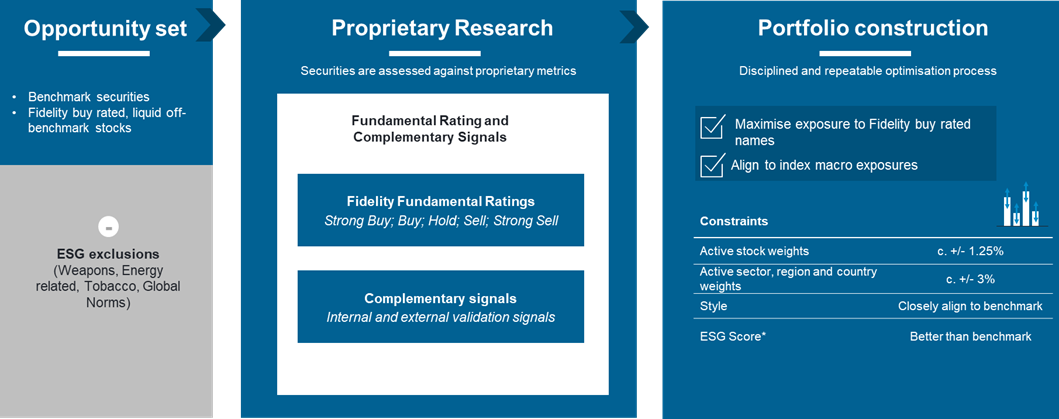
Source: Fidelity International, as at 31 March 2026. Figures are indicatives only. * The fund aims to achieve an ESG score of its portfolio greater than that of its Benchmark, as described in the section of the Prospectus entitled “Sustainable Investing and ESG Integration” and in the Sustainability Annex. It is classified as Article 8 under SFDR. For more details on our SFDR disclosures, please refer to https://www.fidelity.lu/sfdr.
Opportunity set
The investible universe for the fund is defined as the constituents of the benchmark index. From this set, securities are removed where they fall within the fund’s exclusion criteria - including but limited to exposure to controversial weapons, energy-related activities, tobacco, or breaches of global norms.
Proprietary research
Fidelity’s research platform focuses on proprietary, bottom-up, stock-specific fundamentals with a long-term view. The breadth and depth of coverage across value chains built up over many years, and the ability to distill large amounts of data from across the globe into clear, precise, actionable insight, make it an invaluable source of investment ideas and knowledge.
Sustainability research is fully integrated into this framework, with analyst-driven ESG ratings and climate insights used to evaluate how material environmental, social and governance factors influence long-term cash flows and risk-adjusted returns.
The analyst team generates a wealth of strong investment ideas; sufficient to build a fully diversified portfolio at all points of the market cycle and provides the raw material for our proposed research enhanced strategy.
Alpha Generation/Stock selection
These research insights are systematically incorporated into the investment framework of the funds. Internal quantitative signals are complemented by external and internal complementary signals.
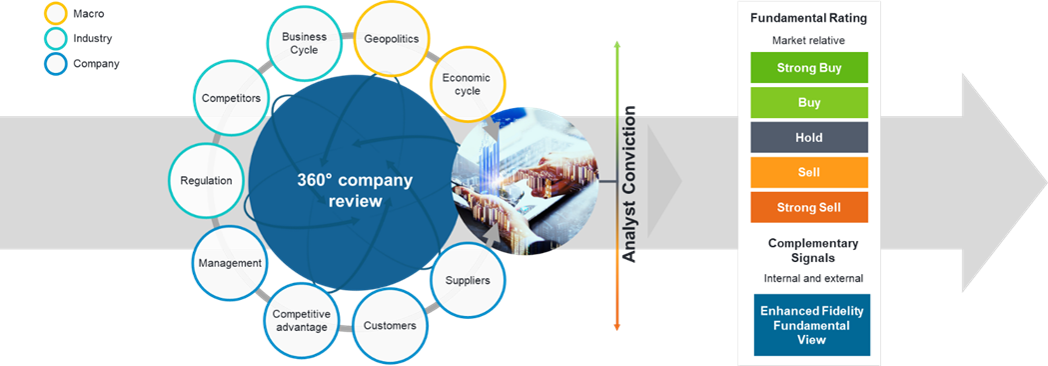
Source: Fidelity International, as at 31 March 2026. For Illustrative purpose only.
A description of these signals is provided below:
Fundamental signal
Fidelity analyst ratings (1 = Strong Buy to 5 = Strong Sell) form the core alpha signal, with the majority of holdings allocated to stocks rated buy or strong buy.
Complementary confirmatory signals
In addition to Fidelity’s core research ratings, the strategy incorporates a small number of complementary signals designed to reinforce research insights and support long-term return potential. These signals draw on both internal and external data sources to enhance consistency and robustness of stock selection.
ESG factors incorporated:
Exclusions: Using a broad investable universe as a starting point (referring to broader market IMI Indices in each of the regions for example, MSCI Europe IMI Index for Europe), the strategy aims to deliver enhanced sustainability profile firstly by excluding Fidelity's firm-wide and Sustainable Family Exclusions (outlined in the row 6) from the investible universe. This typically removes approximately less than 5% of the starting universe.
Optimisation for enhanced sustainability profile: The next stage is an optimisation process which aims to enhance the sustainability profile along with maximising expected future returns within specified parameters. Hence along with the fundamental factors, the portfolio is optimised using the following sustainability signals:
- Enhanced ESG Rating - by tilting the portfolio based on Fidelity’s proprietary ESG Rating Framework (A-E with A being the best and E the worst). The objective is to ensure that at least 70% of the assets are invested in superior ESG rated companies (defined as A-C rated as per Fidelity ESG Rating).
- Improving ESG Ratings Outlook - The portfolio tilts towards/away from securities with an upward/downward sustainability trajectory. Sustainable trajectories are proprietary indicators applied by Fidelity analysts: Improving, stable or deteriorating.
- Carbon reduction - Investors have begun to focus on reducing the carbon footprint of their portfolios, consequently the strategy now incorporates Net Zero principles of the Paris Agreement, in that it seeks to reduce fund's Relative Carbon Emissions by 50% from 2020 (base year) to 2030 (effective from 30th June 2022) with a longer term view to work towards Net Zero by 2050.
Portfolio Construction
The investible portfolio is derived from a market-cap weighted collection of Fidelity’s highest-conviction buy-rated stocks. The aim is to remain as close as possible to this research-driven reference portfolio, while applying constraints that maintain diversification, align macro exposures with the index, and incorporate ESG and carbon-emissions criteria.
Resources, Affiliations & Corporate Strategies:
As an investment manager, we have a fiduciary duty to act in the best interests of our clients. In the context of sustainable investing, we have developed an approach with three key components (integration, stewardship, and solutions) that aim to provide our clients with investment offerings that meet their financial and non-financial objectives, and to comply with rapidly evolving sustainability regulations for product labelling and disclosure.
Fidelity’s sustainable investing approach is established on the foundation of our integration tools and processes. We believe ESG factors should be integrated into different investment processes. We have designed ratings and tools to identify the relevant risks and opportunities of issuers and established other processes to ensure that ESG factors are integrated consistently in our portfolios. We will also consider research insights from third-party data providers where relevant.
Our integration tools and processes also support the prioritisation of stewardship activities and the development of solutions that meet different regulatory requirements and client objectives. While sustainability ratings and scores allow for easier comparison of company performance, sustainability analysis should be both quantitative and qualitative and its findings should be interpreted in the context of financial performance to provide a holistic picture of a company’s performance.
Proprietary ratings and tools sit at the heart of Fidelity’s sustainable investing approach. They build on Fidelity’s heritage of fundamental research, the contribution from investment analysts and the expertise of the Sustainability Team. These tools include:
ESG Ratings: an assessment of management and mitigation of ESG risks
The Fidelity ESG Ratings aim to provide a forward-looking assessment of the extent to which an issuer’s performance on material sustainability issues either supports, or is likely to impair, long-term value creation for shareholders. The ratings are differentiated in their forward-looking emphasis and their use of issuer interaction and due diligence by Fidelity’s fundamental analysts as the main input to identify and assess the material ESG risks impacting an issuer.
Our ESG Ratings are integrated into Fidelity’s investment process and are available to all members of the investment team on our internal research platform. Our rating serves as an additional source of insight and as a tool to support investment decisions.
Our ratings comprise a combination of E, S, and G indicators that aim to address the most material issues in each sector, providing a forward-looking view of an issuer’s ESG practices. The ratings’ methodology reflects the evolution of Fidelity’s ESG integration approach, founded on the principle of ‘double materiality’, focusing on ESG both from a business risk perspective and in terms of the environmental and societal implications of the issuer’s operations.
Four key principles underpin our ESG Ratings:
- Consideration of both non-financial and financial impacts ('double materiality'). A focus on absolute impacts allows comparison across sectors and geographies.
- Providing a forward-looking perspective that is complementary to our financial forecasts, helping to inform the long-term prospects of an individual issuer.
- Consideration of material impact across more than 100 individual subsectors for a more focused and relevant set of indicators.
- Flexible output for different use cases. Individual E, S, and G scores provide guidance for determining an overall ESG score at the issuer level and trajectory ratings.
Our ESG Ratings framework is reviewed regularly to help identify the most material ESG factors for each sector. We aim to provide training on the ratings framework as it evolves and on specific themes and sectors to help enhance understanding of the material ESG factors required for analysis, and to enhance the quality and consistency of ratings. The in-depth nature of our approach means that our coverage is not as broad as a third-party provider, therefore we also use external research and rating providers, such as MSCI and Institutional Shareholder Services (ISS), to complement our internal research process and for the construction of our funds with specific sustainability objectives. Where possible and practical, we aim to use our own ESG ratings as a preferred data source for fundamental insight and measurement of product-level characteristics.
Climate Ratings: alignment to the outcome of net zero carbon emissions by 2050
Our Climate Ratings assess an issuer’s operational alignment to the objectives of the Paris Agreement, providing a holistic view of climate-related risks and opportunities.
To facilitate our assessment of an issuer’s net zero transition, we have developed a Climate Rating that assesses an issuer’s operational alignment to the objectives of the Paris Agreement (to limit global average temperature rise this century well below 2°C and to drive efforts to limit the temperature increase even further to 1.5°C above pre-industrial levels). The Climate Rating is designed to be used in conjunction with our other ESG and climate tools to provide a more holistic view of an issuer’s exposure to climate-related risks and opportunities.
Assessment criteria cover three key areas:
- Carbon emissions disclosure: This assessment focuses on disclosure of Scope 1, Scope 2 and material Scope 3 (based on the definition of the Greenhouse Gas (GHG) Protocol).
- Emissions reduction targets: This assessment concentrates on the issuer’s current emissions, net zero GHG emissions ambitions, targets and carbon reduction targets.
- Climate governance: This assessment analyses executive remuneration plans linked to climate ambitions; governance responsibilities for climate at executive level; and board committees with responsibility for oversight of climate change policies.
For high impact sectors, additional criteria may be included to take into account the unique requirements of certain hard-to-abate sectors in relation to achieving net zero. The Climate Rating does not rely on a single climate change model or scenario. The assessment undertaken takes into account a wide range of data sources including companies’ disclosure, inputs from the Carbon Disclosure Project (CDP), ISS Climate data (e.g., Implied Temperature Rise), and the Science Based Targets initiative (SBTi).
SDG Tool: an assessment of positive contribution to the UN Sustainable Development Goals (SDGs)
Fidelity’s SDG Tool aims to provide an assessment of an issuer’s positive contribution to environmental and social outcomes. It is intended to complement Fidelity’s ESG Ratings which provide an assessment of an entity’s management of adverse impacts arising from ESG issues. The SDG Tool also supports Fidelity’s definition of ‘sustainable investments’ under Europe’s Sustainable Finance Disclosure Regulation (SFDR). We aim to provide a separate analysis of the positive and negative issues an issuer may be exposed to, to help prevent the signal value from identifying a risk being offset by an unrelated positive contribution (e.g., poor corporate governance and a catastrophic tailing-dam failure are not mitigated by selling products that help the energy transition).
Primary use cases for the output of the model are:
- Issuer and entity-level assessment: The model provides an assessment of the percentage of an issuer’s revenue that contributes to each SDG. This can be used as an input to help define a thematic investment universe.
- SFDR: Under SFDR, there is a requirement to identify issuers that make a positive contribution to an environmental or social outcome and can qualify as ‘sustainable investments’. The SDG Tool is a key input in this process.
- Reporting: The SDG Tool provides the ability to report the contribution of a fund’s investments to the SDGs to our clients on a consistent and scalable basis
Quarterly Sustainability Reviews (QSR): an internal forum to review relevant quantitative and qualitative metrics and discuss sustainability integration in specific strategies
The QSR is a component of the Quarterly Fund Reviews (QFRs) which cover performance risk, liquidity, etc. The QSR is a quantitative and qualitative exploration of a product’s sustainability profile, and may include aspects such as ESG ratings, engagement activity, climate characteristics, impact indicators and other datapoints. Attendees may include representatives from the Sustainability Team, the asset class CIO, portfolio manager(s), and risk professionals. The discussion is supported by a data pack which draws together various ESG data sources. The targeted scope of QSRs is actively managed products with a higher level of ESG integration, which may include certain EU SFDR Article 8 and Article 9 products, and UK SDR Labelled and ESG Promoted (unlabelled) products. Products disclosing under SFDR Article 6 are not subject to the QSR process. SI-related investment mandates could be covered by QSR on an optional basis or at the request of clients.
Our integration tools and processes also support the prioritisation of stewardship activities and the development of solutions that meet different regulatory requirements and client objectives. Furthermore, we promote active ownership as the stewards of our clients’ assets, supporting real world sustainability outcomes that help us to fulfil our fiduciary duty. Effective and outcomes-focused stewardship combines bottom-up corporate engagement, top-down thematic engagement, and system-wide stewardship. This approach is essential to drive change and encourages regular engagement and dialogue which we believe is more efficient than exclusions because this simply diverts the problem elsewhere. We believe that monitoring the progress of engagements is as important as initiating them to assess change over time. The outcomes (or lack of outcomes) resulting from our engagements can be reflected by investment analysts in our ESG ratings and used to inform investment decisions. Our Voting Principles and Guidelines sets out our minimum expectations for our investee companies in key areas including climate change, deforestation, and gender diversity.
For further details, please refer to our Sustainable Investing Principles sustainable-investing-principles.pdf.
Sustainability Team
As an active bottom-up research house, we have always looked beyond financial reporting to gauge the value of an investment. This involves maintaining ongoing dialogue with investee companies, staying vigilant to the evolving regulatory landscape, and monitoring other factors that could influence sustainable cash flows over our investment horizon, including those currently categorised as ESG. We began formally integrating ESG considerations into our investment and research processes since becoming a signatory to the Principles for Responsible Investment in October 2012.
As a logical consequence of our focus on sustainability, we established our Sustainability Team over a decade ago. Initially a small group based in London, the team has now grown to include 30* professionals with the global presence spanning London, Singapore, Tokyo, Hong Kong, Shanghai, Sydney and Luxembourg. Members of our Sustainability Team bring a diverse skill set, including expertise in research, climate science, and governance, with many boasting over a decade of experience.
*Source: Fidelity International, as at 31 December 2025.
The team’s scope now encompasses a wide range of activities related to ESG integration, engagement, policy, product development, sales and marketing, proxy voting as well as corporate sustainability. New members have contributed additional skills in legal and thematic areas, client and distribution expertise, and governance.
The Sustainability Team functions across Fidelity in several ways:
- Collaborates closely with the broader investment team, supporting analysts in producing ESG research and conducting company-specific engagements, driving thematic engagement outcomes with sector analysts' input, and assisting portfolio managers in integrating ESG into their investment processes through proprietary tools, training, and frameworks.
- Works in tandem with the product team to develop sustainable investing frameworks and strategies in compliance with ESG regulations and tailored to diverse investor needs.
- Assists client-facing teams and clients with sustainable investing requirements and needs, including client communications, questionnaires, reporting, and training.
The team continues to evolve based on Fidelity's sustainable investing strategy, ensuring comprehensive support for all business areas and improving the quality and outcomes of engagement across asset classes.
Industry collaboration
Fidelity recognises the importance of networks and information platforms for sharing tools and pooling resources, using investor reporting as a source of learning. Our Sustainability Team keeps its current and potential membership of investor organisations under constant review. We monitor all international treaties, supranational organisations and other sustainability memberships to ensure we are up to date with market trends and to stay involved in the debate. We are proactive in strengthening our links within the investment industry, to determine effective ESG initiatives, maintain ethical standards, and attend seminars and conferences to integrate ESG into the investment process. Additionally, our Sustainability Team speaks publicly at industry events on responsible investment practices and promotes transparency in corporate governance issues. Please refer to the following list of our memberships, affiliations and signatories, listed by category:
Social Disparities
- 30% Club Australia (2021)
- 30% Club Hong Kong (2022)
- 30% Club Investors Group (2020)
- 30% Club Japan (2019)
- 40:40 Vision (2020)
- Armed Forces Covenant (2019)
- BBBA Talent Accelerator (2020)
- Business in the Community, Race at Work Charter (2020)
- Diversity Project (2017)
- DWP Disability Confident Scheme (2022)
- Find it, Fix it, Prevent it (CCLA) (2020)
- Global Business Collaboration Leadership Pledge (2022)
- If not now, then when? Campaign on Racial Diversity (2020)
- Investor Initiative on Human Rights Data (2024)
- Investors Against Slavery and Trafficking Asia-Pacific (2020)
- Investor Alliance for Human Rights (2025)
- Lord Mayor's Appeal - We Can Be (2019)
- LGBT Great (2019)
- Luxembourg National Diversity Charter (2020)
- Mental Health First Aid Training (2017)
- Minority Supplier Development UK (2020)
- Mindforward Alliance (2022)
- OutBritain (2022)
- President’s Challenge Enabling Employment Pledge and Enabling Mark (2023)
- PRI Reference Group on Human Rights and Social Issues (2025)
- Progress Together (2022)
- Purple Space (2019)
- Social Mobility Foundation (2021)
- Social Enterprise UK (2021)
- Stonewall (2016)
- Talent-Wise Employment Charter and Inclusive Organisations Recognition Scheme (2022)
- UN LGBTI Standards of Conduct in Business (2019)
- Valuable 500 (2019)
- Veteran-owned UK (2021)
- WEConnect International (2021)
- Women in Finance Charter (2017)
- WorkWell Leaders (2023)
- #10000 Black Interns (2020)
Climate Change:
- Asia Investor Group on Climate Change (2020)
- CDP - formerly Carbon Disclosure Project (2019)
- China Climate Engagement Initiative (2023)
- Climate Action 100+ (2019)
- Climate Bonds Initiative (2019)
- Coalition for Climate Resilient Investment (2019)
- Financial Services Development Council (2022)
- Global Standard on Responsible Corporate Climate Lobbying (2022)
- Green Finance Industry Taskforce Singapore (2020)
- Glasgow Financial Alliance for Net Zero (2021)
- Institutional Investors Group on Climate Change (2020)
- Investor Group on Climate Change (2021)
- Net Zero Asset Managers Initiative (NZAMI) (2020)
- One Planet Asset Manager Initiative (2021)
- Partnership for Carbon Accounting Financials (2022)
- Point Zero Carbon Programme (2022)
- Powering Past Coal Alliance (2021)
- Singapore Sustainable Finance Association (2024)
- Transition Pathway Initiative (2021)
- UK Sustainable Investment and Finance Association (2010)
Good Governance:
- Asia Securities Industry and Financial Markets Association (2015)
- Asian Corporate Governance Association (2004)
- Assogestioni (2007)
- Corporate Governance Forum (2009)
- European Sustainable Investment Forum (2017)
- European Public Real Estate Association (2023)
- Hong Kong Green Finance Association (2020)
- Hong Kong Principles of Responsible Ownership (2017)
- International Corporate Governance Network (2005)
- Investment Association (2010)
- Investor Agenda (2021)
- Investor Forum - UK (2014)
- Japanese Stewardship Code (2014)
- Principles for Responsible Investing (2012)
- Responsible Investment Association Australasia (2020)
- Taiwan Stock Exchange’s Stewardship Principles for Institutional Investors (2016)
- Transition Finance Council (2025)
- UK Stewardship Code (2010)
- World Benchmarking Alliance (2020)
Nature Loss:
- Ceres - Valuing Water Finance Initiative (2022)
- Farm Animal Investment Risk and Return (2020)
- Finance for Biodiversity Pledge (2021)
- Green Praxis Biodiversity (2022)
- Investor Policy Dialogue on Deforestation (2024)
- Natural Capital Investment Alliance (2021)
- Nature Action 100 (2023)
- Taskforce on Nature-related Financial Disclosures Forum (2021)
- Finance Sector Deforestation Action (2021)
SDR Labelling:
Not eligible to use label (out of scope)
Fund Holdings
Voting Record
| Fund Name | SRI Style | SDR Labelling | Product | Region | Asset Type | Launch Date | Last Amended |
|
|---|---|---|---|---|---|---|---|---|
Fidelity Europe Equity Research Enhanced UCITS ETF |
Sustainability Tilt | Not eligible to use label (out of scope) | ETF | Europe | Passive / Index | 18/05/2020 | Jul 2026 | |
ObjectivesThe Sub-Fund promotes environmental or social characteristics, but does not have as its objective a sustainable investment.
|
Fund/Portfolio Size: £95.47m (as at: 31/03/2026) Total Screened Themed SRI Assets: £147090.00m (as at: 31/12/2025) Total Responsible Ownership Assets: £377030.00m (as at: 31/12/2025) Total Assets Under Management: £377030.00m (as at: 12/03/2025) ISIN: IE00BKSBGT50 Contact Us: salessupport@fidelity.co.uk |
|||||||
Sustainable, Responsible &/or ESG OverviewThe fund promotes environmental and social characteristics by aiming to achieve an ESG score of its portfolio greater than the ESG score of its benchmark. ESG scores are determined by reference to ESG ratings. The fund does not intend to make sustainable investments. For more information, please see: IE00BKSBGT50 | Fidelity Europe Equity Research Enhanced UCITS ETF ACC-EUR | Equity Funds
|
||||||||
|
Primary fund last amended: Jul 2026 |
||||||||
|
Information received directly from Fund Manager |
||||||||
|
Please select what you would like to read:
Fund FiltersSustainability - General
Sustainability policy
Has policies that consider (environmental and social) sustainability issues. Strategies vary but are likely to consider environmental issues like climate change, carbon emissions, biodiversity loss, resource management, environmental impacts; and social issues like equal opportunities, human rights, labour standards, diversity and adherence to internationally recognised codes. See individual entry information.
Encourage more sustainable practices through stewardship
Aim to encourage higher sustainability standards through responsible ownership / stewardship / engagement / voting activity
UN Global Compact linked exclusion policy
Use the UN Global Compact to inform or help direct where they can or cannot invest. Will typically not invest in companies with significant breaches (low standards) - strategies vary. (The UNGC covers a wide range of issues - search 'UNGC'). See https://unglobalcompact.org/ Environmental - General
Environmental policy
Has policies which relate to environmental issues. These will typically set out their stance on issues such as pollution, climate change, resource management, biodiversity loss, carbon emissions, plastics and/or additional environmental impacts. Strategies vary. Nature & Biodiversity
Biodiversity / nature policy
Has a written biodiversity policy or theme typically aimed at supporting, encouraging and improving environmental protection and safeguarding the natural world (sometimes referred to as 'natural capital'). See eg https://www.un.org/en/climatechange/science/climate-issues/biodiversity Climate Change & Energy
Climate change / greenhouse gas emissions policy
Has policies (documented strategies that explain their position) on climate change related issues such as greenhouse gas/carbon emissions, net zero, transitioning to lower carbon. Strategies vary.
Coal, oil & / or gas majors excluded
Avoid investment in major coal, oil and/or gas (extraction) companies. Strategies vary.
Fracking & tar sands excluded
Avoid companies involved in fracking and tar sands - which are widely regarded as controversial methods of oil and gas extraction. Strategies vary.
Arctic drilling exclusion
Avoid companies that are involved in extracting oil from the Arctic regions.
Nuclear exclusion policy
Has a policy which describes the avoidance or limited investment in the nuclear industry. Strategies vary. Social / Employment
Social policy
Has policies which set out their approach to social issues (e.g. human rights, labour standards, equal opportunities, child labour and/or adherence to internationally recognised codes such as the UN Global Compact). Strategies with social policies typically avoid companies with low standards and/or work to encourage higher standards. See fund information for detail.
Labour standards policy
Has a labour standards policy - likely to mean they will invest in / favour companies that have higher employment related standards and avoid those with low standards. Strategies vary. See eg https://www.ilo.org/international-labour-standards Ethical Values Led Exclusions
Ethical policies
Has policies that set out their position on ethical or 'personal values' based issues. Strategies vary.
Tobacco & related product manufacturers excluded
Companies are excluded if they are involved in any aspect of the production chain for tobacco products, including cigarettes, vaping, e-cigarettes, chewing tobacco and cigars.
Controversial weapons exclusion
Excludes companies which make controversial weapons such as landmines, cluster munitions and chemical weapons. Human Rights
Human rights policy
Has policies relating to human rights issues. Typically require companies to demonstrate higher standards, although some managers work to encourage improvements. Investee companies are often judged against internationally agreed norms or standards. Strategies vary.
Child labour exclusion
Has policies to avoid companies that employ children.
Modern slavery exclusion policy
Has a policy which excludes assets with involvement in Modern Slavery Gilts & Sovereigns
Does not invest in sovereigns
Does not invest in / excludes 'sovereigns' - debt issued by governments. See eg https://www.investopedia.com/terms/s/sovereign-debt.asp Governance & Management
UN sanctions exclusion
Exclude companies that are subject to United Nations sanctions. See eg https://main.un.org/securitycouncil/en/content/un-sc-consolidated-list
Anti-bribery & corruption policy
Has policies explaining how managers will respond to assets / companies that do not comply with relevant anti-bribery and anti-corruption standards or laws. Strategies vary; options include stewardship/ engagement and divestment - or a combination. Product / Service Governance
ESG integration strategy
Find fund / asset managers that factor in 'environmental, social and governance' issues as part of their investment decision making process. A focus on 'ESG' typically means a fund is carrying out additional research to help reduce ESG related risks. It does not necessarily mean a focus on sustainability. Strategies vary. See fund literature. How The Fund/Portfolio Works
ESG weighted / tilt
Invest more heavily in assets which have higher ESG ratings/standards or scores and less heavily in companies with lower ESG ratings. Where this is central to the strategy you should expect assets in most sectors. Strategies vary.
Passive / index driven strategy
Only uses an investment index to direct where they can invest. Fund strategies and indices vary.
Significant harm exclusion
Aims to avoid companies that do significant harm. This originates from the EU’s sustainable finance ‘DNSH’ (do no significant harm) work, which is not necessarily used by UK investors.
Combines norms based exclusions with other SRI criteria
Investment selection process uses internationally agreed 'norms' (e.g. United Nations Global Compact - UNGC - or the UN Sustainable Development Goals - SDGs) alongside additional SRI criteria such as positive or negative stock selection policies and/or stewardship strategies.
Combines ESG strategy with other SRI criteria
Invests in assets which have an ESG strategy (which is typically focused on avoiding companies that pose environmental, social or governance related risks) together with additional criteria such as positive and/or negative screens, themes and stewardship strategies.
SRI / ESG / Ethical policies explained on website
Publish explanations of their ethical, social and/or environmental policies online (i.e. investment decision making strategies/ buy/sell &/or asset management strategies).
Use stock / securities lending
Uses specialist strategies to aid performance which involve ‘lending’ assets to others at specific points in time. Labels & Accreditations
SFDR Article 8 fund / product (EU)
Find options classified under Article 8 of the EU’s SFDR (Sustainable Finance Disclosure Requirements). Article 8 of the SFDR is a set of requirements that apply to financial products that 'promote' environmental or social characteristics together with high governance. These rules do not currently apply to UK products so many managers may leave this field blank.
ACT signatory
A voluntary corporate culture standard for investment managers, see https://www.investorsact.com/ - City Hive Fund Management Company InformationAbout The Business
Responsible ownership / stewardship policy or strategy (AFM companywide)
Finds fund / asset management companies that have a published company wide stewardship, engagement and / or responsible ownership policy or strategy that covers all investments. Stewardship typically involves encouraging higher ESG standards through voting and dialogue.
ESG / SRI engagement (AFM companywide)
Find fund / asset management companies that actively encourage higher 'environmental, social and governance' and / or 'sustainable and responsible investment' practices across investee companies - typically where the aim is to encourage positive change that is aligned with the best interests of investors. Strategies vary. See additional information and options.
Vote all* shares at AGMs / EGMs (AFM companywide)
Find fund / asset managers that vote all* the shares they own at Annual General Meetings and Extraordinary General Meetings. A commitment to voting shares is a key indicator of 'responsible share ownership' demonstrating their support for or disagreement with management policy. (*situations can legitimately, occasionally occur where voting proves impossible, but in principle all shares should be voted.)
Responsible ownership / ESG a key differentiator (AFM companywide)
Find fund / asset managers that consider responsible ownership and ESG to be a key differentiator for their business.
Sustainable property strategy (AFM companywide)
Find fund / asset management companies that take sustainability criteria into account when selecting and/or managing all of their property / real estate investments.
Senior management KPIs include environmental goals (AFM companywide)
The leadership team of this fund / asset manager have performance targets linked to environmental goals.
SDG aligned aims / objectives (AFM companywide)
Find fund / asset management companies that aim to align all their investments (across all funds) to help meet the aims of the UN Sustainable Development Goals.
Responsible ownership policy for non SRI / sustainable options (AFM companywide)
Find options run by managers that apply Responsible ownership or 'Stewardship' policies to all or most of their investment assets. This means active involvement (e.g. voting, dialogue) with the companies across all or most funds, products and services.
Integrates ESG factors into all / most research (AFM companywide)
Find fund / asset management companies that consider environmental, social and governance (ESG) issues when deciding whether or not to invest in a company for all / almost all of their funds and other assets. This is increasingly seen as part of sound risk management.
In-house diversity improvement programme (AFM companywide)
Finds organisations / fund managers that have an in-house (company wide) diversity improvement programme - meaning that they are working to ensure that within their own businesses they employ people from diverse backgrounds - often typically focused on ethnicity and/or sex.
Diversity, equality & inclusion engagement policy (AFM companywide)
Find fund / asset management companies that encourage the companies they invest in to have strong diversity, race, gender and other equality policies across all assets held, not simply screened or themed SRI/ESG funds. (ie Asset Management company wide).
Invests in newly listed companies (AFM companywide)
This fund / asset management company invests in companies which have recently listed on a stock exchange (which is important as it can help grow new businesses).
Offer structured intermediary sustainable investment training
Fund management entity offers unstructured intermediary training on sustainable investment (ie for financial advisers and wealth managers)
Offer unstructured intermediary sustainable investment training
Fund management entity offers unstructured intermediary training on sustainable investment (ie for financial advisers and wealth managers) Collaborations & Affiliations
PRI signatory
Find fund / asset management companies that have signed up to the UN backed 'Principles of Responsible Investment'.
UKSIF member
Find fund / asset management companies that are members of UKSIF - the UK Sustainable Investment and Finance association
Fund EcoMarket partner
Find fund / asset management companies that have partnered with Fund EcoMarket - meaning that they are helping to improve access to information on sustainable and responsible investment by paying an annual fee to us which enables us to publish information for free. Partner funds are listed ahead of other funds and have their logos displayed.
TNFD forum member (AFM companywide)
A member of the Taskforce for Nature Related Financial Disclosures group which aims to aid risk management and shift money towards nature-positive outcomes.
Investment Association (IA) member
Fund management entity is a member of the Investment Association https://www.theia.org/
Net Zero Asset Managers (NZAM) signatory
Resources
In-house responsible ownership / voting expertise
Find fund / asset management companies that employ people to steer and support fund managers in voting shares at company AGM's and EGMs in ways that are consistent with encouraging higher ESG/sustainability standards.
Employ specialist ESG / SRI / sustainability researchers
Find a fund / asset management company that directly employs specialist ESG/SRI/sustainability researchers or analysts. This allows asset managers to discuss environmental, social and governance risks and opportunities directly with companies.
Use specialist ESG / SRI / sustainability research companies
Find fund / asset management companies that makes use of expert external research companies. This can help deliver specialist expertise and means resources are pooled with other investors.
ESG specialists on all investment desks (AFM companywide)
Finds organisations / fund managers that have one or more ESG/sustainability experts on all investment teams or 'desks' (all asset types) Accreditations
PRI A+ rated (AFM companywide)
Finds organisations / fund managers that have an A+ PRI rating - meaning they are highly rated according to the 'Principles of Responsible Investment'
UK Stewardship Code signatory (AFM companywide)
Find fund / asset managers that are signatories to the FRC UK Stewardship Code, which sets out a framework for constructive investor / investee relations where managers are encouraged to behave like responsible, typically longer term 'company owners'. Engagement Approach
Regularly lead collaborative ESG initiatives (AFM companywide)
Find fund / asset management companies that regularly initiate or run industry wide (collaborative) investor projects aimed at raising environmental, social and governance standards amongst investee companies.
Encourage responsible corporate taxation (AFM companywide)
Find fund / asset management companies that are working with the companies they invest in to encourage more responsible corporate taxation.
Engaging on climate change issues
Fund / asset manager has stewardship /responsible ownership strategy that is focused on addressing climate change with investee assets.
Engaging with fossil fuel companies on climate change
Fund / asset manager has a stewardship /responsible ownership strategy that involves working with fossil fuel companies on climate change related issues. See fund manager website for details.
Engaging to reduce plastics pollution / waste
Fund / asset manager has stewardship /responsible ownership strategy with involves encouraging investee asset to reduce plastic waste and pollution.
Engaging to encourage responsible mining practices
Fund / asset manager has a stewardship / responsible ownership policy that means they are working to encourage more responsible mining practices - where environmental and social issues are properly dealt with by the companies they invest in.
Engaging on biodiversity / nature issues
The fund / asset manager has a responsible ownership / stewardship strategy that focuses on biodiversity and nature issues relating to the assets they invest the aim of which will be to reduce harm and or deliver improvement. Strategies vary. https://tnfd.global
Engaging to encourage a Just Transition
Fund / asset manager has a responsible ownership / stewardship strategy which means they are working to encourage the shift to more sustainable business practices in ways that respect and are sensitive to social issues and the impact change has on people effected by the changes that are taking place. https://www.transitionpathwayinitiative.org/ https://transitiontaskforce.net/
Engaging on human rights issues
Fund / asset manager has responsible ownership / stewardship strategy in place which aims to address human rights issues in investee companies (and potentially their suppliers) with the aim of raising standards
Engaging on labour / employment issues
Fund / asset manager has responsible ownership / stewardship strategy in place that aims to improve labour standards for the benefit of employees in investee companies (and potentially their suppliers)
Engaging on diversity, equality & / or inclusion issues
Fund / asset management company has a stewardship strategy in place which involves working to raise diversity, equality and inclusion standards across investee assets
Engaging to stop modern slavery
Fund / asset manager is working with the assets they hold to help stamp out modern slavery - where direct or indirect company employees are exploited for business benefits.
Engaging on governance issues
Fund / asset managers have stewardship strategies in place that focus on improving governance standards across investee assets
Engaging on responsible supply chain issues
Has a stewardship / responsible ownership strategy that encourages responsible supply chain - ie the managers will discuss environmental, social and governance issues with investee companies with the aim of raising standards
Stewardship escalation policy
Escalation policies describe how a manager will proceed if stewardship / engagement activity is not successful in the short term. Company Wide Exclusions
Controversial weapons avoidance policy (AFM companywide)
Find fund / asset management companies (not funds) that avoid investment in 'controversial weapons' across all of their funds and other investment vehicles.
Nuclear exclusion policy (AFM companywide)
Fund / asset management company excludes assets with significant involvement in the nuclear industry - across all funds. Strategies vary. Climate & Net Zero Transition
Net Zero commitment (AFM companywide)
Fund / asset management organisations that have pledged to reduce their greenhouse gas emissions to ‘net zero’. Strategies vary - this area is changing rapidly.
Voting policy includes net zero targets (AFM companywide)
Fund / asset manager AGM / EGM voting strategy has processes in place that mean they will normally be expected to vote in a way that will encourage the transition to net zero greenhouse gas emissions.
Publish 'CEO owned' Climate Risk policy (AFM companywide)
Find fund / asset management companies that have published a Climate Risk policy or statement that is signed / owned by their Chief Executive.
Net Zero - have set a Net Zero target date (AFM companywide)
This fund / asset management company has set a date by which they plan to achieve net zero greenhouse gas / CO2e emissions.
Encourage carbon / greenhouse gas reduction (AFM companywide)
Find fund / asset management companies that are working with the companies they invest in to encourage reductions in carbon dioxide and other greenhouse gas emissions.
Carbon transition plan published (AFM companywide)
Finds organisations / fund managers that have a company wide carbon transition plan - meaning that they have plotted a path to how they will move away from activities that produce or use carbon based energy sources (that emit greenhouse gases) towards clean, alternative, renewable energy sources.
Carbon offsetting – do NOT offset carbon as part of net zero plan (AFM companywide)
This fund / asset management company plans to achieve net zero greenhouse gas (CO2e) emissions by reducing their emissions. Calculations and scope vary.
In-house carbon / GHG reduction policy (AFM companywide)
Find fund / asset management companies that are working to reduce their own (fund management company) carbon/greenhouse gas emissions.
Working towards a ‘Net Zero’ commitment (AFM companywide)
Finds organisations / fund management companies that are in the process of working out how to make a ‘net zero commitment’ - meaning that when that is finalised they will have started the process of reducing their total greenhouse gas emissions to 'zero'. Transparency
Publish responsible ownership / stewardship report (AFM companywide)
Find fund / asset management companies that publish a report detailing their responsible investment ownership - also known as 'Stewardship' - activity.
Full stewardship / responsible ownership policy information on company website
Find fund / asset management companies that publish information about their sustainable and responsible investment strategies on their company website.
Full stewardship / responsible ownership policy information available on request
Find fund / asset management companies that will supply information about their sustainable and responsible investment activity on request.
Publish full voting record (AFM companywide)
Fund / asset management companies that publish a full record of how they vote their shares at AGMs (annual general meetings) and EGMs (extraordinary general meetings). Voting strategies have an important role to play encouraging higher environmental, social and governance standards.
Sustainability transition plan publicly available (AFM companywide)
This fund / asset management company has published a plan that explains how they are to become a sustainable business - without significant negative environmental or social impacts.
Paris Alignment plan publicly available (AFM companywide)
This fund / asset management company has published a plan that explains how they will align to the climate change commitments made at the Paris Climate Talks, COP21.
Net Zero transition plan publicly available (AFM companywide)
This fund / asset management company has published a plan that explains how they are going to achieve net zero greenhouse gas / CO2e emissions.
Dialshifter statement
Find fund / asset management companies that have supplied Dialshifter information. See Dialshifter tab within record for more information. Sustainable, Responsible &/or ESG Policy:Our firm substantiality policies are applicable to all funds. Please refer to these at Our policies and reports At Fidelity, we strive to deliver innovative investment solutions, including a range of sustainable investing capabilities designed to meet client needs alongside complex and evolving regulatory requirements for sustainable funds in different geographies. Increasingly we also work with our institutional clients to advise them on how to meet their own sustainable investing objectives. Fidelity’s Sustainable Investing Framework aims to provide a modular, consistent, and transparent set of principles and criteria that can be used as the basis for sustainable products across different asset classes. The framework also helps to facilitate monitoring by compliance, aid client reporting and meet regulatory requirements. There are three broad categories under the framework:
This central framework is complemented where appropriate by market specific requirements including the Sustainable Finance Disclosure Regulation (SFDR) in Europe, Sustainability Disclosure Requirements (SDR) in the UK, Autorité des marchés financiers (AMF) requirements in France. In the Asia Pacific region (including Hong Kong, Singapore, and Taiwan), product specific disclosures may be included in order to meet local compliance requirements. Under FSIF, the fund is classified as ESG Tilt. Complete list of exclusions applicable to ESG tilt funds can be found at Fidelity International Exclusion Framework - August 2025 Further exclusions beyond those described in the Exclusion Framework document also apply. Please refer to those at Fund Level Exclusions Process:The investment process of the ETFs is designed to systematically translate Fidelity’s proprietary bottom-up research into a diversified, risk-controlled portfolio that reflects our highest-conviction ideas. Please see below for an overview of the process:
Source: Fidelity International, as at 31 March 2026. Figures are indicatives only. * The fund aims to achieve an ESG score of its portfolio greater than that of its Benchmark, as described in the section of the Prospectus entitled “Sustainable Investing and ESG Integration” and in the Sustainability Annex. It is classified as Article 8 under SFDR. For more details on our SFDR disclosures, please refer to https://www.fidelity.lu/sfdr.
Opportunity set The investible universe for the fund is defined as the constituents of the benchmark index. From this set, securities are removed where they fall within the fund’s exclusion criteria - including but limited to exposure to controversial weapons, energy-related activities, tobacco, or breaches of global norms.
Proprietary research Fidelity’s research platform focuses on proprietary, bottom-up, stock-specific fundamentals with a long-term view. The breadth and depth of coverage across value chains built up over many years, and the ability to distill large amounts of data from across the globe into clear, precise, actionable insight, make it an invaluable source of investment ideas and knowledge. Sustainability research is fully integrated into this framework, with analyst-driven ESG ratings and climate insights used to evaluate how material environmental, social and governance factors influence long-term cash flows and risk-adjusted returns. The analyst team generates a wealth of strong investment ideas; sufficient to build a fully diversified portfolio at all points of the market cycle and provides the raw material for our proposed research enhanced strategy.
Alpha Generation/Stock selection These research insights are systematically incorporated into the investment framework of the funds. Internal quantitative signals are complemented by external and internal complementary signals.
Source: Fidelity International, as at 31 March 2026. For Illustrative purpose only.
A description of these signals is provided below: Fundamental signal Fidelity analyst ratings (1 = Strong Buy to 5 = Strong Sell) form the core alpha signal, with the majority of holdings allocated to stocks rated buy or strong buy. Complementary confirmatory signals In addition to Fidelity’s core research ratings, the strategy incorporates a small number of complementary signals designed to reinforce research insights and support long-term return potential. These signals draw on both internal and external data sources to enhance consistency and robustness of stock selection.
ESG factors incorporated: Exclusions: Using a broad investable universe as a starting point (referring to broader market IMI Indices in each of the regions for example, MSCI Europe IMI Index for Europe), the strategy aims to deliver enhanced sustainability profile firstly by excluding Fidelity's firm-wide and Sustainable Family Exclusions (outlined in the row 6) from the investible universe. This typically removes approximately less than 5% of the starting universe. Optimisation for enhanced sustainability profile: The next stage is an optimisation process which aims to enhance the sustainability profile along with maximising expected future returns within specified parameters. Hence along with the fundamental factors, the portfolio is optimised using the following sustainability signals:
Portfolio Construction The investible portfolio is derived from a market-cap weighted collection of Fidelity’s highest-conviction buy-rated stocks. The aim is to remain as close as possible to this research-driven reference portfolio, while applying constraints that maintain diversification, align macro exposures with the index, and incorporate ESG and carbon-emissions criteria. Resources, Affiliations & Corporate Strategies:As an investment manager, we have a fiduciary duty to act in the best interests of our clients. In the context of sustainable investing, we have developed an approach with three key components (integration, stewardship, and solutions) that aim to provide our clients with investment offerings that meet their financial and non-financial objectives, and to comply with rapidly evolving sustainability regulations for product labelling and disclosure. Fidelity’s sustainable investing approach is established on the foundation of our integration tools and processes. We believe ESG factors should be integrated into different investment processes. We have designed ratings and tools to identify the relevant risks and opportunities of issuers and established other processes to ensure that ESG factors are integrated consistently in our portfolios. We will also consider research insights from third-party data providers where relevant. Our integration tools and processes also support the prioritisation of stewardship activities and the development of solutions that meet different regulatory requirements and client objectives. While sustainability ratings and scores allow for easier comparison of company performance, sustainability analysis should be both quantitative and qualitative and its findings should be interpreted in the context of financial performance to provide a holistic picture of a company’s performance. Proprietary ratings and tools sit at the heart of Fidelity’s sustainable investing approach. They build on Fidelity’s heritage of fundamental research, the contribution from investment analysts and the expertise of the Sustainability Team. These tools include:
ESG Ratings: an assessment of management and mitigation of ESG risks The Fidelity ESG Ratings aim to provide a forward-looking assessment of the extent to which an issuer’s performance on material sustainability issues either supports, or is likely to impair, long-term value creation for shareholders. The ratings are differentiated in their forward-looking emphasis and their use of issuer interaction and due diligence by Fidelity’s fundamental analysts as the main input to identify and assess the material ESG risks impacting an issuer. Our ESG Ratings are integrated into Fidelity’s investment process and are available to all members of the investment team on our internal research platform. Our rating serves as an additional source of insight and as a tool to support investment decisions. Our ratings comprise a combination of E, S, and G indicators that aim to address the most material issues in each sector, providing a forward-looking view of an issuer’s ESG practices. The ratings’ methodology reflects the evolution of Fidelity’s ESG integration approach, founded on the principle of ‘double materiality’, focusing on ESG both from a business risk perspective and in terms of the environmental and societal implications of the issuer’s operations. Four key principles underpin our ESG Ratings:
Our ESG Ratings framework is reviewed regularly to help identify the most material ESG factors for each sector. We aim to provide training on the ratings framework as it evolves and on specific themes and sectors to help enhance understanding of the material ESG factors required for analysis, and to enhance the quality and consistency of ratings. The in-depth nature of our approach means that our coverage is not as broad as a third-party provider, therefore we also use external research and rating providers, such as MSCI and Institutional Shareholder Services (ISS), to complement our internal research process and for the construction of our funds with specific sustainability objectives. Where possible and practical, we aim to use our own ESG ratings as a preferred data source for fundamental insight and measurement of product-level characteristics.
Climate Ratings: alignment to the outcome of net zero carbon emissions by 2050 Our Climate Ratings assess an issuer’s operational alignment to the objectives of the Paris Agreement, providing a holistic view of climate-related risks and opportunities. To facilitate our assessment of an issuer’s net zero transition, we have developed a Climate Rating that assesses an issuer’s operational alignment to the objectives of the Paris Agreement (to limit global average temperature rise this century well below 2°C and to drive efforts to limit the temperature increase even further to 1.5°C above pre-industrial levels). The Climate Rating is designed to be used in conjunction with our other ESG and climate tools to provide a more holistic view of an issuer’s exposure to climate-related risks and opportunities. Assessment criteria cover three key areas:
For high impact sectors, additional criteria may be included to take into account the unique requirements of certain hard-to-abate sectors in relation to achieving net zero. The Climate Rating does not rely on a single climate change model or scenario. The assessment undertaken takes into account a wide range of data sources including companies’ disclosure, inputs from the Carbon Disclosure Project (CDP), ISS Climate data (e.g., Implied Temperature Rise), and the Science Based Targets initiative (SBTi).
SDG Tool: an assessment of positive contribution to the UN Sustainable Development Goals (SDGs) Fidelity’s SDG Tool aims to provide an assessment of an issuer’s positive contribution to environmental and social outcomes. It is intended to complement Fidelity’s ESG Ratings which provide an assessment of an entity’s management of adverse impacts arising from ESG issues. The SDG Tool also supports Fidelity’s definition of ‘sustainable investments’ under Europe’s Sustainable Finance Disclosure Regulation (SFDR). We aim to provide a separate analysis of the positive and negative issues an issuer may be exposed to, to help prevent the signal value from identifying a risk being offset by an unrelated positive contribution (e.g., poor corporate governance and a catastrophic tailing-dam failure are not mitigated by selling products that help the energy transition). Primary use cases for the output of the model are:
Quarterly Sustainability Reviews (QSR): an internal forum to review relevant quantitative and qualitative metrics and discuss sustainability integration in specific strategies The QSR is a component of the Quarterly Fund Reviews (QFRs) which cover performance risk, liquidity, etc. The QSR is a quantitative and qualitative exploration of a product’s sustainability profile, and may include aspects such as ESG ratings, engagement activity, climate characteristics, impact indicators and other datapoints. Attendees may include representatives from the Sustainability Team, the asset class CIO, portfolio manager(s), and risk professionals. The discussion is supported by a data pack which draws together various ESG data sources. The targeted scope of QSRs is actively managed products with a higher level of ESG integration, which may include certain EU SFDR Article 8 and Article 9 products, and UK SDR Labelled and ESG Promoted (unlabelled) products. Products disclosing under SFDR Article 6 are not subject to the QSR process. SI-related investment mandates could be covered by QSR on an optional basis or at the request of clients. Our integration tools and processes also support the prioritisation of stewardship activities and the development of solutions that meet different regulatory requirements and client objectives. Furthermore, we promote active ownership as the stewards of our clients’ assets, supporting real world sustainability outcomes that help us to fulfil our fiduciary duty. Effective and outcomes-focused stewardship combines bottom-up corporate engagement, top-down thematic engagement, and system-wide stewardship. This approach is essential to drive change and encourages regular engagement and dialogue which we believe is more efficient than exclusions because this simply diverts the problem elsewhere. We believe that monitoring the progress of engagements is as important as initiating them to assess change over time. The outcomes (or lack of outcomes) resulting from our engagements can be reflected by investment analysts in our ESG ratings and used to inform investment decisions. Our Voting Principles and Guidelines sets out our minimum expectations for our investee companies in key areas including climate change, deforestation, and gender diversity. For further details, please refer to our Sustainable Investing Principles sustainable-investing-principles.pdf.
Sustainability Team As an active bottom-up research house, we have always looked beyond financial reporting to gauge the value of an investment. This involves maintaining ongoing dialogue with investee companies, staying vigilant to the evolving regulatory landscape, and monitoring other factors that could influence sustainable cash flows over our investment horizon, including those currently categorised as ESG. We began formally integrating ESG considerations into our investment and research processes since becoming a signatory to the Principles for Responsible Investment in October 2012. As a logical consequence of our focus on sustainability, we established our Sustainability Team over a decade ago. Initially a small group based in London, the team has now grown to include 30* professionals with the global presence spanning London, Singapore, Tokyo, Hong Kong, Shanghai, Sydney and Luxembourg. Members of our Sustainability Team bring a diverse skill set, including expertise in research, climate science, and governance, with many boasting over a decade of experience. *Source: Fidelity International, as at 31 December 2025. The team’s scope now encompasses a wide range of activities related to ESG integration, engagement, policy, product development, sales and marketing, proxy voting as well as corporate sustainability. New members have contributed additional skills in legal and thematic areas, client and distribution expertise, and governance. The Sustainability Team functions across Fidelity in several ways:
The team continues to evolve based on Fidelity's sustainable investing strategy, ensuring comprehensive support for all business areas and improving the quality and outcomes of engagement across asset classes.
Industry collaboration Fidelity recognises the importance of networks and information platforms for sharing tools and pooling resources, using investor reporting as a source of learning. Our Sustainability Team keeps its current and potential membership of investor organisations under constant review. We monitor all international treaties, supranational organisations and other sustainability memberships to ensure we are up to date with market trends and to stay involved in the debate. We are proactive in strengthening our links within the investment industry, to determine effective ESG initiatives, maintain ethical standards, and attend seminars and conferences to integrate ESG into the investment process. Additionally, our Sustainability Team speaks publicly at industry events on responsible investment practices and promotes transparency in corporate governance issues. Please refer to the following list of our memberships, affiliations and signatories, listed by category: Social Disparities
Climate Change:
Good Governance:
Nature Loss:
Dialshifter (Corporate)Our organisation is helping to support the Paris Climate Agreement and the Race to Net Zero by… We take a pro-active approach to minimising our own environmental footprint. We are committed to achieving net zero emissions by 2030 for Fidelity International’s operational emissions (including all Scope 1, 2 and 3 emissions we have direct control over). Our focus will be on the reduction of emissions through operational changes and investment in operational efficiencies, on-site renewals and purchasing of renewable energy whilst offsetting those we are unable to eradicate. The goal at Fidelity is to conduct current and future business operations in a sustainable manner which helps create a better future for the environment. Fidelity ensures Environmental Sustainability is managed as any other critical business activity in an integrated, systematic way. The framework is designed to ensure Pollution Prevention, Carbon Reduction, Waste minimisation, responsible use of resources and compliance with legislation through good practice and continuous improvement. Fidelity’s Commitment:
Reports on environmental performance are produced covering a range of areas including energy management, carbon footprint, waste reduction, water usage and recycling. This data is collated on a monthly basis and communicated to Senior Management on a regular basis. Our environmental management policy is based around our ability to obtain regular, accurate information on our environmental performance, not only in energy use and waste management, but also areas such as monitoring our carbon emissions in (for instance) air travel. We receive regular reports from our incumbent service providers, and collate these for review. We then hold regular meetings with them to investigate areas for improvement. Where the meetings produce ideas which may help reduce the environmental impact of our operations, they are implemented and monitored. Where successful, they are incorporated into our procedures. Fidelity’s corporate sustainability team have initiated carbon footprinting for a number of offices in recent years and are consolidating that in 2020 to produce global carbon emissions for Fidelity’s activities. SDR Labelling:Not eligible to use label (out of scope) Fund HoldingsVoting Record |
||||||||