Reflections on Net Zero – in a heatwave
Posted on: July 29th, 2026
It terrifies me that there are seemingly intelligent people who disagree with ‘net zero’ – the reduction of greenhouse gas emissions to manageable levels.
Living in Hertfordshire, just north of London, we have had almost no rain for approaching two months. It feels like much longer. It is uncomfortably hot, again. It is not quite as bad as it was when I was struggling to run talks during the London Climate Action Week heatwave – but not far off. This time we have a hosepipe ban – so we can’t water our struggling plants, or top up our small pond that local blue tits and our other guests rely on. And local rivers have run dry.
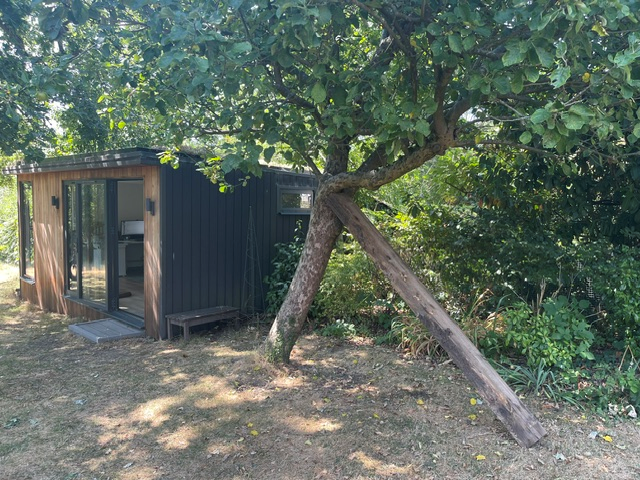
We are lucky to have a garden, but the old apple tree next to my garden office took a turn for the worse yesterday. It is now leaning precariously because the ground is so dry. We are trying to stop it from falling further by wedging a plank under it, but are not overly hopeful. We will probably get a saw out on the weekend, to reduce its weight – and will certainly lose most of this year’s crop – but if this saves an old friend that’s fine by me.
Many people are in far worse situations, and in the overall scheme of things our dear old apple tree does not matter much.
My heart particularly goes out to those in Spain and France who are affected by the horrific and terrifying wildfires.
I can’t imagine what local people there are going through, let alone the wildlife. Parts of North America are similar.
We had a small taste of this some years ago with a house fire – that was bad enough.
Why do people disagree with net zero?
Disagreeing with net zero, as I understand it, seems to be about about people wanting to carry on ‘as normal’. Opposing change.
It is however widely recognised that ‘normal’ is no more.
Burning fossil fuels, outdated farming methods and depleting nature have caused the climate to change and the longer such practices continue the worse it will get. As far as we know there is no upper limit to the potential destruction – or ‘change’.
Climate change is sadly not an on/off switch as it is sometimes portrayed. It is not simply a matter of getting used to being a few degrees warmer – like moving to a warmer country might have meant a decade or two ago. If greenhouse emissions continue to rise, rather than being capped at the level the planet can absorb (‘net zero’), global temperature levels – and the cocktail of extreme weather events this brings – will get progressively worse. Increasing, and accelerating change.
Except, of course, for when things get suddenly much worse – known as ‘tipping points’ – for example, when global air flows shift, or ice caps melt triggering uncontrollable, accelerated temperature increases – ie sudden, seismic change.
Signals from the North Pole 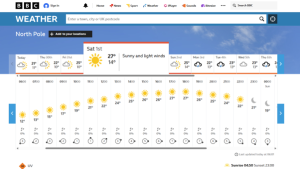
This thought process led me to look at the weather forecast in the North Pole just now. (Weather and climate are not ‘interchangeable’ they can line up).
The North Pole is forecast to reach 27 C ° this Saturday, and is not far off that today. This is not just melting the ice that helps reflect the sun’s rays away – and helping keep us all cool – but also the Tundra – frozen ground that that has locked away methane – a potent, fast acting greenhouse gas, for millennia.
This is something the media should be paying far more attention to. It is not okay.
Dusty and unpleasant land
If the country we love is normally, shall we say, a ‘green and pleasant’ land not a ‘dusty and unpleasant’ one, and if we like it that way – is it not time to help put the brakes on greenhouse gas emissions, and habitat destruction in order to keep it so?
Doing so will take collective effort, and good policies. Change won’t happen overnight – which is why we now talk about a ‘transition’.
But perhaps most importantly we all have the opportunity to help change the narrative, and call out nonsense when we see it.
We can also share happier message in place of negativity by talking about what has improved over recent years, and will facilitate change. Most notably the efficacy and cost efficiency of renewable energy, and electrification. Some might say these successes are what sits behind today’s opposition to ‘net zero’.
They make a return to ‘near normal’ , or at least a new plateau, entirely possible.
Welcome alternatives
There are now plenty of energy options that are cheaper, faster to build, less dangerous and less likely to be traded for profit on world markets than fossil fuels. For sure, there are vested interests that will continue to pull largely invisible opposing strings, and people will be impacted. There will be training needs, and some jobs will effectively transition from one industry to another. Many already have. So whilst change causes uncertainty – how bad can that be compared to wildfires, disruption to livelihoods, food and water supplies, loss of life and associated, and likely associated unrest and of course migration ? Do we have a choice? Seriously?
My area is sustainable and ethical investing, and has been for three decades. We really don’t have all the answers, and are only a small part of a more optimistic future – seeking out, supporting and encouraging tomorrow’s more desirable growth. But this is not a blog about my chosen area of work, my concerns today are more personal.
In brief, anyone with an interest in natural sciences will know the planet will go on without us, and indeed without the many species we are destroying.
Turning our backs on ‘net zero’ means allowing emissions to continue to rise and increasing the risks to ourselves, and others today and tomorrow.
Whether or not someone likes the term ‘net zero’, or thinks it needs a new name, I doubt many of us like climate change or the natural disasters it is fuelling. Perhaps we should call greenhouse gas emission what they are? Pollution. Zero pollution?
As with many forms of pollution we all have a part to play in controlling it – a major part of which involves supporting and encouraging policy makers who are in a position to make positive change happen.
China’s emissions are coming down, other countries’ are not. And the road will probably remain bumpy, but those who can lead by example – should. I put the UK firmly in this camp.
This is not me being alarmist, or political. It is a response to science, the art of the eminently possible (both good and bad) – and what is plainly visible.
It may be too late for our old apple tree, but our collective future is not yet set in stone. Or dust. It is time to make ‘net zero’ cool again – with or without a re-brand.
- For information on the UK’s route forward see the Climate Change Committee‘s recent report ‘A well adapted UK’.
- See Net Zero Asset Managers initiative members here
- For information on sustainable and ethical investment options see our Fund EcoMarket investment information tool.